×
Request Free Sample ×

Kindly complete the form below to receive a free sample of this Report

* Please use a valid business email

Leading companies partner with us for data-driven Insights

clients tt-cursor
Hero Background

Argentina E Learning Virtual Reality Market

ID: MRFR/ICT/60187-HCR
200 Pages
Aarti Dhapte
February 2026

Argentina E-Learning Virtual Reality Market Size, Share and Trends Analysis Report By Component (Hardware, Software), By Technology (Non-Immersive, Fully Immersive), and By Application (Academic, Corporate)-Forecast to 2035

Share:
Download PDF ×

We do not share your information with anyone. However, we may send you emails based on your report interest from time to time. You may contact us at any time to opt-out.

Argentina E Learning Virtual Reality Market Infographic
Purchase Options

Argentina E Learning Virtual Reality Market Summary

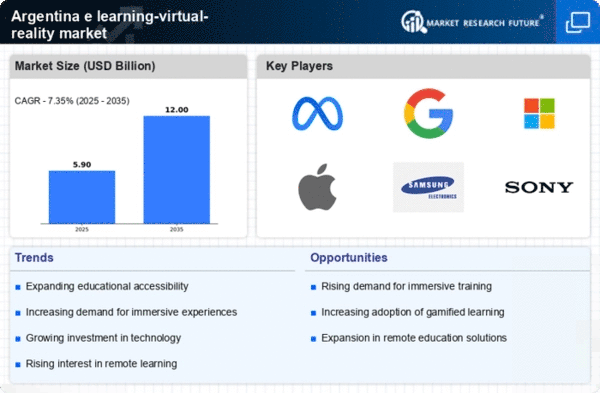
As per Market Research Future analysis, the Argentina E Learning Virtual Reality Market size was estimated at 5.5 USD Billion in 2024. The E Learning-virtual-reality market is projected to grow from 5.9 USD Billion in 2025 to 12.0 USD Billion by 2035, exhibiting a compound annual growth rate (CAGR) of 7.3% during the forecast period 2025 - 2035

Key Market Trends & Highlights

The Argentina e learning-virtual-reality market is experiencing robust growth driven by technological advancements and educational reforms.

  • The largest segment in the Argentina e learning-virtual-reality market is higher education, while the fastest-growing segment is K-12 education.
  • There is a notable increase in the adoption of virtual reality technologies within educational institutions, enhancing interactive learning experiences.
  • Investment in technological infrastructure is on the rise, facilitating the development of innovative e learning solutions.
  • Key market drivers include the growing demand for interactive learning and government initiatives supporting EdTech.

Market Size & Forecast

2024 Market Size 5.5 (USD Billion)
2035 Market Size 12.0 (USD Billion)
CAGR (2025 - 2035) 7.35%

Major Players

Meta Platforms (US), Google (US), Microsoft (US), Apple (US), Samsung Electronics (KR), Sony Corporation (JP), HTC Corporation (TW), Unity Technologies (US), Coursera (US)

Our Impact
Enabled $4.3B Revenue Impact for Fortune 500 and Leading Multinationals
Partnering with 2000+ Global Organizations Each Year
30K+ Citations by Top-Tier Firms in the Industry

Argentina E Learning Virtual Reality Market Trends

The Argentina E Learning Virtual Reality Market is currently experiencing notable growth, driven by advancements in technology and increasing demand for immersive educational experiences. In Argentina, educational institutions are increasingly adopting virtual reality tools to enhance learning outcomes. This trend appears to be fueled by a desire to engage students more effectively, as traditional methods may not fully capture their attention. Furthermore, the integration of virtual reality into curricula seems to provide opportunities for experiential learning, which can lead to improved retention of information. As a result, educators are exploring innovative ways to incorporate these technologies into their teaching practices. Moreover, the rise of remote learning has prompted a shift in how educational content is delivered. The e learning-virtual-reality market is likely to benefit from this transition, as more learners seek flexible and interactive learning environments. Institutions are investing in virtual reality platforms that allow for real-time collaboration and interaction among students and instructors. This shift not only enhances the learning experience but also prepares students for a future where digital skills are paramount. Overall, the e learning-virtual-reality market in Argentina appears poised for continued expansion, driven by technological advancements and changing educational needs.

Increased Adoption of Virtual Reality in Education

Educational institutions are increasingly integrating virtual reality tools into their curricula. This trend indicates a shift towards more engaging and interactive learning experiences, allowing students to explore complex concepts in immersive environments.

Focus on Remote Learning Solutions

The demand for flexible learning options is rising, leading to a greater emphasis on remote learning solutions. The e learning-virtual-reality market is likely to expand as institutions develop platforms that facilitate virtual collaboration and interaction.

Investment in Technological Infrastructure

There appears to be a growing investment in technological infrastructure to support the e learning-virtual-reality market. Educational institutions are allocating resources to enhance their capabilities, ensuring they can effectively implement virtual reality tools.

Argentina E Learning Virtual Reality Market Drivers

Increased Focus on Skills Development

The e learning-virtual-reality market in Argentina is witnessing a heightened emphasis on skills development, particularly in response to the evolving job market. Employers are increasingly seeking candidates with practical skills that can be effectively taught through immersive learning experiences. As a result, educational institutions are adopting virtual reality technologies to simulate real-world scenarios, enabling students to gain hands-on experience in a safe environment. Data indicates that 70% of employers prefer candidates who have undergone skills training through innovative methods such as VR. This trend is likely to drive growth in the e learning-virtual-reality market as institutions strive to equip students with the competencies needed for future employment.

Expansion of Private Sector Investment

The e learning-virtual-reality market in Argentina is benefiting from a surge in private sector investment, which is crucial for the development of innovative educational technologies. Venture capital firms and tech companies are increasingly recognizing the potential of virtual reality in transforming education. Recent statistics reveal that investment in EdTech startups has increased by 40% over the last year, with a significant portion directed towards VR solutions. This influx of capital is expected to accelerate the development of cutting-edge applications and platforms that enhance the learning experience. As private sector involvement grows, the e learning-virtual-reality market is likely to evolve, offering more diverse and effective educational tools.

Growing Demand for Interactive Learning

The e learning-virtual-reality market in Argentina is experiencing a notable surge in demand for interactive learning experiences. Educational institutions are increasingly recognizing the value of immersive technologies in enhancing student engagement and retention. According to recent data, approximately 65% of educators in Argentina believe that virtual reality can significantly improve learning outcomes. This shift towards interactive learning is driven by the need to cater to diverse learning styles and preferences, making education more accessible and effective. As a result, the e learning-virtual-reality market is likely to expand, with institutions investing in VR tools and platforms to create dynamic learning environments that foster collaboration and creativity.

Government Initiatives Supporting EdTech

In Argentina, government initiatives aimed at promoting educational technology are playing a crucial role in the growth of the e learning-virtual-reality market. The government has allocated substantial funding to enhance digital infrastructure in schools and universities, which is expected to increase access to advanced learning tools. For instance, recent reports indicate that public spending on educational technology has risen by 20% over the past year. These initiatives not only facilitate the integration of virtual reality into curricula but also encourage partnerships between educational institutions and tech companies. Consequently, the e learning-virtual-reality market is poised for growth as more institutions adopt VR solutions to enrich the educational experience.

Rising Popularity of Gamification in Education

Gamification is emerging as a powerful trend within the e learning-virtual-reality market in Argentina. By incorporating game-like elements into educational content, institutions are able to enhance motivation and engagement among students. Research suggests that gamified learning experiences can lead to a 30% increase in student participation. This trend is particularly appealing to younger learners who are accustomed to interactive digital environments. As educational institutions seek to leverage gamification, the demand for virtual reality applications that facilitate this approach is likely to rise. This shift may lead to a more vibrant e learning-virtual-reality market, as developers create innovative solutions that blend education with entertainment.


Market Segment Insights

By Component: Hardware (Largest) vs. Software (Fastest-Growing)

In the Argentina e learning-virtual-reality market, the component segment is primarily dominated by hardware, which holds a significant share due to its essential role in VR experiences. Hardware solutions, including VR headsets and haptic devices, are critical in enhancing user engagement and interaction. Software, while smaller in market share compared to hardware, is rapidly gaining traction as developers create more immersive and interactive educational content to meet the demand from institutions and learners alike. Growth trends in this segment reflect a shift toward more sophisticated VR solutions, with software projected to be the fastest-growing component as educational institutions explore innovative teaching methods through virtual platforms. Key drivers include advancements in technology, increased investment in VR content development, and the need for enhanced remote learning solutions, leading to a stronger focus on software applications in the education sector.

Hardware (Dominant) vs. Software (Emerging)

The hardware segment, characterized by high-performance VR equipment designed for educational purposes, remains the dominant player in the Argentina e learning-virtual-reality market. This segment includes head-mounted displays and motion-tracking devices, which are essential for delivering immersive learning experiences. In contrast, the software segment is emerging with an increasing variety of applications aimed at enhancing learning efficiency and engagement. As educational institutions adopt VR, they are progressively recognizing the importance of high-quality software that complements hardware. The need for interactive and adaptive learning environments drives innovation, pushing software vendors to develop more sophisticated platforms and content tailored to educational requirements.

By Technology: Non-Immersive (Largest) vs. Fully Immersive (Fastest-Growing)

In the Argentina e learning-virtual-reality market, the Non-Immersive segment dominates with a significant share as educational institutions and businesses continue to adopt cost-effective solutions. This segment appeals to a wide range of users, from students to corporate professionals, leading to its substantial market presence. On the other hand, the Fully Immersive segment, while currently smaller in share, is rapidly gaining traction due to advancements in technology and growing interest in immersive learning experiences. The growth trends indicate that while Non-Immersive solutions hold the majority of market share, Fully Immersive technologies are expected to experience exponential growth in the coming years. Factors driving this transformation include advancements in virtual reality technology, increasing investment in educational technologies, and a growing recognition of the effectiveness of immersive learning methods. As more users seek to engage deeply with content, the demand for Fully Immersive experiences will likely rise, making it a key area to watch in the near future.

Technology: Non-Immersive (Dominant) vs. Fully Immersive (Emerging)

The Non-Immersive segment represents the current dominant force in the Argentina e learning-virtual-reality market, characterized by its accessibility and affordability. This segment typically utilizes basic digital tools, allowing users to engage with educational material without the need for specialized equipment. Conversely, the Fully Immersive segment is emerging as a significant player, leveraging cutting-edge technology to provide comprehensive and engaging learning experiences. This segment is gaining attention for its ability to simulate real-world scenarios, thereby enhancing learner engagement and retention. As both segments evolve, their respective advantages address diverse learner needs, positioning them uniquely within the educational landscape.

By Application: Academic (Largest) vs. Corporate (Fastest-Growing)

The Argentina e learning-virtual-reality market is characterized by a diverse application segment comprising Academic and Corporate. Currently, the Academic segment holds the largest share, showcasing its critical role in enhancing educational experiences through immersive technologies. The Corporate segment, although smaller, is rapidly gaining traction as businesses recognize the value of virtual reality in training and professional development. Growth trends indicate that the Corporate segment is emerging as the fastest-growing area within the market. Driven by technological advancements and the increasing adoption of VR in training programs, companies are leveraging these solutions to enhance employee performance and engagement. Meanwhile, the Academic segment remains robust due to continuous investments in educational technology and a growing emphasis on interactive learning methodologies.

Academic (Dominant) vs. Corporate (Emerging)

The Academic segment is currently dominant in the Argentina e learning-virtual-reality market, driven by widespread acceptance of immersive learning technologies in schools and higher education institutions. This segment benefits from significant investment and demand for innovative teaching tools aimed at enhancing student engagement. Conversely, the Corporate segment is emerging, characterized by a growing interest in utilizing virtual reality solutions for workforce training and development. Organizations are leveraging VR to create realistic training scenarios, leading to improved skills acquisition and employee satisfaction. As the market evolves, the Corporate segment is projected to capture an increasing share, compelling educational institutions to innovate and adapt their offerings.

Get more detailed insights about Argentina E Learning Virtual Reality Market

Key Players and Competitive Insights

The e learning-virtual-reality market in Argentina is characterized by a dynamic competitive landscape, driven by rapid technological advancements and increasing demand for immersive educational experiences. Major players such as Meta Platforms (US), Google (US), and Microsoft (US) are strategically positioned to leverage their technological prowess and extensive resources. Meta Platforms (US) focuses on enhancing its virtual reality offerings through continuous innovation, while Google (US) emphasizes partnerships with educational institutions to expand its reach. Microsoft (US) is actively integrating its cloud services with virtual reality applications, thereby enhancing user engagement and learning outcomes. Collectively, these strategies contribute to a competitive environment that is increasingly centered around technological innovation and strategic collaborations.Key business tactics within this market include localizing manufacturing and optimizing supply chains to enhance responsiveness to regional demands. The competitive structure appears moderately fragmented, with several key players vying for market share. This fragmentation is indicative of a landscape where innovation and adaptability are crucial for success, as companies seek to differentiate themselves through unique offerings and localized solutions.

In October Meta Platforms (US) announced a partnership with several Argentine universities to develop tailored virtual reality curricula aimed at enhancing student engagement. This strategic move underscores Meta's commitment to fostering educational innovation and expanding its footprint in the Argentine market. By collaborating with local institutions, Meta not only enhances its product offerings but also strengthens its brand presence in a region that values educational advancement.

In September Google (US) launched a new initiative aimed at integrating artificial intelligence with its virtual reality learning platforms. This initiative is designed to provide personalized learning experiences, adapting content to individual student needs. The strategic importance of this move lies in its potential to revolutionize the learning process, making it more efficient and effective, thereby positioning Google as a leader in the educational technology space.

In August Microsoft (US) unveiled a new suite of virtual reality tools specifically designed for remote learning environments. This development reflects Microsoft's ongoing commitment to enhancing digital learning experiences, particularly in a post-pandemic world. The introduction of these tools is likely to bolster Microsoft's competitive edge by providing educators with innovative solutions that facilitate interactive and engaging learning experiences.

As of November current competitive trends in the e learning-virtual-reality market are heavily influenced by digitalization, sustainability, and the integration of AI technologies. Strategic alliances among key players are shaping the landscape, fostering innovation and collaboration. Looking ahead, competitive differentiation is expected to evolve, with a pronounced shift from price-based competition to a focus on innovation, technological advancements, and supply chain reliability. This transition suggests that companies will increasingly prioritize unique value propositions and sustainable practices to maintain their competitive edge.

Key Companies in the Argentina E Learning Virtual Reality Market include

Industry Developments

In Argentina, the E-Learning Virtual Reality Market is witnessing significant advancements, particularly driven by prominent companies such as Globant and Mercado Libre. In August 2023, Globant announced the launch of a new immersive learning platform that integrates virtual reality into online education, catering to diverse educational needs across the nation. Similarly, Mercado Libre has expanded its educational offerings, providing VR-based courses to enhance skill development among its users.

The demand for virtual reality tools, especially post-pandemic, has surged, leading to a notable growth in market valuation for key players. The Argentine government has also been promoting digital learning initiatives, aligning with companies like Cursos Online and UCA to improve educational access nationwide.

In terms of mergers and acquisitions, there has been notable activity; for instance, in April 2023, EduLib acquired a small VR educational startup, aiming to enhance its content delivery. These developments reflect the ongoing transformation within the Argentine education sector, emphasizing innovative teaching methodologies and accessibility, with several companies focusing on enhancing technology integration in their curriculum to meet modern educational demands.

Future Outlook

Argentina E Learning Virtual Reality Market Future Outlook

The e learning-virtual-reality market in Argentina is projected to grow at a 7.35% CAGR from 2025 to 2035, driven by technological advancements and increasing demand for immersive learning experiences.

New opportunities lie in:

  • Development of tailored VR training modules for corporate clients
  • Partnerships with educational institutions for curriculum integration
  • Creation of subscription-based VR content platforms for continuous learning

By 2035, the market is expected to be robust, driven by innovation and strategic partnerships.

Market Segmentation

Argentina E Learning Virtual Reality Market Component Outlook

  • Hardware
  • Software

Argentina E Learning Virtual Reality Market Technology Outlook

  • Non-Immersive
  • Fully Immersive

Argentina E Learning Virtual Reality Market Application Outlook

  • Academic
  • Corporate

Report Scope

MARKET SIZE 2024 5.5(USD Billion)
MARKET SIZE 2025 5.9(USD Billion)
MARKET SIZE 2035 12.0(USD Billion)
COMPOUND ANNUAL GROWTH RATE (CAGR) 7.35% (2025 - 2035)
REPORT COVERAGE Revenue Forecast, Competitive Landscape, Growth Factors, and Trends
BASE YEAR 2024
Market Forecast Period 2025 - 2035
Historical Data 2019 - 2024
Market Forecast Units USD Billion
Key Companies Profiled Meta Platforms (US), Google (US), Microsoft (US), Apple (US), Samsung Electronics (KR), Sony Corporation (JP), HTC Corporation (TW), Unity Technologies (US), Coursera (US)
Segments Covered Component, Technology, Application
Key Market Opportunities Integration of immersive technologies enhances engagement and retention in the e learning-virtual-reality market.
Key Market Dynamics Rising demand for immersive learning experiences drives innovation in the e learning-virtual-reality market.
Countries Covered Argentina
Leave a Comment

FAQs

What is the expected market size of the Argentina E-Learning Virtual Reality Market in 2024?

The Argentina E-Learning Virtual Reality Market is expected to be valued at 2.89 billion USD in 2024.

How much is the Argentina E-Learning Virtual Reality Market projected to grow by 2035?

By 2035, the market is projected to reach a value of 8.33 billion USD.

What is the expected compound annual growth rate (CAGR) for the Argentina E-Learning Virtual Reality Market from 2025 to 2035?

The market is expected to experience a CAGR of 10.119% from 2025 to 2035.

What is the expected value of the hardware segment in the Argentina E-Learning Virtual Reality Market in 2024?

The hardware segment is expected to be valued at 1.45 billion USD in 2024.

How much is the software segment projected to be valued at in the Argentina E-Learning Virtual Reality Market in 2024?

The software segment is projected to have a value of 1.44 billion USD in 2024.

Who are the key players in the Argentina E-Learning Virtual Reality Market?

Major players include Cursos Online, Techint, Globant, Mercado Libre, and UCA among others.

What is the expected value of the hardware segment in the Argentina E-Learning Virtual Reality Market by 2035?

By 2035, the hardware segment is anticipated to increase to 4.3 billion USD.

What will be the expected value of the software segment in the Argentina E-Learning Virtual Reality Market by 2035?

The software segment is expected to reach 4.03 billion USD by 2035.

What are the growth drivers for the Argentina E-Learning Virtual Reality Market?

Key growth drivers include advancements in technology, increased adoption of online education, and demand for immersive learning experiences.

What challenges does the Argentina E-Learning Virtual Reality Market face?

Challenges include high costs of VR equipment and content development, as well as the need for technical expertise among educators.

Download Free Sample

Kindly complete the form below to receive a free sample of this Report

Compare Licence

×
Features License Type
Single User Multiuser License Enterprise User
Price $4,950 $5,950 $7,250
Maximum User Access Limit 1 User Upto 10 Users Unrestricted Access Throughout the Organization
Free Customization
Direct Access to Analyst
Deliverable Format
Platform Access
Discount on Next Purchase 10% 15% 15%
Printable Versions