×
Request Free Sample ×

Kindly complete the form below to receive a free sample of this Report

* Please use a valid business email

Leading companies partner with us for data-driven Insights

clients tt-cursor
Hero Background

Germany E Learning Virtual Reality Market

ID: MRFR/ICT/60182-HCR
200 Pages
Aarti Dhapte
February 2026

Germany E-Learning Virtual Reality Market Research Report By Component (Hardware, Software), By Technology (Non-Immersive, Fully Immersive), and By Application (Academic, Corporate)-Forecast to 2035

Share:
Download PDF ×

We do not share your information with anyone. However, we may send you emails based on your report interest from time to time. You may contact us at any time to opt-out.

Germany E Learning Virtual Reality Market Infographic
Purchase Options

Germany E Learning Virtual Reality Market Summary

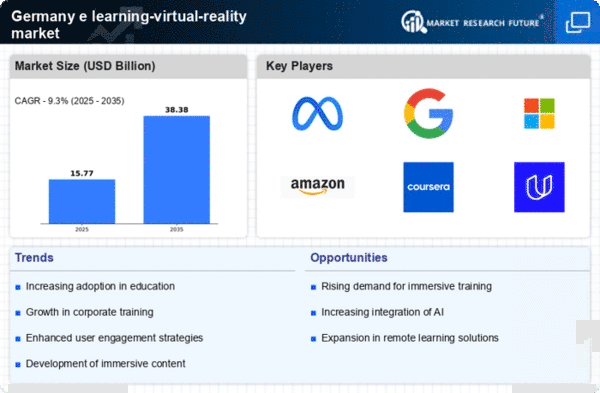
As per Market Research Future analysis, the Germany E Learning Virtual Reality Market size was estimated at 14.43 USD Billion in 2024. The E Learning-virtual-reality market industry is projected to grow from 15.77 USD Billion in 2025 to 38.38 USD Billion by 2035, exhibiting a compound annual growth rate (CAGR) of 9% during the forecast period 2025 - 2035

Key Market Trends & Highlights

The Germany e learning-virtual-reality market is experiencing robust growth driven by technological advancements and increasing demand for immersive learning solutions.

  • The largest segment in the Germany e learning-virtual-reality market is corporate training, which is undergoing a transformation towards more interactive and engaging methods.
  • The fastest-growing segment is the educational sector, where immersive learning tools are being rapidly adopted to enhance student engagement.
  • Government support for digital education is fostering an environment conducive to the adoption of virtual reality in learning.
  • Technological advancements in VR and the rising demand for remote learning solutions are key drivers propelling market growth.

Market Size & Forecast

2024 Market Size 14.43 (USD Billion)
2035 Market Size 38.38 (USD Billion)
CAGR (2025 - 2035) 9.3%

Major Players

Meta Platforms (US), Google (US), Microsoft (US), Amazon (US), Coursera (US), Udacity (US), Edmodo (US), Prowise (NL), ClassVR (GB)

Our Impact
Enabled $4.3B Revenue Impact for Fortune 500 and Leading Multinationals
Partnering with 2000+ Global Organizations Each Year
30K+ Citations by Top-Tier Firms in the Industry

Germany E Learning Virtual Reality Market Trends

The Germany E Learning Virtual Reality Market is currently experiencing a notable transformation, driven by advancements in technology and an increasing demand for immersive educational experiences. In Germany, educational institutions and corporate training programs are increasingly adopting virtual reality solutions to enhance learning outcomes. This shift appears to be influenced by the need for more engaging and interactive methods of instruction, which traditional learning environments often lack. As a result, the integration of virtual reality into educational frameworks is becoming more prevalent, suggesting a potential for growth in this sector. Moreover, the German government has been actively promoting digital education initiatives, which may further bolster the e learning-virtual-reality market. Investments in infrastructure and technology are likely to facilitate the development of innovative learning tools. This trend indicates a commitment to improving educational standards and accessibility, potentially leading to a more skilled workforce. As the market evolves, it seems that the collaboration between technology providers and educational institutions will be crucial in shaping the future of learning in Germany.

Increased Adoption of Immersive Learning Tools

Educational institutions are increasingly integrating immersive technologies into their curricula. This trend suggests a shift towards experiential learning, where students engage with content in a more interactive manner. The use of virtual reality tools may enhance retention and understanding, making learning more effective.

Government Support for Digital Education

The German government appears to be prioritizing digital education initiatives, which could significantly impact the e learning-virtual-reality market. By investing in technology and infrastructure, the government is likely to create an environment conducive to the growth of innovative educational solutions.

Corporate Training Transformation

Businesses in Germany are recognizing the potential of virtual reality for employee training. This trend indicates a move towards more engaging and effective training methods, which may lead to improved employee performance and satisfaction. Companies are likely to invest in these technologies to stay competitive.

Germany E Learning Virtual Reality Market Drivers

Technological Advancements in VR

The e learning-virtual-reality market is experiencing a surge due to rapid technological advancements in virtual reality (VR) hardware and software. Innovations such as improved graphics, enhanced interactivity, and more affordable VR headsets are making immersive learning experiences more accessible. In Germany, the market for VR hardware is projected to grow at a CAGR of 25% over the next five years, indicating a strong demand for VR solutions in educational settings. This technological evolution not only enhances user engagement but also facilitates personalized learning experiences, which are crucial in the e learning-virtual-reality market. As educational institutions and corporate training programs increasingly adopt these technologies, the potential for growth in this sector appears substantial.

Increased Focus on Skill Development

The e learning-virtual-reality market is being propelled by an increased focus on skill development across various sectors. In Germany, industries are recognizing the need for continuous training and upskilling of employees to remain competitive. VR provides a unique platform for immersive training simulations, allowing learners to practice skills in a safe environment. Reports suggest that companies investing in VR training solutions can see a 30% improvement in employee performance. This emphasis on skill enhancement is likely to drive the adoption of VR technologies in corporate training programs, thereby expanding the e learning-virtual-reality market. The ability to create realistic training scenarios positions VR as a valuable tool for workforce development.

Support from Educational Institutions

The e learning-virtual-reality market is receiving substantial support from educational institutions that are increasingly recognizing the value of immersive learning experiences. In Germany, many universities and colleges are incorporating VR into their curricula to enhance student engagement and learning outcomes. This institutional backing is crucial, as it not only legitimizes the use of VR in education but also encourages investment in related technologies. Reports indicate that educational institutions that adopt VR technologies can improve student satisfaction rates by up to 40%. This trend of institutional support is likely to foster further growth in the e learning-virtual-reality market, as more schools and universities seek to innovate their teaching methods.

Rising Demand for Remote Learning Solutions

The e learning-virtual-reality market is significantly influenced by the rising demand for remote learning solutions. As educational institutions and businesses seek to provide flexible learning options, VR offers an immersive alternative that can replicate in-person experiences. In Germany, a survey indicates that 70% of educators believe that VR can enhance remote learning by providing interactive and engaging content. This shift towards remote learning is likely to drive investments in VR technologies, as organizations aim to improve learning outcomes and student engagement. The potential for VR to bridge the gap between traditional and remote education makes it a pivotal driver in the e learning-virtual-reality market.

Growing Interest in Gamification of Learning

The e learning-virtual-reality market is benefiting from the growing interest in gamification as a method to enhance learning experiences. Gamification incorporates game-like elements into educational content, making learning more engaging and enjoyable. In Germany, studies show that learners are 50% more likely to retain information when it is presented in a gamified format. This trend is encouraging educational institutions and training providers to integrate VR with gamification strategies, thereby increasing the appeal of their programs. As the demand for interactive and enjoyable learning experiences rises, the e learning-virtual-reality market is likely to see significant growth driven by this innovative approach.


Market Segment Insights

By Component: Hardware (Largest) vs. Software (Fastest-Growing)

In the Germany e learning-virtual-reality market, the hardware segment holds significant market share, driven by increased investments in various hardware solutions that enhance immersive learning experiences. The demand for VR headsets and peripheral devices has been robust, allowing this segment to dominate the overall market landscape. On the other hand, the software segment is experiencing rapid growth, fueled by the rise of interactive content and applications designed to facilitate engaging educational experiences. Innovative software solutions that integrate AI and adaptive learning technologies are paving the way for exponential growth, making this segment particularly appealing to both educators and learners.

Hardware (Dominant) vs. Software (Emerging)

The hardware segment in the Germany e learning-virtual-reality market is characterized by its established presence, offering essential components like VR headsets, motion controllers, and sensory feedback devices. This segment has garnered substantial investment due to its pivotal role in delivering immersive educational experiences. In contrast, the software segment, while emerging, is rapidly evolving, focused on creating interactive and customizable learning platforms. This evolution is powered by advancements in content creation tools, gamification, and analytics that enhance user engagement and learning outcomes, positioning software as a key driver for future market dynamics.

By Technology: Non-Immersive (Largest) vs. Fully Immersive (Fastest-Growing)

In the Germany e learning-virtual-reality market, the Non-Immersive segment currently commands the largest market share, appealing to a broad audience seeking accessible VR experiences. This segment encompasses interactive 2D environments that enhance traditional learning methods, making them prevalent among educational institutions. Conversely, Fully Immersive experiences are gaining traction, targeting niche markets that demand high engagement and realism, albeit with a smaller current share. The rapid growth of the Fully Immersive segment is driven by advancements in VR technology and an increasing acceptance of immersive learning in corporate training and professional education. As more businesses realize the efficacy of immersive simulations for skill development, this segment is expected to experience significant year-on-year growth. The ongoing evolution of hardware and software solutions also contributes to the appeal and accessibility of Fully Immersive VR in educational contexts.

Technology: Non-Immersive (Dominant) vs. Fully Immersive (Emerging)

The Non-Immersive segment dominates the Germany e learning-virtual-reality market due to its established presence and user-friendly nature, making VR technology accessible to a wider audience. Non-Immersive solutions leverage existing technologies, often integrating with current e-learning platforms, thereby facilitating seamless adoption in educational settings. In contrast, Fully Immersive VR represents an emerging frontier that, while less prevalent, offers unparalleled engagement and interactivity. This segment caters to specialized needs, such as advanced vocational training and unique educational experiences, positioning itself as a valuable complement to traditional learning methods. As organizations increasingly invest in innovative training tools, Fully Immersive solutions are primed to capture a growing share of the market.

By Application: Academic (Largest) vs. Corporate (Fastest-Growing)

The Germany e learning-virtual-reality market showcases a significant segmentation between academic and corporate applications. Academic usage holds the largest share, leveraging traditional educational structures to integrate immersive learning experiences. This sector benefits from the familiarity of educational institutions adopting e-learning methodologies, enhancing knowledge retention and engagement through virtual reality environments. In contrast, corporate applications, although smaller in share, are rapidly gaining traction as businesses seek innovative training solutions to improve employee performance and reduce onboarding times. Growth in this sector is driven by the increasing demand for flexible learning solutions and the momentum of digital transformation in businesses. The corporate segment is particularly influenced by advancements in VR technology, which offers simulations that replicate real-world scenarios for training purposes. As companies recognize the effectiveness of VR in enhancing skill development and retention, the corporate application of e-learning virtual reality continues to expand, positioning itself as the fastest-growing segment in the market.

Academic (Dominant) vs. Corporate (Emerging)

In the Germany e learning-virtual-reality market, the academic segment stands as the dominant force, primarily due to its established presence within educational institutions that thrive on innovative teaching methods. This segment utilizes virtual reality to enhance classroom experiences, promoting active learning through interactive simulations. Conversely, the corporate segment is emerging as a key player, characterized by its growing adoption of e-learning VR for training and development. Companies are increasingly investing in VR to create immersive training modules that not only engage employees but also lead to better retention of skills and knowledge. While academic applications are deeply rooted in tradition, the corporate sector represents a shift towards modern, technology-driven solutions for workforce education.

Get more detailed insights about Germany E Learning Virtual Reality Market

Key Players and Competitive Insights

The e learning-virtual-reality market in Germany is characterized by a dynamic competitive landscape, driven by rapid technological advancements and increasing demand for immersive educational experiences. Major players such as Meta Platforms (US), Google (US), and Microsoft (US) are strategically positioned to leverage their technological prowess and extensive resources. Meta Platforms (US) focuses on enhancing its virtual reality offerings through continuous innovation, while Google (US) emphasizes partnerships with educational institutions to expand its reach. Microsoft (US) is actively integrating its cloud services with virtual learning environments, thereby enhancing user engagement and accessibility. Collectively, these strategies contribute to a competitive environment that is increasingly defined by technological integration and user-centric solutions.Key business tactics within this market include localizing content and optimizing supply chains to better serve regional needs. The competitive structure appears moderately fragmented, with numerous players vying for market share. However, the influence of key players is substantial, as they set industry standards and drive innovation. This fragmentation allows for niche players to emerge, yet the dominance of larger firms often dictates market trends and consumer expectations.

In October Meta Platforms (US) announced a partnership with several German universities to develop a new virtual reality curriculum aimed at enhancing remote learning experiences. This strategic move underscores Meta's commitment to educational innovation and positions it as a leader in the integration of VR technology in academic settings. By collaborating with educational institutions, Meta not only expands its market presence but also aligns its offerings with the evolving needs of learners.

In September Google (US) launched an initiative to provide free access to its VR learning tools for K-12 schools across Germany. This initiative is significant as it reflects Google's strategy to democratize access to advanced educational technologies, potentially increasing its user base and fostering brand loyalty among educators and students alike. By removing financial barriers, Google enhances its competitive edge in the market.

In August Microsoft (US) unveiled a new suite of tools designed to integrate its Azure cloud services with virtual reality applications for educational purposes. This development is crucial as it not only enhances the functionality of VR in learning environments but also positions Microsoft as a key player in the intersection of cloud computing and immersive education. The integration of these technologies is likely to attract educational institutions seeking comprehensive solutions.

As of November current competitive trends in the e learning-virtual-reality market are heavily influenced by digitalization, sustainability, and the integration of artificial intelligence. Strategic alliances among key players are shaping the landscape, fostering innovation and enhancing service delivery. Looking ahead, competitive differentiation is expected to evolve, with a shift from price-based competition to a focus on technological innovation, user experience, and supply chain reliability. This transition suggests that companies will need to invest in cutting-edge technologies and sustainable practices to maintain their competitive advantage.

Key Companies in the Germany E Learning Virtual Reality Market include

Industry Developments

The Germany E-Learning Virtual Reality Market is experiencing significant advancements, with numerous companies leading the charge. Noteworthy developments include Bosch and Siemens enhancing their training programs through virtual reality, effectively increasing employee skillsets and safety standards in manufacturing.

In July 2023, Festo announced a partnership with Virtual Reality Education to innovate its technical training modules. The demand for immersive learning experiences is driving growth in startups like CleverBooks and He's Learning, which cater to younger audiences, promoting engagement through gamified learning.

There have been notable mergers and acquisitions in the market, such as Udacity's acquisition of educational technology firms to enhance its content offerings in April 2023. Additionally, LearnLife's collaboration with Bertelsmann aims to develop flexible learning platforms that emphasize personalized education.

The growth trajectory of this sector indicates a market valuation increase fueled by substantial investments and a heightened focus on online education, driven by the pandemic and evolving workplace needs. In recent years, the integration of 5G technology in October 2021 has further propelled the capabilities of Virtual Reality applications in educational settings, allowing seamless connectivity and enhanced user experiences across various devices.

Future Outlook

Germany E Learning Virtual Reality Market Future Outlook

The e learning-virtual-reality market in Germany is projected to grow at a 9.3% CAGR from 2025 to 2035, driven by technological advancements and increasing demand for immersive learning experiences.

New opportunities lie in:

  • Development of tailored VR training modules for corporate clients.
  • Partnerships with educational institutions for integrated VR curricula.
  • Creation of subscription-based VR content platforms for continuous learning.

By 2035, the market is expected to be robust, driven by innovation and strategic partnerships.

Market Segmentation

Germany E Learning Virtual Reality Market Component Outlook

  • Hardware
  • Software

Germany E Learning Virtual Reality Market Technology Outlook

  • Non-Immersive
  • Fully Immersive

Germany E Learning Virtual Reality Market Application Outlook

  • Academic
  • Corporate

Report Scope

MARKET SIZE 2024 14.43(USD Billion)
MARKET SIZE 2025 15.77(USD Billion)
MARKET SIZE 2035 38.38(USD Billion)
COMPOUND ANNUAL GROWTH RATE (CAGR) 9.3% (2025 - 2035)
REPORT COVERAGE Revenue Forecast, Competitive Landscape, Growth Factors, and Trends
BASE YEAR 2024
Market Forecast Period 2025 - 2035
Historical Data 2019 - 2024
Market Forecast Units USD Billion
Key Companies Profiled Meta Platforms (US), Google (US), Microsoft (US), Amazon (US), Coursera (US), Udacity (US), Edmodo (US), Prowise (NL), ClassVR (GB)
Segments Covered Component, Technology, Application
Key Market Opportunities Integration of immersive technologies enhances engagement and retention in the e learning-virtual-reality market.
Key Market Dynamics Growing demand for immersive learning experiences drives innovation in the e learning-virtual-reality market.
Countries Covered Germany
Leave a Comment

FAQs

What is the expected market size of the Germany E-Learning Virtual Reality Market by 2024?

The Germany E-Learning Virtual Reality Market is expected to be valued at 14.43 billion USD by 2024.

What is the projected market size for the Germany E-Learning Virtual Reality Market by 2035?

By 2035, the Germany E-Learning Virtual Reality Market is projected to reach a value of 39.29 billion USD.

What is the expected compound annual growth rate (CAGR) for the Germany E-Learning Virtual Reality Market from 2025 to 2035?

The expected CAGR for the Germany E-Learning Virtual Reality Market from 2025 to 2035 is 9.534 percent.

What are the main components of the Germany E-Learning Virtual Reality Market?

The main components of the market include hardware and software segments.

What is the market value of hardware in the Germany E-Learning Virtual Reality Market by 2035?

The hardware segment of the market is expected to be valued at 13.5 billion USD by 2035.

How much is the software segment expected to be valued at by 2035 in the Germany E-Learning Virtual Reality Market?

The software segment is projected to reach a value of 25.79 billion USD by 2035.

Who are some of the key players in the Germany E-Learning Virtual Reality Market?

Key players in the market include Bosch, Festo, SAP, Siemens, Udacity, and several others.

What growth opportunities are present in the Germany E-Learning Virtual Reality Market?

The market presents growth opportunities in technology advancements and increasing demand for innovative learning solutions.

What challenges does the Germany E-Learning Virtual Reality Market face?

Challenges faced by the market include budget constraints in educational institutions and rapid technology changes.

What is the current market growth trend for the Germany E-Learning Virtual Reality Market?

The market is experiencing a trend of increasing investment in virtual reality solutions for educational purposes.

Download Free Sample

Kindly complete the form below to receive a free sample of this Report

Compare Licence

×
Features License Type
Single User Multiuser License Enterprise User
Price $4,950 $5,950 $7,250
Maximum User Access Limit 1 User Upto 10 Users Unrestricted Access Throughout the Organization
Free Customization
Direct Access to Analyst
Deliverable Format
Platform Access
Discount on Next Purchase 10% 15% 15%
Printable Versions