×
Request Free Sample ×

Kindly complete the form below to receive a free sample of this Report

* Please use a valid business email

Leading companies partner with us for data-driven Insights

clients tt-cursor
Hero Background

APAC Gas Turbine Market

ID: MRFR/EnP/46887-CR
200 Pages
Chitranshi Jaiswal
January 2026

APAC Gas Turbine Market Research Report By Type (Industrial, Heavy-Duty, Aeroderivative), By Rating Capacity (Less Than 40 MW, 40 to 120 MW, 121 to 300 MW, Above 300 MW), By End-User (Power Generation, Oil & Gas, Others), By Technology (Open Cycle, Combined Cycle), By Region – Forecast to 2035

Share:
Download PDF ×

We do not share your information with anyone. However, we may send you emails based on your report interest from time to time. You may contact us at any time to opt-out.

APAC Gas Turbine Market Infographic
Purchase Options

APAC Gas Turbine Market Summary

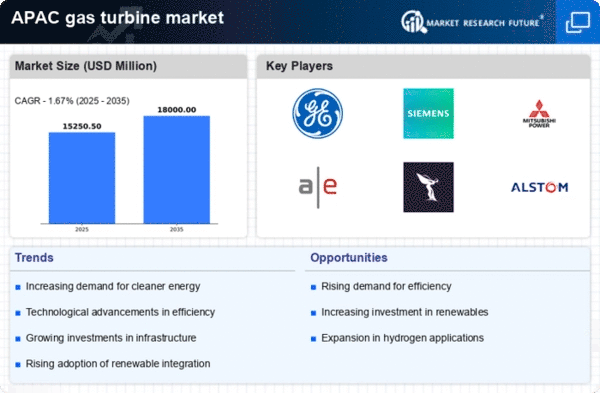
As per Market Research Future analysis, the APAC Gas Turbine Market Size was valued at USD 12,168.4 million in 2024. The Gas Turbine Market industry is projected to grow from USD 12,288.8 million in 2025 to USD 14,503.82 million by 2035, exhibiting a compound annual growth rate (CAGR) of 1.671% during the forecast period (2025 - 2035).

Key Market Trends & Highlights

The APAC gas turbine market supports power generation and industrial applications across Asia-Pacific countries, driven by rising energy demand and shifts toward cleaner fuels like natural gas:

  • Governments prioritize natural gas over coal to cut emissions, with China's coal-to-gas mandates and India's 25% coal reduction target by 2030 boosting installations.
  • Net zero and NDC commitments push countries to retire or limit new coal, positioning gas turbines as a “transition” technology that can back up intermittent renewable.
  • Carbon pricing, emission standards, and air quality regulations are favoring high efficiency combined cycle plants over older simple cycle and coal assets.
  • OEMs and utilities are adopting digital twins, AI based predictive maintenance, and remote monitoring to cut unplanned outages and extend maintenance intervals.
  • Grid operators increasingly value fast ramping turbines that can cycle frequently to balance solar and wind, shifting focus from baseload to flexible operation.

Market Size & Forecast

2024 Market Size 12,168.4 (USD Million)
2035 Market Size 14,503.82 (USD Million)
CAGR (2025 - 2035) 1.671%

Major Players

Siemens Energy, General Electric, Ansaldo Energia, IHI Corporation, Kawasaki Heavy Industries Ltd., Mitsubishi Heavy Industries, Ltd., Bharat Heavy Electricals Limited, Solar Turbines Incorporated, Rolls-Royce, Baker Hughes and Others.
Our Impact
Enabled $4.3B Revenue Impact for Fortune 500 and Leading Multinationals
Partnering with 2000+ Global Organizations Each Year
30K+ Citations by Top-Tier Firms in the Industry

APAC Gas Turbine Market Trends

The APAC gas turbine market is accounted for to register a CAGR of 1.671% during the forecast period and is estimated to reach USD 14,503.82 million by 2035. Combined Heat and Power (CHP) is an energy technology that achieves high efficiencies by simultaneously generating electricity and thermal energy using various technologies and fuel sources. They offer a valuable opportunity to increase the efficiency of power plants by utilizing wasted heat from electricity generation. In traditional power plants, only around 40% of the fuel energy is effectively converted into electricity, while the remaining 60% is released as heat, often wasted through smokestacks or into bodies of water. In CHP plants, this rejected heat is captured and used to create steam, hot water, or chilled water, which can then be utilized for heating or cooling purposes in a network of surrounding buildings through a district energy system. By harnessing the thermal by-product of electricity production, CHP plants can achieve fuel efficiencies of 70% to 85% or even higher. Thus, gas turbines are well-suited for CHP Rating Capacities due to their ability to produce both electricity and high-quality heat, resulting in efficiency levels of 60-80%, compared to about 50% for conventional separate heat and power production. This increased efficiency translates into operational cost savings and makes gas turbines an attractive option for facilities seeking to maximize energy use.

Additionally, the environmental benefits of CHP systems further drive their adoption. By utilizing the heat that would otherwise be wasted, CHP systems significantly reduce greenhouse gas emissions and other pollutants. This aligns with the global push for stricter environmental regulations and sustainability goals, positioning gas turbines as a key technology for achieving these objectives. Additionally, CHP systems are versatile and scalable, catering to a range of Rating Capacities from large industrial plants to smaller commercial buildings. This flexibility opens up numerous market opportunities, including hospitals, universities, manufacturing facilities, and residential complexes, all of which can benefit from the reliable and efficient energy provided by gas turbines in CHP systems.

Furthermore, ongoing research and development efforts are focused on improving the efficiency and performance of gas turbines in CHP Rating Capacities. This includes the development of more efficient turbines, high power-to-heat ratio CHP systems, and the integration of gas turbines into micro grids and district energy systems. These advancements aim to enhance the overall effectiveness and flexibility of CHP systems, making them even more attractive for various Rating Capacities.

APAC Gas Turbine Market Drivers

Increasing demand for reliable and efficient power generation solutions

The demand for gas turbines in the market is driven by the increasing demand for reliable and efficient power generation solutions. As the global economy continues to expand, the need for consistent and dependable energy sources becomes more critical. Industries, businesses, and residential areas all require a stable supply of electricity to function effectively. Additionally, according to the data published by United Nations, the global population has more than tripled since the mid-twentieth century, growing from an estimated 2.5 billion in 1950 to 8.0 billion by mid-November 2022. This includes an increase of 1 billion people since 2010 and 2 billion since 1998. Over the next 30 years, the population is projected to rise by nearly 2 billion, reaching 9.7 billion by 2050, and could potentially peak at around 10.4 billion in the mid-2080s. This rise in population will result into increase in demand for electricity.

Gas turbines play a crucial role in meeting this demand, as they provide a reliable and efficient source of power generation. Moreover, according to the International Energy Administration, the global electricity demand is anticipated to witness faster growth over the next three years with an average annual growth rate of 3.4% by 2026. Thus, with growing demand is anticipated to drive the demand for reliable and efficient power generation solutions such as gas turbines over the forecast period. One of the significant advantages of gas turbines is their ability to generate power with high efficiency. Modern gas turbines achieve efficiency rates exceeding 60% in combined cycle operations, where both gas and steam turbines are used in tandem to produce electricity. This high efficiency translates into lower fuel consumption per unit of electricity generated, resulting in cost savings and reduced environmental impact. As fuel costs continue to fluctuate, the economic benefits of efficient power generation are becoming increasingly important to power producers and end-users alike.

Market Segment Insights

By Rating Capacity: Less Than 40 MW (Largest) vs Above 300 MW (Fastest-Growing)

Based on Rating Capacity, the APAC Gas Turbine Market is segmented into Less Than 40 MW, 40 to 120 MW, 121 to 300 MW, and Above 300 MW. The less than 40 MW segment drove the APAC Gas Turbine Market by holding a substantial market share during the assessment period. It is projected to register a highest growth rate during the projected timeframe. Gas turbines with a rating capacity of less than 40 MW are primarily utilized in small-scale power generation applications, including distributed energy systems, industrial processes, and backup power solutions. These turbines are particularly valued for their compact size and flexibility, making them suitable for various settings, including remote locations and smaller industrial facilities. They are often employed in cogeneration or combined heat and power (CHP) systems, where the simultaneous production of electricity and useful thermal energy enhances overall efficiency. One of the key advantages of turbines in this capacity range is their quick start-up time, which allows operators to respond rapidly to fluctuations in energy demand.

By End-User: Power Generation vs. Oil & Gas: Emerging

Based on End-User, the APAC Gas Turbine Market is segmented into Power Generation, Oil & Gas, and Others. The Power Generation segment drove the APAC Gas Turbine Market by holding a substantial market share during the assessment period. It is projected to register a highest growth rate during the projected timeframe. The power generation segment is the largest and most significant in the APAC Gas Turbine Market. Gas turbines play a critical role in electricity production, particularly in combined cycle power plants, which are known for their high efficiency and low emissions. These plants use both gas and steam turbines to generate more electricity from the same amount of fuel compared to traditional single-cycle power plants. The versatility and reliability of gas turbines make them an attractive option for utilities and independent power producers. They can be quickly started and stopped, providing valuable grid stability and backup power, which is crucial as the integration of intermittent renewable energy sources like wind and solar increases.

By Technology: Open Cycle vs Combined Cycle

Based on Technology, the APAC Gas Turbine Market is segmented into Open Cycle and Combined Cycle. In 2024, the and Combined Cycle segment drove the APAC Gas Turbine Market by holding a substantial market share during the assessment period. It is projected to register a highest growth rate during the projected timeframe. Combined cycle gas turbines (CCGT) represent a more advanced and efficient technology in the gas turbine market, integrating both gas and steam turbine systems to maximize energy output and minimize emissions. In a CCGT system, a gas turbine generates electricity by burning fuel and producing high-temperature exhaust gases, which are then used to drive a steam turbine. The steam turbine utilizes waste heat from the gas turbine's exhaust to generate additional electricity, significantly improving overall thermal efficiency

By Type: Industrial vs. Aeroderivative (Fastest-Growing)

Based on type has been segmented into Industrial, Heavy-Duty and Aeroderivative. In 2024, the Heavy-Duty segment drove the APAC Gas Turbine Market by holding a substantial market share. Heavy duty gas turbines are designed for large-scale power generation and industrial applications, characterized by their robust construction and high efficiency. This segment is further divided into three classes: E Class, F Class, and H Class, each representing advancements in technology and performance capabilities. E Class turbines are typically utilized in applications requiring moderate output and efficiency. They are known for their reliability and are often employed in base-load power generation, where consistent energy supply is crucial. The E Class turbines operate at lower temperatures compared to their F and H Class counterparts, which allows for a longer operational life and reduced maintenance costs. However, they are less efficient than the higher classes, making them suitable for regions with lower efficiency requirements or where capital costs are a primary concern. F Class turbines represent a significant technological advancement, offering improved efficiency and output compared to E Class models. These turbines are capable of operating at higher temperatures and pressures, which enhances their thermal efficiency and power output.

Get more detailed insights about APAC Gas Turbine Market

Regional Insights

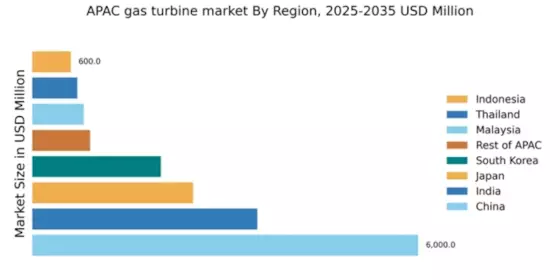
Based on Country, the Gas Turbine market is segmented into China, India, Japan, South Korea, Australia, New Zealand, Rest of Asia Pacific.

 The China Gas Turbine market held the maximum market share and is also expected to account for the significant revenue share during the forecast period. China has emerged as a leading player in the APAC Gas Turbine Market due to its role as a global manufacturing hub. China is witnessing rapid growth in the gas turbine market, driven by increasing energy demand, urbanization, and industrialization. The shift from coal to natural gas is a key trend in the region, as governments seek to reduce air pollution and greenhouse gas emissions while ensuring energy security.

APAC Gas Turbine Market Regional Image

Key Players and Competitive Insights

Many global, regional, and local vendors characterize the APAC Gas Turbine Market. The market is highly competitive, with all the players competing to gain market share. Intense competition, rapid advances in technology, frequent changes in government policies, and environmental regulations are key factors that confront market growth. The vendors compete based on cost, product quality, reliability, and government regulations. Vendors must provide cost-efficient, high-quality products to survive and succeed in an intensely competitive market.
The major players in the market — Siemens Energy, General Electric, Ansaldo Energia, IHI Corporation, Kawasaki Heavy Industries Ltd., Mitsubishi Heavy Industries, Ltd., Bharat Heavy Electricals Limited, Solar Turbines Incorporated, Rolls-Royce, Baker Hughes and Others strategic market developments and decisions to improve operational effectiveness.

Key Companies in the APAC Gas Turbine Market include

Industry Developments

  • In 2023, providing gas turbines for industrial and commercial Rating Capacities.

Future Outlook

APAC Gas Turbine Market Future Outlook

APAC Gas Turbine Market is projected to grow at a 1.671% CAGR from 2025 to 2035, driven by growing geriatric population and technological advancements.

New opportunities lie in:

  • Growing emphasis on cleaner energy sources

By 2035, the market is expected to demonstrate steady growth and resilience.

Market Segmentation

APAC Gas Turbine Market Type Outlook

  • Industrial
  • Heavy-Duty
  • Aeroderivative

APAC Gas Turbine Market End-User Outlook

  • Power Generation
  • Oil & Gas
  • Others

APAC Gas Turbine Market Technology Outlook

  • Open Cycle
  • Combined Cycle

APAC Gas Turbine Market by Rating Capacity Outlook

  • Less Than 40 MW
  • 40 to 120 MW
  • 121 to 300 MW
  • Above 300 MW

Report Scope

Market Size 2024

12,168.4 (USD Million)

Market Size 2025

12,288.8 (USD Million

Market Size 2035

14,503.82 (USD Million)

Compound Annual Growth Rate (CAGR)

1.671% (2025 - 2035)

Report Coverage

Revenue Forecast, Competitive Landscape, Growth Factors, and Trends

Base Year

2024

Market Forecast Period

2025 - 2035

Historical Data

2019 - 2023

Market Forecast Units

USD Million

Key Companies Profiled

Siemens Energy, General Electric, Ansaldo Energia, IHI Corporation, Kawasaki Heavy Industries Ltd., Mitsubishi Heavy Industries, Ltd., Bharat Heavy Electricals Limited, Solar Turbines Incorporated, Rolls-Royce, Baker Hughes and Others

Segments Covered

By Type, By Rating Capacity, By End-User, By Technology

Key Market Opportunities

·         Growing emphasis on cleaner energy sources

Key Market Dynamics

·         Increasing demand for reliable and efficient power generation solutions

Countries Covered

APAC


Leave a Comment

FAQs

How much is the APAC Gas Turbine Market?

The global Seabed Security Market size is expected to be valued at USD 12,288.8 Million in 2025.

What is the growth rate of the APAC Gas Turbine Market?

The global market is projected to grow at a CAGR of 1.671% during the forecast period, 2025-2035.

Who are the key players in the APAC Gas Turbine Market?

The key players in the market are Siemens Energy, General Electric, Ansaldo Energia, IHI Corporation, Kawasaki Heavy Industries Ltd., Mitsubishi Heavy Industries, Ltd., Bharat Heavy Electricals Limited, Solar Turbines Incorporated, Rolls-Royce, Baker Hughes and Others.

Which type segment led the APAC Gas Turbine Market?

The Industrial dominated the market in 2025

Download Free Sample

Kindly complete the form below to receive a free sample of this Report

Compare Licence

×
Features License Type
Single User Multiuser License Enterprise User
Price $4,950 $5,950 $7,250
Maximum User Access Limit 1 User Upto 10 Users Unrestricted Access Throughout the Organization
Free Customization
Direct Access to Analyst
Deliverable Format
Platform Access
Discount on Next Purchase 10% 15% 15%
Printable Versions