×
Request Free Sample ×

Kindly complete the form below to receive a free sample of this Report

* Please use a valid business email

Leading companies partner with us for data-driven Insights

clients tt-cursor
Hero Background

Agrifiber Product Market

ID: MRFR/CnM/33045-HCR
111 Pages
Chitranshi Jaiswal
February 2026

Agrifiber Product Market Research Report By Product Type (Hemp Fiber, Flax Fiber, Sisal Fiber, Jute Fiber, Coir Fiber), By Application (Textiles, Construction Materials, Biocomposites, Automotive Parts, Insulation Materials), By End Use (Industrial, Consumer Goods, Agriculture, Textiles and Apparels, Construction), By Form (Raw Fiber, Composites, Nonwoven Fabrics, Insulation Materials, Panels) and By Regional (North America, Europe, South America, Asia Pacific, Middle East and Africa) - Forecast to 2035

Share:
Download PDF ×

We do not share your information with anyone. However, we may send you emails based on your report interest from time to time. You may contact us at any time to opt-out.

Agrifiber Product Market Infographic
Purchase Options

Agrifiber Product Market Summary

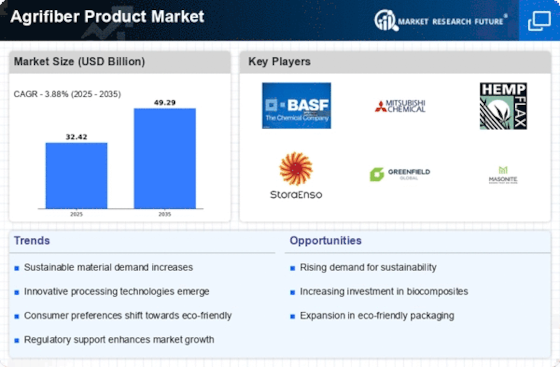
As per Market Research Future analysis, the Agrifiber Product Market Size was estimated at 32.42 USD Billion in 2024. The Agrifiber industry is projected to grow from 33.68 USD Billion in 2025 to 49.29 USD Billion by 2035, exhibiting a compound annual growth rate (CAGR) of 3.88% during the forecast period 2025 - 2035

Key Market Trends & Highlights

The Agrifiber Product Market is experiencing robust growth driven by sustainability and innovation.

  • North America remains the largest market for agrifiber products, reflecting a strong consumer preference for eco-friendly materials.
  • The Asia-Pacific region is emerging as the fastest-growing market, propelled by increasing investments in sustainable practices.
  • Hemp fiber dominates the market, while flax fiber is rapidly gaining traction due to its versatility and eco-friendliness.
  • Key market drivers include rising demand for eco-friendly products and government incentives for sustainable practices, particularly in the construction sector.

Market Size & Forecast

2024 Market Size 32.42 (USD Billion)
2035 Market Size 49.29 (USD Billion)
CAGR (2025 - 2035) 3.88%

Major Players

BASF SE (DE), Mitsubishi Chemical Corporation (JP), HempFlax (NL), Stora Enso Oyj (FI), Greenfield Global (CA), Masonite International Corporation (CA), Hempco Food and Fiber Inc. (CA), EcoCeres (US), Bamboo Technologies (US)

Our Impact
Enabled $4.3B Revenue Impact for Fortune 500 and Leading Multinationals
Partnering with 2000+ Global Organizations Each Year
30K+ Citations by Top-Tier Firms in the Industry

Agrifiber Product Market Trends

The Agrifiber Product Market is currently experiencing a notable transformation, driven by increasing consumer awareness regarding sustainability and environmental impact. This sector encompasses a diverse range of products derived from agricultural fibers, such as hemp, flax, and jute, which are gaining traction due to their eco-friendly attributes. As industries seek alternatives to traditional materials, agrifiber products are emerging as viable substitutes, appealing to both manufacturers and consumers alike. The growing emphasis on reducing carbon footprints and promoting renewable resources appears to be a significant catalyst for this market's expansion. Moreover, innovations in processing technologies and product applications are likely to enhance the versatility of agrifiber materials. This evolution may lead to the development of new applications in sectors such as construction, automotive, and textiles. As the demand for sustainable solutions continues to rise, the Agrifiber Product Market is poised for further growth, potentially reshaping the landscape of material sourcing and usage. Stakeholders in this market must remain vigilant to emerging trends and consumer preferences to capitalize on the opportunities presented by this dynamic sector.

Sustainability Focus

The Agrifiber Product Market is increasingly influenced by a growing emphasis on sustainability. Consumers and businesses alike are prioritizing eco-friendly materials, leading to heightened demand for products derived from agricultural fibers. This trend reflects a broader societal shift towards environmental responsibility.

Technological Advancements

Innovations in processing technologies are transforming the capabilities of agrifiber materials. Enhanced methods of extraction and treatment are expanding the range of applications for these fibers, making them suitable for various industries, including construction and automotive.

Regulatory Support

Government policies and regulations are increasingly favoring sustainable materials, providing a supportive framework for the Agrifiber Product Market. Incentives for using renewable resources and reducing waste are likely to encourage further investment and development in this sector.

Agrifiber Product Market Drivers

Growing Construction Sector

The growing construction sector is a significant driver for the Agrifiber Product Market. As urbanization continues to rise, the demand for sustainable building materials is increasing. Agrifiber products, known for their lightweight and insulating properties, are becoming increasingly popular in construction applications. In 2025, the construction industry is projected to reach a value of 10 trillion USD, with a substantial portion of this growth attributed to the use of sustainable materials. This trend indicates a shift towards greener building practices, where agrifiber products are likely to play a crucial role in meeting sustainability goals.

Innovations in Production Techniques

Innovations in production techniques are significantly impacting the Agrifiber Product Market. Advances in processing technologies, such as improved fiber extraction methods and enhanced bonding techniques, are enabling manufacturers to produce higher quality agrifiber products. These innovations not only enhance product performance but also reduce production costs. For instance, the introduction of automated processing systems has streamlined operations, leading to increased efficiency. As a result, the market is expected to grow at a compound annual growth rate of 8% over the next five years. This growth is indicative of the potential for agrifiber products to replace conventional materials in various applications, including construction and packaging.

Increased Awareness of Health Benefits

Increased awareness of health benefits associated with agrifiber products is driving growth in the Agrifiber Product Market. Consumers are becoming more informed about the nutritional advantages of incorporating agrifiber into their diets, particularly in food products. Agrifiber is recognized for its high fiber content, which contributes to improved digestive health and overall well-being. As health-conscious consumers seek alternatives to processed foods, the demand for agrifiber-based products is expected to rise. This trend is likely to result in a 10% increase in market share for agrifiber food products by 2026, highlighting the potential for agrifiber to become a staple in health-oriented diets.

Rising Demand for Eco-Friendly Products

The Agrifiber Product Market is experiencing a notable increase in demand for eco-friendly products. Consumers are becoming more environmentally conscious, leading to a shift towards sustainable materials. This trend is reflected in the growing popularity of agrifiber products, which are derived from agricultural residues. In 2025, the market for sustainable materials is projected to reach approximately 200 billion USD, with agrifiber products playing a crucial role in this growth. The increasing awareness of climate change and the need for sustainable alternatives to traditional materials are driving this demand. As a result, manufacturers in the Agrifiber Product Market are focusing on developing innovative products that meet consumer expectations for sustainability.

Government Incentives for Sustainable Practices

Government incentives for sustainable practices are playing a pivotal role in the Agrifiber Product Market. Various governments are implementing policies that promote the use of renewable resources and sustainable materials. These initiatives often include financial incentives, tax breaks, and grants for companies that invest in agrifiber technologies. In 2025, it is estimated that government support could lead to a 15% increase in the adoption of agrifiber products across multiple sectors. This regulatory support not only encourages innovation but also fosters a competitive environment for agrifiber manufacturers, ultimately benefiting the market as a whole.


Market Segment Insights

By Type: Hemp Fiber (Largest) vs. Flax Fiber (Fastest-Growing)

In the Agrifiber Product Market, Hemp Fiber holds the largest market share, attributed to its versatile applications in textiles, construction, and bio-composites. Following closely is Flax Fiber, whose market position is rapidly strengthening due to the increasing demand for sustainable and eco-friendly products. Other fibers in this segment, such as Sisal, Jute, and Coir, also contribute to the overall market dynamics, but their shares remain smaller in comparison to Hemp and Flax. As consumers seek more sustainable options, the overall growth of the Agrifiber segment continues to accelerate, showcasing the importance of plant-based solutions in various industries.

Hemp Fiber (Dominant) vs. Flax Fiber (Emerging)

Hemp Fiber is recognized for its strength and durability, making it a preferred choice for numerous applications ranging from textiles to bioplastics, positioning it prominently as a dominant player in the Agrifiber Product Market. The fiber's rich growth characteristics and minimal environmental impact also contribute to its popularity. In contrast, Flax Fiber is emerging as a strong contender, distinguished by its lightweight nature and excellent moisture-wicking properties. The rising awareness of eco-friendly materials is driving Flax Fiber's growth, attracting new investments and innovations in sustainable production methods, which enhance its market appeal and potential for future expansion.

By Application: Textiles (Largest) vs. Construction Materials (Fastest-Growing)

The Agrifiber Product Market is diverse, with significant contributions from various applications. Textiles hold the largest market share, driven by an increasing demand for sustainable and eco-friendly materials in the fashion industry. Meanwhile, construction materials are emerging as a fast-growing segment, reflecting the rising interest in sustainable building practices and the adoption of green construction technologies. As consumers become more environmentally conscious, the preference for agrifiber-based textiles continues to rise, promoting increased market penetration in this area. In terms of growth trends, both the textiles and construction materials segments are witnessing significant advancements. The textile application benefits from a shift towards natural fibers, while the construction sector sees a surge in demand for insulation materials and biocomposites. Innovations in product development and manufacturing processes are creating new opportunities, positioning these segments for robust growth in the coming years. The sustainable nature of agrifiber products amplifies their attractiveness in applications ranging from fashion to construction, solidifying their market presence.

Textiles (Dominant) vs. Biocomposites (Emerging)

Textiles represent the dominant segment in the Agrifiber Product Market due to the shift towards sustainable fashion and biodegradable materials. They are widely used in clothing, home textiles, and upholstery, appealing to environmentally conscious consumers. The increasing acceptance of agrifiber textiles, reinforced by their versatility and aesthetic properties, drives their market dominance. Conversely, biocomposites are emerging as a significant player, particularly in various manufacturing sectors. Biocomposites combine natural fibers with resins to produce high-performance materials, suitable for automotive parts and other applications. Their lightweight, strength, and eco-friendliness offer advantages over traditional composite materials, making them appealing to manufacturers seeking to reduce carbon footprints.

By End Use: Industrial (Largest) vs. Consumer Goods (Fastest-Growing)

The Agrifiber Product Market showcases a diverse application landscape across various end-use segments, with Industrial and Consumer Goods representing significant portions of the market share. The Industrial segment holds the largest share, primarily driven by the demand for sustainable materials in manufacturing processes. In contrast, the Consumer Goods segment is rapidly gaining traction, fueled by increasing consumer awareness regarding eco-friendly products and a shift towards sustainable consumption patterns. Growth in these segments is largely influenced by regulatory pressures encouraging sustainable materials, alongside rising interest from both consumers and industries in reducing their carbon footprint. The Agriculture and Textiles and Apparels segments also play a notable role, yet they remain behind Industrial and Consumer Goods in terms of market growth and overall impact, indicating a potential for future expansion within these areas.

Industrial (Dominant) vs. Textiles and Apparels (Emerging)

The Industrial segment stands out as the dominant force in the Agrifiber Product Market, showcasing a broad application spectrum in construction materials, packaging, and composite materials. This dominance is attributed to the robust demand for sustainable alternatives, as industries increasingly seek to replace conventional materials with agrifiber-based options due to their biodegradable and renewable characteristics. On the other hand, the Textiles and Apparels segment, while emerging, is witnessing significant growth driven by a rise in 'green' fashion trends and consumer demand for eco-friendly clothing. As brands integrate agrifiber materials into their offerings, this segment is likely to gain further prominence, positioning itself as an essential player in the sustainable textiles market.

By Form: Raw Fiber (Largest) vs. Composites (Fastest-Growing)

The Agrifiber Product Market is largely dominated by raw fiber, which holds the largest market share among various forms. Raw fiber serves as a fundamental material for numerous applications, emphasizing its significance in the market. On the other hand, composites have emerged as the fastest-growing segment, gaining traction due to their innovative applications and versatility. This dual dynamic showcases the diverse potential across the form spectrum within the agrifiber category.

Raw Fiber (Dominant) vs. Composites (Emerging)

Raw fiber stands out as the dominant form in the agrifiber product market, primarily due to its integral role in traditional applications, including textiles and paper products. It offers a sustainable alternative to synthetic materials, catering to the increasing demand for eco-friendly solutions. Conversely, composites are recognized as an emerging force, driven by technological advancements that enhance their properties and application scope. They are gaining popularity in automotive and construction industries, where lightweight and strength are pivotal. This shift indicates a broader acceptance of innovative agrifiber solutions.

Get more detailed insights about Agrifiber Product Market

Regional Insights

North America : Sustainable Innovation Leader

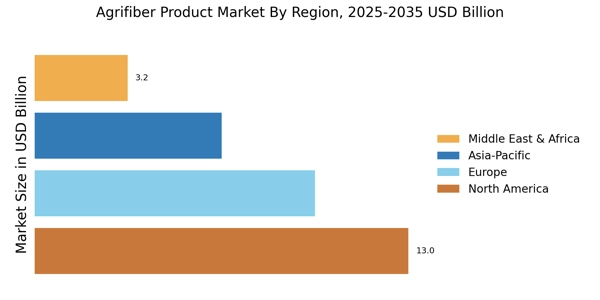
North America is the largest market for agrifiber products, holding approximately 40% of the global market share. The region's growth is driven by increasing demand for sustainable materials in construction and packaging, alongside supportive regulations promoting eco-friendly practices. The U.S. and Canada are the primary contributors, with a strong focus on innovation and sustainability in agricultural practices. The competitive landscape in North America is robust, featuring key players such as BASF SE, Greenfield Global, and Masonite International Corporation. These companies are leveraging advanced technologies to enhance product offerings and meet the rising consumer demand for sustainable solutions. The presence of established agricultural sectors further supports the growth of agrifiber products, positioning North America as a leader in this market.

Europe : Regulatory Framework Support

Europe is the second-largest market for agrifiber products, accounting for approximately 30% of the global market share. The region's growth is fueled by stringent environmental regulations and a strong consumer preference for sustainable products. Countries like Germany and the Netherlands are leading the charge, with policies that encourage the use of renewable resources and waste reduction in manufacturing processes. The competitive landscape in Europe is characterized by a mix of established companies and innovative startups. Key players such as Stora Enso Oyj and HempFlax are at the forefront, driving advancements in agrifiber technology. The European market is also witnessing increased collaboration between industries and research institutions, fostering innovation and enhancing product development in the agrifiber sector.

Asia-Pacific : Emerging Market Potential

Asia-Pacific is rapidly emerging as a significant player in the agrifiber product market, holding about 20% of the global market share. The region's growth is driven by rising urbanization, increasing awareness of environmental issues, and government initiatives promoting sustainable agriculture. Countries like Japan and Australia are leading the way, with policies that support the development of agrifiber technologies and sustainable practices. The competitive landscape in Asia-Pacific is diverse, with a mix of local and international players. Companies such as Mitsubishi Chemical Corporation are investing in research and development to enhance product offerings. The region's growing population and demand for sustainable materials in construction and packaging are expected to further drive market growth, making it a key area for future investment in agrifiber products.

Middle East and Africa : Resource-Rich Opportunities

The Middle East and Africa region is gradually developing its agrifiber market, currently holding around 10% of the global market share. The growth is primarily driven by increasing agricultural activities and a rising demand for sustainable building materials. Countries like South Africa and Kenya are focusing on enhancing their agricultural practices, supported by government initiatives aimed at promoting eco-friendly materials and practices. The competitive landscape in this region is still evolving, with local players beginning to emerge alongside international companies. The presence of key players such as EcoCeres and Bamboo Technologies is helping to establish a foothold in the market. As awareness of sustainability grows, the region is expected to see significant advancements in agrifiber product development, creating new opportunities for investment and growth.

Agrifiber Product Market Regional Image

Key Players and Competitive Insights

The Agrifiber Product Market is currently characterized by a dynamic competitive landscape, driven by increasing demand for sustainable materials and innovative applications across various industries. Key players such as BASF SE (Germany), Mitsubishi Chemical Corporation (Japan), and Stora Enso Oyj (Finland) are strategically positioning themselves through a combination of technological advancements and regional expansions. BASF SE (Germany) focuses on enhancing its product portfolio through research and development, while Mitsubishi Chemical Corporation (Japan) emphasizes partnerships to bolster its market presence. Stora Enso Oyj (Finland) is actively pursuing digital transformation initiatives to optimize its operations, thereby shaping a competitive environment that prioritizes sustainability and innovation.In terms of business tactics, companies are increasingly localizing manufacturing to reduce supply chain vulnerabilities and enhance responsiveness to market demands. The Agrifiber Product Market appears moderately fragmented, with a mix of established players and emerging companies vying for market share. The collective influence of these key players is significant, as they drive trends in sustainability and innovation, which are becoming essential for competitive differentiation.

In August BASF SE (Germany) announced a partnership with a leading agricultural technology firm to develop bio-based composites aimed at reducing carbon footprints in construction. This strategic move underscores BASF's commitment to sustainability and positions it favorably in a market that increasingly values eco-friendly solutions. The collaboration is expected to enhance product offerings and expand market reach, aligning with global trends towards greener construction materials.

In September Stora Enso Oyj (Finland) launched a new line of agrifiber-based packaging solutions designed to replace traditional plastics. This initiative not only reflects the company's dedication to sustainability but also addresses the growing consumer demand for environmentally friendly packaging options. The introduction of these products is likely to strengthen Stora Enso's market position and appeal to eco-conscious consumers, further driving the shift towards sustainable materials.

In October Mitsubishi Chemical Corporation (Japan) unveiled a new research facility dedicated to the development of advanced agrifiber materials. This facility aims to accelerate innovation in the sector, focusing on enhancing the performance characteristics of agrifiber products. By investing in research and development, Mitsubishi Chemical Corporation is positioning itself as a leader in the agrifiber market, potentially setting new standards for product quality and performance.

As of October the competitive trends in the Agrifiber Product Market are increasingly defined by digitalization, sustainability, and the integration of artificial intelligence in production processes. Strategic alliances among key players are shaping the landscape, fostering innovation and enhancing supply chain efficiencies. Looking ahead, it is anticipated that competitive differentiation will evolve from traditional price-based competition to a focus on innovation, technological advancements, and reliable supply chains, reflecting the growing importance of sustainability in consumer preferences.

Key Companies in the Agrifiber Product Market include

Industry Developments

Masonite International Corporation has recently expanded its product line in agrifiber products, focusing on sustainability and innovative design. West Fraser Timber Co Ltd has reported increased production capabilities, responding to growing demand for environmentally friendly building materials. International Paper is investing in advanced technologies to enhance the efficiency of its agrifiber processing operations. Meanwhile, Greenwood Resources has secured new partnerships aimed at promoting sustainable forestry practices, strengthening its market presence. Canfor Corporation continues to expand its biomass offerings, reflecting a growing interest in renewable energy sources derived from agrifiber.

Domtar Corporation and UPM-Kymmene Corporation are collaborating on developing eco-friendly packaging solutions, emphasizing the shift towards sustainability in product development. Välinge Innovation has introduced new technologies aimed at improving the performance and durability of agrifiber products, while Klausner Trading USA is enhancing its supply chain management in response to market growth. Smurfit Kappa Group has reported a significant increase in its agrifiber packaging sales, further solidifying its role in the market.

Sappi Group and Metsa Group are focusing on innovation and sustainable practices in their production processes, while Nippon Paper Industries is actively exploring expansion opportunities to better serve the rising demand in the sector.

Future Outlook

Agrifiber Product Market Future Outlook

The Agrifiber Product Market is projected to grow at a 3.88% CAGR from 2025 to 2035, driven by sustainability trends, technological advancements, and increasing demand for eco-friendly materials.

New opportunities lie in:

  • Development of biodegradable packaging solutions using agrifiber materials.
  • Expansion into emerging markets with tailored agrifiber products.
  • Investment in R&D for innovative agrifiber composites and applications.

By 2035, the Agrifiber Product Market is expected to achieve robust growth and increased market penetration.

Market Segmentation

Agrifiber Product Market Form Outlook

  • Raw Fiber
  • Composites
  • Nonwoven Fabrics
  • Insulation Materials
  • Panels

Agrifiber Product Market Type Outlook

  • Hemp Fiber
  • Flax Fiber
  • Sisal Fiber
  • Jute Fiber
  • Coir Fiber

Agrifiber Product Market End Use Outlook

  • Industrial
  • Consumer Goods
  • Agriculture
  • Textiles and Apparels
  • Construction

Agrifiber Product Market Application Outlook

  • Textiles
  • Construction Materials
  • Biocomposites
  • Automotive Parts
  • Insulation Materials

Report Scope

MARKET SIZE 202432.42(USD Billion)
MARKET SIZE 202533.68(USD Billion)
MARKET SIZE 203549.29(USD Billion)
COMPOUND ANNUAL GROWTH RATE (CAGR)3.88% (2025 - 2035)
REPORT COVERAGERevenue Forecast, Competitive Landscape, Growth Factors, and Trends
BASE YEAR2024
Market Forecast Period2025 - 2035
Historical Data2019 - 2024
Market Forecast UnitsUSD Billion
Key Companies ProfiledBASF SE (DE), Mitsubishi Chemical Corporation (JP), HempFlax (NL), Stora Enso Oyj (FI), Greenfield Global (CA), Masonite International Corporation (CA), Hempco Food and Fiber Inc. (CA), EcoCeres (US), Bamboo Technologies (US)
Segments CoveredProduct Type, Application, End Use, Form, Regional
Key Market OpportunitiesGrowing demand for sustainable packaging solutions drives innovation in the Agrifiber Product Market.
Key Market DynamicsRising consumer demand for sustainable materials drives innovation and competition in the Agrifiber Product Market.
Countries CoveredNorth America, Europe, APAC, South America, MEA
Leave a Comment

FAQs

What is the current valuation of the Agrifiber Product Market?

The Agrifiber Product Market was valued at 32.42 USD Billion in 2024.

What is the projected market size for the Agrifiber Product Market by 2035?

The market is projected to reach 49.29 USD Billion by 2035.

What is the expected CAGR for the Agrifiber Product Market during the forecast period?

The expected CAGR for the Agrifiber Product Market from 2025 to 2035 is 3.88%.

Which companies are considered key players in the Agrifiber Product Market?

Key players include BASF SE, Mitsubishi Chemical Corporation, HempFlax, Stora Enso Oyj, and Greenfield Global.

What are the main types of fibers in the Agrifiber Product Market?

The main types of fibers include Hemp Fiber, Flax Fiber, Sisal Fiber, Jute Fiber, and Coir Fiber.

What is the market valuation for Jute Fiber in 2025?

The market valuation for Jute Fiber is expected to range from 10.0 to 15.0 USD Billion.

How does the Agrifiber Product Market perform in the textiles application segment?

The textiles application segment is projected to have a market size between 8.0 and 12.0 USD Billion.

What is the expected market size for construction materials in the Agrifiber Product Market?

The construction materials segment is anticipated to reach between 10.0 and 15.0 USD Billion.

What end-use segments are included in the Agrifiber Product Market?

End-use segments include Industrial, Consumer Goods, Agriculture, Textiles and Apparels, and Construction.

Download Free Sample

Kindly complete the form below to receive a free sample of this Report

Compare Licence

×
Features License Type
Single User Multiuser License Enterprise User
Price $4,950 $ $7,250
Maximum User Access Limit 1 User Upto 10 Users Unrestricted Access Throughout the Organization
Free Customization
Direct Access to Analyst
Deliverable Format
Platform Access
Discount on Next Purchase 10% 15% 15%
Printable Versions