×
Request Free Sample ×

Kindly complete the form below to receive a free sample of this Report

* Please use a valid business email

Leading companies partner with us for data-driven Insights

clients tt-cursor
Hero Background
English
Chinese
French
Japanese
Korean
German
Spanish

Aerospace Maintenance Chemicals Market Analysis

ID: MRFR/CnM/4746-HCR
100 Pages
Priya Nagrale
October 2025

Aerospace Maintenance Chemicals Market Research Report Information by Grade (Food, Pharmaceutical, Cosmetic), Application (Food & Beverage, Pharmaceuticals, Cosmetics & Personal Care, Agriculture/Animal Feed), and Region: Forecast till 2035

Share:
Download PDF ×

We do not share your information with anyone. However, we may send you emails based on your report interest from time to time. You may contact us at any time to opt-out.

Aerospace Maintenance Chemicals Market Infographic
Purchase Options

Market Analysis

In-depth Analysis of Aerospace Maintenance Chemicals Market Industry Landscape

Market dynamics within the aerospace maintenance chemicals sector are shaped by a complex interplay of various factors that influence the demand, supply, and overall market behavior. These dynamics encompass a range of elements, including technological advancements, regulatory frameworks, economic conditions, industry trends, and environmental concerns, all of which significantly impact the dynamics of this specialized market.

Technological Advancements stand as a key driver of market dynamics in aerospace maintenance chemicals. Ongoing advancements in chemical formulations, material science, and manufacturing processes lead to the development of more efficient and innovative products. Companies invest in research and development to create chemicals that offer enhanced performance, durability, and environmental sustainability. These technological innovations often dictate market trends, influencing the adoption of newer, more advanced maintenance chemicals.

Regulatory Frameworks play a pivotal role in shaping market dynamics. The aerospace industry operates within a stringent regulatory environment to ensure safety, reliability, and environmental sustainability. Chemicals used in aircraft maintenance must comply with rigorous industry standards and regulations imposed by aviation authorities and environmental agencies globally. Any changes or updates in these regulations directly impact the demand, production, and adoption of maintenance chemicals, influencing market dynamics.

Economic Conditions and Industry Trends significantly influence the demand for aerospace maintenance chemicals. Factors such as air passenger traffic, fleet expansion, and airline profitability impact the need for maintenance, thereby affecting the demand for associated chemicals. Economic downturns or fluctuations in fuel prices can directly impact airline budgets, affecting their expenditure on maintenance, which, in turn, affects the market dynamics of maintenance chemicals.

Environmental Concerns have increasingly shaped market dynamics in recent years. There is a growing emphasis on sustainability and environmental responsibility within the aerospace industry. Manufacturers and airlines are under pressure to reduce their carbon footprint and adopt eco-friendly practices. Consequently, there's a rising demand for maintenance chemicals that are biodegradable, non-toxic, and have minimal environmental impact. Companies that offer environmentally friendly solutions gain a competitive edge in the market due to shifting industry preferences.

Supply Chain Dynamics and Market Competition also play a crucial role in shaping the aerospace maintenance chemicals market. The market is characterized by intense competition among manufacturers and suppliers. Companies strive to innovate, differentiate, and offer competitive pricing to gain market share. Additionally, supply chain disruptions, raw material availability, and logistical challenges impact the market dynamics, influencing product availability and pricing.

Market Segmentation and Customer Preferences contribute significantly to market dynamics. Different segments within the aerospace industry, such as commercial aviation, military, and general aviation, have distinct maintenance requirements. Understanding and catering to these specific needs through targeted products and services influence market dynamics. Moreover, evolving customer preferences for cost-effective, efficient, and sustainable solutions impact the development and adoption of maintenance chemicals.

Emerging Markets and Global Expansion present opportunities for market dynamics to shift. The aerospace industry is witnessing growth in emerging markets like Asia-Pacific, Latin America, and the Middle East. These regions offer significant potential due to increased air travel demand and expanding aircraft fleets. Companies that strategically expand their presence in these markets can influence market dynamics by capturing new market shares and shaping demand patterns.


Author
Priya Nagrale
Senior Research Analyst

With an experience of over five years in market research industry (Chemicals & Materials domain), I gather and analyze market data from diverse sources to produce results, which are then presented back to a client. Also, provide recommendations based on the findings. As a Senior Research Analyst, I perform quality checks (QC) for market estimations, QC for reports, and handle queries and work extensively on client customizations. Also, handle the responsibilities of client proposals, report planning, report finalization, and execution

Leave a Comment

FAQs

What is the major driver of the global aerospace maintenance chemicals market?

Strict regulations pertaining to safety and operation functionality of airplanes by federal agencies is the major driver of the global aerospace maintenance chemicals market.

What are trends in the global aerospace maintenance chemicals market?

The expansion of the commercial aviation sector and the constant need for maintenance, repair, and overhaul (MRO) of aircraft are trends which can influence the global aerospace maintenance chemicals market.

Which region can contribute the most to the global aerospace maintenance chemicals market?

North America can contribute the most to the global aerospace maintenance chemicals market till 2035 due to increased production of aircraft.

Who are the key players of the global aerospace maintenance chemicals market?

Florida Chemical Supply, Inc., Nexeo Solutions, Krayden, Inc., Eastman Chemical Company, 3M, Aviation Chemical Solutions, Hansair Logistics Inc., Callington Haven Pty Ltd., Arrow Solutions, KLX Inc., Aerochemicals, Henkel AG & Co., KGaA, Royal Dutch Shell, and Exxon Mobil Corporation are notable players of the global aerospace maintenance chemicals market.

What is the key strategy of players witnessed in the global aerospace maintenance chemicals market?

Acquisitions is the key strategy of players in the global aerospace maintenance chemicals market.

Market Summary

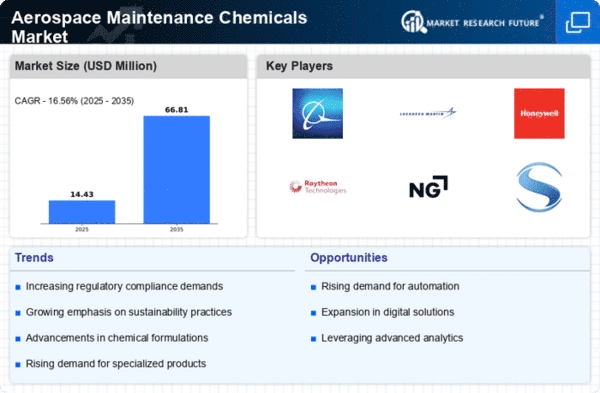
As per MRFR analysis, the Aerospace Maintenance Chemicals Market Size was estimated at 12.38 USD Million in 2024. The Aerospace Maintenance Chemicals industry is projected to grow from 14.43 USD Million in 2025 to 66.81 USD Million by 2035, exhibiting a compound annual growth rate (CAGR) of 16.56 during the forecast period 2025 - 2035.

Key Market Trends & Highlights

The Aerospace Maintenance Chemicals Market is experiencing a dynamic shift towards sustainability and technological innovation.

  • North America remains the largest market for aerospace maintenance chemicals, driven by a robust aircraft fleet and stringent safety regulations.
  • The Asia-Pacific region is emerging as the fastest-growing market, fueled by increasing air travel and expanding MRO services.
  • The cleaning segment dominates the market, while corrosion inhibition is witnessing rapid growth due to heightened awareness of material longevity.
  • Key market drivers include the increased aircraft fleet size and the growing demand for sustainable solutions, which are shaping industry practices.

Market Size & Forecast

2024 Market Size 12.38 (USD Million)
2035 Market Size 66.81 (USD Million)
CAGR (2025 - 2035) 16.56%
Largest Regional Market Share in 2024 North America

Major Players

Boeing (US), Lockheed Martin (US), Honeywell (US), Raytheon Technologies (US), Northrop Grumman (US), Safran (FR), Airbus (FR), General Electric (US), L3Harris Technologies (US)

Market Trends

The Aerospace Maintenance Chemicals Market is currently experiencing a dynamic evolution, driven by the increasing demand for efficient and effective maintenance solutions in the aviation sector. As aircraft technology advances, the need for specialized chemicals that ensure optimal performance and safety becomes paramount. This market encompasses a wide range of products, including cleaners, lubricants, and corrosion inhibitors, all designed to meet the stringent requirements of aerospace applications. Furthermore, the growing emphasis on sustainability and environmental compliance is influencing the development of eco-friendly alternatives, which may reshape product offerings in the near future. In addition, the Aerospace Maintenance Chemicals Market is likely to witness a surge in innovation as manufacturers strive to enhance the efficacy and safety of their products. The integration of advanced technologies, such as nanotechnology and bio-based materials, appears to be a focal point for research and development efforts. Moreover, the increasing collaboration between chemical manufacturers and aerospace companies suggests a trend towards tailored solutions that address specific maintenance challenges. Overall, the market seems poised for growth, driven by technological advancements and a heightened focus on sustainability in the aerospace industry.

Sustainability Initiatives

The Aerospace Maintenance Chemicals Market is increasingly influenced by sustainability initiatives. Manufacturers are focusing on developing eco-friendly products that minimize environmental impact. This trend reflects a broader commitment to reducing carbon footprints and adhering to stringent regulations. As a result, the market is likely to see a rise in the adoption of biodegradable and non-toxic chemicals.

Technological Advancements

Technological advancements are playing a crucial role in shaping the Aerospace Maintenance Chemicals Market. Innovations such as nanotechnology and advanced formulations are enhancing the performance of maintenance chemicals. These developments may lead to more effective cleaning agents and lubricants, which could improve aircraft longevity and operational efficiency.

Customization and Tailored Solutions

Customization is becoming a prominent trend within the Aerospace Maintenance Chemicals Market. As aerospace companies face unique maintenance challenges, there is a growing demand for tailored chemical solutions. This trend indicates a shift towards collaborative efforts between chemical manufacturers and aerospace firms to create products that meet specific operational needs.

Aerospace Maintenance Chemicals Market Market Drivers

Market Growth Projections

The Global Aerospace Maintenance Chemicals Market Industry is projected to experience substantial growth over the coming years. With an estimated market value of 7.04 USD Billion in 2024, the industry is on track to reach approximately 10.3 USD Billion by 2035. This growth trajectory, characterized by a CAGR of 3.48% from 2025 to 2035, reflects the increasing demand for maintenance solutions driven by a growing global fleet and advancements in technology. The market's expansion is indicative of a broader trend towards enhanced safety, compliance, and operational efficiency within the aerospace sector.

Rising Focus on Sustainability

Sustainability has emerged as a pivotal driver in the Global Aerospace Maintenance Chemicals Market Industry. As environmental concerns escalate, manufacturers and operators are increasingly adopting eco-friendly maintenance chemicals that minimize environmental impact. This shift is evident in the growing demand for biodegradable cleaning agents and low-VOC coatings. Airlines and military organizations are recognizing the importance of sustainable practices, not only for regulatory compliance but also for enhancing their corporate image. The market's growth trajectory, projected to reach 10.3 USD Billion by 2035, reflects the industry's responsiveness to sustainability trends, positioning it as a key factor in the Global Aerospace Maintenance Chemicals Market Industry.

Increasing Demand for Aircraft Maintenance

The Global Aerospace Maintenance Chemicals Market Industry experiences a notable surge in demand for aircraft maintenance as the global fleet of commercial and military aircraft expands. With the number of aircraft projected to reach approximately 39,000 by 2035, the need for effective maintenance solutions becomes paramount. This growth is driven by the necessity to ensure safety, compliance with regulations, and operational efficiency. The market is expected to reach 7.04 USD Billion in 2024, reflecting the industry's response to these demands. As airlines and military operators prioritize maintenance, the Global Aerospace Maintenance Chemicals Market Industry is poised for sustained growth.

Regulatory Compliance and Safety Standards

The Global Aerospace Maintenance Chemicals Market Industry is significantly influenced by stringent regulatory compliance and safety standards imposed by aviation authorities worldwide. These regulations mandate the use of approved maintenance chemicals to ensure the safety and reliability of aircraft operations. As regulatory bodies continue to enhance their oversight, operators are compelled to adopt compliant maintenance solutions. This trend is expected to drive market growth, as companies invest in certified products to meet these requirements. The projected CAGR of 3.48% from 2025 to 2035 indicates a sustained commitment to safety and compliance within the Global Aerospace Maintenance Chemicals Market Industry.

Expansion of Aerospace Manufacturing and Services

The expansion of aerospace manufacturing and services globally contributes significantly to the growth of the Global Aerospace Maintenance Chemicals Market Industry. As new aircraft models are introduced and existing fleets are upgraded, the demand for maintenance chemicals rises correspondingly. This expansion is driven by increasing passenger traffic and the need for efficient air transportation solutions. The market is expected to reach 7.04 USD Billion in 2024, indicating a robust response to this growth. Furthermore, the anticipated CAGR of 3.48% from 2025 to 2035 suggests a sustained upward trajectory for the Global Aerospace Maintenance Chemicals Market Industry as manufacturers and service providers seek to enhance operational efficiency.

Technological Advancements in Maintenance Solutions

Technological innovations play a crucial role in shaping the Global Aerospace Maintenance Chemicals Market Industry. The introduction of advanced cleaning agents, corrosion inhibitors, and specialized coatings enhances the efficiency and effectiveness of maintenance processes. For instance, the development of eco-friendly chemicals aligns with global sustainability initiatives, appealing to environmentally conscious operators. As these technologies evolve, they not only improve maintenance outcomes but also reduce operational costs. The anticipated growth of the market to 10.3 USD Billion by 2035 underscores the impact of these advancements on the Global Aerospace Maintenance Chemicals Market Industry, as stakeholders seek to leverage cutting-edge solutions.

Market Segment Insights

By Application: Cleaning (Largest) vs. Corrosion Inhibition (Fastest-Growing)

In the Aerospace Maintenance Chemicals Market, the application segment is divided into Cleaning, Corrosion Inhibition, Surface Treatment, and Lubrication. Among these, Cleaning holds the largest market share, primarily due to the ongoing necessity for maintaining aircraft cleanliness and safety. Corrosion Inhibition is gaining traction, reflecting its vital role in prolonging the lifespan of aerospace components, thus positioning it as the fastest-growing segment within this category.

Cleaning (Dominant) vs. Corrosion Inhibition (Emerging)

Cleaning agents in the aerospace maintenance sector are instrumental in ensuring structural integrity and operational efficiency by removing contaminants that could lead to malfunction. The dominant application of Cleaning encompasses a broad range of products specifically formulated to meet rigorous safety standards. In contrast, Corrosion Inhibition is emerging as a critical focus area as manufacturers increasingly recognize the importance of protecting metal surfaces from corrosive damage. Innovations in eco-friendly corrosion inhibitors highlight the demand for sustainable practices in aerospace maintenance, making this segment highly attractive and essential for the future growth of the market.

By End Use: Commercial Aviation (Largest) vs. MRO Services (Fastest-Growing)

In the Aerospace Maintenance Chemicals Market, the distribution of market share among various end-use segments reveals that Commercial Aviation holds the largest share, driven by a substantial demand for regular maintenance and repair services. This segment's dominance is primarily attributed to the increasing number of commercial flights and the need for stringent maintenance protocols to ensure aircraft safety and efficiency. In contrast, MRO Services is emerging as the fastest-growing segment, benefiting from the rising trend of outsourcing maintenance operations and an increasing focus on operational efficiency in the aviation sector.

Commercial Aviation (Dominant) vs. MRO Services (Emerging)

Commercial Aviation serves as the dominant end-use segment in the aerospace maintenance chemicals market, characterized by consistent demand for specialized maintenance solutions to uphold safety and operational efficiency. This segment involves extensive use of maintenance chemicals for cleaning, repair, and compliance with aviation regulations. Conversely, MRO Services are quickly transitioning into an emerging segment, spurred by technological advancements and an increasing preference for outsourced maintenance. The alignment of MRO services with digital initiatives and data-driven maintenance strategies positions it well for future growth, catering to both commercial and military aviation demands.

By Chemical Type: Solvents (Largest) vs. Degreasers (Fastest-Growing)

In the Aerospace Maintenance Chemicals Market, solvents hold the largest share, reflecting their essential role in cleaning and preparing surfaces prior to maintenance activities. Degreasers, while currently smaller in share, are rapidly gaining attention, driven by the demand for effective removal of greases and oils from various aerospace components. This growing focus on efficiency and cleanliness in maintenance practices has led to a significant shift towards specialized degreasing solutions, augmenting their market presence.

Solvents (Dominant) vs. Degreasers (Emerging)

Solvents in the Aerospace Maintenance Chemicals Market are critical for maintaining the integrity of aerospace components, utilized primarily for surface preparation and cleaning. Their dominant position stems from longstanding applications in various maintenance procedures, offering users reliable performance and compliance with aerospace standards. On the other hand, degreasers are emerging as a vital alternative, emphasizing eco-friendly formulations and advanced cleaning technologies that appeal to a modern, sustainability-focused market. As manufacturers innovate with biodegradable and less volatile compounds, the demand for degreasers is surging, positioning them as a key player in ensuring maintenance efficiency and environmental compliance.

Get more detailed insights about Aerospace Maintenance Chemicals Market Research Report – Forecast to 2035

Regional Insights

North America : Market Leader in Aerospace Chemicals

North America is poised to maintain its leadership in the Aerospace Maintenance Chemicals Market, holding a significant market share of 6.19 billion. The region's growth is driven by robust demand from military and commercial aviation sectors, alongside stringent regulatory standards that promote safety and efficiency. The increasing focus on sustainable practices and advanced technologies further fuels market expansion, making it a key player in the global landscape. The competitive landscape in North America is characterized by the presence of major players such as Boeing, Lockheed Martin, and Honeywell. These companies are investing heavily in R&D to innovate and enhance their product offerings. The U.S. government’s support for aerospace initiatives and defense spending also contributes to the region's market strength, ensuring a steady demand for maintenance chemicals across various aircraft types.

Europe : Emerging Market with Growth Potential

Europe's Aerospace Maintenance Chemicals Market is valued at 3.71 billion, reflecting a growing demand driven by the region's strong aerospace manufacturing base and increasing air traffic. Regulatory frameworks, such as the European Union Aviation Safety Agency (EASA) guidelines, are pivotal in shaping market dynamics, ensuring compliance and safety in aviation operations. The push for environmentally friendly products is also influencing market trends, leading to innovations in chemical formulations. Leading countries in this region include France, Germany, and the UK, where key players like Airbus and Safran are headquartered. The competitive landscape is marked by collaborations and partnerships aimed at enhancing product offerings and market reach. The presence of established aerospace manufacturers and a skilled workforce further solidifies Europe's position in The Aerospace Maintenance Chemicals.

Asia-Pacific : Rapidly Growing Aerospace Sector

The Asia-Pacific region, with a market size of 2.25 billion, is rapidly emerging as a significant player in the Aerospace Maintenance Chemicals Market. The growth is fueled by increasing air travel demand, expanding aerospace manufacturing capabilities, and government initiatives to boost the aviation sector. Countries like China and India are investing heavily in their aerospace industries, leading to a surge in demand for maintenance chemicals that meet international standards. China and India are at the forefront of this growth, with major investments in both commercial and military aviation. The competitive landscape is evolving, with local and international players vying for market share. Companies are focusing on innovation and sustainability to cater to the growing demand for eco-friendly maintenance solutions, positioning the region as a key contributor to The Aerospace Maintenance Chemicals.

Middle East and Africa : Emerging Market with Untapped Potential

The Middle East and Africa region, with a market size of 0.23 billion, is in the early stages of developing its Aerospace Maintenance Chemicals Market. The growth is primarily driven by increasing investments in aviation infrastructure and a rising number of air travel passengers. Governments in the region are recognizing the importance of aviation for economic development, leading to regulatory frameworks that support the aerospace sector's growth. Countries like the UAE and South Africa are leading the charge, with significant investments in their aerospace capabilities. The competitive landscape is still developing, with both local and international players exploring opportunities. As the region continues to invest in its aviation sector, the demand for maintenance chemicals is expected to rise, presenting opportunities for growth in the coming years.

Key Players and Competitive Insights

The Aerospace Maintenance Chemicals Market is characterized by a competitive landscape that is increasingly shaped by innovation, sustainability, and strategic partnerships. Key players such as Boeing (US), Lockheed Martin (US), and Honeywell (US) are actively pursuing strategies that emphasize technological advancements and operational efficiencies. Boeing (US), for instance, has been focusing on enhancing its product offerings through research and development, which appears to be a response to the growing demand for more efficient and environmentally friendly maintenance solutions. Lockheed Martin (US) has also positioned itself as a leader in this space by investing in digital transformation initiatives that streamline maintenance processes and improve overall aircraft performance. These strategies collectively contribute to a dynamic competitive environment where companies are not only vying for market share but also striving to meet evolving regulatory standards and customer expectations.In terms of business tactics, companies are increasingly localizing manufacturing and optimizing supply chains to enhance responsiveness and reduce costs. The market structure is moderately fragmented, with several key players exerting considerable influence. This fragmentation allows for niche players to emerge, yet the collective strength of major companies like Raytheon Technologies (US) and Northrop Grumman (US) ensures that competition remains robust. The strategic focus on supply chain reliability and localized production is likely to enhance operational resilience, particularly in a market that is sensitive to geopolitical and economic fluctuations.

In November Honeywell (US) announced a partnership with a leading aerospace manufacturer to develop advanced maintenance chemicals that utilize bio-based materials. This strategic move not only aligns with the growing trend towards sustainability but also positions Honeywell (US) as a frontrunner in eco-friendly solutions within the aerospace sector. The implications of this partnership could be far-reaching, potentially setting new industry standards for environmental compliance and operational efficiency.

In October Boeing (US) unveiled a new line of maintenance chemicals designed to reduce environmental impact while enhancing aircraft performance. This initiative reflects a broader industry trend towards sustainability and innovation, suggesting that Boeing (US) is keen to leverage its technological capabilities to meet the demands of a more environmentally conscious market. The introduction of these products may also serve to strengthen Boeing's (US) competitive position by appealing to customers prioritizing sustainability in their procurement decisions.

In September Lockheed Martin (US) expanded its research and development efforts to include artificial intelligence (AI) applications in maintenance processes. This strategic initiative aims to enhance predictive maintenance capabilities, thereby reducing downtime and operational costs for clients. The integration of AI into maintenance practices could signify a pivotal shift in how aerospace maintenance chemicals are utilized, potentially leading to more efficient and effective maintenance cycles.

As of December the competitive trends in the Aerospace Maintenance Chemicals Market are increasingly defined by digitalization, sustainability, and the integration of advanced technologies such as AI. Strategic alliances are becoming more prevalent, as companies recognize the need to collaborate in order to innovate and meet regulatory demands. The future landscape of competition is likely to evolve from a focus on price-based strategies to one that emphasizes technological differentiation, innovation, and supply chain reliability. This shift may redefine how companies position themselves in the market, with a greater emphasis on delivering value through advanced solutions rather than merely competing on cost.

Key Companies in the Aerospace Maintenance Chemicals Market include

Industry Developments

PPG, a global manufacturer of paints, coatings, and specialty materials based in Pittsburg plans to invest $17 million in the construction of an aerospace application support center (ASC) in Toulouse, France. PPG plans to break ground on the new facility in the third quarter of 2022, with operations beginning in the fourth quarter of 2023. The facility will be strategically located near aerospace customers as well as Toulouse Blagnac Airport.

Singapore Technologies Engineering Ltd, a Singapore-based integrated engineering group, sold half of its equity stake in Keystone Holdings Pte. Ltd. to SJ Aviation Capital Pte. Ltd. for an estimated US$10.7 million. ST Aerospace Resources and SJ Aviation Capital will each own 50% of Keystone Holdings, which will develop a portfolio of maintenance chemical products in response to opportunities created by global aircraft fleet expansion and renewal.

Key Players

Some of the key players in the global aerospace maintenance chemicals are 3M (U.S.), Royal Dutch Shell (Netherlands), Aerochemicals (France), Arrow Solutions (England), Aviation Chemical Solutions (U.S.), Callington Haven Pty Ltd. (Australia), Eastman Chemical Company (U.S.), Exxon Mobil Corporation (U.S.), Florida Chemical Supply, Inc. (U.S.), Hansair Logistics Inc. (U.S.), Henkel AG & Co., KGaA (Germany), Nexeo Solutions (U.S.), KLX  Inc. (U.S.), and Krayden, Inc.(U.S.).

Future Outlook

Aerospace Maintenance Chemicals Market Future Outlook

The Aerospace Maintenance Chemicals Market is projected to grow at a 16.56% CAGR from 2025 to 2035, driven by technological advancements, increasing aircraft fleet size, and stringent maintenance regulations.

New opportunities lie in:

  • Development of eco-friendly maintenance chemicals
  • Integration of IoT for predictive maintenance solutions
  • Expansion of specialized training programs for maintenance personnel

By 2035, the market is expected to achieve substantial growth, reflecting evolving industry demands.

Market Segmentation

Aerospace Maintenance Chemicals Market End Use Outlook

  • Commercial Aviation
  • Military Aviation
  • General Aviation
  • MRO Services

Aerospace Maintenance Chemicals Market Application Outlook

  • Cleaning
  • Corrosion Inhibition
  • Surface Treatment
  • Lubrication

Aerospace Maintenance Chemicals Market Chemical Type Outlook

  • Solvents
  • Degreasers
  • Paint Strippers
  • Adhesives

Report Scope

MARKET SIZE 202412.38(USD Million)
MARKET SIZE 202514.43(USD Million)
MARKET SIZE 203566.81(USD Million)
COMPOUND ANNUAL GROWTH RATE (CAGR)16.56% (2025 - 2035)
REPORT COVERAGERevenue Forecast, Competitive Landscape, Growth Factors, and Trends
BASE YEAR2024
Market Forecast Period2025 - 2035
Historical Data2019 - 2024
Market Forecast UnitsUSD Million
Key Companies ProfiledBoeing (US), Lockheed Martin (US), Honeywell (US), Raytheon Technologies (US), Northrop Grumman (US), Safran (FR), Airbus (FR), General Electric (US), L3Harris Technologies (US)
Segments CoveredApplication, End Use, Chemical Type
Key Market OpportunitiesAdoption of eco-friendly formulations in the Aerospace Maintenance Chemicals Market presents significant growth potential.
Key Market DynamicsRising demand for eco-friendly aerospace maintenance chemicals drives innovation and regulatory compliance in the industry.
Countries CoveredNorth America, Europe, APAC, South America, MEA

FAQs

What is the major driver of the global aerospace maintenance chemicals market?

Strict regulations pertaining to safety and operation functionality of airplanes by federal agencies is the major driver of the global aerospace maintenance chemicals market.

What are trends in the global aerospace maintenance chemicals market?

The expansion of the commercial aviation sector and the constant need for maintenance, repair, and overhaul (MRO) of aircraft are trends which can influence the global aerospace maintenance chemicals market.

Which region can contribute the most to the global aerospace maintenance chemicals market?

North America can contribute the most to the global aerospace maintenance chemicals market till 2035 due to increased production of aircraft.

Who are the key players of the global aerospace maintenance chemicals market?

Florida Chemical Supply, Inc., Nexeo Solutions, Krayden, Inc., Eastman Chemical Company, 3M, Aviation Chemical Solutions, Hansair Logistics Inc., Callington Haven Pty Ltd., Arrow Solutions, KLX Inc., Aerochemicals, Henkel AG & Co., KGaA, Royal Dutch Shell, and Exxon Mobil Corporation are notable players of the global aerospace maintenance chemicals market.

What is the key strategy of players witnessed in the global aerospace maintenance chemicals market?

Acquisitions is the key strategy of players in the global aerospace maintenance chemicals market.

  1. SECTION I: EXECUTIVE SUMMARY AND KEY HIGHLIGHTS
    1. | 1.1 EXECUTIVE SUMMARY
    2. | 1.1.1 Market Overview
    3. | 1.1.2 Key Findings
    4. | 1.1.3 Market Segmentation
    5. | 1.1.4 Competitive Landscape
    6. | 1.1.5 Challenges and Opportunities
    7. | 1.1.6 Future Outlook
  2. SECTION II: SCOPING, METHODOLOGY AND MARKET STRUCTURE
    1. | 2.1 MARKET INTRODUCTION
    2. | 2.1.1 Definition
    3. | 2.1.2 Scope of the study
    4. |-- 2.1.2.1 Research Objective
    5. |-- 2.1.2.2 Assumption
    6. |-- 2.1.2.3 Limitations
    7. | 2.2 RESEARCH METHODOLOGY
    8. | 2.2.1 Overview
    9. | 2.2.2 Data Mining
    10. | 2.2.3 Secondary Research
    11. | 2.2.4 Primary Research
    12. |-- 2.2.4.1 Primary Interviews and Information Gathering Process
    13. |-- 2.2.4.2 Breakdown of Primary Respondents
    14. | 2.2.5 Forecasting Model
    15. | 2.2.6 Market Size Estimation
    16. |-- 2.2.6.1 Bottom-Up Approach
    17. |-- 2.2.6.2 Top-Down Approach
    18. | 2.2.7 Data Triangulation
    19. | 2.2.8 Validation
  3. SECTION III: QUALITATIVE ANALYSIS
    1. | 3.1 MARKET DYNAMICS
    2. | 3.1.1 Overview
    3. | 3.1.2 Drivers
    4. | 3.1.3 Restraints
    5. | 3.1.4 Opportunities
    6. | 3.2 MARKET FACTOR ANALYSIS
    7. | 3.2.1 Value chain Analysis
    8. | 3.2.2 Porter's Five Forces Analysis
    9. |-- 3.2.2.1 Bargaining Power of Suppliers
    10. |-- 3.2.2.2 Bargaining Power of Buyers
    11. |-- 3.2.2.3 Threat of New Entrants
    12. |-- 3.2.2.4 Threat of Substitutes
    13. |-- 3.2.2.5 Intensity of Rivalry
    14. | 3.2.3 COVID-19 Impact Analysis
    15. |-- 3.2.3.1 Market Impact Analysis
    16. |-- 3.2.3.2 Regional Impact
    17. |-- 3.2.3.3 Opportunity and Threat Analysis
  4. SECTION IV: QUANTITATIVE ANALYSIS
    1. | 4.1 Chemicals and Materials, BY Application (USD Million)
    2. | 4.1.1 Cleaning
    3. | 4.1.2 Corrosion Inhibition
    4. | 4.1.3 Surface Treatment
    5. | 4.1.4 Lubrication
    6. | 4.2 Chemicals and Materials, BY End Use (USD Million)
    7. | 4.2.1 Commercial Aviation
    8. | 4.2.2 Military Aviation
    9. | 4.2.3 General Aviation
    10. | 4.2.4 MRO Services
    11. | 4.3 Chemicals and Materials, BY Chemical Type (USD Million)
    12. | 4.3.1 Solvents
    13. | 4.3.2 Degreasers
    14. | 4.3.3 Paint Strippers
    15. | 4.3.4 Adhesives
    16. | 4.4 Chemicals and Materials, BY Region (USD Million)
    17. | 4.4.1 North America
    18. |-- 4.4.1.1 US
    19. |-- 4.4.1.2 Canada
    20. | 4.4.2 Europe
    21. |-- 4.4.2.1 Germany
    22. |-- 4.4.2.2 UK
    23. |-- 4.4.2.3 France
    24. |-- 4.4.2.4 Russia
    25. |-- 4.4.2.5 Italy
    26. |-- 4.4.2.6 Spain
    27. |-- 4.4.2.7 Rest of Europe
    28. | 4.4.3 APAC
    29. |-- 4.4.3.1 China
    30. |-- 4.4.3.2 India
    31. |-- 4.4.3.3 Japan
    32. |-- 4.4.3.4 South Korea
    33. |-- 4.4.3.5 Malaysia
    34. |-- 4.4.3.6 Thailand
    35. |-- 4.4.3.7 Indonesia
    36. |-- 4.4.3.8 Rest of APAC
    37. | 4.4.4 South America
    38. |-- 4.4.4.1 Brazil
    39. |-- 4.4.4.2 Mexico
    40. |-- 4.4.4.3 Argentina
    41. |-- 4.4.4.4 Rest of South America
    42. | 4.4.5 MEA
    43. |-- 4.4.5.1 GCC Countries
    44. |-- 4.4.5.2 South Africa
    45. |-- 4.4.5.3 Rest of MEA
  5. SECTION V: COMPETITIVE ANALYSIS
    1. | 5.1 Competitive Landscape
    2. | 5.1.1 Overview
    3. | 5.1.2 Competitive Analysis
    4. | 5.1.3 Market share Analysis
    5. | 5.1.4 Major Growth Strategy in the Chemicals and Materials
    6. | 5.1.5 Competitive Benchmarking
    7. | 5.1.6 Leading Players in Terms of Number of Developments in the Chemicals and Materials
    8. | 5.1.7 Key developments and growth strategies
    9. |-- 5.1.7.1 New Product Launch/Service Deployment
    10. |-- 5.1.7.2 Merger & Acquisitions
    11. |-- 5.1.7.3 Joint Ventures
    12. | 5.1.8 Major Players Financial Matrix
    13. |-- 5.1.8.1 Sales and Operating Income
    14. |-- 5.1.8.2 Major Players R&D Expenditure. 2023
    15. | 5.2 Company Profiles
    16. | 5.2.1 Boeing (US)
    17. |-- 5.2.1.1 Financial Overview
    18. |-- 5.2.1.2 Products Offered
    19. |-- 5.2.1.3 Key Developments
    20. |-- 5.2.1.4 SWOT Analysis
    21. |-- 5.2.1.5 Key Strategies
    22. | 5.2.2 Lockheed Martin (US)
    23. |-- 5.2.2.1 Financial Overview
    24. |-- 5.2.2.2 Products Offered
    25. |-- 5.2.2.3 Key Developments
    26. |-- 5.2.2.4 SWOT Analysis
    27. |-- 5.2.2.5 Key Strategies
    28. | 5.2.3 Honeywell (US)
    29. |-- 5.2.3.1 Financial Overview
    30. |-- 5.2.3.2 Products Offered
    31. |-- 5.2.3.3 Key Developments
    32. |-- 5.2.3.4 SWOT Analysis
    33. |-- 5.2.3.5 Key Strategies
    34. | 5.2.4 Raytheon Technologies (US)
    35. |-- 5.2.4.1 Financial Overview
    36. |-- 5.2.4.2 Products Offered
    37. |-- 5.2.4.3 Key Developments
    38. |-- 5.2.4.4 SWOT Analysis
    39. |-- 5.2.4.5 Key Strategies
    40. | 5.2.5 Northrop Grumman (US)
    41. |-- 5.2.5.1 Financial Overview
    42. |-- 5.2.5.2 Products Offered
    43. |-- 5.2.5.3 Key Developments
    44. |-- 5.2.5.4 SWOT Analysis
    45. |-- 5.2.5.5 Key Strategies
    46. | 5.2.6 Safran (FR)
    47. |-- 5.2.6.1 Financial Overview
    48. |-- 5.2.6.2 Products Offered
    49. |-- 5.2.6.3 Key Developments
    50. |-- 5.2.6.4 SWOT Analysis
    51. |-- 5.2.6.5 Key Strategies
    52. | 5.2.7 Airbus (FR)
    53. |-- 5.2.7.1 Financial Overview
    54. |-- 5.2.7.2 Products Offered
    55. |-- 5.2.7.3 Key Developments
    56. |-- 5.2.7.4 SWOT Analysis
    57. |-- 5.2.7.5 Key Strategies
    58. | 5.2.8 General Electric (US)
    59. |-- 5.2.8.1 Financial Overview
    60. |-- 5.2.8.2 Products Offered
    61. |-- 5.2.8.3 Key Developments
    62. |-- 5.2.8.4 SWOT Analysis
    63. |-- 5.2.8.5 Key Strategies
    64. | 5.2.9 L3Harris Technologies (US)
    65. |-- 5.2.9.1 Financial Overview
    66. |-- 5.2.9.2 Products Offered
    67. |-- 5.2.9.3 Key Developments
    68. |-- 5.2.9.4 SWOT Analysis
    69. |-- 5.2.9.5 Key Strategies
    70. | 5.3 Appendix
    71. | 5.3.1 References
    72. | 5.3.2 Related Reports

Chemicals and Materials Market Segmentation

Chemicals and Materials By Application (USD Million, 2025-2035)

  • Cleaning
  • Corrosion Inhibition
  • Surface Treatment
  • Lubrication

Chemicals and Materials By End Use (USD Million, 2025-2035)

  • Commercial Aviation
  • Military Aviation
  • General Aviation
  • MRO Services

Chemicals and Materials By Chemical Type (USD Million, 2025-2035)

  • Solvents
  • Degreasers
  • Paint Strippers
  • Adhesives
Infographic

Free Sample Request

Kindly complete the form below to receive a free sample of this Report

Get Free Sample

Customer Strories

Compare Licence

×
Features License Type
Single User Multiuser License Enterprise User
Price $4,950 $5,950 $7,250
Maximum User Access Limit 1 User Upto 10 Users Unrestricted Access Throughout the Organization
Free Customization
Direct Access to Analyst
Deliverable Format
Platform Access
Discount on Next Purchase 10% 15% 15%
Printable Versions