×
Request Free Sample ×

Kindly complete the form below to receive a free sample of this Report

* Please use a valid business email

Leading companies partner with us for data-driven Insights

clients tt-cursor
Hero Background
English
Chinese
French
Japanese
Korean
German
Spanish

Advanced Connectivity in E-Commerce and Retail Market Share

ID: MRFR/ICT/10644-HCR
215 Pages
Aarti Dhapte
October 2025

Advanced Connectivity in E-Commerce & Retail Market Research Report: Information By Type (Cellular, Low-Earth orbit satellites, Wireline/Fixed, Short range, LPWAN, Wireless Low-Power Networks, Optical fiber, and Others), Technology (Edge computing, Internet of Things (IoT), Artificial intelligence, Machine learning), Application, (Real-time inventory tracking, Order fulfillment, Personalized recommendations, Fraud detection, Supply Chain Management, E-Commerce Data Integration) By Regions-Forecast Till 2035.

Share:
Download PDF ×

We do not share your information with anyone. However, we may send you emails based on your report interest from time to time. You may contact us at any time to opt-out.

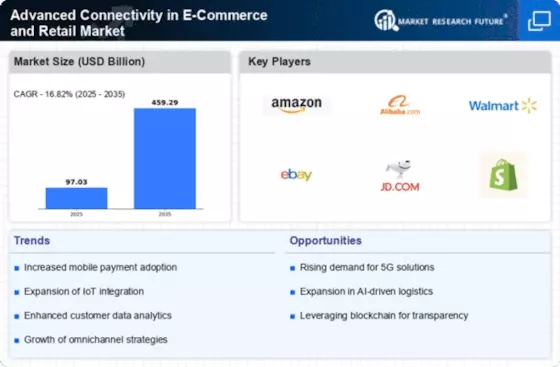
Advanced Connectivity in E-Commerce and Retail Market Infographic
×
Advanced Connectivity in E-Commerce and Retail Market Infographic Full View
Purchase Options

Market Share

Advanced Connectivity in E-Commerce and Retail Market Share Analysis

The e-commerce and retail market is experiencing significant advancements in advanced connectivity technologies, creating new market trends in the industry. Advanced connectivity refers to technologies that enable fast and reliable internet connections, such as 5G, Internet of Things (IoT), and edge computing. These ideas introduce a brand new way of conducting business in e-commerce and retail industry and customer engagement.

A vital trait of the modern connectivity in the E-commerce & Retail market is the use of the 5G technology. The 5G networks offer the embodiment of extremely high speeds, low latency, and great capacity compared to their predecessors. Hence, e-commerce and retail businesses could use the technology to implement a flawless and immersive experience to customers ,like high-speed video streaming, virtual reality (VR) shopping experiences, and real time personalized recommendations. The main reason is that retailers are seeking to give their customers more competitive online shopping processes, transact more, and provide the infrastructure that fresh technologies like IoT, virtual presence, and smart objects require for high-speed and low-latency connections.

The growing interest in off-premise connectivity solutions is no small contributor to this development. It is directly linked to the application of omnichannel strategies. Omnichannel commerce is the summation chance of online and offline stores into one, giving customers unified and individualized experience in between different contact points. Over the advanced networking technologies retailers can be synchronized data and operation over channels, customer got real-time inventory view, personalized offer, and flexible fulfillment option, such as buy online pick up in-store (BOPIS) Creates.

Moreover, there is a trend towards utilizing advanced connectivity technologies for supply chain optimization and logistics management. Technologies such as IoT, real-time tracking, and analytics enable businesses to track and monitor goods throughout the supply chain, optimize inventory, and improve delivery efficiency. In addition to that, advanced connectivity also enables the optimisation of last mile delivery, for example, route optimisation and real-time tracking, which contributes to the improvement of customer experience. These trends have accelerated because it is essential for companies to be cost-efficient, be able to do things well and give customers an instant and trustworthy delivery service.

Moreover, amongst the trends for Advanced Connectivity in E-Commerce & Retail, the is an obvious rise in the level of AI and ML technology integration. AI and ML models have the ability to process a very large amount of data gathered by the improved connectivity technologies and exploiting this data businesses can identify their customers' patterns, can set prices efficiently and can also handle inventory very well, making recommendations which are custom made to each one of the customers. Not only the automated technologies can be the chatbots and virtual assistants but they additionally can be the personalized customer support and customer experience. This move is propelled by promises of data-centric impact, process automaticity, and customer engagement customization across the spectrum.

Furthermore, data security and privacy have been garnering a great deal of attentions in the Advanced Connectivity in E-Commerce and Retail market. With the growth of companies being in a possession of customer’s data and processing of it, it is becoming critical to provide security and privacy of the data. The mainstream adoption of advanced interaction technologies is a prerequisite for the security of the customer’s sensitive data, which is to be accomplished through robust security measures, encryption techniques, and compliance with data protection rules. This trend is driven by the need to build trust with customers, mitigate the risk of data breaches, and comply with increasingly stringent data privacy regulations.


Author
Aarti Dhapte
Team Lead - Research

She holds an experience of about 6+ years in Market Research and Business Consulting, working under the spectrum of Information Communication Technology, Telecommunications and Semiconductor domains. Aarti conceptualizes and implements a scalable business strategy and provides strategic leadership to the clients. Her expertise lies in market estimation, competitive intelligence, pipeline analysis, customer assessment, etc.

Leave a Comment

FAQs

What is the projected market valuation for the US advanced connectivity in e-commerce retail market by 2035?

<p>The projected market valuation for the US advanced connectivity in e-commerce retail market is expected to reach 62.91 USD Billion by 2035.</p>

What was the market valuation in 2024 for the US advanced connectivity in e-commerce retail market?

<p>The overall market valuation for the US advanced connectivity in e-commerce retail market was 13.29 USD Billion in 2024.</p>

What is the expected CAGR for the US advanced connectivity in e-commerce retail market during the forecast period 2025 - 2035?

<p>The expected CAGR for the US advanced connectivity in e-commerce retail market during the forecast period 2025 - 2035 is 15.18%.</p>

Which companies are considered key players in the US advanced connectivity in e-commerce retail market?

<p>Key players in the market include Amazon, Walmart, eBay, Target, Shopify, Best Buy, Costco, Wayfair, and Zalando.</p>

Market Summary

As per analysis, the US advanced connectivity in e-commerce retail market is projected to grow from USD 13.29 Billion in 2024 to USD 62.91 Billion by 2035, exhibiting a compound annual growth rate (CAGR) of 15.18% during the forecast period (2025 - 2035).

Key Market Trends & Highlights

The US advanced connectivity in e-commerce retail market is poised for substantial growth driven by technological advancements and evolving consumer preferences.

  • The 5G segment remains the largest contributor to the market, enhancing connectivity and customer experience.
  • Mobile commerce is the fastest-growing segment, reflecting a shift towards more convenient shopping methods.
  • Real-time data utilization is becoming increasingly critical for businesses to tailor their offerings and improve customer engagement.
  • The expansion of 5G networks and the rise of omnichannel retailing are key drivers propelling market growth.

Market Size & Forecast

2024 Market Size 13.29 (USD Billion)
2035 Market Size 62.91 (USD Billion)
CAGR (2025 - 2035) 15.18%

Major Players

<p>Amazon (US), Walmart (US), eBay (US), Target (US), Shopify (CA), Best Buy (US), Costco (US), Wayfair (US), Zalando (DE)</p>

Market Trends

The US advanced connectivity in e-commerce retail market is currently experiencing a transformative phase, driven by the rapid evolution of technology and consumer expectations. Enhanced internet infrastructure, including the expansion of high-speed broadband and the rollout of 5G networks, appears to be reshaping the landscape of online shopping. Retailers are increasingly leveraging these advancements to provide seamless shopping experiences, integrating augmented reality and artificial intelligence to personalize customer interactions. This shift not only enhances user engagement but also fosters loyalty, as consumers are drawn to platforms that offer convenience and tailored services. Moreover, the integration of advanced connectivity solutions is likely to facilitate more efficient supply chain management and logistics operations. Retailers are adopting real-time data analytics to optimize inventory levels and streamline delivery processes. This trend suggests a growing emphasis on operational efficiency, which may lead to reduced costs and improved customer satisfaction. As the market continues to evolve, it seems that businesses that prioritize advanced connectivity will be better positioned to thrive in an increasingly competitive environment, adapting to the dynamic needs of consumers and the broader retail landscape.

Enhanced Customer Experience

The focus on advanced connectivity is leading to improved customer experiences in the retail market. Retailers are utilizing technologies such as augmented reality and virtual reality to create immersive shopping environments. This trend allows consumers to visualize products in their own spaces, thereby increasing confidence in purchasing decisions.

Real-Time Data Utilization

The adoption of real-time data analytics is becoming prevalent among retailers in the retail market. By harnessing data insights, businesses can make informed decisions regarding inventory management and customer preferences. This capability enables retailers to respond swiftly to market demands, enhancing operational efficiency.

Integration of AI and Automation

The integration of artificial intelligence and automation technologies is reshaping the operational framework of the retail market. Retailers are employing AI-driven chatbots and automated systems to streamline customer service and order processing. This trend not only reduces operational costs but also improves response times, contributing to a more efficient shopping experience.

Advanced Connectivity in E-Commerce and Retail Market Market Drivers

Growth of IoT Devices

The increasing adoption of Internet of Things (IoT) devices is transforming the US advanced connectivity in e commerce retail market. IoT technology enables retailers to gather real-time data on consumer behavior, inventory levels, and supply chain logistics. This data can be utilized to optimize operations and enhance customer experiences. As of 2025, it is estimated that there will be over 30 billion connected devices in the US, providing retailers with unprecedented insights into consumer preferences. Retailers that effectively integrate IoT solutions can streamline their operations, reduce costs, and offer personalized shopping experiences, thereby driving sales and customer loyalty in the competitive e commerce landscape.

Expansion of 5G Networks

The proliferation of 5G networks across the United States is a pivotal driver for the US advanced connectivity in e commerce retail market. With 5G technology, retailers can offer faster and more reliable internet connections, enhancing the online shopping experience. This technology is expected to support a surge in mobile commerce, as consumers increasingly rely on their smartphones for shopping. According to the Federal Communications Commission, 5G deployment is projected to cover over 90% of the US population by 2026, which could lead to a significant increase in online sales. Retailers that leverage 5G capabilities may experience improved customer engagement and higher conversion rates, as seamless connectivity allows for richer content and interactive shopping experiences.

Rise of Omnichannel Retailing

The shift towards omnichannel retailing is a significant driver in the US advanced connectivity in e commerce retail market. Consumers now expect a seamless shopping experience across various platforms, including online, mobile, and in-store. Retailers that adopt an omnichannel approach can enhance customer satisfaction and retention. According to the National Retail Federation, retailers with strong omnichannel strategies retain an average of 89% of their customers, compared to 33% for those with weak strategies. This trend encourages retailers to invest in advanced connectivity solutions that integrate their online and offline channels, ensuring a cohesive shopping experience that meets the evolving demands of consumers.

Increased Focus on Cybersecurity

As the US advanced connectivity in e commerce retail market expands, the emphasis on cybersecurity becomes increasingly critical. Retailers are investing in advanced security measures to protect customer data and maintain trust. The Federal Trade Commission has reported a rise in data breaches, prompting retailers to adopt robust cybersecurity protocols. This focus on security not only safeguards sensitive information but also enhances the overall shopping experience, as consumers feel more secure when making online purchases. Retailers that prioritize cybersecurity can differentiate themselves in a crowded market, potentially leading to increased customer loyalty and higher sales.

Advancements in Payment Technologies

The evolution of payment technologies is a key driver in the US advanced connectivity in e commerce retail market. Innovations such as mobile wallets, contactless payments, and cryptocurrency transactions are reshaping how consumers make purchases. According to a report by the Electronic Payments Association, digital payment transactions in the US are expected to exceed 1 trillion by 2026. Retailers that adopt these advanced payment solutions can enhance the checkout experience, reduce cart abandonment rates, and cater to the preferences of tech-savvy consumers. This shift towards more convenient payment options is likely to drive growth in the e commerce sector, as consumers increasingly seek frictionless shopping experiences.

Market Segment Insights

By Connectivity Technology: 5G (Largest) vs. Wi-Fi 6 (Fastest-Growing)

<p>In the US advanced connectivity in e-commerce retail market, 5G technology is currently the largest segment, driven by its high-speed capabilities and low latency that enhance user experience and operational efficiency. Wi-Fi 6 is gaining remarkable traction, representing the fastest-growing segment as retailers adopt this technology to improve in-store connectivity and provide seamless online service for customers. Together, they are transforming the connectivity landscape for e-commerce retailers across the nation.</p>

<p>Connectivity: 5G (Dominant) vs. Wi-Fi 6 (Emerging)</p>

<p>5G technology is dominating the US e-commerce retail connectivity space due to its superior speed and reliability, enabling retailers to implement innovative solutions like augmented reality and real-time inventory tracking. It allows for robust connections that meet the growing demands of consumers for instantaneous services. On the other hand, Wi-Fi 6 is emerging quickly as a vital technology, offering enhanced network efficiency and capacity, which is essential for stores with high customer traffic. As more retailers enhance their Wi-Fi infrastructure, Wi-Fi 6 will play a critical role in improving customer engagement through enhanced connectivity.</p>

By E-commerce Platform Type: B2C (Largest) vs. Mobile Commerce (Fastest-Growing)

<p>In the US advanced connectivity in e-commerce retail market, the B2C segment holds the largest market share, as it directly caters to consumers seeking products and services through online platforms. This segment has established itself as a key player in the market, with brands increasingly investing in user-friendly interfaces and enhanced shopping experiences. Meanwhile, the B2B segment follows closely, serving businesses that require bulk transactions and supply chain integration. C2C, while smaller, plays a significant role through platforms facilitating peer-to-peer transactions, enriching the e-commerce landscape. As the market evolves, mobile commerce is emerging as the fastest-growing segment, driven by increased smartphone penetration and changing consumer behavior towards convenience and instant access to products. Social commerce is also gaining traction, leveraging social media platforms to facilitate shopping experiences. The synergistic relationship between technology adoption and consumer preferences accelerates growth for these segments, indicating a shift in how connectivity influences e-commerce practices.</p>

<p>B2C (Dominant) vs. C2C (Emerging)</p>

<p>The B2C segment is dominant within the US advanced connectivity in e-commerce retail market, characterized by direct sales from businesses to consumers. This segment benefits from robust online marketing strategies, personalized shopping experiences, and a diverse range of products readily available to the consumer. The B2C platforms prioritize customer engagement and satisfaction, effectively steering their operations to meet evolving consumer expectations. Conversely, the C2C segment, while emerging, facilitates transactions directly between consumers, often through online marketplaces and auction sites. This segment thrives on the growing trend of peer-to-peer sales and resale of goods, fostering community interaction and sustainability. As this segment matures, it is expected to leverage advanced connectivity to enhance user experiences and operational efficiencies, thereby capturing a more significant share of the market.</p>

By Consumer Demographics: Millennials (Largest) vs. Generation Z (Fastest-Growing)

<p>In the US advanced connectivity in e-commerce retail market, Millennials account for a substantial market share, as they are the most significant consumer group driving online sales and influencing retail trends. This demographic is highly tech-savvy, with a preference for seamless shopping experiences, making them a dominant force in e-commerce. In contrast, Generation Z is emerging rapidly due to their increasing purchasing power and propensity for digital shopping. This group’s behavior is shaped by their experiences growing up in a fully digital environment, leading to unique shopping preferences that challenge traditional retail models.</p>

<p>Millennials: (Dominant) vs. Generation Z (Emerging)</p>

<p>Millennials represent the dominant consumer demographic in the US advanced connectivity in e-commerce retail market, characterized by their familiarity with technology and trendsetting behaviors. They prioritize convenience and personalized shopping experiences, often utilizing mobile devices for their purchases. Generation Z, while currently emerging, is the fastest-growing segment in the e-commerce landscape, distinguished by their authentic brand engagement and social media influence. As digital natives, they possess distinct preferences for interactivity and community-driven shopping experiences, which are reshaping the retail market. This demographic highlights the need for brands to innovate and adapt to an increasingly mobile-first shopping paradigm.</p>

By Payment Method: Credit Card (Largest) vs. Digital Wallet (Fastest-Growing)

<p>In the US advanced connectivity in e-commerce retail market, the payment method segment showcases a diverse distribution. Credit cards remain the largest segment, offering consumers convenience and security with their established infrastructure. Digital wallets are rapidly gaining momentum, especially among younger demographics who favor seamless and frictionless transactions. Other payment methods like bank transfers and Buy Now Pay Later are also part of this segment, but they hold relatively smaller shares in comparison to credit cards and digital wallets, indicating a shifting consumer preference. As online shopping continues to expand, the growth of various payment methods is significantly influenced by technological advancements and changing consumer behaviors. Digital wallets are expected to be the fastest-growing segment, driven by the integration of mobile payment technologies and the increasing adoption of contactless transactions. Additionally, the rising popularity of Buy Now Pay Later services affords consumers the flexibility to make purchases without immediate payment, further enhancing consumer spending and driving market growth. Overall, as the e-commerce landscape evolves, these payment methods will redefine the shopping experience for consumers.</p>

<p>Credit Card (Dominant) vs. Buy Now Pay Later (Emerging)</p>

<p>In the US advanced connectivity in e-commerce retail market, credit cards remain the dominant payment method, favored for their widespread acceptance and built-in security features. They offer consumers various benefits, including reward points and fraud protection, which are appealing to a wide range of customers. On the other hand, Buy Now Pay Later (BNPL) is emerging as a popular alternative, particularly among younger shoppers looking for flexibility in payments. BNPL solutions allow consumers to split their purchases into manageable installments without incurring interest if paid on time. This method caters to the increasing demand for convenience and accessibility, providing a more inclusive shopping experience. Both payment methods underline distinct consumer preferences, with credit cards still leading the market while BNPL solutions rapidly gain traction.</p>

By Logistics and Delivery Method: Same Day Delivery (Largest) vs. Drone Delivery (Fastest-Growing)

<p>In the US advanced connectivity in e-commerce retail market, logistics and delivery methods are critical to consumer satisfaction and operational efficiency. Same Day Delivery has emerged as the largest segment due to rising consumer demand for quick delivery solutions. Following closely are Next Day Delivery and Standard Shipping, which still hold significant portions of the market share. Click and Collect has also gained traction, allowing consumers to purchase items online and pick them up in-store, further enhancing convenience. Furthermore, the pandemic has accelerated the adoption of various delivery methods, with Same Day Delivery leading the charge. Drone Delivery is projected to become the fastest-growing segment as technology matures, allowing for efficient last-mile logistics. Other factors fueling growth include advancements in AI and automation, enabling smarter and faster delivery networks, thus reshaping consumer expectations in the e-commerce landscape.</p>

<p>Same Day Delivery (Dominant) vs. Drone Delivery (Emerging)</p>

<p>Same Day Delivery stands out as the dominant logistics method in the US advanced connectivity in e-commerce market, catering particularly to consumers who prioritize speed and convenience. Retailers offering this service are seen as more competitive, tapping into a significant consumer base seeking immediate gratification. In contrast, Drone Delivery has emerged as an exciting new alternative, promising to revolutionize the last-mile delivery process. With ongoing advancements in drone technology, this method holds the potential to streamline delivery operations significantly. While still in its infancy, the increasing investment in drone logistics indicates a strong belief in its future, as it addresses urban congestion and improves delivery times, appealing to tech-savvy consumers who are eager for innovative solutions.</p>

Get more detailed insights about Advanced Connectivity in E-Commerce & Retail Market Research Report – Forecast till 2035

Regional Insights

North America : Digital Commerce Leader

North America is the largest market for advanced connectivity in e-commerce and retail, holding approximately 40% of the global market share. Key growth drivers include high internet penetration, increasing smartphone usage, and a robust logistics infrastructure. Regulatory support for digital transactions and data privacy is also a significant catalyst for growth, enhancing consumer trust and engagement. The United States dominates this region, with major players like Amazon, Walmart, and eBay leading the charge. The competitive landscape is characterized by rapid technological advancements and a focus on customer experience. Canada also plays a vital role, with Shopify emerging as a key player in the e-commerce platform space, further solidifying North America's position as a leader in advanced connectivity.

Europe : Innovation and Regulation Hub

Europe is witnessing a significant transformation in the advanced connectivity e-commerce market, holding around 30% of the global share. Key drivers include stringent regulations on data protection, such as GDPR, which enhance consumer confidence. The rise of omnichannel retailing and increasing mobile commerce are also pivotal trends, pushing the market forward in various European nations. Germany and the United Kingdom are the leading countries in this region, with companies like Zalando and various local retailers leveraging advanced connectivity to enhance customer experiences. The competitive landscape is marked by a mix of established players and innovative startups, all striving to meet the evolving demands of consumers in a highly regulated environment.

Asia-Pacific : Emerging Market Powerhouse

Asia-Pacific is rapidly emerging as a powerhouse in the advanced connectivity e-commerce market, accounting for approximately 25% of the global market share. The region's growth is fueled by a burgeoning middle class, increasing internet accessibility, and a strong push towards digital payments. Countries like China and India are at the forefront, with supportive government policies promoting e-commerce and digital infrastructure development. China, led by giants like Alibaba and JD.com, is the largest market in this region, while India is witnessing a surge in e-commerce adoption, driven by platforms like Flipkart and Paytm. The competitive landscape is vibrant, with numerous players vying for market share, and innovations in logistics and payment solutions are enhancing the overall consumer experience.

Middle East and Africa : Emerging Digital Frontier

The Middle East and Africa (MEA) region is an emerging frontier in the advanced connectivity e-commerce market, holding about 5% of the global market share. Key growth drivers include increasing smartphone penetration, a young population, and rising internet connectivity. Government initiatives aimed at boosting digital economies are also playing a crucial role in shaping the market landscape. Countries like the UAE and South Africa are leading the charge, with local players and international brands expanding their presence. The competitive landscape is characterized by a mix of traditional retailers adapting to digital platforms and new entrants focusing on innovative solutions. The region's unique challenges, such as logistics and payment systems, are being addressed through technological advancements and partnerships.

Key Players and Competitive Insights

The US advanced connectivity in e-commerce retail market is characterized by a dynamic competitive landscape, driven by rapid technological advancements and evolving consumer preferences. Major players such as Amazon (US), Walmart (US), and Shopify (CA) are at the forefront, each adopting distinct strategies to enhance their market positioning. Amazon (US) continues to innovate through its extensive logistics network and advanced AI capabilities, while Walmart (US) focuses on integrating its physical stores with digital platforms to create a seamless shopping experience. Shopify (CA) emphasizes empowering small to medium-sized businesses with robust e commerce tools, thereby fostering a diverse marketplace. Collectively, these strategies contribute to a competitive environment that is increasingly reliant on technological integration and customer-centric approaches.

Key business tactics within this market include localizing manufacturing and optimizing supply chains to enhance efficiency and responsiveness. The competitive structure appears moderately fragmented, with a mix of large incumbents and emerging players. This fragmentation allows for varied consumer choices, while the influence of key players like Amazon (US) and Walmart (US) shapes market dynamics significantly, often setting benchmarks for service quality and technological adoption.

In December 2025, Amazon (US) announced the launch of its new drone delivery service, aimed at reducing delivery times to under 30 minutes for select urban areas. This strategic move is likely to enhance customer satisfaction and solidify Amazon's position as a leader in rapid delivery solutions. The integration of drone technology not only reflects Amazon's commitment to innovation but also underscores the growing importance of logistics in the e commerce sector.

In November 2025, Walmart (US) unveiled its partnership with a leading AI firm to enhance its inventory management systems. This collaboration is expected to optimize stock levels and reduce waste, thereby improving operational efficiency. By leveraging AI, Walmart (US) aims to create a more responsive supply chain, which is crucial in meeting the demands of an increasingly digital consumer base.

In October 2025, Shopify (CA) introduced a new feature that allows merchants to integrate augmented reality (AR) into their online stores. This development is significant as it enhances the shopping experience by allowing customers to visualize products in their own environments before making a purchase. Such innovations are indicative of Shopify's strategy to differentiate itself in a crowded market, appealing to tech-savvy consumers who seek immersive shopping experiences.

As of January 2026, current competitive trends in the market include a pronounced shift towards digitalization, sustainability, and AI integration. Strategic alliances are increasingly shaping the landscape, enabling companies to pool resources and expertise to drive innovation. Looking ahead, competitive differentiation is likely to evolve from traditional price-based competition to a focus on technological innovation, supply chain reliability, and enhanced customer experiences. This shift suggests that companies will need to invest in cutting-edge technologies and sustainable practices to maintain their competitive edge.

Key Companies in the Advanced Connectivity in E-Commerce and Retail Market include

Industry Developments

June 2023, For hybrid workforces, Cisco and AT&T have unveiled new technologies to improve connection and transform the calling environment. The modern worker is not bound to a particular space, technology, or geography, whether they are working on the ground level, the top floor, in a branch office, at home, or during their commute. With the new products, which include Cisco's Webex Calling and SD-WAN solutions in addition to AT&T mobile network, companies of any size can provide employees with a straightforward, secure, and consistent experience to thrive in any environment.

February 2023, Qualcomm Technologies, Inc. announced that it is working with SES-imagotag to create technology that would enable new electronic shelf labels (ESLs) based on the Bluetooth Special Interest Group's (SIG) recently established ESL wireless standards. ESL systems have utilised exclusive wireless communication protocols up to now. The Bluetooth SIG working group was led by Qualcomm Technologies and SES-imagotag with the aim of developing scalable, ultra-low power, highly secure, standard-based ESLs to enable retailers to increase operational effectiveness, empower staff, and improve customer experiences.

Future Outlook

Advanced Connectivity in E-Commerce and Retail Market Future Outlook

The US advanced connectivity in e-commerce retail market is projected to grow at a 15.18% CAGR from 2024 to 2035, driven by technological advancements and consumer demand for seamless shopping experiences.

New opportunities lie in:

  • Integration of AI-driven customer service chatbots
  • Expansion of 5G networks for enhanced mobile shopping
  • Development of personalized shopping experiences using big data analytics

By 2035, the market is expected to be robust, characterized by innovative solutions and increased consumer engagement.

Market Segmentation

Advanced Connectivity in E-Commerce and Retail Market Payment Method Outlook

  • Credit Card
  • Digital Wallet
  • Bank Transfer
  • Buy Now Pay Later
  • Cryptocurrency

Advanced Connectivity in E-Commerce and Retail Market Consumer Demographics Outlook

  • Millennials
  • Generation X
  • Baby Boomers
  • Generation Z
  • Affluent Consumers

Advanced Connectivity in E-Commerce and Retail Market Connectivity Technology Outlook

  • 5G
  • Wi-Fi 6
  • Bluetooth
  • Fiber Optic
  • Satellite

Advanced Connectivity in E-Commerce and Retail Market E-commerce Platform Type Outlook

  • B2C
  • B2B
  • C2C
  • Mobile Commerce
  • Social Commerce

Advanced Connectivity in E-Commerce and Retail Market Logistics and Delivery Method Outlook

  • Same Day Delivery
  • Next Day Delivery
  • Standard Shipping
  • Click and Collect
  • Drone Delivery

Report Scope

MARKET SIZE 202413.29(USD Billion)
MARKET SIZE 202515.52(USD Billion)
MARKET SIZE 203562.91(USD Billion)
COMPOUND ANNUAL GROWTH RATE (CAGR)15.18% (2024 - 2035)
REPORT COVERAGERevenue Forecast, Competitive Landscape, Growth Factors, and Trends
BASE YEAR2024
Market Forecast Period2025 - 2035
Historical Data2019 - 2024
Market Forecast UnitsUSD Billion
Key Companies ProfiledAmazon (US), Walmart (US), eBay (US), Target (US), Shopify (CA), Best Buy (US), Costco (US), Wayfair (US), Zalando (DE)
Segments CoveredConnectivity Technology, E-commerce Platform Type, Consumer Demographics, Payment Method, Logistics and Delivery Method
Key Market OpportunitiesIntegration of 5G technology enhances real-time data analytics in the US advanced connectivity in e commerce retail market.
Key Market DynamicsRapid technological advancements enhance connectivity, driving competition and reshaping consumer engagement in the US e-commerce retail market.
Countries CoveredUS

FAQs

What is the projected market valuation for the US advanced connectivity in e-commerce retail market by 2035?

<p>The projected market valuation for the US advanced connectivity in e-commerce retail market is expected to reach 62.91 USD Billion by 2035.</p>

What was the market valuation in 2024 for the US advanced connectivity in e-commerce retail market?

<p>The overall market valuation for the US advanced connectivity in e-commerce retail market was 13.29 USD Billion in 2024.</p>

What is the expected CAGR for the US advanced connectivity in e-commerce retail market during the forecast period 2025 - 2035?

<p>The expected CAGR for the US advanced connectivity in e-commerce retail market during the forecast period 2025 - 2035 is 15.18%.</p>

Which companies are considered key players in the US advanced connectivity in e-commerce retail market?

<p>Key players in the market include Amazon, Walmart, eBay, Target, Shopify, Best Buy, Costco, Wayfair, and Zalando.</p>

  1. EXECUTIVE SUMMARY
    1. Market Attractiveness Analysis
      1. Global Advanced Connectivity in E-Commerce & Retail Market, by Type
      2. Global Advanced Connectivity in E-Commerce & Retail Market, by Technology
      3. Global Advanced Connectivity in E-Commerce & Retail Market, by Application
      4. Global Advanced Connectivity in E-Commerce & Retail Market, by Region
  2. MARKET INTRODUCTION
    1. Definition
    2. Scope of the Study
    3. Market Structure
    4. Key Buying Criteria
    5. Macro Factor Indicator
    6. Analysis
  3. RESEARCH METHODOLOGY
    1. Research Process
    2. Primary
    3. Research
    4. Secondary Research
    5. Market Size Estimation
    6. Forecast Model
    7. List of Assumptions
  4. MARKET DYNAMICS
    1. Introduction
    2. Drivers
      1. Ecommerce is growing rapidly, and this is driving the
      2. Increasing use of IoT devices in a
      3. Driver impact analysis
    3. demand for advanced connectivity
    4. variety of applications in e-commerce and retail
    5. Restraints
      1. Advanced connectivity can be expensive to implement
      2. Advanced connectivity can be vulnerable to security threats.
      3. Advanced connectivity can be complex to implement and manage
    6. and maintain.
    7. Restraint impact analysis
    8. Opportunities
      1. Improved customer
      2. Advanced connectivity can be used to improve the efficiency
    9. experience
    10. of operations
    11. Covid-19 Impact Analysis
      1. Impact on surge in
      2. Impact on Advanced Connectivity in E-Commerce & Retail
      3. YOY growth 2020-202
    12. economies
  5. COVID-19 IMPACT ON SUPPLY CHAIN MARKET FACTOR
    1. ANALYSIS
    2. Value Chain Analysis/Supply Chain Analysis
    3. Porter’s
      1. Bargaining Power of Suppliers
      2. Bargaining
      3. Threat of New Entrants
      4. Threat of Substitutes
      5. Intensity of Rivalry
    4. Five Forces Model
    5. Power of Buyers
  6. GLOBAL ADVANCED CONNECTIVITY IN E-COMMERCE
  7. & RETAIL MARKET, BY TYPE
    1. Introduction
    2. Cellular
    3. Low-Earth orbit (LEO) satellites
    4. Wireline/Fixed
    5. Shortrange
    6. LPWAN
    7. Wireless Low-Power Networks
    8. Optical fiber
    9. Others
  8. GLOBAL ADVANCED CONNECTIVITY IN E-COMMERCE & RETAIL MARKET, BY
    1. TECHNOLOGY
    2. Introduction
    3. Edge computing
    4. Internet of
    5. Things (IoT)
    6. Artificial intelligence (AI)
    7. Machine learning (ML)
    8. Others
  9. GLOBAL ADVANCED CONNECTIVITY IN E-COMMERCE & RETAIL MARKET,
    1. BY APPLICATION
    2. Introduction
    3. Real-time inventory tracking
    4. Order fulfillment
    5. Personalized recommendations
    6. Fraud
    7. detection
    8. Supply Chain Management
    9. E-Commerce Data Integration
    10. Others
  10. GLOBAL ADVANCED CONNECTIVITY IN E-COMMERCE & RETAIL MARKET
    1. SIZE ESTIMATION & FORECAST, BY REGION
    2. Introduction
    3. North
      1. Market Estimates & Forecast, by Country, 2018-2032
    4. America
  11. Market Estimates & Forecast, by Type, 2018-2032
    1. & Forecast, by Technology, 2018-2032
    2. by Application, 2018-2032
    3. by Type, 2018-2032
  12. Market Estimates
  13. Market Estimates & Forecast,
  14. US
  15. Market Estimates & Forecast,
  16. Market Estimates & Forecast, by Technology,
  17. Market Estimates & Forecast, by Application, 2018-2032
  18. Canada
  19. Market Estimates & Forecast, by Type, 2018-2032
  20. Market Estimates & Forecast, by Technology, 2018-2032
  21. Market Estimates & Forecast, by Application, 2018-2032
    1. Estimates & Forecast, by Technology, 2018-2032
    2. & Forecast, by Application, 2018-2032
    3. & Forecast, by Country, 2018-2032
    4. by Type, 2018-2032
    5. UK
  22. Mexico
  23. Market Estimates & Forecast, by Type, 2018-2032
  24. Market
  25. Market Estimates
    1. Europe
      1. Market Estimates
      2. Market Estimates & Forecast,
      3. Market Estimates & Forecast, by Technology, 2018-2032
      4. Market Estimates & Forecast, by Application, 2018-2032
  26. Market Estimates & Forecast, by Technology, 2018-2032
    1. & Forecast, by Application, 2018-2032
    2. Estimates & Forecast, by Type, 2018-2032
    3. Forecast, by Technology, 2018-2032
    4. by Application, 2018-2032
    5. Forecast, by Type, 2018-2032
  27. Market Estimates
  28. Germany
  29. Market
  30. Market Estimates &
  31. Market Estimates & Forecast,
  32. France
  33. Market Estimates &
  34. Market Estimates & Forecast, by Technology,
  35. Market Estimates & Forecast, by Application, 2018-2032
  36. Italy
  37. Market Estimates & Forecast, by Type, 2018-2032
  38. Market Estimates & Forecast, by Technology, 2018-2032
  39. Market Estimates & Forecast, by Application, 2018-2032
    1. Estimates & Forecast, by Technology, 2018-2032
    2. & Forecast, by Application, 2018-2032
  40. Spain
  41. Market Estimates & Forecast, by Type, 2018-2032
  42. Market
  43. Market Estimates
  44. Rest of Europe
  45. Market Estimates & Forecast, by Type, 2018-2032
    1. & Forecast, by Technology, 2018-2032
    2. by Application, 2018-2032
    3. Forecast, by Country, 2018-2032
    4. Type, 2018-2032
    5. China
  46. Market Estimates
  47. Market Estimates & Forecast,
    1. Asia-Pacific
      1. Market Estimates &
      2. Market Estimates & Forecast, by
      3. Market Estimates & Forecast, by Technology, 2018-2032
      4. Market Estimates & Forecast, by Application, 2018-2032
  48. Market Estimates & Forecast, by Technology, 2018-2032
    1. & Forecast, by Application, 2018-2032
    2. Estimates & Forecast, by Type, 2018-2032
    3. Forecast, by Technology, 2018-2032
    4. by Application, 2018-2032
    5. Forecast, by Type, 2018-2032
  49. Market Estimates
  50. Japan
  51. Market
  52. Market Estimates &
  53. Market Estimates & Forecast,
  54. India
  55. Market Estimates &
  56. Market Estimates & Forecast, by Technology,
  57. Market Estimates & Forecast, by Application, 2018-2032
  58. South Korea
  59. Market Estimates & Forecast, by Type, 2018-2032
  60. Market Estimates & Forecast, by Technology, 2018-2032
  61. Market Estimates & Forecast, by Application, 2018-2032
    1. Estimates & Forecast, by Technology, 2018-2032
    2. & Forecast, by Application, 2018-2032
    3. Estimates & Forecast, by Type, 2018-2032
    4. Forecast, by Technology, 2018-2032
    5. by Application, 2018-2032
    6. & Forecast, by Type, 2018-2032
    7. by Technology, 2018-2032
    8. South Africa
  62. Rest of Asia-Pacific
  63. Market Estimates & Forecast, by Type, 2018-2032
  64. Market
  65. Market Estimates
    1. Middle East & Africa
      1. Market Estimates & Forecast, by Country, 2018-2032
      2. Market
      3. Market Estimates &
      4. Market Estimates & Forecast,
      5. Saudi Arabia
      6. UAE
  66. Market Estimates & Forecast, by Application, 2018-2032
    1. Middle East & Africa
    2. South America
    3. Estimates & Forecast, by Technology, 2018-2032
    4. & Forecast, by Application, 2018-2032
    5. Estimates & Forecast, by Type, 2018-2032
    6. Forecast, by Technology, 2018-2032
    7. by Application, 2018-2032
    8. Forecast, by Type, 2018-2032
  67. Rest of the
  68. Market Estimates & Forecast, by Type,
  69. Market Estimates & Forecast, by Technology, 2018-2032
  70. Market Estimates & Forecast, by Application, 2018-2032
  71. Market Estimates & Forecast, by Country, 2018-2032
  72. Market Estimates & Forecast, by Type, 2018-2032
  73. Market
  74. Market Estimates
  75. Brazil
  76. Market
  77. Market Estimates &
  78. Market Estimates & Forecast,
  79. Argentina
  80. Market Estimates &
  81. Market Estimates & Forecast, by Technology,
  82. Market Estimates & Forecast, by Application, 2018-2032
  83. Chile
  84. Market Estimates & Forecast, by Type, 2018-2032
  85. Market Estimates & Forecast, by Technology, 2018-2032
  86. Market Estimates & Forecast, by Application, 2018-2032
    1. America
  87. Rest of South
  88. Market Estimates & Forecast, by Type, 2018-2032
  89. Market Estimates & Forecast, by Technology, 2018-2032
    1. & Forecast, by Application, 2018-2032
  90. Market Estimates
  91. COMPETITIVE LANDSCAPE
    1. Introduction
    2. Key Developments & Growth Strategies
    3. Competitor
    4. Benchmarking
    5. Vendor Share Analysis, 2022(% Share)
  92. COMPANY PROFILES
    1. AT&T
      1. Company Overview
      2. Financial Overview
      3. Solution/Services Offered
      4. Key Developments
      5. SWOT
      6. Key Strategies
    2. Analysis
    3. Verizon
    4. Qualcomm
    5. Ericsson
    6. Huawei
    7. Cisco Systems
    8. IBM
    9. Oracle
    10. SAP
    11. Microsoft
    12. Samsung
    13. Dell
    14. HPE
    15. Intel
    16. Juniper Networks
    17. Akamai Technologies
    18. NTT
    19. Vodafone
    20. Telstra
    21. Singtel
  93. LIST OF TABLES
  94. MARKET SYNOPSIS
  95. GLOBAL ADVANCED CONNECTIVITY
  96. IN E-COMMERCE & RETAIL MARKET, BY TYPE, 2018–2032 (USD BILLION)
    1. TABLE
  97. GLOBAL ADVANCED CONNECTIVITY IN E-COMMERCE & RETAIL MARKET, BY TECHNOLOGY,
  98. GLOBAL ADVANCED CONNECTIVITY IN E-COMMERCE
  99. & RETAIL MARKET, BY APPLICATION, 2018–2032 (USD BILLION)
    1. TABLE 5
  100. GLOBAL ADVANCED CONNECTIVITY IN E-COMMERCE & RETAIL MARKET, BY REGION, 2018–2032
    1. (USD BILLION)
  101. NORTH AMERICA ADVANCED CONNECTIVITY IN E-COMMERCE &
  102. RETAIL MARKET, BY COUNTRY, 2018–2032 (USD BILLION)
  103. NORTH AMERICA
  104. ADVANCED CONNECTIVITY IN E-COMMERCE & RETAIL MARKET, BY TYPE, 2018–2032
    1. (USD BILLION)
  105. NORTH AMERICA ADVANCED CONNECTIVITY IN E-COMMERCE &
  106. RETAIL MARKET, BY TECHNOLOGY, 2018–2032 (USD BILLION)
  107. NORTH AMERICA
  108. ADVANCED CONNECTIVITY IN E-COMMERCE & RETAIL MARKET, BY APPLICATION, 2018–2032
    1. (USD BILLION)
  109. US ADVANCED CONNECTIVITY IN E-COMMERCE & RETAIL
  110. MARKET, BY TYPE, 2018–2032 (USD BILLION)
  111. US ADVANCED CONNECTIVITY
  112. IN E-COMMERCE & RETAIL MARKET, BY TECHNOLOGY, 2018–2032 (USD BILLION)
  113. US ADVANCED CONNECTIVITY IN E-COMMERCE & RETAIL MARKET, BY APPLICATION,
  114. CANADA ADVANCED CONNECTIVITY IN E-COMMERCE
  115. & RETAIL MARKET, BY TYPE, 2018–2032 (USD BILLION)
  116. CANADA
  117. ADVANCED CONNECTIVITY IN E-COMMERCE & RETAIL MARKET, BY TECHNOLOGY, 2018–2032
    1. (USD BILLION)
  118. CANADA ADVANCED CONNECTIVITY IN E-COMMERCE & RETAIL
  119. MARKET, BY APPLICATION, 2018–2032 (USD BILLION)
  120. MEXICO ADVANCED
  121. CONNECTIVITY IN E-COMMERCE & RETAIL MARKET, BY TYPE, 2018–2032 (USD BILLION)
  122. MEXICO ADVANCED CONNECTIVITY IN E-COMMERCE & RETAIL MARKET, BY TECHNOLOGY,
  123. MEXICO ADVANCED CONNECTIVITY IN E-COMMERCE
  124. & RETAIL MARKET, BY APPLICATION, 2018–2032 (USD BILLION)
    1. TABLE 19
  125. EUROPE ADVANCED CONNECTIVITY IN E-COMMERCE & RETAIL MARKET, BY COUNTRY, 2018–2032
    1. (USD BILLION)
  126. EUROPE ADVANCED CONNECTIVITY IN E-COMMERCE & RETAIL
  127. MARKET, BY TYPE, 2018–2032 (USD BILLION)
  128. EUROPE ADVANCED CONNECTIVITY
  129. IN E-COMMERCE & RETAIL MARKET, BY TECHNOLOGY, 2018–2032 (USD BILLION)
  130. EUROPE ADVANCED CONNECTIVITY IN E-COMMERCE & RETAIL MARKET, BY APPLICATION,
  131. UK ADVANCED CONNECTIVITY IN E-COMMERCE
  132. & RETAIL MARKET, BY TYPE, 2018–2032 (USD BILLION)
  133. UK ADVANCED
  134. CONNECTIVITY IN E-COMMERCE & RETAIL MARKET, BY TECHNOLOGY, 2018–2032 (USD
    1. BILLION)
  135. UK ADVANCED CONNECTIVITY IN E-COMMERCE & RETAIL MARKET,
    1. BY APPLICATION, 2018–2032 (USD BILLION)
  136. GERMANY ADVANCED CONNECTIVITY
  137. IN E-COMMERCE & RETAIL MARKET, BY TYPE, 2018–2032 (USD BILLION)
    1. TABLE
  138. GERMANY ADVANCED CONNECTIVITY IN E-COMMERCE & RETAIL MARKET, BY TECHNOLOGY,
  139. GERMANY ADVANCED CONNECTIVITY IN E-COMMERCE
  140. & RETAIL MARKET, BY APPLICATION, 2018–2032 (USD BILLION)
    1. TABLE 29
  141. FRANCE ADVANCED CONNECTIVITY IN E-COMMERCE & RETAIL MARKET, BY TYPE, 2018–2032
    1. (USD BILLION)
  142. FRANCE ADVANCED CONNECTIVITY IN E-COMMERCE & RETAIL
  143. MARKET, BY TECHNOLOGY, 2018–2032 (USD BILLION)
  144. FRANCE ADVANCED
  145. CONNECTIVITY IN E-COMMERCE & RETAIL MARKET, BY APPLICATION, 2018–2032
    1. (USD BILLION)
  146. SPAIN ADVANCED CONNECTIVITY IN E-COMMERCE & RETAIL
  147. MARKET, BY TYPE, 2018–2032 (USD BILLION)
  148. SPAIN ADVANCED CONNECTIVITY
  149. IN E-COMMERCE & RETAIL MARKET, BY TECHNOLOGY, 2018–2032 (USD BILLION)
  150. SPAIN ADVANCED CONNECTIVITY IN E-COMMERCE & RETAIL MARKET, BY APPLICATION,
  151. ITALY ADVANCED CONNECTIVITY IN E-COMMERCE
  152. & RETAIL MARKET, BY TYPE, 2018–2032 (USD BILLION)
  153. ITALY
  154. ADVANCED CONNECTIVITY IN E-COMMERCE & RETAIL MARKET, BY TECHNOLOGY, 2018–2032
    1. (USD BILLION)
  155. ITALY ADVANCED CONNECTIVITY IN E-COMMERCE & RETAIL
  156. MARKET, BY APPLICATION, 2018–2032 (USD BILLION)
  157. REST OF EUROPE
  158. ADVANCED CONNECTIVITY IN E-COMMERCE & RETAIL MARKET, BY TYPE, 2018–2032
    1. (USD BILLION)
  159. REST OF EUROPE ADVANCED CONNECTIVITY IN E-COMMERCE &
  160. RETAIL MARKET, BY TECHNOLOGY, 2018–2032 (USD BILLION)
  161. REST OF
  162. EUROPE ADVANCED CONNECTIVITY IN E-COMMERCE & RETAIL MARKET, BY APPLICATION,
  163. ASIA-PACIFIC ADVANCED CONNECTIVITY IN
  164. E-COMMERCE & RETAIL MARKET, BY COUNTRY, 2018–2032 (USD BILLION)
    1. TABLE
  165. ASIA-PACIFIC ADVANCED CONNECTIVITY IN E-COMMERCE & RETAIL MARKET, BY TYPE,
  166. ASIA-PACIFIC ADVANCED CONNECTIVITY IN
  167. E-COMMERCE & RETAIL MARKET, BY TECHNOLOGY, 2018–2032 (USD BILLION)
  168. ASIA-PACIFIC ADVANCED CONNECTIVITY IN E-COMMERCE & RETAIL MARKET,
    1. BY APPLICATION, 2018–2032 (USD BILLION)
  169. CHINA ADVANCED CONNECTIVITY
  170. IN E-COMMERCE & RETAIL MARKET, BY TYPE, 2018–2032 (USD BILLION)
    1. TABLE
  171. CHINA ADVANCED CONNECTIVITY IN E-COMMERCE & RETAIL MARKET, BY TECHNOLOGY,
  172. CHINA ADVANCED CONNECTIVITY IN E-COMMERCE
  173. & RETAIL MARKET, BY APPLICATION, 2018–2032 (USD BILLION)
    1. TABLE 48
  174. JAPAN ADVANCED CONNECTIVITY IN E-COMMERCE & RETAIL MARKET, BY TYPE, 2018–2032
    1. (USD BILLION)
  175. JAPAN ADVANCED CONNECTIVITY IN E-COMMERCE & RETAIL
  176. MARKET, BY TECHNOLOGY, 2018–2032 (USD BILLION)
  177. JAPAN ADVANCED
  178. CONNECTIVITY IN E-COMMERCE & RETAIL MARKET, BY APPLICATION, 2018–2032
    1. (USD BILLION)
  179. INDIA ADVANCED CONNECTIVITY IN E-COMMERCE & RETAIL
  180. MARKET, BY TYPE, 2018–2032 (USD BILLION)
  181. INDIA ADVANCED CONNECTIVITY
  182. IN E-COMMERCE & RETAIL MARKET, BY TECHNOLOGY, 2018–2032 (USD BILLION)
  183. INDIA ADVANCED CONNECTIVITY IN E-COMMERCE & RETAIL MARKET, BY APPLICATION,
  184. SOUTH KOREA ADVANCED CONNECTIVITY IN
  185. E-COMMERCE & RETAIL MARKET, BY TYPE, 2018–2032 (USD BILLION)
    1. TABLE
  186. SOUTH KOREA ADVANCED CONNECTIVITY IN E-COMMERCE & RETAIL MARKET, BY TECHNOLOGY,
  187. SOUTH KOREA ADVANCED CONNECTIVITY IN
  188. E-COMMERCE & RETAIL MARKET, BY APPLICATION, 2018–2032 (USD BILLION)
  189. REST OF ASIA-PACIFIC ADVANCED CONNECTIVITY IN E-COMMERCE & RETAIL
  190. MARKET, BY TYPE, 2018–2032 (USD BILLION)
  191. REST OF ASIA-PACIFIC
  192. ADVANCED CONNECTIVITY IN E-COMMERCE & RETAIL MARKET, BY TECHNOLOGY, 2018–2032
    1. (USD BILLION)
  193. REST OF ASIA-PACIFIC ADVANCED CONNECTIVITY IN E-COMMERCE
  194. & RETAIL MARKET, BY APPLICATION, 2018–2032 (USD BILLION)
    1. TABLE 60
    2. MIDDLE EAST & AFRICA ADVANCED CONNECTIVITY IN E-COMMERCE & RETAIL MARKET,
    3. BY COUNTRY, 2018–2032 (USD BILLION)
  195. MIDDLE EAST & AFRICA
  196. ADVANCED CONNECTIVITY IN E-COMMERCE & RETAIL MARKET, BY TYPE, 2018–2032
    1. (USD BILLION)
  197. MIDDLE EAST & AFRICA ADVANCED CONNECTIVITY IN E-COMMERCE
  198. & RETAIL MARKET, BY TECHNOLOGY, 2018–2032 (USD BILLION)
    1. TABLE 63
    2. MIDDLE EAST & AFRICA ADVANCED CONNECTIVITY IN E-COMMERCE & RETAIL MARKET,
    3. BY APPLICATION, 2018–2032 (USD BILLION)
  199. SAUDI ARABIA ADVANCED
  200. CONNECTIVITY IN E-COMMERCE & RETAIL MARKET, BY TYPE, 2018–2032 (USD BILLION)
  201. SAUDI ARABIA ADVANCED CONNECTIVITY IN E-COMMERCE & RETAIL MARKET,
    1. BY TECHNOLOGY, 2018–2032 (USD BILLION)
  202. SAUDI ARABIA ADVANCED
  203. CONNECTIVITY IN E-COMMERCE & RETAIL MARKET, BY APPLICATION, 2018–2032
    1. (USD BILLION)
  204. UAE ADVANCED CONNECTIVITY IN E-COMMERCE & RETAIL
  205. MARKET, BY TYPE, 2018–2032 (USD BILLION)
  206. UAE ADVANCED CONNECTIVITY
  207. IN E-COMMERCE & RETAIL MARKET, BY TECHNOLOGY, 2018–2032 (USD BILLION)
  208. UAE ADVANCED CONNECTIVITY IN E-COMMERCE & RETAIL MARKET, BY APPLICATION,
  209. SOUTH AFRICA ADVANCED CONNECTIVITY IN
  210. E-COMMERCE & RETAIL MARKET, BY TYPE, 2018–2032 (USD BILLION)
    1. TABLE
  211. SOUTH AFRICA ADVANCED CONNECTIVITY IN E-COMMERCE & RETAIL MARKET, BY TECHNOLOGY,
  212. SOUTH AFRICA ADVANCED CONNECTIVITY IN
  213. E-COMMERCE & RETAIL MARKET, BY APPLICATION, 2018–2032 (USD BILLION)
  214. REST OF THE MIDDLE EAST & AFRICA ADVANCED CONNECTIVITY IN E-COMMERCE
  215. & RETAIL MARKET, BY TYPE, 2018–2032 (USD BILLION)
  216. REST OF
    1. THE MIDDLE EAST & AFRICA ADVANCED CONNECTIVITY IN E-COMMERCE & RETAIL MARKET,
    2. BY TECHNOLOGY, 2018–2032 (USD BILLION)
  217. REST OF THE MIDDLE EAST
  218. & AFRICA ADVANCED CONNECTIVITY IN E-COMMERCE & RETAIL MARKET, BY APPLICATION,
  219. SOUTH AMERICA ADVANCED CONNECTIVITY
  220. IN E-COMMERCE & RETAIL MARKET, BY COUNTRY, 2018–2032 (USD BILLION)
  221. SOUTH AMERICA ADVANCED CONNECTIVITY IN E-COMMERCE & RETAIL MARKET,
    1. BY TYPE, 2018–2032 (USD BILLION)
  222. SOUTH AMERICA ADVANCED CONNECTIVITY
  223. IN E-COMMERCE & RETAIL MARKET, BY TECHNOLOGY, 2018–2032 (USD BILLION)
  224. SOUTH AMERICA ADVANCED CONNECTIVITY IN E-COMMERCE & RETAIL MARKET,
    1. BY APPLICATION, 2018–2032 (USD BILLION)
  225. BRAZIL ADVANCED CONNECTIVITY
  226. IN E-COMMERCE & RETAIL MARKET, BY TYPE, 2018–2032 (USD BILLION)
    1. TABLE
  227. BRAZIL ADVANCED CONNECTIVITY IN E-COMMERCE & RETAIL MARKET, BY TECHNOLOGY,
  228. BRAZIL ADVANCED CONNECTIVITY IN E-COMMERCE
  229. & RETAIL MARKET, BY APPLICATION, 2018–2032 (USD BILLION)
    1. TABLE 83
  230. ARGENTINA ADVANCED CONNECTIVITY IN E-COMMERCE & RETAIL MARKET, BY TYPE, 2018–2032
    1. (USD BILLION)
  231. ARGENTINA ADVANCED CONNECTIVITY IN E-COMMERCE &
  232. RETAIL MARKET, BY TECHNOLOGY, 2018–2032 (USD BILLION)
  233. ARGENTINA
  234. ADVANCED CONNECTIVITY IN E-COMMERCE & RETAIL MARKET, BY APPLICATION, 2018–2032
    1. (USD BILLION)
  235. CHILE ADVANCED CONNECTIVITY IN E-COMMERCE & RETAIL
  236. MARKET, BY TYPE, 2018–2032 (USD BILLION)
  237. CHILE ADVANCED CONNECTIVITY
  238. IN E-COMMERCE & RETAIL MARKET, BY TECHNOLOGY, 2018–2032 (USD BILLION)
  239. CHILE ADVANCED CONNECTIVITY IN E-COMMERCE & RETAIL MARKET, BY APPLICATION,
  240. REST OF THE SOUTH AMERICA ADVANCED CONNECTIVITY
  241. IN E-COMMERCE & RETAIL MARKET, BY TYPE, 2018–2032 (USD BILLION)
    1. TABLE
  242. REST OF THE SOUTH AMERICA ADVANCED CONNECTIVITY IN E-COMMERCE & RETAIL MARKET,
    1. BY TECHNOLOGY, 2018–2032 (USD BILLION)
  243. REST OF THE SOUTH AMERICA
  244. ADVANCED CONNECTIVITY IN E-COMMERCE & RETAIL MARKET, BY APPLICATION, 2018–2032
    1. (USD BILLION)
  245. BUSINESS EXPANSIONS/PRODUCT LAUNCHES
  246. PARTNERSHIPS/AGREEMENTS/CONTRACTS/COLLABORATIONS
  247. ACQUISITIONS/MERGERS
  248. AT&T : PRODUCTS OFFERED
    1. TABLE
  249. AT&T : KEY DEVELOPMENT
  250. VERIZON : PRODUCTS OFFERED
    1. TABLE
  251. VERIZON : KEY DEVELOPMENT
  252. QUALCOMM : PRODUCTS OFFERED
    1. TABLE
  253. QUALCOMM : KEY DEVELOPMENT
  254. ERICSSON : PRODUCTS OFFERED
    1. TABLE
  255. ERICSSON : KEY DEVELOPMENT
  256. HUAWEI : PRODUCTS OFFERED
    1. TABLE
  257. HUAWEI : KEY DEVELOPMENT
  258. CISCO SYSTEMS : PRODUCTS OFFERED
  259. CISCO SYSTEMS : KEY DEVELOPMENT
  260. IBM : PRODUCTS OFFERED
  261. IBM : KEY DEVELOPMENT
  262. ORACLE : PRODUCTS OFFERED
    1. TABLE
  263. ORACLE : KEY DEVELOPMENT
  264. SAP : PRODUCTS OFFERED
    1. TABLE 112
    2. SAP : KEY DEVELOPMENT
  265. MICROSOFT : PRODUCTS OFFERED
    1. TABLE 114
    2. MICROSOFT : KEY DEVELOPMENT
  266. SAMSUNG : PRODUCTS OFFERED
    1. TABLE
  267. SAMSUNG : KEY DEVELOPMENT
  268. DELL : PRODUCTS OFFERED
    1. TABLE
  269. DELL : KEY DEVELOPMENT
  270. HPE : PRODUCTS OFFERED
    1. TABLE 120
    2. HPE : KEY DEVELOPMENT
  271. INTEL : PRODUCTS OFFERED
  272. INTEL
    1. : KEY DEVELOPMENT
  273. JUNIPER NETWORKS : PRODUCTS OFFERED
    1. TABLE
  274. JUNIPER NETWORKS : KEY DEVELOPMENT
  275. AKAMAI TECHNOLOGIES : PRODUCTS
    1. OFFERED
  276. AKAMAI TECHNOLOGIES : KEY DEVELOPMENT
  277. NTT
    1. : PRODUCTS OFFERED
  278. NTT : KEY DEVELOPMENT
  279. VODAFONE
    1. : PRODUCTS OFFERED
  280. VODAFONE : KEY DEVELOPMENT
  281. TELSTRA
    1. : PRODUCTS OFFERED
  282. TELSTRA : KEY DEVELOPMENT
  283. SINGTEL
    1. : PRODUCTS OFFERED
  284. SINGTEL : KEY DEVELOPMENT
  285. LIST OF FIGURES
  286. MARKET ATTRACTIVENESS ANALYSIS: GLOBAL ADVANCED CONNECTIVITY IN E-COMMERCE
    1. & RETAIL MARKET
  287. GLOBAL ADVANCED CONNECTIVITY IN E-COMMERCE &
    1. RETAIL MARKET: MARKET STRUCTURE
  288. BOTTOM-UP AND TOP-DOWN APPROACHES
  289. NORTH AMERICA: ADVANCED CONNECTIVITY IN E-COMMERCE & RETAIL MARKET
  290. SIZE (USD BILLION) & MARKET SHARE (%), BY COUNTRY (2022 VS 2032)
    1. FIGURE
  291. EUROPE: ADVANCED CONNECTIVITY IN E-COMMERCE & RETAIL MARKET SIZE (USD BILLION)
  292. & MARKET SHARE (%), BY COUNTRY (2022 VS 2032)
  293. ASIA–PACIFIC:
    1. ADVANCED CONNECTIVITY IN E-COMMERCE & RETAIL MARKET SIZE (USD BILLION) &
  294. MARKET SHARE (%), BY COUNTRY (2022 VS 2032)
  295. MIDDLE EAST & AFRICA:
    1. ADVANCED CONNECTIVITY IN E-COMMERCE & RETAIL MARKET SIZE (USD BILLION) &
  296. MARKET SHARE (%), BY COUNTRY (2022 VS 2032)
  297. SOUTH AMERICA: ADVANCED
    1. CONNECTIVITY IN E-COMMERCE & RETAIL MARKET SIZE (USD BILLION) & MARKET SHARE
    2. (%), BY COUNTRY (2022 VS 2032)
  298. GLOBAL ADVANCED CONNECTIVITY IN E-COMMERCE
  299. & RETAIL MARKET SIZE (USD BILLION) & MARKET SHARE (%), BY TYPE (2022 VS
  300. GLOBAL ADVANCED CONNECTIVITY IN E-COMMERCE & RETAIL MARKET
  301. SIZE (USD BILLION) & MARKET SHARE (%), BY TECHNOLOGY (2022 VS 2032)
    1. FIGURE
  302. GLOBAL ADVANCED CONNECTIVITY IN E-COMMERCE & RETAIL MARKET SIZE (USD BILLION)
  303. & MARKET SHARE (%), BY APPLICATION (2022 VS 2032)
  304. MARKET DYNAMIC
  305. ANALYSIS OF THE GLOBAL ADVANCED CONNECTIVITY IN E-COMMERCE & RETAIL MARKET
  306. DRIVER IMPACT ANALYSIS
  307. RESTRAINT IMPACT ANALYSIS
    1. FIGURE
  308. VALUE CHAIN: GLOBAL ADVANCED CONNECTIVITY IN E-COMMERCE & RETAIL MARKET
  309. PORTER''S FIVE FORCES ANALYSIS OF THE GLOBAL ADVANCED CONNECTIVITY IN
  310. E-COMMERCE & RETAIL MARKET
  311. GLOBAL ADVANCED CONNECTIVITY IN E-COMMERCE
  312. & RETAIL MARKET, BY TYPE, 2022 (% SHARE)
  313. GLOBAL ADVANCED CONNECTIVITY
  314. IN E-COMMERCE & RETAIL MARKET, BY TYPE, 2022 VS 2032 (USD BILLION)
    1. FIGURE
  315. GLOBAL ADVANCED CONNECTIVITY IN E-COMMERCE & RETAIL MARKET, BY TECHNOLOGY,
  316. GLOBAL ADVANCED CONNECTIVITY IN E-COMMERCE & RETAIL
  317. MARKET, BY TECHNOLOGY, 2022 VS 2032 (USD BILLION)
  318. GLOBAL ADVANCED
  319. CONNECTIVITY IN E-COMMERCE & RETAIL MARKET, BY APPLICATION, 2022 (% SHARE)
  320. GLOBAL ADVANCED CONNECTIVITY IN E-COMMERCE & RETAIL MARKET, BY APPLICATION,
  321. GLOBAL ADVANCED CONNECTIVITY IN E-COMMERCE
  322. & RETAIL MARKET, BY REGION, 2022 (% SHARE)
  323. GLOBAL ADVANCED CONNECTIVITY
  324. IN E-COMMERCE & RETAIL MARKET, BY REGION, 2022 VS 2032 (USD BILLION)
    1. FIGURE
  325. NORTH AMERICA ADVANCED CONNECTIVITY IN E-COMMERCE & RETAIL MARKET, BY COUNTRY,
  326. NORTH AMERICA ADVANCED CONNECTIVITY IN E-COMMERCE
  327. & RETAIL MARKET, BY COUNTRY, 2022 VS 2032 (USD BILLION)
  328. NORTH
  329. AMERICA ADVANCED CONNECTIVITY IN E-COMMERCE & RETAIL MARKET, BY TYPE, 2022-2032
    1. (USD BILLION)
  330. NORTH AMERICA ADVANCED CONNECTIVITY IN E-COMMERCE &
  331. RETAIL MARKET, BY TECHNOLOGY, 2022-2032 (USD BILLION)
  332. NORTH AMERICA
  333. ADVANCED CONNECTIVITY IN E-COMMERCE & RETAIL MARKET, BY APPLICATION, 2022-2032
    1. (USD BILLION)
  334. EUROPE ADVANCED CONNECTIVITY IN E-COMMERCE & RETAIL
  335. MARKET, BY COUNTRY, 2022 (% SHARE)
  336. EUROPE ADVANCED CONNECTIVITY IN
  337. E-COMMERCE & RETAIL MARKET, BY COUNTRY, 2022 VS 2032 (USD BILLION)
    1. FIGURE
  338. EUROPE ADVANCED CONNECTIVITY IN E-COMMERCE & RETAIL MARKET, BY TYPE, 2022-2032
    1. (USD BILLION)
  339. EUROPE ADVANCED CONNECTIVITY IN E-COMMERCE & RETAIL
  340. MARKET, BY TECHNOLOGY, 2022-2032 (USD BILLION)
  341. EUROPE ADVANCED CONNECTIVITY
  342. IN E-COMMERCE & RETAIL MARKET, BY APPLICATION, 2022-2032 (USD BILLION)
    1. FIGURE
  343. ASIA-PACIFIC ADVANCED CONNECTIVITY IN E-COMMERCE & RETAIL MARKET, BY COUNTRY,
  344. ASIA-PACIFIC ADVANCED CONNECTIVITY IN E-COMMERCE &
  345. RETAIL MARKET, BY COUNTRY, 2022 VS 2032 (USD BILLION)
  346. ASIA-PACIFIC
  347. ADVANCED CONNECTIVITY IN E-COMMERCE & RETAIL MARKET, BY TYPE, 2022-2032 (USD
    1. BILLION)
  348. ASIA-PACIFIC ADVANCED CONNECTIVITY IN E-COMMERCE & RETAIL
  349. MARKET, BY TECHNOLOGY, 2022-2032 (USD BILLION)
  350. ASIA-PACIFIC ADVANCED
  351. CONNECTIVITY IN E-COMMERCE & RETAIL MARKET, BY APPLICATION, 2022-2032 (USD BILLION)
  352. MIDDLE EAST & AFRICA ADVANCED CONNECTIVITY IN E-COMMERCE & RETAIL
  353. MARKET, BY COUNTRY, 2022 (% SHARE)
  354. MIDDLE EAST & AFRICA ADVANCED
  355. CONNECTIVITY IN E-COMMERCE & RETAIL MARKET, BY COUNTRY, 2022 VS 2032 (USD BILLION)
  356. MIDDLE EAST & AFRICA ADVANCED CONNECTIVITY IN E-COMMERCE & RETAIL
  357. MARKET, BY TYPE, 2022-2032 (USD BILLION)
  358. MIDDLE EAST & AFRICA
  359. ADVANCED CONNECTIVITY IN E-COMMERCE & RETAIL MARKET, BY TECHNOLOGY, 2022-2032
    1. (USD BILLION)
  360. MIDDLE EAST & AFRICA ADVANCED CONNECTIVITY IN E-COMMERCE
  361. & RETAIL MARKET, BY APPLICATION, 2022-2032 (USD BILLION)
  362. SOUTH
  363. AMERICA ADVANCED CONNECTIVITY IN E-COMMERCE & RETAIL MARKET, BY COUNTRY, 2022
    1. (% SHARE)
  364. SOUTH AMERICA ADVANCED CONNECTIVITY IN E-COMMERCE &
  365. RETAIL MARKET, BY COUNTRY, 2022 VS 2032 (USD BILLION)
  366. SOUTH AMERICA
  367. ADVANCED CONNECTIVITY IN E-COMMERCE & RETAIL MARKET, BY TYPE, 2022-2032 (USD
    1. BILLION)
  368. SOUTH AMERICA ADVANCED CONNECTIVITY IN E-COMMERCE &
  369. RETAIL MARKET, BY TECHNOLOGY, 2022-2032 (USD BILLION)
  370. SOUTH AMERICA
  371. ADVANCED CONNECTIVITY IN E-COMMERCE & RETAIL MARKET, BY APPLICATION, 2022-2032
    1. (USD BILLION)
  372. GLOBAL ADVANCED CONNECTIVITY IN E-COMMERCE & RETAIL
    1. MARKET: COMPETITIVE BENCHMARKING
  373. VENDOR SHARE ANALYSIS (2022) (%)
  374. AT&T : FINANCIAL OVERVIEW SNAPSHOT
  375. AT&T : SWOT
    1. ANALYSIS
  376. VERIZON : FINANCIAL OVERVIEW SNAPSHOT
  377. VERIZON
    1. : SWOT ANALYSIS
  378. QUALCOMM : FINANCIAL OVERVIEW SNAPSHOT
    1. FIGURE
  379. QUALCOMM : SWOT ANALYSIS
  380. ERICSSON : FINANCIAL OVERVIEW SNAPSHOT
  381. ERICSSON : SWOT ANALYSIS
  382. HUAWEI : FINANCIAL OVERVIEW
    1. SNAPSHOT
  383. HUAWEI : SWOT ANALYSIS
  384. CISCO SYSTEMS : FINANCIAL
    1. OVERVIEW SNAPSHOT
  385. CISCO SYSTEMS : SWOT ANALYSIS
  386. IBM
    1. : FINANCIAL OVERVIEW SNAPSHOT
  387. IBM : SWOT ANALYSIS
    1. FIGURE 66
    2. ORACLE : FINANCIAL OVERVIEW SNAPSHOT
  388. ORACLE : SWOT ANALYSIS
    1. FIGURE
  389. SAP : FINANCIAL OVERVIEW SNAPSHOT
  390. SAP : SWOT ANALYSIS
    1. FIGURE
  391. MICROSOFT : FINANCIAL OVERVIEW SNAPSHOT
  392. MICROSOFT : SWOT ANALYSIS
  393. SAMSUNG : FINANCIAL OVERVIEW SNAPSHOT
  394. SAMSUNG : SWOT
    1. ANALYSIS
  395. DELL : FINANCIAL OVERVIEW SNAPSHOT
  396. DELL :
  397. SWOT ANALYSIS
  398. HPE : FINANCIAL OVERVIEW SNAPSHOT
  399. HPE
    1. : SWOT ANALYSIS
  400. INTEL : FINANCIAL OVERVIEW SNAPSHOT
    1. FIGURE 79
    2. INTEL : SWOT ANALYSIS
  401. JUNIPER NETWORKS : FINANCIAL OVERVIEW SNAPSHOT
  402. JUNIPER NETWORKS : SWOT ANALYSIS
  403. AKAMAI TECHNOLOGIES
    1. : FINANCIAL OVERVIEW SNAPSHOT
  404. AKAMAI TECHNOLOGIES : SWOT ANALYSIS
  405. NTT : FINANCIAL OVERVIEW SNAPSHOT
  406. NTT : SWOT ANALYSIS
  407. VODAFONE : FINANCIAL OVERVIEW SNAPSHOT
  408. VODAFONE : SWOT
    1. ANALYSIS
  409. TELSTRA : FINANCIAL OVERVIEW SNAPSHOT
  410. TELSTRA
    1. : SWOT ANALYSIS
  411. SINGTEL : FINANCIAL OVERVIEW SNAPSHOT
    1. FIGURE
  412. SINGTEL : SWOT ANALYSIS

Advanced Connectivity in E-Commerce & Retail Market Segmentation

Market Segmentation Overview

  • Detailed segmentation data will be available in the full report
  • Comprehensive analysis by multiple parameters
  • Regional and country-level breakdowns
  • Market size forecasts by segment
Infographic

Free Sample Request

Kindly complete the form below to receive a free sample of this Report

Get Free Sample

Customer Strories

Compare Licence

×
Features License Type
Single User Multiuser License Enterprise User
Price $4,950 $5,950 $7,250
Maximum User Access Limit 1 User Upto 10 Users Unrestricted Access Throughout the Organization
Free Customization
Direct Access to Analyst
Deliverable Format
Platform Access
Discount on Next Purchase 10% 15% 15%
Printable Versions