×
Request Free Sample ×

Kindly complete the form below to receive a free sample of this Report

* Please use a valid business email

Leading companies partner with us for data-driven Insights

clients tt-cursor
Hero Background

Advanced Connectivity in E-Commerce and Retail Market

ID: MRFR/ICT/10644-HCR
215 Pages
Aarti Dhapte
February 2026

Advanced Connectivity in E-Commerce & Retail Market Research Report: Information By Type (Cellular, Low-Earth orbit satellites, Wireline/Fixed, Short range, LPWAN, Wireless Low-Power Networks, Optical fiber, and Others), Technology (Edge computing, Internet of Things (IoT), Artificial intelligence, Machine learning), Application, (Real-time inventory tracking, Order fulfillment, Personalized recommendations, Fraud detection, Supply Chain Management, E-Commerce Data Integration) By Regions-Forecast Till 2035.

Share:
Download PDF ×

We do not share your information with anyone. However, we may send you emails based on your report interest from time to time. You may contact us at any time to opt-out.

Advanced Connectivity in E-Commerce and Retail Market Infographic
Purchase Options

Advanced Connectivity in E-Commerce and Retail Market Summary

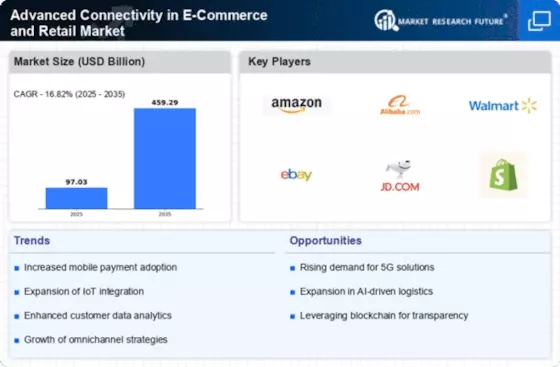
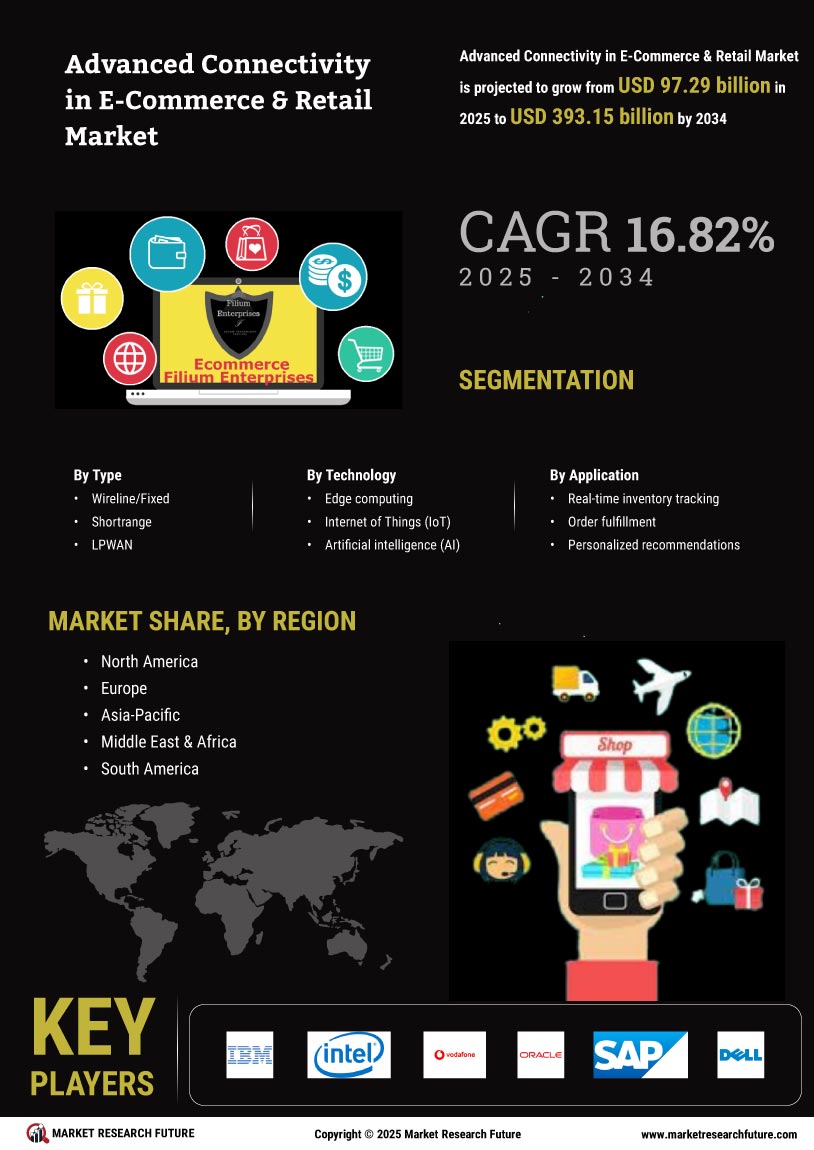
As per MRFR analysis, the Advanced Connectivity in E-Commerce and Retail Market was estimated at 83.06 USD Billion in 2024. The Advanced Connectivity industry is projected to grow from 97.03 in 2025 to 459.29 by 2035, exhibiting a compound annual growth rate (CAGR) of 16.82 during the forecast period 2025 - 2035.

Key Market Trends & Highlights

The Advanced Connectivity in E-Commerce and Retail Market is experiencing transformative growth driven by technological advancements and evolving consumer behaviors.

  • Omnichannel integration is becoming increasingly prevalent, allowing retailers to provide seamless shopping experiences across various platforms.
  • Artificial intelligence utilization is enhancing customer personalization and operational efficiency, particularly in North America.
  • Enhanced data security measures are gaining traction as consumers demand greater protection of their personal information.
  • Rising consumer expectations and the expansion of mobile commerce are key drivers propelling market growth in both North America and Asia-Pacific.

Market Size & Forecast

2024 Market Size 83.06 (USD Billion)
2035 Market Size 459.29 (USD Billion)
CAGR (2025 - 2035) 16.82%

Major Players

Amazon (US), Alibaba (CN), Walmart (US), eBay (US), JD.com (CN), Shopify (CA), Target (US), Rakuten (JP), Zalando (DE), Best Buy (US)

Our Impact
Enabled $4.3B Revenue Impact for Fortune 500 and Leading Multinationals
Partnering with 2000+ Global Organizations Each Year
30K+ Citations by Top-Tier Firms in the Industry

Advanced Connectivity in E-Commerce and Retail Market Trends

The Advanced Connectivity in E-Commerce and Retail Market is currently experiencing a transformative phase, driven by the integration of cutting-edge technologies and evolving consumer expectations. As digital platforms continue to proliferate, businesses are increasingly adopting advanced connectivity solutions to enhance customer experiences and streamline operations. This shift appears to be fueled by the growing demand for seamless interactions across various channels, which necessitates robust infrastructure and innovative approaches to data management. Furthermore, the emphasis on personalization and real-time engagement suggests that companies are prioritizing connectivity as a means to foster loyalty and drive sales. In February 2026, the landscape of the Advanced Connectivity in E-Commerce and Retail Market is characterized by a heightened focus on omnichannel strategies and the utilization of artificial intelligence. Retailers are leveraging these technologies to create cohesive shopping experiences that transcend traditional boundaries. The potential for enhanced analytics and customer insights indicates that businesses are not only responding to current trends but are also preparing for future developments. As the market evolves, the interplay between technology and consumer behavior will likely shape the trajectory of connectivity solutions, making it imperative for stakeholders to remain agile and responsive to emerging opportunities.

Omnichannel Integration

The trend towards omnichannel integration is becoming increasingly prevalent, as businesses strive to provide a unified shopping experience across various platforms. This approach allows customers to engage with brands seamlessly, whether online or in-store, thereby enhancing satisfaction and loyalty.

Artificial Intelligence Utilization

The incorporation of artificial intelligence in the Advanced Connectivity in E-Commerce and Retail Market is gaining momentum. AI technologies are being employed to analyze consumer behavior, optimize inventory management, and personalize marketing efforts, which may lead to improved operational efficiency.

Enhanced Data Security Measures

As connectivity solutions expand, the importance of data security is becoming more pronounced. Retailers are investing in advanced security protocols to protect customer information and maintain trust, indicating a proactive approach to safeguarding sensitive data.

Advanced Connectivity in E-Commerce and Retail Market Drivers

Emergence of 5G Technology

The rollout of 5G technology is poised to revolutionize the Advanced Connectivity in E-Commerce and Retail Market. With its promise of faster data transfer speeds and lower latency, 5G enables retailers to enhance their online platforms and improve customer interactions. This technological advancement allows for richer multimedia content, such as augmented reality experiences, which can significantly enhance the shopping experience. As 5G networks become more widespread, retailers that leverage this technology are likely to gain a competitive edge, attracting tech-savvy consumers who seek innovative shopping experiences.

Expansion of Mobile Commerce

The proliferation of smartphones and mobile devices has significantly influenced the Advanced Connectivity in E-Commerce and Retail Market. Recent data indicates that mobile commerce accounts for over 50 percent of total e-commerce sales, highlighting the necessity for retailers to optimize their platforms for mobile users. This shift necessitates the implementation of advanced connectivity solutions that facilitate smooth transactions and enhance user experience on mobile devices. Retailers that adapt to this trend by investing in mobile-friendly technologies are likely to capture a larger share of the market, as consumers increasingly prefer shopping via their smartphones.

Rising Consumer Expectations

The Advanced Connectivity in E-Commerce and Retail Market is currently experiencing a shift in consumer expectations. Customers increasingly demand seamless and personalized shopping experiences across multiple channels. This trend is evidenced by a reported 70 percent of consumers expressing a preference for brands that offer integrated shopping experiences. Retailers are thus compelled to invest in advanced connectivity solutions to meet these expectations, ensuring that their platforms are not only user-friendly but also capable of providing real-time updates and personalized recommendations. As a result, businesses that prioritize advanced connectivity are likely to enhance customer satisfaction and loyalty, ultimately driving sales growth.

Integration of Internet of Things (IoT)

The integration of Internet of Things (IoT) technology is transforming the Advanced Connectivity in E-Commerce and Retail Market. IoT devices enable retailers to gather real-time data on consumer behavior, inventory levels, and supply chain logistics. This data-driven approach allows for more informed decision-making and enhances operational efficiency. For instance, retailers utilizing IoT solutions can optimize inventory management, reducing costs and improving customer satisfaction. As IoT technology continues to evolve, its role in enhancing connectivity and streamlining operations within the retail sector is expected to grow, potentially reshaping the competitive landscape.

Focus on Sustainability and Ethical Practices

The Advanced Connectivity in E-Commerce and Retail Market is increasingly influenced by a growing consumer focus on sustainability and ethical practices. Shoppers are becoming more conscious of the environmental impact of their purchases, prompting retailers to adopt sustainable practices and transparent supply chains. This shift is reflected in a survey indicating that 66 percent of consumers are willing to pay more for sustainable products. Retailers that prioritize advanced connectivity solutions to communicate their sustainability efforts effectively are likely to resonate with this conscientious consumer base, thereby enhancing brand loyalty and driving sales.

Market Segment Insights

By Application: Mobile Commerce (Largest) vs. Social Commerce (Fastest-Growing)

In the Advanced Connectivity in E-Commerce and Retail Market, Mobile Commerce holds the largest share, driven by increased smartphone penetration and the convenience it offers consumers. It enables seamless shopping experiences and drives sales through applications. In contrast, Social Commerce is experiencing rapid growth as social media platforms enhance shopping functionalities, blending social interactions with purchasing decisions, appealing to younger demographics and influencers, fueling its expansion.

Mobile Commerce: Dominant vs. Augmented Reality Shopping: Emerging

Mobile Commerce is characterized by its dominance within the market, capitalizing on the widespread usage of smartphones, providing user-friendly and efficient shopping solutions. Its integration with payment processing technology further simplifies transactions, creating a compelling case for consumers. On the other hand, Augmented Reality Shopping is an emerging trend that enhances the shopping experience by allowing customers to visualize products in their own environment before making a purchase. This technology is gaining traction as retailers recognize its potential to reduce returns and increase customer satisfaction, making it a valuable addition to traditional shopping methods.

By Technology: 5G Connectivity (Largest) vs. Artificial Intelligence (Fastest-Growing)

In the Advanced Connectivity in E-Commerce and Retail Market, 5G Connectivity emerges as the largest segment, significantly influencing the landscape with its robust infrastructure. The adoption of 5G technology has been pivotal for enhancing data transfer speeds and reducing latency, which are essential traits for improving online shopping experiences. Conversely, Artificial Intelligence is recognized as the fastest-growing segment, showcasing remarkable potential in personalizing customer interactions and streamlining retail operations. As retailers increasingly leverage AI for data analysis and customer service automation, its market presence expands rapidly. The growth of these technology segments is driven by the ever-evolving demands for faster, more reliable connectivity and smarter e-commerce solutions. 5G's ability to support numerous connected devices simultaneously enhances the Internet of Things (IoT) ecosystem, fueling innovations in smart retail environments and operational efficiencies. Meanwhile, AI's influence continues to burgeon as retailers seek advanced analytics and machine learning capabilities to understand consumer behavior better. Together, these technologies are reshaping the future of retail, creating dynamic and responsive shopping experiences.

Technology: 5G Connectivity (Dominant) vs. Artificial Intelligence (Emerging)

5G Connectivity stands as the dominant force in the Advanced Connectivity in E-Commerce and Retail Market due to its extensive deployment and ability to provide ultra-reliable, low-latency connections. This technology not only supports enhanced mobile broadband experiences but also plays a critical role in facilitating IoT applications, ensuring seamless interactions between devices. In contrast, Artificial Intelligence is an emerging segment that has rapidly gained traction for its ability to analyze data, predict consumer trends, and optimize inventory management. AI’s capabilities in personalizing customer experiences and improving supply chain efficiencies mark it as a significant player in transforming retail strategies. Both technologies complement each other, positioning 5G as essential infrastructure while AI drives intelligent automation in retail.

By Consumer Behavior: Personalization (Largest) vs. Omnichannel Shopping (Fastest-Growing)

The Advanced Connectivity in E-Commerce and Retail Market reveals that personalization holds a significant share as a leading consumer behavior trend. As brands continue to focus on tailoring offerings to individual preferences and shopping habits, personalization stands out as the dominant strategy for engaging customers. In contrast, omnichannel shopping is rapidly gaining traction, with more consumers leveraging various platforms and devices to optimize their shopping experiences, indicating a shift towards integrated strategies in retail.

Personalization (Dominant) vs. Omnichannel Shopping (Emerging)

Personalization is evolving as a dominant force within the Advanced Connectivity in E-Commerce and Retail Market. Brands prioritize creating tailored experiences that resonate with individual consumers, fostering deeper engagement and loyalty. On the other hand, omnichannel shopping is emerging as a crucial trend, characterized by seamless customer journeys across multiple channels and touchpoints. As consumers increasingly expect a cohesive shopping experience, businesses are investing in technologies and strategies to deliver integrated solutions. This juxtaposition illustrates how personalization drives brand loyalty while omnichannel shopping enhances convenience and flexibility, capturing the evolving preferences of today's consumers.

By Payment Methods: Digital Wallets (Largest) vs. Buy Now Pay Later (Fastest-Growing)

In the Advanced Connectivity in E-Commerce and Retail Market, Digital Wallets have emerged as the largest payment method due to their convenience, speed, and security. They capture a significant share of the market as consumers increasingly prefer seamless transactions without the need for physical cash. Meanwhile, Buy Now Pay Later (BNPL) is rapidly gaining traction, appealing to consumers who seek flexibility in their purchasing decisions, especially among younger demographics. The growth trends for Digital Wallets are driven by technological advancements and increasing smartphone penetration, offering enhanced user experiences. On the other hand, BNPL's rapid expansion can be attributed to changes in consumer spending habits, focusing more on managing cash flow. The demand for frictionless transactions and flexible payment options will propel both segments forward in this competitive market.

Digital Wallets: Dominant vs. Buy Now Pay Later: Emerging

Digital Wallets stand out as the dominant payment method, driven by their ability to integrate various financial services into one platform. They appeal to a broad audience thanks to their convenience and enhanced security protocols, making online transactions smooth and user-friendly. Major players in this sector continuously innovate, offering features like loyalty rewards and instant payment confirmations that further solidify their market position. In contrast, Buy Now Pay Later is characterized as an emerging payment option, particularly popular among millennials and Gen Z consumers. This service allows customers to make purchases while deferring payment, tapping into the growing demand for flexible spending. As retailers increasingly adopt BNPL solutions, they cater to a more financially conscious consumer base seeking to enhance their shopping experiences.

Get more detailed insights about Advanced Connectivity in E-Commerce and Retail Market

Regional Insights

North America : Market Leader in Connectivity

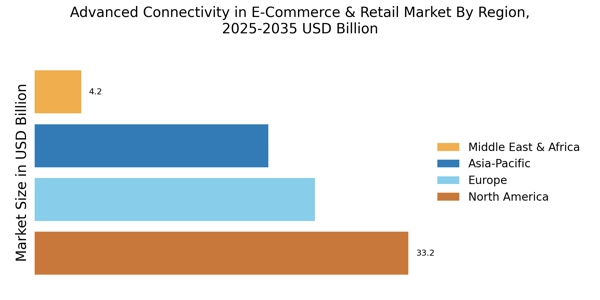
North America leads the Advanced Connectivity in E-Commerce and Retail Market, holding a significant market share of 41.83% as of 2024. The region's growth is driven by high internet penetration, increasing smartphone usage, and a robust logistics infrastructure. Regulatory support for digital commerce and data protection laws further catalyze market expansion, fostering consumer trust and encouraging online shopping trends. The competitive landscape is characterized by major players such as Amazon, Walmart, and eBay, which dominate the market with innovative solutions and extensive product offerings. The U.S. remains the largest contributor, while Canada is also emerging as a key player with platforms like Shopify. The presence of these giants ensures a dynamic market environment, pushing for continuous advancements in connectivity and customer experience.

Europe : Emerging E-Commerce Hub

Europe's Advanced Connectivity in E-Commerce and Retail Market is valued at €25.0 billion, reflecting a growing demand for seamless online shopping experiences. Factors such as increasing digital literacy, favorable regulations, and a strong emphasis on sustainability are driving this growth. The European Union's Digital Single Market initiative aims to enhance connectivity and streamline cross-border e-commerce, further boosting market potential. Leading countries like Germany, the UK, and France are at the forefront, with companies such as Zalando and other local players enhancing their digital offerings. The competitive landscape is vibrant, with a mix of established retailers and innovative startups. The region's focus on consumer privacy and data protection also shapes the market, ensuring a secure shopping environment for consumers.

Asia-Pacific : Rapidly Growing Market

The Asia-Pacific region, with a market size of $14.23 billion, is witnessing rapid growth in the Advanced Connectivity in E-Commerce and Retail Market. Factors such as rising disposable incomes, urbanization, and increasing smartphone penetration are driving demand. Additionally, government initiatives to promote digital economies and improve internet infrastructure are significant catalysts for market expansion in this region. China and Japan are leading the charge, with major players like Alibaba and Rakuten dominating the landscape. The competitive environment is marked by aggressive strategies, including partnerships and technological innovations aimed at enhancing customer experience. As e-commerce continues to evolve, the region is expected to see further advancements in connectivity solutions, catering to a tech-savvy consumer base.

Middle East and Africa : Emerging Market Potential

The Middle East and Africa region, with a market size of $2.0 billion, is gradually emerging in the Advanced Connectivity in E-Commerce and Retail Market. Factors such as increasing internet access, mobile penetration, and a young population are driving growth. Governments are also investing in digital infrastructure, which is crucial for enhancing e-commerce capabilities and attracting foreign investment. Countries like South Africa and the UAE are leading the way, with local players and international companies exploring opportunities in this burgeoning market. The competitive landscape is evolving, with a focus on mobile commerce and innovative payment solutions. As the region continues to develop, the potential for advanced connectivity in e-commerce is significant, paving the way for future growth.

Advanced Connectivity in E-Commerce and Retail Market Regional Image

Key Players and Competitive Insights

The Advanced Connectivity in E-Commerce and Retail Market is characterized by a rapidly evolving competitive landscape, driven by technological advancements and shifting consumer preferences. Major players such as Amazon (US), Alibaba (CN), and Walmart (US) are at the forefront, each adopting distinct strategies to enhance their market positioning. Amazon (US) continues to innovate through its extensive logistics network and advanced AI capabilities, focusing on personalized shopping experiences. In contrast, Alibaba (CN) emphasizes its vast ecosystem, integrating e-commerce with cloud computing and digital payments, thereby enhancing customer engagement. Walmart (US) is strategically investing in its omnichannel capabilities, merging physical and digital shopping experiences to cater to a diverse consumer base. Collectively, these strategies not only bolster individual company performance but also intensify competition within the market.

Key business tactics employed by these companies include localized manufacturing and supply chain optimization, which are essential in meeting the demands of a global consumer base. The market structure appears moderately fragmented, with a mix of established giants and emerging players. This fragmentation allows for a dynamic competitive environment where innovation and adaptability are crucial. The influence of key players is significant, as their strategies often set benchmarks for operational excellence and customer satisfaction.

In January 2026, Amazon (US) announced the launch of its new drone delivery service, aimed at reducing delivery times to under 30 minutes for select urban areas. This strategic move is likely to enhance customer satisfaction and solidify Amazon's position as a leader in rapid delivery solutions. The integration of drone technology not only streamlines logistics but also reflects a broader trend towards automation in e-commerce.

In December 2025, Alibaba (CN) unveiled its latest AI-driven shopping assistant, designed to provide personalized recommendations based on user behavior and preferences. This innovation underscores Alibaba's commitment to leveraging technology to enhance the shopping experience, potentially increasing customer loyalty and driving sales. The deployment of AI in retail is indicative of a larger trend towards data-driven decision-making in the industry.

In February 2026, Walmart (US) expanded its partnership with various local farmers to enhance its supply chain sustainability. This initiative aims to reduce carbon emissions and promote local sourcing, aligning with growing consumer demand for environmentally responsible practices. Such strategic alliances not only improve supply chain reliability but also resonate with consumers increasingly concerned about sustainability.

As of February 2026, the competitive trends in the Advanced Connectivity in E-Commerce and Retail Market are heavily influenced by digitalization, sustainability, and AI integration. Strategic alliances are becoming increasingly vital, as companies seek to enhance their capabilities and market reach. The shift from price-based competition to a focus on innovation, technology, and supply chain reliability is evident, suggesting that future competitive differentiation will hinge on these factors. Companies that can effectively leverage technology and foster sustainable practices are likely to emerge as leaders in this dynamic market.

Key Companies in the Advanced Connectivity in E-Commerce and Retail Market include

Industry Developments

June 2023, For hybrid workforces, Cisco and AT&T have unveiled new technologies to improve connection and transform the calling environment. The modern worker is not bound to a particular space, technology, or geography, whether they are working on the ground level, the top floor, in a branch office, at home, or during their commute. With the new products, which include Cisco's Webex Calling and SD-WAN solutions in addition to AT&T mobile network, companies of any size can provide employees with a straightforward, secure, and consistent experience to thrive in any environment.

February 2023, Qualcomm Technologies, Inc. announced that it is working with SES-imagotag to create technology that would enable new electronic shelf labels (ESLs) based on the Bluetooth Special Interest Group's (SIG) recently established ESL wireless standards. ESL systems have utilised exclusive wireless communication protocols up to now. The Bluetooth SIG working group was led by Qualcomm Technologies and SES-imagotag with the aim of developing scalable, ultra-low power, highly secure, standard-based ESLs to enable retailers to increase operational effectiveness, empower staff, and improve customer experiences.

Future Outlook

Advanced Connectivity in E-Commerce and Retail Market Future Outlook

The Advanced Connectivity in E-Commerce and Retail Market is projected to grow at a 16.82% CAGR from 2024 to 2035, driven by technological advancements, consumer demand for seamless experiences, and enhanced logistics capabilities.

New opportunities lie in:

  • Integration of AI-driven customer analytics platforms
  • Development of IoT-enabled smart retail environments
  • Expansion of blockchain for secure supply chain management

By 2035, the market is expected to be robust, characterized by innovative solutions and enhanced consumer engagement.

Market Segmentation

Advanced Connectivity in E-Commerce and Retail Market Technology Outlook

  • 5G Connectivity
  • Internet of Things
  • Artificial Intelligence
  • Blockchain Technology
  • Cloud Computing

Advanced Connectivity in E-Commerce and Retail Market Application Outlook

  • Mobile Commerce
  • Social Commerce
  • Online Marketplaces
  • Augmented Reality Shopping
  • Virtual Reality Shopping

Advanced Connectivity in E-Commerce and Retail Market Payment Methods Outlook

  • Digital Wallets
  • Cryptocurrency Transactions
  • Buy Now Pay Later
  • Contactless Payments
  • Subscription Services

Advanced Connectivity in E-Commerce and Retail Market Consumer Behavior Outlook

  • Personalization
  • Omnichannel Shopping
  • Sustainability Preferences
  • Price Sensitivity
  • Brand Loyalty

Report Scope

MARKET SIZE 202483.06(USD Billion)
MARKET SIZE 202597.03(USD Billion)
MARKET SIZE 2035459.29(USD Billion)
COMPOUND ANNUAL GROWTH RATE (CAGR)16.82% (2024 - 2035)
REPORT COVERAGERevenue Forecast, Competitive Landscape, Growth Factors, and Trends
BASE YEAR2024
Market Forecast Period2025 - 2035
Historical Data2019 - 2024
Market Forecast UnitsUSD Billion
Key Companies ProfiledAmazon (US), Alibaba (CN), Walmart (US), eBay (US), JD.com (CN), Shopify (CA), Target (US), Rakuten (JP), Zalando (DE), Best Buy (US)
Segments CoveredApplication, Technology, Consumer Behavior, Payment Methods
Key Market OpportunitiesIntegration of Internet of Things technology enhances personalized shopping experiences in Advanced Connectivity in E-Commerce and Retail Market.
Key Market DynamicsRising demand for seamless digital experiences drives innovation in connectivity solutions for e-commerce and retail sectors.
Countries CoveredNorth America, Europe, APAC, South America, MEA

Market Highlights

Author
Aarti Dhapte
Team Lead - Research

She holds an experience of about 6+ years in Market Research and Business Consulting, working under the spectrum of Information Communication Technology, Telecommunications and Semiconductor domains. Aarti conceptualizes and implements a scalable business strategy and provides strategic leadership to the clients. Her expertise lies in market estimation, competitive intelligence, pipeline analysis, customer assessment, etc.

Leave a Comment

FAQs

What is the projected market valuation for the US advanced connectivity in e-commerce retail market by 2035?

The projected market valuation for the US advanced connectivity in e-commerce retail market is expected to reach 62.91 USD Billion by 2035.

What was the market valuation in 2024 for the US advanced connectivity in e-commerce retail market?

The overall market valuation for the US advanced connectivity in e-commerce retail market was 13.29 USD Billion in 2024.

What is the expected CAGR for the US advanced connectivity in e-commerce retail market during the forecast period 2025 - 2035?

The expected CAGR for the US advanced connectivity in e-commerce retail market during the forecast period 2025 - 2035 is 15.18%.

Which companies are considered key players in the US advanced connectivity in e-commerce retail market?

Key players in the market include Amazon, Walmart, eBay, Target, Shopify, Best Buy, Costco, Wayfair, and Zalando.

Download Free Sample

Kindly complete the form below to receive a free sample of this Report

Compare Licence

×
Features License Type
Single User Multiuser License Enterprise User
Price $4,950 $5,950 $7,250
Maximum User Access Limit 1 User Upto 10 Users Unrestricted Access Throughout the Organization
Free Customization
Direct Access to Analyst
Deliverable Format
Platform Access
Discount on Next Purchase 10% 15% 15%
Printable Versions