×
Request Free Sample ×

Kindly complete the form below to receive a free sample of this Report

* Please use a valid business email

Leading companies partner with us for data-driven Insights

clients tt-cursor
Hero Background

Adalimumab Drug Market

ID: MRFR/HC/40324-HCR
200 Pages
Rahul Gotadki
February 2026

Adalimumab Drug Market Research Report By Application (Rheumatoid Arthritis, Psoriasis, Crohn's Disease, Ulcerative Colitis), By Type (Original Biological, Biosimilars), By Dosage Form (Injection, Prefilled Syringe, Auto-Injector), By End Use (Hospitals, Clinics, Homecare) and By Regional (North America, Europe, South America, Asia Pacific, Middle East and Africa) - Growth & Industry Forecast 2025 To 2035

Share:
Download PDF ×

We do not share your information with anyone. However, we may send you emails based on your report interest from time to time. You may contact us at any time to opt-out.

Adalimumab Drug Market Infographic
Purchase Options

Adalimumab Drug Market Summary

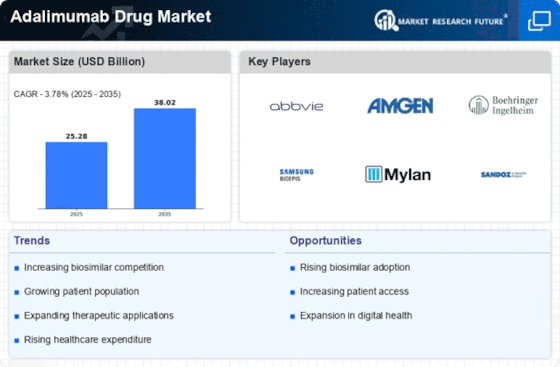
As per Market Research Future analysis, the Adalimumab Drug Market Size was estimated at 25.28 USD Billion in 2024. The Adalimumab industry is projected to grow from 26.24 USD Billion in 2025 to 38.02 USD Billion by 2035, exhibiting a compound annual growth rate (CAGR) of 3.78% during the forecast period 2025 - 2035

Key Market Trends & Highlights

The Adalimumab Drug Market is experiencing dynamic growth driven by emerging biosimilars and expanding treatment indications.

  • The North American market remains the largest for Adalimumab, driven by high healthcare expenditure and advanced medical infrastructure.
  • The Asia-Pacific region is identified as the fastest-growing market, reflecting increasing patient populations and healthcare investments.
  • Rheumatoid Arthritis continues to be the largest segment, while the Psoriasis segment is witnessing rapid growth due to rising awareness and treatment options.
  • Key market drivers include the rising prevalence of autoimmune diseases and regulatory support for biologics, which are fueling demand for effective treatments.

Market Size & Forecast

2024 Market Size 25.28 (USD Billion)
2035 Market Size 38.02 (USD Billion)
CAGR (2025 - 2035) 3.78%

Major Players

AbbVie Inc (US), Amgen Inc (US), Boehringer Ingelheim (DE), Samsung Bioepis (KR), Mylan N.V. (US), Sandoz (CH), Fresenius Kabi (DE), Pfizer Inc (US), Eisai Co Ltd (JP)

Our Impact
Enabled $4.3B Revenue Impact for Fortune 500 and Leading Multinationals
Partnering with 2000+ Global Organizations Each Year
30K+ Citations by Top-Tier Firms in the Industry

Adalimumab Drug Market Trends

The Adalimumab Drug Market is currently experiencing a dynamic phase characterized by evolving treatment paradigms and increasing patient demand. This biologic medication, primarily utilized for autoimmune conditions, has garnered attention due to its efficacy and relatively favorable safety profile. As healthcare systems worldwide adapt to the growing prevalence of chronic diseases, the market for Adalimumab is likely to expand, driven by both established and emerging therapeutic applications. Furthermore, the introduction of biosimilars appears to be reshaping competitive dynamics, potentially leading to more accessible treatment options for patients. In addition, the ongoing research into the drug's applications beyond its current indications suggests a promising future for the Adalimumab Drug Market. Pharmaceutical companies are exploring innovative formulations and delivery methods, which may enhance patient adherence and overall treatment outcomes. As the landscape continues to evolve, stakeholders must remain vigilant to the shifting regulatory environment and the implications of cost-effectiveness in treatment decisions. Overall, the Adalimumab Drug Market seems poised for growth, with various factors contributing to its trajectory.

Emergence of Biosimilars

The rise of biosimilars in the Adalimumab Drug Market is altering competitive dynamics. These alternatives offer similar therapeutic effects at potentially lower costs, which may enhance patient access to treatment. As more biosimilars enter the market, the original product may face pricing pressures, prompting manufacturers to innovate and differentiate their offerings.

Expansion of Indications

Research into the Adalimumab Drug Market indicates a trend towards expanding the drug's indications. Ongoing clinical trials are exploring its efficacy in additional autoimmune disorders, which could broaden its therapeutic applications. This expansion may lead to increased adoption among healthcare providers and patients alike.

Focus on Patient-Centric Approaches

There is a growing emphasis on patient-centric approaches within the Adalimumab Drug Market. Pharmaceutical companies are increasingly prioritizing patient experience, including ease of administration and adherence to treatment regimens. This trend may drive the development of more user-friendly formulations and delivery systems, ultimately enhancing treatment outcomes.

Adalimumab Drug Market Drivers

Advancements in Drug Development

Innovations in drug development and biotechnology are significantly influencing the Adalimumab Drug Market. The ongoing research and development efforts aimed at enhancing the efficacy and safety profiles of existing therapies are likely to yield new formulations and delivery methods. These advancements may include improved dosing regimens and combination therapies that could enhance patient outcomes. The Adalimumab Drug Market stands to gain from these developments, as pharmaceutical companies invest in cutting-edge technologies to optimize treatment options. Additionally, the introduction of novel delivery systems, such as autoinjectors and prefilled syringes, may improve patient adherence and satisfaction. As a result, the Adalimumab Drug Market is poised for growth, driven by the continuous evolution of drug development practices.

Regulatory Support for Biologics

Regulatory agencies are increasingly supportive of biologic therapies, which is a significant driver for the Adalimumab Drug Market. The streamlined approval processes and favorable policies for biologics are likely to facilitate the introduction of new products and indications. This regulatory environment encourages pharmaceutical companies to invest in the development of innovative therapies, including those based on Adalimumab. Moreover, the growing acceptance of biosimilars is expected to enhance competition within the Adalimumab Drug Market, potentially leading to lower prices and increased accessibility for patients. As regulatory frameworks continue to evolve, the Adalimumab Drug Market is well-positioned to capitalize on these opportunities, fostering growth and innovation in the sector.

Increasing Healthcare Expenditure

The rise in healthcare expenditure across various regions is a crucial factor propelling the Adalimumab Drug Market. As governments and private sectors allocate more resources to healthcare, there is a corresponding increase in the availability of advanced treatment options for patients. This trend is particularly evident in developed economies, where healthcare budgets are expanding to accommodate innovative therapies. The Adalimumab Drug Market benefits from this increased spending, as more patients gain access to biologic treatments that were previously unaffordable. Furthermore, the emphasis on value-based care is likely to drive investments in effective therapies, including Adalimumab, which has demonstrated substantial clinical benefits. Consequently, the Adalimumab Drug Market is expected to thrive in an environment characterized by rising healthcare investments.

Patient Demand for Effective Treatments

The increasing patient demand for effective and convenient treatment options is a driving force in the Adalimumab Drug Market. Patients are becoming more informed about their health conditions and are actively seeking therapies that offer better outcomes and improved quality of life. This trend is particularly evident in chronic conditions, where patients often require long-term management strategies. The Adalimumab Drug Market is responding to this demand by providing therapies that not only address symptoms but also target the underlying causes of diseases. Additionally, the focus on personalized medicine is likely to enhance patient engagement and adherence to treatment regimens. As patients continue to advocate for effective therapies, the Adalimumab Drug Market is expected to grow in response to this evolving landscape.

Rising Prevalence of Autoimmune Diseases

The increasing incidence of autoimmune diseases such as rheumatoid arthritis, psoriasis, and Crohn's disease is a primary driver for the Adalimumab Drug Market. According to recent data, autoimmune diseases affect millions of individuals worldwide, leading to a heightened demand for effective treatment options. This trend is likely to continue, as the prevalence of these conditions appears to be on the rise. The Adalimumab Drug Market is positioned to benefit from this growing patient population, as healthcare providers seek reliable therapies to manage these chronic conditions. Furthermore, the increasing awareness and diagnosis of autoimmune diseases contribute to the market's expansion, as more patients are being identified and treated. As a result, the Adalimumab Drug Market is expected to experience sustained growth in response to this rising demand.


Market Segment Insights

By Application: Rheumatoid Arthritis (Largest) vs. Psoriasis (Fastest-Growing)

The Adalimumab drug market exhibits a diverse application landscape, with Rheumatoid Arthritis commanding the largest share among the therapeutic areas. This segment benefits from a well-established patient base and extensive research. Psoriasis has emerged as the fastest-growing application, driven by increasing diagnosis rates and rising awareness about skin diseases. As healthcare providers expand their treatment options for these conditions, the demand for Adalimumab continues to rise—positioning these applications as significant players in the overall drug market.

Rheumatoid Arthritis (Dominant) vs. Crohn's Disease (Emerging)

Rheumatoid Arthritis is a dominant application in the Adalimumab market, recognized for its debilitating impact on patients and the high demand for effective treatments. This condition has paved the way for widespread adoption of Adalimumab, often seen as a first-line therapy. In contrast, Crohn's Disease is considered an emerging segment, with growing recognition of its severity and the window for Adalimumab to capture a larger market share. The rising prevalence of inflammatory bowel diseases, coupled with advances in diagnosis and treatment, creates ample opportunities for Crohn's Disease, indicating a shifting focus in the therapeutic landscape.

By Type: Original Biological (Largest) vs. Biosimilars (Fastest-Growing)

In the Adalimumab Drug Market, the segmentation between Original Biological and Biosimilars displays a clear market dominance. The Original Biological segment holds a significant share, being the pioneering formulation that has defined treatment standards over the years. This segment benefits from a strong brand loyalty among prescribers and patients, reinforcing its market position despite emerging competition. On the other hand, the Biosimilars segment, gaining traction due to their cost-effectiveness and similar efficacy, is rapidly expanding its footprint in the market.

Original Biological (Dominant) vs. Biosimilars (Emerging)

The Original Biological segment remains dominant in the Adalimumab market, characterized by established credibility and a well-regarded safety and efficacy profile. With patents expiring for Original Biological drugs, the transition to Biosimilars is facilitated, but the Original Biological products will likely continue to lead in physician preference. In contrast, the Biosimilars segment is an emerging force, appealing to cost-conscious healthcare systems while still ensuring therapeutic equivalence. This growing acceptance among healthcare providers is expected to enhance the overall competitive landscape, enabling them to cater effectively to diverse patient needs.

By Dosage Form: Injection (Largest) vs. Prefilled Syringe (Fastest-Growing)

In the Adalimumab Drug Market, the dosage form segment displays a distinct market share distribution, where injections account for the largest portion due to their traditional use in delivering biologics. Prefilled syringes are gaining traction, standing out as a notable emerging option, especially among patients seeking convenience and reduced preparation time. Auto-injectors, while representing a smaller share, are increasingly recognized for enhancing the patient experience through their ease of use and precise dosing features.

Injection (Dominant) vs. Auto-Injector (Emerging)

The injection form of Adalimumab remains the dominant choice among healthcare providers due to its long-standing efficacy and reliability in patient treatment protocols. It offers ease of administration for severe conditions. On the other hand, auto-injectors are emerging as a new alternative, appealing to patients who value self-administration and convenience. With user-friendly designs and the ability to provide accurate doses, auto-injectors are slowly carving out a niche with the potential for significant growth as healthcare trends favor patient-centric approaches.

By End Use: Hospitals (Largest) vs. Clinics (Fastest-Growing)

In the Adalimumab Drug Market, the distribution of end-use segments reveals that hospitals hold the largest market share due to their extensive resources and capacity to provide advanced treatments. They are equipped with specialized healthcare professionals and infrastructure that allows for comprehensive care management, leading to a higher utilization of Adalimumab. On the other hand, clinics are gaining traction, representing an increasingly significant segment as they cater to outpatient care and chronic illness management, thus appealing to a different demographic needing accessible treatments.

Hospitals (Dominant) vs. Clinics (Emerging)

Hospitals act as the dominant players in the Adalimumab Drug Market, primarily because they have the infrastructure to handle complex cases requiring this biologic therapy. With their advanced diagnostic capabilities and therapy administration protocols, they are essential in managing diseases such as rheumatoid arthritis and inflammatory bowel disease. In contrast, clinics are emerging as vital alternatives, especially for patients preferring outpatient services. Clinics focus on personalized care and convenience, often having more direct patient engagement, leading them to rapidly evolve as a preferred care model. This shift is further driven by the growing emphasis on value-based care and the need for immediate access to treatments.

Get more detailed insights about Adalimumab Drug Market

Regional Insights

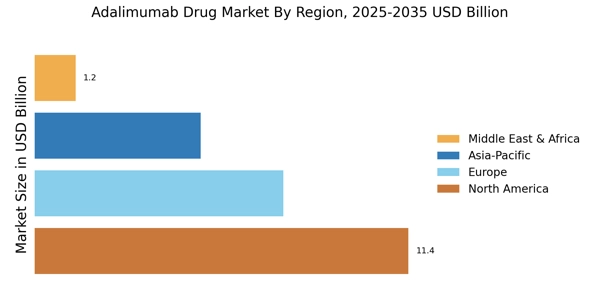
The Global Adalimumab Drug Market, valued at 25.28 USD Billion in 2024, exhibits a diverse regional segmentation with significant variations. North America dominates the market, holding a majority with a valuation of 12.76 USD Billion in 2024, demonstrating the region's strong healthcare infrastructure and high prevalence of autoimmune diseases. Europe follows, with a valuation of 7.58 USD Billion, reflecting considerable demand supported by advanced treatment options and healthcare policies. The APAC region, valued at 3.87 USD Billion, is emerging due to increasing investment in healthcare and rising patient awareness.

South America and MEA, with valuations of 0.89 USD Billion and 0.18 USD Billion, respectively, are smaller players in the market, facing challenges like limited accessibility and healthcare resources. Despite this, these regions present opportunities for growth as healthcare systems evolve and access to treatments improves. Overall, the Global Adalimumab Drug Market statistics indicate a positive growth trajectory across regions, driven by the increasing prevalence of inflammatory diseases, ongoing research, and development efforts in the pharmaceutical sector.

Adalimumab Drug Market Regional Image

Key Players and Competitive Insights

The Global Adalimumab Drug Market is characterized by intense competition driven by the increasing prevalence of diseases such as rheumatoid arthritis, psoriasis, and Crohn's disease, among others. As one of the first fully human monoclonal antibodies on the market, adalimumab has set a benchmark in the therapeutic landscape for autoimmune diseases. The competitive landscape is further complicated by the entry of biosimilars, which have begun to gain market share, driven largely by competitive pricing strategies. Companies are vying for market leadership by focusing on product differentiation, extensive research and development, and strategic partnerships.
The dynamics of this market reflect a mix of established pharmaceutical giants and emerging biotechnology firms, each looking to leverage its strengths to capture a piece of the growing demand for adalimumab-based therapies. Hikma Pharmaceuticals has made significant strides in the Global Adalimumab Drug Market, underscored by its commitment to providing high-quality therapeutics that meet the needs of healthcare providers and patients. The company’s strengths lie in its robust manufacturing capabilities and its strategic positioning in both branded and generic pharmaceuticals, enabling it to offer cost-effective adalimumab options to a diverse customer base.
Hikma has effectively utilized its extensive distribution networks to enhance market access and has focused on rigorous compliance with regulatory standards, thereby ensuring a reliable supply of products. Moreover, with a strong emphasis on innovation and a pipeline that includes biosimilar versions of adalimumab, Hikma Pharmaceuticals continues to enhance its competitive edge in a rapidly evolving market. Merck has established a noteworthy presence in the Global Adalimumab Drug Market by leveraging its extensive research capabilities and an aggressive marketing strategy.
The company's strengths are anchored in its solid scientific foundation, enabling it to develop advanced formulations of biologic drugs, including adalimumab, that cater to specialized therapeutic needs. Merck's commitment to research and development is evident in its continuous investment in groundbreaking therapies and its ability to swiftly adapt to market changes, including the introduction of biosimilars. Additionally, its strategic partnerships with healthcare providers and payers have enhanced community access to adalimumab therapies, further solidifying its reputation as a trusted leader in the market.
The company’s proactive approach to compliance and quality assurance continues to play a crucial role in building brand loyalty and maintaining a significant market share amidst growing competition.

Key Companies in the Adalimumab Drug Market include

Industry Developments

  • Q2 2024: Early Success of Adalimumab Biosimilars Featured at AMCP 2025 Two retrospective studies presented at the Academy of Managed Care Pharmacy annual meeting in April 2024 highlighted high adherence rates, comparable clinical effectiveness, and cost savings following the adoption of adalimumab biosimilars, with over half of patients in one study starting biosimilar treatment in April 2024 due to formulary changes.
  • Q2 2024: 2025 Formularies: Humira Is Out, White-Label Biosimilars Are In In early 2024, major pharmacy benefit managers (PBMs) began removing AbbVie's Humira from their standard formularies, notably with Caremark favoring a cobranded biosimilar from Cordavis, a move credited with accelerating biosimilar uptake and reducing Humira's market share.
  • Q1 2024: Humira Biosimilars Gain Ground as Doctors Adjust and New Therapies Rise Boehringer Ingelheim laid off staff in 2024 due to slow uptake of its Humira biosimilar, Cyltezo, highlighting the competitive and challenging environment for biosimilar manufacturers despite increasing market share for biosimilars overall.
  • Q4 2024: PSG Report: Humira Biosimilars Ease Specialty Drug Claim Costs By the end of 2024, adalimumab biosimilars reached 21% of prescription volume, up from 1% in 2023, as insurer and pharmacy contracts encouraged greater uptake and biosimilars began to displace branded Humira on some formularies.

Future Outlook

Adalimumab Drug Market Future Outlook

The Adalimumab Drug Market is projected to grow at a 3.78% CAGR from 2025 to 2035, driven by increasing autoimmune disease prevalence and expanding treatment options.

New opportunities lie in:

  • Development of biosimilars to enhance market penetration.
  • Expansion into emerging markets with tailored pricing strategies.
  • Investment in digital health platforms for patient engagement and adherence.

By 2035, the Adalimumab market is expected to solidify its position as a leading therapeutic option.

Market Segmentation

Adalimumab Drug Market Type Outlook

  • Original Biological
  • Biosimilars

Adalimumab Drug Market End Use Outlook

  • Hospitals
  • Clinics
  • Homecare

Adalimumab Drug Market Application Outlook

  • Rheumatoid Arthritis
  • Psoriasis
  • Crohn's Disease
  • Ulcerative Colitis

Adalimumab Drug Market Dosage Form Outlook

  • Injection
  • Prefilled Syringe
  • Auto-Injector

Report Scope

MARKET SIZE 2024 25.28(USD Billion)
MARKET SIZE 2025 26.24(USD Billion)
MARKET SIZE 2035 38.02(USD Billion)
COMPOUND ANNUAL GROWTH RATE (CAGR) 3.78% (2025 - 2035)
REPORT COVERAGE Revenue Forecast, Competitive Landscape, Growth Factors, and Trends
BASE YEAR 2024
Market Forecast Period 2025 - 2035
Historical Data 2019 - 2024
Market Forecast Units USD Billion
Key Companies Profiled AbbVie Inc (US), Amgen Inc (US), Boehringer Ingelheim (DE), Samsung Bioepis (KR), Mylan N.V. (US), Sandoz (CH), Fresenius Kabi (DE), Pfizer Inc (US), Eisai Co Ltd (JP)
Segments Covered Application, Type, Dosage Form, End Use, Regional
Key Market Opportunities Emergence of biosimilars and evolving regulatory frameworks enhance competition in the Adalimumab Drug Market.
Key Market Dynamics Intensifying competition and regulatory scrutiny shape the evolving landscape of the Adalimumab Drug Market.
Countries Covered North America, Europe, APAC, South America, MEA
Leave a Comment

FAQs

What is the projected market valuation of the Adalimumab Drug Market by 2035?

The projected market valuation of the Adalimumab Drug Market is expected to reach 38.02 USD Billion by 2035.

What was the overall market valuation of the Adalimumab Drug Market in 2024?

The overall market valuation of the Adalimumab Drug Market was 25.28 USD Billion in 2024.

What is the expected CAGR for the Adalimumab Drug Market during the forecast period 2025 - 2035?

The expected CAGR for the Adalimumab Drug Market during the forecast period 2025 - 2035 is 3.78%.

Which companies are considered key players in the Adalimumab Drug Market?

Key players in the Adalimumab Drug Market include AbbVie Inc, Amgen Inc, Boehringer Ingelheim, Samsung Bioepis, Mylan N.V., Sandoz, Fresenius Kabi, Pfizer Inc, and Eisai Co Ltd.

What are the projected revenues for the Rheumatoid Arthritis segment by 2035?

The projected revenues for the Rheumatoid Arthritis segment are expected to reach 15.0 USD Billion by 2035.

How much is the Psoriasis segment expected to generate by 2035?

The Psoriasis segment is anticipated to generate 10.0 USD Billion by 2035.

What is the expected revenue for the Original Biological type in 2035?

The expected revenue for the Original Biological type is projected to be 30.0 USD Billion by 2035.

What are the anticipated revenues for the Homecare end-use segment by 2035?

The anticipated revenues for the Homecare end-use segment are expected to reach 11.02 USD Billion by 2035.

What is the projected revenue for the Auto-Injector dosage form by 2035?

The projected revenue for the Auto-Injector dosage form is expected to be 11.02 USD Billion by 2035.

How does the market for Biosimilars compare to Original Biologicals in 2035?

In 2035, the market for Biosimilars is projected to generate 8.02 USD Billion, compared to 30.0 USD Billion for Original Biologicals.

Download Free Sample

Kindly complete the form below to receive a free sample of this Report

Compare Licence

×
Features License Type
Single User Multiuser License Enterprise User
Price $4,950 $5,950 $7,250
Maximum User Access Limit 1 User Upto 10 Users Unrestricted Access Throughout the Organization
Free Customization
Direct Access to Analyst
Deliverable Format
Platform Access
Discount on Next Purchase 10% 15% 15%
Printable Versions