×
Request Free Sample ×

Kindly complete the form below to receive a free sample of this Report

* Please use a valid business email

Leading companies partner with us for data-driven Insights

clients tt-cursor
Hero Background

Actuator Sensor Interface Market

ID: MRFR/SEM/2532-HCR
200 Pages
Shubham Munde
February 2026

AS Interface Market Size, Share and Research Report By Application (Industrial Automation, Building Automation, Transportation), By Technology (Wired AS Interface, Wireless AS Interface, Hybrid AS Interface), By End Use (Manufacturing, Oil and Gas, Utilities), By Component Type (Sensors, Actuators, Control Units) and By Regional (North America, Europe, South America, Asia Pacific, Middle East and Africa) - Industry Forecast Till 2035

Share:
Download PDF ×

We do not share your information with anyone. However, we may send you emails based on your report interest from time to time. You may contact us at any time to opt-out.

Actuator Sensor Interface Market Infographic
Purchase Options

Actuator Sensor Interface Market Summary

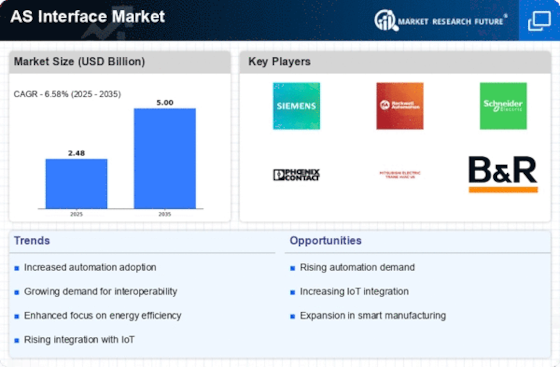
As per MRFR analysis, the Actuator Sensor Interface Market Size was estimated at 2480.0 USD Million in 2024. The Actuator Sensor Interface industry is projected to grow from 2643.18 USD Million in 2025 to 4999.02 USD Million by 2035, exhibiting a compound annual growth rate (CAGR) of 6.58 during the forecast period 2025 - 2035.

Key Market Trends & Highlights

The Actuator Sensor Interface Market is poised for substantial growth driven by technological advancements and increasing automation demands.

  • The integration of IoT technologies is transforming the Actuator Sensor Interface Market, enhancing connectivity and data exchange.
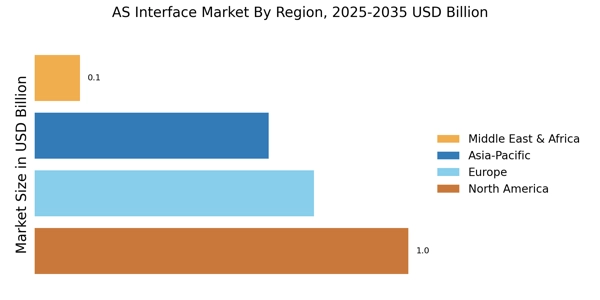
  • North America remains the largest market, while Asia-Pacific is emerging as the fastest-growing region, reflecting diverse industrial needs.
  • Advancements in wireless communication are facilitating more efficient and flexible actuator-sensor systems across various applications.
  • Rising demand for automation and a growing focus on smart manufacturing are key drivers propelling market expansion.

Market Size & Forecast

2024 Market Size 2480.0 (USD Million)
2035 Market Size 4999.02 (USD Million)
CAGR (2025 - 2035) 6.58%

Major Players

Siemens (DE), Rockwell Automation (US), Honeywell (US), Schneider Electric (FR), Emerson Electric (US), Mitsubishi Electric (JP), Bosch Rexroth (DE), B&R Industrial Automation (AT), National Instruments (US)

Our Impact
Enabled $4.3B Revenue Impact for Fortune 500 and Leading Multinationals
Partnering with 2000+ Global Organizations Each Year
30K+ Citations by Top-Tier Firms in the Industry

Actuator Sensor Interface Market Trends

The Actuator Sensor Interface Market is currently experiencing a notable evolution, driven by advancements in automation and the increasing demand for efficient control systems across various industries. This market encompasses a range of technologies that facilitate communication between sensors and actuators, thereby enhancing operational efficiency and reliability. As industries strive for greater productivity, the integration of actuator sensor interfaces is becoming more prevalent, particularly in sectors such as manufacturing, automotive, and aerospace. The ongoing push towards smart manufacturing and Industry Four Point Zero is further propelling the adoption of these technologies, as organizations seek to optimize processes and reduce operational costs. In February 2026, the Actuator Sensor Interface Market appears poised for continued growth, with innovations in wireless communication and IoT integration likely to play a pivotal role. The increasing focus on sustainability and energy efficiency may also drive demand for advanced actuator sensor solutions. Furthermore, as industries become more interconnected, the need for seamless data exchange between devices is expected to rise, potentially leading to the development of more sophisticated actuator sensor interfaces. Overall, the market seems to be on a trajectory of expansion, with various factors contributing to its dynamic landscape.

Integration of IoT Technologies

The Actuator Sensor Interface Market is witnessing a trend towards the integration of Internet of Things (IoT) technologies. This integration facilitates real-time data exchange and enhances the ability to monitor and control systems remotely. As industries increasingly adopt IoT solutions, the demand for actuator sensor interfaces that can seamlessly connect with various devices is likely to grow.

Focus on Energy Efficiency

There is a growing emphasis on energy efficiency within the Actuator Sensor Interface Market. Organizations are seeking solutions that not only improve operational performance but also reduce energy consumption. This trend is prompting the development of actuator sensor interfaces that optimize energy use, aligning with broader sustainability goals.

Advancements in Wireless Communication

The market is experiencing advancements in wireless communication technologies, which are transforming the way actuator sensor interfaces operate. These innovations enable greater flexibility and ease of installation, as well as improved reliability in data transmission. As wireless solutions become more prevalent, they are expected to enhance the functionality and appeal of actuator sensor interfaces.

Actuator Sensor Interface Market Drivers

Increased Investment in R&D

The Actuator Sensor Interface Market is benefiting from increased investment in research and development across various sectors. Companies are allocating substantial resources to innovate and improve actuator sensor technologies, aiming to enhance performance and reliability. This trend is particularly evident in industries such as automotive and aerospace, where precision and safety are paramount. The global investment in R&D is projected to reach approximately 2 trillion by 2025, indicating a strong commitment to technological advancement. As companies strive to develop cutting-edge actuator sensor interfaces, the market is likely to experience robust growth, driven by these innovations.

Rising Demand for Automation

The Actuator Sensor Interface Market is experiencing a notable surge in demand for automation across various sectors, including manufacturing, automotive, and healthcare. This trend is driven by the need for enhanced efficiency and productivity. As industries increasingly adopt automated systems, the integration of actuator sensor interfaces becomes crucial for seamless communication between sensors and actuators. According to recent data, the automation market is projected to grow at a compound annual growth rate of approximately 9% over the next five years. This growth is likely to propel the Actuator Sensor Interface Market, as companies seek to implement advanced technologies that facilitate real-time data exchange and operational optimization.

Advancements in Sensor Technology

Technological advancements in sensor technology are playing a pivotal role in shaping the Actuator Sensor Interface Market. Innovations such as miniaturization, increased sensitivity, and enhanced accuracy are making sensors more effective and versatile. These advancements enable the development of more sophisticated actuator sensor interfaces that can cater to a wide range of applications, from industrial automation to smart home systems. The sensor market is projected to grow significantly, with estimates indicating a value of over 200 billion by 2026. This growth is expected to positively impact the Actuator Sensor Interface Market, as the demand for high-performance sensors continues to rise.

Growing Focus on Smart Manufacturing

The Actuator Sensor Interface Market is significantly influenced by the growing emphasis on smart manufacturing practices. Industries are increasingly adopting Industry 4.0 principles, which prioritize interconnected systems and data-driven decision-making. This shift necessitates the deployment of actuator sensor interfaces that enable efficient communication between devices. The smart manufacturing sector is expected to witness substantial growth, with estimates suggesting a market size of over 300 billion by 2025. As manufacturers strive to enhance operational efficiency and reduce downtime, the demand for actuator sensor interfaces is likely to rise, thereby driving the overall market.

Regulatory Compliance and Safety Standards

The Actuator Sensor Interface Market is also influenced by the need for compliance with regulatory standards and safety protocols. As industries face increasing scrutiny regarding safety and environmental impact, the demand for reliable actuator sensor interfaces that meet these standards is on the rise. Regulatory bodies are establishing stringent guidelines that necessitate the use of advanced technologies to ensure safety and efficiency. This trend is particularly prominent in sectors such as healthcare and automotive, where adherence to safety standards is critical. As companies invest in compliant actuator sensor interfaces, the market is expected to expand, driven by the need for reliable and safe operational practices.


Market Segment Insights

By Application: Industrial Automation (Largest) vs. Automotive (Fastest-Growing)

The Actuator Sensor Interface Market is characterized by distinct applications such as industrial automation, automotive, consumer electronics, healthcare, and aerospace. Among these, industrial automation holds the largest market share, driven by the increasing demand for system integration and streamlined processes in manufacturing sectors. Automotive applications follow closely, showcasing a significant share as advancements in automotive technology, such as electric and autonomous vehicles, necessitate sophisticated actuator sensor interfaces. In terms of growth trends, the automotive segment is emerging as the fastest-growing application in the actuator sensor interface market. This growth can be attributed to the rising adoption of smart technologies and connectivity features in vehicles. Meanwhile, industrial automation continues to thrive due to ongoing investments in automation technology aimed at enhancing efficiency and productivity in manufacturing processes. The overall demand for healthcare applications is also expected to rise, although at a slower pace compared to the automotive sector.

Industrial Automation: Dominant vs. Automotive: Emerging

In the Actuator Sensor Interface Market, industrial automation is a dominant force, primarily due to its extensive application in modern manufacturing environments. Industrial automation relies on robust sensor interfaces to ensure smooth machinery operation, which is critical for productivity and efficiency. On the other hand, the automotive sector is recognized as an emerging application, driven by rapid advancements in vehicle technology and increasing consumer demand for enhanced connectivity and automation features. As vehicles evolve with smart technology, actuator sensor interfaces become vital for functionalities such as engine management, safety systems, and driver-assistance technologies. Hence, while industrial automation solidifies its position with established practices, the automotive industry is dynamically adapting, making it a significant growth area.

By End Use: Manufacturing (Largest) vs. Transportation (Fastest-Growing)

In the Actuator Sensor Interface Market, the manufacturing sector holds the largest share, driven by the substantial demand for automation and control systems in various production processes. This segment benefits significantly from advancements in sensor technologies and the increasing need for precision in manufacturing operations. Transportation, while smaller in current market share compared to manufacturing, is emerging rapidly due to innovations in smart vehicles and the integration of IoT solutions, highlighting a shift towards intelligent transport systems. Growth trends in the actuator sensor interface market for these end use applications are influenced by the push for efficiency and productivity in manufacturing, along with sustainability initiatives. Additionally, investments in smart transportation networks, including connected and autonomous vehicles, set the stage for robust expansion in the transportation sector. As industrial sectors evolve, the importance of reliable actuator and sensor interfaces becomes paramount, indicating strong prospects across both sectors.

Manufacturing: Industrial Automation (Dominant) vs. Transportation: Smart Vehicles (Emerging)

The manufacturing sector is characterized by its reliance on industrial automation, where actuator sensor interfaces play a crucial role in enhancing operational efficiency, precision, and reliability. As industries embrace automation, the demand for sophisticated actuator technologies is rising, enabling seamless integration of systems for monitoring and controlling processes. In contrast, the transportation sector is witnessing the emergence of smart vehicles equipped with advanced actuator sensor interfaces, designed for improved safety, navigation, and overall functionality. This shift is propelled by technological advancements, including connected systems and AI, which promise to revolutionize transport solutions, making the segment a focal point for future innovations.

By Technology: Wired Technology (Largest) vs. Wireless Technology (Fastest-Growing)

In the Actuator Sensor Interface Market, the Wired Technology segment leads with a significant market share, driven by its robustness and reliability in high-demand applications. This segment continues to be favored for industrial automation due to its stable performance and lower latency compared to alternative technologies, allowing for precise control and communication in actuator systems. Conversely, the Wireless Technology segment is witnessing exponential growth, appealing to industries seeking flexibility and reduced installation costs. With advancements in communication protocols and battery technologies, this segment is adapting to deliver seamless connectivity in diverse environments.

Technology: Wired (Dominant) vs. Wireless (Emerging)

Wired Technology is characterized by its reliability and consistent performance, making it the dominant force within the Actuator Sensor Interface Market. It utilizes established protocols such as RS-485 and CAN, which ensure real-time data transmission with minimal interference. This technology is particularly favored in settings requiring high precision and low latency. On the other hand, Wireless Technology represents an emerging trend, offering enhanced flexibility in installations. As industries evolve, the shift towards smart manufacturing and IoT integrations propels growth in wireless solutions, enabling remote monitoring and control. The evolution in battery life and reduced power consumption further enhances the appeal of wireless systems, positioning them as a critical growth driver in the market.

By Component Type: Sensors (Largest) vs. Interface Modules (Fastest-Growing)

In the Actuator Sensor Interface Market, sensors hold the largest market share, reflecting their critical role in facilitating communication between the actuator systems and control infrastructure. Interface modules are rapidly gaining traction as they enhance the efficiency of data transfer and improve overall system integration, thus accounting for a significant portion of market share growth over the forecast period. As automation and smart technologies continue to permeate various industries, the share of these components is expected to shift significantly among the players. Additionally, the growth trends are heavily influenced by technological advancements and the increasing incorporation of IoT in industrial applications. The demand for smarter and more efficient control solutions is driving innovations in sensor technology, while interface modules are being recognized for their capability to streamline processes and integrate diverse systems. This trend is expected to propel interface modules toward becoming the fastest-growing component in the actuator sensor interface market, as industries prioritize digital transformation in their operations.

Sensors (Dominant) vs. Interface Modules (Emerging)

In the Actuator Sensor Interface Market, sensors are positioned as the dominant component due to their essential function in data acquisition and real-time monitoring within automated systems. They are integral to various applications across industries, making their applicability widespread and essential. However, interface modules are emerging as significant players, characterized by their ability to facilitate seamless communication between sensors and actuators. These modules support various protocols, allowing for easier system integrations and interoperability, which is increasingly demanded in smart factories. As industries undergo digital transformation, the versatility and adaptability of interface modules position them to capture more market share, marking a shift in the overall composition of the market. As sensor technology advances, interface modules are likely to adapt in parallel, further solidifying their relevance in this evolving landscape.

By System Type: Closed Loop System (Largest) vs. Open Loop System (Fastest-Growing)

In the Actuator Sensor Interface Market, the system types exhibit varied market share distributions. Closed Loop Systems account for a significant portion of the market as they are widely adopted in automation and control processes due to their high precision and reliability. On the other hand, Open Loop Systems are gaining traction, with a rapidly increasing share as industries seek cost-effective solutions for less critical applications, thus invigorating competition within the segment.

Control Mechanisms: Closed Loop (Dominant) vs. Distributed Control System (Emerging)

Closed Loop Systems dominate the Actuator Sensor Interface Market, offering enhanced accuracy through continuous feedback, ensuring optimal performance. These systems are integral to processes that require precise adjustments based on real-time data. Contrastingly, Distributed Control Systems are emerging as a flexible alternative, decentralizing control across various nodes, thus enhancing resilience and scalability in industrial applications. While Closed Loop Systems are preferred for high-stakes operations, Distributed Control Systems are gaining popularity for their adaptability in modern manufacturing environments, marking a significant shift in operational strategies.

Get more detailed insights about Actuator Sensor Interface Market

Regional Insights

North America : Market Leader in Innovation

North America leads the Actuator Sensor Interface market with a share of $1240.0M, driven by technological advancements and a robust manufacturing sector. The region's growth is fueled by increasing automation in industries such as automotive and aerospace, alongside supportive government regulations promoting smart manufacturing. The demand for efficient and reliable sensor interfaces is on the rise, reflecting a shift towards Industry 4.0 practices. The competitive landscape is characterized by major players like Siemens, Rockwell Automation, and Honeywell, which are investing heavily in R&D to enhance product offerings. The U.S. stands out as a key market, supported by a strong infrastructure and a focus on innovation. The presence of these industry leaders ensures a dynamic market environment, fostering continuous growth and development.

Europe : Emerging Market with Growth Potential

Europe's Actuator Sensor Interface market is valued at $680.0M, with significant growth driven by the push for automation and sustainability. The region is witnessing increased investments in smart manufacturing technologies, supported by EU regulations aimed at enhancing energy efficiency and reducing carbon emissions. The demand for advanced sensor interfaces is expected to rise as industries adapt to these regulatory changes, positioning Europe as a key player in the global market. Leading countries such as Germany, France, and the UK are at the forefront of this growth, with companies like Schneider Electric and Bosch Rexroth leading the charge. The competitive landscape is marked by innovation and collaboration among key players, ensuring that Europe remains a vital hub for actuator sensor technology. The region's commitment to sustainability and technological advancement is set to drive further market expansion.

Asia-Pacific : Rapidly Growing Market Dynamics

The Asia-Pacific Actuator Sensor Interface market, valued at $480.0M, is experiencing rapid growth due to increasing industrial automation and urbanization. Countries like China and Japan are leading this trend, driven by government initiatives aimed at modernizing manufacturing processes. The region's growth is also supported by a rising demand for smart technologies and IoT applications, which are reshaping traditional industries and creating new opportunities for actuator sensor interfaces. China, as a manufacturing powerhouse, is home to several key players, including Mitsubishi Electric, which are investing in advanced technologies to enhance their product offerings. The competitive landscape is evolving, with local and international companies vying for market share. As the region continues to embrace automation, the demand for efficient actuator sensor solutions is expected to soar, further solidifying Asia-Pacific's position in the global market.

Middle East and Africa : Emerging Market with Untapped Potential

The Middle East and Africa (MEA) Actuator Sensor Interface market is valued at $80.0M, with significant growth potential driven by increasing industrialization and infrastructure development. The region is witnessing a gradual shift towards automation in various sectors, including oil and gas, manufacturing, and utilities. Government initiatives aimed at diversifying economies and enhancing operational efficiency are catalyzing the demand for advanced actuator sensor technologies. Countries like the UAE and South Africa are leading the charge, with investments in smart technologies and automation solutions. The competitive landscape is still developing, with both local and international players exploring opportunities in this emerging market. As industries in MEA continue to evolve, the demand for actuator sensor interfaces is expected to grow, presenting lucrative opportunities for key players in the region.

Actuator Sensor Interface Market Regional Image

Key Players and Competitive Insights

The Actuator Sensor Interface Market is currently characterized by a dynamic competitive landscape, driven by technological advancements and increasing demand for automation across various industries. Key players such as Siemens (DE), Rockwell Automation (US), and Honeywell (US) are strategically positioned to leverage their extensive portfolios and innovative capabilities. Siemens (DE) focuses on digital transformation and smart manufacturing solutions, while Rockwell Automation (US) emphasizes integrated control and information solutions. Honeywell (US) is enhancing its offerings through advanced sensor technologies and IoT integration, collectively shaping a competitive environment that prioritizes innovation and operational efficiency.

In terms of business tactics, companies are increasingly localizing manufacturing to reduce lead times and optimize supply chains. The market structure appears moderately fragmented, with several key players exerting considerable influence. This fragmentation allows for niche players to emerge, yet the collective strength of major companies like Schneider Electric (FR) and Emerson Electric (US) ensures that competition remains robust and innovation-driven.

In January 2026, Schneider Electric (FR) announced a strategic partnership with a leading AI firm to enhance its actuator sensor technologies. This collaboration aims to integrate AI capabilities into their existing product lines, potentially revolutionizing how data is processed and utilized in automation systems. The strategic importance of this move lies in Schneider's commitment to staying at the forefront of digital transformation, thereby enhancing its competitive edge in the market.

In December 2025, Emerson Electric (US) launched a new line of smart actuators designed to improve energy efficiency and reduce operational costs for industrial applications. This product introduction reflects Emerson's focus on sustainability and innovation, aligning with current market trends that favor environmentally friendly solutions. The launch is likely to strengthen Emerson's market position by appealing to customers increasingly concerned with energy consumption and sustainability.

In November 2025, Rockwell Automation (US) expanded its global footprint by acquiring a regional automation solutions provider in Asia. This acquisition is expected to enhance Rockwell's capabilities in delivering localized solutions, thereby improving customer service and responsiveness. The strategic significance of this move underscores Rockwell's commitment to expanding its market presence and adapting to regional demands, which is crucial in a competitive landscape.

As of February 2026, current trends in the Actuator Sensor Interface Market include a pronounced shift towards digitalization, sustainability, and AI integration. Strategic alliances are increasingly shaping the competitive landscape, enabling companies to pool resources and expertise. Looking ahead, competitive differentiation is likely to evolve from traditional price-based competition to a focus on innovation, technology, and supply chain reliability. This shift suggests that companies that prioritize these aspects will be better positioned to thrive in an increasingly complex market.

Key Companies in the Actuator Sensor Interface Market include

Industry Developments

The AS Interface Market has seen significant developments recently, particularly in automation technologies and digital connectivity. In September 2023, Siemens announced an initiative to integrate its automation platform with No-code/Low-code capabilities, enhancing interoperability across multiple systems. Similarly, in August 2023, Rockwell Automation launched a new suite designed to streamline the use of industrial Internet of Things solutions, addressing the efficiency needs of diverse manufacturing sectors.

In terms of mergers and acquisitions, Schneider Electric acquired a minor technology firm focused on innovative edge computing solutions in July 2023, bolstering its portfolio in smart manufacturing. In the growth landscape, companies like Mitsubishi Electric and Honeywell reported positive advances in their market valuations, attributed to increased demand for automation solutions driven by Industry 4.0 initiatives.

Furthermore, Bosch and Phoenix Contact have partnered to develop comprehensive solutions that enhance factory automation processes, tapping into the rising need for adaptable manufacturing technologies. These trends and activities highlight the dynamic nature of the AS Interface Market, showcasing advancements that align with contemporary automation demands.

Future Outlook

Actuator Sensor Interface Market Future Outlook

The Actuator Sensor Interface Market is projected to grow at a 6.58% CAGR from 2024 to 2035, driven by automation, IoT integration, and demand for efficient control systems.

New opportunities lie in:

  • Development of smart actuator systems for industrial automation
  • Integration of AI-driven analytics in sensor networks
  • Expansion into renewable energy applications for enhanced efficiency

By 2035, the market is expected to achieve robust growth, driven by technological advancements and increased adoption.

Market Segmentation

Actuator Sensor Interface Market End Use Outlook

  • Manufacturing
  • Transportation
  • Energy
  • Telecommunications
  • Medical Devices

Actuator Sensor Interface Market Technology Outlook

  • Wired Technology
  • Wireless Technology
  • Hybrid Technology
  • Smart Technology

Actuator Sensor Interface Market Application Outlook

  • Industrial Automation
  • Automotive
  • Consumer Electronics
  • Healthcare
  • Aerospace

Actuator Sensor Interface Market System Type Outlook

  • Closed Loop System
  • Open Loop System
  • Distributed Control System
  • Centralized Control System

Actuator Sensor Interface Market Component Type Outlook

  • Sensors
  • Actuators
  • Controllers
  • Interface Modules

Report Scope

MARKET SIZE 20242480.0(USD Million)
MARKET SIZE 20252643.18(USD Million)
MARKET SIZE 20354999.02(USD Million)
COMPOUND ANNUAL GROWTH RATE (CAGR)6.58% (2024 - 2035)
REPORT COVERAGERevenue Forecast, Competitive Landscape, Growth Factors, and Trends
BASE YEAR2024
Market Forecast Period2025 - 2035
Historical Data2019 - 2024
Market Forecast UnitsUSD Million
Key Companies ProfiledSiemens (DE), Rockwell Automation (US), Honeywell (US), Schneider Electric (FR), Emerson Electric (US), Mitsubishi Electric (JP), Bosch Rexroth (DE), B&R Industrial Automation (AT), National Instruments (US)
Segments CoveredApplication, End Use, Technology, Component Type, System Type
Key Market OpportunitiesIntegration of advanced automation technologies enhances efficiency in the Actuator Sensor Interface Market.
Key Market DynamicsRising demand for automation drives innovation and competition in the Actuator Sensor Interface Market.
Countries CoveredNorth America, Europe, APAC, South America, MEA

Market Highlights

Author
Shubham Munde
Research Analyst Level II

With a technical background in information technology & semiconductors, Shubham has 4.5+ years of experience in market research and analytics with the tasks of data mining, analysis, and project execution. He is the POC for our clients, for their consulting projects running under the ICT/Semiconductor domain. Shubham holds a Bachelor’s in Information and Technology and a Master of Business Administration (MBA). Shubham has executed over 150 research projects for our clients under the brand name Market Research Future in the last 2 years. His core skill is building the research respondent relation for gathering the primary information from industry and market estimation for niche markets. He is having expertise in conducting secondary & primary research, market estimations, market projections, competitive analysis, analysing current market trends and market dynamics, deep-dive analysis on market scenarios, consumer behaviour, technological impact analysis, consulting, analytics, etc. He has worked on fortune 500 companies' syndicate and consulting projects along with several government projects. He has worked on the projects of top tech brands such as IBM, Google, Microsoft, AWS, Meta, Oracle, Cisco Systems, Samsung, Accenture, VMware, Schneider Electric, Dell, HP, Ericsson, and so many others. He has worked on Metaverse, Web 3.0, Zero-Trust security, cyber-security, blockchain, quantum computing, robotics, 5G technology, High-Performance computing, data centers, AI, automation, IT equipment, sensors, semiconductors, consumer electronics and so many tech domain projects.

Leave a Comment

FAQs

What is the projected market valuation of the AS Interface Market by 2035?

The AS Interface Market is projected to reach a valuation of 4.999 USD Billion by 2035.

What was the market valuation of the AS Interface Market in 2024?

The overall market valuation of the AS Interface Market was 2.48 USD Billion in 2024.

What is the expected CAGR for the AS Interface Market during the forecast period 2025 - 2035?

The expected CAGR for the AS Interface Market during the forecast period 2025 - 2035 is 6.58%.

Which companies are considered key players in the AS Interface Market?

Key players in the AS Interface Market include Siemens, Rockwell Automation, Schneider Electric, and others.

What are the main application segments of the AS Interface Market?

The main application segments include Industrial Automation, Building Automation, and Transportation.

How does the Wired AS Interface segment compare to the Wireless AS Interface segment in terms of valuation?

The Wired AS Interface segment was valued at 1.24 USD Billion in 2024 and is projected to reach 2.5 USD Billion by 2035, while the Wireless AS Interface segment was valued at 0.74 USD Billion and is expected to reach 1.5 USD Billion.

What are the projected valuations for the component types in the AS Interface Market?

Projected valuations for component types include Sensors at 1.99 USD Billion, Actuators at 1.48 USD Billion, and Control Units at 1.5 USD Billion by 2035.

What end-use segments are included in the AS Interface Market analysis?

End-use segments include Manufacturing, Oil and Gas, and Utilities.

What is the growth outlook for the Building Automation segment within the AS Interface Market?

The Building Automation segment is projected to grow from 0.74 USD Billion in 2024 to 1.5 USD Billion by 2035.

How does the AS Interface Market's growth compare across different technologies?

The Hybrid AS Interface segment is expected to grow from 0.5 USD Billion in 2024 to 1.0 USD Billion by 2035, indicating a robust growth trajectory.

Download Free Sample

Kindly complete the form below to receive a free sample of this Report

Compare Licence

×
Features License Type
Single User Multiuser License Enterprise User
Price $4,950 $5,950 $7,250
Maximum User Access Limit 1 User Upto 10 Users Unrestricted Access Throughout the Organization
Free Customization
Direct Access to Analyst
Deliverable Format
Platform Access
Discount on Next Purchase 10% 15% 15%
Printable Versions