×
Request Free Sample ×

Kindly complete the form below to receive a free sample of this Report

* Please use a valid business email

Leading companies partner with us for data-driven Insights

clients tt-cursor
Hero Background
English
Chinese
French
Japanese
Korean
German
Spanish

Zinc Market Share

ID: MRFR/CnM/6531-HCR
140 Pages
Anshula Mandaokar
February 2026

Zinc Market Research Report Information by Form (Powder, Sheet), Application (Galvanizing, Die Casting, Others), End-Use Industries (Construction, Transportation, Consumer Goods, Others) and Region (North America, Latin America, Asia-Pacific, Middle East & Africa, Latin America) - Forecast till 2035

Share:
Download PDF ×

We do not share your information with anyone. However, we may send you emails based on your report interest from time to time. You may contact us at any time to opt-out.

Zinc Market Infographic
Purchase Options

Market Share

Zinc Market Share Analysis

In order to establish a competitive position and substantial market share in the world zinc industry, organizations need effective market strategies. These fall under product differentiation and environmental protection, and are also important to the good management of market fluctuations. The change in prices for basic metals, including zinc, is an important variable that affects the market's pulse. Zinc prices, impacted by geopolitical events and trade disputes as well as macroeconomic variables such interest rates, balance of payments trends etc. also influence short term market sentiment greatly; in addition to affecting supply-demand dynamics it has an important bearing on investment decisions within the zin A strong brand and good market visibility are key to fighting for a favorable position in the share of the market. In such a highly competitive environment, companies that assign resources to marketing and branding strategies aimed at well-calibrated expression of their beliefs or products will stick out. A strategic approach to gain a competitive edge is the offering of more services which confer greater benefits. For market leaders this is a strategic necessity, which requires massive and continuous investment in research and development. Companies which concentrate their resources to improve mining technology, as well as seeking new uses for zinc and increased efficiency in the overall production process can hold a firm lead. International trade Exchange rates greatly influence the price of zinc. Exchange rates may, in turn, change the competitiveness of zinc exports and imports. This then changes market dynamics for producers and consumers across different countries. The zinc market is greatly influenced by geopolitical stability. Companies that supply extra options, along with technical assistance or streamlined logistics, can add more value for customers and boost their market share. One strategy for placing oneself in the market is to place great emphasis on quality assurance and acquire relevant certificates. When companies satisfy strict standards and certifications, such as ISO standards, they further the their commitment to producing high-quality zinc products. As a result customers' and industry partners 'confidence is won over.
Author
Anshula Mandaokar
Team Lead - Research

Anshula Mandaokar holds an academic degree in Chemical Engineering and has been contributing to the field for more than 5 years. She has expertise in Market Research and Business Consulting and serves as a Team Lead for a reputed Market Research firm under the Chemicals and Materials domain spectrum. She has worked on multiple projects, generating explicit results in a quick turnaround time. Her understanding of data interpretation justifies her role as a leader.

Leave a Comment

FAQs

What is the current valuation of The Global Zinc?

<p>The Global Zinc was valued at 23.36 USD Billion in 2024.</p>

What is the projected market valuation for The Global Zinc in 2035?

<p>The market is projected to reach a valuation of 42.46 USD Billion by 2035.</p>

What is the expected CAGR for The Global Zinc from 2025 to 2035?

<p>The expected CAGR for The Global Zinc during the forecast period 2025 - 2035 is 5.58%.</p>

Which companies are considered key players in The Global Zinc?

<p>Key players in the market include Nyrstar, Teck Resources, Glencore, Hindustan Zinc, Southern Copper Corporation, Korea Zinc, Boliden, China Zinc Corporation, and Zinc Nacional.</p>

What are the primary segments of The Global Zinc?

<p>The primary segments of The Global Zinc include Form and End-Use.</p>

What is the valuation of the Powder segment in The Global Zinc?

The Powder segment was valued at 10.0 USD Billion in 2024 and is projected to reach 18.0 USD Billion by 2035.

How does the Sheet segment perform in terms of market valuation?

The Sheet segment had a valuation of 13.36 USD Billion in 2024 and is expected to grow to 24.46 USD Billion by 2035.

What is the market valuation for the Construction end-use segment?

The Construction end-use segment was valued at 8.0 USD Billion in 2024 and is projected to reach 15.0 USD Billion by 2035.

What is the expected growth for the Transportation end-use segment?

The Transportation end-use segment had a valuation of 7.0 USD Billion in 2024 and is expected to grow to 12.0 USD Billion by 2035.

What is the projected valuation for the Consumer Goods end-use segment?

The Consumer Goods end-use segment was valued at 8.36 USD Billion in 2024 and is projected to reach 15.46 USD Billion by 2035.

Market Summary

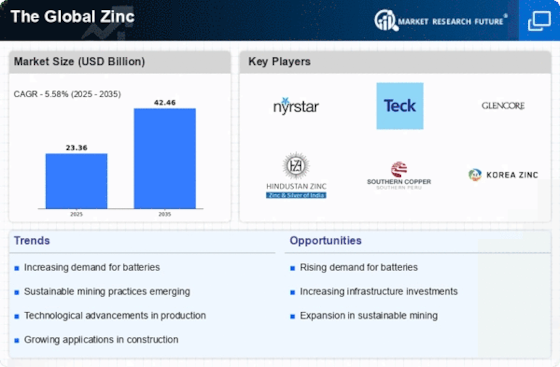
As per Market Research Future analysis, The Global Zinc Market Size was estimated at 23.36 USD Billion in 2024. The zinc industry is projected to grow from 24.66 USD Billion in 2025 to 42.46 USD Billion by 2035, exhibiting a compound annual growth rate (CAGR) of 5.5% during the forecast period 2025 - 2035

Key Market Trends & Highlights

The Global Zinc Market is poised for growth driven by sustainability and technological advancements.

  • North America remains the largest market for zinc, primarily due to robust infrastructure development. Asia-Pacific is emerging as the fastest-growing region, fueled by increasing industrialization and urbanization. The powder segment dominates the market, while the sheet segment is experiencing rapid growth due to diverse applications. Key market drivers include rising demand from the construction sector and advancements in renewable energy initiatives.

Market Size & Forecast

2024 Market Size 23.36 (USD Billion)
2035 Market Size 42.46 (USD Billion)
CAGR (2025 - 2035) 5.58%
Largest Regional Market Share in 2024 Asia Pacific

Major Players

Nyrstar (BE), Teck Resources (CA), Glencore (CH), Hindustan Zinc (IN), Southern Copper Corporation (US), Korea Zinc (KR), Boliden (SE), China Zinc Corporation (CN), Zinc Nacional (MX)

Market Trends

The Global Zinc Market is currently experiencing a dynamic phase characterized by evolving demand patterns and shifting supply dynamics. The increasing utilization of zinc in various industries, particularly in construction and automotive sectors, appears to be driving growth. Additionally, the rising awareness regarding the benefits of zinc in health and nutrition is likely to contribute to its expanding applications. As sustainability becomes a focal point, the market may witness a surge in recycled zinc usage, which could reshape traditional supply chains. Furthermore, geopolitical factors and trade policies may influence the availability and pricing of zinc, adding layers of complexity to market dynamics. In the context of technological advancements, innovations in extraction and processing methods seem to enhance efficiency and reduce environmental impact. This trend may attract investments and foster collaborations among industry players. Overall, The Global Zinc Market is poised for transformation, with various factors intertwining to create a multifaceted landscape that stakeholders must navigate carefully. The interplay of demand, supply, and regulatory frameworks will likely dictate future trajectories, making it essential for market participants to remain vigilant and adaptable to changes.

Sustainability Initiatives

The emphasis on sustainable practices is gaining traction within The Global Zinc Market. Companies are increasingly adopting eco-friendly methods for extraction and processing, which may lead to a rise in the use of recycled zinc. This shift not only addresses environmental concerns but also aligns with global efforts to reduce carbon footprints.

Technological Advancements

Innovations in technology are reshaping The Global Zinc Market. Enhanced extraction techniques and improved processing methods are likely to increase efficiency and reduce costs. These advancements may also facilitate the development of new applications for zinc, further expanding its market reach.

Health and Nutrition Applications

The growing recognition of zinc's health benefits is influencing its demand in The Global Zinc Market. As consumers become more health-conscious, the incorporation of zinc in dietary supplements and fortified foods appears to be on the rise. This trend may open new avenues for market growth.

Zinc Market Market Drivers

Automotive Sector Growth

The automotive industry is undergoing a transformation, with a notable shift towards electric vehicles (EVs) and advanced manufacturing techniques. This evolution is expected to bolster The Global Zinc Industry, as zinc is increasingly utilized in automotive applications for corrosion resistance and lightweighting. In 2025, the automotive sector is anticipated to account for around 20% of total zinc consumption, driven by the need for durable and efficient materials. Furthermore, the integration of zinc in battery production for EVs may further augment its demand. As the automotive sector continues to innovate, The Global Zinc Industry is likely to benefit from these advancements, indicating a promising outlook.

Infrastructure Development

The ongoing expansion of infrastructure projects worldwide appears to be a primary driver for The Global Zinc Industry. Governments and private sectors are investing heavily in construction, transportation, and energy sectors, which require substantial amounts of zinc for galvanization and alloy production. For instance, the demand for zinc in the construction of bridges, roads, and buildings is projected to increase as urbanization accelerates. In 2025, the global consumption of zinc in construction is estimated to reach approximately 13 million metric tons, reflecting a robust growth trajectory. This trend suggests that as infrastructure development continues, The Global Zinc Industry will likely experience sustained demand, thereby enhancing its market dynamics.

Renewable Energy Initiatives

The Global Zinc Industry. Zinc Market plays a crucial role in the production of solar panels and wind turbines, both of which are essential components of sustainable energy systems. In 2025, the demand for zinc in renewable energy applications is projected to increase by approximately 15%, reflecting the growing emphasis on clean energy solutions. This trend suggests that as countries strive to meet their renewable energy targets, The Global Zinc Industry will likely see a corresponding rise in demand, thereby enhancing its overall market potential.

Technological Innovations in Mining

Advancements in mining technologies are poised to reshape The Global Zinc Industry. Innovations such as automation, artificial intelligence, and improved extraction techniques are enhancing the efficiency and sustainability of zinc production. These developments may lead to reduced operational costs and increased output, potentially resulting in a more competitive market landscape. In 2025, the global zinc production is expected to reach approximately 14 million metric tons, driven by these technological improvements. As mining operations become more efficient, The Global Zinc Industry could experience a surge in supply, which may influence pricing and availability in the coming years.

Rising Demand from the Construction Sector

The construction sector's resurgence is likely to be a pivotal driver for The Global Zinc Industry. With increasing investments in residential and commercial projects, the demand for zinc is expected to rise significantly. In 2025, the construction industry is projected to consume around 30% of the total zinc production, primarily for galvanizing steel to prevent corrosion. This trend indicates that as construction activities ramp up globally, The Global Zinc Industry will likely benefit from heightened demand, thereby reinforcing its market position. The interplay between construction growth and zinc consumption suggests a robust future for the industry.

Market Segment Insights

By Form: Powder (Largest) vs. Sheet (Fastest-Growing)

<p>In The Global Zinc, the form segment is primarily divided into Powder and Sheet forms. The Powder segment holds a significant portion of the market, driven by its versatility and widespread applications in industries such as pharmaceuticals, automotive, and construction. It continues to dominate due to its effective properties, including corrosion resistance and ease of application. On the other hand, the Sheet segment, although smaller in comparison, is rapidly gaining traction due to the increasing demand for lightweight materials in various industrial applications. The growth of the Zinc market's form segment is influenced by several factors, including technological advancements in metallurgy and an increased emphasis on sustainability. The Powder form is advancing due to innovations that enhance its performance in various formulations. Meanwhile, the Sheet segment benefits from the burgeoning trends towards the use of zinc in renewable energy applications and automotive structures, positioning it as a key player in meeting future market demands.</p>

<p>Form: Powder (Dominant) vs. Sheet (Emerging)</p>

<p>In The Global Zinc, the Powder form is recognized as the dominant segment due to its extensive utility across various applications. Its primary benefits include the enhancement of product longevity and performance, making it a preferred choice in coatings and electronics. Its adaptability allows for incorporation into diverse formulations, attracting sectors such as manufacturing and construction. On the other hand, the Sheet form is emerging as an important segment, driven by shifts in production techniques and material science advancements. Its lightweight and sturdy nature is particularly appealing in automotive and structural applications, contributing to significant growth potential. As industries seek sustainable and efficient materials, the Sheet segment is expected to capture new market opportunities in the coming years.</p>

By End-Use: Construction (Largest) vs. Transportation (Fastest-Growing)

<p>In The Global Zinc, the distribution of market share among end-use segments reveals that the construction sector holds the largest share, driven by the extensive utilization of zinc in galvanization, roofing, and various construction materials. Following this, the transportation sector is on the rise with significant applications in automotive components and aircraft parts, showcasing a robust growth trend in recent years. This diversification highlights the critical role of zinc in enhancing durability and corrosion resistance in these industries. The growth trends in the end-use segment are fueled by urbanization, infrastructure development, and increasing demand for sustainable and durable materials. The construction sector's growth is underpinned by a booming real estate market and renewable energy projects, while the transportation sector's growth is a result of advancements in technology and a shift towards electric vehicles. As the need for lightweight and corrosion-resistant materials rises, The Global Zinc is poised for significant advancements in both segments.</p>

<p>Construction (Dominant) vs. Transportation (Emerging)</p>

<p>The construction segment of The Global Zinc is characterized by its extensive applications, particularly in galvanization processes that protect steel structures and enhance their lifespan. This segment is dominant due to its established role in the industry, supported by ongoing construction and renovation projects globally. With a focus on sustainability, the construction sector is increasingly adopting zinc for roofing, cladding, and other architectural applications, which emphasizes its beneficial properties such as resistance to corrosion and aesthetic appeal. In contrast, the transportation segment is emerging, gaining traction from innovations in automotive design where zinc is utilized for its lightweight and durability characteristics. As electric vehicles become more prevalent and regulatory standards tighten, the demand for zinc in the transportation sector is expected to grow rapidly, positioning it as a key player in the future of The Global Zinc.</p>

Get more detailed insights about Zinc Market Research Report - Global Forecast till 2035

Regional Insights

North America : Market Leader in Zinc Market Production

North America is a significant player in The Global Zinc Market, driven by robust industrial demand and a focus on sustainable mining practices. The region holds approximately 35% of the global market share, with the United States being the largest contributor, followed by Canada. Regulatory support for mining operations and environmental standards are key growth drivers, fostering innovation and efficiency in production. The competitive landscape is characterized by major players such as Southern Copper Corporation and Teck Resources, which are investing in advanced technologies to enhance production capabilities. The U.S. Geological Survey indicates a steady increase in zinc production, reflecting the region's commitment to meeting both domestic and international demand. The presence of established companies ensures a stable supply chain and fosters competitive pricing in the market.

Europe : Emerging Regulatory Frameworks

Europe is witnessing a transformation in its zinc market, driven by stringent environmental regulations and a shift towards sustainable practices. The region accounts for approximately 25% of the global market share, with Germany and Sweden being the largest contributors. The European Union's Green Deal and various national policies are catalyzing investments in eco-friendly mining technologies, enhancing the region's competitiveness in the global market. Leading countries like Germany and Sweden host key players such as Boliden and Nyrstar, which are adapting to regulatory changes by investing in cleaner production methods. The competitive landscape is evolving, with a focus on recycling and sustainable sourcing of zinc. This shift not only meets regulatory requirements but also aligns with growing consumer demand for environmentally responsible products. The European Commission emphasizes the importance of sustainable mining practices in its reports.

Asia-Pacific : Rapid Growth and Demand Surge

The Asia-Pacific region is experiencing rapid growth in the zinc market, driven by increasing industrialization and urbanization. This region holds approximately 30% of the global market share, with China being the largest consumer and producer of zinc, followed by India. The demand for zinc in construction, automotive, and electronics sectors is propelling market growth, supported by government initiatives to boost infrastructure development. China Zinc Market Corporation and Hindustan Zinc Market are key players in this competitive landscape, focusing on expanding their production capacities to meet rising demand. The region's market dynamics are influenced by fluctuating raw material prices and trade policies, which can impact supply chains. As the region continues to industrialize, the demand for zinc is expected to remain strong, positioning Asia-Pacific as a critical player in the global market.

Middle East and Africa : Resource-Rich Yet Underdeveloped

The Middle East and Africa region holds significant potential in The Global Zinc Market, yet it remains underdeveloped compared to other regions. This area accounts for about 10% of the global market share, with South Africa and Morocco leading in production. The region's growth is driven by increasing investments in mining infrastructure and a focus on resource extraction, supported by government initiatives to attract foreign investment. Countries like South Africa are home to key players such as Zinc Market Nacional, which are working to enhance production capabilities and explore new mining opportunities. The competitive landscape is evolving, with a growing emphasis on sustainable practices and local community engagement. As the region seeks to capitalize on its mineral wealth, the zinc market is poised for growth, driven by both domestic and international demand.

Key Players and Competitive Insights

Major competitors in the global zinc market employ crucial strategies like partnership deals, mergers and acquisitions, expansion deals, and huge investment rounds to expand their business operations. Some of the key competitors in this market are listed below.

Key Companies in the Zinc Market include

Industry Developments

  • Q1 2025: Ivanhoe Mines reopens Kipushi zinc mine in Democratic Republic of Congo Ivanhoe Mines has reopened the Kipushi mine, which is expected to produce 278,000 tonnes of zinc per year over its first five years, making it Africa's largest zinc mine and the fourth-largest globally.
  • Q1 2025: Boliden ramps up output at Odda zinc smelter in Norway Boliden's Odda smelter in Norway is expanding production, contributing to increased zinc concentrate supply in early 2025.
  • Q1 2025: Production resumes at Tara zinc mine in Ireland The Tara zinc mine in Ireland has resumed operations, adding to European zinc supply and supporting the global increase in mined zinc output.
  • Q1 2025: Ozerneoye zinc plant opens in Russia Russia's zinc production is set to rise following the opening of the Ozerneoye plant, which will contribute to global supply growth in 2025.
  • Q1 2025: New zinc mine capacity launches in Australia, China, Mexico, and DRC New zinc mine capacity is coming online in Australia, China, Mexico, and the Democratic Republic of Congo, driving a forecasted 4.3% increase in global zinc mine production for 2025.
  • Q1 2025: Global zinc mine production to increase by 4.3% in 2025 The International Lead and Zinc Market Study Group (ILZSG) reports that global zinc mine production will rise by 4.3% to 12.43 million tonnes in 2025, supported by new capacity in several countries.
  • Q1 2025: US implements new tariffs affecting zinc trade in early 2025 The US government has introduced new tariffs in 2025 to address trade imbalances, impacting zinc market fundamentals and contributing to price volatility.
  • Q1 2025: Ex-China zinc concentrate production rises 6.47% in Q1 2025 Ex-China zinc concentrate production increased by 6.47% in the first quarter of 2025, reaching 1.3 million metric tons, driven by resumed operations at key mines.

Future Outlook

Zinc Market Future Outlook

The Global Zinc Market is projected to grow at a 5.58% CAGR from 2025 to 2035, driven by increasing demand in construction, automotive, and renewable energy sectors.

New opportunities lie in:

  • Expansion into emerging markets with high infrastructure needs.
  • Development of zinc-based battery technologies for energy storage.
  • Investment in sustainable mining practices to enhance supply chain resilience.

By 2035, the market is expected to solidify its position as a key player in various industrial applications.

Market Segmentation

Zinc Market Form Outlook

  • Powder
  • Sheet

Zinc Market End-Use Outlook

  • Construction
  • Transportation
  • Consumer Goods

Report Scope

MARKET SIZE 2024 23.36(USD Billion)
MARKET SIZE 2025 24.66(USD Billion)
MARKET SIZE 2035 42.46(USD Billion)
COMPOUND ANNUAL GROWTH RATE (CAGR) 5.58% (2025 - 2035)
REPORT COVERAGE Revenue Forecast, Competitive Landscape, Growth Factors, and Trends
BASE YEAR 2024
Market Forecast Period 2025 - 2035
Historical Data 2019 - 2024
Market Forecast Units USD Billion
Key Companies Profiled Nyrstar (BE), Teck Resources (CA), Glencore (CH), Hindustan Zinc (IN), Southern Copper Corporation (US), Korea Zinc (KR), Boliden (SE), China Zinc Corporation (CN), Zinc Nacional (MX)
Segments Covered Form
Key Market Opportunities Growing demand for sustainable zinc applications in renewable energy and electric vehicle sectors.
Key Market Dynamics Rising demand for galvanized steel drives competition and innovation in zinc production and processing technologies.
Countries Covered North America, Europe, APAC, South America, MEA

FAQs

What is the current valuation of The Global Zinc?

<p>The Global Zinc was valued at 23.36 USD Billion in 2024.</p>

What is the projected market valuation for The Global Zinc in 2035?

<p>The market is projected to reach a valuation of 42.46 USD Billion by 2035.</p>

What is the expected CAGR for The Global Zinc from 2025 to 2035?

<p>The expected CAGR for The Global Zinc during the forecast period 2025 - 2035 is 5.58%.</p>

Which companies are considered key players in The Global Zinc?

<p>Key players in the market include Nyrstar, Teck Resources, Glencore, Hindustan Zinc, Southern Copper Corporation, Korea Zinc, Boliden, China Zinc Corporation, and Zinc Nacional.</p>

What are the primary segments of The Global Zinc?

<p>The primary segments of The Global Zinc include Form and End-Use.</p>

What is the valuation of the Powder segment in The Global Zinc?

The Powder segment was valued at 10.0 USD Billion in 2024 and is projected to reach 18.0 USD Billion by 2035.

How does the Sheet segment perform in terms of market valuation?

The Sheet segment had a valuation of 13.36 USD Billion in 2024 and is expected to grow to 24.46 USD Billion by 2035.

What is the market valuation for the Construction end-use segment?

The Construction end-use segment was valued at 8.0 USD Billion in 2024 and is projected to reach 15.0 USD Billion by 2035.

What is the expected growth for the Transportation end-use segment?

The Transportation end-use segment had a valuation of 7.0 USD Billion in 2024 and is expected to grow to 12.0 USD Billion by 2035.

What is the projected valuation for the Consumer Goods end-use segment?

The Consumer Goods end-use segment was valued at 8.36 USD Billion in 2024 and is projected to reach 15.46 USD Billion by 2035.

  1. SECTION I: EXECUTIVE SUMMARY AND KEY HIGHLIGHTS
    1. | 1.1 EXECUTIVE SUMMARY
    2. | | 1.1.1 Market Overview
    3. | | 1.1.2 Key Findings
    4. | | 1.1.3 Market Segmentation
    5. | | 1.1.4 Competitive Landscape
    6. | | 1.1.5 Challenges and Opportunities
    7. | | 1.1.6 Future Outlook
  2. SECTION II: SCOPING, METHODOLOGY AND MARKET STRUCTURE
    1. | 2.1 MARKET INTRODUCTION
    2. | | 2.1.1 Definition
    3. | | 2.1.2 Scope of the study
    4. | | | 2.1.2.1 Research Objective
    5. | | | 2.1.2.2 Assumption
    6. | | | 2.1.2.3 Limitations
    7. | 2.2 RESEARCH METHODOLOGY
    8. | | 2.2.1 Overview
    9. | | 2.2.2 Data Mining
    10. | | 2.2.3 Secondary Research
    11. | | 2.2.4 Primary Research
    12. | | | 2.2.4.1 Primary Interviews and Information Gathering Process
    13. | | | 2.2.4.2 Breakdown of Primary Respondents
    14. | | 2.2.5 Forecasting Model
    15. | | 2.2.6 Market Size Estimation
    16. | | | 2.2.6.1 Bottom-Up Approach
    17. | | | 2.2.6.2 Top-Down Approach
    18. | | 2.2.7 Data Triangulation
    19. | | 2.2.8 Validation
  3. SECTION III: QUALITATIVE ANALYSIS
    1. | 3.1 MARKET DYNAMICS
    2. | | 3.1.1 Overview
    3. | | 3.1.2 Drivers
    4. | | 3.1.3 Restraints
    5. | | 3.1.4 Opportunities
    6. | 3.2 MARKET FACTOR ANALYSIS
    7. | | 3.2.1 Value chain Analysis
    8. | | 3.2.2 Porter's Five Forces Analysis
    9. | | | 3.2.2.1 Bargaining Power of Suppliers
    10. | | | 3.2.2.2 Bargaining Power of Buyers
    11. | | | 3.2.2.3 Threat of New Entrants
    12. | | | 3.2.2.4 Threat of Substitutes
    13. | | | 3.2.2.5 Intensity of Rivalry
    14. | | 3.2.3 COVID-19 Impact Analysis
    15. | | | 3.2.3.1 Market Impact Analysis
    16. | | | 3.2.3.2 Regional Impact
    17. | | | 3.2.3.3 Opportunity and Threat Analysis
  4. SECTION IV: QUANTITATIVE ANALYSIS
    1. | 4.1 Chemicals and Materials, BY Form (USD Billion)
    2. | | 4.1.1 Powder
    3. | | 4.1.2 Sheet
    4. | 4.2 Chemicals and Materials, BY End-Use (USD Billion)
    5. | | 4.2.1 Construction
    6. | | 4.2.2 Transportation
    7. | | 4.2.3 Consumer Goods
    8. | 4.3 Chemicals and Materials, BY Region (USD Billion)
    9. | | 4.3.1 North America
    10. | | | 4.3.1.1 US
    11. | | | 4.3.1.2 Canada
    12. | | 4.3.2 Europe
    13. | | | 4.3.2.1 Germany
    14. | | | 4.3.2.2 UK
    15. | | | 4.3.2.3 France
    16. | | | 4.3.2.4 Russia
    17. | | | 4.3.2.5 Italy
    18. | | | 4.3.2.6 Spain
    19. | | | 4.3.2.7 Rest of Europe
    20. | | 4.3.3 APAC
    21. | | | 4.3.3.1 China
    22. | | | 4.3.3.2 India
    23. | | | 4.3.3.3 Japan
    24. | | | 4.3.3.4 South Korea
    25. | | | 4.3.3.5 Malaysia
    26. | | | 4.3.3.6 Thailand
    27. | | | 4.3.3.7 Indonesia
    28. | | | 4.3.3.8 Rest of APAC
    29. | | 4.3.4 South America
    30. | | | 4.3.4.1 Brazil
    31. | | | 4.3.4.2 Mexico
    32. | | | 4.3.4.3 Argentina
    33. | | | 4.3.4.4 Rest of South America
    34. | | 4.3.5 MEA
    35. | | | 4.3.5.1 GCC Countries
    36. | | | 4.3.5.2 South Africa
    37. | | | 4.3.5.3 Rest of MEA
  5. SECTION V: COMPETITIVE ANALYSIS
    1. | 5.1 Competitive Landscape
    2. | | 5.1.1 Overview
    3. | | 5.1.2 Competitive Analysis
    4. | | 5.1.3 Market share Analysis
    5. | | 5.1.4 Major Growth Strategy in the Chemicals and Materials
    6. | | 5.1.5 Competitive Benchmarking
    7. | | 5.1.6 Leading Players in Terms of Number of Developments in the Chemicals and Materials
    8. | | 5.1.7 Key developments and growth strategies
    9. | | | 5.1.7.1 New Product Launch/Service Deployment
    10. | | | 5.1.7.2 Merger & Acquisitions
    11. | | | 5.1.7.3 Joint Ventures
    12. | | 5.1.8 Major Players Financial Matrix
    13. | | | 5.1.8.1 Sales and Operating Income
    14. | | | 5.1.8.2 Major Players R&D Expenditure. 2023
    15. | 5.2 Company Profiles
    16. | | 5.2.1 Nyrstar (BE)
    17. | | | 5.2.1.1 Financial Overview
    18. | | | 5.2.1.2 Products Offered
    19. | | | 5.2.1.3 Key Developments
    20. | | | 5.2.1.4 SWOT Analysis
    21. | | | 5.2.1.5 Key Strategies
    22. | | 5.2.2 Teck Resources (CA)
    23. | | | 5.2.2.1 Financial Overview
    24. | | | 5.2.2.2 Products Offered
    25. | | | 5.2.2.3 Key Developments
    26. | | | 5.2.2.4 SWOT Analysis
    27. | | | 5.2.2.5 Key Strategies
    28. | | 5.2.3 Glencore (CH)
    29. | | | 5.2.3.1 Financial Overview
    30. | | | 5.2.3.2 Products Offered
    31. | | | 5.2.3.3 Key Developments
    32. | | | 5.2.3.4 SWOT Analysis
    33. | | | 5.2.3.5 Key Strategies
    34. | | 5.2.4 Hindustan Zinc (IN)
    35. | | | 5.2.4.1 Financial Overview
    36. | | | 5.2.4.2 Products Offered
    37. | | | 5.2.4.3 Key Developments
    38. | | | 5.2.4.4 SWOT Analysis
    39. | | | 5.2.4.5 Key Strategies
    40. | | 5.2.5 Southern Copper Corporation (US)
    41. | | | 5.2.5.1 Financial Overview
    42. | | | 5.2.5.2 Products Offered
    43. | | | 5.2.5.3 Key Developments
    44. | | | 5.2.5.4 SWOT Analysis
    45. | | | 5.2.5.5 Key Strategies
    46. | | 5.2.6 Korea Zinc (KR)
    47. | | | 5.2.6.1 Financial Overview
    48. | | | 5.2.6.2 Products Offered
    49. | | | 5.2.6.3 Key Developments
    50. | | | 5.2.6.4 SWOT Analysis
    51. | | | 5.2.6.5 Key Strategies
    52. | | 5.2.7 Boliden (SE)
    53. | | | 5.2.7.1 Financial Overview
    54. | | | 5.2.7.2 Products Offered
    55. | | | 5.2.7.3 Key Developments
    56. | | | 5.2.7.4 SWOT Analysis
    57. | | | 5.2.7.5 Key Strategies
    58. | | 5.2.8 China Zinc Corporation (CN)
    59. | | | 5.2.8.1 Financial Overview
    60. | | | 5.2.8.2 Products Offered
    61. | | | 5.2.8.3 Key Developments
    62. | | | 5.2.8.4 SWOT Analysis
    63. | | | 5.2.8.5 Key Strategies
    64. | | 5.2.9 Zinc Nacional (MX)
    65. | | | 5.2.9.1 Financial Overview
    66. | | | 5.2.9.2 Products Offered
    67. | | | 5.2.9.3 Key Developments
    68. | | | 5.2.9.4 SWOT Analysis
    69. | | | 5.2.9.5 Key Strategies
    70. | 5.3 Appendix
    71. | | 5.3.1 References
    72. | | 5.3.2 Related Reports
  6. LIST OF FIGURES
    1. | 6.1 MARKET SYNOPSIS
    2. | 6.2 NORTH AMERICA MARKET ANALYSIS
    3. | 6.3 US MARKET ANALYSIS BY FORM
    4. | 6.4 US MARKET ANALYSIS BY END-USE
    5. | 6.5 CANADA MARKET ANALYSIS BY FORM
    6. | 6.6 CANADA MARKET ANALYSIS BY END-USE
    7. | 6.7 EUROPE MARKET ANALYSIS
    8. | 6.8 GERMANY MARKET ANALYSIS BY FORM
    9. | 6.9 GERMANY MARKET ANALYSIS BY END-USE
    10. | 6.10 UK MARKET ANALYSIS BY FORM
    11. | 6.11 UK MARKET ANALYSIS BY END-USE
    12. | 6.12 FRANCE MARKET ANALYSIS BY FORM
    13. | 6.13 FRANCE MARKET ANALYSIS BY END-USE
    14. | 6.14 RUSSIA MARKET ANALYSIS BY FORM
    15. | 6.15 RUSSIA MARKET ANALYSIS BY END-USE
    16. | 6.16 ITALY MARKET ANALYSIS BY FORM
    17. | 6.17 ITALY MARKET ANALYSIS BY END-USE
    18. | 6.18 SPAIN MARKET ANALYSIS BY FORM
    19. | 6.19 SPAIN MARKET ANALYSIS BY END-USE
    20. | 6.20 REST OF EUROPE MARKET ANALYSIS BY FORM
    21. | 6.21 REST OF EUROPE MARKET ANALYSIS BY END-USE
    22. | 6.22 APAC MARKET ANALYSIS
    23. | 6.23 CHINA MARKET ANALYSIS BY FORM
    24. | 6.24 CHINA MARKET ANALYSIS BY END-USE
    25. | 6.25 INDIA MARKET ANALYSIS BY FORM
    26. | 6.26 INDIA MARKET ANALYSIS BY END-USE
    27. | 6.27 JAPAN MARKET ANALYSIS BY FORM
    28. | 6.28 JAPAN MARKET ANALYSIS BY END-USE
    29. | 6.29 SOUTH KOREA MARKET ANALYSIS BY FORM
    30. | 6.30 SOUTH KOREA MARKET ANALYSIS BY END-USE
    31. | 6.31 MALAYSIA MARKET ANALYSIS BY FORM
    32. | 6.32 MALAYSIA MARKET ANALYSIS BY END-USE
    33. | 6.33 THAILAND MARKET ANALYSIS BY FORM
    34. | 6.34 THAILAND MARKET ANALYSIS BY END-USE
    35. | 6.35 INDONESIA MARKET ANALYSIS BY FORM
    36. | 6.36 INDONESIA MARKET ANALYSIS BY END-USE
    37. | 6.37 REST OF APAC MARKET ANALYSIS BY FORM
    38. | 6.38 REST OF APAC MARKET ANALYSIS BY END-USE
    39. | 6.39 SOUTH AMERICA MARKET ANALYSIS
    40. | 6.40 BRAZIL MARKET ANALYSIS BY FORM
    41. | 6.41 BRAZIL MARKET ANALYSIS BY END-USE
    42. | 6.42 MEXICO MARKET ANALYSIS BY FORM
    43. | 6.43 MEXICO MARKET ANALYSIS BY END-USE
    44. | 6.44 ARGENTINA MARKET ANALYSIS BY FORM
    45. | 6.45 ARGENTINA MARKET ANALYSIS BY END-USE
    46. | 6.46 REST OF SOUTH AMERICA MARKET ANALYSIS BY FORM
    47. | 6.47 REST OF SOUTH AMERICA MARKET ANALYSIS BY END-USE
    48. | 6.48 MEA MARKET ANALYSIS
    49. | 6.49 GCC COUNTRIES MARKET ANALYSIS BY FORM
    50. | 6.50 GCC COUNTRIES MARKET ANALYSIS BY END-USE
    51. | 6.51 SOUTH AFRICA MARKET ANALYSIS BY FORM
    52. | 6.52 SOUTH AFRICA MARKET ANALYSIS BY END-USE
    53. | 6.53 REST OF MEA MARKET ANALYSIS BY FORM
    54. | 6.54 REST OF MEA MARKET ANALYSIS BY END-USE
    55. | 6.55 KEY BUYING CRITERIA OF CHEMICALS AND MATERIALS
    56. | 6.56 RESEARCH PROCESS OF MRFR
    57. | 6.57 DRO ANALYSIS OF CHEMICALS AND MATERIALS
    58. | 6.58 DRIVERS IMPACT ANALYSIS: CHEMICALS AND MATERIALS
    59. | 6.59 RESTRAINTS IMPACT ANALYSIS: CHEMICALS AND MATERIALS
    60. | 6.60 SUPPLY / VALUE CHAIN: CHEMICALS AND MATERIALS
    61. | 6.61 CHEMICALS AND MATERIALS, BY FORM, 2024 (% SHARE)
    62. | 6.62 CHEMICALS AND MATERIALS, BY FORM, 2024 TO 2035 (USD Billion)
    63. | 6.63 CHEMICALS AND MATERIALS, BY END-USE, 2024 (% SHARE)
    64. | 6.64 CHEMICALS AND MATERIALS, BY END-USE, 2024 TO 2035 (USD Billion)
    65. | 6.65 BENCHMARKING OF MAJOR COMPETITORS
  7. LIST OF TABLES
    1. | 7.1 LIST OF ASSUMPTIONS
    2. | | 7.1.1
    3. | 7.2 North America MARKET SIZE ESTIMATES; FORECAST
    4. | | 7.2.1 BY FORM, 2025-2035 (USD Billion)
    5. | | 7.2.2 BY END-USE, 2025-2035 (USD Billion)
    6. | 7.3 US MARKET SIZE ESTIMATES; FORECAST
    7. | | 7.3.1 BY FORM, 2025-2035 (USD Billion)
    8. | | 7.3.2 BY END-USE, 2025-2035 (USD Billion)
    9. | 7.4 Canada MARKET SIZE ESTIMATES; FORECAST
    10. | | 7.4.1 BY FORM, 2025-2035 (USD Billion)
    11. | | 7.4.2 BY END-USE, 2025-2035 (USD Billion)
    12. | 7.5 Europe MARKET SIZE ESTIMATES; FORECAST
    13. | | 7.5.1 BY FORM, 2025-2035 (USD Billion)
    14. | | 7.5.2 BY END-USE, 2025-2035 (USD Billion)
    15. | 7.6 Germany MARKET SIZE ESTIMATES; FORECAST
    16. | | 7.6.1 BY FORM, 2025-2035 (USD Billion)
    17. | | 7.6.2 BY END-USE, 2025-2035 (USD Billion)
    18. | 7.7 UK MARKET SIZE ESTIMATES; FORECAST
    19. | | 7.7.1 BY FORM, 2025-2035 (USD Billion)
    20. | | 7.7.2 BY END-USE, 2025-2035 (USD Billion)
    21. | 7.8 France MARKET SIZE ESTIMATES; FORECAST
    22. | | 7.8.1 BY FORM, 2025-2035 (USD Billion)
    23. | | 7.8.2 BY END-USE, 2025-2035 (USD Billion)
    24. | 7.9 Russia MARKET SIZE ESTIMATES; FORECAST
    25. | | 7.9.1 BY FORM, 2025-2035 (USD Billion)
    26. | | 7.9.2 BY END-USE, 2025-2035 (USD Billion)
    27. | 7.10 Italy MARKET SIZE ESTIMATES; FORECAST
    28. | | 7.10.1 BY FORM, 2025-2035 (USD Billion)
    29. | | 7.10.2 BY END-USE, 2025-2035 (USD Billion)
    30. | 7.11 Spain MARKET SIZE ESTIMATES; FORECAST
    31. | | 7.11.1 BY FORM, 2025-2035 (USD Billion)
    32. | | 7.11.2 BY END-USE, 2025-2035 (USD Billion)
    33. | 7.12 Rest of Europe MARKET SIZE ESTIMATES; FORECAST
    34. | | 7.12.1 BY FORM, 2025-2035 (USD Billion)
    35. | | 7.12.2 BY END-USE, 2025-2035 (USD Billion)
    36. | 7.13 APAC MARKET SIZE ESTIMATES; FORECAST
    37. | | 7.13.1 BY FORM, 2025-2035 (USD Billion)
    38. | | 7.13.2 BY END-USE, 2025-2035 (USD Billion)
    39. | 7.14 China MARKET SIZE ESTIMATES; FORECAST
    40. | | 7.14.1 BY FORM, 2025-2035 (USD Billion)
    41. | | 7.14.2 BY END-USE, 2025-2035 (USD Billion)
    42. | 7.15 India MARKET SIZE ESTIMATES; FORECAST
    43. | | 7.15.1 BY FORM, 2025-2035 (USD Billion)
    44. | | 7.15.2 BY END-USE, 2025-2035 (USD Billion)
    45. | 7.16 Japan MARKET SIZE ESTIMATES; FORECAST
    46. | | 7.16.1 BY FORM, 2025-2035 (USD Billion)
    47. | | 7.16.2 BY END-USE, 2025-2035 (USD Billion)
    48. | 7.17 South Korea MARKET SIZE ESTIMATES; FORECAST
    49. | | 7.17.1 BY FORM, 2025-2035 (USD Billion)
    50. | | 7.17.2 BY END-USE, 2025-2035 (USD Billion)
    51. | 7.18 Malaysia MARKET SIZE ESTIMATES; FORECAST
    52. | | 7.18.1 BY FORM, 2025-2035 (USD Billion)
    53. | | 7.18.2 BY END-USE, 2025-2035 (USD Billion)
    54. | 7.19 Thailand MARKET SIZE ESTIMATES; FORECAST
    55. | | 7.19.1 BY FORM, 2025-2035 (USD Billion)
    56. | | 7.19.2 BY END-USE, 2025-2035 (USD Billion)
    57. | 7.20 Indonesia MARKET SIZE ESTIMATES; FORECAST
    58. | | 7.20.1 BY FORM, 2025-2035 (USD Billion)
    59. | | 7.20.2 BY END-USE, 2025-2035 (USD Billion)
    60. | 7.21 Rest of APAC MARKET SIZE ESTIMATES; FORECAST
    61. | | 7.21.1 BY FORM, 2025-2035 (USD Billion)
    62. | | 7.21.2 BY END-USE, 2025-2035 (USD Billion)
    63. | 7.22 South America MARKET SIZE ESTIMATES; FORECAST
    64. | | 7.22.1 BY FORM, 2025-2035 (USD Billion)
    65. | | 7.22.2 BY END-USE, 2025-2035 (USD Billion)
    66. | 7.23 Brazil MARKET SIZE ESTIMATES; FORECAST
    67. | | 7.23.1 BY FORM, 2025-2035 (USD Billion)
    68. | | 7.23.2 BY END-USE, 2025-2035 (USD Billion)
    69. | 7.24 Mexico MARKET SIZE ESTIMATES; FORECAST
    70. | | 7.24.1 BY FORM, 2025-2035 (USD Billion)
    71. | | 7.24.2 BY END-USE, 2025-2035 (USD Billion)
    72. | 7.25 Argentina MARKET SIZE ESTIMATES; FORECAST
    73. | | 7.25.1 BY FORM, 2025-2035 (USD Billion)
    74. | | 7.25.2 BY END-USE, 2025-2035 (USD Billion)
    75. | 7.26 Rest of South America MARKET SIZE ESTIMATES; FORECAST
    76. | | 7.26.1 BY FORM, 2025-2035 (USD Billion)
    77. | | 7.26.2 BY END-USE, 2025-2035 (USD Billion)
    78. | 7.27 MEA MARKET SIZE ESTIMATES; FORECAST
    79. | | 7.27.1 BY FORM, 2025-2035 (USD Billion)
    80. | | 7.27.2 BY END-USE, 2025-2035 (USD Billion)
    81. | 7.28 GCC Countries MARKET SIZE ESTIMATES; FORECAST
    82. | | 7.28.1 BY FORM, 2025-2035 (USD Billion)
    83. | | 7.28.2 BY END-USE, 2025-2035 (USD Billion)
    84. | 7.29 South Africa MARKET SIZE ESTIMATES; FORECAST
    85. | | 7.29.1 BY FORM, 2025-2035 (USD Billion)
    86. | | 7.29.2 BY END-USE, 2025-2035 (USD Billion)
    87. | 7.30 Rest of MEA MARKET SIZE ESTIMATES; FORECAST
    88. | | 7.30.1 BY FORM, 2025-2035 (USD Billion)
    89. | | 7.30.2 BY END-USE, 2025-2035 (USD Billion)
    90. | 7.31 PRODUCT LAUNCH/PRODUCT DEVELOPMENT/APPROVAL
    91. | | 7.31.1
    92. | 7.32 ACQUISITION/PARTNERSHIP
    93. | | 7.32.1

Chemicals and Materials Market Segmentation

Chemicals and Materials By Form (USD Billion, 2025-2035)

  • Powder
  • Sheet

Chemicals and Materials By End-Use (USD Billion, 2025-2035)

  • Construction
  • Transportation
  • Consumer Goods
Infographic

Free Sample Request

Kindly complete the form below to receive a free sample of this Report

Get Free Sample

Customer Strories

Compare Licence

×
Features License Type
Single User Multiuser License Enterprise User
Price $4,950 $5,950 $7,250
Maximum User Access Limit 1 User Upto 10 Users Unrestricted Access Throughout the Organization
Free Customization
Direct Access to Analyst
Deliverable Format
Platform Access
Discount on Next Purchase 10% 15% 15%
Printable Versions