×
Request Free Sample ×

Kindly complete the form below to receive a free sample of this Report

* Please use a valid business email

Leading companies partner with us for data-driven Insights

clients tt-cursor
Hero Background
English
Chinese
French
Japanese
Korean
German
Spanish

Web3 Marketing Market Size

ID: MRFR/ICT/10723-CR
137 Pages
Aarti Dhapte
December 2024

Web3 Marketing Market Research Report By Type (Public ,Private, Consortium, Hybrid), By application (NFT Marketing, Metaverse Marketing, Content Marketing, social media marketing, influencer marketing, public relations, pay-per-click marketing, and others),By Industry Vertical (BFSI, Retail & e-Commerce, Media & Entertainment, pharmaceuticals, IT & Telecom, and others) and By Region (North America, Europe, Asia-Pacific, Middle East and Africa, South America) –Market Forecast Till 2035

Share:
Download PDF ×

We do not share your information with anyone. However, we may send you emails based on your report interest from time to time. You may contact us at any time to opt-out.

Web3 Marketing Market Infographic
Purchase Options

Web3ing Size

Web3 Marketing Market Growth Projections and Opportunities

The size of the Web3 marketing market is shifting gears due to changes in how the internet functions and the coming of decentralized innovations. It is the next stage of the World Wide Web that combines blockchain technology, decentralized protocols and user-centered digital experience. When it comes to marketing, Web3 brings about new trends that are all about putting customer data back where it belongs, privacy in a higher value than before and centralized platforms. Web3 marketing’s dynamic nature can be attributed to several factors.

Firstly, a key mover in this sphere is user sovereignty and data ownership, these are two core drivers of progress in Web3 marketing unlike traditional models which allow for centralization of users’ data through few plat forms hence web 3 puts more emphasis on allowing users to control personal information and use their personal information securely. This change has necessitated transparency as the basis of any effective promotion strategy thus businesses must abide by open and permissioned based ways if sharing information.

Blockchain technology which sits at the core of Web3 plays a major role in shaping its market dynamics.. Blockchain offers transparent tamper-resistant ledger that can be used for various marketing uses such as supply chain transparency, authentication of digital assets or even dApps creation. Smart contracts are self-executing contracts with terms directly written into code enabling trustless transactions without intermediaries between marketers like advertisers, content distributors or affiliates. Web3 marketing market dynamics are also driven by rise in decentralized finance (DeFi) within the ecosystem. DeFi platforms are powered by blockchain technology offering financial services outside conventional intermediaries. This shift creates opportunities for innovative methods of advertising such as Decentralized Autonomous Organizations (DAOs) where community members have influence over decision-making and governance . Furthermore, the concept of decentralized platforms as well as social tokens also plays a major role in ongoing dynamics observed in relation to web 3 marketing. This notion has given raise to community-owned or brand owned currencies referred to as social tokens which allow new forms of fan engagement and monetization . Decentralizing social media sites use blockchain so that users have more control over their information. Also, integration of artificial intelligence (AI) together with machine learning within Web3 borne marketing is another impacting factor towards market trends. AI-powered algorithms combined with decentralized data sources enable personalized targeted approaches to advertising.. The automation of marketing processes through smart contracts powered by AI enhances optimization of advertisement campaigns and the creation dynamic data-driven costumer experiences within the realm of Web3. The dynamics of Web3 marketing are influenced by an increasing global awareness and interest in decentralized technologies. The need for Web3 solutions that prioritize user empowerment is on the rise as privacy concerns and data ownership become more significant to individuals. Brands and marketers are being driven toward embracing Web3 principles, using decentralized marketing strategies as a way of staying ahead in a rapidly changing digital world.

Web3 Marketing Market Size Graph
Author
Aarti Dhapte
Team Lead - Research

She holds an experience of about 6+ years in Market Research and Business Consulting, working under the spectrum of Information Communication Technology, Telecommunications and Semiconductor domains. Aarti conceptualizes and implements a scalable business strategy and provides strategic leadership to the clients. Her expertise lies in market estimation, competitive intelligence, pipeline analysis, customer assessment, etc.

Leave a Comment

FAQs

How much is the Web3 Marketing Market?

The Web3 Marketing Market size is expected to be valued at USD 1,588.9 Million in 2023.

What is the growth rate of the Web3 Marketing Market?

The global market is projected to grow at a CAGR of 26.5% during the forecast period, 2024-2032.

Which region held the largest market share in the Web3 Marketing Market?

North America had the largest share of the global market.

Who are the key players in the Web3 Marketing Market?

The key players in the market are Roketto, Coinbound, Crowdcreate, Single Grain, Blockwiz, Lunar Strategy, Ninja Promo, Rehab Agency, Kryptonite, CryptoArmy, ICODA, Viral Nation, NeoReach, NinjaPromo, TechnoSuite, GuerrillaBuzz.

Which Type led the Web3 Marketing Market?

The Private segment dominated the market in 2023.

Market Summary

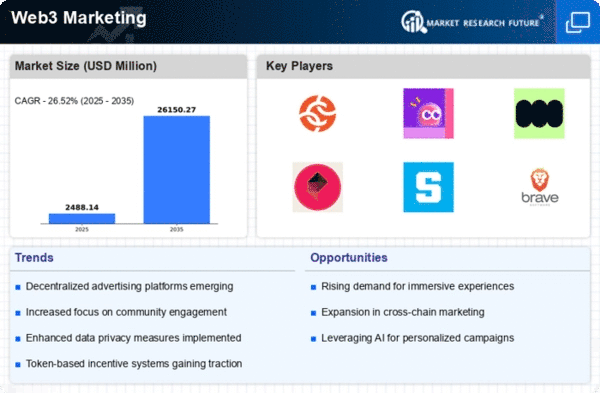
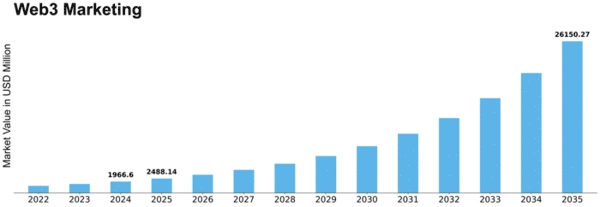
As per MRFR analysis, the Web3 Marketing Market Size was estimated at 1966.6 USD Million in 2024. The Web3 Marketing industry is projected to grow from 2488.15 in 2025 to 26150.27 by 2035, exhibiting a compound annual growth rate (CAGR) of 26.52% during the forecast period 2025 - 2035.

Key Market Trends & Highlights

The Web3 Marketing Market is evolving towards decentralized engagement and privacy-centric strategies.

  • Decentralized community engagement is becoming a cornerstone of marketing strategies in North America.
  • Privacy-centric marketing strategies are gaining traction, particularly among cryptocurrency enthusiasts.
  • The integration of NFTs in marketing is witnessing rapid adoption, especially in the Asia-Pacific region.
  • The rise of decentralized applications and the increased focus on data privacy are driving market growth.

Market Size & Forecast

2024 Market Size 1966.6 (USD Million)
2035 Market Size 26150.27 (USD Million)
CAGR (2025 - 2035) 26.52%
Largest Regional Market Share in 2024 North America

Major Players

Chainalysis (US), Dapper Labs (CA), Consensys (US), Polygon (IN), The Sandbox (FR), Brave Software (US), Immutable (AU), Audius (US), Enjin (SG)

Market Trends

The Web3 Marketing Market is currently experiencing a transformative phase, characterized by the integration of decentralized technologies and innovative marketing strategies. This market appears to be driven by the increasing adoption of blockchain technology, which facilitates transparency and trust in digital transactions. As businesses seek to engage with consumers in more meaningful ways, the emphasis on community-driven marketing strategies has become more pronounced. Companies are leveraging decentralized platforms to foster direct relationships with their audiences, thereby enhancing brand loyalty and customer engagement. Furthermore, the rise of non-fungible tokens (NFTs) and decentralized finance (DeFi) is reshaping how brands interact with consumers, creating new avenues for marketing and engagement. In addition, the Web3 Marketing Market seems to be influenced by the growing demand for privacy and data security. Consumers are becoming more aware of their digital footprints, prompting brands to adopt privacy-centric marketing approaches. This shift indicates a potential move towards more ethical marketing practices, where user consent and data protection are prioritized. As the landscape evolves, businesses that adapt to these changes may find themselves better positioned to thrive in this dynamic environment. Overall, the Web3 Marketing Market is poised for continued growth, driven by technological advancements and changing consumer expectations.

Decentralized Community Engagement

The trend towards decentralized community engagement highlights the importance of building authentic relationships between brands and consumers. Companies are increasingly utilizing decentralized platforms to create interactive experiences that foster community involvement and loyalty. This approach not only enhances customer satisfaction but also encourages user-generated content, which can amplify brand visibility.

Privacy-Centric Marketing Strategies

As consumers become more conscious of their data privacy, brands are shifting towards privacy-centric marketing strategies. This trend emphasizes the need for transparency and user consent in data collection practices. By prioritizing consumer privacy, companies can build trust and enhance their reputation, potentially leading to increased customer loyalty.

Integration of NFTs in Marketing

The integration of non-fungible tokens (NFTs) into marketing strategies represents a novel approach to brand engagement. Brands are exploring the use of NFTs to create unique digital assets that resonate with consumers. This trend not only provides new revenue streams but also allows for innovative storytelling and deeper connections with audiences.

Web3 Marketing Market Market Drivers

Market Growth Projections

The Global Web3 Marketing Market Industry is poised for substantial growth, with projections indicating a market size of 1.97 USD Billion in 2024 and an impressive increase to 26.1 USD Billion by 2035. This growth trajectory suggests a compound annual growth rate of 26.49% from 2025 to 2035, highlighting the increasing importance of Web3 technologies in marketing strategies. As businesses adapt to the evolving landscape, the integration of decentralized technologies into marketing practices is likely to become a standard approach. This chart illustrates the anticipated growth, emphasizing the potential for innovation and investment in the Web3 marketing sector.

Emergence of New Revenue Models

The emergence of new revenue models, such as tokenization and decentralized finance (DeFi), is reshaping the Global Web3 Marketing Market Industry. These models allow businesses to explore innovative ways to monetize their products and services, creating new opportunities for marketers. For instance, brands are now able to issue tokens that provide users with unique benefits, fostering loyalty and engagement. As these models gain traction, marketing strategies must evolve to effectively communicate the value propositions associated with them. The market's projected growth indicates that these new revenue streams will play a crucial role in shaping future marketing efforts.

Increased Focus on Consumer Privacy

Consumer privacy concerns are driving changes in marketing strategies within the Global Web3 Marketing Market Industry. As regulations around data protection tighten globally, businesses are compelled to adopt practices that prioritize user privacy. This shift is leading to the development of marketing solutions that respect consumer data rights while still delivering targeted advertising. Companies that successfully navigate these challenges are likely to gain a competitive edge. The anticipated growth of the market to 26.1 USD Billion by 2035 suggests that privacy-centric marketing approaches will become increasingly vital in the coming years.

Rising Adoption of Blockchain Technology

The increasing adoption of blockchain technology is a primary driver of the Global Web3 Marketing Market Industry. As businesses and consumers recognize the benefits of decentralized systems, marketing strategies are evolving to leverage blockchain's transparency and security. This shift is evident in various sectors, including finance and supply chain, where companies are implementing blockchain solutions to enhance trust and engagement. The Global Web3 Marketing Market is projected to reach 1.97 USD Billion in 2024, reflecting the growing interest in decentralized marketing approaches that utilize blockchain technology.

Expansion of Global Internet Accessibility

The expansion of global internet accessibility is a significant driver of the Global Web3 Marketing Market Industry. As more individuals gain access to the internet, particularly in developing regions, the potential customer base for Web3 applications and services expands. This increased connectivity enables marketers to reach a broader audience, fostering engagement and participation in decentralized platforms. The growth in internet users is likely to correlate with the rising demand for Web3 solutions, further propelling market growth. The anticipated market size of 1.97 USD Billion in 2024 underscores the importance of this trend in shaping the future of marketing.

Growing Demand for Decentralized Applications

The demand for decentralized applications (dApps) is surging, significantly impacting the Global Web3 Marketing Market Industry. dApps offer users enhanced privacy and control over their data, which resonates with the increasing consumer preference for data ownership. This trend is particularly pronounced in sectors such as gaming and finance, where dApps are transforming user experiences. As more developers create innovative dApps, marketing strategies must adapt to promote these platforms effectively. The market is expected to witness a compound annual growth rate of 26.49% from 2025 to 2035, indicating a robust future for marketing in the dApp space.

Market Segment Insights

By Application: Decentralized Finance (Largest) vs. Non-Fungible Tokens (Fastest-Growing)

<p>The web3 market is witnessing significant evolution across its application segments. Decentralized Finance (DeFi) has established itself as the dominant player due to its broad adoption and extensive functionalities, capturing the attention of traditional financial sectors and tech enthusiasts alike. Following closely, Non-Fungible Tokens (NFTs) have surged in popularity, driven by their unique offerings in digital ownership, art, and gaming. Together, these two segments command a considerable share of the market, illustrating a clear demarcation between established applications and emerging trends. Growth trends within these segments highlight a strong inclination towards digital asset management and ownership rights. DeFi is propelled by increasing consumer confidence in blockchain technology, leading to a rise in decentralized exchanges, lending platforms, and yield farming opportunities. Meanwhile, NFTs are rapidly gaining traction as creators and brands explore innovative ways to engage audiences, further fueled by social media and pop culture trends. The intersection of these applications indicates a thriving ecosystem fostering collaboration and resilience in the evolving digital landscape.</p>

<p>Decentralized Finance (Dominant) vs. Non-Fungible Tokens (Emerging)</p>

<p>Decentralized Finance (DeFi) is reshaping the financial landscape by offering users unprecedented access to financial services without intermediaries. It enables lending, borrowing, and trading directly on blockchain networks, favoring peer-to-peer interactions. Its core attributes of transparency and decentralization appeal to a diverse range of users, from institutional investors to individual traders, solidifying its position as a dominant application in the web3 market. In contrast, Non-Fungible Tokens (NFTs) are emerging rapidly as the digital collectibles market expands. They represent unique digital assets, allowing for the ownership and exchange of everything from virtual art to in-game items. The NFT space thrives on creativity and community engagement, attracting artists, gamers, and collectors alike. Together, these segments illustrate the dynamic capabilities of web3 technology, adapting to various sectors and user preferences.</p>

By Technology: Blockchain (Largest) vs. Smart Contracts (Fastest-Growing)

<p>In the web3 market, Blockchain holds the largest share among the technology segment values, reflecting its foundational role in decentralized systems. Other significant contributors include Smart Contracts, Cryptographic Protocols, Decentralized Storage, and Interoperability Solutions. Each segment plays a pivotal role in establishing a robust, secure, and seamless web3 ecosystem, but Blockchain continues to lead due to its widespread adoption and integration across various industries.</p>

<p>Blockchain (Dominant) vs. Smart Contracts (Emerging)</p>

<p>Blockchain technology is the backbone of the web3 market, offering a decentralized ledger system that ensures transparency and security. It is widely recognized for its ability to facilitate immutable transactions across various sectors, including finance, supply chain, and more. In contrast, Smart Contracts are rapidly gaining traction as an emerging technology, enabling automated, self-executing agreements that enhance efficiency and reduce reliance on intermediaries. As businesses increasingly adopt smart contracts for their ability to streamline operations and reduce operational risks, their growth within the web3 market signifies a significant shift towards more automated and decentralized solutions.</p>

By End User: Individual Users (Largest) vs. Small and Medium Enterprises (Fastest-Growing)

<p>In the web3 market, the user distribution reflects a significant presence of Individual Users, representing the largest share of the market. These users leverage decentralized applications for various purposes, including finance, gaming, and social interactions. While Small and Medium Enterprises (SMEs) are growing rapidly, they still capture a smaller portion as they adapt to the dynamics of blockchain technology. The enthusiasm around web3 adoption among individual users drives this segment's dominance.</p>

<p>Individual Users (Dominant) vs. Small and Medium Enterprises (Emerging)</p>

<p>Individual Users are the backbone of the web3 ecosystem, utilizing blockchain technology to engage in decentralized finance, NFTs, and online communities. This segment has seen a rapid increase due to the growing desire for digital ownership and security. In contrast, Small and Medium Enterprises (SMEs) are emerging powerhouses within the web3 market. These enterprises, often innovative and agile, are embracing decentralized solutions to enhance efficiency and reduce costs. Their rapid adoption is driven by the need to remain competitive in a technology-driven landscape, positioning them as key players in the ongoing evolution of web3.</p>

By Service Type: Consulting Services (Largest) vs. Development Services (Fastest-Growing)

<p>In the web3 market, the service type segment is diverse, with consulting services leading the charge as the largest segment. This dominance is attributed to the increasing need for expert guidance on decentralized technologies and blockchain strategies. Development services, however, are witnessing rapid growth, fueled by the rising demand for custom blockchain development solutions and decentralized applications. As businesses look to innovate and leverage web3 capabilities, these two service segments are at the forefront of market activity. The growth trajectory within the web3 service type segment highlights a shift toward integration and implementation of blockchain technologies. Organizations are increasingly seeking consulting services to navigate the complexities of web3, while development services are expanding to meet the accelerating demand for innovative solutions. Moreover, as more industries embrace blockchain, training and integration services are emerging, creating a comprehensive ecosystem for web3 adoption.</p>

<p>Consulting Services (Dominant) vs. Maintenance Services (Emerging)</p>

<p>In the web3 market, consulting services are recognized as the dominant force, providing essential expertise in strategy formulation, technology selection, and operational implementation. These services enable organizations to seamlessly transition into decentralized frameworks and leverage the full potential of blockchain technology. On the other hand, maintenance services are emerging as a critical support component, addressing the ongoing needs for system performance and security in an evolving digital landscape. This segment focuses on ensuring that blockchain networks remain robust and functional, which is vital as more businesses adopt these technologies. The interplay between consulting and maintenance services highlights the importance of both forward-thinking strategies and reliable infrastructure management in the growth of the web3 ecosystem.</p>

Get more detailed insights about Web3 Marketing Market Research Report – Forecast till 2035

Regional Insights

North America : Innovation and Leadership Hub

North America leads the Web3 Marketing Market with a substantial share of $980.0M, driven by technological advancements and a robust startup ecosystem. The region benefits from a favorable regulatory environment that encourages innovation, particularly in blockchain and decentralized applications. Increased investment in Web3 technologies and growing consumer interest in digital assets are key demand trends fueling this growth. The competitive landscape is characterized by major players like Chainalysis, Consensys, and Dapper Labs, which are at the forefront of Web3 marketing solutions. The U.S. and Canada are the leading countries, showcasing a vibrant market with numerous startups and established firms. This region's focus on user engagement and community building positions it as a leader in the global Web3 marketing arena.

Europe : Emerging Regulatory Frameworks

Europe's Web3 Marketing Market is valued at $600.0M, with growth driven by increasing regulatory clarity and a focus on digital transformation. The European Union's initiatives to create a unified digital market are pivotal, as they encourage innovation while ensuring consumer protection. The demand for transparency and security in digital transactions is also a significant driver, aligning with the region's regulatory standards. Leading countries include France, Germany, and the Netherlands, where companies like The Sandbox and Brave Software are making significant strides. The competitive landscape is evolving, with a mix of established firms and innovative startups. The presence of key players enhances collaboration and knowledge sharing, fostering a dynamic environment for Web3 marketing.

Asia-Pacific : Rapid Growth and Adoption

The Asia-Pacific region, with a market size of $300.0M, is witnessing rapid growth in Web3 marketing, driven by increasing internet penetration and a young, tech-savvy population. Countries like India and Singapore are at the forefront, with a surge in blockchain adoption and decentralized finance (DeFi) applications. The region's regulatory landscape is evolving, with governments exploring frameworks to support innovation while addressing security concerns. Key players such as Polygon and Enjin are leading the charge, contributing to a competitive environment that fosters innovation. The presence of numerous startups and a growing interest in NFTs and digital assets are shaping the market dynamics. As the region continues to embrace Web3 technologies, the potential for growth remains significant, attracting both local and international investments.

Middle East and Africa : Emerging Market Opportunities

The Middle East and Africa (MEA) region, valued at $86.6M, is gradually emerging in the Web3 marketing space, driven by increasing digital adoption and investment in technology. Governments are recognizing the potential of blockchain and decentralized applications, leading to supportive policies and initiatives. The demand for innovative marketing solutions is growing as businesses seek to engage with consumers in new ways, particularly in the context of digital currencies and NFTs. Countries like the UAE and South Africa are leading the charge, with a burgeoning startup ecosystem and increasing interest from global players. The competitive landscape is still developing, but the presence of companies like Audius and Immutable indicates a growing commitment to Web3 marketing. As the region continues to evolve, opportunities for growth and collaboration are expanding.

Key Players and Competitive Insights

The Web3 Marketing Market is currently characterized by a dynamic competitive landscape, driven by rapid technological advancements and an increasing demand for decentralized solutions. Key players such as Chainalysis (US), Dapper Labs (CA), and Consensys (US) are at the forefront, each adopting distinct strategies to enhance their market positioning. Chainalysis (US) focuses on providing blockchain data analytics, which is crucial for compliance and risk management in the evolving regulatory environment. Dapper Labs (CA), known for its innovative NFT platforms, emphasizes user engagement through gamification and community-building initiatives. Meanwhile, Consensys (US) is leveraging its expertise in Ethereum-based solutions to foster partnerships that enhance decentralized finance (DeFi) applications, thereby solidifying its role in the ecosystem. Collectively, these strategies contribute to a competitive environment that is increasingly collaborative yet fiercely innovative.In terms of business tactics, companies are increasingly localizing their operations to better cater to regional markets, optimizing supply chains to enhance efficiency, and investing in digital transformation initiatives. The competitive structure of the market appears moderately fragmented, with numerous players vying for market share. However, the influence of major companies is substantial, as they set benchmarks for innovation and operational excellence, thereby shaping the overall market dynamics.

In November Dapper Labs (CA) announced a strategic partnership with a leading gaming studio to develop a new blockchain-based gaming platform. This move is significant as it not only expands Dapper's portfolio but also positions it to capture a larger share of the gaming market, which is increasingly integrating blockchain technology. The collaboration is expected to enhance user experience and drive engagement, reflecting a broader trend of merging gaming with decentralized technologies.

In October Chainalysis (US) launched a new suite of tools aimed at enhancing compliance for cryptocurrency exchanges. This initiative is particularly relevant given the increasing scrutiny from regulatory bodies worldwide. By providing advanced analytics and compliance solutions, Chainalysis is likely to strengthen its market position and attract more clients seeking to navigate the complex regulatory landscape. This strategic focus on compliance underscores the growing importance of regulatory adherence in the Web3 space.

In September Consensys (US) secured a multi-million dollar investment to expand its Ethereum-based solutions. This funding is poised to accelerate the development of new decentralized applications (dApps) and enhance the scalability of existing platforms. The investment reflects a strong belief in the future of Ethereum and its potential to drive innovation in the Web3 Marketing Market. By bolstering its technological capabilities, Consensys is likely to maintain a competitive edge in a rapidly evolving landscape.

As of December the competitive trends in the Web3 Marketing Market are increasingly defined by digitalization, sustainability, and the integration of artificial intelligence (AI). Strategic alliances are becoming more prevalent, as companies recognize the value of collaboration in driving innovation and expanding market reach. Looking ahead, competitive differentiation is expected to evolve, shifting from traditional price-based competition to a focus on innovation, technological advancement, and supply chain reliability. This transition may redefine how companies engage with consumers and position themselves within the market.

Key Companies in the Web3 Marketing Market include

Industry Developments

  • In November 2023, Amazon Web Services, Animoca Brands, and Polygon Labs entered into collaboration agreement to support Web 3.0 developers and accelerate the development of Web 3.0 products and services. In this collaboration, the companies announced MoonRealm Express Accelerator program that allows builders across the world to fast-track the development in emerging areas such as SocialFi, GameFi, decentralized identity and encourage builders to develop new ideas and solutions on Mocaverse.
  • In September 2023, Coinbase Global, Inc., a leading crypto exchange entered into partnership with Truflation, an economic data provider, to support Web3 and Blockchain technologies. This partnership aims to offer real-time inflation information required to expand Web3 and blockchain ecosystem.

Future Outlook

Web3 Marketing Market Future Outlook

The Web3 Marketing Market is projected to grow at a 26.52% CAGR from 2025 to 2035, driven by increased blockchain adoption, decentralized applications, and enhanced consumer engagement strategies.

New opportunities lie in:

  • Development of decentralized advertising platforms leveraging blockchain technology.
  • Creation of token-based loyalty programs to enhance customer retention.
  • Integration of AI-driven analytics for personalized marketing strategies.

By 2035, the Web3 Marketing Market is expected to be a robust and dynamic sector.

Market Segmentation

Web3 Marketing Market Service Type Outlook

  • Consulting Services
  • Marketing Automation Tools
  • Content Creation Services
  • Community Management Services
  • Analytics and Reporting Tools

Web3 Marketing Market Target Audience Outlook

  • Cryptocurrency Enthusiasts
  • Decentralized Finance Users
  • Non-Fungible Token Collectors
  • Blockchain Developers
  • Web3 Startups

Web3 Marketing Market Marketing Channels Outlook

  • Social Media Platforms
  • Decentralized Applications
  • Influencer Marketing
  • Content Marketing
  • Community Engagement

Web3 Marketing Market Technology Adoption Outlook

  • Blockchain Technology
  • Smart Contracts
  • Decentralized Identity Solutions
  • Tokenization
  • Interoperability Solutions

Report Scope

MARKET SIZE 2024 1966.6(USD Million)
MARKET SIZE 2025 2488.15(USD Million)
MARKET SIZE 2035 26150.27(USD Million)
COMPOUND ANNUAL GROWTH RATE (CAGR) 26.52% (2025 - 2035)
REPORT COVERAGE Revenue Forecast, Competitive Landscape, Growth Factors, and Trends
BASE YEAR 2024
Market Forecast Period 2025 - 2035
Historical Data 2019 - 2024
Market Forecast Units USD Million
Key Companies Profiled Chainalysis (US), Dapper Labs (CA), Consensys (US), Polygon (IN), The Sandbox (FR), Brave Software (US), Immutable (AU), Audius (US), Enjin (SG)
Segments Covered Target Audience, Marketing Channels, Service Type, Technology Adoption
Key Market Opportunities Integration of decentralized finance tools enhances consumer engagement in the Web3 Marketing Market.
Key Market Dynamics Emerging decentralized platforms reshape consumer engagement strategies, driving innovation in Web3 Marketing dynamics.
Countries Covered North America, Europe, APAC, South America, MEA

FAQs

How much is the Web3 Marketing Market?

The Web3 Marketing Market size is expected to be valued at USD 1,588.9 Million in 2023.

What is the growth rate of the Web3 Marketing Market?

The global market is projected to grow at a CAGR of 26.5% during the forecast period, 2024-2032.

Which region held the largest market share in the Web3 Marketing Market?

North America had the largest share of the global market.

Who are the key players in the Web3 Marketing Market?

The key players in the market are Roketto, Coinbound, Crowdcreate, Single Grain, Blockwiz, Lunar Strategy, Ninja Promo, Rehab Agency, Kryptonite, CryptoArmy, ICODA, Viral Nation, NeoReach, NinjaPromo, TechnoSuite, GuerrillaBuzz.

Which Type led the Web3 Marketing Market?

The Private segment dominated the market in 2023.

  1. SECTION I: EXECUTIVE SUMMARY AND KEY HIGHLIGHTS
    1. | 1.1 EXECUTIVE SUMMARY
    2. | | 1.1.1 Market Overview
    3. | | 1.1.2 Key Findings
    4. | | 1.1.3 Market Segmentation
    5. | | 1.1.4 Competitive Landscape
    6. | | 1.1.5 Challenges and Opportunities
    7. | | 1.1.6 Future Outlook
  2. SECTION II: SCOPING, METHODOLOGY AND MARKET STRUCTURE
    1. | 2.1 MARKET INTRODUCTION
    2. | | 2.1.1 Definition
    3. | | 2.1.2 Scope of the study
    4. | | | 2.1.2.1 Research Objective
    5. | | | 2.1.2.2 Assumption
    6. | | | 2.1.2.3 Limitations
    7. | 2.2 RESEARCH METHODOLOGY
    8. | | 2.2.1 Overview
    9. | | 2.2.2 Data Mining
    10. | | 2.2.3 Secondary Research
    11. | | 2.2.4 Primary Research
    12. | | | 2.2.4.1 Primary Interviews and Information Gathering Process
    13. | | | 2.2.4.2 Breakdown of Primary Respondents
    14. | | 2.2.5 Forecasting Model
    15. | | 2.2.6 Market Size Estimation
    16. | | | 2.2.6.1 Bottom-Up Approach
    17. | | | 2.2.6.2 Top-Down Approach
    18. | | 2.2.7 Data Triangulation
    19. | | 2.2.8 Validation
  3. SECTION III: QUALITATIVE ANALYSIS
    1. | 3.1 MARKET DYNAMICS
    2. | | 3.1.1 Overview
    3. | | 3.1.2 Drivers
    4. | | 3.1.3 Restraints
    5. | | 3.1.4 Opportunities
    6. | 3.2 MARKET FACTOR ANALYSIS
    7. | | 3.2.1 Value chain Analysis
    8. | | 3.2.2 Porter's Five Forces Analysis
    9. | | | 3.2.2.1 Bargaining Power of Suppliers
    10. | | | 3.2.2.2 Bargaining Power of Buyers
    11. | | | 3.2.2.3 Threat of New Entrants
    12. | | | 3.2.2.4 Threat of Substitutes
    13. | | | 3.2.2.5 Intensity of Rivalry
    14. | | 3.2.3 COVID-19 Impact Analysis
    15. | | | 3.2.3.1 Market Impact Analysis
    16. | | | 3.2.3.2 Regional Impact
    17. | | | 3.2.3.3 Opportunity and Threat Analysis
  4. SECTION IV: QUANTITATIVE ANALYSIS
    1. | 4.1 Information and Communications Technology, BY Application (USD Billion)
    2. | | 4.1.1 Decentralized Finance
    3. | | 4.1.2 Non-Fungible Tokens
    4. | | 4.1.3 Decentralized Autonomous Organizations
    5. | | 4.1.4 Supply Chain Management
    6. | | 4.1.5 Identity Verification
    7. | 4.2 Information and Communications Technology, BY Technology (USD Billion)
    8. | | 4.2.1 Blockchain
    9. | | 4.2.2 Smart Contracts
    10. | | 4.2.3 Cryptographic Protocols
    11. | | 4.2.4 Decentralized Storage
    12. | | 4.2.5 Interoperability Solutions
    13. | 4.3 Information and Communications Technology, BY End User (USD Billion)
    14. | | 4.3.1 Individual Users
    15. | | 4.3.2 Small and Medium Enterprises
    16. | | 4.3.3 Large Enterprises
    17. | | 4.3.4 Developers
    18. | | 4.3.5 Investors
    19. | 4.4 Information and Communications Technology, BY Service Type (USD Billion)
    20. | | 4.4.1 Consulting Services
    21. | | 4.4.2 Development Services
    22. | | 4.4.3 Integration Services
    23. | | 4.4.4 Maintenance Services
    24. | | 4.4.5 Training Services
    25. | 4.5 Information and Communications Technology, BY Region (USD Billion)
    26. | | 4.5.1 North America
    27. | | | 4.5.1.1 US
    28. | | | 4.5.1.2 Canada
    29. | | 4.5.2 Europe
    30. | | | 4.5.2.1 Germany
    31. | | | 4.5.2.2 UK
    32. | | | 4.5.2.3 France
    33. | | | 4.5.2.4 Russia
    34. | | | 4.5.2.5 Italy
    35. | | | 4.5.2.6 Spain
    36. | | | 4.5.2.7 Rest of Europe
    37. | | 4.5.3 APAC
    38. | | | 4.5.3.1 China
    39. | | | 4.5.3.2 India
    40. | | | 4.5.3.3 Japan
    41. | | | 4.5.3.4 South Korea
    42. | | | 4.5.3.5 Malaysia
    43. | | | 4.5.3.6 Thailand
    44. | | | 4.5.3.7 Indonesia
    45. | | | 4.5.3.8 Rest of APAC
    46. | | 4.5.4 South America
    47. | | | 4.5.4.1 Brazil
    48. | | | 4.5.4.2 Mexico
    49. | | | 4.5.4.3 Argentina
    50. | | | 4.5.4.4 Rest of South America
    51. | | 4.5.5 MEA
    52. | | | 4.5.5.1 GCC Countries
    53. | | | 4.5.5.2 South Africa
    54. | | | 4.5.5.3 Rest of MEA
  5. SECTION V: COMPETITIVE ANALYSIS
    1. | 5.1 Competitive Landscape
    2. | | 5.1.1 Overview
    3. | | 5.1.2 Competitive Analysis
    4. | | 5.1.3 Market share Analysis
    5. | | 5.1.4 Major Growth Strategy in the Information and Communications Technology
    6. | | 5.1.5 Competitive Benchmarking
    7. | | 5.1.6 Leading Players in Terms of Number of Developments in the Information and Communications Technology
    8. | | 5.1.7 Key developments and growth strategies
    9. | | | 5.1.7.1 New Product Launch/Service Deployment
    10. | | | 5.1.7.2 Merger & Acquisitions
    11. | | | 5.1.7.3 Joint Ventures
    12. | | 5.1.8 Major Players Financial Matrix
    13. | | | 5.1.8.1 Sales and Operating Income
    14. | | | 5.1.8.2 Major Players R&D Expenditure. 2023
    15. | 5.2 Company Profiles
    16. | | 5.2.1 Ethereum (US)
    17. | | | 5.2.1.1 Financial Overview
    18. | | | 5.2.1.2 Products Offered
    19. | | | 5.2.1.3 Key Developments
    20. | | | 5.2.1.4 SWOT Analysis
    21. | | | 5.2.1.5 Key Strategies
    22. | | 5.2.2 Binance (MT)
    23. | | | 5.2.2.1 Financial Overview
    24. | | | 5.2.2.2 Products Offered
    25. | | | 5.2.2.3 Key Developments
    26. | | | 5.2.2.4 SWOT Analysis
    27. | | | 5.2.2.5 Key Strategies
    28. | | 5.2.3 Cardano (US)
    29. | | | 5.2.3.1 Financial Overview
    30. | | | 5.2.3.2 Products Offered
    31. | | | 5.2.3.3 Key Developments
    32. | | | 5.2.3.4 SWOT Analysis
    33. | | | 5.2.3.5 Key Strategies
    34. | | 5.2.4 Solana (US)
    35. | | | 5.2.4.1 Financial Overview
    36. | | | 5.2.4.2 Products Offered
    37. | | | 5.2.4.3 Key Developments
    38. | | | 5.2.4.4 SWOT Analysis
    39. | | | 5.2.4.5 Key Strategies
    40. | | 5.2.5 Polkadot (US)
    41. | | | 5.2.5.1 Financial Overview
    42. | | | 5.2.5.2 Products Offered
    43. | | | 5.2.5.3 Key Developments
    44. | | | 5.2.5.4 SWOT Analysis
    45. | | | 5.2.5.5 Key Strategies
    46. | | 5.2.6 Chainlink (US)
    47. | | | 5.2.6.1 Financial Overview
    48. | | | 5.2.6.2 Products Offered
    49. | | | 5.2.6.3 Key Developments
    50. | | | 5.2.6.4 SWOT Analysis
    51. | | | 5.2.6.5 Key Strategies
    52. | | 5.2.7 Ripple (US)
    53. | | | 5.2.7.1 Financial Overview
    54. | | | 5.2.7.2 Products Offered
    55. | | | 5.2.7.3 Key Developments
    56. | | | 5.2.7.4 SWOT Analysis
    57. | | | 5.2.7.5 Key Strategies
    58. | | 5.2.8 Tezos (FR)
    59. | | | 5.2.8.1 Financial Overview
    60. | | | 5.2.8.2 Products Offered
    61. | | | 5.2.8.3 Key Developments
    62. | | | 5.2.8.4 SWOT Analysis
    63. | | | 5.2.8.5 Key Strategies
    64. | | 5.2.9 Avalanche (US)
    65. | | | 5.2.9.1 Financial Overview
    66. | | | 5.2.9.2 Products Offered
    67. | | | 5.2.9.3 Key Developments
    68. | | | 5.2.9.4 SWOT Analysis
    69. | | | 5.2.9.5 Key Strategies
    70. | 5.3 Appendix
    71. | | 5.3.1 References
    72. | | 5.3.2 Related Reports
  6. LIST OF FIGURES
    1. | 6.1 MARKET SYNOPSIS
    2. | 6.2 NORTH AMERICA MARKET ANALYSIS
    3. | 6.3 US MARKET ANALYSIS BY APPLICATION
    4. | 6.4 US MARKET ANALYSIS BY TECHNOLOGY
    5. | 6.5 US MARKET ANALYSIS BY END USER
    6. | 6.6 US MARKET ANALYSIS BY SERVICE TYPE
    7. | 6.7 CANADA MARKET ANALYSIS BY APPLICATION
    8. | 6.8 CANADA MARKET ANALYSIS BY TECHNOLOGY
    9. | 6.9 CANADA MARKET ANALYSIS BY END USER
    10. | 6.10 CANADA MARKET ANALYSIS BY SERVICE TYPE
    11. | 6.11 EUROPE MARKET ANALYSIS
    12. | 6.12 GERMANY MARKET ANALYSIS BY APPLICATION
    13. | 6.13 GERMANY MARKET ANALYSIS BY TECHNOLOGY
    14. | 6.14 GERMANY MARKET ANALYSIS BY END USER
    15. | 6.15 GERMANY MARKET ANALYSIS BY SERVICE TYPE
    16. | 6.16 UK MARKET ANALYSIS BY APPLICATION
    17. | 6.17 UK MARKET ANALYSIS BY TECHNOLOGY
    18. | 6.18 UK MARKET ANALYSIS BY END USER
    19. | 6.19 UK MARKET ANALYSIS BY SERVICE TYPE
    20. | 6.20 FRANCE MARKET ANALYSIS BY APPLICATION
    21. | 6.21 FRANCE MARKET ANALYSIS BY TECHNOLOGY
    22. | 6.22 FRANCE MARKET ANALYSIS BY END USER
    23. | 6.23 FRANCE MARKET ANALYSIS BY SERVICE TYPE
    24. | 6.24 RUSSIA MARKET ANALYSIS BY APPLICATION
    25. | 6.25 RUSSIA MARKET ANALYSIS BY TECHNOLOGY
    26. | 6.26 RUSSIA MARKET ANALYSIS BY END USER
    27. | 6.27 RUSSIA MARKET ANALYSIS BY SERVICE TYPE
    28. | 6.28 ITALY MARKET ANALYSIS BY APPLICATION
    29. | 6.29 ITALY MARKET ANALYSIS BY TECHNOLOGY
    30. | 6.30 ITALY MARKET ANALYSIS BY END USER
    31. | 6.31 ITALY MARKET ANALYSIS BY SERVICE TYPE
    32. | 6.32 SPAIN MARKET ANALYSIS BY APPLICATION
    33. | 6.33 SPAIN MARKET ANALYSIS BY TECHNOLOGY
    34. | 6.34 SPAIN MARKET ANALYSIS BY END USER
    35. | 6.35 SPAIN MARKET ANALYSIS BY SERVICE TYPE
    36. | 6.36 REST OF EUROPE MARKET ANALYSIS BY APPLICATION
    37. | 6.37 REST OF EUROPE MARKET ANALYSIS BY TECHNOLOGY
    38. | 6.38 REST OF EUROPE MARKET ANALYSIS BY END USER
    39. | 6.39 REST OF EUROPE MARKET ANALYSIS BY SERVICE TYPE
    40. | 6.40 APAC MARKET ANALYSIS
    41. | 6.41 CHINA MARKET ANALYSIS BY APPLICATION
    42. | 6.42 CHINA MARKET ANALYSIS BY TECHNOLOGY
    43. | 6.43 CHINA MARKET ANALYSIS BY END USER
    44. | 6.44 CHINA MARKET ANALYSIS BY SERVICE TYPE
    45. | 6.45 INDIA MARKET ANALYSIS BY APPLICATION
    46. | 6.46 INDIA MARKET ANALYSIS BY TECHNOLOGY
    47. | 6.47 INDIA MARKET ANALYSIS BY END USER
    48. | 6.48 INDIA MARKET ANALYSIS BY SERVICE TYPE
    49. | 6.49 JAPAN MARKET ANALYSIS BY APPLICATION
    50. | 6.50 JAPAN MARKET ANALYSIS BY TECHNOLOGY
    51. | 6.51 JAPAN MARKET ANALYSIS BY END USER
    52. | 6.52 JAPAN MARKET ANALYSIS BY SERVICE TYPE
    53. | 6.53 SOUTH KOREA MARKET ANALYSIS BY APPLICATION
    54. | 6.54 SOUTH KOREA MARKET ANALYSIS BY TECHNOLOGY
    55. | 6.55 SOUTH KOREA MARKET ANALYSIS BY END USER
    56. | 6.56 SOUTH KOREA MARKET ANALYSIS BY SERVICE TYPE
    57. | 6.57 MALAYSIA MARKET ANALYSIS BY APPLICATION
    58. | 6.58 MALAYSIA MARKET ANALYSIS BY TECHNOLOGY
    59. | 6.59 MALAYSIA MARKET ANALYSIS BY END USER
    60. | 6.60 MALAYSIA MARKET ANALYSIS BY SERVICE TYPE
    61. | 6.61 THAILAND MARKET ANALYSIS BY APPLICATION
    62. | 6.62 THAILAND MARKET ANALYSIS BY TECHNOLOGY
    63. | 6.63 THAILAND MARKET ANALYSIS BY END USER
    64. | 6.64 THAILAND MARKET ANALYSIS BY SERVICE TYPE
    65. | 6.65 INDONESIA MARKET ANALYSIS BY APPLICATION
    66. | 6.66 INDONESIA MARKET ANALYSIS BY TECHNOLOGY
    67. | 6.67 INDONESIA MARKET ANALYSIS BY END USER
    68. | 6.68 INDONESIA MARKET ANALYSIS BY SERVICE TYPE
    69. | 6.69 REST OF APAC MARKET ANALYSIS BY APPLICATION
    70. | 6.70 REST OF APAC MARKET ANALYSIS BY TECHNOLOGY
    71. | 6.71 REST OF APAC MARKET ANALYSIS BY END USER
    72. | 6.72 REST OF APAC MARKET ANALYSIS BY SERVICE TYPE
    73. | 6.73 SOUTH AMERICA MARKET ANALYSIS
    74. | 6.74 BRAZIL MARKET ANALYSIS BY APPLICATION
    75. | 6.75 BRAZIL MARKET ANALYSIS BY TECHNOLOGY
    76. | 6.76 BRAZIL MARKET ANALYSIS BY END USER
    77. | 6.77 BRAZIL MARKET ANALYSIS BY SERVICE TYPE
    78. | 6.78 MEXICO MARKET ANALYSIS BY APPLICATION
    79. | 6.79 MEXICO MARKET ANALYSIS BY TECHNOLOGY
    80. | 6.80 MEXICO MARKET ANALYSIS BY END USER
    81. | 6.81 MEXICO MARKET ANALYSIS BY SERVICE TYPE
    82. | 6.82 ARGENTINA MARKET ANALYSIS BY APPLICATION
    83. | 6.83 ARGENTINA MARKET ANALYSIS BY TECHNOLOGY
    84. | 6.84 ARGENTINA MARKET ANALYSIS BY END USER
    85. | 6.85 ARGENTINA MARKET ANALYSIS BY SERVICE TYPE
    86. | 6.86 REST OF SOUTH AMERICA MARKET ANALYSIS BY APPLICATION
    87. | 6.87 REST OF SOUTH AMERICA MARKET ANALYSIS BY TECHNOLOGY
    88. | 6.88 REST OF SOUTH AMERICA MARKET ANALYSIS BY END USER
    89. | 6.89 REST OF SOUTH AMERICA MARKET ANALYSIS BY SERVICE TYPE
    90. | 6.90 MEA MARKET ANALYSIS
    91. | 6.91 GCC COUNTRIES MARKET ANALYSIS BY APPLICATION
    92. | 6.92 GCC COUNTRIES MARKET ANALYSIS BY TECHNOLOGY
    93. | 6.93 GCC COUNTRIES MARKET ANALYSIS BY END USER
    94. | 6.94 GCC COUNTRIES MARKET ANALYSIS BY SERVICE TYPE
    95. | 6.95 SOUTH AFRICA MARKET ANALYSIS BY APPLICATION
    96. | 6.96 SOUTH AFRICA MARKET ANALYSIS BY TECHNOLOGY
    97. | 6.97 SOUTH AFRICA MARKET ANALYSIS BY END USER
    98. | 6.98 SOUTH AFRICA MARKET ANALYSIS BY SERVICE TYPE
    99. | 6.99 REST OF MEA MARKET ANALYSIS BY APPLICATION
    100. | 6.100 REST OF MEA MARKET ANALYSIS BY TECHNOLOGY
    101. | 6.101 REST OF MEA MARKET ANALYSIS BY END USER
    102. | 6.102 REST OF MEA MARKET ANALYSIS BY SERVICE TYPE
    103. | 6.103 KEY BUYING CRITERIA OF INFORMATION AND COMMUNICATIONS TECHNOLOGY
    104. | 6.104 RESEARCH PROCESS OF MRFR
    105. | 6.105 DRO ANALYSIS OF INFORMATION AND COMMUNICATIONS TECHNOLOGY
    106. | 6.106 DRIVERS IMPACT ANALYSIS: INFORMATION AND COMMUNICATIONS TECHNOLOGY
    107. | 6.107 RESTRAINTS IMPACT ANALYSIS: INFORMATION AND COMMUNICATIONS TECHNOLOGY
    108. | 6.108 SUPPLY / VALUE CHAIN: INFORMATION AND COMMUNICATIONS TECHNOLOGY
    109. | 6.109 INFORMATION AND COMMUNICATIONS TECHNOLOGY, BY APPLICATION, 2024 (% SHARE)
    110. | 6.110 INFORMATION AND COMMUNICATIONS TECHNOLOGY, BY APPLICATION, 2024 TO 2035 (USD Billion)
    111. | 6.111 INFORMATION AND COMMUNICATIONS TECHNOLOGY, BY TECHNOLOGY, 2024 (% SHARE)
    112. | 6.112 INFORMATION AND COMMUNICATIONS TECHNOLOGY, BY TECHNOLOGY, 2024 TO 2035 (USD Billion)
    113. | 6.113 INFORMATION AND COMMUNICATIONS TECHNOLOGY, BY END USER, 2024 (% SHARE)
    114. | 6.114 INFORMATION AND COMMUNICATIONS TECHNOLOGY, BY END USER, 2024 TO 2035 (USD Billion)
    115. | 6.115 INFORMATION AND COMMUNICATIONS TECHNOLOGY, BY SERVICE TYPE, 2024 (% SHARE)
    116. | 6.116 INFORMATION AND COMMUNICATIONS TECHNOLOGY, BY SERVICE TYPE, 2024 TO 2035 (USD Billion)
    117. | 6.117 BENCHMARKING OF MAJOR COMPETITORS
  7. LIST OF TABLES
    1. | 7.1 LIST OF ASSUMPTIONS
    2. | | 7.1.1
    3. | 7.2 North America MARKET SIZE ESTIMATES; FORECAST
    4. | | 7.2.1 BY APPLICATION, 2025-2035 (USD Billion)
    5. | | 7.2.2 BY TECHNOLOGY, 2025-2035 (USD Billion)
    6. | | 7.2.3 BY END USER, 2025-2035 (USD Billion)
    7. | | 7.2.4 BY SERVICE TYPE, 2025-2035 (USD Billion)
    8. | 7.3 US MARKET SIZE ESTIMATES; FORECAST
    9. | | 7.3.1 BY APPLICATION, 2025-2035 (USD Billion)
    10. | | 7.3.2 BY TECHNOLOGY, 2025-2035 (USD Billion)
    11. | | 7.3.3 BY END USER, 2025-2035 (USD Billion)
    12. | | 7.3.4 BY SERVICE TYPE, 2025-2035 (USD Billion)
    13. | 7.4 Canada MARKET SIZE ESTIMATES; FORECAST
    14. | | 7.4.1 BY APPLICATION, 2025-2035 (USD Billion)
    15. | | 7.4.2 BY TECHNOLOGY, 2025-2035 (USD Billion)
    16. | | 7.4.3 BY END USER, 2025-2035 (USD Billion)
    17. | | 7.4.4 BY SERVICE TYPE, 2025-2035 (USD Billion)
    18. | 7.5 Europe MARKET SIZE ESTIMATES; FORECAST
    19. | | 7.5.1 BY APPLICATION, 2025-2035 (USD Billion)
    20. | | 7.5.2 BY TECHNOLOGY, 2025-2035 (USD Billion)
    21. | | 7.5.3 BY END USER, 2025-2035 (USD Billion)
    22. | | 7.5.4 BY SERVICE TYPE, 2025-2035 (USD Billion)
    23. | 7.6 Germany MARKET SIZE ESTIMATES; FORECAST
    24. | | 7.6.1 BY APPLICATION, 2025-2035 (USD Billion)
    25. | | 7.6.2 BY TECHNOLOGY, 2025-2035 (USD Billion)
    26. | | 7.6.3 BY END USER, 2025-2035 (USD Billion)
    27. | | 7.6.4 BY SERVICE TYPE, 2025-2035 (USD Billion)
    28. | 7.7 UK MARKET SIZE ESTIMATES; FORECAST
    29. | | 7.7.1 BY APPLICATION, 2025-2035 (USD Billion)
    30. | | 7.7.2 BY TECHNOLOGY, 2025-2035 (USD Billion)
    31. | | 7.7.3 BY END USER, 2025-2035 (USD Billion)
    32. | | 7.7.4 BY SERVICE TYPE, 2025-2035 (USD Billion)
    33. | 7.8 France MARKET SIZE ESTIMATES; FORECAST
    34. | | 7.8.1 BY APPLICATION, 2025-2035 (USD Billion)
    35. | | 7.8.2 BY TECHNOLOGY, 2025-2035 (USD Billion)
    36. | | 7.8.3 BY END USER, 2025-2035 (USD Billion)
    37. | | 7.8.4 BY SERVICE TYPE, 2025-2035 (USD Billion)
    38. | 7.9 Russia MARKET SIZE ESTIMATES; FORECAST
    39. | | 7.9.1 BY APPLICATION, 2025-2035 (USD Billion)
    40. | | 7.9.2 BY TECHNOLOGY, 2025-2035 (USD Billion)
    41. | | 7.9.3 BY END USER, 2025-2035 (USD Billion)
    42. | | 7.9.4 BY SERVICE TYPE, 2025-2035 (USD Billion)
    43. | 7.10 Italy MARKET SIZE ESTIMATES; FORECAST
    44. | | 7.10.1 BY APPLICATION, 2025-2035 (USD Billion)
    45. | | 7.10.2 BY TECHNOLOGY, 2025-2035 (USD Billion)
    46. | | 7.10.3 BY END USER, 2025-2035 (USD Billion)
    47. | | 7.10.4 BY SERVICE TYPE, 2025-2035 (USD Billion)
    48. | 7.11 Spain MARKET SIZE ESTIMATES; FORECAST
    49. | | 7.11.1 BY APPLICATION, 2025-2035 (USD Billion)
    50. | | 7.11.2 BY TECHNOLOGY, 2025-2035 (USD Billion)
    51. | | 7.11.3 BY END USER, 2025-2035 (USD Billion)
    52. | | 7.11.4 BY SERVICE TYPE, 2025-2035 (USD Billion)
    53. | 7.12 Rest of Europe MARKET SIZE ESTIMATES; FORECAST
    54. | | 7.12.1 BY APPLICATION, 2025-2035 (USD Billion)
    55. | | 7.12.2 BY TECHNOLOGY, 2025-2035 (USD Billion)
    56. | | 7.12.3 BY END USER, 2025-2035 (USD Billion)
    57. | | 7.12.4 BY SERVICE TYPE, 2025-2035 (USD Billion)
    58. | 7.13 APAC MARKET SIZE ESTIMATES; FORECAST
    59. | | 7.13.1 BY APPLICATION, 2025-2035 (USD Billion)
    60. | | 7.13.2 BY TECHNOLOGY, 2025-2035 (USD Billion)
    61. | | 7.13.3 BY END USER, 2025-2035 (USD Billion)
    62. | | 7.13.4 BY SERVICE TYPE, 2025-2035 (USD Billion)
    63. | 7.14 China MARKET SIZE ESTIMATES; FORECAST
    64. | | 7.14.1 BY APPLICATION, 2025-2035 (USD Billion)
    65. | | 7.14.2 BY TECHNOLOGY, 2025-2035 (USD Billion)
    66. | | 7.14.3 BY END USER, 2025-2035 (USD Billion)
    67. | | 7.14.4 BY SERVICE TYPE, 2025-2035 (USD Billion)
    68. | 7.15 India MARKET SIZE ESTIMATES; FORECAST
    69. | | 7.15.1 BY APPLICATION, 2025-2035 (USD Billion)
    70. | | 7.15.2 BY TECHNOLOGY, 2025-2035 (USD Billion)
    71. | | 7.15.3 BY END USER, 2025-2035 (USD Billion)
    72. | | 7.15.4 BY SERVICE TYPE, 2025-2035 (USD Billion)
    73. | 7.16 Japan MARKET SIZE ESTIMATES; FORECAST
    74. | | 7.16.1 BY APPLICATION, 2025-2035 (USD Billion)
    75. | | 7.16.2 BY TECHNOLOGY, 2025-2035 (USD Billion)
    76. | | 7.16.3 BY END USER, 2025-2035 (USD Billion)
    77. | | 7.16.4 BY SERVICE TYPE, 2025-2035 (USD Billion)
    78. | 7.17 South Korea MARKET SIZE ESTIMATES; FORECAST
    79. | | 7.17.1 BY APPLICATION, 2025-2035 (USD Billion)
    80. | | 7.17.2 BY TECHNOLOGY, 2025-2035 (USD Billion)
    81. | | 7.17.3 BY END USER, 2025-2035 (USD Billion)
    82. | | 7.17.4 BY SERVICE TYPE, 2025-2035 (USD Billion)
    83. | 7.18 Malaysia MARKET SIZE ESTIMATES; FORECAST
    84. | | 7.18.1 BY APPLICATION, 2025-2035 (USD Billion)
    85. | | 7.18.2 BY TECHNOLOGY, 2025-2035 (USD Billion)
    86. | | 7.18.3 BY END USER, 2025-2035 (USD Billion)
    87. | | 7.18.4 BY SERVICE TYPE, 2025-2035 (USD Billion)
    88. | 7.19 Thailand MARKET SIZE ESTIMATES; FORECAST
    89. | | 7.19.1 BY APPLICATION, 2025-2035 (USD Billion)
    90. | | 7.19.2 BY TECHNOLOGY, 2025-2035 (USD Billion)
    91. | | 7.19.3 BY END USER, 2025-2035 (USD Billion)
    92. | | 7.19.4 BY SERVICE TYPE, 2025-2035 (USD Billion)
    93. | 7.20 Indonesia MARKET SIZE ESTIMATES; FORECAST
    94. | | 7.20.1 BY APPLICATION, 2025-2035 (USD Billion)
    95. | | 7.20.2 BY TECHNOLOGY, 2025-2035 (USD Billion)
    96. | | 7.20.3 BY END USER, 2025-2035 (USD Billion)
    97. | | 7.20.4 BY SERVICE TYPE, 2025-2035 (USD Billion)
    98. | 7.21 Rest of APAC MARKET SIZE ESTIMATES; FORECAST
    99. | | 7.21.1 BY APPLICATION, 2025-2035 (USD Billion)
    100. | | 7.21.2 BY TECHNOLOGY, 2025-2035 (USD Billion)
    101. | | 7.21.3 BY END USER, 2025-2035 (USD Billion)
    102. | | 7.21.4 BY SERVICE TYPE, 2025-2035 (USD Billion)
    103. | 7.22 South America MARKET SIZE ESTIMATES; FORECAST
    104. | | 7.22.1 BY APPLICATION, 2025-2035 (USD Billion)
    105. | | 7.22.2 BY TECHNOLOGY, 2025-2035 (USD Billion)
    106. | | 7.22.3 BY END USER, 2025-2035 (USD Billion)
    107. | | 7.22.4 BY SERVICE TYPE, 2025-2035 (USD Billion)
    108. | 7.23 Brazil MARKET SIZE ESTIMATES; FORECAST
    109. | | 7.23.1 BY APPLICATION, 2025-2035 (USD Billion)
    110. | | 7.23.2 BY TECHNOLOGY, 2025-2035 (USD Billion)
    111. | | 7.23.3 BY END USER, 2025-2035 (USD Billion)
    112. | | 7.23.4 BY SERVICE TYPE, 2025-2035 (USD Billion)
    113. | 7.24 Mexico MARKET SIZE ESTIMATES; FORECAST
    114. | | 7.24.1 BY APPLICATION, 2025-2035 (USD Billion)
    115. | | 7.24.2 BY TECHNOLOGY, 2025-2035 (USD Billion)
    116. | | 7.24.3 BY END USER, 2025-2035 (USD Billion)
    117. | | 7.24.4 BY SERVICE TYPE, 2025-2035 (USD Billion)
    118. | 7.25 Argentina MARKET SIZE ESTIMATES; FORECAST
    119. | | 7.25.1 BY APPLICATION, 2025-2035 (USD Billion)
    120. | | 7.25.2 BY TECHNOLOGY, 2025-2035 (USD Billion)
    121. | | 7.25.3 BY END USER, 2025-2035 (USD Billion)
    122. | | 7.25.4 BY SERVICE TYPE, 2025-2035 (USD Billion)
    123. | 7.26 Rest of South America MARKET SIZE ESTIMATES; FORECAST
    124. | | 7.26.1 BY APPLICATION, 2025-2035 (USD Billion)
    125. | | 7.26.2 BY TECHNOLOGY, 2025-2035 (USD Billion)
    126. | | 7.26.3 BY END USER, 2025-2035 (USD Billion)
    127. | | 7.26.4 BY SERVICE TYPE, 2025-2035 (USD Billion)
    128. | 7.27 MEA MARKET SIZE ESTIMATES; FORECAST
    129. | | 7.27.1 BY APPLICATION, 2025-2035 (USD Billion)
    130. | | 7.27.2 BY TECHNOLOGY, 2025-2035 (USD Billion)
    131. | | 7.27.3 BY END USER, 2025-2035 (USD Billion)
    132. | | 7.27.4 BY SERVICE TYPE, 2025-2035 (USD Billion)
    133. | 7.28 GCC Countries MARKET SIZE ESTIMATES; FORECAST
    134. | | 7.28.1 BY APPLICATION, 2025-2035 (USD Billion)
    135. | | 7.28.2 BY TECHNOLOGY, 2025-2035 (USD Billion)
    136. | | 7.28.3 BY END USER, 2025-2035 (USD Billion)
    137. | | 7.28.4 BY SERVICE TYPE, 2025-2035 (USD Billion)
    138. | 7.29 South Africa MARKET SIZE ESTIMATES; FORECAST
    139. | | 7.29.1 BY APPLICATION, 2025-2035 (USD Billion)
    140. | | 7.29.2 BY TECHNOLOGY, 2025-2035 (USD Billion)
    141. | | 7.29.3 BY END USER, 2025-2035 (USD Billion)
    142. | | 7.29.4 BY SERVICE TYPE, 2025-2035 (USD Billion)
    143. | 7.30 Rest of MEA MARKET SIZE ESTIMATES; FORECAST
    144. | | 7.30.1 BY APPLICATION, 2025-2035 (USD Billion)
    145. | | 7.30.2 BY TECHNOLOGY, 2025-2035 (USD Billion)
    146. | | 7.30.3 BY END USER, 2025-2035 (USD Billion)
    147. | | 7.30.4 BY SERVICE TYPE, 2025-2035 (USD Billion)
    148. | 7.31 PRODUCT LAUNCH/PRODUCT DEVELOPMENT/APPROVAL
    149. | | 7.31.1
    150. | 7.32 ACQUISITION/PARTNERSHIP
    151. | | 7.32.1

Information and Communications Technology Market Segmentation

Information and Communications Technology By Application (USD Billion, 2025-2035)

  • Decentralized Finance
  • Non-Fungible Tokens
  • Decentralized Autonomous Organizations
  • Supply Chain Management
  • Identity Verification

Information and Communications Technology By Technology (USD Billion, 2025-2035)

  • Blockchain
  • Smart Contracts
  • Cryptographic Protocols
  • Decentralized Storage
  • Interoperability Solutions

Information and Communications Technology By End User (USD Billion, 2025-2035)

  • Individual Users
  • Small and Medium Enterprises
  • Large Enterprises
  • Developers
  • Investors

Information and Communications Technology By Service Type (USD Billion, 2025-2035)

  • Consulting Services
  • Development Services
  • Integration Services
  • Maintenance Services
  • Training Services
Infographic

Free Sample Request

Kindly complete the form below to receive a free sample of this Report

Get Free Sample

Customer Strories

Compare Licence

×
Features License Type
Single User Multiuser License Enterprise User
Price $4,950 $5,950 $7,250
Maximum User Access Limit 1 User Upto 10 Users Unrestricted Access Throughout the Organization
Free Customization
Direct Access to Analyst
Deliverable Format
Platform Access
Discount on Next Purchase 10% 15% 15%
Printable Versions