×
Request Free Sample ×

Kindly complete the form below to receive a free sample of this Report

* Please use a valid business email

Leading companies partner with us for data-driven Insights

clients tt-cursor
Hero Background
English
Chinese
French
Japanese
Korean
German
Spanish

Vitamins Minerals Supplement Market Size

ID: MRFR/FnB/10452-CR
167 Pages
Varsha More
July 2023

Vitamins & Minerals Supplements Market Size, Share, Industry Trend & Analysis Research Report Information by Product Type (Vitamins, and Mineral), Form (powder, capsule & tablets, liquid), End User (amen, women, and unisex), Application (energy/sports nutrition, weight management, immunity and digestive health, anti-cancer, skin care, glycemic & diabetes management,) Distribution Channel (supermarkets & hypermarkets, chemist/pharmacies, drugstores/parapharamcies, online) And by Region- Forecast 2030

Share:
Download PDF ×

We do not share your information with anyone. However, we may send you emails based on your report interest from time to time. You may contact us at any time to opt-out.

Vitamins Minerals Supplement Market Infographic
Purchase Options

Vitamins Minerals Supplement Size

Vitamins Minerals Supplement Market Growth Projections and Opportunities

The Vitamins and Minerals Supplements market is shaped by a multitude of factors that collectively influence its dynamics and growth. One of the primary drivers is the increasing awareness and emphasis on health and wellness. As consumers become more proactive about their health, there is a growing demand for supplements that can address nutritional gaps and support overall well-being. Vitamins and minerals play essential roles in various physiological functions, and the supplement market responds to this demand by offering a wide range of products catering to different health needs, from immune support to bone health.

Changing dietary patterns and lifestyles contribute significantly to the Vitamins and Minerals Supplements market. Modern diets may not always provide adequate levels of essential nutrients, leading individuals to turn to supplements to meet their nutritional requirements. Factors such as busy schedules, reliance on processed foods, and specific dietary preferences contribute to the need for convenient and targeted supplementation to maintain optimal health.

The influence of aging populations globally is another pivotal factor shaping the market. As individuals age, nutritional needs may change, and certain vitamins and minerals become more critical for maintaining health. The aging demographic contributes to the demand for supplements that address age-related health concerns, including bone health, joint support, and cognitive function. The senior population's focus on maintaining an active and healthy lifestyle further drives the market for specialized supplements.

The impact of the sports and fitness trend contributes to the growth of the Vitamins and Minerals Supplements market. Athletes and fitness enthusiasts often turn to supplements to support their performance, recovery, and overall health. Nutrients like vitamin D, calcium, and iron are crucial for bone health and energy metabolism, making them popular choices among those engaged in physical activities. The market responds by offering specialized formulations to meet the nutritional needs of individuals with active lifestyles.

The influence of preventive healthcare and the desire to avoid chronic diseases drive the adoption of vitamins and minerals supplements. Consumers increasingly view supplements as a proactive measure to support their immune system, heart health, and overall disease prevention. The growing awareness of the potential role of specific nutrients in preventing or managing health conditions contributes to the market's expansion.

Technological advancements and innovations in supplement formulations play a significant role in the Vitamins and Minerals Supplements market. Efforts to enhance the bioavailability, taste, and convenience of supplements contribute to product development and consumer acceptance. Technologies like encapsulation, time-release formulations, and novel delivery systems improve the efficacy of supplements, catering to diverse consumer preferences and needs.

The impact of e-commerce and digital platforms transforms the accessibility and distribution of Vitamins and Minerals Supplements. Consumers can easily research, compare, and purchase a variety of supplements online, making it convenient to explore different brands and formulations. The online presence of health and wellness information further influences consumer decision-making, contributing to the growth of the e-commerce segment in the supplement market.

Regulatory factors, including quality standards and labeling requirements, significantly influence the Vitamins and Minerals Supplements market. Governments and regulatory bodies enforce guidelines to ensure the safety, quality, and efficacy of dietary supplements. Manufacturers must comply with these regulations to gain consumer trust and meet the evolving standards in the industry, contributing to a more transparent and accountable supplement market.

The impact of cultural and regional preferences is evident in the market dynamics of vitamins and minerals supplements. Certain regions may have specific dietary habits or face unique health challenges, influencing the demand for particular nutrients. Manufacturers may tailor their product offerings to cater to the specific needs and preferences of diverse consumer demographics.

Economic factors, including disposable income and purchasing power, play a role in the affordability and accessibility of supplements. Higher disposable incomes often correlate with increased spending on health and wellness products, driving the demand for premium and specialized supplements. Economic fluctuations and uncertainties may influence consumer spending patterns, impacting the market for vitamins and minerals supplements.

Vitamins Minerals Supplement Market Size Graph
Author
Varsha More
Research Analyst

Experienced business professional with a demonstrated history of working in the CFnB industry. Skilled in market research, and market estimation. Strong professional with a Masters focused in marketing management.

Leave a Comment

FAQs

What is the current valuation of the Vitamins & Minerals Supplement Market?

<p>The market valuation reached 57.96 USD Billion in 2024.</p>

What is the projected market size for the Vitamins & Minerals Supplement Market by 2035?

<p>The market is expected to grow to 116.72 USD Billion by 2035.</p>

What is the expected CAGR for the Vitamins & Minerals Supplement Market during the forecast period 2025 - 2035?

<p>The market is projected to experience a CAGR of 6.57% from 2025 to 2035.</p>

Which segment of the Vitamins & Minerals Supplement Market had the highest valuation in 2024?

<p>In 2024, the Vitamins segment was valued at 34.78 USD Billion, surpassing the Minerals segment.</p>

What are the leading distribution channels for Vitamins & Minerals supplements?

<p>Supermarkets & Hypermarkets led the distribution channels with a valuation of 20.0 USD Billion in 2024.</p>

How do the end-user segments compare in terms of market valuation?

<p>In 2024, Women represented the highest end-user segment at 25.0 USD Billion, followed by Men at 20.0 USD Billion.</p>

What forms of Vitamins & Minerals supplements are most popular among consumers?

<p>Capsules & Tablets dominated the market with a valuation of 25.0 USD Billion in 2024.</p>

Which application segment is projected to grow the most by 2035?

<p>The Immunity and Digestive Health application segment is expected to grow significantly, reaching 20.0 USD Billion by 2035.</p>

Who are the key players in the Vitamins & Minerals Supplement Market?

<p>Key players include Amway, Herbalife, GNC Holdings, and Nature's Bounty, among others.</p>

What is the projected growth for the Weight Management application segment by 2035?

<p>The Weight Management segment is anticipated to grow to 15.0 USD Billion by 2035.</p>

Market Summary

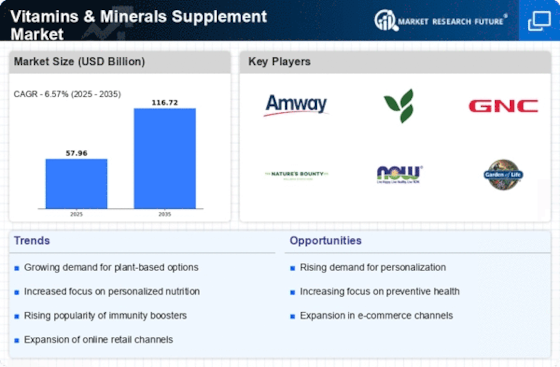
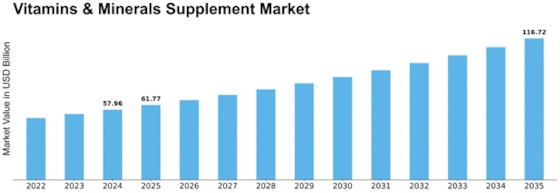
As per Market Research Future analysis, the Vitamins & Minerals Supplement Market size was estimated at 57.96 USD Billion in 2024. The Vitamins & Minerals Supplement industry is projected to grow from 61.77 USD Billion in 2025 to 116.72 USD Billion by 2035, exhibiting a compound annual growth rate (CAGR) of 6.57% during the forecast period 2025 - 2035

Key Market Trends & Highlights

The Vitamins and Minerals Supplement Market is experiencing dynamic growth driven by evolving consumer preferences and technological advancements.

  • The market is witnessing a rise in personalized nutrition, catering to individual health needs and preferences. Sustainability and clean labeling are becoming increasingly important to consumers, particularly in North America. Technological advancements in delivery systems are enhancing product efficacy and consumer experience, especially in the Asia-Pacific region. Key market drivers include increasing health awareness and the growth of e-commerce platforms, which are facilitating access to vitamins and minerals.

Market Size & Forecast

2024 Market Size 57.96 (USD Billion)
2035 Market Size 116.72 (USD Billion)
CAGR (2025 - 2035) 6.57%
Largest Regional Market Share in 2024 Asia Pacific

Major Players

Amway (US), Herbalife (US), GNC Holdings (US), Nature's Bounty (US), NOW Foods (US), Garden of Life (US), Swanson Health Products (US), Solgar (US)

Market Trends

The Vitamins & Minerals Supplement Market is currently experiencing a dynamic evolution, driven by a growing awareness of health and wellness among consumers. This heightened consciousness has led to an increased demand for dietary supplements that can enhance overall well-being and support specific health needs. As individuals become more proactive about their health, they are seeking products that not only provide essential nutrients but also cater to their unique lifestyle choices. This trend is further amplified by the rise of e-commerce platforms, which facilitate easier access to a diverse range of supplements, thereby expanding consumer choices and preferences. Moreover, the Vitamins & Minerals Supplement Market is witnessing a shift towards natural and organic products. Consumers are increasingly inclined to select supplements that are derived from natural sources, reflecting a broader trend towards clean and sustainable living. This inclination is likely to influence product formulations, with manufacturers focusing on transparency and quality in their offerings. As the market continues to evolve, it appears that innovation in product development, along with a commitment to sustainability, will play a crucial role in shaping the future landscape of the Vitamins & Minerals Supplement Market.

Rise of Personalized Nutrition

The Vitamins & Minerals Supplement Market is seeing a notable shift towards personalized nutrition. Consumers are increasingly interested in supplements tailored to their specific health needs and genetic profiles. This trend suggests a move away from one-size-fits-all solutions, as individuals seek products that align with their unique dietary requirements and lifestyle choices.

Sustainability and Clean Labeling

Sustainability is becoming a pivotal factor in the Vitamins & Minerals Supplement Market. Consumers are gravitating towards products that emphasize clean labeling and environmentally friendly practices. This trend indicates a growing demand for transparency in ingredient sourcing and manufacturing processes, as individuals prioritize ethical consumption.

Technological Advancements in Delivery Systems

Innovations in delivery systems are transforming the Vitamins & Minerals Supplement Market. New technologies are enhancing the bioavailability and absorption of nutrients, making supplements more effective. This trend highlights the importance of scientific advancements in improving product efficacy and consumer satisfaction.

Vitamins Minerals Supplement Market Market Drivers

Aging Population

The demographic shift towards an aging population is another critical driver influencing the Vitamins & Minerals Supplement Market. As individuals age, their nutritional needs evolve, often necessitating supplementation to maintain optimal health. Data indicates that the population aged 65 and older is expected to double by 2050, creating a substantial market for vitamins and minerals tailored to this demographic. Older adults are particularly susceptible to deficiencies in essential nutrients, which can lead to various health issues. Consequently, the demand for supplements that support bone health, cognitive function, and immune support is on the rise. This trend underscores the importance of the Vitamins & Minerals Supplement Market in addressing the unique health challenges faced by the aging population.

Increasing Health Awareness

The rising awareness regarding health and wellness is a pivotal driver for the Vitamins & Minerals Supplement Market. Consumers are increasingly prioritizing their health, leading to a surge in demand for dietary supplements. According to recent data, the market for vitamins and minerals is projected to grow at a compound annual growth rate of approximately 7.5% over the next five years. This trend is largely attributed to a shift in consumer behavior, where individuals are more inclined to seek preventive healthcare solutions. As a result, the Vitamins & Minerals Supplement Market is witnessing a significant uptick in sales, particularly among millennials and health-conscious individuals. This demographic is actively seeking products that enhance their overall well-being, thereby propelling the market forward.

Focus on Preventive Healthcare

The emphasis on preventive healthcare is reshaping consumer attitudes towards nutrition and supplementation, serving as a vital driver for the Vitamins & Minerals Supplement Market. Individuals are increasingly recognizing the importance of maintaining health rather than merely treating illnesses. This proactive approach has led to a heightened interest in vitamins and minerals that support immune function, energy levels, and overall vitality. Market data suggests that products promoting preventive health benefits are witnessing robust growth, as consumers seek to enhance their quality of life. This trend is particularly evident among younger demographics, who are more inclined to invest in their health through dietary supplements. The Vitamins & Minerals Supplement Market is thus positioned to benefit from this paradigm shift towards preventive health.

Growth of E-commerce Platforms

The proliferation of e-commerce platforms is transforming the retail landscape for the Vitamins & Minerals Supplement Market. Online shopping has become increasingly popular, providing consumers with convenient access to a wide array of dietary supplements. Recent statistics reveal that online sales of vitamins and minerals have surged, accounting for a significant portion of total market sales. This shift is driven by the ease of comparing products, reading reviews, and accessing a broader selection than traditional retail outlets offer. Furthermore, the rise of subscription services for vitamins and minerals is enhancing customer loyalty and repeat purchases. As e-commerce continues to expand, it is likely to play a crucial role in shaping the future of the Vitamins & Minerals Supplement Market.

Innovations in Product Formulations

Innovations in product formulations are driving the evolution of the Vitamins & Minerals Supplement Market. Manufacturers are increasingly focusing on developing advanced formulations that enhance bioavailability and efficacy. This includes the incorporation of new delivery systems, such as gummies, powders, and liquid forms, which cater to diverse consumer preferences. Recent trends indicate that consumers are gravitating towards products that offer convenience and improved absorption. Additionally, the rise of plant-based and organic supplements is gaining traction, reflecting a broader shift towards clean and sustainable nutrition. As these innovations continue to emerge, they are likely to attract a wider audience, thereby expanding the market reach of the Vitamins & Minerals Supplement Market.

Market Segment Insights

By Type: Vitamins (Largest) vs. Minerals (Fastest-Growing)

The Vitamins &amp; Minerals Supplement Market showcases a diverse distribution within its key segments. Vitamins account for the largest share of the market, reflecting a long-standing consumer preference driven by perceived health benefits. In contrast, minerals are rising rapidly, attracting attention from consumers seeking to enhance their dietary intake and overall well-being. This shift indicates a growing awareness of the role minerals play in health management, resulting in increased sales and market presence.

Vitamins (Dominant) vs. Minerals (Emerging)

Vitamins are recognized as the dominant segment in the Vitamins &amp; Minerals Supplement Market, appealing to a wide demographic due to their established benefits in supporting immune health, energy levels, and overall wellness. This segment includes various forms, such as gummies, tablets, and powders, catering to different consumer preferences. On the other hand, the minerals segment is emerging rapidly, capitalizing on trends such as clean label products and holistic nutrition. Products like magnesium and calcium supplements are gaining popularity as consumers become more health-conscious, leading to innovative formulations and increased distribution in both offline and online channels.

By Form: Powder (Largest) vs. Capsules & Tablets (Fastest-Growing)

In the Vitamins &amp; Minerals Supplement Market, the segmentation by form reveals distinct preferences among consumers. The Powder form currently holds the largest market share, appealing to health-conscious individuals seeking flexibility in their supplementation routine. It is favored for its versatility in being mixed with beverages or foods, thus allowing for customizable nutrient intake. Meanwhile, Capsules &amp; Tablets are gaining significant traction and are recognized as the fastest-growing segment, driven by their ease of use and portability, particularly among busy professionals. The growth trends within the Vitamins &amp; Minerals Supplement Market indicate an increasing inclination towards convenient and efficient supplement forms. Factors such as a rising awareness of health benefits associated with vitamins and minerals, coupled with busy lifestyles, are steering consumers toward Capsules &amp; Tablets. Additionally, innovations in product formulations and delivery methods are attracting more consumers, thereby enhancing the growth potential of this segment significantly, which emphasizes the shift toward practicality without compromising on health benefits.

Powder (Dominant) vs. Capsules &amp; Tablets (Emerging)

The Powder form of vitamins and minerals has established itself as a dominant force in the market, catering to those who prefer a customizable and versatile approach to supplementation. Its ability to blend with various foods and drinks makes it popular among fitness enthusiasts and individuals looking to enhance their diets effectively. This form allows for bulk buying and offers a range of flavor options, increasing its appeal. Conversely, the Capsules &amp; Tablets segment is seen as an emerging favorite due to their convenience and straightforward consumption. They cater to a demographic seeking quick and portable solutions that fit seamlessly into their hectic lifestyles. This segment is increasingly innovating with slow-release formulas and plant-based alternatives, thus expanding its market reach and attracting a younger audience.

By End User: Men (Largest) vs. Women (Fastest-Growing)

The Vitamins &amp; Minerals Supplement Market is significantly influenced by its end-user segmentation, especially among men, women, and children. In this sector, men constitute the largest share, driven by their increasing focus on health and nutrition. This demographic traditionally places a strong emphasis on maintaining physical fitness and well-being through dietary supplements, reflecting their lifestyle choices and proactive approach to health.

Men (Dominant) vs. Women (Emerging)

The men's segment is characterized by a robust demand for performance-oriented vitamins and minerals that enhance physical vitality and support overall health. This demographic leans towards products that aid in muscle recovery and boost energy levels. On the other hand, the women's segment is emerging rapidly, propelled by a growing awareness of health issues and a desire for preventive health measures. Women are seeking supplements that cater to hormonal balance, beauty from within, and immune support, making this demographic a dynamic force in the market.

By Application: Energy/Sports Nutrition (Largest) vs. Immunity and Digestive Health (Fastest-Growing)

The Vitamins &amp; Minerals Supplement Market displays a diverse range of applications, with Energy/Sports Nutrition commanding the largest share. This segment appeals particularly to fitness enthusiasts and athletes, driving a significant portion of market engagement. Meanwhile, segments such as Immunity and Digestive Health are capturing attention due to increasing health awareness and the rising prevalence of lifestyle diseases, showcasing strong market potential. As health trends continue to evolve, innovative product formulations cater to specific consumer needs. The Immunity and Digestive Health segment is experiencing a rapid upswing, fueled by the growing demand for preventive health solutions. Increased consumer focus on holistic well-being, particularly following global health challenges, positions this segment for enduring growth in the foreseeable future.

Energy/Sports Nutrition (Dominant) vs. Immunity and Digestive Health (Emerging)

Energy/Sports Nutrition stands as a dominant force in the Vitamins &amp; Minerals Supplement Market, characterized by its robust appeal to active individuals seeking optimal performance enhancement. This segment includes various products aimed at energy replenishment and muscle recovery, contributing significantly to its market lead. The rise in fitness culture and increasing participation in athletic activities further solidify its position. Conversely, Immunity and Digestive Health represents an emerging segment, capturing attention through formulations focused on gut health and immune support. This segment thrives on the trend toward natural and proactive health solutions, with many consumers opting for supplements as a means to bolster their defenses in present health climates, paving the way for a promising growth trajectory.

By Distribution Channel: Supermarkets & Hypermarkets (Largest) vs. Online (Fastest-Growing)

In the Vitamins &amp; Minerals Supplement Market, the distribution channel landscape is diverse, with Supermarkets and Hypermarkets commanding the largest share. Their ability to offer a wide range of products under one roof provides convenience and appeals to a broad consumer base. Following this, online sales have seen significant growth, especially among younger consumers who favor the convenience of online shopping. Other smaller segments like Chemist/Pharmacies and Drugstores are also notable, but their growth rates are comparatively slower due to limited reach and product availability.

Supermarkets &amp; Hypermarkets (Dominant) vs. Online (Emerging)

Supermarkets and Hypermarkets dominate the Vitamins &amp; Minerals Supplement distribution channel, offering extensive selection and accessibility to a wide demographic. Their layout allows consumers to purchase supplements alongside other grocery items, enhancing convenience. Conversely, the Online segment is emerging rapidly, driven by increasing consumer preference for e-commerce, particularly post-pandemic. Online platforms provide consumers with a vast array of options, often with better pricing and home delivery services. This shift reflects a changing consumer behavior, favoring flexibility and choice. As a result, while Supermarkets and Hypermarkets remain the cornerstone of distribution, the Online channel is redefining market engagement in the vitamins and minerals sector.

Get more detailed insights about Vitamins & Minerals Supplement Market Research Report-Global Forecast till 2035

Regional Insights

North America : Health-Conscious Consumer Base

North America leads the Vitamins & Minerals Supplement Market, accounting for approximately 40% of the global share. The region's growth is driven by increasing health awareness, a rise in preventive healthcare, and a growing aging population. Regulatory support from agencies like the FDA ensures product safety and efficacy, further boosting consumer confidence in supplements. The demand for organic and natural products is also on the rise, reflecting changing consumer preferences. The United States is the largest market, followed by Canada, with key players like Amway, Herbalife, and GNC Holdings dominating the landscape. The competitive environment is characterized by innovation and extensive marketing strategies. Retail channels, including e-commerce, are expanding rapidly, making products more accessible. The presence of established brands and a focus on research and development are pivotal in maintaining market leadership.

Europe : Regulatory Framework and Growth

Europe is witnessing significant growth in the Vitamins & Minerals Supplement Market, holding approximately 30% of the global share. The region's growth is fueled by increasing health consciousness, a rise in chronic diseases, and supportive regulatory frameworks. The European Food Safety Authority (EFSA) plays a crucial role in ensuring product safety and efficacy, which enhances consumer trust and drives market expansion. The demand for clean-label products is also gaining traction among consumers. Germany and the United Kingdom are the leading markets, with a competitive landscape featuring both local and international brands. Key players include Nature's Bounty and Solgar, which focus on quality and innovation. The market is characterized by a mix of traditional retail and online sales channels, with e-commerce rapidly gaining popularity. The presence of stringent regulations ensures that only high-quality products reach consumers, fostering a competitive yet safe market environment.

Asia-Pacific : Rapid Growth and Innovation

Asia-Pacific is rapidly emerging as a significant player in the Vitamins & Minerals Supplement Market, accounting for about 25% of the global share. The region's growth is driven by increasing disposable incomes, urbanization, and a growing awareness of health and wellness. Countries like China and India are witnessing a surge in demand for dietary supplements, supported by favorable government policies and a young population increasingly focused on health. The rise of e-commerce is also facilitating market access. China is the largest market in the region, followed by India and Japan. The competitive landscape is marked by a mix of local and international brands, with companies like Herbalife and NOW Foods making substantial inroads. The market is characterized by innovation, with a focus on herbal and natural supplements. The increasing prevalence of lifestyle-related diseases is further propelling the demand for vitamins and minerals, making this region a key area for future growth.

Middle East and Africa : Untapped Market Potential

The Middle East and Africa represent an emerging market for the Vitamins & Minerals Supplement Market, holding approximately 5% of the global share. The region's growth is driven by increasing health awareness, rising disposable incomes, and a growing population. Regulatory bodies are beginning to establish frameworks to ensure product safety and efficacy, which is crucial for market expansion. The demand for dietary supplements is also being fueled by a shift towards preventive healthcare and wellness trends. South Africa and the UAE are the leading markets, with a competitive landscape that includes both local and international players. The presence of key brands is growing, but the market is still relatively fragmented. Companies are focusing on educating consumers about the benefits of vitamins and minerals, which is essential for driving demand. The region's unique cultural and dietary needs present opportunities for tailored product offerings, making it a promising area for future investment.

Key Players and Competitive Insights

The Vitamins & Minerals Supplement Market is currently characterized by a dynamic competitive landscape, driven by increasing consumer awareness regarding health and wellness. This market is witnessing robust growth, propelled by factors such as rising disposable incomes, an aging population, and a growing inclination towards preventive healthcare. Key players like Amway (US), Herbalife (US), and GNC Holdings (US) are strategically positioning themselves through innovation and regional expansion. For instance, Amway (US) has focused on enhancing its product portfolio with scientifically-backed formulations, while Herbalife (US) emphasizes personalized nutrition solutions, thereby shaping a competitive environment that prioritizes consumer-centric offerings.

In terms of business tactics, companies are increasingly localizing manufacturing to reduce costs and enhance supply chain efficiency. The market structure appears moderately fragmented, with several players vying for market share. However, the collective influence of major companies like Nature's Bounty (US) and NOW Foods (US) is significant, as they leverage their established brand equity and distribution networks to maintain competitive advantages.

In August 2025, GNC Holdings (US) announced a strategic partnership with a leading e-commerce platform to enhance its online presence and reach a broader consumer base. This move is indicative of the growing importance of digital channels in the supplement market, as consumers increasingly prefer online shopping for convenience and variety. By aligning with a prominent e-commerce entity, GNC Holdings (US) is likely to bolster its sales and brand visibility in a highly competitive digital landscape.

In September 2025, Herbalife (US) launched a new line of plant-based supplements aimed at health-conscious consumers seeking sustainable options. This initiative not only reflects the growing trend towards plant-based nutrition but also positions Herbalife (US) as a forward-thinking player in the market. The strategic importance of this launch lies in its potential to attract a new demographic of consumers who prioritize sustainability and ethical sourcing in their purchasing decisions.

In October 2025, Nature's Bounty (US) unveiled a new range of vitamins fortified with probiotics, targeting the increasing consumer interest in gut health. This product innovation is significant as it aligns with current health trends and demonstrates Nature's Bounty's commitment to meeting evolving consumer needs. By integrating probiotics into their offerings, the company is likely to enhance its competitive edge in a market that is increasingly focused on holistic health solutions.

As of October 2025, the competitive trends in the Vitamins & Minerals Supplement Market are heavily influenced by digitalization, sustainability, and the integration of artificial intelligence in product development and consumer engagement. Strategic alliances are becoming more prevalent, as companies recognize the value of collaboration in enhancing their market positions. Looking ahead, competitive differentiation is expected to evolve, shifting from traditional price-based competition to a focus on innovation, technological advancements, and supply chain reliability. This transition underscores the necessity for companies to adapt and innovate continuously to maintain relevance in a rapidly changing market.

Key Companies in the Vitamins Minerals Supplement Market include

Industry Developments

April 2023: Herbalife launched a SKUs of 106 products, across 95 markets worldwide. This launch supports the company’s ongoing commitment of expanding and evolving its quality product offerings for meeting consumer needs across numerous wellness categories and promoting healthy active lifestyles around the world.

March 2023: Nature’s Way launched a gummy supplement Brain Fuel. This supplement is formulated for supporting focus, short-term memory, and concentration in adults

September 2022: Abbott launched Ensure with HMB. The new product under Ensure is a nutritional supplement formulated with 32 vital nutrients such as calcium, protein, and vitamin D for helping in the improvement of muscle and bone strength. It contains an ingredient HMB or β-hydroxy-β-methyl butyrate – which helps in counteracting muscle loss and restore strength and energy.

Future Outlook

Vitamins Minerals Supplement Market Future Outlook

The Vitamins &amp; Minerals Supplement Market is projected to grow at a 6.57% CAGR from 2025 to 2035, driven by increasing health awareness, aging populations, and rising disposable incomes.

New opportunities lie in:

  • Development of personalized vitamin subscription services
  • Expansion into emerging markets with tailored products
  • Integration of digital health platforms for consumer engagement

By 2035, the market is expected to be robust, reflecting substantial growth and innovation.

Market Segmentation

Vitamins Minerals Supplement Market Form Outlook

  • Powder
  • Capsules & Tablets
  • Liquid
  • Others

Vitamins Minerals Supplement Market Type Outlook

  • Vitamins
  • Minerals

Vitamins Minerals Supplement Market End User Outlook

  • Men
  • Women
  • Children

Vitamins Minerals Supplement Market Application Outlook

  • Energy/Sports Nutrition
  • Weight Management
  • Immunity and Digestive Health
  • Anti-Cancer
  • Skin Care
  • Glycemic & Diabetes Management
  • Other

Vitamins Minerals Supplement Market Distribution Channel Outlook

  • Supermarkets & Hypermarkets
  • Chemist/Pharmacies
  • Drugstores/Paraharmacies
  • Online
  • Others

Report Scope

MARKET SIZE 2024 57.96(USD Billion)
MARKET SIZE 2025 61.77(USD Billion)
MARKET SIZE 2035 116.72(USD Billion)
COMPOUND ANNUAL GROWTH RATE (CAGR) 6.57% (2025 - 2035)
REPORT COVERAGE Revenue Forecast, Competitive Landscape, Growth Factors, and Trends
BASE YEAR 2024
Market Forecast Period 2025 - 2035
Historical Data 2019 - 2024
Market Forecast Units USD Billion
Key Companies Profiled Amway (US), Herbalife (US), GNC Holdings (US), Nature's Bounty (US), NOW Foods (US), Garden of Life (US), Swanson Health Products (US), Solgar (US)
Segments Covered Product Type, Region- Forecast 2030
Key Market Opportunities Growing consumer demand for personalized nutrition drives innovation in the Vitamins and Minerals Supplement Market.
Key Market Dynamics Rising consumer awareness drives demand for clean-label vitamins and minerals, influencing market competition and product innovation.
Countries Covered North America, Europe, APAC, South America, MEA

FAQs

What is the current valuation of the Vitamins & Minerals Supplement Market?

<p>The market valuation reached 57.96 USD Billion in 2024.</p>

What is the projected market size for the Vitamins & Minerals Supplement Market by 2035?

<p>The market is expected to grow to 116.72 USD Billion by 2035.</p>

What is the expected CAGR for the Vitamins & Minerals Supplement Market during the forecast period 2025 - 2035?

<p>The market is projected to experience a CAGR of 6.57% from 2025 to 2035.</p>

Which segment of the Vitamins & Minerals Supplement Market had the highest valuation in 2024?

<p>In 2024, the Vitamins segment was valued at 34.78 USD Billion, surpassing the Minerals segment.</p>

What are the leading distribution channels for Vitamins & Minerals supplements?

<p>Supermarkets & Hypermarkets led the distribution channels with a valuation of 20.0 USD Billion in 2024.</p>

How do the end-user segments compare in terms of market valuation?

<p>In 2024, Women represented the highest end-user segment at 25.0 USD Billion, followed by Men at 20.0 USD Billion.</p>

What forms of Vitamins & Minerals supplements are most popular among consumers?

<p>Capsules & Tablets dominated the market with a valuation of 25.0 USD Billion in 2024.</p>

Which application segment is projected to grow the most by 2035?

<p>The Immunity and Digestive Health application segment is expected to grow significantly, reaching 20.0 USD Billion by 2035.</p>

Who are the key players in the Vitamins & Minerals Supplement Market?

<p>Key players include Amway, Herbalife, GNC Holdings, and Nature's Bounty, among others.</p>

What is the projected growth for the Weight Management application segment by 2035?

<p>The Weight Management segment is anticipated to grow to 15.0 USD Billion by 2035.</p>

  1. SECTION I: EXECUTIVE SUMMARY AND KEY HIGHLIGHTS
    1. | 1.1 EXECUTIVE SUMMARY
    2. | | 1.1.1 Market Overview
    3. | | 1.1.2 Key Findings
    4. | | 1.1.3 Market Segmentation
    5. | | 1.1.4 Competitive Landscape
    6. | | 1.1.5 Challenges and Opportunities
    7. | | 1.1.6 Future Outlook
  2. SECTION II: SCOPING, METHODOLOGY AND MARKET STRUCTURE
    1. | 2.1 MARKET INTRODUCTION
    2. | | 2.1.1 Definition
    3. | | 2.1.2 Scope of the study
    4. | | | 2.1.2.1 Research Objective
    5. | | | 2.1.2.2 Assumption
    6. | | | 2.1.2.3 Limitations
    7. | 2.2 RESEARCH METHODOLOGY
    8. | | 2.2.1 Overview
    9. | | 2.2.2 Data Mining
    10. | | 2.2.3 Secondary Research
    11. | | 2.2.4 Primary Research
    12. | | | 2.2.4.1 Primary Interviews and Information Gathering Process
    13. | | | 2.2.4.2 Breakdown of Primary Respondents
    14. | | 2.2.5 Forecasting Model
    15. | | 2.2.6 Market Size Estimation
    16. | | | 2.2.6.1 Bottom-Up Approach
    17. | | | 2.2.6.2 Top-Down Approach
    18. | | 2.2.7 Data Triangulation
    19. | | 2.2.8 Validation
  3. SECTION III: QUALITATIVE ANALYSIS
    1. | 3.1 MARKET DYNAMICS
    2. | | 3.1.1 Overview
    3. | | 3.1.2 Drivers
    4. | | 3.1.3 Restraints
    5. | | 3.1.4 Opportunities
    6. | 3.2 MARKET FACTOR ANALYSIS
    7. | | 3.2.1 Value chain Analysis
    8. | | 3.2.2 Porter's Five Forces Analysis
    9. | | | 3.2.2.1 Bargaining Power of Suppliers
    10. | | | 3.2.2.2 Bargaining Power of Buyers
    11. | | | 3.2.2.3 Threat of New Entrants
    12. | | | 3.2.2.4 Threat of Substitutes
    13. | | | 3.2.2.5 Intensity of Rivalry
    14. | | 3.2.3 COVID-19 Impact Analysis
    15. | | | 3.2.3.1 Market Impact Analysis
    16. | | | 3.2.3.2 Regional Impact
    17. | | | 3.2.3.3 Opportunity and Threat Analysis
  4. SECTION IV: QUANTITATIVE ANALYSIS
    1. | 4.1 Food, Beverages & Nutrition, BY Type (USD Billion)
    2. | | 4.1.1 Vitamins
    3. | | 4.1.2 Minerals
    4. | 4.2 Food, Beverages & Nutrition, BY Form (USD Billion)
    5. | | 4.2.1 Powder
    6. | | 4.2.2 Capsules & Tablets
    7. | | 4.2.3 Liquid
    8. | | 4.2.4 Others
    9. | 4.3 Food, Beverages & Nutrition, BY End User (USD Billion)
    10. | | 4.3.1 Men
    11. | | 4.3.2 Women
    12. | | 4.3.3 Children
    13. | 4.4 Food, Beverages & Nutrition, BY Application (USD Billion)
    14. | | 4.4.1 Energy/Sports Nutrition
    15. | | 4.4.2 Weight Management
    16. | | 4.4.3 Immunity and Digestive Health
    17. | | 4.4.4 Anti-Cancer
    18. | | 4.4.5 Skin Care
    19. | | 4.4.6 Glycemic & Diabetes Management
    20. | | 4.4.7 Other
    21. | 4.5 Food, Beverages & Nutrition, BY Distribution Channel (USD Billion)
    22. | | 4.5.1 Supermarkets & Hypermarkets
    23. | | 4.5.2 Chemist/Pharmacies
    24. | | 4.5.3 Drugstores/Paraharmacies
    25. | | 4.5.4 Online
    26. | | 4.5.5 Others
    27. | 4.6 Food, Beverages & Nutrition, BY Region (USD Billion)
    28. | | 4.6.1 North America
    29. | | | 4.6.1.1 US
    30. | | | 4.6.1.2 Canada
    31. | | 4.6.2 Europe
    32. | | | 4.6.2.1 Germany
    33. | | | 4.6.2.2 UK
    34. | | | 4.6.2.3 France
    35. | | | 4.6.2.4 Russia
    36. | | | 4.6.2.5 Italy
    37. | | | 4.6.2.6 Spain
    38. | | | 4.6.2.7 Rest of Europe
    39. | | 4.6.3 APAC
    40. | | | 4.6.3.1 China
    41. | | | 4.6.3.2 India
    42. | | | 4.6.3.3 Japan
    43. | | | 4.6.3.4 South Korea
    44. | | | 4.6.3.5 Malaysia
    45. | | | 4.6.3.6 Thailand
    46. | | | 4.6.3.7 Indonesia
    47. | | | 4.6.3.8 Rest of APAC
    48. | | 4.6.4 South America
    49. | | | 4.6.4.1 Brazil
    50. | | | 4.6.4.2 Mexico
    51. | | | 4.6.4.3 Argentina
    52. | | | 4.6.4.4 Rest of South America
    53. | | 4.6.5 MEA
    54. | | | 4.6.5.1 GCC Countries
    55. | | | 4.6.5.2 South Africa
    56. | | | 4.6.5.3 Rest of MEA
  5. SECTION V: COMPETITIVE ANALYSIS
    1. | 5.1 Competitive Landscape
    2. | | 5.1.1 Overview
    3. | | 5.1.2 Competitive Analysis
    4. | | 5.1.3 Market share Analysis
    5. | | 5.1.4 Major Growth Strategy in the Food, Beverages & Nutrition
    6. | | 5.1.5 Competitive Benchmarking
    7. | | 5.1.6 Leading Players in Terms of Number of Developments in the Food, Beverages & Nutrition
    8. | | 5.1.7 Key developments and growth strategies
    9. | | | 5.1.7.1 New Product Launch/Service Deployment
    10. | | | 5.1.7.2 Merger & Acquisitions
    11. | | | 5.1.7.3 Joint Ventures
    12. | | 5.1.8 Major Players Financial Matrix
    13. | | | 5.1.8.1 Sales and Operating Income
    14. | | | 5.1.8.2 Major Players R&D Expenditure. 2023
    15. | 5.2 Company Profiles
    16. | | 5.2.1 Amway (US)
    17. | | | 5.2.1.1 Financial Overview
    18. | | | 5.2.1.2 Products Offered
    19. | | | 5.2.1.3 Key Developments
    20. | | | 5.2.1.4 SWOT Analysis
    21. | | | 5.2.1.5 Key Strategies
    22. | | 5.2.2 Herbalife (US)
    23. | | | 5.2.2.1 Financial Overview
    24. | | | 5.2.2.2 Products Offered
    25. | | | 5.2.2.3 Key Developments
    26. | | | 5.2.2.4 SWOT Analysis
    27. | | | 5.2.2.5 Key Strategies
    28. | | 5.2.3 GNC Holdings (US)
    29. | | | 5.2.3.1 Financial Overview
    30. | | | 5.2.3.2 Products Offered
    31. | | | 5.2.3.3 Key Developments
    32. | | | 5.2.3.4 SWOT Analysis
    33. | | | 5.2.3.5 Key Strategies
    34. | | 5.2.4 Nature's Bounty (US)
    35. | | | 5.2.4.1 Financial Overview
    36. | | | 5.2.4.2 Products Offered
    37. | | | 5.2.4.3 Key Developments
    38. | | | 5.2.4.4 SWOT Analysis
    39. | | | 5.2.4.5 Key Strategies
    40. | | 5.2.5 NOW Foods (US)
    41. | | | 5.2.5.1 Financial Overview
    42. | | | 5.2.5.2 Products Offered
    43. | | | 5.2.5.3 Key Developments
    44. | | | 5.2.5.4 SWOT Analysis
    45. | | | 5.2.5.5 Key Strategies
    46. | | 5.2.6 Garden of Life (US)
    47. | | | 5.2.6.1 Financial Overview
    48. | | | 5.2.6.2 Products Offered
    49. | | | 5.2.6.3 Key Developments
    50. | | | 5.2.6.4 SWOT Analysis
    51. | | | 5.2.6.5 Key Strategies
    52. | | 5.2.7 Swanson Health Products (US)
    53. | | | 5.2.7.1 Financial Overview
    54. | | | 5.2.7.2 Products Offered
    55. | | | 5.2.7.3 Key Developments
    56. | | | 5.2.7.4 SWOT Analysis
    57. | | | 5.2.7.5 Key Strategies
    58. | | 5.2.8 Solgar (US)
    59. | | | 5.2.8.1 Financial Overview
    60. | | | 5.2.8.2 Products Offered
    61. | | | 5.2.8.3 Key Developments
    62. | | | 5.2.8.4 SWOT Analysis
    63. | | | 5.2.8.5 Key Strategies
    64. | 5.3 Appendix
    65. | | 5.3.1 References
    66. | | 5.3.2 Related Reports
  6. LIST OF FIGURES
    1. | 6.1 MARKET SYNOPSIS
    2. | 6.2 NORTH AMERICA MARKET ANALYSIS
    3. | 6.3 US MARKET ANALYSIS BY TYPE
    4. | 6.4 US MARKET ANALYSIS BY FORM
    5. | 6.5 US MARKET ANALYSIS BY END USER
    6. | 6.6 US MARKET ANALYSIS BY APPLICATION
    7. | 6.7 US MARKET ANALYSIS BY DISTRIBUTION CHANNEL
    8. | 6.8 CANADA MARKET ANALYSIS BY TYPE
    9. | 6.9 CANADA MARKET ANALYSIS BY FORM
    10. | 6.10 CANADA MARKET ANALYSIS BY END USER
    11. | 6.11 CANADA MARKET ANALYSIS BY APPLICATION
    12. | 6.12 CANADA MARKET ANALYSIS BY DISTRIBUTION CHANNEL
    13. | 6.13 EUROPE MARKET ANALYSIS
    14. | 6.14 GERMANY MARKET ANALYSIS BY TYPE
    15. | 6.15 GERMANY MARKET ANALYSIS BY FORM
    16. | 6.16 GERMANY MARKET ANALYSIS BY END USER
    17. | 6.17 GERMANY MARKET ANALYSIS BY APPLICATION
    18. | 6.18 GERMANY MARKET ANALYSIS BY DISTRIBUTION CHANNEL
    19. | 6.19 UK MARKET ANALYSIS BY TYPE
    20. | 6.20 UK MARKET ANALYSIS BY FORM
    21. | 6.21 UK MARKET ANALYSIS BY END USER
    22. | 6.22 UK MARKET ANALYSIS BY APPLICATION
    23. | 6.23 UK MARKET ANALYSIS BY DISTRIBUTION CHANNEL
    24. | 6.24 FRANCE MARKET ANALYSIS BY TYPE
    25. | 6.25 FRANCE MARKET ANALYSIS BY FORM
    26. | 6.26 FRANCE MARKET ANALYSIS BY END USER
    27. | 6.27 FRANCE MARKET ANALYSIS BY APPLICATION
    28. | 6.28 FRANCE MARKET ANALYSIS BY DISTRIBUTION CHANNEL
    29. | 6.29 RUSSIA MARKET ANALYSIS BY TYPE
    30. | 6.30 RUSSIA MARKET ANALYSIS BY FORM
    31. | 6.31 RUSSIA MARKET ANALYSIS BY END USER
    32. | 6.32 RUSSIA MARKET ANALYSIS BY APPLICATION
    33. | 6.33 RUSSIA MARKET ANALYSIS BY DISTRIBUTION CHANNEL
    34. | 6.34 ITALY MARKET ANALYSIS BY TYPE
    35. | 6.35 ITALY MARKET ANALYSIS BY FORM
    36. | 6.36 ITALY MARKET ANALYSIS BY END USER
    37. | 6.37 ITALY MARKET ANALYSIS BY APPLICATION
    38. | 6.38 ITALY MARKET ANALYSIS BY DISTRIBUTION CHANNEL
    39. | 6.39 SPAIN MARKET ANALYSIS BY TYPE
    40. | 6.40 SPAIN MARKET ANALYSIS BY FORM
    41. | 6.41 SPAIN MARKET ANALYSIS BY END USER
    42. | 6.42 SPAIN MARKET ANALYSIS BY APPLICATION
    43. | 6.43 SPAIN MARKET ANALYSIS BY DISTRIBUTION CHANNEL
    44. | 6.44 REST OF EUROPE MARKET ANALYSIS BY TYPE
    45. | 6.45 REST OF EUROPE MARKET ANALYSIS BY FORM
    46. | 6.46 REST OF EUROPE MARKET ANALYSIS BY END USER
    47. | 6.47 REST OF EUROPE MARKET ANALYSIS BY APPLICATION
    48. | 6.48 REST OF EUROPE MARKET ANALYSIS BY DISTRIBUTION CHANNEL
    49. | 6.49 APAC MARKET ANALYSIS
    50. | 6.50 CHINA MARKET ANALYSIS BY TYPE
    51. | 6.51 CHINA MARKET ANALYSIS BY FORM
    52. | 6.52 CHINA MARKET ANALYSIS BY END USER
    53. | 6.53 CHINA MARKET ANALYSIS BY APPLICATION
    54. | 6.54 CHINA MARKET ANALYSIS BY DISTRIBUTION CHANNEL
    55. | 6.55 INDIA MARKET ANALYSIS BY TYPE
    56. | 6.56 INDIA MARKET ANALYSIS BY FORM
    57. | 6.57 INDIA MARKET ANALYSIS BY END USER
    58. | 6.58 INDIA MARKET ANALYSIS BY APPLICATION
    59. | 6.59 INDIA MARKET ANALYSIS BY DISTRIBUTION CHANNEL
    60. | 6.60 JAPAN MARKET ANALYSIS BY TYPE
    61. | 6.61 JAPAN MARKET ANALYSIS BY FORM
    62. | 6.62 JAPAN MARKET ANALYSIS BY END USER
    63. | 6.63 JAPAN MARKET ANALYSIS BY APPLICATION
    64. | 6.64 JAPAN MARKET ANALYSIS BY DISTRIBUTION CHANNEL
    65. | 6.65 SOUTH KOREA MARKET ANALYSIS BY TYPE
    66. | 6.66 SOUTH KOREA MARKET ANALYSIS BY FORM
    67. | 6.67 SOUTH KOREA MARKET ANALYSIS BY END USER
    68. | 6.68 SOUTH KOREA MARKET ANALYSIS BY APPLICATION
    69. | 6.69 SOUTH KOREA MARKET ANALYSIS BY DISTRIBUTION CHANNEL
    70. | 6.70 MALAYSIA MARKET ANALYSIS BY TYPE
    71. | 6.71 MALAYSIA MARKET ANALYSIS BY FORM
    72. | 6.72 MALAYSIA MARKET ANALYSIS BY END USER
    73. | 6.73 MALAYSIA MARKET ANALYSIS BY APPLICATION
    74. | 6.74 MALAYSIA MARKET ANALYSIS BY DISTRIBUTION CHANNEL
    75. | 6.75 THAILAND MARKET ANALYSIS BY TYPE
    76. | 6.76 THAILAND MARKET ANALYSIS BY FORM
    77. | 6.77 THAILAND MARKET ANALYSIS BY END USER
    78. | 6.78 THAILAND MARKET ANALYSIS BY APPLICATION
    79. | 6.79 THAILAND MARKET ANALYSIS BY DISTRIBUTION CHANNEL
    80. | 6.80 INDONESIA MARKET ANALYSIS BY TYPE
    81. | 6.81 INDONESIA MARKET ANALYSIS BY FORM
    82. | 6.82 INDONESIA MARKET ANALYSIS BY END USER
    83. | 6.83 INDONESIA MARKET ANALYSIS BY APPLICATION
    84. | 6.84 INDONESIA MARKET ANALYSIS BY DISTRIBUTION CHANNEL
    85. | 6.85 REST OF APAC MARKET ANALYSIS BY TYPE
    86. | 6.86 REST OF APAC MARKET ANALYSIS BY FORM
    87. | 6.87 REST OF APAC MARKET ANALYSIS BY END USER
    88. | 6.88 REST OF APAC MARKET ANALYSIS BY APPLICATION
    89. | 6.89 REST OF APAC MARKET ANALYSIS BY DISTRIBUTION CHANNEL
    90. | 6.90 SOUTH AMERICA MARKET ANALYSIS
    91. | 6.91 BRAZIL MARKET ANALYSIS BY TYPE
    92. | 6.92 BRAZIL MARKET ANALYSIS BY FORM
    93. | 6.93 BRAZIL MARKET ANALYSIS BY END USER
    94. | 6.94 BRAZIL MARKET ANALYSIS BY APPLICATION
    95. | 6.95 BRAZIL MARKET ANALYSIS BY DISTRIBUTION CHANNEL
    96. | 6.96 MEXICO MARKET ANALYSIS BY TYPE
    97. | 6.97 MEXICO MARKET ANALYSIS BY FORM
    98. | 6.98 MEXICO MARKET ANALYSIS BY END USER
    99. | 6.99 MEXICO MARKET ANALYSIS BY APPLICATION
    100. | 6.100 MEXICO MARKET ANALYSIS BY DISTRIBUTION CHANNEL
    101. | 6.101 ARGENTINA MARKET ANALYSIS BY TYPE
    102. | 6.102 ARGENTINA MARKET ANALYSIS BY FORM
    103. | 6.103 ARGENTINA MARKET ANALYSIS BY END USER
    104. | 6.104 ARGENTINA MARKET ANALYSIS BY APPLICATION
    105. | 6.105 ARGENTINA MARKET ANALYSIS BY DISTRIBUTION CHANNEL
    106. | 6.106 REST OF SOUTH AMERICA MARKET ANALYSIS BY TYPE
    107. | 6.107 REST OF SOUTH AMERICA MARKET ANALYSIS BY FORM
    108. | 6.108 REST OF SOUTH AMERICA MARKET ANALYSIS BY END USER
    109. | 6.109 REST OF SOUTH AMERICA MARKET ANALYSIS BY APPLICATION
    110. | 6.110 REST OF SOUTH AMERICA MARKET ANALYSIS BY DISTRIBUTION CHANNEL
    111. | 6.111 MEA MARKET ANALYSIS
    112. | 6.112 GCC COUNTRIES MARKET ANALYSIS BY TYPE
    113. | 6.113 GCC COUNTRIES MARKET ANALYSIS BY FORM
    114. | 6.114 GCC COUNTRIES MARKET ANALYSIS BY END USER
    115. | 6.115 GCC COUNTRIES MARKET ANALYSIS BY APPLICATION
    116. | 6.116 GCC COUNTRIES MARKET ANALYSIS BY DISTRIBUTION CHANNEL
    117. | 6.117 SOUTH AFRICA MARKET ANALYSIS BY TYPE
    118. | 6.118 SOUTH AFRICA MARKET ANALYSIS BY FORM
    119. | 6.119 SOUTH AFRICA MARKET ANALYSIS BY END USER
    120. | 6.120 SOUTH AFRICA MARKET ANALYSIS BY APPLICATION
    121. | 6.121 SOUTH AFRICA MARKET ANALYSIS BY DISTRIBUTION CHANNEL
    122. | 6.122 REST OF MEA MARKET ANALYSIS BY TYPE
    123. | 6.123 REST OF MEA MARKET ANALYSIS BY FORM
    124. | 6.124 REST OF MEA MARKET ANALYSIS BY END USER
    125. | 6.125 REST OF MEA MARKET ANALYSIS BY APPLICATION
    126. | 6.126 REST OF MEA MARKET ANALYSIS BY DISTRIBUTION CHANNEL
    127. | 6.127 KEY BUYING CRITERIA OF FOOD, BEVERAGES & NUTRITION
    128. | 6.128 RESEARCH PROCESS OF MRFR
    129. | 6.129 DRO ANALYSIS OF FOOD, BEVERAGES & NUTRITION
    130. | 6.130 DRIVERS IMPACT ANALYSIS: FOOD, BEVERAGES & NUTRITION
    131. | 6.131 RESTRAINTS IMPACT ANALYSIS: FOOD, BEVERAGES & NUTRITION
    132. | 6.132 SUPPLY / VALUE CHAIN: FOOD, BEVERAGES & NUTRITION
    133. | 6.133 FOOD, BEVERAGES & NUTRITION, BY TYPE, 2024 (% SHARE)
    134. | 6.134 FOOD, BEVERAGES & NUTRITION, BY TYPE, 2024 TO 2035 (USD Billion)
    135. | 6.135 FOOD, BEVERAGES & NUTRITION, BY FORM, 2024 (% SHARE)
    136. | 6.136 FOOD, BEVERAGES & NUTRITION, BY FORM, 2024 TO 2035 (USD Billion)
    137. | 6.137 FOOD, BEVERAGES & NUTRITION, BY END USER, 2024 (% SHARE)
    138. | 6.138 FOOD, BEVERAGES & NUTRITION, BY END USER, 2024 TO 2035 (USD Billion)
    139. | 6.139 FOOD, BEVERAGES & NUTRITION, BY APPLICATION, 2024 (% SHARE)
    140. | 6.140 FOOD, BEVERAGES & NUTRITION, BY APPLICATION, 2024 TO 2035 (USD Billion)
    141. | 6.141 FOOD, BEVERAGES & NUTRITION, BY DISTRIBUTION CHANNEL, 2024 (% SHARE)
    142. | 6.142 FOOD, BEVERAGES & NUTRITION, BY DISTRIBUTION CHANNEL, 2024 TO 2035 (USD Billion)
    143. | 6.143 BENCHMARKING OF MAJOR COMPETITORS
  7. LIST OF TABLES
    1. | 7.1 LIST OF ASSUMPTIONS
    2. | | 7.1.1
    3. | 7.2 North America MARKET SIZE ESTIMATES; FORECAST
    4. | | 7.2.1 BY TYPE, 2025-2035 (USD Billion)
    5. | | 7.2.2 BY FORM, 2025-2035 (USD Billion)
    6. | | 7.2.3 BY END USER, 2025-2035 (USD Billion)
    7. | | 7.2.4 BY APPLICATION, 2025-2035 (USD Billion)
    8. | | 7.2.5 BY DISTRIBUTION CHANNEL, 2025-2035 (USD Billion)
    9. | 7.3 US MARKET SIZE ESTIMATES; FORECAST
    10. | | 7.3.1 BY TYPE, 2025-2035 (USD Billion)
    11. | | 7.3.2 BY FORM, 2025-2035 (USD Billion)
    12. | | 7.3.3 BY END USER, 2025-2035 (USD Billion)
    13. | | 7.3.4 BY APPLICATION, 2025-2035 (USD Billion)
    14. | | 7.3.5 BY DISTRIBUTION CHANNEL, 2025-2035 (USD Billion)
    15. | 7.4 Canada MARKET SIZE ESTIMATES; FORECAST
    16. | | 7.4.1 BY TYPE, 2025-2035 (USD Billion)
    17. | | 7.4.2 BY FORM, 2025-2035 (USD Billion)
    18. | | 7.4.3 BY END USER, 2025-2035 (USD Billion)
    19. | | 7.4.4 BY APPLICATION, 2025-2035 (USD Billion)
    20. | | 7.4.5 BY DISTRIBUTION CHANNEL, 2025-2035 (USD Billion)
    21. | 7.5 Europe MARKET SIZE ESTIMATES; FORECAST
    22. | | 7.5.1 BY TYPE, 2025-2035 (USD Billion)
    23. | | 7.5.2 BY FORM, 2025-2035 (USD Billion)
    24. | | 7.5.3 BY END USER, 2025-2035 (USD Billion)
    25. | | 7.5.4 BY APPLICATION, 2025-2035 (USD Billion)
    26. | | 7.5.5 BY DISTRIBUTION CHANNEL, 2025-2035 (USD Billion)
    27. | 7.6 Germany MARKET SIZE ESTIMATES; FORECAST
    28. | | 7.6.1 BY TYPE, 2025-2035 (USD Billion)
    29. | | 7.6.2 BY FORM, 2025-2035 (USD Billion)
    30. | | 7.6.3 BY END USER, 2025-2035 (USD Billion)
    31. | | 7.6.4 BY APPLICATION, 2025-2035 (USD Billion)
    32. | | 7.6.5 BY DISTRIBUTION CHANNEL, 2025-2035 (USD Billion)
    33. | 7.7 UK MARKET SIZE ESTIMATES; FORECAST
    34. | | 7.7.1 BY TYPE, 2025-2035 (USD Billion)
    35. | | 7.7.2 BY FORM, 2025-2035 (USD Billion)
    36. | | 7.7.3 BY END USER, 2025-2035 (USD Billion)
    37. | | 7.7.4 BY APPLICATION, 2025-2035 (USD Billion)
    38. | | 7.7.5 BY DISTRIBUTION CHANNEL, 2025-2035 (USD Billion)
    39. | 7.8 France MARKET SIZE ESTIMATES; FORECAST
    40. | | 7.8.1 BY TYPE, 2025-2035 (USD Billion)
    41. | | 7.8.2 BY FORM, 2025-2035 (USD Billion)
    42. | | 7.8.3 BY END USER, 2025-2035 (USD Billion)
    43. | | 7.8.4 BY APPLICATION, 2025-2035 (USD Billion)
    44. | | 7.8.5 BY DISTRIBUTION CHANNEL, 2025-2035 (USD Billion)
    45. | 7.9 Russia MARKET SIZE ESTIMATES; FORECAST
    46. | | 7.9.1 BY TYPE, 2025-2035 (USD Billion)
    47. | | 7.9.2 BY FORM, 2025-2035 (USD Billion)
    48. | | 7.9.3 BY END USER, 2025-2035 (USD Billion)
    49. | | 7.9.4 BY APPLICATION, 2025-2035 (USD Billion)
    50. | | 7.9.5 BY DISTRIBUTION CHANNEL, 2025-2035 (USD Billion)
    51. | 7.10 Italy MARKET SIZE ESTIMATES; FORECAST
    52. | | 7.10.1 BY TYPE, 2025-2035 (USD Billion)
    53. | | 7.10.2 BY FORM, 2025-2035 (USD Billion)
    54. | | 7.10.3 BY END USER, 2025-2035 (USD Billion)
    55. | | 7.10.4 BY APPLICATION, 2025-2035 (USD Billion)
    56. | | 7.10.5 BY DISTRIBUTION CHANNEL, 2025-2035 (USD Billion)
    57. | 7.11 Spain MARKET SIZE ESTIMATES; FORECAST
    58. | | 7.11.1 BY TYPE, 2025-2035 (USD Billion)
    59. | | 7.11.2 BY FORM, 2025-2035 (USD Billion)
    60. | | 7.11.3 BY END USER, 2025-2035 (USD Billion)
    61. | | 7.11.4 BY APPLICATION, 2025-2035 (USD Billion)
    62. | | 7.11.5 BY DISTRIBUTION CHANNEL, 2025-2035 (USD Billion)
    63. | 7.12 Rest of Europe MARKET SIZE ESTIMATES; FORECAST
    64. | | 7.12.1 BY TYPE, 2025-2035 (USD Billion)
    65. | | 7.12.2 BY FORM, 2025-2035 (USD Billion)
    66. | | 7.12.3 BY END USER, 2025-2035 (USD Billion)
    67. | | 7.12.4 BY APPLICATION, 2025-2035 (USD Billion)
    68. | | 7.12.5 BY DISTRIBUTION CHANNEL, 2025-2035 (USD Billion)
    69. | 7.13 APAC MARKET SIZE ESTIMATES; FORECAST
    70. | | 7.13.1 BY TYPE, 2025-2035 (USD Billion)
    71. | | 7.13.2 BY FORM, 2025-2035 (USD Billion)
    72. | | 7.13.3 BY END USER, 2025-2035 (USD Billion)
    73. | | 7.13.4 BY APPLICATION, 2025-2035 (USD Billion)
    74. | | 7.13.5 BY DISTRIBUTION CHANNEL, 2025-2035 (USD Billion)
    75. | 7.14 China MARKET SIZE ESTIMATES; FORECAST
    76. | | 7.14.1 BY TYPE, 2025-2035 (USD Billion)
    77. | | 7.14.2 BY FORM, 2025-2035 (USD Billion)
    78. | | 7.14.3 BY END USER, 2025-2035 (USD Billion)
    79. | | 7.14.4 BY APPLICATION, 2025-2035 (USD Billion)
    80. | | 7.14.5 BY DISTRIBUTION CHANNEL, 2025-2035 (USD Billion)
    81. | 7.15 India MARKET SIZE ESTIMATES; FORECAST
    82. | | 7.15.1 BY TYPE, 2025-2035 (USD Billion)
    83. | | 7.15.2 BY FORM, 2025-2035 (USD Billion)
    84. | | 7.15.3 BY END USER, 2025-2035 (USD Billion)
    85. | | 7.15.4 BY APPLICATION, 2025-2035 (USD Billion)
    86. | | 7.15.5 BY DISTRIBUTION CHANNEL, 2025-2035 (USD Billion)
    87. | 7.16 Japan MARKET SIZE ESTIMATES; FORECAST
    88. | | 7.16.1 BY TYPE, 2025-2035 (USD Billion)
    89. | | 7.16.2 BY FORM, 2025-2035 (USD Billion)
    90. | | 7.16.3 BY END USER, 2025-2035 (USD Billion)
    91. | | 7.16.4 BY APPLICATION, 2025-2035 (USD Billion)
    92. | | 7.16.5 BY DISTRIBUTION CHANNEL, 2025-2035 (USD Billion)
    93. | 7.17 South Korea MARKET SIZE ESTIMATES; FORECAST
    94. | | 7.17.1 BY TYPE, 2025-2035 (USD Billion)
    95. | | 7.17.2 BY FORM, 2025-2035 (USD Billion)
    96. | | 7.17.3 BY END USER, 2025-2035 (USD Billion)
    97. | | 7.17.4 BY APPLICATION, 2025-2035 (USD Billion)
    98. | | 7.17.5 BY DISTRIBUTION CHANNEL, 2025-2035 (USD Billion)
    99. | 7.18 Malaysia MARKET SIZE ESTIMATES; FORECAST
    100. | | 7.18.1 BY TYPE, 2025-2035 (USD Billion)
    101. | | 7.18.2 BY FORM, 2025-2035 (USD Billion)
    102. | | 7.18.3 BY END USER, 2025-2035 (USD Billion)
    103. | | 7.18.4 BY APPLICATION, 2025-2035 (USD Billion)
    104. | | 7.18.5 BY DISTRIBUTION CHANNEL, 2025-2035 (USD Billion)
    105. | 7.19 Thailand MARKET SIZE ESTIMATES; FORECAST
    106. | | 7.19.1 BY TYPE, 2025-2035 (USD Billion)
    107. | | 7.19.2 BY FORM, 2025-2035 (USD Billion)
    108. | | 7.19.3 BY END USER, 2025-2035 (USD Billion)
    109. | | 7.19.4 BY APPLICATION, 2025-2035 (USD Billion)
    110. | | 7.19.5 BY DISTRIBUTION CHANNEL, 2025-2035 (USD Billion)
    111. | 7.20 Indonesia MARKET SIZE ESTIMATES; FORECAST
    112. | | 7.20.1 BY TYPE, 2025-2035 (USD Billion)
    113. | | 7.20.2 BY FORM, 2025-2035 (USD Billion)
    114. | | 7.20.3 BY END USER, 2025-2035 (USD Billion)
    115. | | 7.20.4 BY APPLICATION, 2025-2035 (USD Billion)
    116. | | 7.20.5 BY DISTRIBUTION CHANNEL, 2025-2035 (USD Billion)
    117. | 7.21 Rest of APAC MARKET SIZE ESTIMATES; FORECAST
    118. | | 7.21.1 BY TYPE, 2025-2035 (USD Billion)
    119. | | 7.21.2 BY FORM, 2025-2035 (USD Billion)
    120. | | 7.21.3 BY END USER, 2025-2035 (USD Billion)
    121. | | 7.21.4 BY APPLICATION, 2025-2035 (USD Billion)
    122. | | 7.21.5 BY DISTRIBUTION CHANNEL, 2025-2035 (USD Billion)
    123. | 7.22 South America MARKET SIZE ESTIMATES; FORECAST
    124. | | 7.22.1 BY TYPE, 2025-2035 (USD Billion)
    125. | | 7.22.2 BY FORM, 2025-2035 (USD Billion)
    126. | | 7.22.3 BY END USER, 2025-2035 (USD Billion)
    127. | | 7.22.4 BY APPLICATION, 2025-2035 (USD Billion)
    128. | | 7.22.5 BY DISTRIBUTION CHANNEL, 2025-2035 (USD Billion)
    129. | 7.23 Brazil MARKET SIZE ESTIMATES; FORECAST
    130. | | 7.23.1 BY TYPE, 2025-2035 (USD Billion)
    131. | | 7.23.2 BY FORM, 2025-2035 (USD Billion)
    132. | | 7.23.3 BY END USER, 2025-2035 (USD Billion)
    133. | | 7.23.4 BY APPLICATION, 2025-2035 (USD Billion)
    134. | | 7.23.5 BY DISTRIBUTION CHANNEL, 2025-2035 (USD Billion)
    135. | 7.24 Mexico MARKET SIZE ESTIMATES; FORECAST
    136. | | 7.24.1 BY TYPE, 2025-2035 (USD Billion)
    137. | | 7.24.2 BY FORM, 2025-2035 (USD Billion)
    138. | | 7.24.3 BY END USER, 2025-2035 (USD Billion)
    139. | | 7.24.4 BY APPLICATION, 2025-2035 (USD Billion)
    140. | | 7.24.5 BY DISTRIBUTION CHANNEL, 2025-2035 (USD Billion)
    141. | 7.25 Argentina MARKET SIZE ESTIMATES; FORECAST
    142. | | 7.25.1 BY TYPE, 2025-2035 (USD Billion)
    143. | | 7.25.2 BY FORM, 2025-2035 (USD Billion)
    144. | | 7.25.3 BY END USER, 2025-2035 (USD Billion)
    145. | | 7.25.4 BY APPLICATION, 2025-2035 (USD Billion)
    146. | | 7.25.5 BY DISTRIBUTION CHANNEL, 2025-2035 (USD Billion)
    147. | 7.26 Rest of South America MARKET SIZE ESTIMATES; FORECAST
    148. | | 7.26.1 BY TYPE, 2025-2035 (USD Billion)
    149. | | 7.26.2 BY FORM, 2025-2035 (USD Billion)
    150. | | 7.26.3 BY END USER, 2025-2035 (USD Billion)
    151. | | 7.26.4 BY APPLICATION, 2025-2035 (USD Billion)
    152. | | 7.26.5 BY DISTRIBUTION CHANNEL, 2025-2035 (USD Billion)
    153. | 7.27 MEA MARKET SIZE ESTIMATES; FORECAST
    154. | | 7.27.1 BY TYPE, 2025-2035 (USD Billion)
    155. | | 7.27.2 BY FORM, 2025-2035 (USD Billion)
    156. | | 7.27.3 BY END USER, 2025-2035 (USD Billion)
    157. | | 7.27.4 BY APPLICATION, 2025-2035 (USD Billion)
    158. | | 7.27.5 BY DISTRIBUTION CHANNEL, 2025-2035 (USD Billion)
    159. | 7.28 GCC Countries MARKET SIZE ESTIMATES; FORECAST
    160. | | 7.28.1 BY TYPE, 2025-2035 (USD Billion)
    161. | | 7.28.2 BY FORM, 2025-2035 (USD Billion)
    162. | | 7.28.3 BY END USER, 2025-2035 (USD Billion)
    163. | | 7.28.4 BY APPLICATION, 2025-2035 (USD Billion)
    164. | | 7.28.5 BY DISTRIBUTION CHANNEL, 2025-2035 (USD Billion)
    165. | 7.29 South Africa MARKET SIZE ESTIMATES; FORECAST
    166. | | 7.29.1 BY TYPE, 2025-2035 (USD Billion)
    167. | | 7.29.2 BY FORM, 2025-2035 (USD Billion)
    168. | | 7.29.3 BY END USER, 2025-2035 (USD Billion)
    169. | | 7.29.4 BY APPLICATION, 2025-2035 (USD Billion)
    170. | | 7.29.5 BY DISTRIBUTION CHANNEL, 2025-2035 (USD Billion)
    171. | 7.30 Rest of MEA MARKET SIZE ESTIMATES; FORECAST
    172. | | 7.30.1 BY TYPE, 2025-2035 (USD Billion)
    173. | | 7.30.2 BY FORM, 2025-2035 (USD Billion)
    174. | | 7.30.3 BY END USER, 2025-2035 (USD Billion)
    175. | | 7.30.4 BY APPLICATION, 2025-2035 (USD Billion)
    176. | | 7.30.5 BY DISTRIBUTION CHANNEL, 2025-2035 (USD Billion)
    177. | 7.31 PRODUCT LAUNCH/PRODUCT DEVELOPMENT/APPROVAL
    178. | | 7.31.1
    179. | 7.32 ACQUISITION/PARTNERSHIP
    180. | | 7.32.1

Food, Beverages & Nutrition Market Segmentation

Food, Beverages & Nutrition By Type (USD Billion, 2025-2035)

  • Vitamins
  • Minerals

Food, Beverages & Nutrition By Form (USD Billion, 2025-2035)

  • Powder
  • Capsules & Tablets
  • Liquid
  • Others

Food, Beverages & Nutrition By End User (USD Billion, 2025-2035)

  • Men
  • Women
  • Children

Food, Beverages & Nutrition By Application (USD Billion, 2025-2035)

  • Energy/Sports Nutrition
  • Weight Management
  • Immunity and Digestive Health
  • Anti-Cancer
  • Skin Care
  • Glycemic & Diabetes Management
  • Other

Food, Beverages & Nutrition By Distribution Channel (USD Billion, 2025-2035)

  • Supermarkets & Hypermarkets
  • Chemist/Pharmacies
  • Drugstores/Paraharmacies
  • Online
  • Others
Infographic

Free Sample Request

Kindly complete the form below to receive a free sample of this Report

Get Free Sample

Customer Strories

Compare Licence

×
Features License Type
Single User Multiuser License Enterprise User
Price $4,950 $5,950 $7,250
Maximum User Access Limit 1 User Upto 10 Users Unrestricted Access Throughout the Organization
Free Customization
Direct Access to Analyst
Deliverable Format
Platform Access
Discount on Next Purchase 10% 15% 15%
Printable Versions