Research Methodology on Process Orchestration Market
1. Introduction
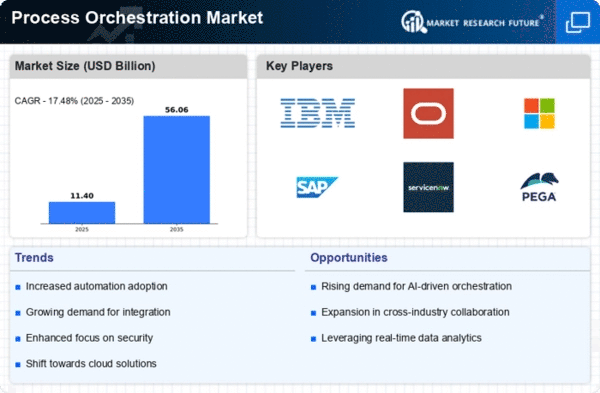
This research methodology focuses on understanding the core fundamentals of the research study conducted by Market Research Future (MRFR) on the global process orchestration market. The objectives of the report are to gain an in-depth analysis and insights into the process orchestration market, outline the key factors influencing its dynamics, and elucidate the opportunities, threats, trends and positioning in the global market along with the market forecasts from 2023 to 2030.
2. Research Approach
The research for this report has been conducted using a variety of approaches that includes primary and secondary research. Relevant industry journals and reports from industry associations have been used to study the processes and dynamics of the market. Primary market research was conducted to present an initial assessment of the industry's issues, dynamics, and challenges. The primary research involved telephonic interviews with industry stakeholders and industry participants. The interviews were conducted with product vendors, investors, customers, and experts.
The secondary research focuses on an in-depth analysis of industry publications, government publications, financial reports and industry databases. The analysis conducted for this report is based on both qualitative and quantitative factors. Market sizing was derived from primary sources, statistical data from secondary sources, and proprietary data from the Market Research Future (MRFF) database.
3. Market Selection
The market selection process has been used to identify the target market segment. The selection of the market was performed by analyzing the demand and supply of different market segments. The selection of the target market segment was done through interviews with industry stakeholders and customer surveys. The interviews were conducted with various stakeholders in the process orchestration market, such as product vendors, investors, customers, and experts. The customer surveys were aimed at obtaining their opinions on various aspects of the process orchestration market.
4. Data Collection
Data collection is one of the most important components of the research methodology used in this report. As a part of this research methodology, primary and secondary sources of data were used. Primary sources of data used in the report included interviews with industry stakeholders, such as product vendors, investors, customers, and experts. The interviews were conducted using telephonic interviews. Secondary sources used in the report include industry publications, government publications, and proprietary data from the Market Research Future (MRFR) database.
5. Market Segmentation
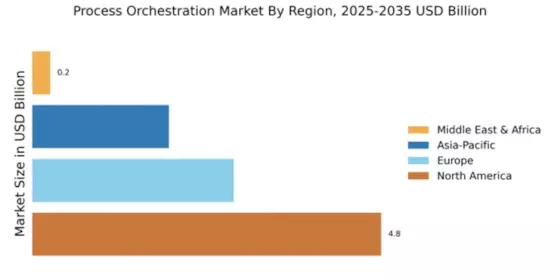
The market segmentation process included dividing the global market into four segments. These segments are application, enterprise size, deployment and regions (North America, Europe, Asia-Pacific, Middle East and Africa and Latin America). The application segment consists of Process Operations, Process Design and Automation, Process Analytics and Compliance Management. The enterprise size segment consists of Small and Medium-sized Enterprises (SMEs) and Large Enterprises. The deployment segments are cloud-based and on-premises.
6. Data Analysis
The analysis conducted for this report is based on both qualitative and quantitative factors. Market sizing was derived from primary sources, statistical data from secondary sources, and proprietary data from the Market Research Future (MRFR) database. The research methodology used in this report is designed to evaluate the key segments and drivers of the global process orchestration market. An in-depth analysis of the trends, drivers, restraints, and opportunities prevailing in the market was conducted. This included an in-depth analysis of the competitive landscape, market dynamics, and key strategies adopted by the industry players.
7. Report Outcomes
The report aims at providing an in-depth analysis of the process orchestration market and the growth prospects for the years 2023 to 2030. The report provides the market sizing and forecast based on the application, enterprise size, deployment and regions. It also provides a comprehensive overview of the factors driving the global process orchestration market, such as the market dynamics, industry trends and developments, and segmentation by applications. The report also offers insights into the various strategies adopted by the leading players in the global process orchestration market. Finally, the report provides a comprehensive overview of the industry's structure, ecosystem and regulatory framework.