×
Request Free Sample ×

Kindly complete the form below to receive a free sample of this Report

* Please use a valid business email

Leading companies partner with us for data-driven Insights

clients tt-cursor
Hero Background
English
Chinese
French
Japanese
Korean
German
Spanish

Vasectomy Market Share

ID: MRFR/MED/3282-HCR
110 Pages
Rahul Gotadki
October 2025

Vasectomy Market Research Report Information By Type (Conventional Vasectomy, No-Scalpel Vasectomy, Minimally Invasive Vasectomy), Drug (Anesthetics, Painkillers, Antibiotics), Patient (Humans, Animals), End User (Hospitals And Clinics) - Forecast Till 2035

Share:
Download PDF ×

We do not share your information with anyone. However, we may send you emails based on your report interest from time to time. You may contact us at any time to opt-out.

Vasectomy Market Infographic
×
Vasectomy Market Infographic Full View
Purchase Options

Market Share

Vasectomy Market Share Analysis

The reproductive health industry's vasectomy business is small but important since it includes male sterilization. Cultural perspectives, accessibility, and technology advances affect the permanent contraceptive industry. As more men choose vasectomy, the market for this safe and efficient birth control treatment has grown. Businesses seeking strategic positioning must comprehend market size and growth. Vasectomy companies engage in research and development to make operations less invasive and more convenient. Technology improves patient satisfaction and may induce more people to get vasectomy for birth control. Since vasectomy is irreversible, education is crucial to market share positioning. Businesses prioritize comprehensive educational programs for healthcare professionals and the public. Provide patients with facts on surgical safety, effectiveness, and reversibility to dispel myths. Building relationships with healthcare professionals is crucial. Companies teach medical personnel to perform vasectomy procedures properly. Collaboration with healthcare experts may also create a patient referral and endorsement network. Making vasectomy affordable is crucial to market entry. Companies are attempting to get insurance coverage for the therapy, remove financial barriers, and increase the number of individuals contemplating vasectomy for birth control. Businesses must understand the demographic factors that drive vasectomy decisions to adapt their marketing strategies. Tailoring marketing and outreach by age, culture, and socioeconomic status may be more successful. Companies consider global expansion, taking cultural and legal differences into consideration. Adapting one's approach to other places' demands and cooperating with foreign healthcare providers might help expand one's market reach. Offering post-vasectomy care and assistance sets you apart from competition. Businesses are developing follow-up instructions, fixing concerns, and offering vasectomy reversal to boost patient satisfaction and loyalty. Partnerships with NGOs and government health programs may boost market position. Collaborations may include raising awareness, funding marginalized group processes, and supporting larger-scale family planning operations. Successful market entry and success need regulatory framework navigation. Companies prioritize compliance with local and international laws, which compel them to ensure their products and services meet quality and safety requirements. Data analytics for market trends, patient outcomes, and competitor behavior is a key component of adaptive tactics. To be alert and adaptable to vasectomy market changes, companies invest in thorough monitoring systems.

Author
Rahul Gotadki
Assistant Manager

He holds an experience of about 7+ years in Market Research and Business Consulting, working under the spectrum of Life Sciences and Healthcare domains. Rahul conceptualizes and implements a scalable business strategy and provides strategic leadership to the clients. His expertise lies in market estimation, competitive intelligence, pipeline analysis, customer assessment, etc. In addition to the above, his other responsibility includes strategic tracking of high growth markets & advising clients on the potential areas of focus they could direct their business initiatives

Leave a Comment

Market Summary

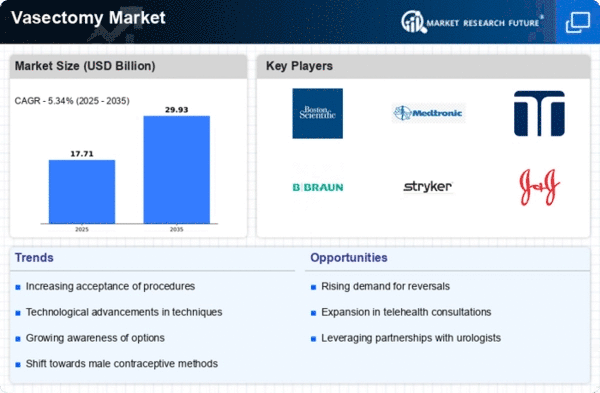
As per MRFR analysis, the Vasectomy Market Size was estimated at 16.81 USD Billion in 2024. The Vasectomy industry is projected to grow from 17.9 in 2025 to 29.93 by 2035, exhibiting a compound annual growth rate (CAGR) of 5.34 during the forecast period 2025 - 2035.

Key Market Trends & Highlights

The Vasectomy Market is experiencing a transformative shift driven by evolving societal attitudes and technological innovations.

  • In North America, there is a notable increase in awareness and education surrounding vasectomy procedures, contributing to higher acceptance rates.
  • The Asia-Pacific region is witnessing rapid growth in the no-scalpel vasectomy segment, reflecting a shift towards less invasive surgical options.
  • Conventional vasectomy remains the largest segment, yet the fastest-growing interest is observed among younger, higher-income demographics.
  • Rising demand for permanent contraception and advancements in surgical techniques are key drivers propelling market expansion.

Market Size & Forecast

2024 Market Size 16.81 (USD Billion)
2035 Market Size 29.93 (USD Billion)
CAGR (2025 - 2035) 5.34%
Largest Regional Market Share in 2024 North America

Major Players

Boston Scientific (US), Medtronic (US), Teleflex (US), B. Braun Melsungen AG (DE), Stryker Corporation (US), Johnson & Johnson (US), ConMed Corporation (US), Cook Medical (US)

Market Trends

The Vasectomy Market is currently experiencing a notable evolution, driven by changing societal attitudes towards family planning and male reproductive health. Increasing awareness regarding the benefits of permanent contraception is influencing men's decisions to consider this procedure. Furthermore, healthcare providers are enhancing their outreach efforts, aiming to educate potential candidates about the advantages and safety of vasectomy. This shift in perception appears to be fostering a more open dialogue about male sterilization, which may lead to a rise in demand for these services. In addition, advancements in surgical techniques and anesthesia are likely contributing to the growing acceptance of vasectomy. Minimally invasive procedures are becoming more prevalent, which could result in reduced recovery times and lower complication rates. As a result, men may feel more inclined to pursue this option, viewing it as a viable and responsible choice for family planning. Overall, the Vasectomy Market seems poised for growth as it adapts to the evolving needs and preferences of modern society.

Increased Awareness and Education

There is a growing emphasis on educating men about the benefits of vasectomy, which may lead to higher acceptance rates. Healthcare providers are actively promoting awareness campaigns that highlight the procedure's safety and effectiveness, potentially influencing more men to consider this option.

Technological Advancements

Innovations in surgical techniques are transforming the Vasectomy Market. Minimally invasive methods are becoming more common, which could enhance patient comfort and reduce recovery times. This trend may encourage more individuals to opt for the procedure.

Changing Societal Norms

Societal attitudes towards male contraception are shifting, with increasing acceptance of vasectomy as a responsible family planning choice. This change in perception may result in a greater willingness among men to discuss and pursue this option.

Vasectomy Market Market Drivers

Market Growth Projections

The Global Vasectomy Market Industry is projected to experience substantial growth in the coming years. With a current valuation of 16.8 USD Billion in 2024, the market is anticipated to reach 34.0 USD Billion by 2035. This represents a significant increase, driven by various factors including rising awareness of family planning, technological advancements, and changing societal attitudes towards male contraception. The expected compound annual growth rate (CAGR) of 6.63% from 2025 to 2035 further underscores the potential for expansion within this sector. These projections indicate a robust future for the vasectomy market as it adapts to evolving consumer needs and preferences.

Government Initiatives and Support

Government initiatives and support play a crucial role in shaping the Global Vasectomy Market Industry. Many countries have implemented policies aimed at promoting family planning and reproductive health services, which include vasectomy. These initiatives often provide funding for educational programs and subsidized healthcare services, making vasectomy more accessible to the public. For instance, countries with robust family planning programs report higher rates of vasectomy acceptance. This governmental backing not only raises awareness but also encourages men to consider vasectomy as a responsible choice, contributing to the projected CAGR of 6.63% for the period from 2025 to 2035.

Rising Awareness of Family Planning

The increasing awareness surrounding family planning and reproductive health is a pivotal driver for the Global Vasectomy Market Industry. Educational campaigns and healthcare initiatives have emphasized the importance of responsible parenthood, leading to a growing acceptance of vasectomy as a viable option for permanent contraception. This trend is particularly evident in developed nations, where the demand for vasectomies is on the rise. As of 2024, the Global Vasectomy Market is valued at 16.8 USD Billion, reflecting a shift in societal attitudes towards male sterilization. This awareness is expected to further bolster market growth as more individuals consider vasectomy as a practical solution.

Changing Attitudes Towards Male Contraception

Changing attitudes towards male contraception are reshaping the Global Vasectomy Market Industry. Traditionally, contraceptive responsibility has been predominantly placed on women, but there is a noticeable shift as men increasingly recognize the importance of sharing this responsibility. This evolving mindset is fostering a more open dialogue about male sterilization options, including vasectomy. As societal norms continue to evolve, more men are likely to consider vasectomy as a practical and responsible choice. This cultural shift is expected to drive market growth, aligning with the overall trend of increasing acceptance of male contraceptive methods.

Technological Advancements in Surgical Techniques

Technological advancements in surgical techniques are significantly influencing the Global Vasectomy Market Industry. Innovations such as no-scalpel vasectomy and advanced anesthesia methods have improved patient experiences and outcomes, leading to increased adoption rates. These minimally invasive procedures reduce recovery times and complications, making vasectomy a more appealing option for men. As healthcare providers adopt these modern techniques, the market is likely to witness a surge in demand. The anticipated growth trajectory suggests that by 2035, the market could reach 34.0 USD Billion, driven by these advancements that enhance the overall efficacy and safety of the procedure.

Increased Healthcare Access and Insurance Coverage

Increased healthcare access and insurance coverage are significant factors driving the Global Vasectomy Market Industry. As healthcare systems evolve, more individuals gain access to reproductive health services, including vasectomy. Insurance providers are increasingly covering the costs associated with the procedure, reducing financial barriers for potential patients. This trend is particularly pronounced in regions where healthcare reforms have expanded coverage for family planning services. As a result, more men are likely to opt for vasectomy, contributing to the market's growth trajectory. The combination of improved access and financial support is expected to enhance the overall adoption rates of vasectomy.

Market Segment Insights

By Procedure Type: Conventional Vasectomy (Largest) vs. No-Scalpel Vasectomy (Fastest-Growing)

In the Vasectomy Market, the conventional vasectomy procedure remains the largest segment, capturing significant market share due to its established reliability and widespread acceptance among patients. This traditional method is often preferred by healthcare providers due to its familiarity and effectiveness, contributing to its dominance in the market. On the other hand, the no-scalpel vasectomy segment is emerging as the fastest-growing option, attracting patients with its minimally invasive approach and associated benefits, such as reduced recovery time and lower complication rates. The growth trends in the Vasectomy Market indicate a shift towards less invasive procedures, with no-scalpel vasectomy gaining traction. Factors driving this growth include increased awareness of men's health, rising demand for effective contraceptive methods, and advances in surgical techniques that enhance patient outcomes. The combination of growing societal acceptance of male contraception and the superior patient experience offered by no-scalpel techniques underpins the robust outlook for this segment in the foreseeable future.

Conventional Vasectomy (Dominant) vs. Laparoscopic Vasectomy (Emerging)

The conventional vasectomy procedure, known for its effectiveness and lower procedural risks, remains the dominant choice among patients and healthcare professionals. Its established methodology fosters confidence, while its long track record of success plays a crucial role in patient preference. In contrast, laparoscopic vasectomy represents an emerging trend, characterized by its minimally invasive technique that can lead to quicker recovery and reduced post-operative pain. Although currently smaller in market share, laparoscopic procedures are gaining popularity due to technological advancements and enhanced patient education, presenting a compelling alternative for those seeking a less invasive option in male sterilization. As awareness continues to grow, laparoscopic vasectomy is expected to carve out a larger share of the market.

By Patient Demographics: Age Group (Largest) vs. Income Level (Fastest-Growing)

In the Vasectomy Market, various patient demographic segments exhibit distinct market shares. The largest age group utilizing vasectomy services tends to be men aged 30 to 40, who contribute significantly to the market. Following this, marital status shows a strong preference among married couples seeking permanent contraception solutions, enhancing the market’s growth potential. Income levels indicate that higher-income demographics are more likely to consider surgical interventions, suggesting a correlation between financial stability and healthcare choices. Growth trends in this segment are being driven by increased awareness and acceptance of vasectomy as a viable contraceptive option. Additionally, the rising number of married couples and men seeking long-term family planning methods fuels this demand. The emergence of new minimally invasive techniques is also propelling younger demographics to consider vasectomy, while income levels are growing in tandem with overall healthcare trends that encourage proactive health management.

Age Group: 30-40 (Dominant) vs. Income Level: High-Income (Emerging)

The dominant age group in the Vasectomy Market is men aged 30 to 40, who often seek vasectomy services due to family planning needs and lifestyle choices. This demographic is characterized by more established relationships and a strong desire for permanent contraception as they navigate parenthood. In contrast, the emerging segment consists of high-income individuals who are increasingly opting for vasectomies, driven by the availability of advanced medical solutions and a growing focus on personalized healthcare. High-income patients tend to prioritize convenience and are willing to invest in innovative treatment options. Overall, the dynamics between these two segments reveal a market that is adapting to both life stage requirements and economic factors.

By Healthcare Setting: Private Clinics (Largest) vs. Specialized Urology Centers (Fastest-Growing)

In the Vasectomy Market, the distribution of healthcare settings reflects diverse preferences among patients seeking this service. Private clinics hold the largest market share, attracting those who prioritize personalized care and convenience. Hospitals and community health centers also play significant roles, but their market presence is comparatively smaller. Specialized urology centers are emerging as a notable contender, carving out a niche with focused expertise in male reproductive health services, thus gradually increasing their share within the segment.

Private Clinics (Dominant) vs. Specialized Urology Centers (Emerging)

Private clinics dominate the Vasectomy Market by offering tailored services that prioritize patient comfort and accessibility. They often provide flexible scheduling, shorter wait times, and individualized care plans, making them a preferred choice for many. In contrast, specialized urology centers represent an emerging segment, characterized by advanced medical technologies and specialized staff extensively trained in male reproductive health. These centers focus on providing comprehensive solutions for vasectomy procedures and related consultations, appealing to patients seeking expert care. The growth of specialized urology centers is fueled by increasing awareness of male reproductive health, leading to a broader acceptance of vasectomy as a viable contraceptive option.

By Awareness and Attitude: Awareness Level (Largest) vs. Cultural Attitudes (Fastest-Growing)

In the Vasectomy Market, Awareness Level emerges as the largest segment, indicating a broad understanding of the procedure among potential candidates. This level of awareness is crucial, as it drives the decision-making process and reflects the effectiveness of educational campaigns targeting male contraceptive options. Conversely, Cultural Attitudes, while currently smaller, are the fastest-growing segment, reflecting changing societal norms around male sterilization. As more individuals recognize the benefits of vasectomy, cultural barriers are beginning to decline, facilitating greater acceptance. The increasing focus on men’s health and family planning is fueling growth in both segments. Awareness campaigns by healthcare organizations and advocacy groups are vital in enhancing knowledge about vasectomy, thereby dispelling misconceptions. Cultural shifts towards shared responsibility in family planning further accelerate the positive reception of vasectomy, influencing the overall market dynamics positively.

Awareness Level (Dominant) vs. Cultural Attitudes (Emerging)

The Awareness Level segment in the Vasectomy Market denotes a well-informed population regarding the procedure and its implications for family planning. This segment dominates due to extensive educational initiatives that have successfully conveyed the benefits and safety of vasectomy. In contrast, the Cultural Attitudes segment is emerging sharply, characterized by a progressive shift in perceptions towards male sterilization. This growth is driven by younger generations increasingly challenging traditional roles in family planning. The combination of traditional practices with modern health approaches fosters an environment where cultural stigmas are lessening, making way for an integrated understanding of shared reproductive responsibility.

Get more detailed insights about Vasectomy Market Research Report- Forecast till 2035

Regional Insights

North America : Market Leader in Vasectomy

North America is poised to maintain its leadership in the vasectomy market, holding a significant share of 8.41 in 2024. The region's growth is driven by increasing awareness of male sterilization, advancements in surgical techniques, and supportive healthcare policies. Regulatory frameworks are evolving to enhance patient access to these procedures, further boosting demand. The rising trend of family planning and male participation in reproductive health is also a key driver of market expansion. The competitive landscape in North America is robust, featuring key players such as Boston Scientific, Medtronic, and Johnson & Johnson. The U.S. is the leading country, accounting for the majority of the market share, supported by a well-established healthcare infrastructure. The presence of innovative technologies and a focus on minimally invasive procedures are enhancing the attractiveness of vasectomy as a permanent contraceptive option. As awareness grows, the market is expected to see sustained growth in the coming years.

Europe : Emerging Market Dynamics

Europe's vasectomy market is evolving, with a market size of 4.52 in 2024. The region is witnessing a gradual increase in demand for male sterilization procedures, driven by changing societal norms and a growing emphasis on family planning. Regulatory bodies are promoting awareness and accessibility, which is expected to catalyze market growth. The integration of advanced medical technologies and training programs for healthcare professionals is also enhancing service delivery in this sector. Leading countries in Europe include Germany, the UK, and France, where the presence of established healthcare systems supports the adoption of vasectomy procedures. Key players like B. Braun Melsungen AG and Teleflex are actively contributing to market growth through innovative product offerings. The competitive landscape is characterized by a mix of local and international companies, all vying to capture a share of this emerging market. As awareness increases, the market is set for significant expansion.

Asia-Pacific : Rapidly Growing Market Potential

The Asia-Pacific region is witnessing a burgeoning vasectomy market, with a size of 2.88 in 2024. Factors such as increasing urbanization, changing family structures, and rising awareness about male contraceptive options are driving demand. Governments are beginning to recognize the importance of male sterilization in family planning, leading to supportive policies and initiatives aimed at improving access to these services. The region's diverse population presents unique challenges and opportunities for market growth. Countries like India, Australia, and Japan are at the forefront of this market, with varying levels of acceptance and availability of vasectomy procedures. The competitive landscape includes both local and international players, with companies like Cook Medical and ConMed Corporation making significant inroads. As cultural perceptions shift and healthcare access improves, the Asia-Pacific vasectomy market is expected to expand rapidly in the coming years.

Middle East and Africa : Untapped Market Opportunities

The Middle East and Africa region presents a nascent but promising vasectomy market, with a size of 1.0 in 2024. The growth is primarily driven by increasing awareness of family planning and male reproductive health. Governments and NGOs are beginning to promote male sterilization as a viable option, which is expected to catalyze market growth. However, cultural barriers and limited access to healthcare services remain significant challenges that need to be addressed for the market to flourish. Leading countries in this region include South Africa and the UAE, where healthcare systems are gradually evolving to support such procedures. The competitive landscape is still developing, with few key players currently operating. As awareness campaigns and educational initiatives gain traction, the market is likely to see increased participation from both local and international companies, paving the way for future growth.

Key Players and Competitive Insights

The Vasectomy Market is currently characterized by a competitive landscape that is both dynamic and multifaceted. Key growth drivers include an increasing awareness of male contraceptive options, advancements in surgical techniques, and a growing acceptance of vasectomy as a viable family planning method. Major players such as Boston Scientific (US), Medtronic (US), and Johnson & Johnson (US) are strategically positioned to leverage these trends. Boston Scientific (US) focuses on innovation in minimally invasive procedures, while Medtronic (US) emphasizes its extensive product portfolio and global reach. Johnson & Johnson (US) is enhancing its market presence through strategic partnerships and digital health initiatives, collectively shaping a competitive environment that is increasingly reliant on technological advancements and patient-centric solutions.In terms of business tactics, companies are localizing manufacturing to reduce costs and optimize supply chains, which is particularly relevant in a moderately fragmented market. This approach allows for greater responsiveness to regional demands and enhances operational efficiency. The competitive structure is influenced by the collective actions of these key players, who are not only competing on product offerings but also on service delivery and patient engagement strategies.

In November Medtronic (US) announced a partnership with a leading telehealth provider to enhance access to vasectomy consultations and follow-up care. This strategic move is significant as it aligns with the growing trend of digital health solutions, potentially increasing patient engagement and satisfaction. By integrating telehealth into their service model, Medtronic (US) positions itself as a forward-thinking leader in the market, catering to the evolving needs of patients seeking convenience and accessibility.

In October Boston Scientific (US) launched a new line of advanced surgical instruments specifically designed for vasectomy procedures. This introduction not only underscores the company's commitment to innovation but also aims to improve surgical outcomes and reduce recovery times. The strategic importance of this launch lies in its potential to enhance the overall patient experience, thereby solidifying Boston Scientific's competitive edge in a market that increasingly values efficiency and effectiveness.

In September Johnson & Johnson (US) expanded its product offerings by acquiring a smaller firm specializing in male reproductive health technologies. This acquisition is indicative of a broader trend where larger companies are seeking to diversify their portfolios and integrate complementary technologies. By doing so, Johnson & Johnson (US) not only strengthens its market position but also enhances its ability to offer comprehensive solutions in male reproductive health, which is becoming increasingly relevant in the context of evolving consumer preferences.

As of December current competitive trends in the Vasectomy Market are heavily influenced by digitalization, sustainability, and the integration of artificial intelligence (AI) in surgical procedures. Strategic alliances are becoming more prevalent, as companies recognize the value of collaboration in driving innovation and improving patient outcomes. Looking ahead, competitive differentiation is likely to evolve from traditional price-based competition to a focus on innovation, technology, and supply chain reliability. This shift suggests that companies that prioritize these aspects will be better positioned to thrive in an increasingly complex and competitive landscape.

Key Companies in the Vasectomy Market include

Industry Developments

Pfizer Inc. and BioNTech S.E. today announced that they had submitted an application to the U.S. Food and Drug Administration for emergency use authorization of an additional booster dose for the adults. The submission is completely based on the two-real world data sets from Israel.

Future Outlook

Vasectomy Market Future Outlook

The Vasectomy Market is projected to grow at a 5.34% CAGR from 2025 to 2035, driven by increasing awareness, technological advancements, and changing societal norms.

New opportunities lie in:

  • Expansion of telehealth consultations for vasectomy procedures.
  • Development of minimally invasive surgical techniques to enhance patient comfort.
  • Partnerships with healthcare providers for integrated male reproductive health services.

By 2035, the Vasectomy Market is expected to be robust, reflecting evolving consumer preferences and healthcare innovations.

Market Segmentation

Vasectomy Market Procedure Type Outlook

  • Conventional Vasectomy
  • No-Scalpel Vasectomy
  • Electrocautery Vasectomy
  • Laparoscopic Vasectomy

Vasectomy Market Healthcare Setting Outlook

  • Private Clinics
  • Hospitals
  • Specialized Urology Centers
  • Community Health Centers

Vasectomy Market Patient Demographics Outlook

  • Age Group
  • Marital Status
  • Income Level
  • Education Level

Vasectomy Market Awareness and Attitude Outlook

  • Awareness Level
  • Perception of Vasectomy
  • Cultural Attitudes
  • Influence of Healthcare Providers

Report Scope

MARKET SIZE 202416.81(USD Billion)
MARKET SIZE 202517.9(USD Billion)
MARKET SIZE 203529.93(USD Billion)
COMPOUND ANNUAL GROWTH RATE (CAGR)5.34% (2025 - 2035)
REPORT COVERAGERevenue Forecast, Competitive Landscape, Growth Factors, and Trends
BASE YEAR2024
Market Forecast Period2025 - 2035
Historical Data2019 - 2024
Market Forecast UnitsUSD Billion
Key Companies ProfiledBoston Scientific (US), Medtronic (US), Teleflex (US), B. Braun Melsungen AG (DE), Stryker Corporation (US), Johnson & Johnson (US), ConMed Corporation (US), Cook Medical (US)
Segments CoveredProcedure Type, Patient Demographics, Healthcare Setting, Awareness and Attitude
Key Market OpportunitiesIncreasing acceptance of male contraceptive options drives growth in the Vasectomy Market.
Key Market DynamicsRising consumer awareness and acceptance drive demand for vasectomy procedures amid evolving healthcare regulations.
Countries CoveredNorth America, Europe, APAC, South America, MEA

FAQs

  1. SECTION I: EXECUTIVE SUMMARY AND KEY HIGHLIGHTS
    1. | 1.1 EXECUTIVE SUMMARY
    2. | 1.1.1 Market Overview
    3. | 1.1.2 Key Findings
    4. | 1.1.3 Market Segmentation
    5. | 1.1.4 Competitive Landscape
    6. | 1.1.5 Challenges and Opportunities
    7. | 1.1.6 Future Outlook
  2. SECTION II: SCOPING, METHODOLOGY AND MARKET STRUCTURE
    1. | 2.1 MARKET INTRODUCTION
    2. | 2.1.1 Definition
    3. | 2.1.2 Scope of the study
    4. |-- 2.1.2.1 Research Objective
    5. |-- 2.1.2.2 Assumption
    6. |-- 2.1.2.3 Limitations
    7. | 2.2 RESEARCH METHODOLOGY
    8. | 2.2.1 Overview
    9. | 2.2.2 Data Mining
    10. | 2.2.3 Secondary Research
    11. | 2.2.4 Primary Research
    12. |-- 2.2.4.1 Primary Interviews and Information Gathering Process
    13. |-- 2.2.4.2 Breakdown of Primary Respondents
    14. | 2.2.5 Forecasting Model
    15. | 2.2.6 Market Size Estimation
    16. |-- 2.2.6.1 Bottom-Up Approach
    17. |-- 2.2.6.2 Top-Down Approach
    18. | 2.2.7 Data Triangulation
    19. | 2.2.8 Validation
  3. SECTION III: QUALITATIVE ANALYSIS
    1. | 3.1 MARKET DYNAMICS
    2. | 3.1.1 Overview
    3. | 3.1.2 Drivers
    4. | 3.1.3 Restraints
    5. | 3.1.4 Opportunities
    6. | 3.2 MARKET FACTOR ANALYSIS
    7. | 3.2.1 Value chain Analysis
    8. | 3.2.2 Porter's Five Forces Analysis
    9. |-- 3.2.2.1 Bargaining Power of Suppliers
    10. |-- 3.2.2.2 Bargaining Power of Buyers
    11. |-- 3.2.2.3 Threat of New Entrants
    12. |-- 3.2.2.4 Threat of Substitutes
    13. |-- 3.2.2.5 Intensity of Rivalry
    14. | 3.2.3 COVID-19 Impact Analysis
    15. |-- 3.2.3.1 Market Impact Analysis
    16. |-- 3.2.3.2 Regional Impact
    17. |-- 3.2.3.3 Opportunity and Threat Analysis
  4. SECTION IV: QUANTITATIVE ANALYSIS
    1. | 4.1 Healthcare, BY Procedure Type (USD Billion)
    2. | 4.1.1 Conventional Vasectomy
    3. | 4.1.2 No-Scalpel Vasectomy
    4. | 4.1.3 Electrocautery Vasectomy
    5. | 4.1.4 Laparoscopic Vasectomy
    6. | 4.2 Healthcare, BY Patient Demographics (USD Billion)
    7. | 4.2.1 Age Group
    8. | 4.2.2 Marital Status
    9. | 4.2.3 Income Level
    10. | 4.2.4 Education Level
    11. | 4.3 Healthcare, BY Healthcare Setting (USD Billion)
    12. | 4.3.1 Private Clinics
    13. | 4.3.2 Hospitals
    14. | 4.3.3 Specialized Urology Centers
    15. | 4.3.4 Community Health Centers
    16. | 4.4 Healthcare, BY Awareness and Attitude (USD Billion)
    17. | 4.4.1 Awareness Level
    18. | 4.4.2 Perception of Vasectomy
    19. | 4.4.3 Cultural Attitudes
    20. | 4.4.4 Influence of Healthcare Providers
    21. | 4.5 Healthcare, BY Region (USD Billion)
    22. | 4.5.1 North America
    23. |-- 4.5.1.1 US
    24. |-- 4.5.1.2 Canada
    25. | 4.5.2 Europe
    26. |-- 4.5.2.1 Germany
    27. |-- 4.5.2.2 UK
    28. |-- 4.5.2.3 France
    29. |-- 4.5.2.4 Russia
    30. |-- 4.5.2.5 Italy
    31. |-- 4.5.2.6 Spain
    32. |-- 4.5.2.7 Rest of Europe
    33. | 4.5.3 APAC
    34. |-- 4.5.3.1 China
    35. |-- 4.5.3.2 India
    36. |-- 4.5.3.3 Japan
    37. |-- 4.5.3.4 South Korea
    38. |-- 4.5.3.5 Malaysia
    39. |-- 4.5.3.6 Thailand
    40. |-- 4.5.3.7 Indonesia
    41. |-- 4.5.3.8 Rest of APAC
    42. | 4.5.4 South America
    43. |-- 4.5.4.1 Brazil
    44. |-- 4.5.4.2 Mexico
    45. |-- 4.5.4.3 Argentina
    46. |-- 4.5.4.4 Rest of South America
    47. | 4.5.5 MEA
    48. |-- 4.5.5.1 GCC Countries
    49. |-- 4.5.5.2 South Africa
    50. |-- 4.5.5.3 Rest of MEA
  5. SECTION V: COMPETITIVE ANALYSIS
    1. | 5.1 Competitive Landscape
    2. | 5.1.1 Overview
    3. | 5.1.2 Competitive Analysis
    4. | 5.1.3 Market share Analysis
    5. | 5.1.4 Major Growth Strategy in the Healthcare
    6. | 5.1.5 Competitive Benchmarking
    7. | 5.1.6 Leading Players in Terms of Number of Developments in the Healthcare
    8. | 5.1.7 Key developments and growth strategies
    9. |-- 5.1.7.1 New Product Launch/Service Deployment
    10. |-- 5.1.7.2 Merger & Acquisitions
    11. |-- 5.1.7.3 Joint Ventures
    12. | 5.1.8 Major Players Financial Matrix
    13. |-- 5.1.8.1 Sales and Operating Income
    14. |-- 5.1.8.2 Major Players R&D Expenditure. 2023
    15. | 5.2 Company Profiles
    16. | 5.2.1 Boston Scientific (US)
    17. |-- 5.2.1.1 Financial Overview
    18. |-- 5.2.1.2 Products Offered
    19. |-- 5.2.1.3 Key Developments
    20. |-- 5.2.1.4 SWOT Analysis
    21. |-- 5.2.1.5 Key Strategies
    22. | 5.2.2 Medtronic (US)
    23. |-- 5.2.2.1 Financial Overview
    24. |-- 5.2.2.2 Products Offered
    25. |-- 5.2.2.3 Key Developments
    26. |-- 5.2.2.4 SWOT Analysis
    27. |-- 5.2.2.5 Key Strategies
    28. | 5.2.3 Teleflex (US)
    29. |-- 5.2.3.1 Financial Overview
    30. |-- 5.2.3.2 Products Offered
    31. |-- 5.2.3.3 Key Developments
    32. |-- 5.2.3.4 SWOT Analysis
    33. |-- 5.2.3.5 Key Strategies
    34. | 5.2.4 B. Braun Melsungen AG (DE)
    35. |-- 5.2.4.1 Financial Overview
    36. |-- 5.2.4.2 Products Offered
    37. |-- 5.2.4.3 Key Developments
    38. |-- 5.2.4.4 SWOT Analysis
    39. |-- 5.2.4.5 Key Strategies
    40. | 5.2.5 Stryker Corporation (US)
    41. |-- 5.2.5.1 Financial Overview
    42. |-- 5.2.5.2 Products Offered
    43. |-- 5.2.5.3 Key Developments
    44. |-- 5.2.5.4 SWOT Analysis
    45. |-- 5.2.5.5 Key Strategies
    46. | 5.2.6 Johnson & Johnson (US)
    47. |-- 5.2.6.1 Financial Overview
    48. |-- 5.2.6.2 Products Offered
    49. |-- 5.2.6.3 Key Developments
    50. |-- 5.2.6.4 SWOT Analysis
    51. |-- 5.2.6.5 Key Strategies
    52. | 5.2.7 ConMed Corporation (US)
    53. |-- 5.2.7.1 Financial Overview
    54. |-- 5.2.7.2 Products Offered
    55. |-- 5.2.7.3 Key Developments
    56. |-- 5.2.7.4 SWOT Analysis
    57. |-- 5.2.7.5 Key Strategies
    58. | 5.2.8 Cook Medical (US)
    59. |-- 5.2.8.1 Financial Overview
    60. |-- 5.2.8.2 Products Offered
    61. |-- 5.2.8.3 Key Developments
    62. |-- 5.2.8.4 SWOT Analysis
    63. |-- 5.2.8.5 Key Strategies
    64. | 5.3 Appendix
    65. | 5.3.1 References
    66. | 5.3.2 Related Reports

Healthcare Market Segmentation

Healthcare By Procedure Type (USD Billion, 2025-2035)

  • Conventional Vasectomy
  • No-Scalpel Vasectomy
  • Electrocautery Vasectomy
  • Laparoscopic Vasectomy

Healthcare By Patient Demographics (USD Billion, 2025-2035)

  • Age Group
  • Marital Status
  • Income Level
  • Education Level

Healthcare By Healthcare Setting (USD Billion, 2025-2035)

  • Private Clinics
  • Hospitals
  • Specialized Urology Centers
  • Community Health Centers

Healthcare By Awareness and Attitude (USD Billion, 2025-2035)

  • Awareness Level
  • Perception of Vasectomy
  • Cultural Attitudes
  • Influence of Healthcare Providers
Infographic

Free Sample Request

Kindly complete the form below to receive a free sample of this Report

Get Free Sample

Customer Strories

Compare Licence

×
Features License Type
Single User Multiuser License Enterprise User
Price $4,950 $5,950 $7,250
Maximum User Access Limit 1 User Upto 10 Users Unrestricted Access Throughout the Organization
Free Customization
Direct Access to Analyst
Deliverable Format
Platform Access
Discount on Next Purchase 10% 15% 15%
Printable Versions