×
Request Free Sample ×

Kindly complete the form below to receive a free sample of this Report

* Please use a valid business email

Leading companies partner with us for data-driven Insights

clients tt-cursor
Hero Background

US Upcycled Ingredients Market

ID: MRFR/FnB/11293-HCR
100 Pages
MRFR Team
February 2026

US Upcycled Ingredients Market Size, Share, Industry Trend & Analysis Research Report Information By Ingredient Type (Upcycled Starch, Upcycled Proteins / Powder, Upcycled Flour, Upcycled Dietary Fiber, Upcycled Ethanol, Upcycled Oils, Upcycled Vitamins, Upcycled Electrolytes, Upcycled Antioxidants, and Upcycled Minerals), By Source (Plant-based {Seeds, Peels, Flowers, Fruits, and Grains}, Animal-based {Egg Shells, Animal Bones}), By End Use (Food & Beverages, Cosmetics and personal care, Nutraceuticals, And Others), And By - Forecast 2030

Share:
Download PDF ×

We do not share your information with anyone. However, we may send you emails based on your report interest from time to time. You may contact us at any time to opt-out.

US Upcycled Ingredients Market Infographic
Purchase Options

US Upcycled Ingredients Market Summary

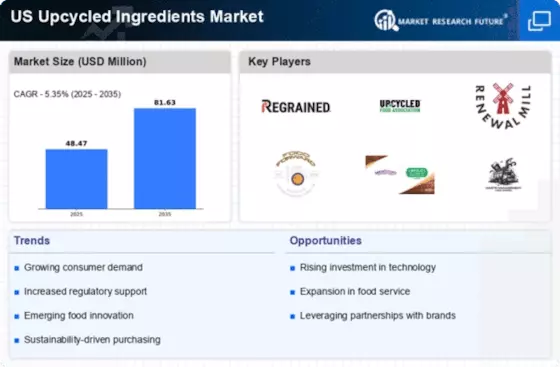
As per analysis, the US Upcycled Ingredients Market is projected to grow from USD 46.01 Million in 2024 to USD 81.63 Million by 2035, exhibiting a compound annual growth rate (CAGR) of 5.35% during the forecast period (2025 - 2035).

Key Market Trends & Highlights

The US Upcycled Ingredients Market is experiencing robust growth driven by sustainability trends and innovation.

  • Consumer demand for sustainable products is surging, particularly in the Food and Beverage segment, which remains the largest market.
  • The Cosmetics and Personal Care segment is witnessing rapid growth, reflecting a shift towards eco-friendly formulations.
  • Innovation in food production techniques is enhancing the efficiency and appeal of upcycled ingredients across various applications.
  • Key market drivers include increased consumer awareness of food waste and supportive regulatory frameworks promoting sustainable practices.

Market Size & Forecast

2024 Market Size 46.01 (USD Million)
2035 Market Size 81.63 (USD Million)
CAGR (2025 - 2035) 5.35%

Major Players

ReGrained (US), Upcycled Food Association (US), Renewal Mill (US), Food Forward (US), The Upcycled Food Company (US), Wasted Food (US), Karma (US), The Good Food Institute (US)

Our Impact
Enabled $4.3B Revenue Impact for Fortune 500 and Leading Multinationals
Partnering with 2000+ Global Organizations Each Year
30K+ Citations by Top-Tier Firms in the Industry

US Upcycled Ingredients Market Trends

The US Upcycled Ingredients Market is currently experiencing a notable transformation, driven by a growing awareness of sustainability and waste reduction. Consumers are increasingly seeking products that not only meet their nutritional needs but also align with their values regarding environmental responsibility. This shift is prompting food manufacturers to explore innovative ways to incorporate upcycled ingredients into their offerings, thereby reducing food waste and enhancing product appeal. The market appears to be evolving as companies recognize the potential for upcycled ingredients to provide unique flavors and nutritional benefits, while also contributing to a circular economy. In January 2026, the landscape of the US Upcycled Ingredients Market suggests a promising future, as regulatory frameworks and consumer preferences continue to evolve. The USDA has been actively promoting initiatives that encourage the use of upcycled ingredients, which may further stimulate market growth. Additionally, collaborations between food producers and agricultural sectors are likely to enhance the supply chain for upcycled materials. As awareness of food waste issues persists, the market could see an influx of innovative products that leverage upcycled ingredients, appealing to environmentally conscious consumers and potentially reshaping the food industry.

Increased Consumer Demand for Sustainable Products

There is a noticeable rise in consumer interest in products that utilize upcycled ingredients. This trend indicates a shift towards sustainability, as individuals seek to minimize their environmental impact through their purchasing choices. Companies are responding by reformulating existing products and developing new offerings that highlight the use of upcycled materials.

Regulatory Support for Upcycled Ingredients

The US government appears to be fostering an environment conducive to the growth of the upcycled ingredients sector. Initiatives from agencies such as the USDA are likely to provide guidelines and support for businesses that incorporate upcycled materials, potentially enhancing market credibility and consumer trust.

Innovation in Food Production Techniques

The US Upcycled Ingredients Market is witnessing a surge in innovative food production methods that utilize by-products and surplus materials. This trend suggests that manufacturers are increasingly adopting creative approaches to ingredient sourcing, which may lead to the development of unique products that cater to diverse consumer preferences.

US Upcycled Ingredients Market Drivers

Supportive Regulatory Frameworks

The US Upcycled Ingredients Market is bolstered by a supportive regulatory environment that encourages the use of upcycled ingredients. Recent initiatives by the USDA and FDA aim to promote sustainable practices within the food industry, including the establishment of guidelines for upcycled food products. These regulations not only provide clarity for manufacturers but also enhance consumer confidence in upcycled ingredients. As a result, the market is likely to see an increase in the number of products labeled as upcycled, which could lead to a projected growth rate of 15% annually over the next five years. This regulatory support is crucial for the US Upcycled Ingredients Market, as it fosters innovation and encourages companies to explore new avenues for utilizing food by-products.

Rising Interest in Plant-Based Diets

The US Upcycled Ingredients Market is witnessing a surge in interest surrounding plant-based diets, which often incorporate upcycled ingredients. As more consumers adopt vegetarian and vegan lifestyles, the demand for innovative food products that utilize upcycled plant materials is likely to increase. Research indicates that the plant-based food market in the US is expected to reach $74 billion by 2027, with upcycled ingredients playing a pivotal role in this growth. This trend suggests that companies within the US Upcycled Ingredients Market can capitalize on the intersection of plant-based diets and sustainability, potentially leading to new product development and increased market penetration.

Collaboration with Food Tech Startups

The US Upcycled Ingredients Market is increasingly characterized by collaborations between established food companies and innovative food tech startups. These partnerships are often focused on developing new products that utilize upcycled ingredients, leveraging technology to enhance product quality and sustainability. For instance, several major food brands have recently partnered with startups specializing in upcycling food waste into high-value ingredients. This trend indicates a growing recognition of the potential of upcycled ingredients to meet consumer demands for sustainability while also addressing food waste challenges. Such collaborations are likely to drive innovation within the US Upcycled Ingredients Market, leading to a broader range of products and increased consumer interest.

Increased Consumer Awareness of Food Waste

The US Upcycled Ingredients Market is experiencing a notable shift as consumers become increasingly aware of food waste issues. This heightened awareness is driving demand for products that utilize upcycled ingredients, which are derived from food by-products that would otherwise be discarded. According to recent surveys, approximately 70% of consumers express a preference for brands that actively reduce food waste. This trend suggests that companies focusing on upcycled ingredients may capture a larger market share, as consumers align their purchasing decisions with sustainability values. Furthermore, the US Upcycled Ingredients Market is likely to benefit from this consumer shift, as brands that incorporate upcycled ingredients into their offerings can enhance their appeal and differentiate themselves in a competitive landscape.

Growing Investment in Sustainable Practices

The US Upcycled Ingredients Market is benefiting from a growing trend of investment in sustainable practices among food manufacturers. As companies recognize the economic and environmental advantages of utilizing upcycled ingredients, many are reallocating resources to develop sustainable product lines. Reports suggest that investments in sustainable food practices have increased by over 20% in the past year alone. This influx of capital is likely to accelerate the growth of the US Upcycled Ingredients Market, as companies innovate and expand their offerings to include upcycled ingredients. The financial commitment to sustainability not only enhances brand reputation but also aligns with consumer expectations, further driving market growth.


Market Segment Insights

By Application: Food and Beverage (Largest) vs. Cosmetics and Personal Care (Fastest-Growing)

In the US Upcycled Ingredients Market, the application segments exhibit a diverse distribution of market shares, with Food and Beverage leading as the largest segment. This dominance is attributed to the rising consumer demand for sustainable and eco-friendly products, where upcycled ingredients are becoming increasingly popular for their perceived health benefits and environmental advantages. Cosmetics and Personal Care, while currently smaller in share, follow closely behind, showing a promising potential for growth as brands are increasingly favoring upcycled materials to enhance product sustainability and appeal to eco-conscious consumers.

Animal Feed (Dominant) vs. Textiles (Emerging)

Animal Feed represents a dominant segment within the US Upcycled Ingredients Market, utilizing by-products from food processing to create nutritious feed that aligns with sustainability goals. This segment benefits from a strong demand for cost-effective feed alternatives and a growing awareness of the environmental impact of traditional feed sources. Conversely, the Textiles segment is emerging as a new player in the market, leveraging upcycled materials to innovate in sustainable fashion. As consumer trends shift towards eco-friendly apparel, textile manufacturers are increasingly incorporating upcycled fibers, aiming to reduce waste and carbon footprint while appealing to environmentally conscious consumers.

By Source: Fruits and Vegetables (Largest) vs. Grains and Cereals (Fastest-Growing)

In the US Upcycled Ingredients Market, the source segment comprises various subcategories such as Fruits and Vegetables, Grains and Cereals, Meat and Seafood, Dairy Products, and Plant-Based Materials. Among these, Fruits and Vegetables dominate the market share significantly, driven by high consumer demand for healthy and sustainable food options. Grains and Cereals follow closely, capturing a notable portion of the market, while the remainder, including Meat and Seafood, Dairy Products, and Plant-Based Materials, are gaining traction but remain smaller in overall share.

Fruits and Vegetables (Dominant) vs. Grains and Cereals (Emerging)

Fruits and Vegetables occupy a dominant position in the US Upcycled Ingredients Market due to their versatility and consumer preference for fresh, healthy food options. This segment benefits from extensive waste reduction efforts, particularly in juice and puree production. Conversely, Grains and Cereals are emerging as a significant player, often incorporated into snack foods, baked goods, and breakfast cereals. With rising awareness of food waste, innovative companies are increasingly utilizing upcycled grains, appealing to health-conscious consumers. Both segments are fueled by sustainability trends, with a focus on reducing food waste and promoting a circular economy.

By End Use: Food Industry (Largest) vs. Pharmaceutical Industry (Fastest-Growing)

In the US Upcycled Ingredients Market, the Food Industry represents the largest segment, driven by the increasing demand for sustainable and nutritious food products. A significant portion of the market share is attributed to companies focusing on innovative upcycling techniques to convert food waste into valuable ingredients. Conversely, the Pharmaceutical Industry, while smaller, is gaining traction with the fastest growth, fueled by the urgency to find sustainable solutions amid growing regulatory pressures and consumer demands for eco-friendly products.

Food Industry (Dominant) vs. Pharmaceutical Industry (Emerging)

The Food Industry segment is characterized by its dominance in the US Upcycled Ingredients Market, leveraging the rising consumer trend towards health-conscious and environmentally-friendly food options. Companies in this sector employ various upcycling methods to create natural preservatives and flavor enhancers from food waste. On the other hand, the Pharmaceutical Industry is classified as an emerging segment, utilizing upcycled ingredients to develop sustainable pharmaceuticals and nutraceuticals. This industry responds rapidly to innovation, with a strong focus on research and development to integrate natural, upcycled components in drug formulations, thereby appealing to a growing segment of eco-aware consumers.

By Processing Method: Fermentation (Largest) vs. Extraction (Fastest-Growing)

In the US Upcycled Ingredients Market, processing methods are pivotal in determining the efficiency and quality of ingredient recovery. Among these methods, fermentation holds the largest market share, dominating the segment due to its effective transformation of organic materials into high-value products. Following closely, extraction also plays a key role, capturing significant attention for its versatility in obtaining desired compounds from various raw materials. Other methods like dehydration, hydrolysis, and cold pressing contribute to the market dynamics, albeit at a comparatively lower scale.

Fermentation (Dominant) vs. Extraction (Emerging)

Fermentation is the dominant processing method in the US Upcycled Ingredients Market, favored for its ability to convert waste into valuable ingredients through microbial action. This method not only boosts sustainability but also enhances the nutritional profile of the end products. On the other hand, extraction is emerging as a significant player, recognized for its efficiency in isolating specific components from raw materials. This method is gaining rapid traction due to innovations that enhance yield and purity. Both methods are integral to the market, with fermentation providing stability and extraction driving future growth.

Get more detailed insights about US Upcycled Ingredients Market

Key Players and Competitive Insights

The Upcycled Ingredients Market is currently characterized by a dynamic competitive landscape, driven by increasing consumer awareness regarding sustainability and food waste reduction. Key players are actively engaging in innovative practices and strategic partnerships to enhance their market positioning. For instance, ReGrained (US) has focused on product innovation, particularly in developing new snack products from upcycled grains, which aligns with the growing demand for sustainable food options. Similarly, The Upcycled Food Company (US) emphasizes its commitment to creating high-quality ingredients from food by-products, thereby appealing to environmentally conscious consumers. These strategies collectively contribute to a competitive environment that prioritizes sustainability and innovation.

In terms of business tactics, companies are increasingly localizing manufacturing processes and optimizing supply chains to enhance efficiency and reduce carbon footprints. The market appears moderately fragmented, with several players vying for market share. This fragmentation allows for diverse offerings, yet the collective influence of key players like Renewal Mill (US) and Food Forward (US) is notable, as they drive industry standards and consumer expectations through their operational practices.

In December 2025, Renewal Mill (US) announced a partnership with a major food retailer to launch a new line of upcycled flour products. This strategic move not only expands their distribution channels but also reinforces their commitment to reducing food waste by utilizing by-products from the milling process. Such partnerships are crucial in enhancing market reach and consumer awareness about upcycled ingredients.

In November 2025, Food Forward (US) launched an initiative aimed at increasing the visibility of upcycled ingredients in mainstream grocery stores. This initiative includes educational campaigns and collaborations with local chefs to promote the use of upcycled products in everyday cooking. The strategic importance of this initiative lies in its potential to shift consumer perceptions and increase demand for upcycled ingredients, thereby fostering a more sustainable food system.

In October 2025, Karma (US) introduced a new digital platform that connects consumers with local producers of upcycled ingredients. This platform not only facilitates direct sales but also educates consumers on the benefits of upcycled foods. The integration of technology in this manner suggests a trend towards digitalization in the market, which could enhance consumer engagement and drive sales.

As of January 2026, the competitive trends in the Upcycled Ingredients Market are increasingly defined by digitalization, sustainability, and the integration of AI technologies. Strategic alliances among companies are shaping the landscape, fostering innovation and collaboration. The shift from price-based competition to a focus on technological advancement and supply chain reliability is evident. Moving forward, competitive differentiation is likely to evolve, with companies that prioritize innovation and sustainability standing out in a crowded marketplace.

Key Companies in the US Upcycled Ingredients Market include

Future Outlook

US Upcycled Ingredients Market Future Outlook

The US Upcycled Ingredients Market is projected to grow at a 5.35% CAGR from 2025 to 2035, driven by sustainability trends, regulatory support, and consumer demand for eco-friendly products.

New opportunities lie in:

  • Develop partnerships with food manufacturers for ingredient sourcing.
  • Invest in technology for efficient waste processing and ingredient extraction.
  • Create branded product lines featuring upcycled ingredients to attract eco-conscious consumers.

By 2035, the market is expected to solidify its position as a leader in sustainable ingredient solutions.

Market Segmentation

US Upcycled Ingredients Market Source Outlook

  • Fruits and Vegetables
  • Grains and Cereals
  • Meat and Seafood
  • Dairy Products
  • Plant-Based Materials

US Upcycled Ingredients Market End Use Outlook

  • Food Industry
  • Pharmaceutical Industry
  • Cosmetic Industry
  • Agricultural Sector
  • Textile Industry

US Upcycled Ingredients Market Application Outlook

  • Food and Beverage
  • Cosmetics and Personal Care
  • Animal Feed
  • Nutraceuticals
  • Textiles

US Upcycled Ingredients Market Processing Method Outlook

  • Fermentation
  • Dehydration
  • Extraction
  • Hydrolysis
  • Cold Pressing

Report Scope

MARKET SIZE 202446.01(USD Million)
MARKET SIZE 202548.73(USD Million)
MARKET SIZE 203581.63(USD Million)
COMPOUND ANNUAL GROWTH RATE (CAGR)5.35% (2024 - 2035)
REPORT COVERAGERevenue Forecast, Competitive Landscape, Growth Factors, and Trends
BASE YEAR2024
Market Forecast Period2025 - 2035
Historical Data2019 - 2024
Market Forecast UnitsUSD Million
Key Companies ProfiledReGrained (US), Upcycled Food Association (US), Renewal Mill (US), Food Forward (US), The Upcycled Food Company (US), Wasted Food (US), Karma (US), The Good Food Institute (US)
Segments CoveredApplication, Source, End Use, Processing Method
Key Market OpportunitiesGrowing consumer demand for sustainable products drives innovation in the US Upcycled Ingredients Market.
Key Market DynamicsRising consumer demand for sustainable products drives innovation in the US Upcycled Ingredients Market.
Countries CoveredUS
Leave a Comment

FAQs

What is the current valuation of the US Upcycled Ingredients Market?

As of 2024, the US Upcycled Ingredients Market was valued at 46.01 USD Million.

What is the projected market size for the US Upcycled Ingredients Market by 2035?

The market is projected to reach 81.63 USD Million by 2035.

What is the expected CAGR for the US Upcycled Ingredients Market during the forecast period 2025 - 2035?

The expected CAGR for the market during the forecast period 2025 - 2035 is 5.35%.

Which application segments are leading in the US Upcycled Ingredients Market?

The leading application segments include Food and Beverage, Cosmetics and Personal Care, and Animal Feed, with valuations ranging from 5.0 to 35.0 USD Million.

What are the primary sources of upcycled ingredients in the US market?

Primary sources include Fruits and Vegetables, Grains and Cereals, and Plant-Based Materials, with valuations between 8.0 and 26.63 USD Million.

Which industries are the largest consumers of upcycled ingredients?

The Food Industry and Pharmaceutical Industry are the largest consumers, with market sizes of 18.0 to 32.0 USD Million and 10.0 to 18.0 USD Million, respectively.

What processing methods are commonly used in the US Upcycled Ingredients Market?

Common processing methods include Extraction, Cold Pressing, and Dehydration, with valuations ranging from 9.0 to 19.63 USD Million.

Who are the key players in the US Upcycled Ingredients Market?

Key players include ReGrained, Upcycled Food Association, and Renewal Mill, among others.

How does the market for upcycled ingredients in cosmetics compare to other sectors?

The cosmetics sector is valued between 8.0 and 14.0 USD Million, indicating a growing interest in sustainable ingredients.

What trends are influencing the growth of the US Upcycled Ingredients Market?

Trends include increasing consumer awareness of sustainability and the potential for innovative applications across various industries.

Download Free Sample

Kindly complete the form below to receive a free sample of this Report

Compare Licence

×
Features License Type
Single User Multiuser License Enterprise User
Price $4,950 $5,950 $7,250
Maximum User Access Limit 1 User Upto 10 Users Unrestricted Access Throughout the Organization
Free Customization
Direct Access to Analyst
Deliverable Format
Platform Access
Discount on Next Purchase 10% 15% 15%
Printable Versions