Expansion of Commercial Applications
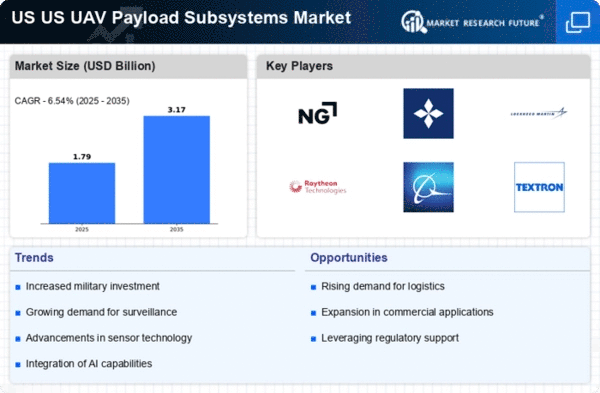
The US UAV Payload Subsystems Market is witnessing a significant expansion in commercial applications, which is diversifying the market landscape. Industries such as agriculture, construction, and logistics are increasingly adopting UAVs equipped with advanced payload subsystems for various purposes, including crop monitoring, infrastructure inspection, and delivery services. According to industry reports, the commercial UAV market in the US is projected to reach 5 billion USD by 2026, with payload subsystems playing a critical role in this growth. The ability to collect high-resolution data and perform tasks efficiently is driving businesses to invest in UAV technologies. This trend not only enhances operational efficiency but also opens new revenue streams for manufacturers of UAV payload subsystems, as they cater to a broader range of industries and applications.
Strategic Partnerships and Collaborations
Strategic partnerships and collaborations are emerging as a key driver in the US UAV Payload Subsystems Market. Companies are increasingly joining forces with technology providers, research institutions, and government agencies to leverage expertise and resources. These collaborations facilitate the development of cutting-edge payload technologies and enhance the overall capabilities of UAV systems. For instance, partnerships between defense contractors and tech firms are leading to the creation of advanced sensor systems that improve data collection and analysis. Additionally, collaborative efforts in testing and validation processes are streamlining the introduction of new payload subsystems into the market. As the competitive landscape evolves, these strategic alliances are likely to play a crucial role in shaping the future of the US UAV payload subsystems market, driving innovation and expanding market reach.
Increased Focus on Research and Development
The US UAV Payload Subsystems Market is characterized by an increased focus on research and development (R&D) initiatives. Government agencies, including NASA and the Department of Defense, are investing heavily in R&D to advance UAV technologies and payload capabilities. This investment is aimed at enhancing the performance, reliability, and versatility of UAV payload subsystems. Recent initiatives have led to the development of innovative payloads, such as multi-spectral sensors and advanced communication systems, which are expected to improve operational effectiveness in various missions. The US government has earmarked over 1 billion USD for UAV-related R&D projects in the upcoming fiscal year, indicating a strong commitment to fostering innovation in this sector. As R&D efforts continue to progress, they are likely to yield breakthroughs that will further propel the US UAV payload subsystems market.
Growing Demand for Surveillance and Reconnaissance
The US UAV Payload Subsystems Market is experiencing a notable surge in demand for surveillance and reconnaissance capabilities. This trend is largely driven by the increasing need for real-time intelligence in military operations and homeland security. The US government has allocated substantial budgets for advanced UAV systems, with the Department of Defense planning to invest over 10 billion USD in UAV technologies by 2026. This investment is expected to enhance the capabilities of UAV payload subsystems, making them more efficient and effective in gathering critical data. As a result, manufacturers are focusing on developing sophisticated sensors and imaging technologies to meet the evolving requirements of military and civilian applications. The growing emphasis on situational awareness and threat detection further propels the demand for advanced UAV payload subsystems in the US.
Integration of Artificial Intelligence and Automation
The integration of artificial intelligence (AI) and automation into UAV payload subsystems is transforming the US UAV Payload Subsystems Market. AI technologies are being utilized to enhance data processing, enabling UAVs to analyze vast amounts of information in real-time. This capability is particularly valuable in military operations, where timely decision-making is crucial. The US military is increasingly adopting AI-driven systems to improve mission outcomes, with projections indicating that AI integration could reduce operational costs by up to 30%. Furthermore, automation in UAV operations is streamlining processes, allowing for more efficient deployment and management of payloads. As these technologies continue to evolve, they are likely to redefine the operational landscape of UAVs in the US, driving further investment and innovation in the payload subsystem sector.