Increased Focus on Sustainability
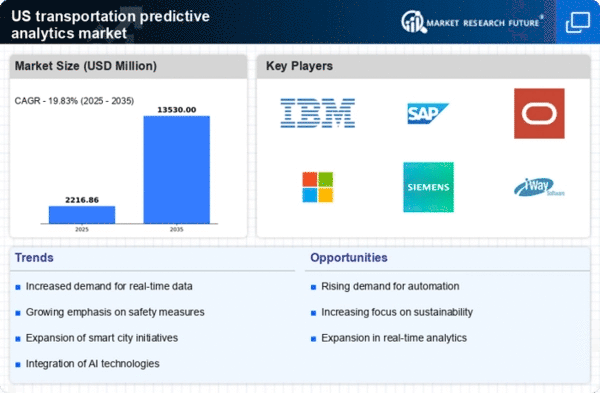
The market is increasingly driven by a focus on sustainability. As environmental concerns rise, companies are under pressure to reduce their carbon footprints and improve fuel efficiency. Predictive analytics can play a crucial role in achieving these goals by optimizing routes and reducing idle times. The US government has set ambitious targets to reduce greenhouse gas emissions, which may further incentivize the adoption of predictive analytics in transportation. By utilizing these tools, organizations can not only comply with regulations but also enhance their brand reputation, thus propelling the transportation predictive-analytics market forward.
Growing Demand for Efficient Logistics
The transportation predictive-analytics market is experiencing a surge in demand for efficient logistics solutions. As e-commerce continues to expand, companies are seeking ways to optimize their supply chains. This has led to an increased reliance on predictive analytics to forecast demand, manage inventory, and streamline operations. According to recent data, logistics costs in the US account for approximately 8% of GDP, highlighting the need for cost-effective solutions. By leveraging predictive analytics, businesses can reduce operational inefficiencies and enhance customer satisfaction, thereby driving growth in the transportation predictive-analytics market.
Integration of Artificial Intelligence
The integration of artificial intelligence (AI) into the transportation predictive-analytics market is transforming how data is analyzed and utilized. AI algorithms can process vast amounts of data at unprecedented speeds, enabling more accurate predictions and insights. This capability is particularly valuable in dynamic environments where conditions change rapidly. The US market is witnessing a growing investment in AI technologies, with projections indicating a potential market size of $190 billion by 2025. As organizations increasingly adopt AI-driven predictive analytics, they can enhance decision-making processes, improve operational efficiency, and drive growth in the transportation predictive-analytics market.
Rising Need for Enhanced Safety Measures
The transportation predictive-analytics market is also being propelled by a rising need for enhanced safety measures. With increasing traffic congestion and accident rates, stakeholders are prioritizing safety in transportation systems. Predictive analytics can help identify potential hazards and optimize safety protocols. For example, the US Department of Transportation reported that traffic fatalities increased by 7.2% in 2020, underscoring the urgency for improved safety solutions. By leveraging predictive analytics, organizations can proactively address safety concerns, thereby fostering a safer transportation environment and contributing to the expansion of the transportation predictive-analytics market.
Advancements in Data Collection Technologies
The transportation predictive-analytics market is significantly influenced by advancements in data collection technologies. The proliferation of IoT devices and sensors enables real-time data gathering from various transportation modes. This influx of data allows for more accurate predictive modeling and analysis. For instance, the US is projected to have over 75 billion connected devices by 2025, providing a wealth of information for predictive analytics applications. Consequently, organizations can make informed decisions regarding route optimization, maintenance scheduling, and resource allocation, thereby enhancing operational efficiency and contributing to the growth of the transportation predictive-analytics market.