×
Request Free Sample ×

Kindly complete the form below to receive a free sample of this Report

* Please use a valid business email

Leading companies partner with us for data-driven Insights

clients tt-cursor
Hero Background

US Test Management Software Market

ID: MRFR/ICT/61613-HCR
200 Pages
Aarti Dhapte
February 2026

US Test Management Software Market Research Report By Deployment (On-premises, Cloud), By Pricing (Monthly, Yearly, One-time License), By Organization size (SMEs, Large Enterprises) and By Vertical (BFSI, IT & Telecom, Manufacturing, Energy & utilities, Healthcare & life sciences, Education, Aerospace & defense, Others)-Forecast to 2035

Share:
Download PDF ×

We do not share your information with anyone. However, we may send you emails based on your report interest from time to time. You may contact us at any time to opt-out.

US Test Management Software Market Infographic
Purchase Options

US Test Management Software Market Summary

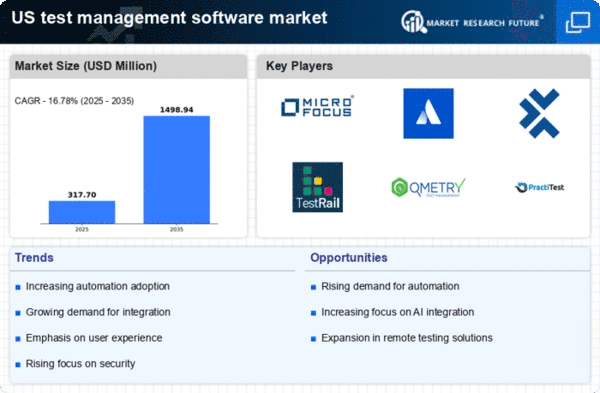
As per Market Research Future analysis, the US test management-software market size was estimated at 272.05 USD Million in 2024. The US test management-software market is projected to grow from 317.7 USD Million in 2025 to 1498.94 USD Million by 2035, exhibiting a compound annual growth rate (CAGR) of 16.7% during the forecast period 2025 - 2035

Key Market Trends & Highlights

The US test management-software market is experiencing a transformative shift towards cloud-based solutions and integration with agile methodologies.

  • The market is witnessing increased adoption of cloud-based solutions, enhancing accessibility and collaboration.
  • Integration with DevOps practices is becoming a critical trend, facilitating faster software delivery cycles.
  • There is a growing focus on enhanced reporting and analytics capabilities to improve decision-making processes.
  • Key market drivers include the rising complexity of software applications and the growing demand for automation in testing.

Market Size & Forecast

2024 Market Size 272.05 (USD Million)
2035 Market Size 1498.94 (USD Million)
CAGR (2025 - 2035) 16.78%

Major Players

Micro Focus (GB), Atlassian (AU), Tricentis (AT), TestRail (US), QMetry (US), PractiTest (IL), Zephyr (US), Xray (PT), TestLink (DE)

Our Impact
Enabled $4.3B Revenue Impact for Fortune 500 and Leading Multinationals
Partnering with 2000+ Global Organizations Each Year
30K+ Citations by Top-Tier Firms in the Industry

US Test Management Software Market Trends

the test management-software market is currently experiencing significant changes, driven by the increasing demand for efficient software development processes. Organizations are recognizing the necessity of robust testing frameworks to ensure product quality and reliability. This shift is largely influenced by the growing complexity of software applications and the need for seamless integration within development cycles. As a result, companies are investing in advanced tools that facilitate better collaboration among teams, enhance visibility into testing processes, and ultimately lead to improved outcomes. Furthermore, the rise of agile methodologies has prompted a reevaluation of traditional testing practices, pushing for more adaptive and iterative approaches. In addition, the emphasis on automation within the test management-software market is becoming increasingly pronounced. Automation tools are being integrated to streamline repetitive tasks, thereby allowing teams to focus on more strategic initiatives. This trend not only accelerates the testing process but also reduces the likelihood of human error, which can be detrimental to software quality. As organizations continue to prioritize efficiency and effectiveness, the test management-software market is poised for further growth, with innovations likely to emerge that cater to the evolving needs of software development teams.

Increased Adoption of Cloud-Based Solutions

The shift towards cloud-based test management solutions is becoming more prevalent. Organizations are increasingly favoring these platforms due to their scalability, accessibility, and cost-effectiveness. Cloud solutions allow teams to collaborate in real-time, regardless of geographical location, which enhances productivity and accelerates the testing process.

Integration with DevOps Practices

There is a growing trend of integrating test management software with DevOps practices. This integration facilitates continuous testing and delivery, ensuring that quality assurance is embedded throughout the development lifecycle. As teams adopt DevOps methodologies, the need for tools that support this alignment is becoming critical.

Focus on Enhanced Reporting and Analytics

The demand for advanced reporting and analytics features within test management software is on the rise. Organizations are seeking tools that provide deeper insights into testing processes, enabling data-driven decision-making. Enhanced analytics capabilities allow teams to identify bottlenecks and optimize their testing strategies effectively.

US Test Management Software Market Drivers

Growing Demand for Automation in Testing

the test management-software market is experiencing a significant increase in demand for automation tools. Organizations are increasingly recognizing the efficiency and accuracy that automated testing brings to the software development lifecycle. This shift is driven by the need to reduce time-to-market and enhance product quality. According to recent data, approximately 70% of companies in the US are investing in automation technologies, which directly influences the growth of the test management-software market. As businesses strive for agility and responsiveness, the integration of automated testing solutions becomes essential, thereby propelling the market forward. Furthermore, the ability to conduct continuous testing aligns with the agile methodologies adopted by many organizations, further solidifying the role of test management software in facilitating these processes.

Rising Complexity of Software Applications

The increasing complexity of software applications is a significant driver for the test management-software market. As applications evolve to incorporate advanced features and functionalities, the need for comprehensive testing solutions becomes paramount. This complexity necessitates robust test management tools that can handle diverse testing scenarios and ensure thorough coverage. In the US, the software development landscape is characterized by a growing number of platforms and devices, which complicates the testing process. Consequently, organizations are investing in sophisticated test management software to streamline their testing efforts and mitigate risks associated with software failures. The market is likely to expand as companies seek to enhance their testing capabilities to keep pace with the rapid evolution of technology.

Emphasis on Quality Assurance and Compliance

Quality assurance and compliance are increasingly becoming focal points for organizations, thereby driving the test management-software market. With the rise of regulatory requirements across various industries, companies are compelled to adopt rigorous testing protocols to ensure compliance. This trend is particularly evident in sectors such as finance and healthcare, where adherence to standards is critical. As a result, the demand for test management software that facilitates compliance tracking and reporting is on the rise. In the US, organizations are allocating substantial budgets towards quality assurance initiatives, with estimates suggesting that spending in this area could reach $5 billion by 2026. This heightened focus on quality assurance not only enhances product reliability but also fosters customer trust, further propelling the market.

Shift Towards Agile and DevOps Methodologies

The shift towards agile and DevOps methodologies is significantly influencing the test management-software market. Organizations are increasingly adopting these frameworks to enhance collaboration between development and operations teams, thereby accelerating the software delivery process. This transition necessitates the use of test management tools that can seamlessly integrate with agile practices and support continuous testing. In the US, a substantial number of companies are embracing DevOps, with reports indicating that over 60% of organizations have implemented some form of agile methodology. This trend is likely to continue, as businesses seek to improve their responsiveness to market demands. Consequently, the test management-software market is poised for growth as organizations invest in tools that facilitate agile testing and foster a culture of collaboration.

Increased Focus on User Experience and Customer Satisfaction

The test management-software market is being driven by an increased focus on user experience and customer satisfaction. As organizations recognize the importance of delivering high-quality software that meets user expectations, the demand for effective testing solutions rises. Companies are prioritizing user feedback and usability testing to ensure that their products resonate with customers. In the US, the emphasis on customer-centric development is evident, with many organizations allocating resources to enhance user experience. This trend is likely to propel the test management-software market, as businesses seek tools that enable comprehensive testing of user interfaces and functionalities. By investing in test management software, organizations aim to improve product quality, thereby fostering customer loyalty and satisfaction.


Market Segment Insights

By Deployment: Cloud (Largest) vs. On-premises (Fastest-Growing)

In the US test management-software market, the distribution between deployment types shows a clear preference for cloud solutions, which hold the largest share as organizations increasingly lean towards flexible, scalable options. Cloud-based test management software benefits from lower upfront costs and easy accessibility, making it a favored choice among companies looking to modernize their testing processes with integrated tools and collaborative capabilities. On the other hand, while on-premises solutions have historically maintained a significant presence, they are facing challenges as cloud offerings gain traction, appealing especially to those seeking robust security and control over their software environments. Growth trends indicate a robust shift towards cloud deployment, driven by the need for agility and remote collaboration in testing phases. As testing processes become more intertwined with continuous integration and delivery pipelines, cloud solutions facilitate seamless integration, allowing teams to respond faster to development changes. Conversely, the on-premises approach is seeing a resurgence among certain sectors that prioritize security and compliance, positioning it as an emerging choice for businesses that manage sensitive data and thus prefer maintaining control over their infrastructure.

Cloud: Dominant vs. On-premises: Emerging

Cloud test management software dominates the landscape, providing unmatched flexibility and scalability for organizations that require rapid deployment and frequent updates. Its ability to integrate with various development and CI/CD tools makes it a strategic choice, particularly for teams practicing Agile and DevOps methodologies. Conversely, on-premises solutions are becoming increasingly recognized as an emerging choice due to heightened security concerns and regulatory compliance requirements. Businesses that operate in highly regulated industries often prefer on-premises systems as they allow for greater control over data and software performance. While cloud solutions continue to grow, on-premises offerings are adapting to meet evolving needs, marking an important narrative in the US test management-software market.

By Pricing: Yearly (Largest) vs. One-time License (Fastest-Growing)

In the US test management-software market, the pricing segment reveals distinct preferences among consumers. The Yearly pricing model holds the largest share, as it offers businesses predictable budgeting and access to continuous updates. In contrast, the One-time License option is emerging as a strong competitor, particularly among organizations seeking long-term solutions without recurring costs, appealing to a niche market differentiating itself by focusing on upfront investment over ongoing expenses. Growth trends indicate that the Yearly model will continue to dominate due to its aligning with SaaS subscriptions and the need for regular feature updates. Conversely, the One-time License segment is witnessing rapid adoption, driven by budget-conscious companies and those hesitant to commit to ongoing expenditures. This dynamic reflects a market in transition where flexibility and cost-effectiveness are paramount.

Yearly (Dominant) vs. One-time License (Emerging)

The Yearly pricing model stands out as the dominant force within the US test management-software market, characterized by its steady revenue generation and ability to offer users regular updates and support. Companies favor this model for its ease of budgeting and consistent feature enhancements, which nurture customer loyalty. On the other hand, the One-time License model is emerging as a viable alternative, particularly appealing to small and mid-sized enterprises (SMEs) that prefer a single upfront payment. This model allows users to own the software without the ongoing financial commitment, making it attractive for those seeking long-term solutions with minimal recurring costs. Together, these pricing strategies illustrate a market balancing between steady subscription revenues and upfront purchase preferences.

By Vertical: BFSI (Largest) vs. Healthcare & Life Sciences (Fastest-Growing)

In the US test management-software market, the BFSI segment holds the largest market share, driven by the industry's increasing need for compliance, risk management, and enhanced software testing capabilities. This sector's focus on delivering secure and efficient digital services has solidified its position as a market leader, showcasing the crucial role test management software plays in protecting sensitive financial and personal data. On the other hand, the Healthcare & Life Sciences sector is recognized as the fastest-growing segment in the US test management-software market. Factors such as the growing emphasis on patient safety, regulatory compliance, and the rapid digital transformation across healthcare institutions are significant drivers. As technological advancements continue to redefine patient care and clinical research, the demand for robust testing tools in this vertical is expected to soar.

BFSI (Dominant) vs. Healthcare & Life Sciences (Emerging)

The BFSI segment, representing banks, financial services, and insurance, remains a dominant force in the US test management-software market due to its extensive focus on compliance, data security, and the integration of advanced technologies. This industry's established processes and technology investments allow for comprehensive testing solutions that address both legacy systems and innovations. In contrast, the Healthcare & Life Sciences segment, an emerging contender in the market, is experiencing significant growth driven by the push for improved patient outcomes through technology. Organizations in this sector are increasingly adopting test management tools to streamline operations, enhance software quality, and ensure compliance with stringent regulatory requirements, thereby underscoring their essential role in maintaining high standards of patient care.

By Organization Size: SMEs (Largest) vs. Large Enterprises (Fastest-Growing)

The distribution of market share in the test management-software segment shows that SMEs hold a significant portion of the total share, reflecting their extensive adoption of cost-effective and agile solutions. This segment typically encompasses small to medium-sized businesses that prioritize flexibility and integration, enabling them to rapidly adapt to changing project demands. Conversely, Large Enterprises, although initially slower to adopt, have begun to increase their presence in the market, tapping into enhanced functionalities offered by advanced test management solutions. Growth trends for the organization size segment indicate a shift toward increased adoption among Large Enterprises, driven by the need for comprehensive solutions that facilitate collaboration across vast teams. This change is propelled by digital transformation, where organizations seek to optimize their testing processes and boost productivity. As a result, the demand for robust test management tools catering to the complexities of large-scale operations is on the rise, positioning Large Enterprises as a crucial player in future market dynamics.

SMEs: Dominant vs. Large Enterprises: Emerging

In the US test management-software market, SMEs are positioned as a dominant force, leveraging their agility and adaptability to implement test management solutions quickly. This segment focuses on affordability and user-friendliness, often integrating these tools into their existing systems with ease. On the other hand, Large Enterprises are emerging as a significant player, characterized by their growing investment in sophisticated test management software. These organizations are increasingly recognizing the necessity of structured testing processes that scale with their expansive operations. As they move towards automation and enhanced collaboration, the demand for comprehensive test management solutions designed to handle the complexity of large projects will continue to drive growth, indicating a shift in market power dynamics.

Get more detailed insights about US Test Management Software Market

Key Players and Competitive Insights

The test management-software market is currently characterized by a dynamic competitive landscape, driven by the increasing demand for efficient software testing solutions. Key players are actively engaging in strategies that emphasize innovation, partnerships, and regional expansion. For instance, Micro Focus (GB) has been focusing on enhancing its product offerings through continuous innovation, while Atlassian (AU) is leveraging its strong market presence to expand its suite of tools, integrating test management capabilities with its existing project management solutions. Tricentis (AT) is also notable for its commitment to automation and AI-driven testing solutions, which positions it favorably in a market that increasingly values speed and efficiency. Collectively, these strategies contribute to a moderately fragmented market structure, where competition is fierce yet offers opportunities for differentiation through technological advancements.In terms of business tactics, companies are increasingly localizing their operations to better serve regional markets and optimize their supply chains. This approach not only enhances customer satisfaction but also reduces operational costs. The competitive structure of the market appears to be moderately fragmented, with several key players holding substantial market shares. The influence of these companies is significant, as they continuously innovate and adapt to changing market demands, thereby shaping the overall competitive environment.

In October TestRail (US) announced a strategic partnership with a leading cloud service provider to enhance its integration capabilities. This move is likely to bolster TestRail's position in the market by providing users with seamless access to cloud-based testing environments, thereby improving collaboration and efficiency. Such partnerships are crucial in a landscape where integration and interoperability are increasingly valued by customers.

In September QMetry (US) launched a new AI-driven analytics feature within its test management platform. This feature aims to provide users with actionable insights derived from testing data, potentially transforming how organizations approach quality assurance. The introduction of AI capabilities reflects a broader trend within the industry, where data-driven decision-making is becoming paramount.

In August Zephyr (US) expanded its product line by introducing a new mobile testing solution, catering to the growing demand for mobile application testing. This strategic expansion not only diversifies Zephyr's offerings but also positions the company to capture a larger share of the mobile testing market, which is expected to grow significantly in the coming years.

As of November the competitive trends in the test management-software market are increasingly defined by digitalization, AI integration, and a focus on sustainability. Strategic alliances are playing a pivotal role in shaping the landscape, as companies seek to enhance their technological capabilities and market reach. Looking ahead, it appears that competitive differentiation will increasingly hinge on innovation and technology rather than price. Companies that can reliably integrate advanced technologies into their offerings are likely to emerge as leaders in this evolving market.

Key Companies in the US Test Management Software Market include

Industry Developments

The US Test Management Software Market has seen significant developments recently, with major players like Tricentis, Atlassian, and Zephyr expanding their offerings through enhanced integrations and user-friendly features. In June 2023, Tricentis announced its partnership with a leading cloud service provider to improve its testing capabilities in CI/CD pipelines, facilitating faster software releases.

Moreover, Katalon launched a new feature in August 2023 aimed at automating testing in Agile environments, indicating a shift towards more dynamic testing solutions. Significant growth has been observed among companies, particularly as smart technologies and remote working trends surge. In July 2023, SmartBear introduced a new pricing model, catering to small and medium-sized enterprises, which was well-received and aimed at increasing market penetration.

Mergers and acquisitions have also shaped the landscape, with Atlassian acquiring a niche test management tool in October 2022 to enhance its product suite. The overall market continues to evolve rapidly, driven by increasing demand for automation and efficient project management in testing practices, highlighting a robust trajectory for upcoming quarters in the US market.

Future Outlook

US Test Management Software Market Future Outlook

The Test Management Software Market is projected to grow at a 16.78% CAGR from 2025 to 2035, driven by increasing automation and demand for quality assurance.

New opportunities lie in:

  • Integration of AI-driven analytics for enhanced testing efficiency.
  • Development of cloud-based solutions for remote team collaboration.
  • Expansion into niche markets such as mobile and IoT testing.

By 2035, the market is expected to achieve substantial growth and innovation.

Market Segmentation

US Test Management Software Market Pricing Outlook

  • Monthly
  • Yearly
  • One-time License

US Test Management Software Market Vertical Outlook

  • BFSI
  • IT & Telecom
  • Manufacturing
  • Energy & Utilities
  • Healthcare & Life Sciences
  • Education
  • Aerospace & Defense
  • Others

US Test Management Software Market Deployment Outlook

  • On-premises
  • Cloud

US Test Management Software Market Organization Size Outlook

  • SMEs
  • Large Enterprises

Report Scope

MARKET SIZE 2024 272.05(USD Million)
MARKET SIZE 2025 317.7(USD Million)
MARKET SIZE 2035 1498.94(USD Million)
COMPOUND ANNUAL GROWTH RATE (CAGR) 16.78% (2025 - 2035)
REPORT COVERAGE Revenue Forecast, Competitive Landscape, Growth Factors, and Trends
BASE YEAR 2024
Market Forecast Period 2025 - 2035
Historical Data 2019 - 2024
Market Forecast Units USD Million
Key Companies Profiled Micro Focus (GB), Atlassian (AU), Tricentis (AT), TestRail (US), QMetry (US), PractiTest (IL), Zephyr (US), Xray (PT), TestLink (DE)
Segments Covered Deployment, Pricing, Vertical, Organization Size
Key Market Opportunities Integration of artificial intelligence enhances efficiency in the test management-software market.
Key Market Dynamics Rising demand for automation in software testing drives innovation in the test management-software market.
Countries Covered US
Leave a Comment

FAQs

What is the projected market size of the US Test Management Software Market by the year 2035?

The US Test Management Software Market is expected to be valued at approximately 1141.2 million USD by the year 2035.

What was the market size of the US Test Management Software Market in 2024?

In 2024, the market size of the US Test Management Software Market was valued at around 290.19 million USD.

What is the expected compound annual growth rate (CAGR) for the US Test Management Software Market from 2025 to 2035?

The market is expected to grow at a CAGR of 13.256% from 2025 to 2035.

How does the On-premises deployment segment compare to the Cloud deployment segment in terms of market value in 2024?

In 2024, the On-premises deployment segment was valued at 92.19 million USD, while the Cloud deployment segment was valued at 198.0 million USD.

What will be the market value for the On-premises segment by the year 2035?

By 2035, the On-premises segment of the US Test Management Software Market is expected to be valued at approximately 366.55 million USD.

What is the anticipated market size of the Cloud deployment segment by 2035?

The Cloud deployment segment is projected to reach around 774.65 million USD by the year 2035.

Who are the key players in the US Test Management Software Market?

The market includes major players such as Tricentis, Atlassian, IBM, SmartBear, and Katalon, among others.

What are the primary growth drivers for the US Test Management Software Market?

Key growth drivers include the increasing demand for automation in software testing and the growing adoption of Agile methodologies.

What impact does the current technological advancement have on the US Test Management Software Market?

Technological advancements are promoting innovation in testing processes, thereby enhancing the overall growth of the market.

What are the emerging trends impacting the US Test Management Software Market?

Emerging trends include the rise of artificial intelligence in testing and the shift towards cloud-based solutions.

Download Free Sample

Kindly complete the form below to receive a free sample of this Report

Compare Licence

×
Features License Type
Single User Multiuser License Enterprise User
Price $4,950 $5,950 $7,250
Maximum User Access Limit 1 User Upto 10 Users Unrestricted Access Throughout the Organization
Free Customization
Direct Access to Analyst
Deliverable Format
Platform Access
Discount on Next Purchase 10% 15% 15%
Printable Versions