×
Request Free Sample ×

Kindly complete the form below to receive a free sample of this Report

* Please use a valid business email

Leading companies partner with us for data-driven Insights

clients tt-cursor
Hero Background

US Terrain Awareness Warning System Market

ID: MRFR/AD/12021-HCR
100 Pages
Garvit Vyas
February 2026

US Terrain Awareness Warning System Market Size, Share, Industry Trend & Analysis

Share:
Download PDF ×

We do not share your information with anyone. However, we may send you emails based on your report interest from time to time. You may contact us at any time to opt-out.

US Terrain Awareness Warning System Market Infographic
Purchase Options

US Terrain Awareness Warning System Market Summary

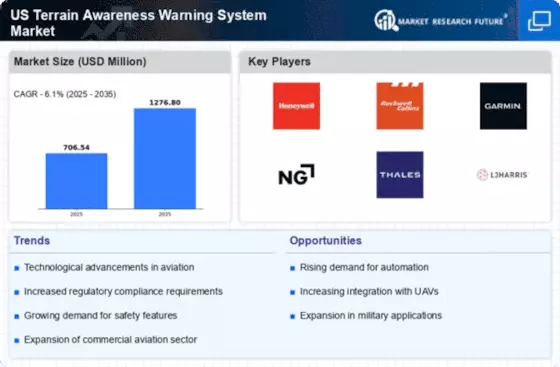
As per analysis, the US Terrain Awareness Warning System Market is projected to grow from USD 665.92 Million in 2024 to USD 1276.8 Million by 2035, exhibiting a compound annual growth rate (CAGR) of 6.1% during the forecast period (2025 - 2035).

Key Market Trends & Highlights

The US Terrain Awareness Warning System Market is poised for growth driven by technological advancements and increasing safety regulations.

  • The market is characterized by rapid technological advancements in safety systems, enhancing operational efficiency.
  • Commercial aviation remains the largest segment, while military aviation is identified as the fastest-growing segment.
  • In the aerospace and defense sector, demand is primarily driven by regulatory compliance and safety standards.
  • Key market drivers include technological advancements in sensor technology and an increasing focus on aviation safety.

Market Size & Forecast

2024 Market Size 665.92 (USD Million)
2035 Market Size 1276.8 (USD Million)
CAGR (2025 - 2035) 6.1%

Major Players

Honeywell (US), Rockwell Collins (US), Garmin (US), Northrop Grumman (US), Thales Group (US), L3Harris Technologies (US), Boeing (US), General Dynamics (US), Textron (US)

Our Impact
Enabled $4.3B Revenue Impact for Fortune 500 and Leading Multinationals
Partnering with 2000+ Global Organizations Each Year
30K+ Citations by Top-Tier Firms in the Industry

US Terrain Awareness Warning System Market Trends

The US Terrain Awareness Warning System Market is currently experiencing a notable evolution, driven by advancements in aviation safety technologies and increasing regulatory requirements. The integration of sophisticated sensors and data processing capabilities into aircraft systems has enhanced situational awareness for pilots, thereby reducing the risk of controlled flight into terrain incidents. Furthermore, the Federal Aviation Administration (FAA) has been actively promoting the adoption of terrain awareness systems, which has led to a growing emphasis on safety protocols within the aviation sector. This trend appears to be fostering a more proactive approach to risk management in flight operations, as stakeholders recognize the critical importance of real-time data in ensuring safe navigation. In addition, the market is likely to benefit from the rising demand for commercial aviation and the expansion of air travel in the United States. As more airlines and operators seek to enhance their safety measures, the implementation of terrain awareness warning systems is becoming increasingly prevalent. This shift may also be influenced by the need for compliance with stringent safety regulations and the desire to improve operational efficiency. Overall, the US Terrain Awareness Warning System Market seems poised for growth, as technological innovations and regulatory frameworks continue to shape the landscape of aviation safety.

Technological Advancements in Safety Systems

The US Terrain Awareness Warning System Market is witnessing a surge in technological innovations, particularly in sensor technology and data analytics. These advancements are enhancing the accuracy and reliability of terrain awareness systems, allowing for better decision-making by pilots. As systems become more sophisticated, they are likely to integrate with other avionics, creating a more comprehensive safety net for flight operations.

Regulatory Compliance and Safety Standards

The increasing focus on regulatory compliance is shaping the US Terrain Awareness Warning System Market. The FAA and other regulatory bodies are emphasizing the necessity of advanced terrain awareness systems in commercial aviation. This trend indicates a shift towards mandatory implementation, which may drive market growth as operators strive to meet evolving safety standards.

Growing Demand for Commercial Aviation

The expansion of the commercial aviation sector in the United States is contributing to the growth of the US Terrain Awareness Warning System Market. As air travel continues to rise, airlines are prioritizing safety enhancements, including the adoption of terrain awareness systems. This trend suggests a proactive approach to risk management, as operators seek to ensure passenger safety and operational efficiency.

US Terrain Awareness Warning System Market Drivers

Increasing Focus on Aviation Safety

The US Terrain Awareness Warning System Market is witnessing a heightened focus on aviation safety, driven by both public demand and industry initiatives. Recent statistics indicate that the number of aviation incidents related to terrain awareness has prompted stakeholders to prioritize safety measures. Airlines and manufacturers are investing in advanced terrain awareness systems to mitigate risks associated with CFIT. This growing emphasis on safety is likely to propel the market forward, as operators seek to enhance their safety protocols. The US Terrain Awareness Warning System Market is thus positioned to benefit from this trend, as investments in safety technologies continue to rise.

Expansion of Commercial Aviation Sector

The US Terrain Awareness Warning System Market is poised for growth due to the expansion of the commercial aviation sector. With an increasing number of flights and passengers, the demand for advanced safety systems is on the rise. The Federal Aviation Administration (FAA) has reported a steady increase in air traffic, which necessitates the implementation of robust terrain awareness systems to ensure passenger safety. As airlines expand their fleets and routes, the need for effective terrain awareness solutions becomes more critical. This expansion is likely to drive investments in the US Terrain Awareness Warning System Market, as operators seek to comply with safety regulations and enhance operational efficiency.

Regulatory Compliance and Safety Standards

The US Terrain Awareness Warning System Market is heavily influenced by stringent regulatory compliance and safety standards set forth by aviation authorities. The Federal Aviation Administration (FAA) mandates the implementation of terrain awareness systems in commercial aircraft to enhance safety. These regulations are designed to minimize the risk of Controlled Flight Into Terrain (CFIT) incidents, which have historically posed significant threats to aviation safety. As regulations become more rigorous, manufacturers are compelled to innovate and improve their systems, thereby driving growth in the market. The ongoing emphasis on compliance ensures that the US Terrain Awareness Warning System Market remains robust and responsive to safety needs.

Technological Advancements in Sensor Technology

The US Terrain Awareness Warning System Market is experiencing a surge in technological advancements, particularly in sensor technology. Enhanced sensors, such as LiDAR and radar systems, are being integrated into terrain awareness systems, providing real-time data on terrain conditions. This integration allows for improved accuracy in detecting potential hazards, thereby reducing the risk of accidents. According to recent data, the market for advanced sensors is projected to grow significantly, driven by the increasing need for safety in aviation. As these technologies evolve, they are likely to become more affordable and accessible, further driving adoption in the US Terrain Awareness Warning System Market.

Integration of Artificial Intelligence in Safety Systems

The US Terrain Awareness Warning System Market is being transformed by the integration of artificial intelligence (AI) into safety systems. AI technologies are enabling more sophisticated data analysis and predictive capabilities, allowing for better decision-making in real-time. This integration enhances the effectiveness of terrain awareness systems by providing pilots with actionable insights and alerts regarding potential hazards. As AI continues to evolve, its application in the US Terrain Awareness Warning System Market is expected to grow, leading to improved safety outcomes. The potential for AI to revolutionize safety protocols presents a compelling opportunity for stakeholders in the market.

Market Segment Insights

By Application: Commercial Aviation (Largest) vs. Military Aviation (Fastest-Growing)

In the US Terrain Awareness Warning System Market, the application segment is primarily dominated by commercial aviation, which accounts for the largest share, driven by the extensive infrastructure and regulatory needs of passenger and cargo airlines. Military aviation, while smaller in overall market share, is experiencing rapid growth as militaries upgrade their systems to incorporate advanced terrain awareness technologies for enhanced operational safety and mission efficiency.

Aviation: Commercial (Dominant) vs. Military (Emerging)

The commercial aviation sector remains the dominant player in the US Terrain Awareness Warning System Market due to the high investment in safety protocols and compliance with stringent regulations. Airlines are increasingly adopting terrain awareness solutions to improve safety and reduce operational costs. Conversely, military aviation is an emerging segment, witnessing accelerated growth driven by the demand for advanced technologies in defense operations. The military is investing heavily in modern systems that provide real-time terrain data for tactical advantages, thus improving safety in challenging environments.

By End Use: Aerospace and Defense (Largest) vs. Private Operators (Fastest-Growing)

In the US Terrain Awareness Warning System Market, the end use segment is primarily dominated by Aerospace and Defense, which accounts for a significant share due to its extensive applications in military operations and defense aircraft. This segment benefits from heightened investments in advanced aviation technology and a continuous focus on enhancing safety protocols for military operations. Other notable segments include Airlines, Government Agencies, and Aircraft Manufacturers, all of which contribute to the overall market dynamics, but with relatively smaller shares compared to Aerospace and Defense.

Aerospace and Defense: Dominant vs. Private Operators: Emerging

Aerospace and Defense stands as the dominant segment in the US Terrain Awareness Warning System Market, characterized by its robust integration of advanced technological features tailored for military aviation. This segment is driven by strict regulatory standards and an imperative focus on safety measures, making it a priority for defense contractors and agencies. On the other hand, Private Operators represent an emerging segment, experiencing rapid growth due to more private sector investments in aviation safety. This segment is becoming increasingly important as more entities prioritize safety in their operations, enabling them to adopt terrain awareness systems at a higher rate than in previous years.

By Technology: Synthetic Vision Systems (Largest) vs. Ground Proximity Warning Systems (Fastest-Growing)

In the US Terrain Awareness Warning System Market, Synthetic Vision Systems hold the largest market share, owing to their advanced visualization capabilities and integration technology. Ground Proximity Warning Systems are emerging as the fastest-growing segment, fueled by an increased focus on aviation safety and regulatory mandates to enhance situational awareness for pilots during takeoffs and landings. This growing emphasis on safety is creating a dynamic market landscape. The market is witnessing significant technological advancements, particularly in Ground Proximity Warning Systems, which are rapidly evolving with new algorithms and real-time data integration. This segment is driven by a rising number of commercial air traffic and the adoption of advanced safety measures. Additionally, Terrain Awareness Systems and Augmented Reality Systems are also experiencing growth, as they complement existing technologies with their unique functionalities.

Technology: Synthetic Vision Systems (Dominant) vs. Ground Proximity Warning Systems (Emerging)

Synthetic Vision Systems are recognized as the dominant technology in the US Terrain Awareness Warning System Market due to their ability to provide pilots with a comprehensive view of terrain, weather, and obstacles, enhancing operational safety. Their integration of advanced data visualization technologies makes them indispensable for real-time decision-making. Conversely, Ground Proximity Warning Systems, while currently emerging, are witnessing rapid growth as they become integral to modern aviation safety protocols. These systems utilize sophisticated algorithms to alert pilots of potential ground collisions, especially in low visibility situations. With increasing regulatory pressures and advancements in sensor technologies, Ground Proximity Warning Systems are poised to become critical components, complementing the established dominance of Synthetic Vision Systems.

By Component: Sensors (Largest) vs. Software (Fastest-Growing)

In the US Terrain Awareness Warning System Market, the distribution among component segments reveals that sensors hold the largest market share, driven by the critical need for accurate real-time data in aviation safety. This dominance is complemented by displays, which provide vital visual information to pilots, and control units, responsible for system integration. The communication systems and software segments, while important, currently make up a smaller portion of the market, but their role is indispensable in enhancing overall system functionality and user experience. Looking ahead, the growth trends within this market segment indicate that while sensor technology remains the cornerstone, software is emerging as the fastest-growing component. Factors driving this growth include the accelerating pace of technological advancements in artificial intelligence and data analytics, coupled with increasing regulatory mandates for enhanced safety systems in aviation. Moreover, as more operators adopt modernized systems, the demand for sophisticated software solutions will continue to rise, indicating a shift in focus toward integrated software capabilities.

Software (Dominant) vs. Communication Systems (Emerging)

In the current landscape of the US Terrain Awareness Warning System Market, software solutions are emerging as a dominant force, offering advanced functionalities that cater to the increasing demand for safety and efficiency. With advancements in artificial intelligence and machine learning, software can now provide predictive analysis and user-friendly interfaces, enhancing pilot decision-making processes significantly. Conversely, communication systems are emerging as a critical segment, facilitating the transfer of real-time data between aircraft and control towers. As the aviation industry pushes towards greater automation and connectivity, communication systems are rapidly evolving, becoming integral to modern terrain awareness solutions. Their integration with software solutions will enhance safety management while enabling seamless integration with existing infrastructure.

By Installation Type: Integrated Systems (Largest) vs. Standalone Systems (Fastest-Growing)

The US Terrain Awareness Warning System market is characterized by a diverse range of installation types, with Integrated Systems occupying the largest share. These systems are preferred for their seamless integration into existing aircraft avionics, enhancing their functionality and efficiency. Standalone Systems, while smaller in market share, are gaining traction rapidly due to their flexibility and ease of installation across various aircraft types. In terms of growth trends, the Retrofit segment is also witnessing increased interest as older aircraft are upgraded with modern safety technology. Factors driving this growth include stringent aviation safety regulations and an increasing emphasis on situational awareness which is essential for pilot safety during flight. This trend is complemented by technological advancements, making these systems more accessible and cost-effective for a wider range of aviation operators.

Integrated Systems (Dominant) vs. Standalone Systems (Emerging)

Integrated Systems are crucial in the US Terrain Awareness Warning System market due to their ability to provide comprehensive situational awareness by connecting with multiple aircraft systems. Their dominant position stems from their ability to enhance operational efficiency and safety in aviation, especially in complex flight environments. On the other hand, Standalone Systems are emerging within the market as a flexible alternative that caters to smaller operators or those looking for budget-friendly solutions. These systems require less overhaul on existing aircraft but still offer reliable warning alerts, appealing to operators who are transitioning to modern safety technologies without the need for extensive upgrades. Both segments serve key roles, addressing different needs within the aviation industry.

Get more detailed insights about US Terrain Awareness Warning System Market

Key Players and Competitive Insights

The Terrain Awareness Warning System Market is characterized by a competitive landscape that is increasingly shaped by technological advancements and strategic collaborations. Key players such as Honeywell (US), Rockwell Collins (US), and Garmin (US) are at the forefront, leveraging innovation and partnerships to enhance their market positions. Honeywell (US) focuses on integrating advanced sensor technologies into its systems, which appears to be a response to the growing demand for enhanced safety features in aviation. Meanwhile, Rockwell Collins (US) emphasizes digital transformation, aiming to streamline operations and improve user experience through software solutions. Garmin (US) is also notable for its commitment to developing user-friendly interfaces, which may attract a broader customer base, particularly in the general aviation sector. Collectively, these strategies indicate a shift towards more integrated and user-centric solutions in the market.

In terms of business tactics, companies are increasingly localizing manufacturing and optimizing supply chains to enhance responsiveness and reduce costs. The market structure appears moderately fragmented, with several players vying for market share, yet the influence of major companies remains substantial. This competitive dynamic fosters innovation, as companies strive to differentiate their offerings in a crowded marketplace.

In December 2025, Honeywell (US) announced a partnership with a leading aerospace manufacturer to develop next-generation terrain awareness systems. This collaboration is likely to enhance Honeywell's product offerings and expand its reach within the aviation sector, positioning the company to better meet the evolving needs of its customers. The strategic importance of this partnership lies in its potential to accelerate the development of advanced safety features, which are increasingly prioritized by regulatory bodies and consumers alike.

In November 2025, Rockwell Collins (US) unveiled a new software update for its terrain awareness systems, which incorporates artificial intelligence to improve predictive capabilities. This move is indicative of the company's commitment to integrating cutting-edge technology into its products, thereby enhancing operational efficiency and safety. The introduction of AI-driven features may provide Rockwell Collins with a competitive edge, as it aligns with the broader industry trend towards automation and data-driven decision-making.

In October 2025, Garmin (US) launched a new line of terrain awareness systems specifically designed for small aircraft, which could significantly broaden its market appeal. This strategic expansion into the small aircraft segment suggests a calculated effort to capture a niche market that has been underserved. By catering to this demographic, Garmin may enhance its market share and establish itself as a leader in the small aircraft sector.

As of January 2026, current trends in the Terrain Awareness Warning System Market are heavily influenced by digitalization, sustainability, and the integration of AI technologies. Strategic alliances are becoming increasingly vital, as companies recognize the need to pool resources and expertise to remain competitive. Looking ahead, it is anticipated that competitive differentiation will evolve, with a pronounced shift from price-based competition to a focus on innovation, technological advancements, and supply chain reliability. This evolution underscores the importance of adaptability and forward-thinking strategies in navigating the complexities of the market.


Key Companies in the US Terrain Awareness Warning System Market include

Future Outlook

US Terrain Awareness Warning System Market Future Outlook

The US Terrain Awareness Warning System Market is projected to grow at a 6.1% CAGR from 2025 to 2035, driven by technological advancements, regulatory mandates, and increasing safety concerns.

New opportunities lie in:

  • Integration of AI-driven predictive analytics for enhanced terrain assessment.
  • Development of modular systems for customizable fleet applications.
  • Expansion into emerging markets with tailored solutions for local regulations.

By 2035, the market is expected to solidify its position as a leader in aviation safety technology.

Market Segmentation

US Terrain Awareness Warning System Market End Use Outlook

  • Aircraft Manufacturers
  • Aerospace and Defense
  • Airlines
  • Government Agencies
  • Private Operators

US Terrain Awareness Warning System Market Component Outlook

  • Sensors
  • Displays
  • Software
  • Control Units
  • Communication Systems

US Terrain Awareness Warning System Market Technology Outlook

  • Synthetic Vision Systems
  • Ground Proximity Warning Systems
  • Terrain Awareness Systems
  • Augmented Reality Systems
  • Data Link Systems

US Terrain Awareness Warning System Market Application Outlook

  • Commercial Aviation
  • Military Aviation
  • General Aviation
  • Unmanned Aerial Vehicles
  • Helicopters

US Terrain Awareness Warning System Market Installation Type Outlook

  • Line Fit
  • Retrofit
  • Portable Systems
  • Integrated Systems
  • Standalone Systems

Report Scope

MARKET SIZE 2024665.92(USD Million)
MARKET SIZE 2025710.72(USD Million)
MARKET SIZE 20351276.8(USD Million)
COMPOUND ANNUAL GROWTH RATE (CAGR)6.1% (2024 - 2035)
REPORT COVERAGERevenue Forecast, Competitive Landscape, Growth Factors, and Trends
BASE YEAR2024
Market Forecast Period2025 - 2035
Historical Data2019 - 2024
Market Forecast UnitsUSD Million
Key Companies ProfiledHoneywell (US), Rockwell Collins (US), Garmin (US), Northrop Grumman (US), Thales Group (US), L3Harris Technologies (US), Boeing (US), General Dynamics (US), Textron (US)
Segments CoveredApplication, End Use, Technology, Component, Installation Type
Key Market OpportunitiesIntegration of advanced artificial intelligence for enhanced predictive terrain awareness capabilities in aviation.
Key Market DynamicsRising demand for advanced safety features drives innovation in the US Terrain Awareness Warning System Market.
Countries CoveredUS
Leave a Comment

FAQs

What is the current valuation of the US Terrain Awareness Warning System Market?

The market valuation was 665.92 USD Million in 2024.

What is the projected market size for the US Terrain Awareness Warning System by 2035?

The projected valuation for 2035 is 1276.8 USD Million.

What is the expected CAGR for the US Terrain Awareness Warning System Market during the forecast period?

The expected CAGR for the market from 2025 to 2035 is 6.1%.

Which companies are the key players in the US Terrain Awareness Warning System Market?

Key players include Honeywell, Rockwell Collins, Garmin, Northrop Grumman, Thales Group, L3Harris Technologies, Boeing, General Dynamics, and Textron.

What are the main application segments of the US Terrain Awareness Warning System Market?

The main application segments include Commercial Aviation, Military Aviation, General Aviation, Unmanned Aerial Vehicles, and Helicopters.

How does the market perform in the Commercial Aviation segment?

The Commercial Aviation segment was valued between 200.0 and 400.0 USD Million.

What is the valuation range for the Military Aviation segment?

The Military Aviation segment was valued between 150.0 and 300.0 USD Million.

What are the key technology segments in the US Terrain Awareness Warning System Market?

Key technology segments include Synthetic Vision Systems, Ground Proximity Warning Systems, Terrain Awareness Systems, Augmented Reality Systems, and Data Link Systems.

What is the valuation range for the Ground Proximity Warning Systems technology?

The Ground Proximity Warning Systems technology was valued between 150.0 and 300.0 USD Million.

What installation types are prevalent in the US Terrain Awareness Warning System Market?

Prevalent installation types include Line Fit, Retrofit, Portable Systems, Integrated Systems, and Standalone Systems.

Download Free Sample

Kindly complete the form below to receive a free sample of this Report

Compare Licence

×
Features License Type
Single User Multiuser License Enterprise User
Price $4,950 $5,950 $7,250
Maximum User Access Limit 1 User Upto 10 Users Unrestricted Access Throughout the Organization
Free Customization
Direct Access to Analyst
Deliverable Format
Platform Access
Discount on Next Purchase 10% 15% 15%
Printable Versions