×
Request Free Sample ×

Kindly complete the form below to receive a free sample of this Report

* Please use a valid business email

Leading companies partner with us for data-driven Insights

clients tt-cursor
Hero Background

US Sonobuoy Market

ID: MRFR/AD/19338-HCR
128 Pages
Sejal Akre
February 2026

US Sonobuoy Market Size, Share, Industry Trend & Analysis Research Report: By Application (Anti-Submarine Warfare, Naval Surveillance, Oceanographic Research, Environmental Monitoring), By Type (Passive Sonobuoys, Active Sonobuoys, Multi-Mode Sonobuoys), By Deployment Method (Aerial Deployment, Ship-Based Deployment, Land-Based Deployment) andBy End Use (Military, Commercial, Research)- Forecast to 2035.

Share:
Download PDF ×

We do not share your information with anyone. However, we may send you emails based on your report interest from time to time. You may contact us at any time to opt-out.

US Sonobuoy Market Infographic
Purchase Options

US Sonobuoy Market Summary

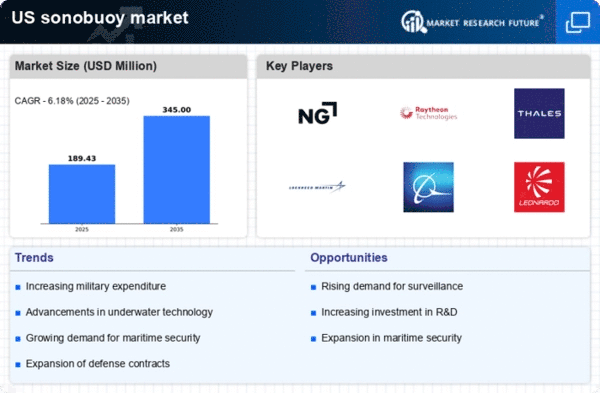
As per Market Research Future analysis, the US sonobuoy market Size was estimated at 178.4 USD Million in 2024. The US sonobuoy market is projected to grow from 189.43 USD Million in 2025 to 345.0 USD Million by 2035, exhibiting a compound annual growth rate (CAGR) of 6.1% during the forecast period 2025 - 2035

Key Market Trends & Highlights

The US sonobuoy market is experiencing robust growth driven by technological advancements and increased military expenditure.

  • Technological advancements in sonobuoy systems are enhancing operational capabilities and efficiency.
  • The largest segment in the US sonobuoy market is the military sector, while the fastest-growing segment is environmental monitoring.
  • Strategic collaborations among defense contractors are becoming more prevalent to leverage innovative technologies.
  • Rising demand for maritime security and increased military expenditure are key drivers propelling market growth.

Market Size & Forecast

2024 Market Size 178.4 (USD Million)
2035 Market Size 345.0 (USD Million)
CAGR (2025 - 2035) 6.18%

Major Players

Northrop Grumman (US), Raytheon Technologies (US), Thales Group (FR), Lockheed Martin (US), Boeing (US), Leonardo S.p.A. (IT), L3Harris Technologies (US), Ultra Electronics (GB), Kongsberg Gruppen (NO)

Our Impact
Enabled $4.3B Revenue Impact for Fortune 500 and Leading Multinationals
Partnering with 2000+ Global Organizations Each Year
30K+ Citations by Top-Tier Firms in the Industry

US Sonobuoy Market Trends

The sonobuoy market is currently experiencing a dynamic evolution, driven by advancements in technology and increasing demand for maritime surveillance. The integration of sophisticated sensors and communication systems into sonobuoys enhances their operational capabilities, allowing for more accurate detection and tracking of underwater threats. This technological progression appears to be a response to the growing need for enhanced security measures in naval operations, particularly in light of rising geopolitical tensions. Furthermore, the emphasis on environmental monitoring and research is likely to spur innovation within the sector, as sonobuoys are increasingly utilized for scientific purposes, such as studying marine life and underwater ecosystems. In addition to technological advancements, the sonobuoy market is influenced by strategic partnerships and collaborations among defense contractors and government agencies. These alliances may facilitate the development of next-generation sonobuoys that meet the evolving requirements of military operations. Moreover, the potential for increased funding from governmental bodies for defense and research initiatives could further stimulate growth in this sector. As the demand for reliable and efficient underwater surveillance solutions continues to rise, the sonobuoy market is poised for significant expansion in the coming years, reflecting broader trends in defense and environmental monitoring.

Technological Advancements

The sonobuoy market is witnessing rapid technological advancements, particularly in sensor integration and data processing capabilities. Enhanced sensors allow for improved detection of underwater objects, while advanced data analytics facilitate real-time decision-making.

Strategic Collaborations

Strategic collaborations between defense contractors and government entities are becoming increasingly common. These partnerships aim to develop innovative sonobuoy solutions that address specific operational needs, thereby enhancing overall effectiveness.

Increased Funding for Defense

There appears to be a trend of increased funding from governmental sources directed towards defense initiatives. This financial support may lead to the development of more sophisticated sonobuoy systems, catering to the growing demand for maritime security.

US Sonobuoy Market Drivers

Increased Military Expenditure

The sonobuoy market is benefiting from a broader trend of increased military expenditure in the United States. With geopolitical tensions rising, the U.S. government has committed to enhancing its defense capabilities, which includes investing in advanced sonar systems. In 2025, military spending is projected to reach $750 billion, with a significant portion allocated to naval operations and anti-submarine warfare. This financial commitment is expected to create a favorable environment for the sonobuoy market, as defense contractors seek to develop and supply cutting-edge sonobuoy systems to meet the demands of the U.S. Navy and allied forces. The correlation between military budgets and sonobuoy procurement is likely to remain strong.

Advancements in Sonobuoy Technology

Technological innovations are significantly shaping the sonobuoy market, with advancements in sensor technology and data processing capabilities. The integration of artificial intelligence and machine learning into sonobuoy systems enhances their effectiveness in detecting and classifying underwater threats. In 2025, the market for advanced sonobuoys is expected to grow by approximately 15%, reflecting the increasing reliance on sophisticated technology in defense operations. The U.S. military's commitment to modernizing its fleet with state-of-the-art sonobuoys indicates a shift towards more efficient and reliable underwater surveillance solutions. This evolution in technology is likely to drive competition and innovation within the sonobuoy market.

Rising Demand for Maritime Security

The sonobuoy market is experiencing a notable increase in demand driven by heightened concerns regarding maritime security. As nations prioritize the protection of their territorial waters, the need for advanced surveillance systems becomes paramount. The U.S. Navy, for instance, has allocated substantial budgets for enhancing its anti-submarine warfare capabilities, which directly influences the sonobuoy market. In 2025, the U.S. defense budget for maritime security is projected to exceed $200 billion, indicating a robust investment in technologies that include sonobuoys. This trend suggests that the sonobuoy market will likely see sustained growth as military and civilian sectors seek to bolster their maritime surveillance capabilities.

Strategic Partnerships and Collaborations

Strategic partnerships and collaborations among defense contractors and technology firms are emerging as a key driver in the sonobuoy market. These alliances facilitate the sharing of expertise and resources, leading to the development of innovative sonobuoy systems. In 2025, several major defense contractors are expected to announce joint ventures aimed at enhancing sonar technology. Such collaborations not only accelerate product development but also improve the competitive landscape of the sonobuoy market. By pooling resources, companies can better address the evolving needs of the U.S. military and other stakeholders, potentially leading to a more dynamic and responsive market environment.

Growing Interest in Environmental Monitoring

The sonobuoy market is also influenced by the increasing interest in environmental monitoring and marine research. As climate change impacts marine ecosystems, there is a growing need for effective monitoring tools to assess underwater conditions. Sonobuoys, with their ability to collect acoustic data, are becoming essential for researchers and environmental agencies. In 2025, funding for marine research initiatives in the U.S. is expected to rise by 20%, further driving the demand for sonobuoy technology. This trend indicates that the sonobuoy market may expand beyond military applications, tapping into the burgeoning field of environmental science and conservation efforts.


Market Segment Insights

By Application: Anti-Submarine Warfare (Largest) vs. Oceanographic Research (Fastest-Growing)

The US sonobuoy market reveals that Anti-Submarine Warfare holds the largest market share among the various applications, driven by the rising demand for naval forces to combat submarine threats. In contrast, Oceanographic Research, while currently smaller in market share, is witnessing rapid growth as environmental concerns and research needs intensify. This creates a dynamic landscape where traditional applications coexist with newer demands for data collection and environmental monitoring. Growth trends indicate a shift towards more advanced sonobuoy technologies across all applications, particularly in Oceanographic Research, which is becoming increasingly relevant due to climate change and the necessity for marine life studies. Environmental Monitoring applications are also gaining traction as regulations tighten. The competitive nature of the US sonobuoy market is further fueled by innovation and the integration of cutting-edge technologies to enhance the effectiveness of these applications.

Anti-Submarine Warfare (Dominant) vs. Oceanographic Research (Emerging)

Anti-Submarine Warfare is the dominant application, characterized by its substantial use in military operations and strategic defense initiatives. This application benefits from established technologies and a robust client base, providing a competitive edge. In contrast, Oceanographic Research is an emerging application focusing on gathering scientific data about oceanic conditions and marine life. Its growth is supported by increasing collaborations between governmental and environmental entities, ultimately driving the demand for advanced sonobuoy technologies. The distinct natures of these applications highlight the market's versatility, reflecting varied yet interlinked objectives ranging from defense to environmental sustainability.

By Type: Active Sonobuoys (Largest) vs. Passive Sonobuoys (Fastest-Growing)

In the US sonobuoy market, Active Sonobuoys have established themselves as the largest segment, thanks to their advanced capabilities in real-time target detection and engagement. This segment benefits from significant investments in military surveillance and naval operations, which drives their continuous demand. Conversely, Passive Sonobuoys, while currently smaller in market share, are gaining traction due to their stealthy operational features and cost-effectiveness, making them particularly appealing for various naval applications. The growth trends in this market indicate a notable shift towards Multi-Mode Sonobuoys, which offer a hybrid approach, combining both passive and active capabilities. This versatility makes them attractive for modern military applications. The increasing emphasis on anti-submarine warfare and the need for enhanced underwater surveillance capabilities are key drivers fostering growth in the Passive segment, positioning it as the fastest-growing area within the market.

Active Sonobuoys (Dominant) vs. Passive Sonobuoys (Emerging)

Active Sonobuoys are the dominant force in the market, leveraging their efficiency in emitting sound waves to pinpoint targets accurately. Their advanced technology is favored by military forces for critical missions, showcasing robust performance in diverse marine environments. On the other hand, Passive Sonobuoys are emerging as a vital alternative, focusing on listening for sounds generated by submarines or other marine vessels. Their appeal lies in their ability to operate undetected, which is a significant advantage in covert operations. Both segments, while distinct, are crucial in modern naval warfare strategies, emphasizing the importance of tactical diversity in sonobuoy applications.

By Deployment Method: Aerial Deployment (Largest) vs. Land-Based Deployment (Fastest-Growing)

In the US sonobuoy market, the deployment method segment is characterized by distinct approaches, with aerial deployment holding the largest share. Ship-based deployment follows closely, while land-based deployment is rapidly gaining traction. The distribution of market share illustrates the varied preferences within the industry, with aerial solutions being favored for their extensive coverage and versatility. Ship-based deployments remain vital for operations at sea, ensuring the operational effectiveness of the sonobuoys across different environments. Growth trends in the deployment method segment show a clear inclination towards land-based deployments as the fastest-growing category. This growth can be attributed to advancements in technology and evolving operational requirements that prioritize quick response and flexibility. Aerial deployment remains prevalent due to its dominant market position, but the emergence of land-based solutions suggests a shift in focus towards more adaptable and mobile deployment strategies, catering to diverse operational needs.

Aerial Deployment (Dominant) vs. Land-Based Deployment (Emerging)

Aerial deployment stands out as the dominant approach within the US sonobuoy market, favored for its ability to provide rapid verification over large areas with minimal logistical constraints. This method leverages aircraft, enabling quick deployment and retrieval of sonobuoys, which is crucial during time-sensitive operations. Conversely, land-based deployment is emerging as a viable alternative, capturing attention due to its adaptability in various terrains and cost-effectiveness. As technology advances, especially in unmanned systems, land-based sonobuoys are becoming increasingly efficient, with the ability to provide real-time data processing and enhanced operational flexibility. Together, these segments showcase a landscape where traditional methods adapt to modern needs, ensuring optimal deployment strategies.

By End Use: Military (Largest) vs. Commercial (Fastest-Growing)

In the US sonobuoy market, the end use segment is primarily dominated by military applications, which command the largest share due to the ongoing investments in naval defense and advanced sonar technology. Commercial use is growing steadily but remains less than military applications, while research plays a smaller role, focusing mainly on experimental and academic projects. Growth trends indicate that the military segment will continue to be robust, driven by rising defense budgets and modernization programs. The commercial sector is witnessing rapid growth, propelled by increased offshore activities and advancements in sonar technologies. Research activities are expected to persist but will likely see fluctuations based on funding and emerging technologies.

Military (Dominant) vs. Commercial (Emerging)

The military segment is characterized by its robust infrastructure and extensive use of sonobuoys for underwater surveillance and reconnaissance. This segment enjoys significant government backing and technological advancements to ensure readiness and effectiveness. Conversely, the commercial segment is emerging rapidly, driven by the need for efficient underwater exploration and resource management. Companies are increasingly adopting sonobuoy technology for purposes such as maritime safety and environmental monitoring. This shift indicates a growing acceptance and integration of these technologies outside of traditional military applications, suggesting a transformation in market dynamics.

Get more detailed insights about US Sonobuoy Market

Key Players and Competitive Insights

The sonobuoy market exhibits a competitive landscape characterized by a blend of innovation, strategic partnerships, and regional expansion. Key players such as Northrop Grumman (US), Raytheon Technologies (US), and L3Harris Technologies (US) are at the forefront, leveraging their technological prowess to enhance operational capabilities. Northrop Grumman (US) focuses on integrating advanced sensor technologies into its sonobuoy systems, thereby improving detection capabilities. Meanwhile, Raytheon Technologies (US) emphasizes partnerships with naval forces to tailor solutions that meet specific operational needs, reflecting a customer-centric approach. L3Harris Technologies (US) is also notable for its commitment to digital transformation, aiming to streamline operations and enhance data analytics capabilities, which collectively shapes a competitive environment that prioritizes technological advancement and customer engagement.The business tactics employed by these companies include localizing manufacturing and optimizing supply chains to enhance responsiveness to market demands. The market structure appears moderately fragmented, with several players vying for market share while also collaborating on various projects. This dynamic fosters a competitive atmosphere where innovation and operational efficiency are paramount, allowing companies to differentiate themselves in a crowded marketplace.

In October Northrop Grumman (US) announced a strategic partnership with the U.S. Navy to develop next-generation sonobuoys that incorporate artificial intelligence (AI) for enhanced underwater surveillance. This initiative is significant as it not only aligns with the increasing demand for advanced maritime security solutions but also positions Northrop Grumman (US) as a leader in integrating AI into defense technologies, potentially setting new industry standards.

In September Raytheon Technologies (US) secured a contract worth $150 million to supply advanced sonobuoy systems to allied naval forces. This contract underscores Raytheon's strategic focus on expanding its international footprint and enhancing interoperability among allied nations. Such moves are likely to strengthen its market position and foster long-term relationships with key defense stakeholders.

In August L3Harris Technologies (US) unveiled a new line of environmentally sustainable sonobuoys designed to minimize ecological impact during military operations. This development reflects a growing trend towards sustainability in defense technologies, indicating L3Harris's commitment to addressing environmental concerns while maintaining operational effectiveness. This strategic pivot may resonate well with government contracts that prioritize sustainability in procurement decisions.

As of November the sonobuoy market is increasingly defined by trends such as digitalization, sustainability, and AI integration. Strategic alliances among key players are shaping the competitive landscape, fostering innovation and collaborative development. The shift from price-based competition to a focus on technological differentiation and supply chain reliability is evident, suggesting that future competitive advantages will hinge on the ability to innovate and adapt to evolving market demands.

Key Companies in the US Sonobuoy Market include

Industry Developments

The US Sonobuoy Market has seen significant activity recently, particularly from key players such as Raytheon Technologies, Boeing, Lockheed Martin, and Northrop Grumman. As of September 2023, the market has been bolstered by advancements in sonobuoy technology that enhance anti-submarine warfare capabilities. There have been no widely reported mergers or acquisitions among the major companies in this sector during this time frame. However, growth in market valuations for companies such as General Dynamics and L3Harris Technologies is noteworthy as they expand their product offerings, positively impacting overall market dynamics.

Over the past few years, in April 2022, the US Naval Research Laboratory debuted a new design of the sonobuoy aimed at improving detection systems, which aligns with ongoing military initiatives focused on maritime security. Meanwhile, ATLAS ELEKTRONIK has been pursuing partnerships with the US government to further develop sonobuoy capabilities within their technological roadmap. This evolution reflects the increasing importance of underwater surveillance, driven by geopolitical tensions and the corresponding need for enhanced naval defense strategies.

Future Outlook

US Sonobuoy Market Future Outlook

The Sonobuoy Market is projected to grow at a 6.18% CAGR from 2025 to 2035, driven by advancements in underwater acoustics and increased defense spending.

New opportunities lie in:

  • Development of advanced sonobuoy technologies for enhanced detection capabilities.
  • Expansion into commercial maritime sectors for environmental monitoring solutions.
  • Partnerships with defense contractors for integrated surveillance systems.

By 2035, the sonobuoy market is expected to achieve robust growth and increased market penetration.

Market Segmentation

US Sonobuoy Market Type Outlook

  • Passive Sonobuoys
  • Active Sonobuoys
  • Multi-Mode Sonobuoys

US Sonobuoy Market End Use Outlook

  • Military
  • Commercial
  • Research

US Sonobuoy Market Application Outlook

  • Anti-Submarine Warfare
  • Naval Surveillance
  • Oceanographic Research
  • Environmental Monitoring

US Sonobuoy Market Deployment Method Outlook

  • Aerial Deployment
  • Ship-Based Deployment
  • Land-Based Deployment

Report Scope

MARKET SIZE 2024 178.4(USD Million)
MARKET SIZE 2025 189.43(USD Million)
MARKET SIZE 2035 345.0(USD Million)
COMPOUND ANNUAL GROWTH RATE (CAGR) 6.18% (2025 - 2035)
REPORT COVERAGE Revenue Forecast, Competitive Landscape, Growth Factors, and Trends
BASE YEAR 2024
Market Forecast Period 2025 - 2035
Historical Data 2019 - 2024
Market Forecast Units USD Million
Key Companies Profiled Northrop Grumman (US), Raytheon Technologies (US), Thales Group (FR), Lockheed Martin (US), Boeing (US), Leonardo S.p.A. (IT), L3Harris Technologies (US), Ultra Electronics (GB), Kongsberg Gruppen (NO)
Segments Covered Application, Type, Deployment Method, End Use
Key Market Opportunities Advancements in underwater acoustics technology enhance operational efficiency in the sonobuoy market.
Key Market Dynamics Technological advancements and regulatory changes drive innovation and competition in the sonobuoy market.
Countries Covered US
Leave a Comment

FAQs

What is the expected market size of the US Sonobuoy Market in 2024?

The US Sonobuoy Market is expected to be valued at 195.0 million USD in 2024.

What will the market size of the US Sonobuoy Market be by 2035?

By 2035, the market is projected to reach 426.0 million USD.

What is the expected CAGR for the US Sonobuoy Market from 2025 to 2035?

The expected CAGR for the US Sonobuoy Market from 2025 to 2035 is 7.362 percent.

Which segment holds the largest market share in the US Sonobuoy Market for Anti-Submarine Warfare?

The Anti-Submarine Warfare segment is valued at 60.0 million USD in 2024 and is anticipated to grow to 130.0 million USD by 2035.

What is the expected growth for the Naval Surveillance application in the US Sonobuoy Market?

The Naval Surveillance application is expected to increase from 50.0 million USD in 2024 to 110.0 million USD in 2035.

Who are the major players in the US Sonobuoy Market?

Key players in the market include Raytheon Technologies, Boeing, Lockheed Martin, and General Dynamics among others.

What market value is expected for Oceanographic Research in the US Sonobuoy Market by 2035?

The Oceanographic Research segment is projected to be valued at 90.0 million USD by 2035.

How much is the Environmental Monitoring application expected to contribute to the market by 2035?

The Environmental Monitoring application is expected to reach a market value of 96.0 million USD by 2035.

What are the growth drivers for the US Sonobuoy Market?

The growth drivers include increasing defense budgets and advancements in underwater surveillance technologies.

What impact do the current global scenarios have on the US Sonobuoy Market?

Current global scenarios are likely to stimulate demand for advanced maritime surveillance solutions, thereby positively affecting the market.

Download Free Sample

Kindly complete the form below to receive a free sample of this Report

Compare Licence

×
Features License Type
Single User Multiuser License Enterprise User
Price $4,950 $5,950 $7,250
Maximum User Access Limit 1 User Upto 10 Users Unrestricted Access Throughout the Organization
Free Customization
Direct Access to Analyst
Deliverable Format
Platform Access
Discount on Next Purchase 10% 15% 15%
Printable Versions