×
Request Free Sample ×

Kindly complete the form below to receive a free sample of this Report

* Please use a valid business email

Leading companies partner with us for data-driven Insights

clients tt-cursor
Hero Background

US Sonar Systems Market

ID: MRFR/AD/14065-HCR
128 Pages
Sejal Akre
February 2026

US Sonar Systems Market Size, Share, Industry Trend & Analysis Research Report: By Type (Active Sonar, Passive Sonar), By Installation (Vessel Mounted, Hand-Held and Pole Mounted, Towed, UUV, Others) andBy Application (Military, Commercial)- Forecast to 2035

Share:
Download PDF ×

We do not share your information with anyone. However, we may send you emails based on your report interest from time to time. You may contact us at any time to opt-out.

US Sonar Systems Market Infographic
Purchase Options

US Sonar Systems Market Summary

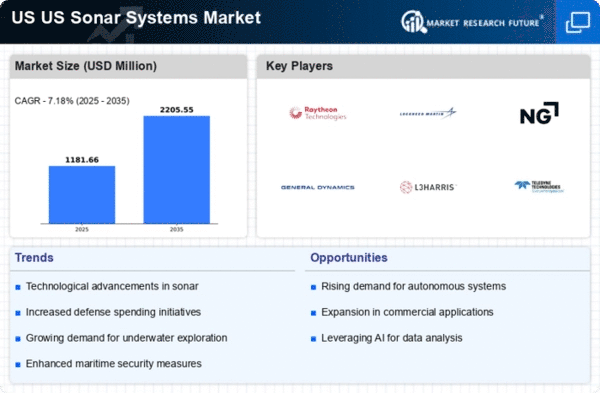
As per analysis, the US Sonar Systems Market is projected to grow from USD 1,176.0 Million in 2025 to USD 2,205.55 Million by 2035, exhibiting a compound annual growth rate (CAGR) of 6.51% during the forecast period (2025 - 2035).

Key Market Trends & Highlights

The US Sonar Systems Market is poised for growth driven by technological advancements and increasing security concerns.

  • Technological advancements are enhancing the capabilities of sonar systems, particularly in defense applications.
  • The defense segment remains the largest contributor to the sonar systems market, driven by ongoing military modernization efforts.
  • Environmental monitoring is emerging as the fastest-growing segment, reflecting heightened awareness of marine ecosystems.
  • Key market drivers include the increased focus on maritime security and government investment in R&D, which are likely to propel market expansion.

Market Size & Forecast

2024 Market Size 1102.5 (USD Million)
2035 Market Size 2205.55 (USD Million)
CAGR (2025 - 2035) 6.51%

Major Players

Raytheon Technologies (US), Lockheed Martin (US), Northrop Grumman (US), Thales Group (US), L3Harris Technologies (US), Kongsberg Gruppen (US), Teledyne Technologies (US), General Dynamics (US), BAE Systems (US)

Our Impact
Enabled $4.3B Revenue Impact for Fortune 500 and Leading Multinationals
Partnering with 2000+ Global Organizations Each Year
30K+ Citations by Top-Tier Firms in the Industry

US Sonar Systems Market Trends

The US Sonar Systems Market is currently experiencing a dynamic evolution, driven by advancements in technology and increasing demand across various sectors. The integration of artificial intelligence and machine learning into sonar systems appears to enhance their capabilities, allowing for improved detection and classification of underwater objects. This technological shift is likely to influence applications in defense, commercial shipping, and environmental monitoring. Furthermore, the growing emphasis on maritime security and the protection of critical infrastructure suggests a robust future for sonar systems in the United States. In addition, the US government is investing in research and development initiatives aimed at enhancing sonar technology. This investment may lead to innovative solutions that address the challenges posed by underwater acoustics and environmental conditions. As the market continues to expand, collaboration between private companies and government entities could foster a more resilient and advanced sonar ecosystem. The interplay of these factors indicates a promising trajectory for the US Sonar Systems Market, with potential growth opportunities in both military and civilian applications.

Technological Advancements

The US Sonar Systems Market is witnessing rapid technological advancements, particularly in the integration of artificial intelligence and machine learning. These innovations are enhancing the accuracy and efficiency of sonar systems, enabling better detection and classification of underwater objects. As a result, applications in defense and commercial sectors are becoming increasingly sophisticated.

Increased Focus on Maritime Security

There is a growing emphasis on maritime security within the US, driven by the need to protect critical infrastructure and ensure safe navigation. This heightened focus is likely to propel demand for advanced sonar systems, which play a crucial role in surveillance and threat detection in coastal and offshore environments.

Government Investment in R&D

The US government is actively investing in research and development initiatives aimed at improving sonar technology. This commitment to innovation may lead to breakthroughs that address existing challenges in underwater acoustics and environmental monitoring, ultimately enhancing the capabilities of sonar systems in various applications.

US Sonar Systems Market Drivers

Government Investment in R&D

Government investment in research and development (R&D) plays a crucial role in the US Sonar Systems Market. Federal funding for defense and maritime technology has increased, fostering innovation in sonar systems. The Department of Defense has prioritized the development of next-generation sonar technologies, which are essential for maintaining a competitive edge in naval warfare. This investment not only supports the advancement of existing sonar systems but also encourages collaboration between government agencies and private sector companies. As a result, the market is likely to see a proliferation of cutting-edge sonar solutions that enhance operational effectiveness and efficiency.

Integration of Autonomous Systems

The integration of autonomous systems into the US Sonar Systems Market is transforming traditional sonar applications. Unmanned underwater vehicles (UUVs) equipped with advanced sonar technology are becoming increasingly prevalent in both military and civilian sectors. These autonomous systems offer enhanced operational capabilities, allowing for extended missions without direct human intervention. The US Navy, for instance, is actively deploying UUVs for reconnaissance and mine detection operations. This trend is likely to drive market growth, as the demand for autonomous solutions continues to rise, reflecting a shift towards more efficient and effective underwater operations.

Increased Focus on Maritime Security

The US Sonar Systems Market is significantly influenced by the heightened focus on maritime security. With rising concerns over illegal fishing, piracy, and territorial disputes, the demand for advanced sonar systems has escalated. The US government has recognized the importance of safeguarding its maritime borders and has allocated substantial resources to enhance naval capabilities. This includes investments in sonar technology for surveillance and reconnaissance missions. The market is expected to benefit from these initiatives, as the US Navy and Coast Guard continue to modernize their fleets with state-of-the-art sonar systems, thereby driving market growth and innovation.

Growing Demand for Underwater Exploration

The US Sonar Systems Market is witnessing a growing demand for underwater exploration, driven by both scientific research and commercial interests. The need for accurate mapping of underwater terrains and ecosystems has led to increased utilization of sonar technology in marine biology, archaeology, and oil and gas exploration. The National Oceanic and Atmospheric Administration (NOAA) has emphasized the importance of sonar systems in conducting marine surveys and habitat assessments. This trend is expected to propel the market forward, as more organizations seek to leverage sonar technology for various applications, thereby expanding the overall market landscape.

Technological Advancements in Sonar Systems

The US Sonar Systems Market is experiencing a surge in technological advancements, particularly in the development of high-frequency sonar systems. These innovations enhance detection capabilities, allowing for improved underwater surveillance and navigation. The integration of artificial intelligence and machine learning into sonar technology is also noteworthy, as it enables real-time data analysis and decision-making. According to recent estimates, the market for advanced sonar systems is projected to grow at a compound annual growth rate (CAGR) of approximately 5.2% through 2028. This growth is driven by the increasing demand for sophisticated sonar solutions in both military and commercial applications, including fisheries management and environmental monitoring.


Market Segment Insights

By Application: Defense (Largest) vs. Environmental Monitoring (Fastest-Growing)

The US sonar systems market is predominantly driven by the defense sector, which holds the largest market share among the application segments. This dominance is attributed to the growing demand for advanced surveillance and reconnaissance systems in naval operations. Other segments, such as commercial and scientific research, also contribute to the overall market dynamics, but their shares are smaller compared to defense. Environmental monitoring is gaining traction as a critical segment, reflecting an increasing focus on ecological sustainability and resource management, further diversifying the market landscape. Growth trends in the sonar systems market are being propelled by technological advancements and rising applications across various sectors. The defense segment is undergoing significant upgrades with investments in next-generation sonar technologies to enhance situational awareness and combat effectiveness. Conversely, environmental monitoring is the fastest-growing segment, driven by the need for effective management of marine ecosystems and compliance with environmental regulations. As both segments evolve, the introduction of innovative solutions and strategic partnerships will likely shape market trajectories over the coming years.

Environmental Monitoring: Defense (Dominant) vs. Underwater Exploration (Emerging)

Within the US sonar systems market, the defense segment stands out as the dominant force, utilizing advanced technologies for surveillance, target detection, and tactical operations. This segment benefits from substantial government investments and a continuous push for modernization to enhance military capabilities. On the other hand, underwater exploration is emerging as a vital segment, fueled by increased interest in marine research and resource extraction activities. This growing interest has prompted the development of sophisticated sonar equipment tailored for underwater mapping and investigation, setting the stage for innovative applications in various fields, including archaeology and natural resource management.

By End Use: Naval Vessels (Largest) vs. AUVs (Fastest-Growing)

The US Sonar Systems Market exhibits a diverse distribution across various end use segments, with Naval Vessels leading in market share due to their extensive application in defense operations. Submarines and Surface Ships also hold significant portions of the market, driven by the ongoing modernization of naval fleets. Meanwhile, Autonomous Underwater Vehicles (AUVs) are emerging rapidly, showcasing a growing interest from both military and commercial sectors, indicating a shift towards more advanced technological solutions. Growth trends within this segment are primarily influenced by increasing defense budgets and the rising importance of maritime surveillance. Technological advancements, particularly in AUVs and ROVs, drive their adoption across multiple applications, including scientific research and environmental monitoring. As naval warfare becomes more sophisticated, demand for sonar systems in these segments is expected to escalate, further solidifying their roles in the market.

Naval Vessels: Dominant vs. AUVs: Emerging

Naval Vessels represent the dominant portion of the US Sonar Systems Market, characterized by extensive investments in advanced sonar technologies to enhance naval defense capabilities and ensure superiority in maritime operations. These systems are crucial for reconnaissance, anti-submarine warfare, and fleet coordination. On the other hand, AUVs are showcasing their status as an emerging segment, driven by innovation and the shift towards unmanned systems. Their capabilities in performing tasks such as underwater mapping and data collection format a significant value proposition for various industries. The demand for AUVs is being fueled by their cost-effectiveness and ability to operate in challenging environments, signaling a transformative phase in underwater operations.

By Technology: Active Sonar (Largest) vs. Passive Sonar (Fastest-Growing)

In the US sonar systems market, Active Sonar holds the largest market share as it provides real-time data on underwater objects, making it invaluable for navigation and fishing applications. Conversely, Passive Sonar, which is growing the fastest, utilizes sound waves to detect activities without emitting signals, catering to military and research sectors where stealth is crucial. The market sees active investments in both technologies, reflecting their essential roles in various industries. The growth of Active Sonar is driven by increasing maritime activities and advancements in sonar technology that enhance detection capabilities. Meanwhile, the rapid expansion of Passive Sonar is fueled by heightened interest in underwater surveillance and environmental monitoring. As threats evolve in maritime domains, both segments are expected to innovate, thus enriching their market presence.

Technology: Active Sonar (Dominant) vs. Multibeam Sonar (Emerging)

Active Sonar is a dominant player in the US sonar systems market, widely utilized in commercial applications such as fishing and navigation due to its effectiveness in real-time object detection. On the other hand, Multibeam Sonar, while considered an emerging technology, is gaining traction for its capability to create detailed maps of the seafloor by emitting multiple beams simultaneously. This is particularly valuable in oceanographic research and underwater infrastructure development. The growing interest in mapping and understanding underwater environments positions Multibeam Sonar as an essential tool for marine exploration, complementing the robust functionalities of Active Sonar.

By Frequency Range: Medium Frequency (Largest) vs. High Frequency (Fastest-Growing)

In the US Sonar Systems Market, the distribution of frequency ranges indicates a significant preference for Medium Frequency systems, which dominate the market due to their versatility in various applications, primarily in marine and defense sectors. Low Frequency and Ultra High Frequency segments trail behind, showcasing niche uses that cater to specific operational needs, such as deep water operations and specialized research applications, respectively.

Medium Frequency (Dominant) vs. High Frequency (Emerging)

Medium Frequency sonar systems are characterized by their effective range and resolution, making them ideal for a variety of applications including underwater navigation, fish finding, and military reconnaissance. Their established market presence and reliability in diverse conditions render them the preferred choice for many sectors. Conversely, High Frequency systems are emerging swiftly, capitalizing on advancements in technology that enhance imaging and detection capabilities. These systems are particularly favored for coastal operations and shallow water applications, thus carving out an increasing share of interest as users seek higher resolution and precision in sonar data.

By Component: Transducers (Largest) vs. Software (Fastest-Growing)

In the US Sonar Systems Market, the component segment showcases a diverse distribution of market shares among key values such as transducers, processors, display systems, software, and power supply. Transducers hold the largest share due to their essential role in the sonar functionality, translating sound waves into electronic signals. Following transducers, processors and display systems have a significant presence, while software and power supplies are gaining traction but remain smaller portions of the market.

Transducers (Dominant) vs. Software (Emerging)

Transducers are the cornerstone of sonar technology, playing a critical role in converting acoustic signals to electrical impulses, making them indispensable in various applications, from military to commercial. Their dominant position in the market is underpinned by technological advancements that enhance sensitivity and performance. On the other hand, software is emerging as a vital component in the sonar systems market, driven by the increasing demand for sophisticated data processing and analysis capabilities. As the industry moves towards automation and integrated solutions, software is expected to experience rapid growth, reflecting the need for enhanced functionalities in sonar applications.

Get more detailed insights about US Sonar Systems Market

Key Players and Competitive Insights

The Sonar Systems Market in the US is characterized by a competitive landscape that is increasingly shaped by technological advancements and strategic collaborations. Key growth drivers include the rising demand for advanced underwater surveillance systems, particularly in defense and maritime security sectors. Major players such as Raytheon Technologies (US), Lockheed Martin (US), and Northrop Grumman (US) are at the forefront, focusing on innovation and digital transformation to enhance their product offerings. These companies are not only investing in research and development but are also pursuing strategic partnerships to bolster their market positions, thereby intensifying the competitive dynamics within the sector.

In terms of business tactics, companies are localizing manufacturing to reduce costs and improve supply chain efficiency. The market structure appears moderately fragmented, with several key players exerting considerable influence. This fragmentation allows for a diverse range of products and services, catering to various customer needs. The collective strategies of these companies, including supply chain optimization and regional expansion, contribute to a robust competitive environment that fosters innovation and responsiveness to market demands.

In December 2025, Raytheon Technologies (US) announced a partnership with a leading AI firm to integrate machine learning capabilities into their sonar systems. This strategic move is likely to enhance the accuracy and efficiency of underwater detection, positioning Raytheon as a leader in the integration of AI technologies within sonar applications. Such advancements may not only improve operational effectiveness but also provide a competitive edge in a rapidly evolving market.

In November 2025, Lockheed Martin (US) unveiled a new line of sonar systems designed specifically for unmanned underwater vehicles (UUVs). This initiative reflects a strategic focus on the growing UUV market, which is expected to expand significantly in the coming years. By aligning their product development with emerging trends, Lockheed Martin is likely to capture a larger share of the market, thereby reinforcing its competitive stance.

In October 2025, Northrop Grumman (US) secured a contract with the US Navy to supply advanced sonar systems for next-generation submarines. This contract not only underscores Northrop Grumman's commitment to supporting national defense initiatives but also highlights the importance of government contracts in driving revenue growth. Such strategic engagements are pivotal for maintaining a competitive edge in the sonar systems market.

As of January 2026, current trends indicate a strong emphasis on digitalization, sustainability, and AI integration within the sonar systems sector. Strategic alliances are increasingly shaping the competitive landscape, enabling companies to leverage complementary strengths and enhance their technological capabilities. Looking ahead, competitive differentiation is expected to evolve, with a shift from price-based competition to a focus on innovation, advanced technology, and supply chain reliability. This transition may redefine market dynamics, compelling companies to continuously adapt and innovate to maintain their competitive advantages.

Key Companies in the US Sonar Systems Market include

Industry Developments

The US Sonar Systems Market has seen significant developments recently, particularly marked by technological advancements and collaborations among key players such as Raytheon Technologies, Lockheed Martin, and Northrop Grumman. In September 2023, Raytheon Technologies announced enhancements in their sonar technology to better support naval operations, emphasizing efforts to improve acoustic performance and data analysis. Meanwhile, in August 2023, Subsea 7 expanded its capabilities by acquiring a team from a tech startup specializing in underwater drone technology, thereby strengthening its position in subsea and sonar solutions.

In the past two years, companies like Fugro and Teledyne Technologies have been increasingly investing in artificial intelligence-driven sonar systems, which are expected to boost market valuation as these technologies become more integral to marine exploration and defense applications. Additionally, in March 2022, General Dynamics showcased its commitment to advancing sonar technologies during a major defense exposition, highlighting ongoing investments in Research and Development.

The increasing focus on maritime security and environmental monitoring has also been a catalyst for growth in the sector, as federal agencies, including the US Navy, ramp up their emphasis on advanced sonar capabilities for surveillance and reconnaissance operations.

Future Outlook

US Sonar Systems Market Future Outlook

The US Sonar Systems Market is projected to grow at a 6.51% CAGR from 2025 to 2035, driven by advancements in underwater technology and increasing defense expenditures.

New opportunities lie in:

  • Development of advanced underwater drones for commercial applications.
  • Integration of AI for real-time data analysis in sonar systems.
  • Expansion into renewable energy sectors for underwater monitoring solutions.

By 2035, the market is expected to be robust, driven by innovation and diverse applications.

Market Segmentation

US Sonar Systems Market End Use Outlook

  • Naval Vessels
  • Submarines
  • Surface Ships
  • AUVs
  • ROVs

US Sonar Systems Market Component Outlook

  • Transducers
  • Processors
  • Display Systems
  • Software
  • Power Supply

US Sonar Systems Market Technology Outlook

  • Active Sonar
  • Passive Sonar
  • Multibeam Sonar
  • Side-scan Sonar
  • Synthetic Aperture Sonar

US Sonar Systems Market Application Outlook

  • Defense
  • Commercial
  • Scientific Research
  • Environmental Monitoring
  • Underwater Exploration

US Sonar Systems Market Frequency Range Outlook

  • Low Frequency
  • Medium Frequency
  • High Frequency
  • Ultra High Frequency

Report Scope

MARKET SIZE 20241102.5(USD Million)
MARKET SIZE 20251176.0(USD Million)
MARKET SIZE 20352205.55(USD Million)
COMPOUND ANNUAL GROWTH RATE (CAGR)6.51% (2024 - 2035)
REPORT COVERAGERevenue Forecast, Competitive Landscape, Growth Factors, and Trends
BASE YEAR2024
Market Forecast Period2025 - 2035
Historical Data2019 - 2024
Market Forecast UnitsUSD Million
Key Companies ProfiledRaytheon Technologies (US), Lockheed Martin (US), Northrop Grumman (US), Thales Group (US), L3Harris Technologies (US), Kongsberg Gruppen (US), Teledyne Technologies (US), General Dynamics (US), BAE Systems (US)
Segments CoveredApplication, End Use, Technology, Frequency Range, Component
Key Market OpportunitiesAdvancements in underwater acoustics technology enhance capabilities in the US Sonar Systems Market.
Key Market DynamicsTechnological advancements drive competitive dynamics in the US Sonar Systems Market, enhancing operational efficiency and capabilities.
Countries CoveredUS
Leave a Comment

FAQs

What is the current valuation of the US Sonar Systems Market?

As of 2024, the US Sonar Systems Market was valued at 1102.5 USD Million.

What is the projected market size for the US Sonar Systems Market by 2035?

The market is expected to reach a valuation of 2205.55 USD Million by 2035.

What is the expected CAGR for the US Sonar Systems Market during the forecast period?

The expected CAGR for the US Sonar Systems Market from 2025 to 2035 is 6.51%.

Which companies are the key players in the US Sonar Systems Market?

Key players include Raytheon Technologies, Lockheed Martin, Northrop Grumman, and Thales Group, among others.

What are the primary applications of sonar systems in the US market?

The primary applications include Defense, Commercial, Scientific Research, Environmental Monitoring, and Underwater Exploration.

How does the market segment by end use in the US Sonar Systems Market?

The market segments by end use include Naval Vessels, Submarines, Surface Ships, AUVs, and ROVs.

What technologies are utilized in the US Sonar Systems Market?

Technologies include Active Sonar, Passive Sonar, Multibeam Sonar, Side-scan Sonar, and Synthetic Aperture Sonar.

What frequency ranges are relevant in the US Sonar Systems Market?

The relevant frequency ranges include Low Frequency, Medium Frequency, High Frequency, and Ultra High Frequency.

What components are essential in the US Sonar Systems Market?

Essential components include Transducers, Processors, Display Systems, Software, and Power Supply.

How does the US Sonar Systems Market perform in terms of environmental monitoring?

The Environmental Monitoring segment is valued between 150.0 and 300.0 USD Million, indicating its relevance in the market.

Download Free Sample

Kindly complete the form below to receive a free sample of this Report

Compare Licence

×
Features License Type
Single User Multiuser License Enterprise User
Price $4,950 $5,950 $7,250
Maximum User Access Limit 1 User Upto 10 Users Unrestricted Access Throughout the Organization
Free Customization
Direct Access to Analyst
Deliverable Format
Platform Access
Discount on Next Purchase 10% 15% 15%
Printable Versions