×
Request Free Sample ×

Kindly complete the form below to receive a free sample of this Report

* Please use a valid business email

Leading companies partner with us for data-driven Insights

clients tt-cursor
Hero Background

US power transmission infrastructure Market

ID: MRFR/EnP/16567-HCR
100 Pages
MRFR Team
February 2026

US Europe power transmission infrastructure Market

Share:
Download PDF ×

We do not share your information with anyone. However, we may send you emails based on your report interest from time to time. You may contact us at any time to opt-out.

US power transmission infrastructure Market Infographic
Purchase Options

US power transmission infrastructure Market Summary

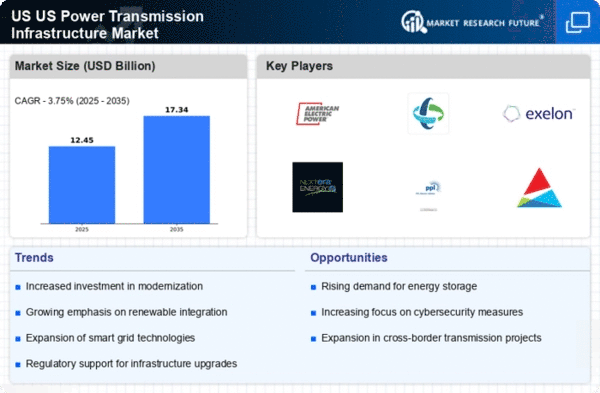
As per analysis, the US Power Transmission Infrastructure Market is projected to grow from USD 12.45 Billion in 2025 to USD 17.34 Billion by 2035, exhibiting a compound annual growth rate (CAGR) of 3.4% during the forecast period (2025 - 2035).

Key Market Trends & Highlights

The US Power Transmission Infrastructure Market is poised for substantial growth driven by modernization and technological advancements.

  • Investment in infrastructure modernization is a prevailing trend, reflecting the need for enhanced reliability and efficiency.
  • The integration of smart grid technologies is transforming the transmission landscape, enabling better management of electricity flow.
  • Sustainability and renewable energy emphasis is reshaping market dynamics, particularly in the renewable integration segment.
  • Regulatory support for infrastructure development and rising demand for electricity are key drivers propelling market expansion.

Market Size & Forecast

2024 Market Size 12.0 (USD Billion)
2035 Market Size 17.34 (USD Billion)
CAGR (2025 - 2035) 3.4%

Major Players

American Electric Power (US), Duke Energy (US), Exelon Corporation (US), NextEra Energy (US), PPL Corporation (US), Southern Company (US), Xcel Energy (US), Consolidated Edison (US)

Our Impact
Enabled $4.3B Revenue Impact for Fortune 500 and Leading Multinationals
Partnering with 2000+ Global Organizations Each Year
30K+ Citations by Top-Tier Firms in the Industry

US power transmission infrastructure Market Trends

The US Power Transmission Infrastructure Market is currently undergoing a transformative phase, driven by the increasing demand for reliable and efficient energy distribution. As the nation shifts towards renewable energy sources, the need for modernized transmission systems becomes paramount. This evolution is characterized by significant investments in upgrading existing infrastructure, enhancing grid resilience, and integrating advanced technologies. Stakeholders are focusing on developing smart grid solutions that facilitate real-time monitoring and management of energy flow, thereby improving overall efficiency and reliability. Furthermore, regulatory frameworks are evolving to support these advancements, encouraging public-private partnerships and fostering innovation in the sector. In addition to technological advancements, environmental considerations are shaping the landscape of the US Power Transmission Infrastructure Market. There is a growing emphasis on reducing carbon footprints and promoting sustainable practices within the energy sector. This trend is likely to drive the adoption of cleaner energy sources and necessitate the expansion of transmission networks to accommodate decentralized energy generation. As the market continues to evolve, it appears that collaboration among various stakeholders, including government entities, utility companies, and technology providers, will be crucial in addressing the challenges and opportunities that lie ahead.

Investment in Infrastructure Modernization

There is a notable trend towards substantial investments aimed at modernizing the existing power transmission infrastructure. This focus on upgrades is essential for enhancing the reliability and efficiency of energy distribution across the United States. Stakeholders are increasingly recognizing the importance of resilient systems that can withstand extreme weather events and other disruptions.

Integration of Smart Grid Technologies

The integration of smart grid technologies is becoming a defining characteristic of the US Power Transmission Infrastructure Market. These technologies enable real-time monitoring and management of energy flow, which enhances operational efficiency. The shift towards smart grids is likely to facilitate better demand response and energy management, ultimately leading to a more reliable power supply.

Emphasis on Sustainability and Renewable Energy

There is a growing emphasis on sustainability within the US Power Transmission Infrastructure Market, driven by the need to reduce carbon emissions. This trend is fostering the integration of renewable energy sources into the transmission network. As a result, infrastructure expansion is necessary to accommodate decentralized energy generation, which aligns with national goals for a cleaner energy future.

US power transmission infrastructure Market Drivers

Rising Demand for Electricity

The increasing demand for electricity in the United States is a primary driver of the US Power Transmission Infrastructure Market. As the population grows and urban areas expand, the need for reliable and efficient power transmission becomes critical. According to the Energy Information Administration (EIA), electricity consumption in the US is projected to rise by approximately 1.5 percent annually through 2030. This escalating demand necessitates significant upgrades and expansions in transmission infrastructure to ensure that energy can be delivered effectively. Moreover, the shift towards electric vehicles and electrification of various sectors further amplifies this demand. Consequently, the US Power Transmission Infrastructure Market is likely to experience substantial growth as utilities invest in enhancing their transmission capabilities to meet the evolving energy landscape.

Focus on Renewable Energy Integration

The transition towards renewable energy sources is a significant driver of the US Power Transmission Infrastructure Market. With the US government setting ambitious targets for reducing greenhouse gas emissions, there is an increasing emphasis on integrating renewable energy into the grid. In 2025, renewable energy sources accounted for approximately 25 percent of the total electricity generation in the US, necessitating upgrades to transmission infrastructure to accommodate this influx. The development of new transmission lines and the enhancement of existing ones are essential to connect remote renewable energy projects to urban centers. This shift not only supports sustainability goals but also stimulates economic growth through job creation in the energy sector. As a result, the US Power Transmission Infrastructure Market is likely to expand as utilities invest in infrastructure that supports renewable energy integration.

Increased Investment from Private Sector

The US Power Transmission Infrastructure Market is witnessing a notable increase in investment from the private sector. As public funding alone may not suffice to meet the growing infrastructure needs, private companies are stepping in to finance and develop transmission projects. In 2025, private investments in transmission infrastructure reached approximately 8 billion USD, reflecting a trend towards public-private partnerships. These collaborations enable faster project execution and innovation in transmission technologies. Furthermore, private sector involvement often leads to improved efficiency and cost-effectiveness in project delivery. This influx of capital is crucial for modernizing the aging transmission infrastructure and ensuring that it can support future energy demands. Consequently, the US Power Transmission Infrastructure Market is expected to thrive as private investments continue to play a vital role in infrastructure development.

Regulatory Support for Infrastructure Development

The US Power Transmission Infrastructure Market benefits from robust regulatory frameworks that promote infrastructure development. Federal and state policies, such as the Federal Energy Regulatory Commission's (FERC) initiatives, encourage investment in transmission projects. These regulations aim to enhance grid reliability and facilitate the integration of renewable energy sources. In 2025, the US witnessed a surge in approved transmission projects, with investments exceeding 10 billion USD, reflecting a growing commitment to modernizing the grid. This regulatory support not only fosters a conducive environment for private investments but also ensures that the infrastructure can meet future energy demands. As a result, the US Power Transmission Infrastructure Market is poised for growth, driven by favorable policies that prioritize infrastructure enhancement.

Technological Advancements in Transmission Systems

Technological innovations play a pivotal role in shaping the US Power Transmission Infrastructure Market. The advent of high-voltage direct current (HVDC) technology and advanced monitoring systems enhances the efficiency and reliability of power transmission. These technologies enable utilities to transmit electricity over long distances with minimal losses, thereby optimizing the existing infrastructure. In 2025, investments in smart grid technologies reached approximately 5 billion USD, reflecting a growing trend towards modernization. Furthermore, the integration of artificial intelligence and machine learning in grid management allows for real-time monitoring and predictive maintenance, reducing downtime and operational costs. As these technologies continue to evolve, they are expected to drive further investments in the US Power Transmission Infrastructure Market, ensuring a more resilient and efficient power delivery system.


Market Segment Insights

By Application: Transmission (Largest) vs. Renewable Integration (Fastest-Growing)

In the US Power Transmission Infrastructure Market, the application segment is largely dominated by Transmission, which holds the largest market share among its counterparts, including Distribution, Substation, and Renewable Integration. As utilities increasingly invest in improving grid reliability, the Transmission sector is poised to maintain a strong presence in the market. In contrast, Renewable Integration is emerging prominently, driven by the growing emphasis on integrating renewable energy sources into the existing power grid.

Distribution (Dominant) vs. Substation (Emerging)

The Distribution segment remains dominant within the US Power Transmission Infrastructure Market, primarily due to its critical role in delivering electricity from transmission systems to end-users. It enables efficient power distribution across residential, commercial, and industrial sectors. Meanwhile, the Substation segment is increasingly recognized as emerging, facilitating the connection between transmission and distribution networks. Substations enhance the reliability of power delivery and are adopting advanced technologies for better performance. This evolution signifies a shift towards modernization and flexibility in power infrastructure, supporting the growing demands for sustainable and resilient energy systems.

By End Use: Utilities (Largest) vs. Industrial (Fastest-Growing)

In the US Power Transmission Infrastructure Market, the end-use segment is prominently led by utilities, which take up the largest share due to their essential role in delivering power to consumers and businesses. This segment includes various utilities like electric power generation and distribution companies that rely heavily on well-developed transmission systems to ensure efficiency and reliability. Following utilities, the industrial segment has been expanding significantly, driven by growing energy demands from manufacturing and production facilities that require robust and reliable power infrastructures.

Utilities (Dominant) vs. Industrial (Emerging)

Utilities dominate the US Power Transmission Infrastructure Market as they are the backbone of power distribution across the country, responsible for traditional energy sources and renewable energy integration. Their substantial market share is attributed to the ongoing need for maintenance, upgrades, and expansion of existing infrastructure to meet growing electricity demands. Conversely, the industrial segment is emerging rapidly as businesses increasingly focus on energy efficiency and sustainability. Industries are progressively adopting advanced transmission technologies to enhance productivity, reduce operational costs, and comply with regulatory standards, thus positioning themselves for growth in the dynamic power landscape.

By Technology: High Voltage Direct Current (Largest) vs. Smart Grid Technology (Fastest-Growing)

In the US Power Transmission Infrastructure Market, High Voltage Direct Current (HVDC) technology currently holds the largest share among the various transmission methods. Its efficient long-distance power transmission capabilities make it a favored choice for many utility companies. High Voltage Alternating Current (HVAC) follows as a traditional yet significant part of the market, while Smart Grid Technology is rapidly gaining ground, reflecting the growing demand for improved energy management and reliability in electricity distribution. Underground Transmission is another essential segment, mainly utilized in urban areas to reduce the visual pollution of overhead lines.

Technology: HVDC (Dominant) vs. Smart Grid Technology (Emerging)

High Voltage Direct Current (HVDC) technology is recognized for its efficiency over long distances, undeniable dominance in the market, and essential role in renewable energy integration. It minimizes energy losses during transmission, making it crucial for connecting renewable energy sources with distant load centers. On the other hand, Smart Grid Technology is emerging rapidly, driven by the increasing need for enhanced grid reliability, smarter energy management, and consumer engagement in energy usage. This technology aims to incorporate advanced metering, automation, and communication tools, thereby optimizing the operational efficiency of power systems. Together, these two segments reflect the shift towards more advanced, efficient, and sustainable energy solutions in the US market.

By Component: Transformers (Largest) vs. Conductors (Fastest-Growing)

In the US Power Transmission Infrastructure Market, the component segment is characterized by a diverse range of technologies that collectively bolster the efficiency of power distribution. Among these, transformers hold the largest market share, playing a critical role in voltage regulation and ensuring the safety of electrical systems. Conductors, meanwhile, have emerged as the fastest-growing segment, driven by increasing demand for renewable energy integration and the expansion of high-capacity transmission networks.

Transformers (Dominant) vs. Switchgear (Emerging)

Transformers are dominant players in the power transmission infrastructure due to their essential role in managing electrical voltage levels across grids. Their ability to convert high voltages to lower ones for safe distribution makes them indispensable for reliable power delivery. Conversely, switchgear has emerged as an increasingly important component, driven by advancements in digital technology and enhanced operational safety. As utilities seek to modernize aging infrastructure, switchgear solutions equipped with smart technologies are gaining traction, representing an innovative approach to power management and fault protection.

By Voltage Level: High Voltage (Largest) vs. Medium Voltage (Fastest-Growing)

In the US Power Transmission Infrastructure Market, voltage level segmentation plays a crucial role in defining infrastructure capabilities. High voltage systems dominate the market, accounting for the largest share of installations and upgrades, mainly due to their effectiveness in transmitting power over long distances without significant losses. Medium voltage systems follow closely, playing a vital role in local distribution networks that bridge the gap between high voltage transmission and low voltage utilization across various sectors.

High Voltage (Dominant) vs. Medium Voltage (Emerging)

High voltage systems are characterized by their ability to transmit electricity efficiently across expansive distances, making them vital for national grid connectivity and large-scale power generation. These systems support the increasing demand for energy while enabling the integration of renewable energy sources into the national grid. On the other hand, medium voltage networks are emerging as crucial components of smart grid initiatives, facilitating local electricity distribution. This segment is experiencing rapid growth, driven by urbanization, the increasing need for reliable power in commercial and industrial sectors, and modernization efforts aimed at enhancing grid resilience and efficiency.

Get more detailed insights about US power transmission infrastructure Market

Key Players and Competitive Insights

The Power Transmission Infrastructure Market in the US is characterized by a competitive landscape that is increasingly shaped by technological advancements and regulatory pressures. Key growth drivers include the transition to renewable energy sources, the need for grid modernization, and the rising demand for reliable electricity supply. Major players such as American Electric Power (US), Duke Energy (US), and NextEra Energy (US) are strategically positioned to leverage these trends. American Electric Power (US) focuses on enhancing its grid resilience through significant investments in infrastructure upgrades, while Duke Energy (US) emphasizes sustainability initiatives and the integration of renewable energy into its transmission networks. NextEra Energy (US) is heavily investing in digital transformation to optimize operations and improve efficiency, collectively shaping a competitive environment that prioritizes innovation and sustainability.

In terms of business tactics, companies are increasingly localizing manufacturing and optimizing supply chains to enhance operational efficiency. The market structure appears moderately fragmented, with several key players exerting considerable influence. This fragmentation allows for a diverse range of strategies, as companies seek to differentiate themselves through unique value propositions and operational efficiencies.

In December 2025, American Electric Power (US) announced a $1.5 billion investment plan aimed at modernizing its transmission infrastructure across several states. This strategic move is expected to enhance grid reliability and support the integration of renewable energy sources, reflecting the company's commitment to sustainability and resilience in its operations. The investment underscores the importance of infrastructure modernization in meeting future energy demands.

In November 2025, Duke Energy (US) launched a new initiative to expand its renewable energy portfolio, targeting a 50% reduction in carbon emissions by 2030. This initiative includes the construction of new transmission lines to facilitate the integration of solar and wind energy into the grid. The strategic importance of this move lies in its alignment with national sustainability goals and the growing demand for clean energy solutions, positioning Duke Energy as a leader in the transition to a low-carbon economy.

In October 2025, NextEra Energy (US) unveiled a partnership with a technology firm to develop advanced AI-driven solutions for grid management. This collaboration aims to enhance operational efficiency and predictive maintenance capabilities, which are critical for managing the complexities of modern power transmission systems. The strategic significance of this partnership lies in its potential to revolutionize grid operations, enabling NextEra Energy to maintain a competitive edge in an evolving market.

As of January 2026, current competitive trends in the Power Transmission Infrastructure Market are heavily influenced by digitalization, sustainability, and the integration of AI technologies. Strategic alliances are increasingly shaping the landscape, allowing companies to pool resources and expertise to tackle complex challenges. The shift from price-based competition to a focus on innovation, technology, and supply chain reliability is evident, suggesting that future competitive differentiation will hinge on the ability to adapt to these emerging trends.

Key Companies in the US power transmission infrastructure Market include

Future Outlook

US power transmission infrastructure Market Future Outlook

The US Power Transmission Infrastructure Market is projected to grow at a 3.4% CAGR from 2025 to 2035, driven by technological advancements, regulatory support, and increasing energy demands.

New opportunities lie in:

  • Investment in smart grid technologies to enhance efficiency and reliability.
  • Development of renewable energy integration solutions for grid modernization.
  • Expansion of high-voltage transmission lines to support urbanization and industrial growth.

By 2035, the market is expected to be robust, reflecting sustained growth and innovation.

Market Segmentation

US power transmission infrastructure Market End Use Outlook

  • Utilities
  • Industrial
  • Commercial
  • Residential

US power transmission infrastructure Market Component Outlook

  • Transformers
  • Conductors
  • Switchgear
  • Insulators

US power transmission infrastructure Market Technology Outlook

  • High Voltage Direct Current
  • High Voltage Alternating Current
  • Smart Grid Technology
  • Underground Transmission

US power transmission infrastructure Market Application Outlook

  • Transmission
  • Distribution
  • Substation
  • Renewable Integration

US power transmission infrastructure Market Voltage Level Outlook

  • Low Voltage
  • Medium Voltage
  • High Voltage

Report Scope

MARKET SIZE 202412.0(USD Billion)
MARKET SIZE 202512.45(USD Billion)
MARKET SIZE 203517.34(USD Billion)
COMPOUND ANNUAL GROWTH RATE (CAGR)3.4% (2024 - 2035)
REPORT COVERAGERevenue Forecast, Competitive Landscape, Growth Factors, and Trends
BASE YEAR2024
Market Forecast Period2025 - 2035
Historical Data2019 - 2024
Market Forecast UnitsUSD Billion
Key Companies ProfiledAmerican Electric Power (US), Duke Energy (US), Exelon Corporation (US), NextEra Energy (US), PPL Corporation (US), Southern Company (US), Xcel Energy (US), Consolidated Edison (US)
Segments CoveredApplication, End Use, Technology, Component, Voltage Level
Key Market OpportunitiesIntegration of smart grid technologies enhances efficiency and reliability in the US Power Transmission Infrastructure Market.
Key Market DynamicsRegulatory changes and technological advancements drive modernization of the US power transmission infrastructure.
Countries CoveredUS
Leave a Comment
Download Free Sample

Kindly complete the form below to receive a free sample of this Report

Compare Licence

×
Features License Type
Single User Multiuser License Enterprise User
Price $4,950 $5,950 $7,250
Maximum User Access Limit 1 User Upto 10 Users Unrestricted Access Throughout the Organization
Free Customization
Direct Access to Analyst
Deliverable Format
Platform Access
Discount on Next Purchase 10% 15% 15%
Printable Versions