×
Request Free Sample ×

Kindly complete the form below to receive a free sample of this Report

* Please use a valid business email

Leading companies partner with us for data-driven Insights

clients tt-cursor
Hero Background

US Ovarian Cysts Market

ID: MRFR/Pharma/18453-HCR
100 Pages
Garvit Vyas
February 2026

US Ovarian Cysts Market Research Report By Type (Functional Cysts, Non-Functional Cysts, Others), By Diagnosis (Imaging, CA-125 Blood Test, Laparoscopy, Others), By Treatment (Medication, Polycystic Ovary Syndrome (PCOS) Drugs, Pain Relievers, Surgery, Others) and By End User (Hospitals & Clinics, Medical Institutes, Research Organization, Others) - Growth & Industry Forecast 2025 To 2035

Share:
Download PDF ×

We do not share your information with anyone. However, we may send you emails based on your report interest from time to time. You may contact us at any time to opt-out.

US Ovarian Cysts Market Infographic
Purchase Options

US Ovarian Cysts Market Summary

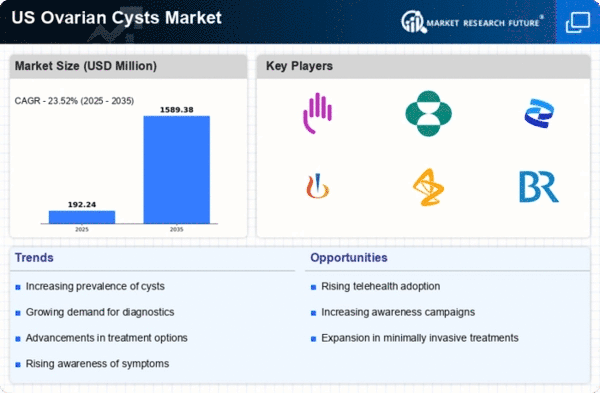
As per Market Research Future analysis, the US ovarian cysts market Size was estimated at 155.64 USD Million in 2024. The US ovarian cysts market is projected to grow from 192.24 USD Million in 2025 to 1589.38 USD Million by 2035, exhibiting a compound annual growth rate (CAGR) of 23.5% during the forecast period 2025 - 2035

Key Market Trends & Highlights

The US ovarian cysts market is experiencing a positive trajectory driven by technological advancements and increased awareness.

  • The market is witnessing a surge in awareness and education regarding ovarian cysts, leading to earlier diagnosis and treatment.
  • Advancements in diagnostic technologies are enhancing the accuracy of ovarian cyst detection, thereby improving patient outcomes.
  • Telemedicine adoption is on the rise, facilitating remote consultations and follow-ups for patients with ovarian cysts.
  • The rising incidence of ovarian cysts and increased healthcare expenditure are key drivers propelling market growth.

Market Size & Forecast

2024 Market Size 155.64 (USD Million)
2035 Market Size 1589.38 (USD Million)
CAGR (2025 - 2035) 23.52%

Major Players

Bristol-Myers Squibb (US), Merck & Co (US), Pfizer (US), Novartis (CH), AstraZeneca (GB), Bayer (DE), Johnson & Johnson (US), AbbVie (US)

Our Impact
Enabled $4.3B Revenue Impact for Fortune 500 and Leading Multinationals
Partnering with 2000+ Global Organizations Each Year
30K+ Citations by Top-Tier Firms in the Industry

US Ovarian Cysts Market Trends

The ovarian cysts market is currently experiencing notable developments, driven by a combination of increasing awareness and advancements in medical technology. As healthcare providers enhance their diagnostic capabilities, the identification of ovarian cysts has become more efficient, leading to earlier interventions. This trend is particularly relevant as more women seek medical advice regarding reproductive health, thereby contributing to a growing patient population. Furthermore, the rise in telemedicine has facilitated access to specialists, allowing for timely consultations and management of ovarian cysts. In addition, the ovarian cysts market is influenced by ongoing research into treatment options, including both surgical and non-surgical methods. The focus on personalized medicine appears to be gaining traction, with healthcare professionals tailoring treatment plans based on individual patient needs. This shift may lead to improved outcomes and patient satisfaction. As the market evolves, the integration of innovative technologies, such as minimally invasive surgical techniques, is likely to enhance the overall management of ovarian cysts, making it a dynamic area within women's health.

Increased Awareness and Education

There is a growing emphasis on educating women about ovarian cysts, which may lead to earlier detection and treatment. Campaigns aimed at raising awareness about reproductive health are becoming more prevalent, encouraging women to seek medical advice when experiencing symptoms.

Advancements in Diagnostic Technologies

The ovarian cysts market is benefiting from advancements in imaging technologies, such as ultrasound and MRI. These innovations enhance the accuracy of diagnoses, allowing healthcare providers to better assess the nature of cysts and determine appropriate treatment options.

Telemedicine Adoption

The rise of telemedicine is transforming how patients access care for ovarian cysts. Virtual consultations provide convenience and accessibility, enabling women to connect with specialists without the need for in-person visits, which may improve overall patient engagement.

US Ovarian Cysts Market Drivers

Increased Healthcare Expenditure

The rising healthcare expenditure in the US is a critical driver for the ovarian cysts market. With healthcare spending projected to reach approximately $4.3 trillion by 2025, there is a growing investment in women's health services, including the diagnosis and treatment of ovarian cysts. This financial commitment is likely to enhance access to healthcare resources, enabling more women to seek timely medical attention for ovarian cysts. The ovarian cysts market stands to gain from this trend, as increased funding may lead to improved diagnostic tools and treatment options. Furthermore, as insurance coverage expands, more patients may be willing to pursue necessary interventions, thereby driving market growth.

Rising Incidence of Ovarian Cysts

The increasing incidence of ovarian cysts among women in the US is a notable driver for the ovarian cysts market. Studies indicate that approximately 10-20% of women of reproductive age may develop ovarian cysts, contributing to a heightened demand for diagnostic and therapeutic solutions. This trend is likely to escalate as awareness regarding women's health issues grows. The ovarian cysts market is expected to benefit from this rising prevalence, as healthcare providers seek effective management strategies. Furthermore, the aging population may also contribute to the increase in cases, as older women are more susceptible to developing cysts. Consequently, the ovarian cysts market is poised for growth as healthcare systems adapt to meet the needs of this demographic.

Technological Innovations in Treatment

Technological advancements in the treatment of ovarian cysts are significantly influencing the ovarian cysts market. Innovations such as minimally invasive surgical techniques and improved pharmacological therapies are enhancing patient outcomes and reducing recovery times. For instance, laparoscopic surgery has become a preferred method due to its effectiveness and lower complication rates. The ovarian cysts market is likely to see an increase in demand for these advanced treatment options, as patients and healthcare providers prioritize safety and efficacy. Additionally, the introduction of new medications targeting cyst management may further stimulate market growth. As these technologies continue to evolve, they may reshape the landscape of the ovarian cysts market, offering patients more choices and better care.

Rising Demand for Personalized Medicine

The trend towards personalized medicine is emerging as a significant driver for the ovarian cysts market. As healthcare shifts towards tailored treatment plans based on individual patient profiles, the ovarian cysts market is likely to adapt by offering more customized therapeutic options. This approach may involve genetic testing and targeted therapies that align with a patient's specific condition and needs. The increasing recognition of the importance of personalized care is expected to enhance patient satisfaction and outcomes, potentially leading to a greater willingness to engage with healthcare services. Consequently, the ovarian cysts market may experience growth as providers develop and implement personalized treatment strategies.

Growing Focus on Women's Health Initiatives

The growing focus on women's health initiatives in the US is fostering a supportive environment for the ovarian cysts market. Various organizations and healthcare providers are emphasizing the importance of regular screenings and education regarding reproductive health. This heightened awareness is likely to encourage women to seek medical advice and treatment for ovarian cysts, thereby increasing market demand. The ovarian cysts market may benefit from partnerships between healthcare providers and advocacy groups aimed at promoting women's health. Additionally, educational campaigns that inform women about the symptoms and risks associated with ovarian cysts could lead to earlier diagnosis and intervention, further propelling market growth.


Market Segment Insights

By Type: Functional Cysts (Largest) vs. Non-Functional Cysts (Fastest-Growing)

In the US ovarian cysts market, Functional Cysts hold the largest market share among the various types. These cysts are commonly related to the menstrual cycle and are often benign, contributing to their significant presence in the market. Non-Functional Cysts, while smaller in market share, are gaining attention due to their association with various medical conditions, making them a key focus area for healthcare providers and researchers. Growth trends indicate that Non-Functional Cysts are the fastest-growing segment due to increasing awareness and diagnosis of conditions such as endometriosis and polycystic ovary syndrome (PCOS). Additionally, advancements in diagnostic imaging and healthcare outreach have contributed to this growth. Consequently, both segments are expected to evolve, with Functional Cysts remaining a staple and Non-Functional Cysts rapidly gaining relevance in treatment protocols.

Functional Cysts (Dominant) vs. Non-Functional Cysts (Emerging)

Functional Cysts, predominating the market, particularly encompass follicular and corpus luteum cysts, closely linked with the menstrual cycle, and typically resolve without intervention. Their benign nature and high prevalence rate, especially among women of reproductive age, reinforce their dominant market position. In contrast, Non-Functional Cysts, characterized by their association with medical conditions such as PCOS and endometriosis, represent an emerging segment. The increasing incidence of these conditions, coupled with heightened diagnostic capabilities, positions Non-Functional Cysts as a critical growth area. As awareness continues to expand, treatment options for these cysts are also being explored, attracting more attention from both clinicians and patients.

By Diagnosis: Imaging (Largest) vs. Laparoscopy (Fastest-Growing)

In the US ovarian cysts market, the diagnosis segment reflects a diverse distribution among its primary values. Imaging dominates this segment, capturing the largest share due to its non-invasive nature and widespread availability. This method allows for effective visualization of cysts, which is crucial in determining their nature and urgency of treatment. Following Imaging, the CA-125 Blood Test is a significant contributor, while Laparoscopy is gaining traction as an innovative approach.

Imaging (Dominant) vs. CA-125 Blood Test (Emerging)

Imaging stands as the dominant method in the diagnosis of ovarian cysts, primarily due to its accessibility and effectiveness in revealing cystic formations. It utilizes advanced technologies such as ultrasound and MRI, enabling healthcare providers to accurately assess cyst characteristics. In contrast, the CA-125 Blood Test is considered an emerging alternative, particularly for differentiating between benign and malignant forms. This test measures levels of a tumor marker that can indicate the presence of ovarian cancer, although it's used as a complementary tool rather than a standalone diagnostic method.

By Treatment: Medication (Largest) vs. Surgery (Fastest-Growing)

In the US ovarian cysts market, the Treatment segment is dominated by Medication, which captures a significant share due to the widespread usage of various pharmacological options. Among these, Pain Relievers and PCOS Drugs play critical roles in managing symptoms and underlying conditions, while Surgery remains a crucial alternative when conservative treatments prove inadequate. Growth trends in this segment are being driven by increasing awareness of ovarian health and advancements in pharmaceutical development. Medication options continue to evolve, with significant R&D investments leading to the introduction of innovative treatments. Additionally, the rising prevalence of conditions like PCOS necessitates effective management strategies, further propelling the Surgery market segment as patients seek definitive solutions.

Medication (Dominant) vs. Surgery (Emerging)

Medication is the dominant category within the Treatment segment, characterized by a wide array of options such as Pain Relievers and PCOS Drugs that address both pain management and hormonal imbalances. These medications are often the first line of defense for patients with ovarian cysts due to their effectiveness and accessibility. In contrast, Surgery is considered an emerging segment, gaining traction as a necessary approach for more severe cases. Surgical interventions are rapidly evolving, offering minimally invasive techniques that enhance recovery times and reduce complications, making them increasingly popular among patients and healthcare providers alike.

By End User: Hospitals & Clinics (Largest) vs. Medical Institutes (Fastest-Growing)

In the US ovarian cysts market, the end user segment is prominently dominated by hospitals and clinics, which account for a substantial share of the market. As critical healthcare facilities, they have a direct impact on diagnosis and treatment services, leading to a higher volume of cases and procedures compared to other segments. Medical institutes also play a significant role, with their contribution increasingly recognized as they engage in more specialized treatments and patient care pathways. Growth trends indicate that while hospitals and clinics remain the largest segment, medical institutes are emerging rapidly as the fastest-growing segment. Factors driving this growth include advances in medical research and technology that enhance treatment protocols and patient outcomes. Furthermore, the increasing awareness of ovarian health among women supports the demand for specialized care in these institutes, significantly contributing to their growth trajectory in the market.

Hospitals & Clinics (Dominant) vs. Medical Institutes (Emerging)

Hospitals and clinics serve as the dominant force in the US ovarian cysts market, providing essential services such as diagnostic imaging, surgical interventions, and ongoing patient management. Their extensive infrastructure, experienced medical professionals, and access to advanced medical technologies enable them to handle a wide array of ovarian cyst cases effectively. Conversely, medical institutes are emerging as key players, focusing on research-driven treatment options and patient-centric care. These facilities often collaborate with academic institutions to innovate and refine cyst treatment methods, attracting a growing patient base seeking specialized expertise in reproductive health. As awareness and understanding of ovarian issues expand, the contribution of medical institutes to this market is likely to increase, fostering a more competitive landscape.

Get more detailed insights about US Ovarian Cysts Market

Key Players and Competitive Insights

The ovarian cysts market is characterized by a competitive landscape that is increasingly shaped by innovation, strategic partnerships, and a focus on patient-centric solutions. Key players such as Bristol-Myers Squibb (US), Merck & Co (US), and AbbVie (US) are actively engaged in enhancing their product portfolios and expanding their market reach. Bristol-Myers Squibb (US) has positioned itself through a robust pipeline of therapies aimed at addressing various gynecological conditions, while Merck & Co (US) emphasizes its commitment to research and development, particularly in the realm of hormonal therapies. AbbVie (US) is leveraging its expertise in biologics to explore novel treatment options, thereby contributing to a dynamic competitive environment that prioritizes innovation and patient outcomes.In terms of business tactics, companies are increasingly localizing manufacturing and optimizing supply chains to enhance efficiency and responsiveness to market demands. The competitive structure of the ovarian cysts market appears moderately fragmented, with several players vying for market share. This fragmentation is indicative of a landscape where both established pharmaceutical giants and emerging biotech firms coexist, collectively influencing market dynamics through diverse strategies and product offerings.

In October Merck & Co (US) announced a strategic collaboration with a leading biotech firm to develop a new class of oral contraceptives aimed at managing ovarian cysts. This partnership is significant as it not only expands Merck's product line but also enhances its position in the hormonal therapy segment, potentially leading to improved patient adherence and outcomes. The collaboration underscores the importance of innovation in addressing unmet medical needs within the ovarian cysts market.

In September AbbVie (US) launched a new biologic therapy specifically targeting endometriosis-related ovarian cysts. This launch is pivotal as it represents a shift towards more targeted therapies that address the underlying causes of ovarian cysts rather than merely managing symptoms. AbbVie's focus on biologics may set a new standard in treatment protocols, thereby influencing competitive strategies across the market.

In November Bristol-Myers Squibb (US) revealed plans to invest in digital health technologies aimed at improving patient engagement and monitoring for those with ovarian cysts. This initiative reflects a broader trend towards digitalization in healthcare, where technology is leveraged to enhance patient outcomes and streamline treatment pathways. By integrating digital solutions, Bristol-Myers Squibb (US) is likely to differentiate itself in a crowded market, emphasizing the importance of patient-centric approaches.

As of November the ovarian cysts market is witnessing trends that emphasize digitalization, sustainability, and the integration of artificial intelligence in treatment protocols. Strategic alliances are increasingly shaping the competitive landscape, allowing companies to pool resources and expertise to drive innovation. Looking ahead, competitive differentiation is expected to evolve, with a notable shift from price-based competition towards a focus on technological advancements, innovative therapies, and reliable supply chains. This evolution suggests that companies that prioritize research and development, alongside strategic partnerships, will likely emerge as leaders in the ovarian cysts market.

Key Companies in the US Ovarian Cysts Market include

Industry Developments

In recent months, the US Ovarian Cysts Market has witnessed significant developments tied to various pharmaceutical companies. Notably, Merck and Co. has been advancing its pipeline for treatments targeting ovarian cysts, as the demand for innovative therapies continues to rise amidst growing awareness of women's health issues.

Genentech has also made strides in Research and Development aimed at understanding the implications of ovarian cysts and potential therapeutic options. As of August 2023, AstraZeneca announced a collaboration with Bristol-Myers Squibb to explore combination therapies which may positively influence treatment protocols for ovarian cyst patients.

There has been notable growth in market valuation, fueled by increased investments in Research and Development from companies such as Pfizer and Eli Lilly, which are focusing on developing less invasive treatment options. Furthermore, between 2021 and 2023, several pivotal clinical trials have been reported, enhancing the understanding of ovarian cysts and contributing to market expansion.

Mylan and Teva Pharmaceuticals are also reinforcing their portfolios, which is expected to reshape market dynamics significantly. These advancements reflect a keen focus on improving patient outcomes and addressing unmet medical needs within the US ovarian cysts landscape.

Future Outlook

US Ovarian Cysts Market Future Outlook

The Ovarian Cysts Market is projected to grow at a 23.52% CAGR from 2025 to 2035, driven by advancements in diagnostic technologies, increasing awareness, and rising healthcare expenditures.

New opportunities lie in:

  • Development of AI-driven diagnostic tools for early detection.
  • Expansion of telehealth services for remote patient monitoring.
  • Investment in targeted therapies to enhance treatment efficacy.

By 2035, the ovarian cysts market is expected to achieve substantial growth and innovation.

Market Segmentation

US Ovarian Cysts Market Type Outlook

  • Functional Cysts
  • Non-Functional Cysts
  • Others

US Ovarian Cysts Market End User Outlook

  • Hospitals & Clinics
  • Medical Institutes
  • Research Organizations
  • Others

US Ovarian Cysts Market Diagnosis Outlook

  • Imaging
  • CA-125 Blood Test
  • Laparoscopy
  • Others

US Ovarian Cysts Market Treatment Outlook

  • Medication
  • Polycystic Ovary Syndrome (PCOS) Drugs
  • Pain Relievers
  • Surgery
  • Others

Report Scope

MARKET SIZE 2024 155.64(USD Million)
MARKET SIZE 2025 192.24(USD Million)
MARKET SIZE 2035 1589.38(USD Million)
COMPOUND ANNUAL GROWTH RATE (CAGR) 23.52% (2025 - 2035)
REPORT COVERAGE Revenue Forecast, Competitive Landscape, Growth Factors, and Trends
BASE YEAR 2024
Market Forecast Period 2025 - 2035
Historical Data 2019 - 2024
Market Forecast Units USD Million
Key Companies Profiled Bristol-Myers Squibb (US), Merck & Co (US), Pfizer (US), Novartis (CH), AstraZeneca (GB), Bayer (DE), Johnson & Johnson (US), AbbVie (US)
Segments Covered Type, Diagnosis, Treatment, End User
Key Market Opportunities Advancements in minimally invasive surgical techniques enhance treatment options in the ovarian cysts market.
Key Market Dynamics Rising demand for minimally invasive treatments drives innovation in ovarian cyst management technologies.
Countries Covered US
Leave a Comment

FAQs

What is the market size of the US Ovarian Cysts Market in 2024?

The US Ovarian Cysts Market is expected to be valued at 155.4 million USD in 2024.

What will be the value of the US Ovarian Cysts Market by 2035?

By 2035, the overall market is projected to reach a valuation of 1302.01 million USD.

What is the expected CAGR for the US Ovarian Cysts Market from 2025 to 2035?

The market is anticipated to grow at a CAGR of 21.318% from 2025 to 2035.

Which segment is expected to dominate the US Ovarian Cysts Market?

The Functional Cysts segment is expected to dominate, valued at 62.16 million USD in 2024.

What is the projected market size for Non-Functional Cysts by 2035?

The Non-Functional Cysts segment is expected to be valued at 580.12 million USD by 2035.

Who are the major players in the US Ovarian Cysts Market?

Key players in the market include Merck and Co, Genentech, and Novartis among others.

What will be the value of the Others segment in 2035?

The Others segment is projected to reach 213.41 million USD by 2035.

What are the growth drivers for the US Ovarian Cysts Market?

Growing awareness and advancements in treatment options are key growth drivers for the market.

What is the value of the US Ovarian Cysts Market for Functional Cysts in 2035?

The market for Functional Cysts is projected to be valued at 508.48 million USD in 2035.

What challenges might impact the US Ovarian Cysts Market growth?

Regulatory hurdles and high treatment costs may pose challenges to market growth.

Download Free Sample

Kindly complete the form below to receive a free sample of this Report

Compare Licence

×
Features License Type
Single User Multiuser License Enterprise User
Price $4,950 $5,950 $7,250
Maximum User Access Limit 1 User Upto 10 Users Unrestricted Access Throughout the Organization
Free Customization
Direct Access to Analyst
Deliverable Format
Platform Access
Discount on Next Purchase 10% 15% 15%
Printable Versions