Rising Demand for Advanced Disease Models
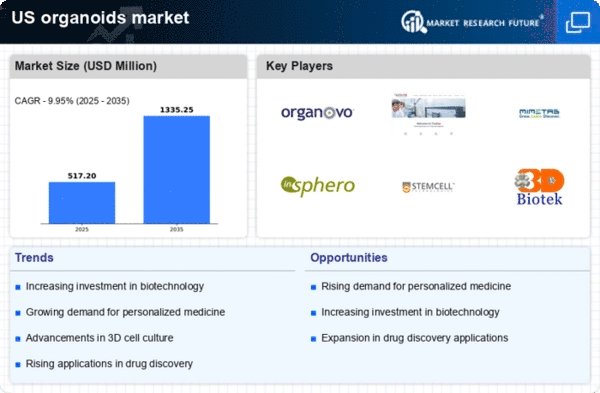
The organoids market is experiencing a notable surge in demand for advanced disease models, which are crucial for understanding complex diseases. Researchers and pharmaceutical companies are increasingly utilizing organoids to replicate human tissue and study disease mechanisms. This trend is driven by the need for more accurate preclinical models that can predict drug responses. The market for organoids is projected to reach approximately $1.5 billion by 2026, reflecting a compound annual growth rate (CAGR) of around 15%. This growth indicates a strong interest in organoids as a viable alternative to traditional cell culture methods, thereby enhancing the organoids market.
Regulatory Support for Innovative Therapies
Regulatory support for innovative therapies is emerging as a crucial driver for the organoids market. Agencies such as the FDA are recognizing the potential of organoids in accelerating drug development and improving safety assessments. This regulatory backing is likely to encourage more companies to invest in organoid technologies, as it provides a clearer pathway for bringing new therapies to market. The organoids market could see a substantial increase in activity, with projections suggesting a market value of $2 billion by 2028. This support from regulatory bodies is essential for fostering growth in the organoids market.
Growing Interest in Drug Discovery and Development
The growing interest in drug discovery and development is significantly impacting the organoids market. Pharmaceutical companies are increasingly adopting organoids for high-throughput screening and toxicity testing, as these models provide more relevant biological insights compared to traditional methods. The organoids market is projected to grow at a CAGR of 14% through 2025, driven by the need for more efficient drug development processes. This trend indicates a shift towards more innovative approaches in the pharmaceutical industry, thereby enhancing the relevance of organoids in drug discovery and development.
Increased Funding for Regenerative Medicine Research
Increased funding for regenerative medicine research is a key driver of growth in the organoids market. Government and private sector investments are being directed towards research initiatives that utilize organoids for tissue engineering and regenerative therapies. This influx of capital is fostering innovation and accelerating the development of organoid-based applications. In the US, funding for regenerative medicine has seen a rise of over 20% in recent years, which is likely to propel the organoids market forward. The emphasis on regenerative medicine is expected to create new opportunities for organoid applications in clinical settings.
Technological Advancements in Organoid Culturing Techniques
Technological advancements in organoid culturing techniques are significantly influencing the organoids market. Innovations such as 3D bioprinting and microfluidics are enhancing the ability to create more complex and functional organoids. These advancements allow for better mimicry of in vivo environments, which is essential for drug testing and disease modeling. As a result, the organoids market is expected to benefit from increased adoption of these technologies, with a projected market value of $1.8 billion by 2027. This growth underscores the importance of continuous innovation in the organoids market.