×
Request Free Sample ×

Kindly complete the form below to receive a free sample of this Report

* Please use a valid business email

Leading companies partner with us for data-driven Insights

clients tt-cursor
Hero Background

US Nano therapy Market

ID: MRFR/LS/18437-HCR
100 Pages
Garvit Vyas
February 2026

US Nano Therapy Market Research Report By Application (Cancer Therapy, Cardiovascular Therapy, Neurological Disorders, Infectious Diseases), By Type (Nanoparticles, Nanorobots, Nanosensors, Nanocapsules), By End User (Pharmaceutical Companies, Research Institutions, Hospitals and Clinics, Diagnostic Centers) and By Technology (Targeted Drug Delivery, Gene Therapy, Immunotherapy, Photothermal Therapy) - Growth & Industry Forecast 2025 To 2035

Share:
Download PDF ×

We do not share your information with anyone. However, we may send you emails based on your report interest from time to time. You may contact us at any time to opt-out.

US Nano therapy Market Infographic
Purchase Options

US Nano therapy Market Summary

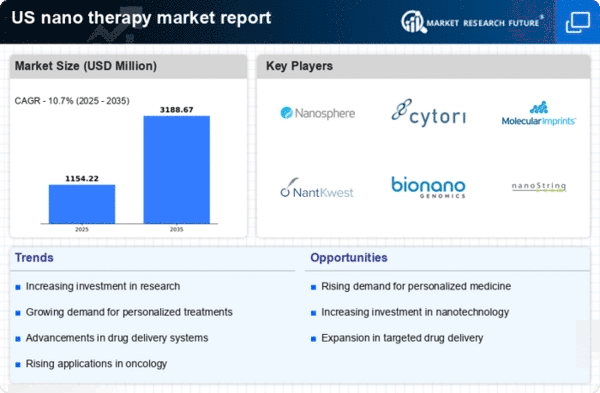
As per Market Research Future analysis, the US nano therapy market Size was estimated at 1042.66 USD Million in 2024. The US nano therapy market is projected to grow from 1154.22 USD Million in 2025 to 3188.67 USD Million by 2035, exhibiting a compound annual growth rate (CAGR) of 10% during the forecast period 2025 - 2035

Key Market Trends & Highlights

The US nano therapy market is poised for substantial growth driven by technological advancements and increasing demand for targeted therapies.

  • Advancements in drug delivery systems are enhancing the efficacy of nano therapies.
  • Regulatory developments are fostering a more favorable environment for nanotechnology applications.
  • Collaborative research initiatives are accelerating innovation within the nano therapy sector.
  • Rising demand for targeted therapies and technological innovations in nanotechnology are key drivers propelling market growth.

Market Size & Forecast

2024 Market Size 1042.66 (USD Million)
2035 Market Size 3188.67 (USD Million)
CAGR (2025 - 2035) 10.7%

Major Players

Nanosphere Inc (US), Cytori Therapeutics Inc (US), Molecular Imprints Inc (US), NantKwest Inc (US), Bionano Genomics Inc (US), NanoString Technologies Inc (US), Zymergen Inc (US), AstraZeneca PLC (GB), BASF SE (DE)

Our Impact
Enabled $4.3B Revenue Impact for Fortune 500 and Leading Multinationals
Partnering with 2000+ Global Organizations Each Year
30K+ Citations by Top-Tier Firms in the Industry

US Nano therapy Market Trends

The nano therapy market is currently experiencing a transformative phase, driven by advancements in nanotechnology and its applications in medicine. This sector focuses on utilizing nanoscale materials and devices to enhance therapeutic efficacy, targeting diseases at the molecular level. The integration of nanotechnology into drug delivery systems appears to improve the precision of treatments, potentially leading to better patient outcomes. Furthermore, the increasing prevalence of chronic diseases and the demand for personalized medicine are likely to propel growth in this market. As research progresses, the potential for innovative therapies that leverage nanoscale mechanisms continues to expand, suggesting a promising future for the nano therapy market. In addition, regulatory bodies are actively working to establish guidelines that ensure the safety and efficacy of nanomedicine products. This regulatory framework may foster greater confidence among healthcare providers and patients, thereby encouraging adoption. The collaboration between academic institutions and industry stakeholders is also noteworthy, as it facilitates the translation of research findings into practical applications. Overall, the nano therapy market is poised for significant advancements, with ongoing research and development efforts likely to yield novel therapeutic options in the near future.

Advancements in Drug Delivery Systems

Recent innovations in nano therapy are enhancing drug delivery mechanisms, allowing for targeted treatment of diseases. By utilizing nanoparticles, medications can be delivered directly to affected cells, minimizing side effects and improving therapeutic effectiveness. This trend indicates a shift towards more personalized treatment approaches.

Regulatory Developments

The establishment of comprehensive regulatory frameworks for nano therapies is gaining momentum. Regulatory agencies are focusing on safety and efficacy standards, which may lead to increased market confidence. This trend suggests that as regulations become clearer, more products may enter the market.

Collaborative Research Initiatives

There is a growing trend of collaboration between academic institutions and industry players in the nano therapy market. These partnerships aim to accelerate the development of innovative therapies and facilitate the translation of research into clinical applications. Such initiatives may enhance the overall growth of the market.

US Nano therapy Market Drivers

Growing Awareness of Nanomedicine

The growing awareness of nanomedicine among healthcare professionals and patients is a pivotal driver for the nano therapy market. Educational initiatives and outreach programs are enhancing understanding of the benefits and applications of nano therapies. As patients become more informed about their treatment options, there is a noticeable shift towards therapies that utilize nanotechnology for improved outcomes. This trend is reflected in the increasing number of clinical trials and publications focusing on nano therapies, which have surged by over 30% in recent years. Furthermore, healthcare providers are increasingly recognizing the potential of nano therapies to address unmet medical needs, particularly in oncology and chronic disease management. Thus, the growing awareness of nanomedicine is a significant driver for the nano therapy market, as it encourages adoption and integration into standard treatment protocols.

Rising Demand for Targeted Therapies

The increasing prevalence of chronic diseases in the US is driving the demand for targeted therapies, which is a key driver for the nano therapy market. As healthcare providers seek more effective treatment options, nano therapies offer the potential for precision medicine that minimizes side effects while maximizing therapeutic efficacy. According to recent estimates, the market for targeted therapies is projected to reach approximately $200 billion by 2026, indicating a robust growth trajectory. This trend suggests that the nano therapy market will likely benefit from the shift towards personalized medicine, as these therapies can be tailored to individual patient needs. Furthermore, the ability of nano therapies to deliver drugs directly to affected cells enhances their appeal, potentially leading to increased adoption in clinical settings. Thus, the rising demand for targeted therapies is a significant driver for the nano therapy market.

Regulatory Support for Nanotechnology

Regulatory support for nanotechnology is emerging as a crucial driver for the nano therapy market. The US Food and Drug Administration (FDA) has established guidelines that facilitate the approval process for nano-based therapies, thereby encouraging innovation in this field. The streamlined regulatory pathways are designed to ensure safety and efficacy while promoting the development of novel therapies. As of 2025, the FDA has approved several nano therapies, which has instilled confidence in both investors and developers. This regulatory environment not only accelerates the introduction of new products to the market but also enhances the credibility of nano therapies among healthcare providers. Consequently, regulatory support for nanotechnology is a vital driver for the nano therapy market, fostering a landscape that encourages research, development, and commercialization.

Increased Investment in Healthcare R&D

The surge in investment in healthcare research and development is significantly impacting the nano therapy market. With the US government and private sector allocating substantial funds towards innovative healthcare solutions, the nano therapy market is poised for growth. In 2025, healthcare R&D spending in the US is projected to exceed $200 billion, with a notable portion directed towards nanotechnology applications. This influx of capital facilitates the exploration of novel nano therapeutic agents and enhances clinical trials, thereby accelerating the path to market for new therapies. Moreover, the focus on improving patient outcomes and reducing healthcare costs aligns with the capabilities of nano therapies, which can provide targeted treatment options. Consequently, increased investment in healthcare R&D serves as a vital driver for the nano therapy market, fostering an environment conducive to innovation and advancement.

Technological Innovations in Nanotechnology

Technological advancements in nanotechnology are propelling the nano therapy market forward. Innovations in nanomaterials and drug formulation techniques are enhancing the efficacy and safety profiles of nano therapies. For instance, the development of nanoparticles that can cross biological barriers, such as the blood-brain barrier, opens new avenues for treating neurological disorders. The US nanotechnology market is expected to grow at a CAGR of around 15% through 2027, reflecting the increasing investment in research and development. These innovations not only improve the therapeutic outcomes but also reduce the overall treatment costs, making nano therapies more accessible. As a result, the continuous evolution of technology in nanotechnology is a crucial driver for the nano therapy market, fostering a competitive landscape that encourages further research and application.


Market Segment Insights

By Application: Cancer Therapy (Largest) vs. Neurological Disorders (Fastest-Growing)

The US nano therapy market exhibits diverse applications, with Cancer Therapy holding the largest market share among segment values. This segment has gained significant traction due to its ability to increase the efficacy of traditional treatments while minimizing side effects. Meanwhile, Neurological Disorders are emerging rapidly, presenting robust growth opportunities as research intensifies in this crucial area, signaling a shift towards innovative treatment options. Growth trends within the US nano therapy market highlight Cancer Therapy's established market presence while spotlighting the burgeoning interest in Neurological Disorders. Factors driving growth include advancements in nanotechnology, increased funding for research, and a growing emphasis on precision medicine. As pharmaceutical companies pivot towards targeted therapies, we expect a surge in demand for innovative treatments across these applications, reshaping healthcare delivery and patient outcomes.

Cancer Therapy: Dominant vs. Neurological Disorders: Emerging

Cancer Therapy stands out as the dominant application in the US nano therapy market, as it leverages nanoparticles to enhance drug delivery, targeting cancer cells more effectively with fewer side effects. This segment benefits from a substantial investment in research, leading to breakthroughs in treatment methodologies. Conversely, Neurological Disorders are recognized as the emerging application, showcasing a rapidly increasing interest from both researchers and investors. With more understanding of the blood-brain barrier and the role of nanoparticles in addressing neurological issues, innovative therapies are on the horizon. These segments highlight a clear dichotomy between well-established treatment routes and the potential for exciting new therapies in the coming years.

By Type: Nanoparticles (Largest) vs. Nanorobots (Fastest-Growing)

In the US nano therapy market, the distribution of market share among segment values is notably dominated by nanoparticles, which have established a significant presence due to their versatile applications in drug delivery and diagnostic imaging. On the other hand, nanorobots, while smaller in market share, have gained traction rapidly due to their innovative applications in targeted therapies and minimally invasive procedures. Growth trends in this segment are being driven by increasing investments in nanotechnology research and a growing demand for advanced therapeutic solutions. Nanoparticles continue to lead, but the development of nanorobots showcases a transformative potential that resonates with ongoing trends in precision medicine and personalized healthcare. This shift indicates that while traditional applications remain strong, emerging technologies are setting the stage for future expansion.

Nanoparticles (Dominant) vs. Nanorobots (Emerging)

Nanoparticles are the dominant force in the US nano therapy market, primarily due to their ability to enhance drug delivery systems and improve therapeutic precision, making them integral to various medical applications including cancer treatments and vaccines. In contrast, nanorobots represent the emerging segment, characterized by their high potential for revolutionizing medical procedures through automation and precision. They are being developed to perform complex tasks at the cellular level, providing a new frontier in minimally invasive treatments. These two segments highlight the spectrum of innovation within the market, with nanoparticles providing established solutions while nanorobots pave the way for future advancements in medical technology.

By End-user: Pharmaceutical Companies (Largest) vs. Research Institutions (Fastest-Growing)

The US nano therapy market is characterized by a diverse end-user segment, where pharmaceutical companies represent the largest share, leveraging their established infrastructure and capabilities to integrate nano therapy into their product lines. Research institutions also play a significant role, focusing on innovation and developments in nanotechnology, thereby contributing to a dynamic competition for market share. Growth trends in this segment are driven by increasing investments in healthcare and biotechnology, alongside an escalating demand for advanced therapeutic solutions. Pharmaceutical companies are expanding their portfolios to include nano therapies, while research institutions are rapidly evolving to become pivotal in clinical trials and partnerships with industry players, positioning themselves as the fastest-growing end-user segment in this market.

Pharmaceutical Companies (Dominant) vs. Research Institutions (Emerging)

Pharmaceutical companies dominate the US nano therapy market due to their extensive experience and robust distribution networks, enabling them to efficiently deliver innovative therapies. Their established R&D capabilities allow them to explore various nano formulations and leverage regulatory pathways for market entry. In contrast, research institutions are emerging as key players, driven by their focus on groundbreaking research and collaborations with commercial entities. This sector is poised for growth as it pioneers novel applications and methodologies within nano therapy, rapidly translating laboratory successes into clinical practice and enhancing patient outcomes.

By Technology: Immunotherapy (Largest) vs. Gene Therapy (Fastest-Growing)

In the US nano therapy market, Immunotherapy currently holds the largest market share, attributed to its advanced mechanisms and successful adoption in treating various cancers and autoimmune diseases. Targeted Drug Delivery is also significant but is overshadowed by Immunotherapy's growing acceptance and proven efficacy. Gene Therapy, while having a smaller share at present, is anticipated to witness rapid growth as advancements in genetic technologies and personalized medicine continue to evolve, allowing for more effective treatment options. The growth trends in the US nano therapy market are driven primarily by increasing investments in research and development, a rise in chronic diseases, and growing demand for personalized treatment options. Immunotherapy's ongoing success in clinical trials propels its dominance, while Gene Therapy benefits from breakthroughs in technology and regulatory support that incentivizes novel treatment validation. These dynamics illustrate a burgeoning landscape where innovation continues to reshape therapy strategies and patient outcomes.

Technology: Immunotherapy (Dominant) vs. Gene Therapy (Emerging)

Immunotherapy stands out as the dominant force in the US nano therapy market, characterized by its ability to harness the body’s immune system to fight cancers and other diseases effectively. This approach has led to successful therapies that have transformed patient prognoses. In contrast, Gene Therapy is emerging as a revolutionary treatment method aimed at correcting or replacing faulty genes to treat diseases at their source. As advancements in gene editing technologies like CRISPR become more prevalent, Gene Therapy is set to gain traction, especially for genetic disorders and rare diseases, promising a paradigm shift in patient management and care.

Get more detailed insights about US Nano therapy Market

Key Players and Competitive Insights

The nano therapy market is currently characterized by a dynamic competitive landscape, driven by rapid advancements in technology and increasing demand for targeted therapies. Key players such as Nanosphere Inc (US), Cytori Therapeutics Inc (US), and NanoString Technologies Inc (US) are at the forefront, each adopting distinct strategies to enhance their market positioning. Nanosphere Inc (US) focuses on innovation in diagnostic technologies, aiming to improve patient outcomes through precision medicine. Cytori Therapeutics Inc (US) emphasizes partnerships with research institutions to accelerate the development of its cell therapy products, while NanoString Technologies Inc (US) leverages its expertise in genomic analysis to expand its product offerings in the therapeutic space. Collectively, these strategies contribute to a competitive environment that is increasingly centered on innovation and collaboration.In terms of business tactics, companies are increasingly localizing manufacturing and optimizing supply chains to enhance efficiency and responsiveness to market demands. The competitive structure of the nano therapy market appears moderately fragmented, with several players vying for market share. However, the influence of major companies is significant, as they set industry standards and drive technological advancements that smaller firms often follow.

In October Nanosphere Inc (US) announced a strategic partnership with a leading healthcare provider to integrate its diagnostic platform into routine clinical practice. This collaboration is expected to enhance the accessibility of nano therapy solutions, potentially increasing patient engagement and improving treatment outcomes. The strategic importance of this partnership lies in its potential to establish Nanosphere as a leader in the integration of nano diagnostics into mainstream healthcare.

In September Cytori Therapeutics Inc (US) secured a $50M funding round aimed at advancing its clinical trials for a novel cell therapy product. This financial boost is likely to accelerate the development timeline and enhance the company's competitive edge in the regenerative medicine sector. The infusion of capital not only supports research and development but also positions Cytori to expand its market reach and solidify its presence in the nano therapy landscape.

In August NanoString Technologies Inc (US) launched a new product line that utilizes advanced nano-scale imaging techniques to improve the accuracy of genomic profiling. This innovation is poised to enhance the company's offerings in precision medicine, allowing for more tailored therapeutic approaches. The launch signifies a strategic move to differentiate NanoString in a crowded market, emphasizing the importance of technological advancement in maintaining competitive advantage.

As of November current trends in the nano therapy market indicate a strong focus on digitalization, sustainability, and the integration of artificial intelligence (AI) into therapeutic development. Strategic alliances are increasingly shaping the competitive landscape, as companies recognize the value of collaboration in driving innovation. Looking ahead, competitive differentiation is likely to evolve, shifting from price-based competition to a focus on technological innovation, supply chain reliability, and the ability to deliver personalized therapies. This transition underscores the importance of agility and responsiveness in a rapidly changing market.

Key Companies in the US Nano therapy Market include

Industry Developments

The US Nano Therapy Market is currently witnessing significant advancements and developments. Recently, CureVac announced progress in its mRNA technology platform, aiming to enhance therapeutic delivery methods in September 2023. AstraZeneca is collaborating with several biotech firms to explore novel nanoformulations, which are expected to improve their oncology portfolio. Biogen has introduced new clinical trials focusing on nanoparticle-based therapies for neurodegenerative diseases, reflecting the growing demand for innovative solutions.

Amid these advancements, Pfizer is expanding its nano-based vaccine technology to improve responsiveness against emerging viral strains, a move that impacts public health initiatives. Notably, there have been developments in merger and acquisition activities; in August 2023, Roche acquired a nano-technology firm to bolster its capabilities in precision medicine. Financial growth in the sector remains robust, with estimates indicating a substantial market valuation increase, prompting further investments in research and development.

Major happenings over the last two years include Novartis's product launches that feature nano-carriers, enhancing drug delivery efficiency and patient outcomes in various therapeutic areas. The US Nano Therapy Market continues to evolve rapidly, characterized by these strategic initiatives and collaborations among top pharmaceutical companies.

Future Outlook

US Nano therapy Market Future Outlook

The Nano therapy Market is projected to grow at a 10.7% CAGR from 2025 to 2035, driven by advancements in drug delivery systems, increasing R&D investments, and rising demand for personalized medicine.

New opportunities lie in:

  • Development of targeted nano drug delivery systems for oncology applications.
  • Partnerships with biotech firms to enhance therapeutic efficacy and market reach.
  • Investment in AI-driven analytics for personalized nano therapy solutions.

By 2035, the nano therapy market is expected to achieve substantial growth, driven by innovation and strategic partnerships.

Market Segmentation

US Nano therapy Market Type Outlook

  • Nanoparticles
  • Nanorobots
  • Nanosensors
  • Nanocapsules

US Nano therapy Market End-user Outlook

  • Pharmaceutical Companies
  • Research Institutions
  • Hospitals and Clinics
  • Diagnostic Centers

US Nano therapy Market Technology Outlook

  • Targeted Drug Delivery
  • Gene Therapy
  • Immunotherapy
  • Photothermal Therapy

US Nano therapy Market Application Outlook

  • Cancer Therapy
  • Cardiovascular Therapy
  • Neurological Disorders
  • Infectious Diseases

Report Scope

MARKET SIZE 2024 1042.66(USD Million)
MARKET SIZE 2025 1154.22(USD Million)
MARKET SIZE 2035 3188.67(USD Million)
COMPOUND ANNUAL GROWTH RATE (CAGR) 10.7% (2025 - 2035)
REPORT COVERAGE Revenue Forecast, Competitive Landscape, Growth Factors, and Trends
BASE YEAR 2024
Market Forecast Period 2025 - 2035
Historical Data 2019 - 2024
Market Forecast Units USD Million
Key Companies Profiled Nanosphere Inc (US), Cytori Therapeutics Inc (US), Molecular Imprints Inc (US), NantKwest Inc (US), Bionano Genomics Inc (US), NanoString Technologies Inc (US), Zymergen Inc (US), AstraZeneca PLC (GB), BASF SE (DE)
Segments Covered Application, Type, End-user, Technology
Key Market Opportunities Advancements in targeted drug delivery systems enhance therapeutic efficacy in the nano therapy market.
Key Market Dynamics Technological advancements drive innovation in nano therapy, enhancing treatment efficacy and attracting investment in Research and Development.
Countries Covered US
Leave a Comment

FAQs

What is the expected market size of the US Nano Therapy Market in 2024?

The US Nano Therapy Market is expected to be valued at 2.2 billion USD in 2024.

How much is the US Nano Therapy Market projected to be worth by 2035?

By 2035, the US Nano Therapy Market is projected to reach a value of 9.5 billion USD.

What is the compound annual growth rate (CAGR) for the US Nano Therapy Market from 2025 to 2035?

The US Nano Therapy Market is anticipated to grow at a CAGR of 14.223% from 2025 to 2035.

Which segment holds the largest market share in the US Nano Therapy Market?

Cancer Therapy is anticipated to hold the largest market share, valued at 0.9 billion USD in 2024 and projected to reach 3.9 billion USD by 2035.

What is the projected market value of the Cardiovascular Therapy segment by 2035?

The Cardiovascular Therapy segment is projected to reach a market value of 2.6 billion USD by 2035.

Who are the key players in the US Nano Therapy Market?

Major players include CureVac, AstraZeneca, Biogen, Amgen, and Pfizer among others.

What value is expected for the Neurological Disorders segment in 2024?

The Neurological Disorders segment is expected to be valued at 0.5 billion USD in 2024.

What challenges are currently facing the US Nano Therapy Market?

Challenges include regulatory hurdles and competition among key players in the market.

What is the value of the Infectious Diseases segment expected to be in 2035?

The Infectious Diseases segment is anticipated to be valued at 0.8 billion USD by 2035.

What are the prospects for growth in the US Nano Therapy Market?

The market holds significant growth opportunities driven by advancements in treatment technologies and increasing prevalence of related diseases.

Download Free Sample

Kindly complete the form below to receive a free sample of this Report

Compare Licence

×
Features License Type
Single User Multiuser License Enterprise User
Price $4,950 $5,950 $7,250
Maximum User Access Limit 1 User Upto 10 Users Unrestricted Access Throughout the Organization
Free Customization
Direct Access to Analyst
Deliverable Format
Platform Access
Discount on Next Purchase 10% 15% 15%
Printable Versions