×
Request Free Sample ×

Kindly complete the form below to receive a free sample of this Report

* Please use a valid business email

Leading companies partner with us for data-driven Insights

clients tt-cursor
Hero Background

US Mobile Security Market

ID: MRFR/ICT/63802-HCR
200 Pages
Aarti Dhapte
February 2026

US Mobile Security Market Size, Share and Research Report: By Solution (Mobile Data Protection, Firewall, Data Encryption, Multi-Factor Authentication), By Deployment (Cloud, On-Premises), By System (Windows, Android, IOS) and By End-User (Telecom and IT, Individual Users, BFSI, Government, Healthcare, Retail, Education) - Industry Forecast to 2035

Share:
Download PDF ×

We do not share your information with anyone. However, we may send you emails based on your report interest from time to time. You may contact us at any time to opt-out.

US Mobile Security Market Infographic
Purchase Options

US Mobile Security Market Summary

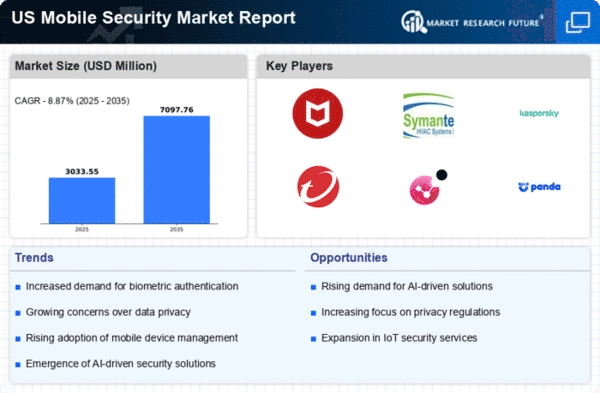
As per Market Research Future analysis, the US mobile security market size was estimated at 2786.4 USD Million in 2024. The US mobile security market is projected to grow from 3033.55 USD Million in 2025 to 7097.76 USD Million by 2035, exhibiting a compound annual growth rate (CAGR) of 8.8% during the forecast period 2025 - 2035

Key Market Trends & Highlights

The US mobile security market is experiencing robust growth driven by technological advancements and increasing consumer awareness.

  • AI-driven security solutions are gaining traction as organizations seek to enhance their mobile security frameworks.
  • Regulatory compliance is becoming increasingly critical, prompting businesses to adopt more stringent security measures.
  • Consumer awareness regarding mobile security threats is on the rise, leading to greater demand for protective solutions.
  • The surge in mobile device usage and the emergence of advanced threats are key drivers propelling market expansion.

Market Size & Forecast

2024 Market Size 2786.4 (USD Million)
2035 Market Size 7097.76 (USD Million)
CAGR (2025 - 2035) 8.87%

Major Players

McAfee (US), Symantec (US), Kaspersky (RU), Trend Micro (JP), Check Point (IL), Panda Security (ES), Bitdefender (RO), Sophos (GB), ESET (SK)

Our Impact
Enabled $4.3B Revenue Impact for Fortune 500 and Leading Multinationals
Partnering with 2000+ Global Organizations Each Year
30K+ Citations by Top-Tier Firms in the Industry

US Mobile Security Market Trends

The mobile security market is currently experiencing significant changes, driven by the increasing reliance on mobile devices for personal and professional activities. As individuals and organizations continue to adopt smartphones and tablets, the demand for robust security solutions has intensified. This trend is further fueled by the rising incidence of cyber threats, which pose significant risks to sensitive data and privacy. Consequently, stakeholders in the mobile security market are compelled to innovate and enhance their offerings to address these challenges effectively. The integration of advanced technologies, such as artificial intelligence and machine learning, appears to be a pivotal factor in developing more sophisticated security measures. Moreover, regulatory frameworks and compliance requirements are shaping the landscape of the mobile security market. Organizations are increasingly mandated to implement stringent security protocols to protect user data, which may drive the adoption of comprehensive security solutions. This regulatory pressure, combined with the growing awareness of cybersecurity issues among consumers, suggests a promising outlook for the mobile security market. As the landscape continues to evolve, it is likely that new players will emerge, and existing companies will adapt their strategies to remain competitive in this rapidly changing environment.

Rise of AI-Driven Security Solutions

Artificial intelligence is increasingly being integrated into mobile security solutions. AI technologies enhance threat detection and response capabilities, allowing for real-time analysis of potential vulnerabilities. This trend indicates a shift towards more proactive security measures, as organizations seek to mitigate risks before they escalate.

Increased Regulatory Compliance

Regulatory requirements are influencing the mobile security market significantly. Organizations are now required to adhere to stricter data protection laws, which necessitate the implementation of comprehensive security measures. This trend highlights the importance of compliance in shaping security strategies and driving the adoption of advanced solutions.

Growing Consumer Awareness

There is a noticeable increase in consumer awareness regarding mobile security issues. As individuals become more informed about potential threats, they are demanding better security features from mobile applications and devices. This trend suggests that companies must prioritize user education and transparency to build trust and enhance their offerings.

US Mobile Security Market Drivers

Shift Towards Remote Work

The ongoing shift towards remote work has transformed the landscape of the mobile security market. As organizations increasingly adopt flexible work arrangements, employees are utilizing personal mobile devices to access corporate resources. This trend raises significant security concerns, as personal devices may lack adequate protection against cyber threats. In 2025, it is estimated that 60% of the US workforce engages in remote work, further emphasizing the need for robust mobile security solutions. Companies are now prioritizing the implementation of mobile device management (MDM) systems and secure access protocols to mitigate risks associated with remote access. This shift is likely to drive substantial growth in the mobile security market as organizations seek to protect sensitive information.

Integration of IoT Devices

The proliferation of Internet of Things (IoT) devices in the US is significantly impacting the mobile security market. With millions of IoT devices connected to mobile networks, the potential attack surface for cyber threats has expanded dramatically. In 2025, it is projected that there will be over 30 billion connected IoT devices globally, many of which rely on mobile platforms for connectivity. This integration necessitates enhanced security measures to protect both mobile devices and the data transmitted between them. Consequently, the mobile security market is witnessing a surge in demand for solutions that can effectively secure IoT ecosystems, thereby ensuring the integrity and confidentiality of user data.

Surge in Mobile Device Usage

The rapid increase in mobile device adoption in the US has been a pivotal driver for the mobile security market. As of 2025, approximately 85% of the US population owns a smartphone, leading to a heightened demand for security solutions. This surge in mobile device usage has resulted in a corresponding rise in cyber threats, prompting businesses and consumers to seek robust security measures. The mobile security market is projected to reach $30 billion by 2026, reflecting a compound annual growth rate (CAGR) of 12% from 2024 to 2026. This growth is largely attributed to the necessity of protecting sensitive data on mobile devices, which has become a critical concern for users and organizations alike.

Emergence of Advanced Threats

The mobile security market is increasingly influenced by the emergence of sophisticated cyber threats. Cybercriminals are employing advanced techniques such as phishing, malware, and ransomware specifically targeting mobile devices. In 2025, it is estimated that mobile malware attacks have increased by 40% compared to previous years. This alarming trend compels organizations to invest in advanced mobile security solutions to safeguard data and maintain trust. The mobile security market is adapting to these challenges by integrating artificial intelligence and machine learning technologies, which enhance threat detection and response capabilities. As a result, the demand for comprehensive mobile security solutions continues to escalate.

Rising Cybersecurity Awareness

The growing awareness of cybersecurity issues among consumers and businesses is a crucial driver for the mobile security market. As high-profile data breaches and cyberattacks make headlines, individuals and organizations are becoming more vigilant about their mobile security practices. In 2025, surveys indicate that 75% of consumers consider mobile security a top priority when choosing devices and applications. This heightened awareness is prompting investments in mobile security solutions, as users seek to protect their personal and financial information. The mobile security market is responding to this demand by offering user-friendly solutions that cater to the needs of both consumers and enterprises, thereby fostering a more secure mobile environment.


Market Segment Insights

By Mobile Security Solution: Mobile Data Protection (Largest) vs. Multi-Factor Authentication (Fastest-Growing)

In the US mobile security market, the distribution of market share among various mobile security solutions reveals that Mobile Data Protection holds the largest share, driven by the increasing importance of safeguarding sensitive data on mobile devices. Following closely is Multi-Factor Authentication, which is rapidly gaining traction as organizations prioritize secure access . Firewall and Mobile Encryption also contribute to the segment but remain behind in both market share and growth rate. Growth trends in this segment indicate a substantial shift towards more comprehensive mobile security solutions. Businesses and consumers are increasingly aware of security vulnerabilities associated with mobile technology, pushing demand for enhanced security measures. The rise in remote work and mobile device usage further propels the adoption of solutions like Multi-Factor Authentication, making it the fastest-growing segment. As cyber threats evolve, the mobile security landscape is adapting to incorporate more advanced solutions to protect sensitive information.

Mobile Data Protection (Dominant) vs. Mobile Encryption (Emerging)

Mobile Data Protection has established itself as the dominant force in the US mobile security market, attributed to its comprehensive capabilities in ensuring data confidentiality and integrity on mobile devices. As enterprises continue to mobilize their operations, the demand for robust data protection solutions is surging. In contrast, Mobile Encryption is an emerging solution that, while increasingly recognized, has yet to achieve the same market penetration. It plays a critical role in securing data at rest and in transit, making it essential in compliance-driven industries. Businesses are gradually integrating encryption technologies as part of their broader security strategies, signifying a growing awareness of its importance in the fight against data breaches and unauthorized access.

By Mobile Security Deployment: Cloud (Largest) vs. On-Premises (Fastest-Growing)

The market share distribution among the deployment methods in the US mobile security market indicates that cloud solutions are currently the largest segment, benefiting from increased demand for scalable and flexible security options. As businesses shift towards digital transformation, the cloud segment has gained significant traction, appealing to a wide range of organizations seeking to enhance their mobile security frameworks. In contrast, the on-premises deployment method is emerging as the fastest-growing segment in the market. The resurgence is driven by organizations seeking to maintain control over their data and security infrastructure, particularly amid rising concerns over data privacy and compliance. As mobile threats evolve, businesses are investing in robust on-premises solutions to address specific security needs, resulting in a surge in this segment's adoption.

Deployment: Cloud (Dominant) vs. On-Premises (Emerging)

The cloud deployment segment dominates the US mobile security market, characterized by its scalability, ease of deployment, and ability to provide real-time updates and threat intelligence. Organizations prefer cloud-based solutions as they allow for enhanced collaboration and a reduction in operational overhead. On the other hand, the on-premises deployment method is emerging as a preferred choice for organizations with stringent data control requirements. This approach offers businesses the ability to customize security measures and maintain direct oversight of their security environment, making it appealing for sectors that deal with sensitive information. As both segments evolve, the market will see a dynamic interplay between the convenience of the cloud and the control offered by on-premises solutions.

By Mobile Security System: Android (Largest) vs. iOS (Fastest-Growing)

In the US mobile security market, Android holds the largest market share among mobile security systems, benefiting from its extensive user base and wide-ranging application ecosystem. This segment's growth is largely attributed to the continued proliferation of Android devices, with a broad spectrum of consumers relying on Android security solutions. In contrast, iOS has been emerging rapidly, with its market share steadily increasing as security-conscious consumers migrate to Apple devices that emphasize robust security features and user privacy. The growth trends in the mobile security system segment are driven by increasing cybersecurity threats and the rising adoption of mobile devices. Users are becoming more aware of the importance of protecting personal information, leading to an uptick in demand for mobile security solutions. Additionally, the continuous advancements in mobile security technologies, including biometric authentication and real-time threat detection, are further fueling the expansion of both Android and iOS security systems, with iOS outpacing Android in growth due to its niche market appeal and brand loyalty.

Android (Dominant) vs. iOS (Emerging)

Android security systems dominate the mobile security landscape, as they cater to a multitude of device manufacturers and offer diverse applications. This flexibility makes them attractive to a broad spectrum of users, from casual consumers to enterprise clients seeking comprehensive mobile security solutions. In contrast, iOS security solutions are gaining traction as an emerging player, characterized by their strong emphasis on privacy and user experience. Apple’s closed ecosystem allows for strict control over applications and data, enhancing security but limiting customization. As the trend towards mobile device usage continues to outpace traditional computing methods, both Android and iOS systems are expected to evolve, with Android maintaining dominance while iOS captures an increasing share of the market driven by its specialized security features.

By Mobile Security End-User: Telecom and IT (Largest) vs. Healthcare (Fastest-Growing)

In the US mobile security market, the distribution of market share among different end-user segments reveals a significant dominance by the Telecom and IT sectors. These industries leverage mobile security solutions extensively to protect sensitive data and ensure compliance with regulatory standards. Other contributors include BFSI, Government, and Retail, which are also considerable players, albeit with smaller shares. Individual Users and Education remain niche segments but are gradually increasing their engagement with mobile security due to growing awareness of cyber threats. Growth trends within the mobile security end-user segment are driven by rapid technological advancements and rising incidents of cyberattacks. The Healthcare sector, in particular, is emerging as the fastest-growing segment as it adopts mobile security solutions to safeguard sensitive patient information. Increased investments in digital transformation across sectors, along with the push for regulatory compliance in Telecom and IT, are instrumental in propelling market growth. The necessity for robust security measures in an increasingly mobile-enabled world continues to shape these trends.

Telecom and IT (Dominant) vs. Healthcare (Emerging)

The Telecom and IT sectors dominate the US mobile security market due to their critical need for safeguarding vast amounts of sensitive data transmitted over mobile networks. Companies in these sectors invest heavily in advanced mobile security solutions to protect their infrastructure while ensuring compliance with regulatory requirements. In contrast, the Healthcare segment is emerging rapidly, driven chiefly by the need for enhanced protection of patient data in mobile applications. Healthcare organizations are increasingly prioritizing mobile security investments as they transition towards digital health solutions. Both segments are characterized by their proactive approach to security, yet they operate in different regulatory landscapes and face unique challenges that shape their mobile security strategies.

Get more detailed insights about US Mobile Security Market

Key Players and Competitive Insights

The mobile security market in the US is characterized by a dynamic competitive landscape, driven by increasing concerns over data breaches and the proliferation of mobile devices. Key players such as McAfee (US), Symantec (US), and Trend Micro (JP) are actively shaping the market through strategic innovations and partnerships. McAfee (US) focuses on enhancing its mobile threat defense capabilities, while Symantec (US) emphasizes its comprehensive security solutions tailored for mobile environments. Trend Micro (JP) is leveraging its expertise in cloud security to integrate mobile security features, thereby positioning itself as a leader in holistic cybersecurity solutions. Collectively, these strategies contribute to a competitive environment that prioritizes innovation and adaptability in response to evolving threats.In terms of business tactics, companies are increasingly localizing their operations to better serve regional markets and optimize supply chains. The competitive structure of the mobile security market appears moderately fragmented, with several key players holding substantial market shares. This fragmentation allows for a diverse range of offerings, yet the influence of major companies remains significant, as they set industry standards and drive technological advancements.

In October McAfee (US) announced a strategic partnership with a leading telecommunications provider to enhance mobile security for their customers. This collaboration aims to integrate advanced threat detection capabilities directly into mobile networks, thereby providing users with real-time protection against emerging threats. The strategic importance of this partnership lies in its potential to expand McAfee's reach and reinforce its position as a trusted security provider in the mobile space.

In September Symantec (US) launched a new mobile application designed to provide users with enhanced privacy features and secure browsing capabilities. This initiative reflects the company's commitment to addressing growing consumer concerns regarding data privacy. By prioritizing user-centric features, Symantec (US) not only strengthens its product portfolio but also enhances customer loyalty in an increasingly competitive market.

In August Trend Micro (JP) unveiled a new AI-driven mobile security solution that utilizes machine learning algorithms to predict and mitigate potential threats. This innovative approach signifies a shift towards proactive security measures, allowing users to stay ahead of cyber threats. The introduction of AI technologies in mobile security solutions is likely to redefine competitive dynamics, as companies that effectively leverage these advancements may gain a significant edge.

As of November current trends in the mobile security market include a strong emphasis on digitalization, sustainability, and the integration of AI technologies. Strategic alliances are increasingly shaping the competitive landscape, enabling companies to pool resources and expertise to address complex security challenges. Looking ahead, competitive differentiation is expected to evolve, with a notable shift from price-based competition towards innovation, technological advancements, and supply chain reliability. This transition underscores the necessity for companies to continuously adapt and innovate in order to maintain a competitive advantage in a rapidly changing market.

Key Companies in the US Mobile Security Market include

Industry Developments

The US Mobile Security Market has witnessed significant developments recently, emphasizing the rising importance of protecting mobile devices from cyber threats. Companies such as Check Point Software Technologies and CrowdStrike are continuously enhancing their offerings to combat increasing mobile malware attacks. In terms of mergers and acquisitions, Cisco announced a strategic acquisition of a leading cyber security firm in September 2023 to bolster its mobile security services. Similarly, Palo Alto Networks completed an acquisition of a mobile security startup in August 2023, strengthening its portfolio.

In 2022, IBM launched a robust mobile security framework that has gained traction among enterprises seeking to safeguard sensitive data on mobile devices. The growing prevalence of remote work and mobile device usage in the US has immensely fueled the mobile security market. Furthermore, the increasing investment in cybersecurity by organizations is expected to drive rapid growth in market valuation, indicating a strong demand for innovative mobile security solutions from companies like McAfee, Fortinet, and Trend Micro. The mobilization of the workforce and the resultant need for mobile security measures are central to this evolution within the US landscape, indicating substantial shifts in both consumer behavior and corporate strategies.

Future Outlook

US Mobile Security Market Future Outlook

The Mobile Security Market is projected to grow at an 8.87% CAGR from 2025 to 2035, driven by increasing cyber threats, regulatory compliance, and the rise of IoT devices.

New opportunities lie in:

  • Development of AI-driven threat detection systems
  • Expansion of mobile security solutions for remote workforces
  • Integration of biometric authentication in mobile applications

By 2035, the mobile security market is expected to be robust, reflecting substantial growth and innovation.

Market Segmentation

US Mobile Security Market Mobile Security System Outlook

  • Windows
  • Android
  • iOS

US Mobile Security Market Mobile Security End-User Outlook

  • Telecom and IT
  • Individual Users
  • BFSI
  • Government
  • Healthcare
  • Retail
  • Education

US Mobile Security Market Mobile Security Solution Outlook

  • Mobile Data Protection
  • Firewall
  • Mobile Encryption
  • Multi-Factor Authentication

US Mobile Security Market Mobile Security Deployment Outlook

  • Cloud
  • On-Premises

Report Scope

MARKET SIZE 2024 2786.4(USD Million)
MARKET SIZE 2025 3033.55(USD Million)
MARKET SIZE 2035 7097.76(USD Million)
COMPOUND ANNUAL GROWTH RATE (CAGR) 8.87% (2025 - 2035)
REPORT COVERAGE Revenue Forecast, Competitive Landscape, Growth Factors, and Trends
BASE YEAR 2024
Market Forecast Period 2025 - 2035
Historical Data 2019 - 2024
Market Forecast Units USD Million
Key Companies Profiled McAfee (US), Symantec (US), Kaspersky (RU), Trend Micro (JP), Check Point (IL), Panda Security (ES), Bitdefender (RO), Sophos (GB), ESET (SK)
Segments Covered Mobile Security Solution, Mobile Security Deployment, Mobile Security System, Mobile Security End-User
Key Market Opportunities Integration of artificial intelligence in mobile security solutions enhances threat detection and response capabilities.
Key Market Dynamics Rising consumer demand for advanced mobile security solutions drives innovation and competitive dynamics in the market.
Countries Covered US
Leave a Comment

FAQs

What was the market size of the US Mobile Security Market in 2024?

The US Mobile Security Market was valued at 2.75 billion USD in 2024.

What is the projected market size of the US Mobile Security Market by 2035?

By 2035, the US Mobile Security Market is anticipated to reach a valuation of 6.8 billion USD.

What is the expected compound annual growth rate (CAGR) for the US Mobile Security Market from 2025 to 2035?

The market is projected to grow at a CAGR of 8.578 percent from 2025 to 2035.

Which companies are considered major players in the US Mobile Security Market?

Key players in this market include FSecure, Check Point Software Technologies, CrowdStrike, and Cisco, among others.

What will be the market value of Mobile Data Protection in 2035?

Mobile Data Protection is expected to be valued at 2.0 billion USD by 2035.

How much was the Firewall solution expected to be valued at in 2024?

The Firewall solution was valued at 0.6 billion USD in 2024.

What is the expected market size for Data Encryption in 2035?

By 2035, the Data Encryption sector is anticipated to reach 1.2 billion USD.

What was the value of Multi-Factor Authentication in 2024?

Multi-Factor Authentication had a market value of 0.85 billion USD in 2024.

What trends are contributing to the growth of the US Mobile Security Market?

Key trends include the increasing demand for mobile data protection and growing concerns over data breaches.

What challenges does the US Mobile Security Market face?

The market faces challenges such as evolving cyber threats and the need for constant technological advancements.

Download Free Sample

Kindly complete the form below to receive a free sample of this Report

Compare Licence

×
Features License Type
Single User Multiuser License Enterprise User
Price $4,950 $5,950 $7,250
Maximum User Access Limit 1 User Upto 10 Users Unrestricted Access Throughout the Organization
Free Customization
Direct Access to Analyst
Deliverable Format
Platform Access
Discount on Next Purchase 10% 15% 15%
Printable Versions