×
Request Free Sample ×

Kindly complete the form below to receive a free sample of this Report

* Please use a valid business email

Leading companies partner with us for data-driven Insights

clients tt-cursor
Hero Background

US Mobile Pos Market

ID: MRFR/ICT/63980-HCR
200 Pages
Aarti Dhapte
February 2026

US Mobile POS Market Size, Share and Research Report: By Deployment Type (On-Premise, Cloud-Based, Hybrid), By Component (Hardware, Software, Services), By Application (Retail, Hospitality, Transportation, Healthcare), and By End User (Small Businesses, Medium Enterprises, Large Enterprises)-Forecast to 2035

Share:
Download PDF ×

We do not share your information with anyone. However, we may send you emails based on your report interest from time to time. You may contact us at any time to opt-out.

US Mobile Pos Market Infographic
Purchase Options

US Mobile Pos Market Summary

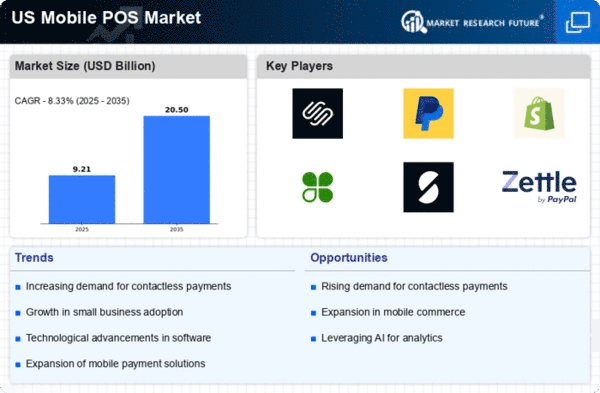
As per Market Research Future analysis, The US mobile POS market size was estimated at 8.5 USD Billion in 2024. The US mobile pos market is projected to grow from 9.21 USD Billion in 2025 to 20.5 USD Billion by 2035, exhibiting a compound annual growth rate (CAGR) of 8.3% during the forecast period 2025 - 2035

Key Market Trends & Highlights

The US mobile POS market is experiencing robust growth driven by technological advancements and changing consumer preferences.

  • The rise of contactless payments is reshaping consumer transaction behaviors across various retail sectors.
  • Cloud-based solutions are becoming increasingly prevalent, enhancing the flexibility and scalability of mobile POS systems.
  • Data security remains a critical focus as businesses seek to protect sensitive customer information in mobile transactions.
  • The increasing demand for mobile payment solutions and the shift towards e-commerce are key drivers propelling market expansion.

Market Size & Forecast

2024 Market Size 8.5 (USD Billion)
2035 Market Size 20.5 (USD Billion)
CAGR (2025 - 2035) 8.33%

Major Players

Square (US), PayPal (US), Shopify (CA), Clover (US), SumUp (GB), Zettle (SE), Toast (US), Lightspeed (CA), Revel Systems (US)

Our Impact
Enabled $4.3B Revenue Impact for Fortune 500 and Leading Multinationals
Partnering with 2000+ Global Organizations Each Year
30K+ Citations by Top-Tier Firms in the Industry

US Mobile Pos Market Trends

The market is currently experiencing a notable transformation, driven by advancements in technology and changing consumer preferences. As businesses increasingly adopt mobile payment solutions, the demand for portable point-of-sale systems continues to rise. This shift is largely influenced by the need for enhanced customer experiences, as mobile pos systems offer convenience and speed during transactions. Furthermore, the integration of contactless payment options has become a critical factor, allowing consumers to complete purchases swiftly and securely. The ongoing evolution of mobile pos technology suggests a promising future, with innovations likely to further streamline operations for retailers and service providers alike. In addition, The market is witnessing a surge in the adoption of cloud-based solutions. These systems provide businesses with flexibility and scalability, enabling them to manage transactions and customer data more efficiently. The emphasis on data security and compliance with regulations is also shaping the landscape, as companies seek to protect sensitive information. Overall, the mobile pos market appears poised for continued growth, driven by technological advancements and a focus on improving customer engagement.

Rise of Contactless Payments

The mobile pos market is increasingly characterized by the adoption of contactless payment methods. This trend reflects consumer preferences for quick and secure transactions, as contactless solutions facilitate faster checkouts. Businesses are integrating these technologies to enhance customer satisfaction and streamline operations.

Cloud-Based Solutions

There is a growing trend towards cloud-based mobile pos systems, which offer businesses greater flexibility and scalability. These solutions enable real-time data access and management, allowing companies to adapt to changing market demands while ensuring efficient transaction processing.

Focus on Data Security

As the mobile pos market evolves, there is an intensified focus on data security and compliance. Businesses are prioritizing the protection of customer information, implementing robust security measures to safeguard against potential breaches and ensure regulatory adherence.

US Mobile Pos Market Drivers

Increasing Demand for Mobile Payment Solutions

The market is experiencing a notable surge in demand as consumers increasingly prefer mobile payment solutions. This shift is driven by the convenience and speed offered by mobile transactions, which are often perceived as more efficient than traditional payment methods. According to recent data, mobile payment transactions in the US are projected to reach approximately $1 trillion by 2025, indicating a robust growth trajectory. This trend is further fueled by the proliferation of smartphones and mobile applications, which facilitate seamless payment experiences. As businesses adapt to consumer preferences, the mobile pos market is likely to expand, providing innovative solutions that cater to the evolving needs of both merchants and customers.

Regulatory Support for Digital Payment Solutions

Regulatory support for digital payment solutions is emerging as a key driver for the mobile pos market. Government initiatives aimed at promoting cashless transactions and enhancing financial inclusion are encouraging businesses to adopt mobile payment technologies. For instance, various states have implemented policies that incentivize the use of digital payment systems, thereby fostering a conducive environment for the growth of the mobile pos market. Additionally, regulatory bodies are working to establish standards that ensure the security and interoperability of mobile payment solutions, which may further bolster consumer confidence. As these supportive measures continue to evolve, the mobile pos market is likely to benefit from increased adoption and innovation.

Technological Advancements in Payment Processing

Technological advancements play a pivotal role in shaping the mobile pos market. Innovations such as near-field communication (NFC), biometric authentication, and artificial intelligence are enhancing the functionality and security of mobile payment systems. These technologies not only streamline transaction processes but also improve customer experiences by reducing wait times and increasing transaction accuracy. The integration of advanced analytics into mobile pos systems allows businesses to gain insights into consumer behavior, enabling them to tailor their offerings effectively. As these technologies continue to evolve, the mobile pos market is expected to witness significant growth, with businesses increasingly adopting sophisticated solutions to stay competitive.

Shift Towards E-commerce and Omnichannel Retailing

The market is significantly influenced by the ongoing shift towards e-commerce and omnichannel retailing. As consumers increasingly engage in online shopping, businesses are compelled to adopt mobile pos solutions that facilitate seamless transactions across various channels. This trend is particularly evident in the retail sector, where companies are integrating mobile payment options to enhance customer convenience and satisfaction. Data suggests that omnichannel customers tend to spend 10-15% more than single-channel customers, highlighting the potential for increased revenue through mobile pos adoption. Consequently, the mobile pos market is likely to expand as retailers seek to create cohesive shopping experiences that bridge online and offline interactions.

Rising Consumer Preference for Contactless Transactions

The market is witnessing a rising consumer preference for contactless transactions, which are perceived as safer and more hygienic. This trend is particularly relevant in the context of retail and hospitality sectors, where speed and convenience are paramount. Data indicates that approximately 70% of consumers in the US express a preference for contactless payment methods, reflecting a significant shift in consumer behavior. This growing inclination towards contactless solutions is prompting businesses to invest in mobile pos systems that support such transactions. As consumer expectations evolve, the mobile pos market is likely to adapt, offering innovative solutions that prioritize convenience and safety in payment processing.


Market Segment Insights

By Deployment Type: Cloud-Based (Largest) vs. On-Premise (Fastest-Growing)

In the US mobile pos market, the distribution among the deployment types shows that cloud-based solutions hold the largest market share, providing flexibility and scalability for businesses of all sizes. On-premise solutions follow, often preferred by large enterprises for data security and control. The hybrid deployment type, while gaining traction, remains a smaller segment due to varying customer preferences towards full cloud or on-premise setups. In terms of growth trends, on-premise solutions are becoming the fastest-growing segment as businesses weigh the benefits of having more control over their systems amidst increasing data privacy regulations. Meanwhile, cloud-based systems continue to evolve, driven by advancements in technology and the demand for remote operations. The hybrid model is also expected to grow as organizations seek tailored solutions that combine the strengths of both on-premise and cloud offerings.

Cloud-Based (Dominant) vs. On-Premise (Emerging)

Cloud-based solutions dominate the US mobile pos market due to their ability to offer real-time updates, easy integration with existing systems, and lower upfront costs, which appeals to small and medium enterprises. They also facilitate remote management and access, aligning with the growing trend of remote work. On-premise solutions, while emerging, cater primarily to larger entities requiring stringent data governance and security. They offer greater customization but with higher deployment costs and maintenance requirements. As businesses evaluate their operational needs, these segments highlight a critical shift towards more fluid and secure payment processing options.

By Component: Hardware (Largest) vs. Software (Fastest-Growing)

In the component segment of the US mobile pos market, Hardware commands the largest market share, making it a crucial part of the ecosystem. Software follows closely, emerging as an essential element of functionality and flexibility. Services, while vital, hold a smaller share compared to Hardware and Software, which together dominate product offerings and consumer preferences. The growth of Software in the US mobile pos market is particularly notable, driven by the increasing demand for advanced functionalities and user-friendly interfaces. As businesses adopt mobile payment solutions, investments in Software development have surged, making it the fastest-growing segment. The continuous evolution of technology and consumer preferences further accelerates the growth of Hardware and Services, ensuring a dynamic market landscape.

Hardware (Dominant) vs. Services (Emerging)

Hardware represents the dominant force in the US mobile pos market, characterized by robust physical components such as card readers and tablets. Its importance cannot be understated, as it lays the foundation for seamless mobile payment transactions. Meanwhile, Services are an emerging segment that complements the physical products by offering customer support, maintenance, and consultative services. Although smaller in market share, the growth potential for Services is significant as businesses increasingly seek integrated solutions. Both segments cater to the evolving needs of merchants, with Hardware providing reliable tools and Services enhancing the overall user experience.

By Application: Retail (Largest) vs. Hospitality (Fastest-Growing)

In the US mobile pos market, the application segment is primarily dominated by retail, accounting for a significant share of overall sales. Retail solutions are preferred for their efficiency and convenience, allowing businesses to enhance customer experience through seamless transactions and inventory management. While retail retains its lead, hospitality applications are also gaining traction, driven by the increasing demand for mobile payment solutions in restaurants and bars. The growth of the mobile pos market in the hospitality sector is fueled by technological advancements and changing consumer preferences towards contactless payments. Restaurants and cafes are investing in mobile solutions to streamline operations and meet customer expectations for speed and convenience. Furthermore, the emerging trends in mobile ordering and delivery services are propelling the growth of mobile pos systems in this segment, positioning hospitality as the fastest-growing application.

Retail: Dominant vs. Hospitality: Emerging

Retail remains the dominant application in the mobile pos sector, characterized by its wide adoption across various retail formats including supermarkets, clothing stores, and restaurants. The ability to process transactions on-the-go not only improves customer engagement but also enhances operational efficiency which is critical in a competitive environment. Conversely, hospitality is an emerging application that is rapidly adapting to new consumer demands for flexibility and speed in service delivery. With the rise of mobile transactions in dining experiences, the hospitality sector is investing heavily in innovative solutions to enhance customer service and streamline payment processes, thus carving a significant niche within the overall mobile pos landscape.

By End User: Small Businesses (Largest) vs. Medium Enterprises (Fastest-Growing)

The US mobile pos market exhibits a diverse distribution across different end-user segments. Small businesses hold a significant share, constituting a substantial portion of the overall market. This dominance is driven by the increasing adoption of mobile payment solutions, which cater to the needs of smaller operations that require flexible payment processing capabilities. In contrast, medium enterprises are emerging as the fastest-growing segment in the US mobile pos market. This growth is attributed to their expanding operations and the need for more sophisticated payment solutions that can handle higher transaction volumes. As medium enterprises increasingly leverage technology to enhance customer experience, the adoption of mobile pos systems is expected to accelerate, creating opportunities for providers in this segment.

Small Businesses: Dominant vs. Medium Enterprises: Emerging

Small businesses are characterized by their adaptability and resourcefulness, often opting for user-friendly mobile pos solutions that enhance customer service and streamline operations. This segment typically prioritizes cost-effective solutions and ease of use, making mobile payment systems an attractive option for improving transaction efficiency. Their significant market presence is fueled by the rapid shift towards cashless payments, driving suppliers to cater specifically to the needs of smaller operations. On the other hand, medium enterprises are emerging as a dynamic segment within the US mobile pos market. They require more advanced features to support their operations, such as inventory management integrations and analytics capabilities. This segment's growth is closely tied to the advancement of technology and the ability to deliver enhanced customer experiences. As competition intensifies, medium enterprises are increasingly investing in mobile pos systems that not only facilitate transactions but also provide valuable insights into customer behaviors.

Get more detailed insights about US Mobile Pos Market

Key Players and Competitive Insights

The mobile pos market in the US is characterized by a dynamic competitive landscape, driven by rapid technological advancements and evolving consumer preferences. Key players such as Square (US), PayPal (US), and Toast (US) are at the forefront, each adopting distinct strategies to enhance their market positioning. Square (US) focuses on innovation through its comprehensive ecosystem of financial services, while PayPal (US) emphasizes partnerships to expand its reach in the mobile payment space. Toast (US), on the other hand, targets the restaurant sector with tailored solutions, indicating a trend towards specialization in service offerings. Collectively, these strategies contribute to a competitive environment that is increasingly defined by technological integration and customer-centric solutions.In terms of business tactics, companies are increasingly localizing manufacturing and optimizing supply chains to enhance efficiency and responsiveness. The market structure appears moderately fragmented, with several players vying for market share. However, the influence of major companies like Square (US) and PayPal (US) is substantial, as they leverage their established brand recognition and technological capabilities to shape market dynamics.

In October Square (US) announced a strategic partnership with a leading e-commerce platform to enhance its mobile payment solutions. This collaboration is expected to streamline payment processes for online retailers, thereby expanding Square's footprint in the digital commerce space. The strategic importance of this move lies in its potential to attract a broader customer base, particularly among small to medium-sized enterprises seeking integrated payment solutions.

In September PayPal (US) launched a new feature that allows users to make in-store payments using cryptocurrency. This initiative not only positions PayPal as a pioneer in the integration of digital currencies into everyday transactions but also reflects a growing trend towards the acceptance of alternative payment methods. The strategic significance of this development is profound, as it may enhance user engagement and attract tech-savvy consumers looking for innovative payment options.

In August Toast (US) expanded its product offerings by introducing a new mobile ordering feature aimed at enhancing customer experience in restaurants. This strategic move is indicative of Toast's commitment to leveraging technology to improve operational efficiency and customer satisfaction. By focusing on the unique needs of the restaurant industry, Toast is likely to strengthen its competitive edge in a niche market.

As of November current trends in the mobile pos market are heavily influenced by digitalization, sustainability, and the integration of artificial intelligence. Strategic alliances are becoming increasingly vital, as companies seek to enhance their technological capabilities and market reach. The competitive differentiation is expected to evolve, shifting from price-based competition to a focus on innovation, technology, and supply chain reliability. This transition suggests that companies that prioritize technological advancements and customer-centric solutions will likely emerge as leaders in the mobile pos market.

Key Companies in the US Mobile Pos Market include

Industry Developments

In recent developments within the US Mobile Point of Sale (POS) market, companies such as Adyen, Shopify, and Toast have been making significant strides in enhancing their payment solutions to support the growing demand for contactless transactions. Revel Systems and Square are focusing on expanding their service offerings, including integrations with various digital wallets and customer loyalty programs.

In terms of mergers and acquisitions, PayPal announced its acquisition of an e-commerce platform in March 2023, further strengthening its position in the mobile payments field. Additionally, Global Payments and Heartland Payment Systems are collaborating on technology innovations that cater to small to mid-sized businesses. The market has witnessed consistent growth, with projected valuations indicating a surge in demand for mobile payment solutions.

This has propelled companies like Lightspeed, Clover, and Payment Depot to enhance their technological capabilities and service offerings. Major industry shifts have also been observed, with Zettle expanding its reach in February 2022 and Verifone increasing its focus on enhancing security features amid evolving regulatory standards. The adaptation to changing consumer behaviors and payment preferences continues to shape the landscape of the US Mobile POS market.

Future Outlook

US Mobile Pos Market Future Outlook

The Mobile POS Market is projected to grow at an 8.33% CAGR from 2025 to 2035, driven by technological advancements, increasing consumer demand, and enhanced payment security.

New opportunities lie in:

  • Integration of AI-driven analytics for personalized customer experiences.
  • Expansion into mobile payment solutions for e-commerce platforms.
  • Development of advanced security features to enhance transaction safety.

By 2035, the mobile pos market is expected to achieve substantial growth and innovation.

Market Segmentation

US Mobile Pos Market End User Outlook

  • Small Businesses
  • Medium Enterprises
  • Large Enterprises

US Mobile Pos Market Component Outlook

  • Hardware
  • Software
  • Services

US Mobile Pos Market Application Outlook

  • Retail
  • Hospitality
  • Transportation
  • Healthcare

US Mobile Pos Market Deployment Type Outlook

  • On-Premise
  • Cloud-Based
  • Hybrid

Report Scope

MARKET SIZE 2024 8.5(USD Billion)
MARKET SIZE 2025 9.21(USD Billion)
MARKET SIZE 2035 20.5(USD Billion)
COMPOUND ANNUAL GROWTH RATE (CAGR) 8.33% (2025 - 2035)
REPORT COVERAGE Revenue Forecast, Competitive Landscape, Growth Factors, and Trends
BASE YEAR 2024
Market Forecast Period 2025 - 2035
Historical Data 2019 - 2024
Market Forecast Units USD Billion
Key Companies Profiled Square (US), PayPal (US), Shopify (CA), Clover (US), SumUp (GB), Zettle (SE), Toast (US), Lightspeed (CA), Revel Systems (US)
Segments Covered Deployment Type, Component, Application, End User
Key Market Opportunities Integration of advanced security features enhances consumer trust in the mobile pos market.
Key Market Dynamics Rising demand for contactless payments drives innovation and competition in the mobile point of sale market.
Countries Covered US
Leave a Comment

FAQs

What is the expected market size of the US Mobile POS Market in 2024?

The US Mobile POS Market is expected to be valued at 8.71 billion USD in 2024.

What is the projected market size of the US Mobile POS Market by 2035?

By 2035, the US Mobile POS Market is projected to reach a valuation of 21.5 billion USD.

What is the expected CAGR for the US Mobile POS Market from 2025 to 2035?

The expected CAGR for the US Mobile POS Market from 2025 to 2035 is 8.558%.

Which segment is expected to dominate the US Mobile POS Market by deployment type in 2024?

In 2024, the Cloud-Based segment is expected to dominate the US Mobile POS Market, valued at 4.2 billion USD.

What will be the market value of the On-Premise segment of the US Mobile POS Market by 2035?

The On-Premise segment is anticipated to reach a market value of 6.5 billion USD by 2035.

Who are the major players in the US Mobile POS Market?

Major players in the US Mobile POS Market include Adyen, Shopify, Revel Systems, Toast, and PayPal.

What is the expected market value for the Hybrid segment in 2035?

The Hybrid segment of the US Mobile POS Market is expected to be valued at 4.8 billion USD in 2035.

What growth opportunities exist in the US Mobile POS Market?

There are numerous growth opportunities in the US Mobile POS Market due to increasing digital payments and technological advancements.

How is the competitive landscape shaping up in the US Mobile POS Market?

The competitive landscape of the US Mobile POS Market has intensified due to the emergence of new players and innovations by existing companies.

What are some key applications driving growth in the US Mobile POS Market?

Key applications driving growth in the US Mobile POS Market include retail transactions, food service payments, and event ticketing solutions.

Download Free Sample

Kindly complete the form below to receive a free sample of this Report

Compare Licence

×
Features License Type
Single User Multiuser License Enterprise User
Price $4,950 $5,950 $7,250
Maximum User Access Limit 1 User Upto 10 Users Unrestricted Access Throughout the Organization
Free Customization
Direct Access to Analyst
Deliverable Format
Platform Access
Discount on Next Purchase 10% 15% 15%
Printable Versions