×
Request Free Sample ×

Kindly complete the form below to receive a free sample of this Report

* Please use a valid business email

Leading companies partner with us for data-driven Insights

clients tt-cursor
Hero Background

US Mobile Controlled Robots Market

ID: MRFR/SEM/13661-HCR
100 Pages
Garvit Vyas
February 2026

United States Mobile Controlled Robots Industry Research Report to 2032

Share:
Download PDF ×

We do not share your information with anyone. However, we may send you emails based on your report interest from time to time. You may contact us at any time to opt-out.

US Mobile Controlled Robots Market Infographic
Purchase Options

US Mobile Controlled Robots Market Summary

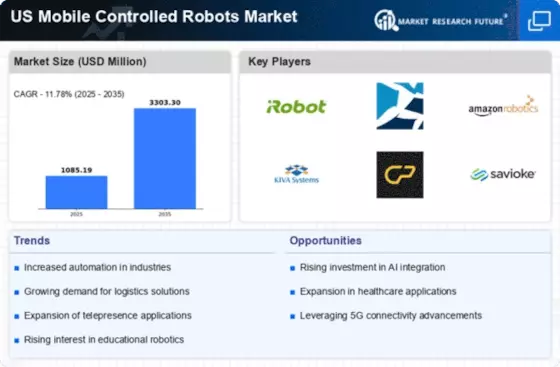
As per analysis, the US Mobile Controlled Robots Market is projected to grow from USD 970.83 Million in 2024 to USD 3303.3 Million by 2035, exhibiting a compound annual growth rate (CAGR) of 11.78% during the forecast period (2025 - 2035).

Key Market Trends & Highlights

The US Mobile Controlled Robots Market is poised for substantial growth driven by automation and technological advancements.

  • The logistics segment remains the largest contributor to the market, reflecting a robust demand for efficiency and speed.
  • Healthcare applications are emerging as the fastest-growing segment, indicating a shift towards automation in patient care and management.
  • Regulatory compliance is becoming increasingly critical, as stakeholders seek to align with evolving standards and safety protocols.
  • Key market drivers include the growing demand for automation and rising labor costs, which are compelling industries to adopt mobile controlled robots.

Market Size & Forecast

2024 Market Size 970.83 (USD Million)
2035 Market Size 3303.3 (USD Million)
CAGR (2025 - 2035) 11.78%

Major Players

iRobot (US), Boston Dynamics (US), Amazon Robotics (US), Kiva Systems (US), Clearpath Robotics (US), Savioke (US), Fetch Robotics (US), Locus Robotics (US), Robomow (US)

Our Impact
Enabled $4.3B Revenue Impact for Fortune 500 and Leading Multinationals
Partnering with 2000+ Global Organizations Each Year
30K+ Citations by Top-Tier Firms in the Industry

US Mobile Controlled Robots Market Trends

The US Mobile Controlled Robots Market is currently experiencing a dynamic evolution, driven by advancements in technology and increasing demand across various sectors. The integration of artificial intelligence and machine learning into mobile robots enhances their capabilities, allowing for improved navigation, obstacle avoidance, and task execution. This technological progression appears to be fostering greater adoption in industries such as logistics, healthcare, and agriculture, where efficiency and precision are paramount. Furthermore, the growing emphasis on automation and the need for remote operations are likely to propel the market forward, as businesses seek to optimize their operations and reduce labor costs. In addition to technological advancements, regulatory frameworks and safety standards are evolving to accommodate the rise of mobile controlled robots. The US government is actively working on policies that promote innovation while ensuring safety and compliance. This regulatory support may encourage further investment in research and development, potentially leading to new applications and enhanced functionalities. As the market continues to mature, collaboration between industry stakeholders, including manufacturers, software developers, and regulatory bodies, will be crucial in shaping the future landscape of the US Mobile Controlled Robots Market.

Increased Adoption in Logistics

The logistics sector is witnessing a notable surge in the utilization of mobile controlled robots. These robots streamline operations by automating tasks such as inventory management and order fulfillment. Their ability to navigate complex environments and operate autonomously enhances efficiency, thereby reducing operational costs.

Expansion in Healthcare Applications

Mobile controlled robots are increasingly being deployed in healthcare settings, particularly for tasks like patient monitoring and medication delivery. This trend reflects a growing recognition of the potential for robots to assist healthcare professionals, improve patient outcomes, and address staffing challenges.

Focus on Regulatory Compliance

As the US Mobile Controlled Robots Market expands, there is a heightened focus on regulatory compliance and safety standards. Government agencies are developing guidelines to ensure the safe integration of robots into various industries, which may foster public trust and encourage broader adoption.

US Mobile Controlled Robots Market Drivers

Growing Demand for Automation

The US Mobile Controlled Robots Market is experiencing a notable surge in demand for automation across various sectors. Industries such as manufacturing, logistics, and agriculture are increasingly adopting mobile robots to enhance operational efficiency and reduce labor costs. According to recent data, the automation market in the US is projected to grow at a compound annual growth rate (CAGR) of approximately 10% over the next five years. This trend indicates a shift towards integrating advanced technologies, including artificial intelligence and machine learning, into mobile robots. As businesses seek to streamline processes and improve productivity, the demand for mobile controlled robots is likely to rise, positioning them as essential tools in modern operations.

Advancements in Robotics Technology

Technological advancements play a pivotal role in shaping the US Mobile Controlled Robots Market. Innovations in sensors, navigation systems, and artificial intelligence are enhancing the capabilities of mobile robots, making them more efficient and versatile. For instance, the introduction of LiDAR technology has improved obstacle detection and navigation accuracy, allowing robots to operate safely in dynamic environments. Furthermore, the integration of machine learning algorithms enables robots to adapt to various tasks and environments, increasing their utility across sectors. As these technologies continue to evolve, the market for mobile controlled robots is expected to expand, driven by the need for smarter and more capable robotic solutions.

Rising Labor Costs and Workforce Shortages

The US Mobile Controlled Robots Market is significantly influenced by rising labor costs and workforce shortages. As companies face challenges in hiring and retaining skilled labor, many are turning to mobile robots as a viable solution. The average hourly wage for manufacturing workers has increased steadily, prompting businesses to seek automation alternatives to mitigate costs. Additionally, the ongoing shortage of qualified workers in sectors like logistics and healthcare has accelerated the adoption of mobile controlled robots. By deploying these robots, companies can maintain productivity levels while addressing labor challenges, thereby driving growth in the mobile robotics market.

Supportive Government Policies and Initiatives

Government policies and initiatives are playing an essential role in the growth of the US Mobile Controlled Robots Market. Federal and state governments are increasingly recognizing the potential of robotics to enhance productivity and economic growth. Initiatives aimed at promoting automation and innovation, such as grants and tax incentives for technology development, are encouraging businesses to invest in mobile robots. Furthermore, regulatory frameworks are being established to ensure the safe integration of robots into various industries. As these supportive measures continue to evolve, they are likely to create a conducive environment for the expansion of the mobile controlled robots market in the United States.

Increased Investment in Research and Development

Investment in research and development (R&D) is a critical driver for the US Mobile Controlled Robots Market. Companies are allocating substantial resources to innovate and enhance their robotic solutions. In 2025, R&D spending in the robotics sector reached an estimated $5 billion, reflecting a commitment to advancing mobile robot technologies. This investment is fostering the development of new applications, such as autonomous delivery systems and robotic assistants in healthcare. As organizations strive to maintain a competitive edge, the focus on R&D is likely to propel the market forward, leading to the introduction of cutting-edge mobile controlled robots that meet diverse industry needs.


Market Segment Insights

By Application: Logistics (Largest) vs. Healthcare (Fastest-Growing)

In the US Mobile Controlled Robots Market, the application segment is primarily driven by logistics, which holds the largest share due to its extensive usage in warehouse automation and inventory management. Automated guided vehicles (AGVs) and autonomous mobile robots (AMRs) are now mainstream in logistics operations, enabling companies to streamline their processes and reduce labor costs. On the other hand, healthcare is experiencing rapid adoption of mobile controlled robots, making it the fastest-growing segment. Applications such as doctor-patient interaction and surgical assistance are increasingly being integrated with robotic systems.

Logistics: AGVs (Dominant) vs. Healthcare: Surgical Robots (Emerging)

In the logistics segment, Automated Guided Vehicles (AGVs) are the dominant force due to their ability to navigate complex warehouse environments efficiently. They facilitate high throughput and minimize human labor, creating significant operational advantages. In contrast, surgical robots in healthcare are emerging as transformative tools for precision and minimally invasive procedures. These robots enhance the capabilities of surgeons, allowing for greater accuracy and improved patient outcomes. While AGVs are foundational in logistics, the rapid technological advancements in healthcare robotics indicate a strong potential for growth, especially as medical facilities increasingly seek innovative solutions to improve care delivery.

By End Use: Industrial (Largest) vs. Commercial (Fastest-Growing)

The US Mobile Controlled Robots Market is categorized into several end-use segments, with industrial applications commanding the largest share. Industrial robots are extensively used in manufacturing, logistics, and supply chain operations, significantly enhancing efficiency and productivity. On the other hand, the commercial segment is gaining momentum, primarily driven by the increasing adoption of mobile robots in retail, hospitality, and service sectors. As we analyze the market share distribution, it is evident that industrial applications maintain a dominant presence, while commercial uses show promise for rapid growth.

Service Robots: Industrial (Dominant) vs. Commercial (Emerging)

Industrial mobile controlled robots are primarily utilized for tasks such as assembly, material handling, and warehousing, leveraging advanced automation technologies to streamline operations. They are characterized by their robust design, enhanced durability, and integration capabilities with existing systems. In contrast, commercial mobile controlled robots are emerging as versatile tools for enhancing customer experience in service settings, equipped with features for interaction, navigation, and task execution. Their adoption is fueled by advancements in AI and machine learning, which allow them to perform complex functions and cater to diverse commercial needs. As businesses increasingly seek to improve operational efficiency and customer service, the commercial segment is positioned for significant expansion.

By Technology: Autonomous Navigation (Largest) vs. Remote Control (Fastest-Growing)

In the US Mobile Controlled Robots Market, the technology segment exhibits diverse dynamics with Autonomous Navigation holding the largest market share. This segment benefits from its ability to enhance navigation and operational efficiency in various environments. On the other hand, Remote Control technology is recognized as the fastest-growing segment, driven by increasing applications in industries such as logistics, security, and entertainment. These technologies are integral to the modernization of mobile robots, catering to specific operational needs while maximizing functionality.

Technology: Autonomous Navigation (Dominant) vs. Remote Control (Emerging)

Autonomous Navigation technology stands out as the dominant force in the US Mobile Controlled Robots Market, providing significant advantages such as reduced human intervention and improved route optimization. This technology is crucial in applications ranging from warehouse automation to autonomous delivery systems. In contrast, Remote Control technology is seen as an emerging force, gaining traction rapidly due to its versatility and ease of use in various sectors. Its rapid adoption is fueled by increasing demand for immediate control in tasks ranging from military applications to recreational use in drone technology, highlighting a shift towards more interactive and user-friendly robotic solutions.

By Mobility Type: Wheeled (Largest) vs. Tracked (Fastest-Growing)

In the US Mobile Controlled Robots Market, wheeled robots currently dominate the mobility type segment, driving the majority of market share due to their versatility and ease of use on various terrains. These robots are extensively utilized in delivery services, warehouse automation, and robotics competitions, positioning them as the preferred choice for many industries. In contrast, tracked robots are emerging as the fastest-growing category, thanks to their superior traction capabilities on rough or uneven surfaces. This makes them particularly appealing for applications in agriculture, construction, and military operations, where navigating challenging environments is essential for operation.

Wheeled (Dominant) vs. Tracked (Emerging)

Wheeled mobile robots enjoy a dominant position in the US market due to their adaptability and low maintenance requirements. They are widely employed in numerous sectors, including logistics and healthcare, where they facilitate efficient movement of goods and services. Conversely, tracked robots are emerging as a vital part of the market landscape, known for their stability and enhanced performance in rugged terrains. These robots are increasingly utilized in applications that demand reliability in harsh conditions, such as agricultural robotics, making them attractive for market growth. Their ability to traverse obstacles and uneven surfaces opens up new use cases, generating increased interest and investment.

By Payload Capacity: Medium (Largest) vs. Lightweight (Fastest-Growing)

The US Mobile Controlled Robots Market is increasingly segmented by payload capacity, with Medium payload capacity models holding the largest market share. These models are favored in various applications due to their balanced mixture of performance and operational efficiency. Conversely, Lightweight models are experiencing rapid growth, as advancements in technology and demand for agile, flexible solutions have made them particularly appealing to industries such as logistics and healthcare.

Payload Capacity: Medium (Dominant) vs. Lightweight (Emerging)

Medium payload capacity mobile controlled robots are dominant in the market, offering a versatile range of applications from warehousing to manufacturing due to their ability to carry substantial loads without compromising on speed or agility. They have established themselves as essential in automation processes where both power and precision are required. On the other hand, Lightweight robots are emerging rapidly, as their reduced weight and size allow for enhanced maneuverability and ease of deployment in crowded environments. They are increasingly used in applications requiring quick repositioning and flexibility, making them an attractive option for businesses looking to adapt to changing operational demands.

Get more detailed insights about US Mobile Controlled Robots Market

Key Players and Competitive Insights

The Mobile Controlled Robots Market is currently characterized by a dynamic competitive landscape, driven by technological advancements and increasing demand for automation across various sectors. Key players such as iRobot (US), Boston Dynamics (US), and Amazon Robotics (US) are at the forefront, each adopting distinct strategies to enhance their market positioning. iRobot (US) focuses on innovation in consumer robotics, particularly in home cleaning solutions, while Boston Dynamics (US) emphasizes the development of advanced robotic systems for industrial applications. Amazon Robotics (US) leverages its extensive logistics network to integrate robotics into its supply chain, thereby enhancing operational efficiency. Collectively, these strategies contribute to a competitive environment that is increasingly defined by technological prowess and operational efficiency.
In terms of business tactics, companies are increasingly localizing manufacturing and optimizing supply chains to respond swiftly to market demands. The competitive structure of the market appears moderately fragmented, with several players vying for market share. However, the influence of major companies is substantial, as they set benchmarks for innovation and operational excellence, thereby shaping the overall market dynamics.
In December 2025, iRobot (US) announced a strategic partnership with a leading AI firm to enhance the intelligence of its robotic vacuum cleaners. This collaboration aims to integrate advanced machine learning algorithms, allowing for improved navigation and cleaning efficiency. The strategic importance of this move lies in iRobot's commitment to maintaining its competitive edge through innovation, particularly in the consumer segment, where user experience is paramount.
In November 2025, Boston Dynamics (US) unveiled a new version of its Spot robot, designed specifically for warehouse operations. This iteration includes enhanced payload capabilities and improved autonomy, which are critical for meeting the growing demands of logistics and supply chain management. The introduction of this advanced model underscores Boston Dynamics' focus on industrial applications, positioning it as a leader in the sector and responding to the increasing need for automation in warehouses.
In October 2025, Amazon Robotics (US) expanded its operations by opening a new robotics fulfillment center in Texas. This facility is expected to enhance the company's logistics capabilities significantly, allowing for faster delivery times and improved inventory management. The strategic importance of this expansion is evident in Amazon's ongoing efforts to integrate robotics into its supply chain, thereby reinforcing its competitive position in the e-commerce sector.
As of January 2026, current trends in the Mobile Controlled Robots Market are heavily influenced by digitalization, sustainability, and AI integration. Strategic alliances among key players are shaping the competitive landscape, fostering innovation and collaboration. Looking ahead, it is likely that competitive differentiation will increasingly pivot from price-based competition to a focus on innovation, technology, and supply chain reliability. This shift suggests that companies will need to invest in advanced technologies and sustainable practices to maintain their competitive edge in a rapidly evolving market.

Key Companies in the US Mobile Controlled Robots Market include

Future Outlook

US Mobile Controlled Robots Market Future Outlook

The US Mobile Controlled Robots Market is projected to grow at 11.78% CAGR from 2025 to 2035, driven by advancements in automation, AI integration, and increasing demand across various sectors.

New opportunities lie in:

  • Development of autonomous delivery robots for e-commerce logistics. Integration of AI-driven analytics for operational efficiency. Expansion into agricultural applications for precision farming.

By 2035, the market is expected to be robust, reflecting substantial growth and innovation.

Market Segmentation

US Mobile Controlled Robots Market End Use Outlook

  • Industrial
  • Commercial
  • Residential
  • Military
  • Educational

US Mobile Controlled Robots Market Technology Outlook

  • Autonomous Navigation
  • Remote Control
  • Artificial Intelligence
  • Sensor Integration
  • Machine Learning

US Mobile Controlled Robots Market Application Outlook

  • Logistics
  • Healthcare
  • Agriculture
  • Surveillance
  • Entertainment

US Mobile Controlled Robots Market Mobility Type Outlook

  • Wheeled
  • Tracked
  • Legged
  • Flying
  • Swimming

US Mobile Controlled Robots Market Payload Capacity Outlook

  • Lightweight
  • Medium
  • Heavyweight
  • Ultra Heavyweight

Report Scope

MARKET SIZE 2024 970.83(USD Million)
MARKET SIZE 2025 1097.25(USD Million)
MARKET SIZE 2035 3303.3(USD Million)
COMPOUND ANNUAL GROWTH RATE (CAGR) 11.78% (2024 - 2035)
REPORT COVERAGE Revenue Forecast, Competitive Landscape, Growth Factors, and Trends
BASE YEAR 2024
Market Forecast Period 2025 - 2035
Historical Data 2019 - 2024
Market Forecast Units USD Million
Key Companies Profiled iRobot (US), Boston Dynamics (US), Amazon Robotics (US), Kiva Systems (US), Clearpath Robotics (US), Savioke (US), Fetch Robotics (US), Locus Robotics (US), Robomow (US)
Segments Covered Application, End Use, Technology, Mobility Type, Payload Capacity
Key Market Opportunities Integration of artificial intelligence enhances operational efficiency in the US Mobile Controlled Robots Market.
Key Market Dynamics Rising demand for automation drives innovation and competition in the US Mobile Controlled Robots Market.
Countries Covered US
Leave a Comment

FAQs

What is the current valuation of the US Mobile Controlled Robots Market?

The market valuation was 970.83 USD Million in 2024.

What is the projected market size for the US Mobile Controlled Robots Market by 2035?

The projected valuation for 2035 is 3303.3 USD Million.

What is the expected CAGR for the US Mobile Controlled Robots Market during the forecast period?

The expected CAGR from 2025 to 2035 is 11.78%.

Which applications are driving growth in the US Mobile Controlled Robots Market?

Key applications include Entertainment, which reached 1653.3 USD Million, and Logistics, valued at 700.0 USD Million.

What are the primary end-use segments in the US Mobile Controlled Robots Market?

The market segments include Industrial, with a valuation of 1000.0 USD Million, and Commercial, at 800.0 USD Million.

How does the technology segment contribute to the US Mobile Controlled Robots Market?

Technologies such as Remote Control, valued at 900.0 USD Million, and Autonomous Navigation, at 800.0 USD Million, are pivotal.

What mobility types are prevalent in the US Mobile Controlled Robots Market?

Wheeled robots dominate the market, with a valuation of 1000.0 USD Million, followed by Tracked robots at 700.0 USD Million.

What payload capacities are represented in the US Mobile Controlled Robots Market?

The market features Heavyweight robots, valued at 1200.0 USD Million, and Medium robots, at 1000.0 USD Million.

Who are the key players in the US Mobile Controlled Robots Market?

Prominent players include iRobot, Boston Dynamics, and Amazon Robotics, among others.

What trends are expected to shape the US Mobile Controlled Robots Market in the coming years?

The market is likely to expand significantly, driven by advancements in AI and sensor integration technologies.

Download Free Sample

Kindly complete the form below to receive a free sample of this Report

Compare Licence

×
Features License Type
Single User Multiuser License Enterprise User
Price $4,950 $5,950 $7,250
Maximum User Access Limit 1 User Upto 10 Users Unrestricted Access Throughout the Organization
Free Customization
Direct Access to Analyst
Deliverable Format
Platform Access
Discount on Next Purchase 10% 15% 15%
Printable Versions