×
Request Free Sample ×

Kindly complete the form below to receive a free sample of this Report

* Please use a valid business email

Leading companies partner with us for data-driven Insights

clients tt-cursor
Hero Background

US Military Communication Market

ID: MRFR/AD/56301-HCR
200 Pages
Sejal Akre
February 2026

US Military Communication Market Size, Share, Industry Trend & Analysis Research Report By Platform (Airborne, Ground Base, Naval), By Type (Satellite Communication, Radio Communication), and By Application (Command & Control, Situational Awareness, Routine Operations, Others)-Forecast to 2035

Share:
Download PDF ×

We do not share your information with anyone. However, we may send you emails based on your report interest from time to time. You may contact us at any time to opt-out.

US Military Communication Market Infographic
Purchase Options

US Military Communication Market Summary

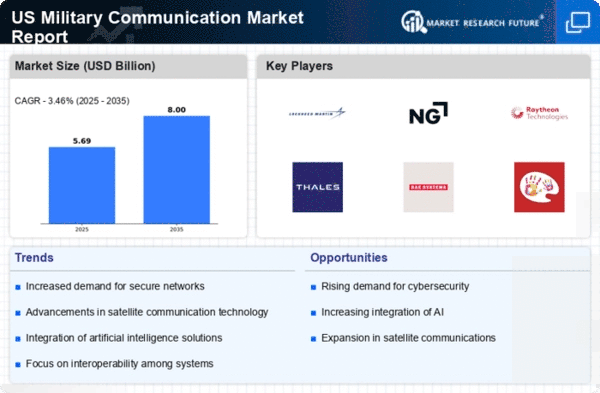
As per Market Research Future analysis, the US military communication market Size was estimated at 5.5 USD Billion in 2024. The US military communication market is projected to grow from 5.69 USD Billion in 2025 to 8.0 USD Billion by 2035, exhibiting a compound annual growth rate (CAGR) of 3.4% during the forecast period 2025 - 2035

Key Market Trends & Highlights

The US military communication market is experiencing robust growth driven by technological advancements and increasing defense budgets.

  • The largest segment in the US military communication market is tactical communication systems, while the fastest-growing segment is mobile communication solutions.
  • There is an increased focus on cybersecurity measures to protect sensitive military communications from potential threats.
  • The integration of artificial intelligence is enhancing the efficiency and effectiveness of military communication systems.
  • Key market drivers include advancements in tactical communication technologies and the growing demand for interoperability solutions.

Market Size & Forecast

2024 Market Size 5.5 (USD Billion)
2035 Market Size 8.0 (USD Billion)
CAGR (2025 - 2035) 3.46%

Major Players

Lockheed Martin (US), Northrop Grumman (US), Raytheon Technologies (US), Thales Group (FR), BAE Systems (GB), Leonardo (IT), General Dynamics (US), L3Harris Technologies (US), Elbit Systems (IL)

Our Impact
Enabled $4.3B Revenue Impact for Fortune 500 and Leading Multinationals
Partnering with 2000+ Global Organizations Each Year
30K+ Citations by Top-Tier Firms in the Industry

US Military Communication Market Trends

The military communication market is currently experiencing a transformative phase, driven by advancements in technology and the increasing need for secure and reliable communication systems. As military operations become more complex, the demand for sophisticated communication solutions is rising. This market encompasses a wide range of technologies, including satellite communications, tactical communication systems, and secure voice and data transmission. The integration of artificial intelligence and machine learning into communication systems is also becoming more prevalent, enhancing operational efficiency and decision-making capabilities. Furthermore, the emphasis on interoperability among allied forces is shaping the development of communication systems, ensuring seamless information sharing across different platforms. In addition, the military communication market is witnessing a shift towards more mobile and flexible communication solutions. The growing reliance on unmanned systems and the Internet of Things (IoT) is influencing the design and deployment of communication networks. As military forces adapt to modern warfare scenarios, the need for real-time data exchange and situational awareness is paramount. This trend is likely to continue, as defense budgets allocate more resources towards innovative communication technologies. Overall, the military communication market is poised for growth, driven by technological advancements and the evolving landscape of military operations.

Increased Focus on Cybersecurity

The military communication market is placing a heightened emphasis on cybersecurity measures. As threats to communication networks evolve, military organizations are investing in advanced encryption technologies and secure communication protocols. This trend aims to protect sensitive information from cyberattacks and ensure the integrity of communication systems.

Integration of Artificial Intelligence

The integration of artificial intelligence into communication systems is becoming increasingly prevalent. AI technologies are being utilized to enhance data analysis, automate communication processes, and improve decision-making capabilities. This trend is expected to streamline operations and provide military personnel with timely and relevant information.

Adoption of Mobile Communication Solutions

There is a noticeable shift towards mobile communication solutions within the military communication market. The growing use of portable devices and mobile networks allows for greater flexibility and adaptability in communication. This trend supports the need for real-time information sharing and enhances operational effectiveness in dynamic environments.

US Military Communication Market Drivers

Increased Investment in Defense Budgets

The military communication market is significantly influenced by the rising defense budgets across various sectors. In the US, defense spending has seen a consistent increase, with allocations for communication technologies being a priority. This trend is expected to continue, with the military communication market benefiting from enhanced funding for research and development. As of 2025, the defense budget is projected to exceed $XX trillion, with a substantial portion directed towards upgrading communication infrastructure. This investment is likely to accelerate the adoption of next-generation communication systems, ensuring that military forces remain at the forefront of technological advancements.

Emphasis on Secure Communication Protocols

In the military communication market, the emphasis on secure communication protocols is paramount. As threats to national security evolve, the need for robust security measures in communication systems becomes increasingly critical. The military communication market is responding by developing advanced security frameworks that protect sensitive information from cyber threats. This focus on security is reflected in the projected market growth, which is expected to reach $XX billion by 2025. The integration of secure communication technologies not only safeguards military operations but also enhances trust among allied forces, thereby improving collaborative efforts in various missions.

Growing Demand for Interoperability Solutions

Interoperability among various military branches and allied forces is becoming increasingly vital in the military communication market. The need for seamless communication across different platforms and systems is driving the development of interoperability solutions. This demand is reflected in the projected growth of the market, which is anticipated to expand at a CAGR of XX% over the next five years. The military communication market is focusing on creating standardized protocols and systems that facilitate effective communication during joint operations. Such advancements not only enhance operational capabilities but also ensure that forces can collaborate efficiently in diverse environments.

Integration of Next-Generation Satellite Systems

The integration of next-generation satellite systems is transforming the military communication market. These systems provide enhanced connectivity and coverage, which are essential for modern military operations. The military communication market is witnessing a shift towards utilizing advanced satellite technologies that offer higher bandwidth and lower latency. This transition is expected to drive market growth, with estimates suggesting an increase to $XX billion by 2025. The ability to maintain reliable communication in remote and challenging environments is crucial for operational success, making the integration of these satellite systems a key driver in the military communication market.

Advancements in Tactical Communication Technologies

The military communication market is experiencing a surge in advancements related to tactical communication technologies. These innovations are crucial for enhancing operational efficiency and ensuring secure communication among military personnel. The integration of advanced encryption methods and secure satellite communication systems is expected to bolster the reliability of military communications. As of 2025, the market is projected to reach approximately $XX billion, driven by the need for real-time data sharing and situational awareness on the battlefield. The military communication market is thus evolving to meet the demands of modern warfare, where timely and secure communication can significantly impact mission success.


Market Segment Insights

By Platform: Airborne (Largest) vs. Ground Base (Fastest-Growing)

In the US military communication market, the platform segment is dominated by the Airborne category, which holds a significant share due to its critical role in intelligence, surveillance, and reconnaissance operations. Ground Base communication systems are gaining traction and are rapidly increasing their share owing to advancements in technology and the growing need for reliable communication on the battlefield. The growth trend in this segment is largely driven by the increasing investments in modernizing communication systems for enhanced operational efficiency. Additionally, the demand for secure communication channels in ground operations spurs the rapid growth of the Ground Base segment. The Airborne platform remains pivotal due to its extensive capabilities in providing real-time situational awareness, while Ground Base systems are emerging as essential tools for day-to-day operations.

Airborne (Dominant) vs. Ground Base (Emerging)

The Airborne segment is characterized by advanced communication systems mounted on aircraft and drones, ensuring superior connectivity in diverse mission scenarios. These systems are critical for high-stakes operations, enabling seamless data transmission and command-and-control capabilities in real-time. The reliability and versatility of Airborne platforms make them indispensable for military forces. Conversely, the Ground Base segment is rapidly evolving, leveraging cutting-edge technologies to enhance communication reliability in tactical environments. Emerging developments focus on mobile communication units that provide flexible and secure connections for troops on the ground. The shift towards modernized ground systems indicates a response to the changing dynamics of warfare, emphasizing the importance of effective communication in support of ground operations.

By Type: Satellite Communication (Largest) vs. Radio Communication (Fastest-Growing)

In the US military communication market, the market share distribution between Satellite Communication and Radio Communication is notable, with Satellite Communication holding the largest share. This dominance is primarily driven by its advanced capabilities in secure, long-range connectivity and data transmission. Radio Communication, while it occupies a smaller segment, is rapidly gaining traction due to its flexibility and adaptability in various operational scenarios. Growth trends indicate that Satellite Communication will continue to enhance its leading position by integrating newer technologies, such as advanced encryption and augmented satellite constellations. In contrast, Radio Communication is experiencing a surge in demand driven by innovations in software-defined radios (SDRs) which are improving efficiency and operational effectiveness in the field. The growing emphasis on enhancing tactical communications in various terrains is fostering Radio Communication's reputation as an emerging segment.

Satellite Communication (Dominant) vs. Radio Communication (Emerging)

Satellite Communication is characterized by its ability to provide extensive coverage, robust security features, and reliable connectivity for military operations, making it a dominant force in the market. Its established infrastructure and technological advancements play a critical role in mission-critical communications. Conversely, Radio Communication, recognized as an emerging segment, is gaining interest because of its cost-effectiveness and adaptability. The introduction of software-defined radios enhances its versatility, allowing for easier updates and integrations with new technologies. This evolution positions Radio Communication as a key player, rapidly evolving to meet changing battlefield needs and maintaining efficient communications in tactical environments.

By Application: Command & Control (Largest) vs. Situational Awareness (Fastest-Growing)

In the US military communication market, the application segment is characterized by significant differentiation among its values. Command & Control currently commands the highest market share, reflecting its criticality in strategic operations and decision-making processes. Situational Awareness is gaining traction as the fastest-growing segment, driven by advancements in technology and the increasing need for real-time information dissemination. The growth trends within this segment are predominantly fueled by the rising emphasis on networked communications and data integration. As military operations become more digitized, the demand for tools empowering commanders with situational insights is escalating. This trend is bolstered by emerging technologies such as artificial intelligence, which enhance operational readiness and decision-making capabilities, positioning Situational Awareness for substantial growth ahead.

Command & Control (Dominant) vs. Situational Awareness (Emerging)

Command & Control serves as the backbone of military operations, embodying systems that enable command personnel to monitor, direct, and coordinate activities efficiently. Its dominance in the market is attributed to robust investments in communication infrastructure and the imperative for enhanced operational command. On the other hand, Situational Awareness, while emerging, has captured attention with its focus on providing critical real-time data to enhance operational effectiveness. Its rapid growth is linked to modern military strategies prioritizing information superiority, ensuring that commanders receive actionable insights swiftly. The interplay between these segments indicates a shift towards more integrated and responsive military communication systems, highlighting the importance of both applications in future military endeavors.

Get more detailed insights about US Military Communication Market

Key Players and Competitive Insights

The military communication market is characterized by a dynamic competitive landscape, driven by technological advancements and the increasing demand for secure communication systems. Key players such as Lockheed Martin (US), Northrop Grumman (US), and L3Harris Technologies (US) are at the forefront, focusing on innovation and strategic partnerships to enhance their operational capabilities. Lockheed Martin (US) emphasizes the integration of advanced technologies into its communication systems, while Northrop Grumman (US) is known for its robust cybersecurity measures, which are critical in military applications. L3Harris Technologies (US) is actively pursuing digital transformation initiatives, which collectively shape a competitive environment that prioritizes technological superiority and operational efficiency.In terms of business tactics, companies are increasingly localizing manufacturing to reduce supply chain vulnerabilities and enhance responsiveness to military needs. The market structure appears moderately fragmented, with several key players exerting significant influence. This fragmentation allows for a variety of innovative solutions to emerge, as companies strive to differentiate themselves through unique offerings and capabilities.

In October Lockheed Martin (US) announced a partnership with a leading tech firm to develop next-generation secure communication systems. This collaboration is expected to leverage cutting-edge technologies such as artificial intelligence (AI) and machine learning, enhancing the effectiveness of military communications. The strategic importance of this partnership lies in its potential to create more resilient communication networks, which are essential for modern military operations.

In September Northrop Grumman (US) secured a contract with the U.S. Department of Defense to upgrade existing communication infrastructure. This initiative aims to enhance interoperability among various military branches, thereby improving operational efficiency. The significance of this contract underscores Northrop Grumman's commitment to maintaining a competitive edge through continuous improvement of communication systems.

In August L3Harris Technologies (US) launched a new satellite communication system designed to provide enhanced connectivity for military operations in remote areas. This development is particularly relevant as it addresses the growing need for reliable communication in challenging environments. The introduction of this system reflects L3Harris's strategic focus on expanding its product portfolio to meet evolving military requirements.

As of November current trends in the military communication market include a strong emphasis on digitalization, sustainability, and AI integration. Strategic alliances are increasingly shaping the competitive landscape, as companies recognize the value of collaboration in driving innovation. Looking ahead, competitive differentiation is likely to evolve from traditional price-based competition to a focus on technological innovation, reliability, and supply chain resilience. This shift indicates a growing recognition that the future of military communication will hinge on the ability to deliver advanced, secure, and efficient solutions.

Key Companies in the US Military Communication Market include

Industry Developments

Recent developments in the US Military Communication Market showcase a dynamic landscape as companies like Lockheed Martin, Northrop Grumman, and Raytheon Technologies continue to advance their technological offerings.

In September 2023, L3Harris Technologies announced a significant contract to provide satellite communication solutions to the Department of Defense, enhancing secure communication capabilities.

Furthermore, Honeywell recently established a partnership with the U.S. Army to modernize tactical communications, emphasizing the drive towards interoperability.

Mergers and acquisitions have also shaped the market, with General Dynamics acquiring the cybersecurity firm Syntel in August 2023, aiming to bolster defense communications.

Additionally, in March 2023, Thales Group and Rockwell Collins were involved in negotiations for a potential collaboration on advanced avionics systems, indicating a trend towards synergistic alliances among key players.

The market valuation for military communication technologies is expected to grow significantly, driven by increasing defense budgets and a focus on modernization.

The US government's commitment to innovation in communication systems reflects its strategic priorities in securing national defense capabilities in an evolving geopolitical landscape.

Future Outlook

US Military Communication Market Future Outlook

The Military Communication Market is projected to grow at 3.46% CAGR from 2025 to 2035, driven by technological advancements, increased defense budgets, and the need for secure communications.

New opportunities lie in:

  • Development of advanced encryption technologies for secure military communications.
  • Integration of AI-driven analytics for real-time decision-making support.
  • Expansion of satellite communication systems for enhanced global coverage.

By 2035, the military communication market is expected to be robust, driven by innovation and strategic investments.

Market Segmentation

US Military Communication Market Type Outlook

  • Satellite Communication
  • Radio Communication

US Military Communication Market Platform Outlook

  • Airborne
  • Ground Base
  • Naval

US Military Communication Market Application Outlook

  • Command & Control
  • Situational Awareness
  • Routine Operations

Report Scope

MARKET SIZE 2024 5.5(USD Billion)
MARKET SIZE 2025 5.69(USD Billion)
MARKET SIZE 2035 8.0(USD Billion)
COMPOUND ANNUAL GROWTH RATE (CAGR) 3.46% (2025 - 2035)
REPORT COVERAGE Revenue Forecast, Competitive Landscape, Growth Factors, and Trends
BASE YEAR 2024
Market Forecast Period 2025 - 2035
Historical Data 2019 - 2024
Market Forecast Units USD Billion
Key Companies Profiled Lockheed Martin (US), Northrop Grumman (US), Raytheon Technologies (US), Thales Group (FR), BAE Systems (GB), Leonardo (IT), General Dynamics (US), L3Harris Technologies (US), Elbit Systems (IL)
Segments Covered Platform, Type, Application
Key Market Opportunities Integration of advanced cybersecurity measures in military communication systems enhances operational security and resilience.
Key Market Dynamics Technological advancements drive innovation in military communication systems, enhancing operational efficiency and interoperability.
Countries Covered US
Leave a Comment

FAQs

What was the market size of the US Military Communication Market in 2024?

The US Military Communication Market was valued at 5.5 USD billion in 2024.

What is the expected value of the US Military Communication Market by 2035?

By 2035, the US Military Communication Market is anticipated to reach a valuation of 8.5 USD billion.

What is the expected compound annual growth rate (CAGR) for the US Military Communication Market from 2025 to 2035?

The market is expected to exhibit a CAGR of 4.037% from 2025 to 2035.

What are the market values for the airborne communication segment in 2024 and 2035?

The airborne communication segment was valued at 1.5 USD billion in 2024 and is expected to reach 2.3 USD billion in 2035.

What are the expected market values for the ground base communication segment in 2024 and 2035?

The ground base communication segment was valued at 2.0 USD billion in 2024 and is projected to reach 3.0 USD billion in 2035.

What are the projected market values for the naval communication segment in 2024 and 2035?

The naval communication segment was valued at 2.0 USD billion in 2024 and is likely to reach 3.2 USD billion in 2035.

Who are the key players in the US Military Communication Market?

Major players in the market include Lockheed Martin, Honeywell, Thales Group, and General Dynamics.

How does the current global scenario or conflicts impact the US Military Communication Market?

The ongoing global scenario and conflicts are likely to drive demand and investment in military communication technologies.

What growth opportunities are present in the US Military Communication Market?

There are substantial growth opportunities in modernizing communication systems for enhanced efficiency and reliability.

Which segment is expected to dominate in terms of market share during the forecast period?

The ground base communication segment is expected to dominate in terms of market share throughout the forecast period.

Download Free Sample

Kindly complete the form below to receive a free sample of this Report

Compare Licence

×
Features License Type
Single User Multiuser License Enterprise User
Price $4,950 $5,950 $7,250
Maximum User Access Limit 1 User Upto 10 Users Unrestricted Access Throughout the Organization
Free Customization
Direct Access to Analyst
Deliverable Format
Platform Access
Discount on Next Purchase 10% 15% 15%
Printable Versions