×
Request Free Sample ×

Kindly complete the form below to receive a free sample of this Report

* Please use a valid business email

Leading companies partner with us for data-driven Insights

clients tt-cursor
Hero Background
English
Chinese
French
Japanese
Korean
German
Spanish

US Melanoma Market Share

ID: MRFR/Pharma/2164-HCR
50 Pages
Kinjoll Dey
October 2025

US Melanoma Market Share And Trends Analysis By Type (Superficial Spreading, Nodular, Lentigo Maglina, Acral Lentigious And Others); Gender (Male And Female); Treatment (Immunotherapy, Biologic Therapy, Radiation Therapy, Chemotherapy, Surgery And Others); Diagnosis (Abcde, Ugly Duckling, Biopsy And Others), End Users (Hospitals, Pharmaceutical Companies, Research Centers, Clinics, Laboratories) - Forecast Till 2035

Share:
Download PDF ×

We do not share your information with anyone. However, we may send you emails based on your report interest from time to time. You may contact us at any time to opt-out.

US Melanoma Market Infographic
×
US Melanoma Market Infographic Full View
Purchase Options

Market Share

US Melanoma Market Share Analysis

A company must understand the US Melanoma market to position its market share. Businesses must investigate novel melanoma treatments, patient kinds, and potential clients. In the cancer industry, you need fresh ideas constantly. Innovative immunotherapies, targeted pharmaceuticals, and precision medicine may set companies apart. New ideas may help you gain market share since people like them. Teaming up with clever healthcare organizations, research institutes, and pharma businesses may improve melanoma therapy. We can combine resources, speed up research, and discover a better method to treat melanoma's complexity by working together, increasing our market share. Beyond large cities, your market doesn't reach many individuals. Targeting such locations is sensible. For more individuals and a better market position, melanoma medications must be widely available. Melanoma patients' needs and wishes must be prioritized while expanding the market. Companies may build trust and loyalty by offering patient assistance, training, and improved treatment. Taking care of consumers can boost your business's image and market share. Healthcare solutions that are cost-effective and effective are crucial. Better manufacturing processes, supply contracts, and marketing avenues may minimize melanoma treatment costs. This boosts patients and market share. Branding and marketing are crucial in the cancer business. Healthcare personnel and clients may learn more via focused education, online marketing, and advertising. This may alter treatment choices and increase market share. Healthcare workers must follow government norms and maintain quality. Quality control and compliance are crucial for market-winning firms. These companies gain healthcare staff' and consumers' confidence. Funding healthcare workers to keep going to school would be a new way to solve the problem. People really want to buy a company's goods, and it does well in its field by telling doctors about the newest ways to treat cancer. This helps the company reach its goals. It's important to keep an eye on and keep track of your rivals if you want to stay ahead in the cancer market. If a company knows everything there is to know about its rivals, it can change its plans, take risks, and stay away from any threats. Some people think this will hurt their market share over time. Things have changed over time. New tools have been made, and people have different tastes in medical care. Businesses and people who can spot and adapt to changing trends are more likely to get and keep market share.

Author
Kinjoll Dey
Research Analyst Level I

He is an extremely curious individual currently working in Healthcare and Medical Devices Domain. Kinjoll is comfortably versed in data centric research backed by healthcare educational background. He leverages extensive data mining and analytics tools such as Primary and Secondary Research, Statistical Analysis, Machine Learning, Data Modelling. His key role also involves Technical Sales Support, Client Interaction and Project management within the Healthcare team. Lastly, he showcases extensive affinity towards learning new skills and remain fascinated in implementing them.

Leave a Comment

FAQs

What is the current valuation of the US Melanoma Market as of 2024?

The US Melanoma Market was valued at 1.57 USD Billion in 2024.

What is the projected market valuation for the US Melanoma Market in 2035?

The market is projected to reach 2.96 USD Billion by 2035.

What is the expected CAGR for the US Melanoma Market during the forecast period 2025 - 2035?

The expected CAGR for the US Melanoma Market during 2025 - 2035 is 5.89%.

Which treatment type segment had the highest valuation in 2024?

In 2024, the Immunotherapy segment had the highest valuation at 0.63 USD Billion.

How does the Localized stage of disease segment perform in terms of valuation?

The Localized stage of disease segment was valued at 0.79 USD Billion in 2024 and is expected to grow significantly.

What are the projected valuations for the Surgery treatment type segment by 2035?

The Surgery treatment type segment is projected to reach between 0.47 and 0.88 USD Billion by 2035.

Which demographic factors are influencing the US Melanoma Market?

Factors such as Age, Gender, Ethnicity, and Socioeconomic Status are influencing the market, with valuations ranging from 0.3 to 0.95 USD Billion in 2024.

What diagnostic methods are utilized in the US Melanoma Market?

Diagnostic methods include Skin Biopsy, Imaging Tests, and Dermatoscopy, with valuations of 0.7, 0.5, and 0.37 USD Billion respectively in 2024.

Who are the key players in the US Melanoma Market?

Key players include Bristol-Myers Squibb, Merck & Co., Amgen, Genentech, Novartis, Eli Lilly and Company, Pfizer, Regeneron Pharmaceuticals, and Incyte Corporation.

What is the expected growth trend for the Regional stage of disease segment by 2035?

The Regional stage of disease segment is projected to grow from 0.56 USD Billion in 2024 to between 1.06 USD Billion by 2035.

Market Summary

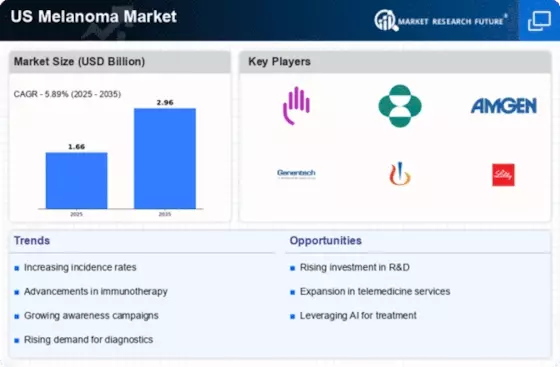
As per analysis, the US Melanoma Market is projected to grow from USD 1.68 Billion in 2025 to USD 2.96 Billion by 2035, exhibiting a compound annual growth rate (CAGR) of 5.89% during the forecast period (2025 - 2035).

Key Market Trends & Highlights

The US Melanoma Market is experiencing a dynamic shift driven by innovative treatment approaches and heightened awareness.

  • Immunotherapy remains the largest segment, reflecting a robust demand for advanced treatment options.
  • Targeted therapy is the fastest-growing segment, indicating a shift towards precision medicine in melanoma treatment.
  • Localized melanoma treatment continues to dominate the market, while distant melanoma treatment is witnessing rapid growth.
  • Rising incidence rates and innovative therapeutic approaches are key drivers propelling market expansion.

Market Size & Forecast

2024 Market Size 1.57 (USD Billion)
2035 Market Size 2.96 (USD Billion)
CAGR (2025 - 2035) 5.89%

Major Players

<p>Bristol-Myers Squibb (US), Merck & Co. (US), Amgen (US), Genentech (US), Novartis (US), Eli Lilly and Company (US), Pfizer (US), Regeneron Pharmaceuticals (US), Incyte Corporation (US)</p>

Market Trends

The US Melanoma Market is currently experiencing notable transformations driven by advancements in treatment modalities and increasing awareness among the population. The rise in melanoma cases has prompted healthcare providers to adopt innovative therapies, including targeted treatments and immunotherapies. These developments appear to enhance patient outcomes and may lead to a shift in treatment paradigms. Furthermore, educational initiatives aimed at promoting sun safety and early detection are likely contributing to a more informed public, which could result in earlier diagnoses and improved survival rates. In addition to treatment advancements, the US Melanoma Market is witnessing a surge in research funding and collaboration among academic institutions and pharmaceutical companies. This trend suggests a commitment to understanding the disease better and developing novel therapeutic options. Regulatory bodies are also playing a crucial role by expediting the approval processes for new drugs, which may facilitate quicker access to innovative treatments for patients. Overall, the landscape of the US Melanoma Market appears to be evolving rapidly, with a focus on improving patient care and outcomes through research and education.

Advancements in Treatment Modalities

The US Melanoma Market is seeing a shift towards innovative treatment options, particularly in the realm of immunotherapy and targeted therapies. These advancements are likely to enhance patient outcomes and provide more effective management of the disease.

Increased Public Awareness

There is a growing emphasis on public education regarding melanoma prevention and early detection. Campaigns promoting sun safety and regular skin checks may lead to earlier diagnoses, which could improve survival rates.

Research Funding and Collaboration

The landscape of the US Melanoma Market is characterized by increased funding for research and collaboration between academic institutions and pharmaceutical companies. This trend indicates a strong commitment to developing new therapies and understanding the disease more comprehensively.

US Melanoma Market Market Drivers

Rising Incidence Rates

The US Melanoma Market is experiencing a notable increase in melanoma incidence rates, with the American Cancer Society estimating that approximately 106,110 new cases of melanoma will be diagnosed in 2026. This rising trend is attributed to factors such as increased sun exposure, tanning bed usage, and genetic predispositions. As awareness of skin cancer grows, more individuals are seeking early diagnosis and treatment, thereby driving demand for innovative therapies and screening methods. The growing patient population necessitates advancements in treatment options, which in turn propels the US Melanoma Market forward. Furthermore, the increasing burden on healthcare systems due to rising melanoma cases is likely to stimulate investment in research and development, enhancing the overall market landscape.

Growing Aging Population

The demographic shift towards an aging population in the United States is significantly impacting the US Melanoma Market. As individuals age, their risk of developing melanoma increases, primarily due to cumulative sun exposure over the years. The US Census Bureau projects that by 2030, nearly 20% of the population will be 65 years or older, leading to a higher prevalence of skin cancers, including melanoma. This demographic trend is likely to result in increased demand for screening, early detection, and treatment options tailored to older adults. Consequently, healthcare providers and pharmaceutical companies are expected to focus on developing age-appropriate therapies and interventions, thereby driving growth in the US Melanoma Market. The intersection of an aging population and rising melanoma incidence presents both challenges and opportunities for market stakeholders.

Enhanced Diagnostic Technologies

Advancements in diagnostic technologies are transforming the landscape of the US Melanoma Market. The introduction of non-invasive imaging techniques, such as dermoscopy and reflectance confocal microscopy, has improved the accuracy of melanoma detection. These technologies enable healthcare professionals to identify suspicious lesions at an early stage, facilitating timely intervention and treatment. Moreover, the integration of artificial intelligence in diagnostic processes is showing promise in enhancing the precision of melanoma diagnosis. As these technologies become more widely adopted, they are likely to increase the rate of early melanoma detection, which is crucial for improving patient outcomes. The growing emphasis on precision medicine and personalized treatment approaches further underscores the importance of enhanced diagnostic capabilities in the US Melanoma Market.

Innovative Therapeutic Approaches

The US Melanoma Market is witnessing a surge in innovative therapeutic approaches, particularly in immunotherapy and targeted therapies. Treatments such as checkpoint inhibitors and BRAF/MEK inhibitors have revolutionized melanoma management, leading to improved patient outcomes. The FDA has approved several novel agents, which have contributed to a significant increase in the survival rates of advanced melanoma patients. For instance, the introduction of pembrolizumab and nivolumab has transformed treatment paradigms, making them essential components of melanoma therapy. This innovation not only enhances the quality of care but also drives market growth as healthcare providers and patients increasingly opt for these advanced treatment modalities. The ongoing research and development in this area suggest a promising future for the US Melanoma Market.

Government Initiatives and Policies

Government initiatives and policies play a crucial role in shaping the US Melanoma Market. The National Cancer Institute and other federal agencies have implemented programs aimed at increasing awareness, funding research, and improving access to melanoma treatments. For example, the Cancer Moonshot initiative seeks to accelerate cancer research and enhance collaboration among stakeholders. Such initiatives are likely to lead to increased funding for melanoma research, which could result in the development of new therapies and diagnostic tools. Additionally, public health campaigns aimed at educating the population about the risks of melanoma and the importance of early detection are expected to further drive market growth. These government efforts create a supportive environment for advancements in the US Melanoma Market.

Market Segment Insights

By Treatment Type: Immunotherapy (Largest) vs. Targeted Therapy (Fastest-Growing)

<p>In the US Melanoma Market, treatment modalities are dynamically evolving with Immunotherapy holding the largest market share. It is increasingly favored due to its ability to enhance the body’s immune response against melanoma cells. Following Immunotherapy are Surgery, Chemotherapy, and Targeted Therapy, which is gaining significant traction. While Surgery remains a conventional approach, the momentum is shifting towards more advanced treatments, with providers advocating for less invasive options that yield better outcomes. The growth trends within this segment are propelled by advancements in research and clinical trials that favor Immunotherapy options, attributed to their efficacy and tolerability. Moreover, Targeted Therapy is becoming the fastest-growing approach, largely due to its precision in targeting melanoma cells with minimal impact on healthy tissues. As healthcare systems continue to evaluate and adopt personalized treatment strategies, the focus on these therapies is expected to intensify, nudged by rising melanoma incidence rates and heightened awareness about treatment options.</p>

<p>Surgery (Dominant) vs. Chemotherapy (Emerging)</p>

<p>In the current landscape of the US Melanoma Market, Surgery remains the dominant treatment modality recognized for its quick effectiveness in removing tumors. It is often the first-line treatment for melanoma, particularly in early-stage cases, where it proves to be most efficacious. On the other hand, Chemotherapy, once a cornerstone treatment, is transitioning into an emerging role. This shift is largely rooted in the awareness of its limitations and side effects. Chemotherapy's position is now characterized by its use in advanced melanoma stages or when other treatments are not achievable. Despite being less favored compared to newer therapies, it still plays a critical role, particularly in comprehensive treatment regimens, as clinicians seek to optimize outcomes based on patient-specific needs.</p>

By Stage of Disease: Localized (Largest) vs. Distant (Fastest-Growing)

<p>In the US melanoma market, the stage of disease plays a crucial role in treatment strategies and patient outcomes. Localized melanoma represents the largest portion of the market due to higher early detection rates and effective treatment options available. In contrast, regional and distant stages account for a smaller market share, as they typically involve more complex treatment regimens and poorer prognoses.</p>

<p>Melanoma Stages: Localized (Dominant) vs. Distant (Emerging)</p>

<p>Localized melanoma is characterized by its confinement to the skin, presenting a significantly better prognosis and treatment success due to less aggressive characteristics. This stage is predominantly targeted by preventive measures and early screening programs, which enhance detection rates. Conversely, distant melanoma, which signifies metastasis beyond the initial site, is considered an emerging segment due to its rising incidence and evolving treatment modalities. This segment is witnessing new drug developments and immunotherapies that aim to improve survival rates, driving increased market attention and investment.</p>

By Patient Demographics: Age (Largest) vs. Gender (Fastest-Growing)

<p>In the US Melanoma Market, the distribution of patient demographics showcases a significant prevalence among older adults, particularly those aged 65 and above, who represent the largest segment. Meanwhile, women have been increasingly diagnosed at a faster rate, indicating a growing awareness and screening practices among this demographic. The underlying statistics suggest that while older adults dominate the patient population, the trend points toward a notable increase in melanoma cases among younger individuals, signifying a shift in demographic patterns. Moreover, factors contributing to these trends include enhanced education on skin health, increased outdoor exposure, and genetic predispositions that younger individuals are starting to manifest. This trend is compounded by demographic shifts, as younger generations become more engaged in preventive measures and seek early diagnosis. Gender-wise, women’s improved access to dermatologic care and their proactive approach to health screenings play a critical role in their faster growth rate in melanoma cases. This evolving landscape necessitates continuous monitoring to adapt treatment strategies effectively.</p>

<p>Age (Dominant) vs. Gender (Emerging)</p>

<p>The patient demographic for melanoma in the United States highlights age as the dominant factor, especially among those 65 and older, who display the highest incidence rates. This age group is characterized by a lifetime accumulation of sun exposure, combined with a generally weaker immune response, which makes them more susceptible to melanoma. The increase in cases among this demographic is attributed to factors like longer life expectancy and the state of overall skin health, where older skin is more vulnerable to malignancies. On the other hand, the emerging gender demographic indicates an uptick in melanoma diagnoses among women, driven by increasing awareness and better access to healthcare. Gender differences have historically been observed in melanoma presentation, with women often developing the disease at a younger age compared to men. The evolving roles of healthcare campaigns in educating women about skin checks and protective measures against UV exposure have contributed significantly to this shift.</p>

By Diagnosis Method: Skin Biopsy (Largest) vs. Imaging Tests (Fastest-Growing)

<p>In the US Melanoma Market, the diagnosis method segment is primarily dominated by Skin Biopsy, which holds the largest market share. Skin Biopsy serves as the gold standard for definitive melanoma diagnosis, being preferred by clinicians due to its accuracy and reliability. Imaging Tests, while holding a smaller market share, are increasingly being utilized for their non-invasive nature and ability to detect distant metastases, which makes them vital in the staging of melanoma.</p>

<p>Diagnosis Methods: Skin Biopsy (Dominant) vs. Imaging Tests (Emerging)</p>

<p>Skin Biopsy remains the dominant diagnosis method in the US Melanoma Market due to its effectiveness in providing histopathological confirmation of melanoma. This method is favored for its proven reliability and accuracy in identifying malignant cells. In contrast, Imaging Tests are emerging as a significant complementary approach, increasingly adopted for their role in early detection and monitoring treatment responses, particularly with advancements in imaging technology. This trend is driven by patients' preferences for less invasive options, making Imaging Tests the fastest-growing segment within diagnostics. The combined use of these methods enhances early detection rates and improves patient outcomes, marking them as pivotal aspects of melanoma management.</p>

Get more detailed insights about US Melanoma Market Research Report- Forecast To 2035

Regional Insights

Key Players and Competitive Insights

The Melanoma Market in the US is characterized by a dynamic competitive landscape, driven by innovation, strategic partnerships, and a focus on personalized medicine. Key players such as Bristol-Myers Squibb (US), Merck & Co. (US), and Amgen (US) are at the forefront, leveraging their extensive research capabilities and established market presence to enhance their product offerings. Bristol-Myers Squibb (US) emphasizes immunotherapy advancements, while Merck & Co. (US) focuses on expanding its portfolio through strategic collaborations. Amgen (US) is increasingly investing in targeted therapies, indicating a collective shift towards precision medicine that shapes the competitive environment.

The market structure appears moderately fragmented, with several players vying for market share. Companies are adopting various business tactics, such as localizing manufacturing and optimizing supply chains, to enhance operational efficiency. This competitive structure allows for a diverse range of treatment options, catering to the evolving needs of patients and healthcare providers alike. The influence of key players is significant, as their strategic decisions can impact market dynamics and patient access to innovative therapies.

In December 2025, Merck & Co. (US) announced a collaboration with a leading biotechnology firm to develop a novel combination therapy for advanced melanoma. This strategic move is likely to enhance Merck's competitive edge by broadening its therapeutic offerings and addressing unmet medical needs in the melanoma treatment landscape. The partnership underscores the importance of collaboration in driving innovation and improving patient outcomes.

In November 2025, Bristol-Myers Squibb (US) received FDA approval for a new indication of its leading immunotherapy drug, which is expected to significantly boost its market presence. This approval not only reinforces the company's commitment to advancing melanoma treatment but also positions it favorably against competitors. The strategic importance of this event lies in its potential to attract a larger patient population and enhance revenue streams.

In October 2025, Amgen (US) launched a new targeted therapy specifically designed for patients with a particular genetic mutation associated with melanoma. This launch reflects Amgen's strategic focus on precision medicine and its commitment to addressing the unique needs of melanoma patients. The introduction of this therapy is anticipated to strengthen Amgen's market position and contribute to the ongoing evolution of treatment paradigms in melanoma.

As of January 2026, current trends in the Melanoma Market indicate a pronounced shift towards digitalization, sustainability, and the integration of artificial intelligence in drug development. Strategic alliances are increasingly shaping the competitive landscape, fostering innovation and enhancing the speed of bringing new therapies to market. The competitive differentiation is likely to evolve from traditional price-based competition to a focus on innovation, technology, and supply chain reliability, as companies strive to meet the growing demand for effective and personalized melanoma treatments.

Key Companies in the US Melanoma Market include

Industry Developments

Future Outlook

US Melanoma Market Future Outlook

The US Melanoma Market is projected to grow at a 5.89% CAGR from 2025 to 2035, driven by advancements in immunotherapy, increased awareness, and early detection technologies.

New opportunities lie in:

  • Development of personalized immunotherapy treatments for melanoma patients.
  • Expansion of telemedicine platforms for remote patient monitoring and consultations.
  • Investment in AI-driven diagnostic tools to enhance early detection rates.

By 2035, the US Melanoma Market is expected to be robust, driven by innovative treatment solutions and enhanced patient engagement.

Market Segmentation

US Melanoma Market Treatment Type Outlook

  • Surgery
  • Immunotherapy
  • Chemotherapy
  • Targeted Therapy

US Melanoma Market Diagnosis Method Outlook

  • Skin Biopsy
  • Imaging Tests
  • Dermatoscopy

US Melanoma Market Stage of Disease Outlook

  • Localized
  • Regional
  • Distant

US Melanoma Market Patient Demographics Outlook

  • Age
  • Gender
  • Ethnicity
  • Socioeconomic Status

Report Scope

MARKET SIZE 20241.57(USD Billion)
MARKET SIZE 20251.68(USD Billion)
MARKET SIZE 20352.96(USD Billion)
COMPOUND ANNUAL GROWTH RATE (CAGR)5.89% (2024 - 2035)
REPORT COVERAGERevenue Forecast, Competitive Landscape, Growth Factors, and Trends
BASE YEAR2024
Market Forecast Period2025 - 2035
Historical Data2019 - 2024
Market Forecast UnitsUSD Billion
Key Companies ProfiledBristol-Myers Squibb (US), Merck & Co. (US), Amgen (US), Genentech (US), Novartis (US), Eli Lilly and Company (US), Pfizer (US), Regeneron Pharmaceuticals (US), Incyte Corporation (US)
Segments CoveredTreatment Type, Stage of Disease, Patient Demographics, Diagnosis Method
Key Market OpportunitiesAdvancements in targeted therapies and immunotherapies enhance treatment options in the US Melanoma Market.
Key Market DynamicsRising demand for targeted therapies drives innovation and competition in the US Melanoma Market.
Countries CoveredUS

FAQs

What is the current valuation of the US Melanoma Market as of 2024?

The US Melanoma Market was valued at 1.57 USD Billion in 2024.

What is the projected market valuation for the US Melanoma Market in 2035?

The market is projected to reach 2.96 USD Billion by 2035.

What is the expected CAGR for the US Melanoma Market during the forecast period 2025 - 2035?

The expected CAGR for the US Melanoma Market during 2025 - 2035 is 5.89%.

Which treatment type segment had the highest valuation in 2024?

In 2024, the Immunotherapy segment had the highest valuation at 0.63 USD Billion.

How does the Localized stage of disease segment perform in terms of valuation?

The Localized stage of disease segment was valued at 0.79 USD Billion in 2024 and is expected to grow significantly.

What are the projected valuations for the Surgery treatment type segment by 2035?

The Surgery treatment type segment is projected to reach between 0.47 and 0.88 USD Billion by 2035.

Which demographic factors are influencing the US Melanoma Market?

Factors such as Age, Gender, Ethnicity, and Socioeconomic Status are influencing the market, with valuations ranging from 0.3 to 0.95 USD Billion in 2024.

What diagnostic methods are utilized in the US Melanoma Market?

Diagnostic methods include Skin Biopsy, Imaging Tests, and Dermatoscopy, with valuations of 0.7, 0.5, and 0.37 USD Billion respectively in 2024.

Who are the key players in the US Melanoma Market?

Key players include Bristol-Myers Squibb, Merck &amp; Co., Amgen, Genentech, Novartis, Eli Lilly and Company, Pfizer, Regeneron Pharmaceuticals, and Incyte Corporation.

What is the expected growth trend for the Regional stage of disease segment by 2035?

The Regional stage of disease segment is projected to grow from 0.56 USD Billion in 2024 to between 1.06 USD Billion by 2035.

  1. SECTION I: EXECUTIVE SUMMARY AND KEY HIGHLIGHTS
    1. | 1.1 EXECUTIVE SUMMARY
  2. SECTION II: SCOPING, METHODOLOGY AND MARKET STRUCTURE
    1. | 2.1 MARKET INTRODUCTION
    2. | 2.2 RESEARCH METHODOLOGY
  3. SECTION III: QUALITATIVE ANALYSIS
    1. | 3.1 MARKET DYNAMICS
    2. | 3.2 MARKET FACTOR ANALYSIS
  4. SECTION IV: QUANTITATIVE ANALYSIS
    1. | 4.1 Healthcare, BY Treatment Type (USD Billion)
    2. | 4.2 Healthcare, BY Stage of Disease (USD Billion)
    3. | 4.3 Healthcare, BY Patient Demographics (USD Billion)
    4. | 4.4 Healthcare, BY Diagnosis Method (USD Billion)
  5. SECTION V: COMPETITIVE ANALYSIS
    1. | 5.1 Competitive Landscape
    2. | 5.2 Company Profiles
    3. | 5.3 Appendix

US Melanoma Market Segmentation

Market Segmentation Overview

  • Detailed segmentation data will be available in the full report
  • Comprehensive analysis by multiple parameters
  • Regional and country-level breakdowns
  • Market size forecasts by segment
Infographic

Free Sample Request

Kindly complete the form below to receive a free sample of this Report

Get Free Sample

Customer Strories

Compare Licence

×
Features License Type
Single User Multiuser License Enterprise User
Price $4,950 $5,950 $7,250
Maximum User Access Limit 1 User Upto 10 Users Unrestricted Access Throughout the Organization
Free Customization
Direct Access to Analyst
Deliverable Format
Platform Access
Discount on Next Purchase 10% 15% 15%
Printable Versions