×
Request Free Sample ×

Kindly complete the form below to receive a free sample of this Report

* Please use a valid business email

Leading companies partner with us for data-driven Insights

clients tt-cursor
Hero Background

US MEA Critical Care Equipment Market

ID: MRFR/MED/11812-HCR
100 Pages
MRFR Team
February 2026

US Middle East and Africa Critical Care Equipment (CCE) Market information, by Type (Patient Monitor, Medical Ventilator, Dialysis, IV Pumps, Infusion pump, Suction Apparatus, and others), by End users (Hospitals, Research laboratories and others) - Forecast to 2035

Share:
Download PDF ×

We do not share your information with anyone. However, we may send you emails based on your report interest from time to time. You may contact us at any time to opt-out.

US MEA Critical Care Equipment Market Infographic
Purchase Options

US MEA Critical Care Equipment Market Summary

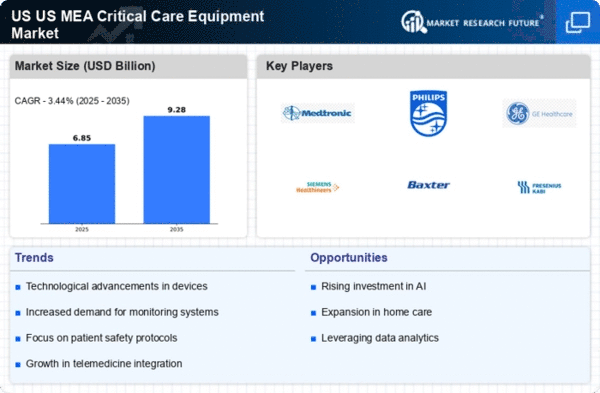
As per analysis, the US Critical Care Equipment Market is projected to grow from USD 6.84 Billion in 2025 to USD 9.28 Billion by 2035, exhibiting a compound annual growth rate (CAGR) of 3.12% during the forecast period (2025 - 2035).

Key Market Trends & Highlights

The US Critical Care Equipment Market is poised for growth driven by technological advancements and increasing demand for patient-centered care.

  • Technological advancements in monitoring systems are reshaping the landscape of critical care equipment.
  • The cardiac monitoring segment remains the largest, while the respiratory support segment is experiencing the fastest growth.
  • Hospitals continue to dominate the market, yet home care solutions are rapidly gaining traction.
  • Rising prevalence of chronic diseases and government initiatives are key drivers propelling market expansion.

Market Size & Forecast

2024 Market Size 6.62 (USD Billion)
2035 Market Size 9.28 (USD Billion)
CAGR (2025 - 2035) 3.12%

Major Players

Medtronic (US), Philips (US), GE Healthcare (US), Siemens Healthineers (DE), Baxter International (US), Fresenius Kabi (DE), Johnson & Johnson (US), Cardinal Health (US), Drägerwerk (DE)

Our Impact
Enabled $4.3B Revenue Impact for Fortune 500 and Leading Multinationals
Partnering with 2000+ Global Organizations Each Year
30K+ Citations by Top-Tier Firms in the Industry

US MEA Critical Care Equipment Market Trends

The US Critical Care Equipment Market is currently experiencing a dynamic evolution, driven by advancements in technology and an increasing emphasis on patient-centered care. The integration of innovative devices, such as advanced monitoring systems and automated ventilators, appears to enhance the efficiency and effectiveness of critical care services. Furthermore, the growing prevalence of chronic diseases necessitates a robust infrastructure for critical care, which in turn propels the demand for sophisticated equipment. As healthcare providers strive to improve patient outcomes, the focus on high-quality, reliable equipment becomes paramount. In addition, regulatory frameworks and standards set forth by government agencies play a crucial role in shaping the landscape of the US Critical Care Equipment Market. These regulations ensure that equipment meets safety and efficacy standards, thereby fostering trust among healthcare professionals and patients alike. The ongoing collaboration between manufacturers and healthcare institutions suggests a trend towards customized solutions that cater to specific clinical needs. As the market continues to evolve, it is likely that innovations will further transform the critical care environment, ultimately benefiting patient care and operational efficiency.

Technological Advancements in Monitoring Systems

The US Critical Care Equipment Market is witnessing a surge in the adoption of advanced monitoring systems. These systems, which include real-time data analytics and remote monitoring capabilities, enhance the ability of healthcare providers to track patient conditions more effectively. This trend indicates a shift towards proactive management of critical care patients, potentially leading to improved outcomes.

Emphasis on Patient-Centered Care

There is a growing focus on patient-centered care within the US Critical Care Equipment Market. This trend reflects a broader movement towards tailoring equipment and services to meet the individual needs of patients. As healthcare providers prioritize patient experiences, equipment that supports comfort and engagement is becoming increasingly important.

Regulatory Compliance and Safety Standards

Regulatory compliance remains a critical aspect of the US Critical Care Equipment Market. Government agencies enforce stringent safety standards to ensure that equipment is reliable and effective. This trend underscores the importance of adhering to regulations, as it not only protects patients but also enhances the credibility of healthcare institutions.

US MEA Critical Care Equipment Market Drivers

Government Initiatives and Funding

Government initiatives and funding significantly influence the US Critical Care Equipment Market. Federal and state programs aimed at improving healthcare infrastructure and access to critical care services are essential. The Health Resources and Services Administration has allocated substantial funds to enhance emergency medical services and critical care capabilities across the nation. These investments not only improve the availability of critical care equipment but also foster innovation within the industry. Additionally, policies promoting the adoption of advanced medical technologies further stimulate market growth. As the government continues to prioritize healthcare improvements, the US Critical Care Equipment Market is likely to benefit from increased funding and support.

Increased Focus on Infection Control

Infection control remains a critical concern within the US Critical Care Equipment Market. The rise in healthcare-associated infections has prompted healthcare facilities to prioritize the implementation of stringent infection control measures. This focus has led to an increased demand for critical care equipment that incorporates advanced sterilization and disinfection technologies. For instance, devices with antimicrobial surfaces and easy-to-clean designs are becoming more prevalent. The market is projected to grow as healthcare providers seek to enhance patient safety and reduce infection rates. As a result, the US Critical Care Equipment Market is likely to witness a surge in the development and adoption of innovative infection control solutions.

Rising Prevalence of Chronic Diseases

The US Critical Care Equipment Market is experiencing growth due to the increasing prevalence of chronic diseases such as diabetes, cardiovascular disorders, and respiratory illnesses. According to the Centers for Disease Control and Prevention, chronic diseases account for approximately 70% of all deaths in the United States. This alarming statistic underscores the necessity for advanced critical care equipment to manage these conditions effectively. As the population ages, the demand for critical care services and equipment is likely to rise, necessitating investments in innovative technologies. The market is projected to expand as healthcare providers seek to enhance patient outcomes through the adoption of sophisticated monitoring and treatment devices, thereby driving the growth of the US Critical Care Equipment Market.

Growing Demand for Home Healthcare Solutions

The shift towards home healthcare solutions is reshaping the US Critical Care Equipment Market. With an increasing number of patients preferring to receive care at home, there is a rising demand for portable and user-friendly critical care equipment. This trend is particularly evident among the elderly population, who often require ongoing monitoring and treatment for chronic conditions. The market for home healthcare equipment is expected to grow significantly, with estimates suggesting it could reach USD 20 billion by 2026. This shift not only alleviates pressure on healthcare facilities but also enhances patient comfort and satisfaction. Consequently, the US Critical Care Equipment Market is adapting to meet the evolving needs of patients and healthcare providers.

Technological Innovations in Medical Devices

Technological advancements play a pivotal role in shaping the US Critical Care Equipment Market. Innovations such as telemedicine, artificial intelligence, and advanced imaging techniques are revolutionizing patient care. For instance, the integration of AI in monitoring systems allows for real-time data analysis, enabling healthcare professionals to make informed decisions swiftly. The market for critical care equipment is projected to reach USD 12 billion by 2027, driven by these technological innovations. Furthermore, the development of portable and user-friendly devices enhances accessibility, particularly in emergency situations. As hospitals and healthcare facilities increasingly adopt these cutting-edge technologies, the US Critical Care Equipment Market is poised for substantial growth.


Market Segment Insights

By Application: Cardiac Monitoring (Largest) vs. Respiratory Support (Fastest-Growing)

In the US Critical Care Equipment Market, the 'Application' segment demonstrates a diverse distribution of market share across various critical care needs. Cardiac monitoring remains the largest segment, driven by the high prevalence of cardiovascular diseases and the need for continuous patient surveillance. Following closely, respiratory support has emerged as a significant share of the market, largely attributed to the increasing respiratory conditions and the technological advancements in ventilatory support systems which cater to a growing patient population.

Cardiac Monitoring (Dominant) vs. Respiratory Support (Emerging)

Cardiac monitoring stands as the dominant application in the critical care equipment sector, emphasizing its crucial role in managing patients with heart conditions. This segment encompasses advanced monitoring technologies that provide real-time data on patient cardiac rhythms, vital for timely interventions. On the other hand, respiratory support is categorized as an emerging application due to its rapid growth, particularly in light of the increasing demand for intensive care during respiratory epidemics. This segment includes various interventions, such as non-invasive and invasive ventilation, which have seen significant innovation. The evolving landscape of patient care and technological integration are pivotal in both segments' ongoing development.

By End Use: Hospitals (Largest) vs. Home Care (Fastest-Growing)

The US Critical Care Equipment Market is largely dominated by hospitals, which account for a significant portion of the market share. This segment serves as the primary setting for critical care equipment utilization, owing to the extensive patient volume and the demand for advanced life-support technologies. As hospitals continue to expand their capabilities and upgrade their facilities, they remain a crucial driver of market dynamics and trends.

Hospitals (Dominant) vs. Home Care (Emerging)

Hospitals play a dominant role in the Critical Care Equipment Market, providing a wide range of services and employing advanced medical technologies to treat critically ill patients. The segment encompasses both emergency and elective procedures, necessitating a comprehensive suite of critical care devices. In contrast, the home care segment is emerging rapidly due to rising patient preference for at-home treatment and advances in portable medical technologies. Home care is becoming more prominent as healthcare shifts towards patient-centric models, enabling better monitoring and management of chronic conditions outside traditional clinical settings.

By Product Type: Ventilators (Largest) vs. Infusion Pumps (Fastest-Growing)

In the US Critical Care Equipment Market, ventilators lead the segment with the largest market share due to their critical role in patient respiratory support, especially in emergency and intensive care settings. Infusion pumps follow as a significant contributor, utilized for precise medication delivery and intravenous therapy. Patient monitors, dialysis equipment, and defibrillators also hold notable positions, catering to diverse critical care needs but with comparatively smaller market shares.

Ventilators (Dominant) vs. Infusion Pumps (Emerging)

Ventilators have established themselves as the dominant force in the US Critical Care Equipment Market, primarily driven by their essential function in respiratory management and treatment of acute respiratory distress conditions. Their advanced technology and integration with hospital systems enhance their efficiency and reliability. Infusion pumps are emerging rapidly as a critical technology, driven by the increasing demand for precise medication administration and the rise in chronic diseases. The growth in home healthcare settings is also propelling their adoption, making them integral in providing effective patient care in both hospital and outpatient settings.

By Technology: Electronic (Largest) vs. Telemedicine (Fastest-Growing)

In the US Critical Care Equipment Market, the technology segment is characterized by diverse categories such as Electronic, Mechanical, Software-based, Telemedicine, and Wearable Technology. Among these, Electronic equipment currently holds the largest market share due to its established reliability and integration into critical care environments. Telemedicine is on the rise as it facilitates remote monitoring and consultation, appealing greatly in emergency response scenarios, thus rapidly gaining share in this segment.

Technology: Electronic (Dominant) vs. Telemedicine (Emerging)

The Electronic technology segment is dominant in the US Critical Care Equipment Market, offering sophisticated devices like advanced monitors and diagnostic tools that enhance patient care. This segment has benefitted from continuous innovations, leading to increased functionality and efficiency in clinical settings. In contrast, Telemedicine is emerging, reflecting a shift in healthcare delivery preferences, particularly during and post-pandemic. It offers critical capabilities for remote patient management and consultations, thereby expediting access to care. Both segments are crucial, but they serve different needs within the critical care paradigm, highlighting the necessity for a blended approach in modern healthcare.

By Patient Type: Adult (Largest) vs. Pediatric (Fastest-Growing)

The US Critical Care Equipment Market is largely dominated by the Adult segment, which holds the largest share due to the aging population and the prevalence of chronic diseases. The demand for critical care equipment such as ventilators, monitors, and infusion pumps for adults is significantly high, reflecting the challenges faced in adult critical care. Pediatric critical care, while smaller in comparison, is emerging as the fastest-growing segment, driven by increased awareness of children's health needs and advancements in technology designed specifically for pediatric patients.

Adult (Dominant) vs. Pediatric (Emerging)

The Adult patient segment is characterized by its robust demand for critical care equipment, with advanced features tailored to meet the needs of adults suffering from severe health conditions. This segment has established dominance due to higher hospitalization rates and better funding for adult healthcare facilities. Conversely, the Pediatric segment is emerging rapidly, fueled by the growing recognition of pediatric healthcare challenges and tailored innovations, including smaller and more efficient devices. As a result, manufacturers are increasingly investing in pediatric-focused critical care solutions, indicating a shift toward addressing the specific needs of younger patients.

Get more detailed insights about US MEA Critical Care Equipment Market

Key Players and Competitive Insights

The Critical Care Equipment Market in the US is characterized by a dynamic competitive landscape, driven by technological advancements, increasing healthcare expenditure, and a growing emphasis on patient-centric care. Major players such as Medtronic (US), Philips (US), and GE Healthcare (US) are at the forefront, each adopting distinct strategies to enhance their market positioning. Medtronic (US) focuses on innovation through the development of advanced monitoring systems, while Philips (US) emphasizes digital transformation and integrated solutions to improve patient outcomes. GE Healthcare (US) is leveraging partnerships to expand its product offerings and enhance its service capabilities, collectively shaping a competitive environment that prioritizes technological integration and patient care efficiency.

Key business tactics within this market include localizing manufacturing and optimizing supply chains to enhance responsiveness to market demands. The competitive structure appears moderately fragmented, with several key players exerting influence over various segments. This fragmentation allows for niche players to thrive, while larger companies leverage their scale to optimize operations and drive innovation. The collective influence of these key players fosters a competitive atmosphere where agility and adaptability are paramount.

In November 2025, Medtronic (US) announced a strategic partnership with a leading telehealth provider to integrate remote monitoring capabilities into its critical care solutions. This move is significant as it aligns with the growing trend towards telemedicine, enabling healthcare providers to monitor patients more effectively and respond to critical situations in real-time. Such partnerships may enhance Medtronic's competitive edge by expanding its service offerings and improving patient engagement.

In December 2025, Philips (US) launched a new line of advanced ventilators designed to meet the evolving needs of critical care environments. This product introduction is noteworthy as it reflects Philips' commitment to innovation and its focus on addressing the challenges faced by healthcare providers. By enhancing its product portfolio, Philips is likely to strengthen its market position and respond to the increasing demand for high-quality critical care equipment.

In January 2026, GE Healthcare (US) revealed plans to invest $500 million in expanding its manufacturing capabilities in the US. This investment is indicative of GE's strategy to localize production and enhance supply chain resilience. By increasing its manufacturing footprint, GE Healthcare aims to better serve the US market and mitigate potential disruptions, thereby reinforcing its competitive stance in the critical care equipment sector.

As of January 2026, current trends in the Critical Care Equipment Market include a pronounced shift towards digitalization, sustainability, and the integration of artificial intelligence (AI) in healthcare solutions. Strategic alliances are increasingly shaping the competitive landscape, enabling companies to pool resources and expertise to drive innovation. Looking ahead, competitive differentiation is likely to evolve from traditional price-based competition to a focus on technological advancements, reliability in supply chains, and the ability to deliver integrated healthcare solutions that enhance patient outcomes.

Key Companies in the US MEA Critical Care Equipment Market include

Future Outlook

US MEA Critical Care Equipment Market Future Outlook

The US Critical Care Equipment Market is projected to grow at a 3.12% CAGR from 2025 to 2035, driven by technological advancements, increasing patient populations, and rising healthcare expenditures.

New opportunities lie in:

  • Integration of AI-driven monitoring systems for real-time patient data analysis.
  • Expansion of telehealth solutions for remote critical care management.
  • Development of portable critical care devices for emergency response units.

By 2035, the market is expected to be robust, reflecting sustained growth and innovation.

Market Segmentation

US MEA Critical Care Equipment Market End Use Outlook

  • Hospitals
  • Ambulatory Surgical Centers
  • Long-term Care Facilities
  • Home Care
  • Emergency Medical Services

US MEA Critical Care Equipment Market Technology Outlook

  • Electronic
  • Mechanical
  • Software-based
  • Telemedicine
  • Wearable Technology

US MEA Critical Care Equipment Market Application Outlook

  • Cardiac Monitoring
  • Respiratory Support
  • Neurological Monitoring
  • Renal Support
  • Infection Control

US MEA Critical Care Equipment Market Patient Type Outlook

  • Adult
  • Pediatric
  • Neonatal
  • Geriatric
  • Critical Care

US MEA Critical Care Equipment Market Product Type Outlook

  • Ventilators
  • Infusion Pumps
  • Patient Monitors
  • Dialysis Equipment
  • Defibrillators

Report Scope

MARKET SIZE 20246.62(USD Billion)
MARKET SIZE 20256.84(USD Billion)
MARKET SIZE 20359.28(USD Billion)
COMPOUND ANNUAL GROWTH RATE (CAGR)3.12% (2024 - 2035)
REPORT COVERAGERevenue Forecast, Competitive Landscape, Growth Factors, and Trends
BASE YEAR2024
Market Forecast Period2025 - 2035
Historical Data2019 - 2024
Market Forecast UnitsUSD Billion
Key Companies ProfiledMedtronic (US), Philips (US), GE Healthcare (US), Siemens Healthineers (DE), Baxter International (US), Fresenius Kabi (DE), Johnson & Johnson (US), Cardinal Health (US), Drägerwerk (DE)
Segments CoveredApplication, End Use, Product Type, Technology, Patient Type
Key Market OpportunitiesIntegration of advanced telemedicine solutions enhances patient monitoring in the US Critical Care Equipment Market.
Key Market DynamicsTechnological advancements and regulatory changes drive innovation in the US Critical Care Equipment Market.
Countries CoveredUS
Leave a Comment
Download Free Sample

Kindly complete the form below to receive a free sample of this Report

Compare Licence

×
Features License Type
Single User Multiuser License Enterprise User
Price $4,950 $5,950 $7,250
Maximum User Access Limit 1 User Upto 10 Users Unrestricted Access Throughout the Organization
Free Customization
Direct Access to Analyst
Deliverable Format
Platform Access
Discount on Next Purchase 10% 15% 15%
Printable Versions