×
Request Free Sample ×

Kindly complete the form below to receive a free sample of this Report

* Please use a valid business email

Leading companies partner with us for data-driven Insights

clients tt-cursor
Hero Background

US Lysine Market

ID: MRFR/Agri/19216-HCR
128 Pages
Garvit Vyas
February 2026

US Lysine Market Size, Share, Industry Trend & Analysis Research Report: By Type (Lysine Hydrochloride, Lysine Monohydrate, Others), By Grade (Feed Grade, Food Grade, Pharma Grade), By Application (Powder, Liquid, Granules) andBy End User (Food & Beverages, Pharmaceuticals & Nutraceuticals, Personal Care, Animal Feed)- Forecast to 2035

Share:
Download PDF ×

We do not share your information with anyone. However, we may send you emails based on your report interest from time to time. You may contact us at any time to opt-out.

US Lysine Market Infographic
Purchase Options

US Lysine Market Summary

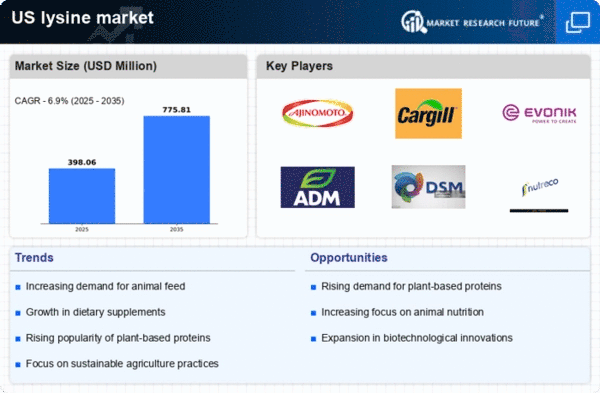
As per Market Research Future analysis, the US lysine market Size was estimated at 372.37 USD Million in 2024. The US lysine market is projected to grow from 398.06 USD Million in 2025 to 775.81 USD Million by 2035, exhibiting a compound annual growth rate (CAGR) of 6% during the forecast period 2025 - 2035

Key Market Trends & Highlights

The US lysine market is experiencing robust growth driven by increasing demand in animal nutrition and sustainability initiatives.

  • The largest segment in the US lysine market is animal nutrition, which is witnessing a surge in demand due to rising livestock production.
  • Sustainability initiatives are shaping production practices, leading to technological advancements in lysine manufacturing.
  • The fastest-growing segment is aquaculture, reflecting a shift towards more sustainable protein sources in response to health-conscious consumer trends.
  • Key market drivers include increasing livestock production and innovations in feed formulation, which are essential for meeting the evolving demands of the industry.

Market Size & Forecast

2024 Market Size 372.37 (USD Million)
2035 Market Size 775.81 (USD Million)
CAGR (2025 - 2035) 6.9%

Major Players

Ajinomoto Co Inc (JP), Cargill Inc (US), Evonik Industries AG (DE), Archer Daniels Midland Company (US), Royal DSM NV (NL), Nutreco N.V. (NL), Kemin Industries Inc (US), Meihua Holdings Group Co Ltd (CN)

Our Impact
Enabled $4.3B Revenue Impact for Fortune 500 and Leading Multinationals
Partnering with 2000+ Global Organizations Each Year
30K+ Citations by Top-Tier Firms in the Industry

US Lysine Market Trends

The lysine market in the United States is currently experiencing notable shifts driven by various factors. The demand for lysine, an essential amino acid primarily used in animal feed, is on the rise due to the increasing focus on livestock health and productivity. This trend is further supported by the growing awareness of the nutritional benefits of lysine in animal diets, which enhances growth rates and feed efficiency. Additionally, the expansion of the poultry and swine industries contributes to the heightened consumption of lysine, as these sectors seek to optimize their production processes. Furthermore, advancements in lysine production technologies are likely to improve yield and reduce costs, making it more accessible to producers. In parallel, regulatory frameworks and sustainability initiatives are shaping the lysine market landscape. The emphasis on environmentally friendly practices is prompting manufacturers to adopt more sustainable production methods. This shift not only aligns with consumer preferences but also addresses the increasing scrutiny on the environmental impact of livestock farming. As a result, companies are exploring alternative sources of lysine, including fermentation processes and plant-based options. Overall, the lysine market appears poised for growth, driven by both demand dynamics and evolving industry standards that prioritize sustainability and efficiency.

Rising Demand in Animal Nutrition

The demand for lysine in animal nutrition is increasing as livestock producers focus on enhancing feed efficiency and overall animal health. This trend is driven by the need for higher productivity in the poultry and swine sectors, where lysine plays a crucial role in optimizing growth rates.

Sustainability Initiatives

Sustainability is becoming a central theme in the lysine market, with manufacturers adopting eco-friendly practices. This shift is influenced by consumer preferences for responsibly sourced products and the need to minimize the environmental impact of livestock production.

Technological Advancements in Production

Innovations in lysine production technologies are likely to enhance efficiency and reduce costs. These advancements may include improved fermentation techniques and alternative raw materials, which could lead to a more competitive market landscape.

US Lysine Market Drivers

Expansion of Aquaculture

The expansion of aquaculture in the US is emerging as a significant driver for the lysine market. As the demand for seafood continues to rise, aquaculture is becoming a vital source of fish production. Lysine is essential in fish feed formulations, promoting growth and improving feed conversion ratios. The aquaculture sector is projected to grow at a CAGR of 5% from 2025 to 2030, leading to an increased requirement for high-quality feed ingredients, including lysine. This growth in aquaculture not only supports the sustainability of fish stocks but also enhances the lysine market by creating new opportunities for lysine producers to cater to this expanding industry.

Increasing Livestock Production

The lysine market is experiencing growth due to the rising demand for livestock production in the US. As the population increases, the need for protein sources, particularly from meat, is escalating. This trend is driving farmers to enhance livestock feed with lysine, an essential amino acid that promotes growth and feed efficiency. In 2025, the US livestock sector is projected to expand, with an estimated increase in meat production by approximately 2.5 million metric tons. Consequently, the demand for lysine in animal feed formulations is expected to rise, thereby positively impacting the lysine market. The integration of lysine into feed not only improves animal health but also contributes to higher yields, making it a critical component in the livestock industry.

Innovations in Feed Formulation

Innovations in feed formulation are significantly impacting the lysine market. Advances in nutritional science and feed technology are enabling the development of more efficient and effective feed products. The incorporation of lysine into these formulations is becoming increasingly sophisticated, allowing for tailored nutrition that meets the specific needs of different livestock species. In 2025, the feed additives market is expected to reach $30 billion, with lysine being a key component. This trend indicates that as feed formulations become more advanced, the demand for lysine will likely increase, driving growth in the lysine market. The focus on optimizing feed efficiency and animal health is propelling the need for high-quality lysine in the industry.

Health Conscious Consumer Trends

The lysine market is influenced by the growing health consciousness among consumers in the US. As individuals become more aware of the nutritional value of their food, there is a notable shift towards protein-rich diets. Lysine, being a vital amino acid, is gaining attention for its role in muscle development and overall health. The demand for lysine-enriched food products is likely to increase, particularly in the health and wellness sector. In 2025, the market for protein supplements is anticipated to reach $20 billion, with lysine playing a crucial role in various formulations. This trend suggests that the lysine market will benefit from the increasing incorporation of lysine into dietary supplements and functional foods, catering to the health-oriented consumer base.

Regulatory Support for Animal Health

Regulatory support for animal health is playing a crucial role in shaping the lysine market. The US government is increasingly emphasizing the importance of animal nutrition and health standards, which includes the use of essential amino acids like lysine in feed. This regulatory framework is encouraging livestock producers to adopt better feeding practices, thereby enhancing animal welfare and productivity. In 2025, it is anticipated that new regulations will further promote the use of lysine in animal feed, potentially increasing its market share. This supportive environment not only fosters growth in the lysine market but also aligns with broader initiatives aimed at improving food safety and quality in the livestock sector.


Market Segment Insights

By Type: Lysine Hydrochloride (Largest) vs. Lysine Monohydrate (Fastest-Growing)

In the US lysine market, the segment distribution shows that Lysine Hydrochloride captures a significant portion of the market share, establishing itself as the dominant type due to its widespread application in animal feed and nutrition. Conversely, Lysine Monohydrate, while smaller in share, is gaining traction due to its increasing adoption in specialty feeds and health supplements, reflecting a dynamic shift in consumer preferences. Growth trends indicate that Lysine Monohydrate is emerging as the fastest-growing segment, bolstered by rising demand for high-quality feed ingredients in the livestock industry. Factors such as improved efficiency in production processes and a focus on animal health are driving this upward trajectory, thereby reshaping the competitive landscape within the US lysine market.

Lysine Hydrochloride (Dominant) vs. Lysine Monohydrate (Emerging)

Lysine Hydrochloride leads the market, characterized by its high solubility and effectiveness in various livestock formulations; it is essential for optimizing feed efficiency and promoting animal growth. Its dominant market position is supported by established manufacturing processes and extensive distribution networks. On the other hand, Lysine Monohydrate is gradually emerging as a favorable alternative, particularly in niche markets focused on health and wellness. This segment appeals to manufacturers seeking specific nutritional profiles for their products, highlighting the trend towards premium and specialty feeds that cater to evolving consumer demands in the US lysine market.

By Grade: Feed Grade (Largest) vs. Pharma Grade (Fastest-Growing)

In the US lysine market, the Feed Grade segment holds the largest market share, largely driven by its extensive application in livestock nutrition. This segment's dominance is supported by the increasing demand for high-quality feed among livestock producers, who are focused on improving animal health and productivity. In contrast, the Pharma Grade segment is emerging as a fast-growth area, attracting attention due to the increasing use of lysine in pharmaceutical formulations. Growth in the Feed Grade segment is primarily fueled by the rising global protein consumption and the continued expansion of the animal husbandry sector. Meanwhile, the Pharma Grade segment experiences rapid growth as advancements in biotechnology pave the way for new applications in health supplements. As consumers become more health-conscious, the demand for pharmaceutical-grade lysine is expected to surge, further propelling this segment's growth trajectory.

Feed Grade (Dominant) vs. Pharma Grade (Emerging)

Feed Grade lysine is characterized by its essential role in animal nutrition, serving as a critical amino acid that promotes growth and reproductive performance in livestock. This segment benefits from established relationships with large-scale veterinary and animal feed manufacturers who prioritize quality and efficacy in their products. On the other hand, Pharma Grade lysine is gaining traction as a result of increasing investments in healthcare and a growing trend towards the use of amino acids in dietary supplements. This emerging segment is defined by high purity levels, catering to regulatory standards in drug formulation, thus appealing to pharmaceutical companies seeking reliable ingredients for their products.

By Form: Powder (Largest) vs. Liquid (Fastest-Growing)

In the US lysine market, the segment distribution is led by the Powder form, which commands a significant market share due to its versatility and ease of use in various applications. Liquid and Granules follow, with Liquid gaining traction among users for its convenient application in nutrition solutions, though it currently holds a smaller share than the Powder segment. Growth trends indicate that while Powder remains dominant, Liquid is experiencing rapid expansion, driven by increasing demand for liquid feed additives in the livestock industry. Factors such as the shift towards more efficient feeding practices and the rising awareness of the benefits of liquid formulations contribute to the accelerated growth of the Liquid segment, positioning it as the fastest-growing category in the market.

Powder (Dominant) vs. Liquid (Emerging)

The Powder form of lysine is characterized by its high protein content and stability, making it the preferred choice for many manufacturers targeting animal feed and health products. Its established presence in the market allows it to dominate segment sales effectively. On the other hand, the Liquid form is emerging rapidly, attributed to its ease of incorporation into feed mixes and enhanced bioavailability. As producers look for innovative solutions to improve livestock health, the Liquid segment is gaining popularity, although it still trails the Powder form in terms of overall market share. This dynamic illustrates a shifting landscape in the US lysine market, where adaptability to market demands is crucial.

By Application: Animal Feed (Largest) vs. Pharmaceuticals & Nutraceuticals (Fastest-Growing)

In the US lysine market, the application distribution shows that the Animal Feed sector holds the largest share, reflecting its critical role in livestock nutrition. This segment benefits from ongoing demand in the meat and dairy industries, which rely heavily on lysine for animal growth and health. In contrast, Pharmaceuticals & Nutraceuticals accounts for a smaller yet notable portion of the market, driven by rising health awareness and the incorporation of lysine in dietary supplements and therapeutic products. Growth trends indicate that the Pharmaceuticals & Nutraceuticals segment is emerging as the fastest-growing application due to increasing consumer interest in health and wellness. Factors such as an aging population, a rise in preventive healthcare measures, and advancements in formulations are propelling this growth. Conversely, while Animal Feed remains stable, it continues to experience consistent demand as livestock production expands to meet protein consumption needs.

Animal Feed: Dominant vs. Pharmaceuticals & Nutraceuticals: Emerging

The Animal Feed segment is the dominant application in the US lysine market, characterized by its long-standing reliance on lysine as an essential amino acid for enhancing animal nutrition. This segment supports livestock growth, improves feed efficiency, and overall animal health, driving its robust position in the market. In contrast, the Pharmaceuticals & Nutraceuticals segment is emerging, characterized by innovative product development and a surge in demand for dietary supplements containing lysine. As consumers increasingly prioritize health, the segment is poised for rapid expansion, leveraging trends in wellness, preventive health, and personalized nutrition to capture more market share, thus reflecting a dynamic shift in application needs.

Get more detailed insights about US Lysine Market

Key Players and Competitive Insights

The lysine market exhibits a competitive landscape characterized by a blend of established players and emerging innovators. Key growth drivers include the increasing demand for high-protein diets, particularly in animal feed, and the rising awareness of lysine's role in enhancing livestock productivity. Major companies such as Ajinomoto Co Inc (Japan), Cargill Inc (US), and Evonik Industries AG (Germany) are strategically positioned to leverage these trends. Ajinomoto Co Inc (Japan) focuses on innovation in fermentation technology, aiming to enhance production efficiency and sustainability. Cargill Inc (US) emphasizes regional expansion and supply chain optimization, ensuring a robust presence in key markets. Meanwhile, Evonik Industries AG (Germany) is investing in digital transformation initiatives to streamline operations and improve customer engagement, collectively shaping a competitive environment that prioritizes efficiency and responsiveness.Key business tactics within the lysine market include localizing manufacturing to reduce transportation costs and enhance supply chain resilience. The market structure appears moderately fragmented, with a few dominant players exerting considerable influence. This fragmentation allows for niche players to thrive, yet the collective strength of major companies like Archer Daniels Midland Company (US) and Royal DSM NV (Netherlands) creates a competitive dynamic that drives innovation and market growth.

In October Cargill Inc (US) announced a strategic partnership with a leading biotechnology firm to develop a new lysine production process that utilizes renewable feedstocks. This initiative is significant as it aligns with global sustainability goals and positions Cargill as a leader in environmentally friendly production methods. The partnership is expected to enhance Cargill's competitive edge by reducing production costs and improving the overall sustainability of its product offerings.

In September Evonik Industries AG (Germany) launched a new digital platform aimed at optimizing the supply chain for lysine distribution. This platform is designed to enhance transparency and efficiency, allowing customers to track their orders in real-time. The strategic importance of this move lies in Evonik's commitment to digitalization, which not only improves customer satisfaction but also streamlines internal processes, potentially leading to cost savings and increased market share.

In August Ajinomoto Co Inc (Japan) expanded its production capacity in the US by investing $50 million in a new facility dedicated to lysine production. This expansion is crucial as it demonstrates Ajinomoto's commitment to meeting the growing demand for lysine in North America. By increasing production capacity, the company aims to solidify its market position and respond effectively to customer needs, thereby enhancing its competitive stance.

As of November current competitive trends in the lysine market are increasingly defined by digitalization, sustainability, and the integration of artificial intelligence in production processes. Strategic alliances are becoming more prevalent, allowing companies to pool resources and expertise to drive innovation. The competitive landscape is shifting from a focus on price-based competition to one that emphasizes technological advancement, supply chain reliability, and sustainable practices. This evolution suggests that companies that prioritize innovation and adaptability will likely emerge as leaders in the lysine market.

Key Companies in the US Lysine Market include

Industry Developments

The US Lysine Market has recently experienced notable developments, with companies such as Cargill and Evonik Industries enhancing their production capabilities to meet rising demand in animal nutrition. The market is witnessing growth due to increasing consumer demand for protein-rich foods, resulting in a higher requirement for lysine as a key amino acid for livestock feed. In terms of mergers and acquisitions, Daesang announced its acquisition of a smaller competitor in August 2023, further consolidating its position in the US market. Henan Tianfu Chemical also expanded its US operations, aiming to leverage the region's favorable market conditions.

Over the past couple of years, fluctuations in raw material prices have prompted companies like Ajinomoto and Kemin Industries to innovate and optimize their supply chains, contributing to overall market resilience. The increasing focus on sustainable sourcing and production practices is shaping investment strategies for major players in this sector. The US Lysine Market is anticipated to grow significantly, reflecting broader trends in the agriculture and food industries that emphasize quality and efficiency in animal nutrition.

Future Outlook

US Lysine Market Future Outlook

The Lysine Market is projected to grow at a 6.9% CAGR from 2025 to 2035, driven by increasing demand in animal feed and nutritional supplements.

New opportunities lie in:

  • Expansion into organic lysine production facilities
  • Development of customized lysine formulations for specific livestock
  • Strategic partnerships with feed manufacturers for integrated solutions

By 2035, the lysine market is expected to achieve robust growth, driven by innovation and strategic collaborations.

Market Segmentation

US Lysine Market Form Outlook

  • Powder
  • Liquid
  • Granules

US Lysine Market Type Outlook

  • Lysine Hydrochloride
  • Lysine Monohydrate
  • Others

US Lysine Market Grade Outlook

  • Feed Grade
  • Food Grade
  • Pharma Grade

US Lysine Market Application Outlook

  • Food & Beverages
  • Pharmaceuticals & Nutraceuticals
  • Personal Care
  • Animal Feed

Report Scope

MARKET SIZE 2024 372.37(USD Million)
MARKET SIZE 2025 398.06(USD Million)
MARKET SIZE 2035 775.81(USD Million)
COMPOUND ANNUAL GROWTH RATE (CAGR) 6.9% (2025 - 2035)
REPORT COVERAGE Revenue Forecast, Competitive Landscape, Growth Factors, and Trends
BASE YEAR 2024
Market Forecast Period 2025 - 2035
Historical Data 2019 - 2024
Market Forecast Units USD Million
Key Companies Profiled Ajinomoto Co Inc (JP), Cargill Inc (US), Evonik Industries AG (DE), Archer Daniels Midland Company (US), Royal DSM NV (NL), Nutreco N.V. (NL), Kemin Industries Inc (US), Meihua Holdings Group Co Ltd (CN)
Segments Covered Type, Grade, Form, Application
Key Market Opportunities Growing demand for sustainable animal feed ingredients drives innovation in the lysine market.
Key Market Dynamics Rising demand for animal feed drives innovation and competition in the lysine market.
Countries Covered US
Leave a Comment

FAQs

What is the projected market size of the US Lysine Market in 2024?

The US Lysine Market is expected to be valued at 366.0 million USD in 2024.

What will be the market size of the US Lysine Market by 2035?

By 2035, the US Lysine Market is projected to reach a value of 819.0 million USD.

What is the expected CAGR for the US Lysine Market from 2025 to 2035?

The expected Compound Annual Growth Rate (CAGR) for the US Lysine Market from 2025 to 2035 is 7.597%.

Which segment has the highest projected market value in 2035?

In 2035, Lysine Monohydrate is projected to have the highest market value at 400.0 million USD.

Who are the major players in the US Lysine Market?

Key players in the US Lysine Market include Daesang, Kemin Industries, Ajinomoto, and Cargill, among others.

What is the expected market value of Lysine Hydrochloride in 2035?

Lysine Hydrochloride is expected to reach a market value of 340.0 million USD by 2035.

What market size is expected for the 'Others' segment in 2035?

The 'Others' segment of the US Lysine Market is projected to be valued at 79.0 million USD in 2035.

What growth drivers are influencing the US Lysine Market?

The growth of the US Lysine Market is driven by rising demand in animal feed and growing awareness of nutritional supplements.

How does the US Lysine Market outlook look in terms of challenges?

Challenges facing the US Lysine Market include fluctuating raw material prices and competition from alternative amino acids.

What impact will regional demand have on the market growth rate?

Regional demand fluctuations are expected to significantly influence the growth rate of the US Lysine Market during the forecast period.

Download Free Sample

Kindly complete the form below to receive a free sample of this Report

Compare Licence

×
Features License Type
Single User Multiuser License Enterprise User
Price $4,950 $5,950 $7,250
Maximum User Access Limit 1 User Upto 10 Users Unrestricted Access Throughout the Organization
Free Customization
Direct Access to Analyst
Deliverable Format
Platform Access
Discount on Next Purchase 10% 15% 15%
Printable Versions