×
Request Free Sample ×

Kindly complete the form below to receive a free sample of this Report

* Please use a valid business email

Leading companies partner with us for data-driven Insights

clients tt-cursor
Hero Background

US Logic Semiconductors Market

ID: MRFR/SEM/17609-HCR
200 Pages
Garvit Vyas
February 2026

US Logic Semiconductors Market Size, Share and Research Report by End Use (Data Centers, Smart Devices, Embedded Systems, Networking Equipment, Robotics), by Technology (Complementary Metal-Oxide-Semiconductor, Bipolar Junction Transistor, Field-Effect Transistor, Integrated Circuit, Optoelectronics), by Application (Consumer Electronics, Automotive, Telecommunications, Industrial Automation, Healthcare), by Product Type (Microcontrollers, Digital Signal Processors, Field Programmable Gate Arrays, Application Specific Integrated Circuits, Logic Gates), by Component Type (Analog Logic Devices, Digital Logic Devices, Mixed-Signal Logic Devices, Power Management Devices, Interface Logic Devices)– Industry Forecast till 2035

Share:
Download PDF ×

We do not share your information with anyone. However, we may send you emails based on your report interest from time to time. You may contact us at any time to opt-out.

US Logic Semiconductors Market Infographic
Purchase Options

US Logic Semiconductors Market Summary

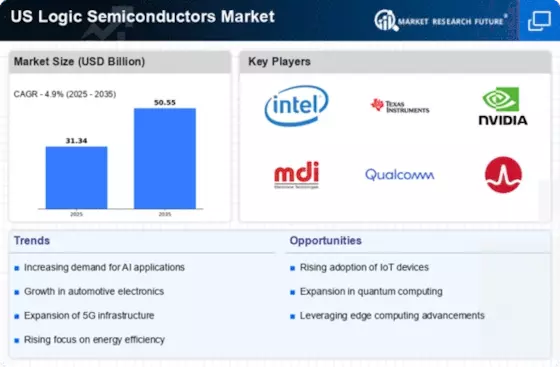
As per analysis, the US Logic Semiconductors Market is projected to grow from USD 29.88 Billion in 2024 to USD 50.55 Billion by 2035, exhibiting a compound annual growth rate (CAGR) of 4.9% during the forecast period (2025 - 2035).

Key Market Trends & Highlights

The US Logic Semiconductors Market is poised for robust growth driven by technological advancements and increasing demand across various sectors.

  • The Consumer Electronics segment remains the largest contributor to the US Logic Semiconductors Market, reflecting a sustained demand for innovative devices.
  • The Automotive segment is currently the fastest-growing area, propelled by advancements in automotive technology and the integration of smart features.
  • Data Centers continue to dominate the market, driven by the increasing need for data processing and storage solutions, while Smart Devices are emerging rapidly as a key growth area.
  • Key market drivers include the increased demand for consumer electronics and government support for local production initiatives, which are likely to shape future trends.

Market Size & Forecast

2024 Market Size 29.88 (USD Billion)
2035 Market Size 50.55 (USD Billion)
CAGR (2025 - 2035) 4.9%

Major Players

Intel Corporation (US), Texas Instruments Incorporated (US), NVIDIA Corporation (US), Advanced Micro Devices, Inc. (US), Qualcomm Incorporated (US), Broadcom Inc. (US), Micron Technology, Inc. (US), Analog Devices, Inc. (US), Xilinx, Inc. (US)

Our Impact
Enabled $4.3B Revenue Impact for Fortune 500 and Leading Multinationals
Partnering with 2000+ Global Organizations Each Year
30K+ Citations by Top-Tier Firms in the Industry

US Logic Semiconductors Market Trends

The US Logic Semiconductors Market is currently experiencing a dynamic evolution, driven by advancements in technology and increasing demand across various sectors. The proliferation of smart devices, coupled with the rise of artificial intelligence and machine learning applications, has led to a heightened need for efficient and powerful logic semiconductor solutions. As industries such as automotive, telecommunications, and consumer electronics continue to integrate sophisticated electronic systems, the market is poised for substantial growth. Furthermore, the ongoing push for energy-efficient solutions is influencing design and manufacturing processes, prompting companies to innovate and adapt to changing consumer preferences. In addition, the US Logic Semiconductors Market is witnessing a shift towards more localized production capabilities. This trend appears to be a response to supply chain vulnerabilities and geopolitical considerations. As a result, manufacturers are increasingly investing in domestic facilities to enhance production resilience and meet the growing demand for semiconductors. This strategic pivot not only supports national interests but also fosters job creation and technological advancement within the country. Overall, the market landscape is characterized by rapid innovation, strategic investments, and a focus on sustainability, indicating a promising future for stakeholders in the US Logic Semiconductors Market.

Rise of AI and Machine Learning

The integration of artificial intelligence and machine learning technologies is reshaping the US Logic Semiconductors Market. As these technologies become more prevalent, the demand for advanced logic chips that can handle complex computations is increasing. This trend suggests that semiconductor manufacturers must innovate to meet the specific requirements of AI applications, potentially leading to the development of specialized products.

Focus on Energy Efficiency

There is a growing emphasis on energy-efficient solutions within the US Logic Semiconductors Market. As environmental concerns gain traction, consumers and businesses alike are seeking products that minimize energy consumption. This trend indicates that manufacturers are likely to prioritize the development of low-power logic devices, which could enhance their competitive edge in the market.

Local Production Initiatives

The US Logic Semiconductors Market is witnessing a notable shift towards local production initiatives. In light of recent supply chain challenges, companies are increasingly investing in domestic manufacturing capabilities. This trend may lead to enhanced supply chain resilience and reduced dependency on foreign sources, ultimately benefiting the US economy and fostering innovation in semiconductor technology.

US Logic Semiconductors Market Drivers

Emergence of 5G Technology

The rollout of 5G technology is poised to have a transformative impact on the US Logic Semiconductors Market. As 5G networks become increasingly prevalent, the demand for high-speed data processing and connectivity solutions is expected to rise dramatically. This technological advancement necessitates the development of advanced logic semiconductors capable of supporting the increased bandwidth and lower latency associated with 5G applications. By January 2026, it is anticipated that the 5G sector will contribute significantly to the overall growth of the semiconductor market, with projections indicating a potential increase in revenue by over 15% annually. Consequently, companies within the US Logic Semiconductors Market are likely to invest heavily in research and development to create innovative solutions that cater to the evolving needs of 5G technology.

Advancements in Automotive Technology

The US Logic Semiconductors Market is significantly influenced by advancements in automotive technology, particularly with the rise of electric vehicles (EVs) and autonomous driving systems. As of January 2026, the automotive sector is projected to account for a substantial share of the logic semiconductor market, with estimates indicating that it could represent over 20% of total demand. The integration of advanced driver-assistance systems (ADAS) and infotainment solutions necessitates the use of high-performance logic semiconductors, which are essential for processing complex algorithms and data. This trend not only drives demand for semiconductors but also encourages manufacturers to innovate and develop specialized products tailored for the automotive industry, thereby enhancing the overall growth of the US Logic Semiconductors Market.

Growing Focus on Artificial Intelligence

The US Logic Semiconductors Market is witnessing a growing focus on artificial intelligence (AI) applications, which are becoming increasingly integral to various sectors, including healthcare, finance, and manufacturing. As of January 2026, the demand for AI-driven solutions is expected to propel the growth of the logic semiconductor market, with estimates suggesting a CAGR of approximately 10% in this segment. The need for high-performance computing and data processing capabilities drives the requirement for advanced logic semiconductors that can efficiently handle AI workloads. This trend not only enhances the performance of AI applications but also encourages collaboration between semiconductor manufacturers and AI developers, fostering innovation within the US Logic Semiconductors Market.

Government Support and Policy Initiatives

The US Logic Semiconductors Market benefits from robust government support and policy initiatives aimed at bolstering domestic semiconductor manufacturing. In recent years, the US government has introduced various incentives, including tax breaks and grants, to encourage investment in semiconductor production facilities. The CHIPS Act, enacted to enhance the competitiveness of the US semiconductor industry, allocates substantial funding for research and development, as well as for the construction of new fabrication plants. This proactive approach is expected to stimulate growth within the industry, potentially leading to a more self-sufficient semiconductor supply chain. As a result, the US Logic Semiconductors Market is likely to witness increased investment and innovation, positioning it favorably in the global landscape.

Increased Demand for Consumer Electronics

The US Logic Semiconductors Market is experiencing a surge in demand for consumer electronics, driven by advancements in technology and changing consumer preferences. As of January 2026, the market is projected to grow significantly, with estimates suggesting a compound annual growth rate (CAGR) of around 8% over the next five years. This growth is largely attributed to the proliferation of smart devices, including smartphones, tablets, and smart home appliances, which require sophisticated logic semiconductor components. The increasing integration of Internet of Things (IoT) technology into everyday products further fuels this demand, as consumers seek enhanced connectivity and functionality. Consequently, manufacturers are compelled to innovate and expand their production capabilities to meet the evolving needs of the market.


Market Segment Insights

By Application: Consumer Electronics (Largest) vs. Automotive (Fastest-Growing)

In the US Logic Semiconductors Market, the Consumer Electronics segment holds the largest market share, driven by a robust demand for personal devices such as smartphones, laptops, and home entertainment systems. The proliferation of smart devices and advancements in technology have solidified its position as a key pillar of market growth, necessitating significant investments in logic semiconductors to meet consumer needs. Conversely, the Automotive segment is recognized as the fastest-growing sector, spurred by the electrification of vehicles and the adoption of advanced driver-assistance systems. As electric and autonomous vehicles gain traction, the demand for logic semiconductors tailored for automotive applications is expected to surge, fostering innovation and development within this segment.

Consumer Electronics: Dominant vs. Automotive: Emerging

The Consumer Electronics segment is characterized by its stability and reliability, representing a well-established market driven by continuous innovations in technology. This segment typically includes a wide array of products, from smartphones and computers to wearables, showcasing the impact of consumer demands for greater connectivity and enhanced functionalities. On the other hand, the Automotive segment, while emerging, is rapidly gaining attention as automakers transition towards electric and autonomous technologies. This shift demands advanced logic semiconductor solutions, including those for infotainment systems and battery management, indicating a significant transformation in vehicle functionalities. The convergence of these segments suggests a dynamic interplay where traditional consumer electronics expertise is leveraged to meet the evolving needs of the automotive sector.

By End Use: Data Centers (Largest) vs. Smart Devices (Fastest-Growing)

In the US Logic Semiconductors Market, the distribution of market share among various end-use segments reveals distinct preferences. Data Centers occupy the largest share, driven by increasing data consumption and cloud computing demand. Smart Devices are gaining traction, thanks to the proliferation of IoT technologies and advancements in consumer electronics, contributing significantly to the overall market dynamics. Embedded Systems, Networking Equipment, and Robotics also play essential roles, showcasing a diverse set of applications across industries.

Smart Devices (Dominant) vs. Robotics (Emerging)

Smart Devices have emerged as a dominant force in the US Logic Semiconductors Market due to their integration into everyday life and the shift towards smart technologies. Their versatility in applications such as smartphones, wearables, and smart home devices propels their growth. Conversely, Robotics represents an emerging segment, gaining momentum with advancements in automation and artificial intelligence. As industries streamline operations and seek innovative solutions to enhance productivity, robotics is expected to witness substantial investments and development, positioning it as a critical player in future market expansions.

By Technology: Integrated Circuit (Largest) vs. Optoelectronics (Fastest-Growing)

The US Logic Semiconductors Market showcases a diverse array of technologies, with Integrated Circuits emerging as the dominant player holding the largest market share. Complementary Metal-Oxide-Semiconductors, Bipolar Junction Transistors, and Field-Effect Transistors also represent significant portions of the market, each serving unique applications across various industries. Together, these segments contribute to a comprehensive technological landscape that is critical for advancements in electronics and communication systems. In recent years, the growth trajectory of the Logic Semiconductors Market has been significantly driven by the demand for Integrated Circuits, particularly in consumer electronics and automotive applications. Additionally, Optoelectronics has surfaced as the fastest-growing segment, propelled by the rising adoption of advanced lighting technologies and optical communications, which are gaining traction in various sectors, including telecommunications and data transmission.

Technology: Integrated Circuit (Dominant) vs. Optoelectronics (Emerging)

Integrated Circuits (ICs) are the cornerstone of the US Logic Semiconductors Market, widely used in a variety of electronic devices from smartphones to complex computing systems, facilitating high efficiency and miniaturization. Their ability to integrate multiple functions onto a single chip contributes to reduced size and costs, making them critical in driving technological innovation. On the other hand, Optoelectronics represents an emerging segment that leverages light-based technologies, including LEDs and laser diodes, which are rapidly adopting due to their energy efficiency and enhanced performance. This segment is experiencing explosive growth, influenced by the increasing demand for high-speed data transmission and energy-efficient lighting solutions.

By Product Type: Microcontrollers (Largest) vs. Application Specific Integrated Circuits (Fastest-Growing)

The US Logic Semiconductors Market is characterized by a diverse range of product types, with Microcontrollers holding the largest market share. This dominance is driven by their widespread application in consumer electronics, automotive systems, and industrial control, reflecting their versatility. Following closely are Application Specific Integrated Circuits, which have gained traction due to their tailored functionality that meets specific industry needs. Other notable segments include Digital Signal Processors, Field Programmable Gate Arrays, and Logic Gates, each contributing to the overall market dynamics but at a comparatively smaller scale.

Microcontrollers (Dominant) vs. Digital Signal Processors (Emerging)

Microcontrollers serve as the backbone of modern electronic devices, offering flexibility and adaptability across various applications from home appliances to automotive technologies. Their significant presence in the US market is further enhanced by the increasing push towards IoT and embedded systems, which require efficient processing capabilities. In contrast, Digital Signal Processors are emerging as vital components for tasks that involve complex computations and real-time processing in areas like telecommunications and multimedia applications. Their potential for growth is being stimulated by advancements in AI and machine learning, making them a focal point for future innovations in logic semiconductors.

By Component Type: Digital Logic Devices (Largest) vs. Power Management Devices (Fastest-Growing)

In the US Logic Semiconductors Market, Digital Logic Devices dominate the component type segment, commanding the largest share. These devices primarily include microcontrollers, processors, and digital signal processors, which are driving the integration of logic functionalities in various applications, including consumer electronics and industrial systems. As digital applications continue to proliferate, the demand for efficient and advanced digital logic devices is more pronounced than ever, solidifying their position in the market. On the other hand, Power Management Devices are emerging as the fastest-growing segment within this landscape. With the increasing emphasis on energy efficiency and sustainability, these devices play a significant role in battery management and energy harvesting applications. They enable systems to optimize power consumption, making them essential in the transition towards greener technology, which propels their rapid growth in the market.

Digital Logic Devices (Dominant) vs. Interface Logic Devices (Emerging)

Digital Logic Devices represent a substantial portion of the US Logic Semiconductors Market, characterized by their ability to process and manipulate binary information effectively. As the backbone of modern computing and electronic devices, they are integral to supporting various applications, from smartphones to advanced automotive systems. Their dominant position is further reinforced by continuous innovations in processing capabilities and memory integration, catering to the growing demand for processing and connectivity. In contrast, Interface Logic Devices are an emerging segment, focused on facilitating communication between disparate systems, ensuring compatibility and data transfer across a vast array of devices. With the rise of IoT and smart technology, the demand for these devices is surging as they bridge the gap between different hardware and networks, signifying their increasing importance in future semiconductor applications.

Get more detailed insights about US Logic Semiconductors Market

Key Players and Competitive Insights

The Logic Semiconductors Market in the US is characterized by a dynamic competitive landscape, driven by rapid technological advancements and increasing demand for high-performance computing solutions. Major players such as Intel Corporation (US), NVIDIA Corporation (US), and Advanced Micro Devices, Inc. (US) are at the forefront, each adopting distinct strategies to enhance their market positioning. Intel Corporation (US) focuses on innovation through significant investments in research and development, aiming to lead in process technology and manufacturing capabilities. Meanwhile, NVIDIA Corporation (US) emphasizes partnerships and acquisitions to bolster its AI and machine learning offerings, thereby expanding its influence in emerging sectors. Advanced Micro Devices, Inc. (US) has adopted a strategy of aggressive pricing and product differentiation, which has allowed it to capture market share from competitors, particularly in the gaming and data center segments.
The business tactics employed by these companies reflect a concerted effort to optimize supply chains and localize manufacturing. This approach is particularly relevant in the context of geopolitical tensions and supply chain disruptions, which have prompted firms to reassess their operational frameworks. The market structure appears moderately fragmented, with a few dominant players exerting considerable influence while numerous smaller firms contribute to innovation and niche applications. The collective actions of these key players shape a competitive environment that is both challenging and ripe with opportunities for growth.
In December 2025, Intel Corporation (US) announced a strategic partnership with a leading AI research institute to develop next-generation semiconductor technologies. This collaboration is poised to enhance Intel's capabilities in AI-driven applications, potentially positioning the company as a leader in this burgeoning field. The strategic importance of this partnership lies in its potential to accelerate innovation cycles and improve product offerings, thereby reinforcing Intel's competitive edge.
In November 2025, NVIDIA Corporation (US) unveiled a new line of graphics processing units (GPUs) specifically designed for cloud gaming and AI applications. This launch is significant as it not only addresses the growing demand for high-performance computing but also aligns with NVIDIA's strategy to dominate the AI market. By focusing on these high-demand sectors, NVIDIA is likely to strengthen its market position and drive revenue growth in the coming years.
In October 2025, Advanced Micro Devices, Inc. (US) completed the acquisition of a smaller semiconductor firm specializing in custom chip design. This acquisition is expected to enhance AMD's product portfolio and enable it to offer more tailored solutions to its clients. The strategic importance of this move lies in AMD's ability to leverage the acquired technology to differentiate its offerings in a competitive market, thus appealing to a broader customer base.
As of January 2026, the competitive trends in the Logic Semiconductors Market are increasingly defined by digitalization, sustainability, and the integration of AI technologies. Strategic alliances are becoming more prevalent, as companies recognize the need to collaborate to stay ahead in a rapidly evolving landscape. Looking forward, competitive differentiation is likely to shift from price-based strategies to a focus on innovation, technological advancements, and supply chain reliability. This evolution suggests that companies that prioritize these aspects will be better positioned to thrive in the Logic Semiconductors Market.

Key Companies in the US Logic Semiconductors Market include

Future Outlook

US Logic Semiconductors Market Future Outlook

The US Logic Semiconductors Market is projected to grow at a 4.9% CAGR from 2025 to 2035, driven by advancements in AI, IoT, and automotive technologies.

New opportunities lie in:

  • Development of AI-optimized logic chips for enhanced processing power. Expansion into automotive-grade semiconductors for electric vehicles. Integration of logic semiconductors in smart home devices for increased connectivity.

By 2035, the market is expected to solidify its position as a leader in technological innovation.

Market Segmentation

US Logic Semiconductors Market End Use Outlook

  • Data Centers
  • Smart Devices
  • Embedded Systems
  • Networking Equipment
  • Robotics

US Logic Semiconductors Market Technology Outlook

  • Complementary Metal-Oxide-Semiconductor
  • Bipolar Junction Transistor
  • Field-Effect Transistor
  • Integrated Circuit
  • Optoelectronics

US Logic Semiconductors Market Application Outlook

  • Consumer Electronics
  • Automotive
  • Telecommunications
  • Industrial Automation
  • Healthcare

US Logic Semiconductors Market Product Type Outlook

  • Microcontrollers
  • Digital Signal Processors
  • Field Programmable Gate Arrays
  • Application Specific Integrated Circuits
  • Logic Gates

US Logic Semiconductors Market Component Type Outlook

  • Analog Logic Devices
  • Digital Logic Devices
  • Mixed-Signal Logic Devices
  • Power Management Devices
  • Interface Logic Devices

Report Scope

MARKET SIZE 2024 29.88(USD Billion)
MARKET SIZE 2025 31.49(USD Billion)
MARKET SIZE 2035 50.55(USD Billion)
COMPOUND ANNUAL GROWTH RATE (CAGR) 4.9% (2024 - 2035)
REPORT COVERAGE Revenue Forecast, Competitive Landscape, Growth Factors, and Trends
BASE YEAR 2024
Market Forecast Period 2025 - 2035
Historical Data 2019 - 2024
Market Forecast Units USD Billion
Key Companies Profiled Intel Corporation (US), Texas Instruments Incorporated (US), NVIDIA Corporation (US), Advanced Micro Devices, Inc. (US), Qualcomm Incorporated (US), Broadcom Inc. (US), Micron Technology, Inc. (US), Analog Devices, Inc. (US), Xilinx, Inc. (US)
Segments Covered Application, End Use, Technology, Product Type, Component Type
Key Market Opportunities Advancements in artificial intelligence drive demand for innovative solutions in the US Logic Semiconductors Market.
Key Market Dynamics Intensifying competition drives innovation and regulatory compliance in the US Logic Semiconductors Market.
Countries Covered US
Leave a Comment

FAQs

What is the current valuation of the US Logic Semiconductors Market?

The US Logic Semiconductors Market was valued at 29.88 USD Billion in 2024.

What is the projected market valuation for the US Logic Semiconductors Market by 2035?

The market is projected to reach 50.55 USD Billion by 2035.

What is the expected CAGR for the US Logic Semiconductors Market during the forecast period 2025 - 2035?

The expected CAGR for the market during the forecast period 2025 - 2035 is 4.9%.

Which companies are considered key players in the US Logic Semiconductors Market?

Key players include Intel Corporation, Texas Instruments, NVIDIA Corporation, and Qualcomm Incorporated.

How does the Consumer Electronics segment perform in the US Logic Semiconductors Market?

The Consumer Electronics segment was valued at 10.0 USD Billion in 2024 and is projected to grow to 17.0 USD Billion.

What is the valuation of the Automotive segment in the US Logic Semiconductors Market?

The Automotive segment was valued at 5.0 USD Billion in 2024 and is expected to increase to 9.0 USD Billion.

What are the projected values for the Data Centers segment by 2035?

The Data Centers segment is projected to grow from 8.5 USD Billion in 2024 to 14.5 USD Billion by 2035.

What is the expected growth for the Digital Logic Devices component type?

The Digital Logic Devices component type is anticipated to grow from 10.0 USD Billion in 2024 to 15.0 USD Billion.

How does the Integrated Circuit technology segment perform in the market?

The Integrated Circuit technology segment was valued at 7.0 USD Billion in 2024 and is projected to reach 12.0 USD Billion.

What is the growth outlook for the Robotics end-use segment?

The Robotics end-use segment is expected to grow from 5.38 USD Billion in 2024 to 8.55 USD Billion by 2035.

Download Free Sample

Kindly complete the form below to receive a free sample of this Report

Compare Licence

×
Features License Type
Single User Multiuser License Enterprise User
Price $4,950 $5,950 $7,250
Maximum User Access Limit 1 User Upto 10 Users Unrestricted Access Throughout the Organization
Free Customization
Direct Access to Analyst
Deliverable Format
Platform Access
Discount on Next Purchase 10% 15% 15%
Printable Versions