×
Request Free Sample ×

Kindly complete the form below to receive a free sample of this Report

* Please use a valid business email

Leading companies partner with us for data-driven Insights

clients tt-cursor
Hero Background

US Load Monitoring System Market

ID: MRFR/SEM/17252-HCR
200 Pages
Garvit Vyas
February 2026

US Load Monitoring System Market Size, Share and Research Report by End Use (Residential, Commercial, Industrial, Utilities, Transportation), by Component (Sensors, Software, Controllers, Communication Devices, Data Loggers), by Load Type (Active Load, Reactive Load, Total Load, Peak Load, Base Load), by Technology (Wired Monitoring Systems, Wireless Monitoring Systems, Cloud-Based Monitoring Systems, IoT-Enabled Monitoring Systems, Hybrid Monitoring Systems), by Application (Energy Management, Industrial Automation, Building Management, Renewable Energy Integration, Telecommunications) - Industry Forecast till 2035

Share:
Download PDF ×

We do not share your information with anyone. However, we may send you emails based on your report interest from time to time. You may contact us at any time to opt-out.

US Load Monitoring System Market Infographic
Purchase Options

US Load Monitoring System Market Summary

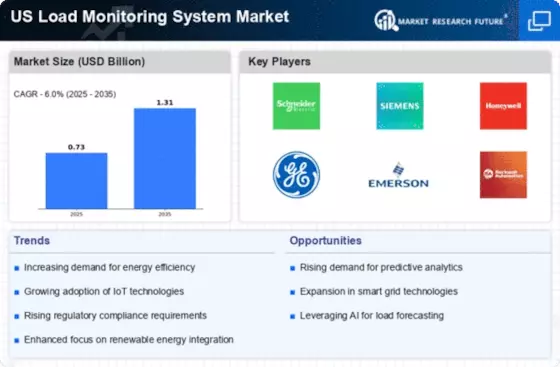
As per analysis, the US Load Monitoring System Market is projected to grow from USD 0.735 Billion in 2025 to USD 1.31 Billion by 2035, exhibiting a compound annual growth rate (CAGR) of 6.0% during the forecast period (2025 - 2035).

Key Market Trends & Highlights

The US Load Monitoring System Market is poised for substantial growth driven by technological advancements and increasing energy management needs.

  • The integration of IoT technologies is transforming load monitoring systems, enhancing real-time data collection and analysis.
  • Energy management remains the largest segment, reflecting a growing emphasis on optimizing energy consumption across various sectors.
  • Industrial automation is the fastest-growing segment, indicating a shift towards automated solutions for improved operational efficiency.
  • Rising demand for energy management solutions and advancements in smart grid technologies are key drivers propelling market expansion.

Market Size & Forecast

2024 Market Size 0.689 (USD Billion)
2035 Market Size 1.31 (USD Billion)
CAGR (2025 - 2035) 6.0%

Major Players

Schneider Electric (US), Siemens (US), Honeywell (US), General Electric (US), Emerson Electric (US), Rockwell Automation (US), Eaton Corporation (US), Fluke Corporation (US), National Instruments (US)

Our Impact
Enabled $4.3B Revenue Impact for Fortune 500 and Leading Multinationals
Partnering with 2000+ Global Organizations Each Year
30K+ Citations by Top-Tier Firms in the Industry

US Load Monitoring System Market Trends

The US Load Monitoring System Market is currently experiencing a notable evolution, driven by the increasing demand for energy efficiency and sustainability. As industries and commercial sectors strive to optimize their energy consumption, load monitoring systems have emerged as essential tools. These systems facilitate real-time tracking of energy usage, enabling organizations to identify inefficiencies and implement corrective measures. Furthermore, the integration of advanced technologies such as IoT and AI into load monitoring solutions is enhancing their capabilities, allowing for predictive analytics and improved decision-making processes. This trend appears to be fostering a more proactive approach to energy management, which is likely to resonate well with regulatory frameworks aimed at reducing carbon footprints. In addition, the growing emphasis on smart grid technologies is shaping the landscape of the US Load Monitoring System Market. Utilities are increasingly adopting load monitoring systems to enhance grid reliability and manage demand response effectively. This shift not only supports the transition towards renewable energy sources but also aligns with federal initiatives promoting energy independence. As a result, stakeholders in the market are likely to witness a surge in demand for innovative load monitoring solutions that can seamlessly integrate with existing infrastructure. Overall, the US Load Monitoring System Market seems poised for substantial growth, driven by technological advancements and a collective commitment to sustainable energy practices.

Integration of IoT Technologies

The incorporation of Internet of Things (IoT) technologies into load monitoring systems is transforming the US Load Monitoring System Market. This integration allows for enhanced data collection and analysis, enabling users to monitor energy consumption in real-time. As IoT devices become more prevalent, the ability to connect and communicate with various systems is likely to improve operational efficiency and facilitate better energy management.

Focus on Energy Efficiency

There is a growing focus on energy efficiency within the US Load Monitoring System Market. Organizations are increasingly recognizing the importance of reducing energy waste and optimizing consumption. Load monitoring systems provide valuable insights that help businesses identify areas for improvement, leading to cost savings and a reduced environmental impact.

Regulatory Support for Sustainable Practices

Regulatory frameworks in the United States are increasingly supporting sustainable energy practices, which is positively influencing the US Load Monitoring System Market. Government initiatives aimed at promoting energy efficiency and reducing greenhouse gas emissions are encouraging the adoption of load monitoring systems. This regulatory support is likely to drive innovation and investment in advanced monitoring technologies.

US Load Monitoring System Market Drivers

Advancements in Smart Grid Technologies

The integration of smart grid technologies is significantly influencing the US Load Monitoring System Market. As utilities and energy providers invest in modernizing their infrastructure, the demand for load monitoring systems that can seamlessly interface with smart grid solutions is increasing. These systems enable real-time monitoring and management of energy loads, facilitating better demand response strategies and enhancing grid reliability. The US government has allocated substantial funding towards smart grid initiatives, which is expected to further propel the adoption of load monitoring systems. This alignment with smart grid technologies not only enhances operational efficiency but also supports the transition towards renewable energy sources, thereby reinforcing the growth trajectory of the US Load Monitoring System Market.

Growing Adoption of Renewable Energy Sources

The transition towards renewable energy sources is significantly impacting the US Load Monitoring System Market. As more organizations and households invest in solar, wind, and other renewable energy technologies, the need for effective load monitoring systems becomes paramount. These systems facilitate the integration of renewable energy into existing grids by providing real-time data on energy production and consumption. The US government has set ambitious targets for renewable energy adoption, which is likely to drive the demand for load monitoring solutions that can support these initiatives. Consequently, the US Load Monitoring System Market is expected to experience robust growth as stakeholders seek to harness the benefits of renewable energy while ensuring grid stability and efficiency.

Rising Demand for Energy Management Solutions

The US Load Monitoring System Market is experiencing a notable surge in demand for energy management solutions. This trend is largely driven by the increasing need for businesses and households to optimize energy consumption and reduce costs. According to recent data, the market for energy management systems is projected to grow at a compound annual growth rate (CAGR) of approximately 15% over the next five years. This growth is indicative of a broader shift towards more efficient energy usage, as organizations seek to implement load monitoring systems that provide real-time insights into energy consumption patterns. Consequently, the US Load Monitoring System Market is poised to benefit from this heightened focus on energy efficiency, as stakeholders recognize the value of data-driven decision-making in managing energy resources.

Technological Innovations in Load Monitoring Solutions

Technological advancements are playing a pivotal role in the evolution of the US Load Monitoring System Market. Innovations such as artificial intelligence, machine learning, and advanced analytics are being integrated into load monitoring systems, enhancing their capabilities and effectiveness. These technologies enable predictive analytics, allowing organizations to anticipate energy demands and optimize resource allocation accordingly. The market is witnessing the emergence of sophisticated solutions that not only monitor energy usage but also provide actionable insights for improving efficiency. As businesses increasingly recognize the potential of these innovations, the demand for advanced load monitoring systems is expected to rise, further propelling the growth of the US Load Monitoring System Market.

Increased Focus on Sustainability and Environmental Regulations

The US Load Monitoring System Market is being shaped by a growing emphasis on sustainability and stringent environmental regulations. As federal and state governments implement policies aimed at reducing carbon emissions, businesses are compelled to adopt load monitoring systems that help track and manage energy usage effectively. For instance, the Environmental Protection Agency (EPA) has introduced various initiatives that encourage the adoption of energy-efficient technologies. This regulatory landscape is fostering a conducive environment for the growth of load monitoring systems, as organizations seek to comply with environmental standards while also achieving operational efficiencies. The alignment of business practices with sustainability goals is likely to drive further investment in the US Load Monitoring System Market.


Market Segment Insights

By Application: Energy Management (Largest) vs. Industrial Automation (Fastest-Growing)

In the US Load Monitoring System Market, the application segment is diverse, with Energy Management representing the largest share due to its critical role in optimizing energy consumption across various industries. Following closely, Industrial Automation stands out as a rapidly growing application, driven by the increasing need for efficiency and productivity in manufacturing processes. Building Management and Renewable Energy Integration also contribute to the segment but at comparatively lower market shares, reflecting a focused yet growing interest in sustainability and smart building technologies.

Systems: Energy Management (Dominant) vs. Industrial Automation (Emerging)

Energy Management systems are vital for monitoring and controlling energy usage, making them dominant in the US Load Monitoring System Market. Their integration helps organizations reduce energy costs and enhance sustainability efforts. Conversely, Industrial Automation systems are emerging strongly as they adopt load monitoring to boost operational efficiency in factories and production lines. This shift towards automation in manufacturing sectors aligns with advancements in IoT technologies and smart sensors, prompting an investment surge in load monitoring systems to facilitate real-time monitoring and control.
By End Use: Residential (Largest) vs. Industrial (Fastest-Growing)

In the US Load Monitoring System Market, the end use segments display a diverse distribution of market share. The residential segment holds the largest share as households increasingly adopt load monitoring systems to manage energy consumption and increase efficiency. Commercial applications also represent a significant portion, as businesses strive to monitor power usage and reduce costs. Utilities and transportation sectors are exploring load monitoring to optimize resources and maintain system resilience, while the industrial segment emerges as a key player in adopting advanced load monitoring technologies.

Residential (Dominant) vs. Industrial (Emerging)

The residential end-use segment stands out as the dominant force in the US Load Monitoring System Market, fueled by the growing trend of home automation and energy efficiency awareness among consumers. This segment benefits from the push for smart homes, where technologies such as IoT devices and connected appliances integrate seamlessly to optimize energy consumption. Conversely, the industrial segment is emerging rapidly, driven by the need for precise power management and operational efficiency. Industries are increasingly recognizing the value of load monitoring systems for real-time data analysis, leading to improved productivity and reduced energy waste. This segment's growth is propelled by technological advancements and the rising need for sustainable operations.

By Technology: Wireless Monitoring Systems (Largest) vs. IoT-Enabled Monitoring Systems (Fastest-Growing)

In the US Load Monitoring System Market, Wireless Monitoring Systems holds the largest market share. This segment has gained traction due to its ease of installation and flexibility, making it a preferred choice for many businesses. Meanwhile, IoT-Enabled Monitoring Systems are emerging as a significant player, catering to the demand for real-time data connectivity and remote monitoring capabilities, which are becoming increasingly crucial in today's industrial settings. Growth drivers for these segments include advancements in technology and rising demand for efficient operational monitoring. Businesses are increasingly investing in systems that offer enhanced analytics and predictive maintenance features. The shift towards automation and smart technologies is fostering a favorable environment for both Wireless and IoT-Enabled Monitoring Systems, indicating robust future growth potential.

Technology: Wireless Monitoring Systems (Dominant) vs. IoT-Enabled Monitoring Systems (Emerging)

Wireless Monitoring Systems are characterized by their convenience and flexibility, often favored for their straightforward installation and ability to work without the complexity of wiring. This dominance in the market speaks to their appeal in various industrial applications. In contrast, IoT-Enabled Monitoring Systems represent an emerging sector characterized by their integration with cloud computing and real-time analytics. These systems leverage the Internet of Things to provide seamless connectivity and data transmission, enabling businesses to make informed decisions rapidly. As industries recognize the importance of data-driven strategies, the growth trajectory of IoT-Enabled Monitoring Systems is set to accelerate, positioning them as a key player in the evolving landscape of load monitoring.

By Component: Sensors (Largest) vs. Software (Fastest-Growing)

In the US Load Monitoring System Market, the component segment is dominated by sensors, which hold the largest market share as they are essential for accurately measuring and monitoring load conditions. Other components like software, controllers, communication devices, and data loggers also contribute to the overall system efficiency, but sensors remain pivotal in driving the market forward. Software is rapidly gaining traction, supported by increased demand for advanced data analytics and remote monitoring capabilities in industrial applications. The growth trends in this segment are primarily driven by technological advancements in sensor technology and the rising adoption of IoT-enabled devices. Communication devices are giving way to enhanced connectivity and real-time monitoring, while data loggers are invaluable for data storage and retrieval. The increasing focus on energy efficiency and load management further boosts demand, making these components vital in operational optimization across industries.

Sensors (Dominant) vs. Software (Emerging)

Sensors are the dominant force in the US Load Monitoring System Market due to their ability to provide real-time data and accurate load measurements, essential for improving operational efficiency. They come in various types, including strain gauges and load cells, tailored for different applications. Meanwhile, software solutions are emerging rapidly, offering enhanced capabilities for data visualization and analytics, which facilitate better decision-making in load management. The integration of AI and machine learning algorithms in software is set to transform the market by providing predictive analytics and automated responses, further highlighting the importance of both segments. Together, these components ensure comprehensive load monitoring and management.

By Load Type: Active Load (Largest) vs. Reactive Load (Fastest-Growing)

In the US Load Monitoring System Market, the distribution of market share among load types is quite diverse, with Active Load holding the largest segment share. This dominance is attributed to its critical role in managing real-time energy consumption across various sectors. In contrast, Reactive Load, while currently smaller in market share, showcases significant growth potential, driven by increased demand for energy efficiency and renewable integration.

Active Load (Dominant) vs. Reactive Load (Emerging)

Active Load is characterized by its ability to supply real-time energy and is heavily integrated into load monitoring systems for industrial and commercial applications. The ongoing shift towards smart grids and advanced energy management solutions underscores its dominant position. On the other hand, Reactive Load is emerging rapidly due to the uptick in energy storage systems and increasing attention to power factor correction. This segment's growth is spurred by regulatory initiatives encouraging energy efficiency and renewable energy sources, prompting significant investments in technologies that effectively manage reactive power. Together, these load types present a comprehensive picture of the evolving dynamics in the Load Monitoring System Market.

Get more detailed insights about US Load Monitoring System Market

Key Players and Competitive Insights

The Load Monitoring System Market is characterized by a dynamic competitive landscape, driven by the increasing demand for energy efficiency and real-time monitoring solutions. Key players such as Schneider Electric (US), Siemens (US), and Honeywell (US) are strategically positioned to leverage technological advancements and enhance operational efficiencies. Schneider Electric (US) focuses on digital transformation and sustainability, aiming to integrate IoT solutions into their load monitoring systems. Siemens (US) emphasizes innovation through its digital twin technology, which allows for enhanced predictive maintenance and operational insights. Honeywell (US) is actively pursuing partnerships to expand its market reach and enhance its product offerings, particularly in smart building technologies. Collectively, these strategies indicate a shift towards more integrated and intelligent load monitoring solutions, shaping a competitive environment that prioritizes innovation and customer-centric approaches.
In terms of business tactics, companies are increasingly localizing manufacturing and optimizing supply chains to enhance responsiveness and reduce costs. The market appears moderately fragmented, with several key players exerting influence over various segments. This fragmentation allows for niche players to emerge, while larger corporations consolidate their positions through strategic acquisitions and partnerships. The collective influence of these key players fosters a competitive structure that encourages innovation and technological advancements.
In December 2025, Schneider Electric (US) announced a partnership with a leading renewable energy firm to develop advanced load monitoring solutions tailored for solar energy applications. This strategic move is likely to enhance Schneider's portfolio, positioning it as a leader in sustainable energy solutions. The collaboration underscores the growing importance of integrating renewable energy sources into load monitoring systems, reflecting a broader industry trend towards sustainability.
In November 2025, Siemens (US) launched a new software platform that utilizes AI to optimize load management in industrial settings. This initiative is significant as it not only enhances operational efficiency but also aligns with the increasing demand for smart manufacturing solutions. By leveraging AI, Siemens (US) is likely to gain a competitive edge, appealing to industries seeking to reduce operational costs while improving energy management.
In October 2025, Honeywell (US) expanded its product line by introducing a new series of load monitoring devices designed for smart homes. This expansion is indicative of Honeywell's commitment to diversifying its offerings and tapping into the growing smart home market. By addressing consumer needs for energy efficiency and automation, Honeywell (US) positions itself favorably in a rapidly evolving market landscape.
As of January 2026, current competitive trends in the Load Monitoring System Market are heavily influenced by digitalization, sustainability, and AI integration. Strategic alliances are increasingly shaping the landscape, enabling companies to pool resources and expertise to drive innovation. The competitive differentiation is likely to evolve from traditional price-based competition towards a focus on technological advancements, reliability in supply chains, and innovative solutions. This shift suggests that companies that prioritize R&D and customer-centric innovations will be better positioned to thrive in the future.

Key Companies in the US Load Monitoring System Market include

Future Outlook

US Load Monitoring System Market Future Outlook

The US Load Monitoring System Market is projected to grow at a 6.0% CAGR from 2025 to 2035, driven by technological advancements, regulatory compliance, and increasing energy efficiency demands.

New opportunities lie in:

  • Integration of IoT-enabled load monitoring solutions for real-time analytics. Development of cloud-based platforms for centralized load management. Expansion into renewable energy sectors with tailored monitoring systems.

By 2035, the market is expected to be robust, driven by innovation and strategic partnerships.

Market Segmentation

US Load Monitoring System Market End Use Outlook

  • Residential
  • Commercial
  • Industrial
  • Utilities
  • Transportation

US Load Monitoring System Market Component Outlook

  • Sensors
  • Software
  • Controllers
  • Communication Devices
  • Data Loggers

US Load Monitoring System Market Load Type Outlook

  • Active Load
  • Reactive Load
  • Total Load
  • Peak Load
  • Base Load

US Load Monitoring System Market Technology Outlook

  • Wired Monitoring Systems
  • Wireless Monitoring Systems
  • Cloud-Based Monitoring Systems
  • IoT-Enabled Monitoring Systems
  • Hybrid Monitoring Systems

US Load Monitoring System Market Application Outlook

  • Energy Management
  • Industrial Automation
  • Building Management
  • Renewable Energy Integration
  • Telecommunications

Report Scope

MARKET SIZE 2024 0.689(USD Billion)
MARKET SIZE 2025 0.735(USD Billion)
MARKET SIZE 2035 1.31(USD Billion)
COMPOUND ANNUAL GROWTH RATE (CAGR) 6.0% (2024 - 2035)
REPORT COVERAGE Revenue Forecast, Competitive Landscape, Growth Factors, and Trends
BASE YEAR 2024
Market Forecast Period 2025 - 2035
Historical Data 2019 - 2024
Market Forecast Units USD Billion
Key Companies Profiled Schneider Electric (US), Siemens (US), Honeywell (US), General Electric (US), Emerson Electric (US), Rockwell Automation (US), Eaton Corporation (US), Fluke Corporation (US), National Instruments (US)
Segments Covered Application, End Use, Technology, Component, Load Type
Key Market Opportunities Integration of advanced analytics and IoT in the US Load Monitoring System Market enhances operational efficiency.
Key Market Dynamics Rising demand for energy efficiency drives innovation in the US Load Monitoring System Market.

Countries Covered US
Leave a Comment

FAQs

What is the current valuation of the US Load Monitoring System Market?

As of 2024, the US Load Monitoring System Market was valued at 0.689 USD Billion.

What is the projected market size for the US Load Monitoring System Market by 2035?

The market is projected to reach 1.31 USD Billion by 2035.

What is the expected CAGR for the US Load Monitoring System Market during the forecast period?

The expected CAGR for the market from 2025 to 2035 is 6.0%.

Which companies are considered key players in the US Load Monitoring System Market?

Key players include Schneider Electric, Siemens, Honeywell, General Electric, Emerson Electric, Rockwell Automation, Eaton Corporation, Fluke Corporation, and National Instruments.

What are the primary applications of load monitoring systems in the US market?

The primary applications include Energy Management, Industrial Automation, Building Management, Renewable Energy Integration, and Telecommunications.

How does the market segment by end use in the US Load Monitoring System Market?

The market segments by end use include Residential, Commercial, Industrial, Utilities, and Transportation.

What technologies are utilized in the US Load Monitoring System Market?

Technologies include Wired Monitoring Systems, Wireless Monitoring Systems, Cloud-Based Monitoring Systems, IoT-Enabled Monitoring Systems, and Hybrid Monitoring Systems.

What components are essential in load monitoring systems?

Essential components include Sensors, Software, Controllers, Communication Devices, and Data Loggers.

How is the load type categorized in the US Load Monitoring System Market?

Load types are categorized into Active Load, Reactive Load, Total Load, Peak Load, and Base Load.

What was the valuation of the Energy Management segment in 2024, and what is its projected growth?

In 2024, the Energy Management segment was valued at 0.207 USD Billion, with a projected growth to 0.39 USD Billion by 2035.

Download Free Sample

Kindly complete the form below to receive a free sample of this Report

Compare Licence

×
Features License Type
Single User Multiuser License Enterprise User
Price $4,950 $5,950 $7,250
Maximum User Access Limit 1 User Upto 10 Users Unrestricted Access Throughout the Organization
Free Customization
Direct Access to Analyst
Deliverable Format
Platform Access
Discount on Next Purchase 10% 15% 15%
Printable Versions