×
Request Free Sample ×

Kindly complete the form below to receive a free sample of this Report

* Please use a valid business email

Leading companies partner with us for data-driven Insights

clients tt-cursor
Hero Background

US IPTV Market

ID: MRFR/ICT/58841-HCR
200 Pages
Aarti Dhapte
February 2026

US IPTV Market Size, Share and Research Report: By Service Type (Subscription-based, Advertisement-based, Hybrid), By Content Type (Live Television, Video on Demand, Time-shifted Television, Download to Own), By End User (Residential, Commercial, Educational Institutions, Government) and By Deployment Type (Cloud-based, On-premises)- Industry Forecast to 2035

Share:
Download PDF ×

We do not share your information with anyone. However, we may send you emails based on your report interest from time to time. You may contact us at any time to opt-out.

US IPTV Market Infographic
Purchase Options

US IPTV Market Summary

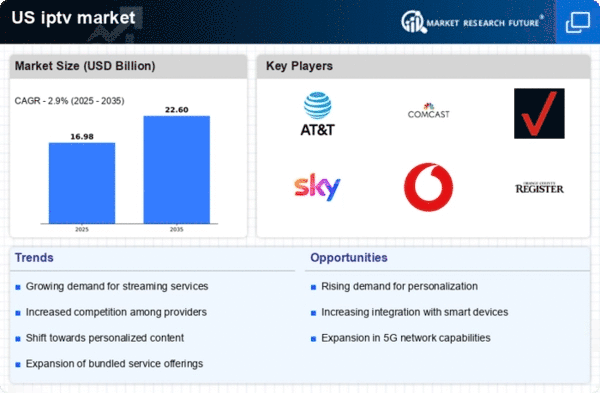
As per Market Research Future analysis, the US iptv market Size was estimated at 16.5 USD Billion in 2024. The US iptv market is projected to grow from 16.98 USD Billion in 2025 to 22.6 USD Billion by 2035, exhibiting a compound annual growth rate (CAGR) of 2% during the forecast period 2025 - 2035

Key Market Trends & Highlights

The US IPTV Market is experiencing robust growth driven by technological advancements and changing consumer preferences.

  • The demand for on-demand content continues to rise, reflecting a shift in consumer viewing habits.
  • Integration of advanced technologies is enhancing the overall user experience in the IPTV sector.
  • The market is witnessing a shift towards multi-device accessibility, allowing users to enjoy content across various platforms.
  • Rising consumer preference for streaming services and increased focus on original content production are key drivers of market growth.

Market Size & Forecast

2024 Market Size 16.5 (USD Billion)
2035 Market Size 22.6 (USD Billion)
CAGR (2025 - 2035) 2.9%

Major Players

AT&T (US), Comcast (US), Verizon (US), Sky Group (GB), Vodafone (GB), Orange (FR), Deutsche Telekom (DE), BT Group (GB), Telefónica (ES)

Our Impact
Enabled $4.3B Revenue Impact for Fortune 500 and Leading Multinationals
Partnering with 2000+ Global Organizations Each Year
30K+ Citations by Top-Tier Firms in the Industry

US IPTV Market Trends

The iptv market is currently experiencing a transformative phase characterized by rapid technological advancements and shifting consumer preferences. As viewers increasingly seek personalized content and flexible viewing options, service providers are adapting their offerings to meet these demands. The integration of artificial intelligence and machine learning into content delivery systems appears to enhance user experience, allowing for tailored recommendations and improved accessibility. Furthermore, the rise of mobile streaming is reshaping how consumers engage with content, leading to a surge in demand for services that support multi-device compatibility. In addition, the competitive landscape of the iptv market is evolving, with traditional cable providers facing challenges from emerging streaming platforms. This shift indicates a potential decline in conventional subscription models, as consumers gravitate towards more cost-effective and versatile alternatives. Regulatory frameworks are also adapting to accommodate the changing dynamics of content distribution, which may influence market growth and innovation. Overall, the iptv market is poised for continued expansion, driven by technological innovation and changing consumer behaviors.

Increased Demand for On-Demand Content

Consumers are increasingly favoring on-demand content over traditional broadcasting. This trend reflects a desire for flexibility and control over viewing schedules, prompting service providers to enhance their libraries with diverse programming.

Integration of Advanced Technologies

The incorporation of advanced technologies, such as artificial intelligence and machine learning, is becoming prevalent. These innovations facilitate personalized content recommendations, improving user engagement and satisfaction.

Shift Towards Multi-Device Accessibility

As mobile streaming gains traction, there is a noticeable shift towards services that offer multi-device compatibility. This trend allows users to access content seamlessly across various platforms, enhancing convenience and user experience.

US IPTV Market Drivers

Regulatory Support for IPTV Services

Regulatory frameworks are increasingly supporting the growth of the iptv market in the US. Recent policy changes have aimed at promoting competition and ensuring consumer protection within the telecommunications sector. The Federal Communications Commission (FCC) has implemented measures to facilitate the entry of new service providers, thereby enhancing consumer choice. This regulatory environment is conducive to innovation, as it encourages companies to develop unique offerings and improve service quality. Furthermore, the push for net neutrality ensures that all content is treated equally, fostering a level playing field for IPTV providers. As a result, the market is likely to see an influx of new entrants, which could lead to more competitive pricing and diverse content options for consumers. This regulatory support is essential for the sustainable growth of the iptv market.

Increased Focus on Original Content Production

The emphasis on original content production is becoming a defining characteristic of the iptv market. Major players are investing heavily in creating exclusive programming to attract and retain subscribers. This trend is evident as companies allocate substantial budgets for original series and films, with estimates suggesting that spending on original content could exceed $20 billion in the US by 2025. Such investments not only enhance the value proposition for consumers but also differentiate service providers in a crowded marketplace. As competition intensifies, the ability to offer unique and compelling content will likely become a critical factor in subscriber acquisition and retention. Consequently, the iptv market is evolving, with content quality and exclusivity emerging as key drivers of growth.

Rising Consumer Preference for Streaming Services

The growing inclination of consumers towards streaming services is a pivotal driver in the iptv market. As traditional cable subscriptions decline, more viewers are opting for flexible, on-demand content. Recent data indicates that approximately 70% of households in the US have subscribed to at least one streaming service, reflecting a shift in viewing habits. This trend is likely to continue, as consumers seek personalized viewing experiences and diverse content offerings. The iptv market is thus positioned to benefit from this transition, as providers adapt to meet the evolving demands of consumers. Enhanced user interfaces and content curation strategies are becoming essential for service providers to capture and retain subscribers. Consequently, the competitive landscape is intensifying, with new entrants and established players vying for market share in this dynamic environment.

Technological Advancements in Streaming Infrastructure

Technological innovations play a crucial role in shaping the iptv market. The deployment of high-speed internet and advancements in streaming technology have significantly improved the quality and reliability of IPTV services. With the increasing availability of 5G networks, consumers can expect faster data transmission and enhanced viewing experiences. Moreover, the integration of artificial intelligence and machine learning in content delivery systems is optimizing user engagement and satisfaction. As a result, service providers are investing heavily in infrastructure upgrades to support these technologies. The US market is witnessing a surge in investments, with projections indicating that spending on IPTV infrastructure could reach $10 billion by 2026. This focus on technology not only enhances service quality but also fosters innovation, enabling providers to differentiate themselves in a competitive landscape.

Growing Demand for Interactive and Personalized Viewing Experiences

The demand for interactive and personalized viewing experiences is reshaping the iptv market. Consumers are increasingly seeking services that offer tailored content recommendations and interactive features. This trend is driven by advancements in data analytics and user interface design, enabling providers to deliver customized experiences. Recent surveys indicate that over 60% of viewers prefer platforms that allow for personalized content curation. As a result, service providers are investing in technologies that enhance user engagement, such as interactive applications and social viewing features. This focus on personalization not only improves customer satisfaction but also fosters loyalty among subscribers. The iptv market is thus likely to see continued growth as providers adapt to meet these evolving consumer preferences.


Market Segment Insights

By Service Type: Subscription-based (Largest) vs. Advertisement-based (Fastest-Growing)

In the US iptv market, the distribution of service types shows that subscription-based services command the largest share, showcasing their popularity among consumers. Advertisement-based services, while smaller in terms of total share, are gaining traction rapidly, reflecting shifting preferences as users seek cost-effective viewing options. Hybrid services, which combine both subscription and advertisement models, also play an essential role in catering to diverse consumer needs. The growth trends within the service type segment indicate a robust increase in advertisement-based services driven by the rise of ad-supported content options. Consumers are increasingly drawn to platforms that offer flexibility, leading to an uptick in hybrid service models. Subscription-based services, while still dominant, may face challenges as competition increases and new entrants innovate within the advertisement-based space.

Subscription-based (Dominant) vs. Advertisement-based (Emerging)

Subscription-based services in the US iptv market are characterized by their stable revenue stream and loyal subscriber base, often featuring exclusive content that appeals to consumers. This dominance allows these services to invest in original programming and enhance user experience. On the other hand, advertisement-based services represent an emerging threat with their ability to offer free or low-cost viewing options. These services leverage data analytics to create targeted advertising, increasing engagement without a subscription fee. As they continue to evolve, advertisement-based platforms are expected to disrupt traditional subscription models by appealing to budget-conscious viewers and those seeking flexibility in their viewing options.

By Content Type: Live Television (Largest) vs. Video on Demand (Fastest-Growing)

In the US iptv market, the distribution of market share among content types reveals that Live Television currently holds the largest share due to its longstanding popularity and traditional viewer preferences. Coupled with a growing interest in live events such as sports and news, this segment continues to attract a substantial audience that values real-time content delivery. Meanwhile, Video on Demand is experiencing rapid growth as viewers increasingly shift towards on-demand content, capitalizing on the flexibility and control it offers over viewing experiences. The growth trends for the US iptv market's content types are clearly favoring Video on Demand, which is projected to disrupt the traditional viewing landscape. Factors such as advancements in broadband technology, the proliferation of smart devices, and changing consumer behaviors towards binge-watching have positioned Video on Demand as a front-runner. While Live Television remains a staple, its growth rate is slower compared to the accelerating demand for on-demand content, making Video on Demand a game-changer in the current market dynamics.

Live Television (Dominant) vs. Video on Demand (Emerging)

Live Television remains the dominant force in the US iptv market, appealing to viewers through its real-time broadcasting of events and scheduled programming. Its established infrastructure and significant investments in content delivery ensure a steady viewership, allowing broadcasters to engage audiences with live events that drive ratings and engagement. On the other hand, Video on Demand represents an emerging trend that caters to the consumer's desire for bespoke viewing experiences. With the ability to watch shows and movies at their convenience, subscribers are increasingly leaning towards this format. The growth of original content offerings from streaming platforms further enhances its popularity, positioning Video on Demand as a formidable rival to traditional live viewing.

By End-user: Residential (Largest) vs. Commercial (Fastest-Growing)

The market for the 'End-user' segment in the US iptv market is predominantly driven by the residential sector, which commands a substantial share due to the increasing demand for streaming services in households. This segment's popularity is attributed to the growing number of internet-connected devices and the convenience of on-demand content, making it the largest contributor to revenue. In contrast, the commercial sector, while smaller in share, is quickly gaining traction as businesses recognize the benefits of IPTV for delivering tailored content and advertising to their customers. Growth trends indicate a notable shift towards more individualized content offerings that resonate with the preferences of diverse user groups. The surge in remote work and educational requirements is also propelling demand for IPTV services in commercial and educational sectors, respectively. Educational institutions are leveraging IPTV for enhanced learning experiences, while government entities are exploring IPTV for communication and information dissemination, illustrating robust drivers for growth beyond traditional residential use.

Residential (Dominant) vs. Educational Institutions (Emerging)

The residential segment of the US iptv market remains dominant due to its established user base and the extensive availability of content options that cater to family or individual preferences. With advancements in broadband technology, households are enjoying seamless streaming experiences across multiple devices, driving engagement and subscription rates. In contrast, educational institutions present an emerging market with significant potential, characterized by a growing number of institutions adopting IPTV solutions to deliver educational content effectively. With a focus on interactive learning experiences, educational IPTV services are designed to engage students with high-quality video content, thereby enhancing educational outcomes. As these institutions recognize the value of IPTV in modern learning environments, they are becoming increasingly invested in such technologies.

By Deployment Type: Cloud-based (Largest) vs. On-premises (Fastest-Growing)

In the US iptv market, the deployment type segment is predominantly composed of cloud-based solutions, which hold the largest market share. This segment benefits from the scalability and flexibility that cloud technologies offer, making it the preferred choice for a wide array of service providers. Conversely, on-premises solutions are gaining traction, particularly among businesses that require greater control over their data and hardware, leading to an overall competitive landscape. The growth trends indicate a robust increase in demand for cloud-based services driven by advancements in streaming technology and consumer preferences for on-the-go access. Meanwhile, the on-premises segment is experiencing rapid growth as organizations invest in customised solutions and infrastructure improvements. This dual growth reflects a broader trend towards hybrid deployment models, with providers seeking to balance the benefits of both approaches.

Cloud-based (Dominant) vs. On-premises (Emerging)

Cloud-based deployment remains the dominant force in the US iptv market, characterized by its ability to deliver services efficiently and cost-effectively. This model allows providers to scale their offerings rapidly and respond dynamically to fluctuating consumer demands. In contrast, on-premises deployments are emerging as a solid alternative for businesses seeking enhanced security and customization. These solutions enable organizations to manage their infrastructure in-house, catering to specific needs and regulatory requirements. As competition intensifies, both segments will continue to adapt, with cloud-based services driving innovation and on-premises solutions offering tailored experiences.

Get more detailed insights about US IPTV Market

Key Players and Competitive Insights

The IPTV market in the US is characterized by a dynamic competitive landscape, driven by rapid technological advancements and shifting consumer preferences. Major players such as AT&T (US), Comcast (US), and Verizon (US) are at the forefront, each adopting distinct strategies to enhance their market positioning. AT&T (US) focuses on integrating its IPTV services with its extensive fiber network, aiming to deliver high-quality streaming experiences. Comcast (US), on the other hand, emphasizes content diversification and partnerships with streaming platforms, thereby broadening its service offerings. Verizon (US) is heavily investing in 5G technology to enhance its IPTV capabilities, indicating a strong commitment to innovation and customer satisfaction. Collectively, these strategies contribute to a competitive environment that is increasingly centered around technological integration and customer-centric services.The business tactics employed by these companies reflect a nuanced understanding of market demands. For instance, localizing content and optimizing supply chains are critical for enhancing service delivery and customer engagement. The market structure appears moderately fragmented, with several key players exerting influence over consumer choices. This fragmentation allows for a variety of service offerings, catering to diverse consumer preferences while fostering competition among providers.

In October AT&T (US) announced a strategic partnership with a leading streaming service to enhance its IPTV content library. This move is likely to attract a broader audience, particularly younger demographics who favor on-demand content. By expanding its content offerings, AT&T (US) positions itself as a more attractive option in a crowded market, potentially increasing its subscriber base and revenue streams.

In September Comcast (US) launched an innovative user interface for its IPTV platform, designed to improve user experience through personalized content recommendations. This strategic enhancement not only aims to retain existing customers but also to attract new subscribers by providing a more engaging viewing experience. The emphasis on user experience reflects a broader trend in the industry, where customer satisfaction is paramount.

In August Verizon (US) unveiled its plans to roll out 5G-enabled IPTV services across major urban areas. This initiative is expected to significantly enhance streaming quality and reduce latency, thereby improving overall customer satisfaction. The integration of 5G technology into IPTV services indicates a forward-thinking approach, positioning Verizon (US) as a leader in technological innovation within the market.

As of November current competitive trends in the IPTV market are heavily influenced by digitalization, sustainability, and the integration of artificial intelligence (AI). Strategic alliances among key players are shaping the landscape, fostering innovation and enhancing service delivery. The shift from price-based competition to a focus on technological advancement and supply chain reliability is evident. Companies are likely to differentiate themselves through innovative solutions and superior customer experiences, suggesting a future where technology and service quality take precedence over mere pricing strategies.

Key Companies in the US IPTV Market include

Industry Developments

The US IPTV Market has experienced significant developments recently, particularly regarding competition and service offerings. In October 2023, Verizon announced the expansion of its Fios TV services, introducing enhanced streaming capabilities that leverage 5G technology, aiming to attract more customers in a highly saturated market. Simultaneously, Altice USA has been upgrading its Optimum TV platform to improve user experience through better integration with streaming services. In September 2023, FuboTV reported record subscriber growth, driven by its focus on sports content, prompting an influx of investment aimed at furthering its content acquisition strategy.

Dish Network is actively pursuing partnerships with content providers to enhance its Sling TV service, while AT&T continues to restructure its digital offerings, with DirecTV focusing on standalone streaming options. Charter Communications has also seen growth in its Spectrum TV platform by bundling it with internet services. In terms of mergers and acquisitions, prominent movements include T-Mobile's strategic partnership with YouTube TV announced in August 2023, aiming to combine telecom and streaming experiences. These advancements highlight the evolving landscape of the US IPTV Market as companies adapt to consumer demands and digital transformation trends.

Future Outlook

US IPTV Market Future Outlook

The IPTV Market is projected to grow at a 2.9% CAGR from 2025 to 2035, driven by technological advancements, increased consumer demand, and competitive pricing strategies.

New opportunities lie in:

  • Development of personalized content delivery platforms
  • Expansion of bundled service packages with internet providers
  • Investment in advanced analytics for viewer behavior insights

By 2035, the IPTV market is expected to achieve robust growth, reflecting evolving consumer preferences and technological innovations.

Market Segmentation

US IPTV Market End-user Outlook

  • Residential
  • Commercial
  • Educational Institutions
  • Government

US IPTV Market Content Type Outlook

  • Live Television
  • Video on Demand
  • Time-shifted Television
  • Download to Own

US IPTV Market Service Type Outlook

  • Subscription-based
  • Advertisement-based
  • Hybrid

US IPTV Market Deployment Type Outlook

  • Cloud-based
  • On-premises

Report Scope

MARKET SIZE 2024 16.5(USD Billion)
MARKET SIZE 2025 16.98(USD Billion)
MARKET SIZE 2035 22.6(USD Billion)
COMPOUND ANNUAL GROWTH RATE (CAGR) 2.9% (2025 - 2035)
REPORT COVERAGE Revenue Forecast, Competitive Landscape, Growth Factors, and Trends
BASE YEAR 2024
Market Forecast Period 2025 - 2035
Historical Data 2019 - 2024
Market Forecast Units USD Billion
Key Companies Profiled AT&T (US), Comcast (US), Verizon (US), Sky Group (GB), Vodafone (GB), Orange (FR), Deutsche Telekom (DE), BT Group (GB), Telefónica (ES)
Segments Covered Service Type, Content Type, End-user, Deployment Type
Key Market Opportunities Integration of advanced streaming technologies enhances user experience in the iptv market.
Key Market Dynamics Rising consumer demand for personalized content drives competition and innovation in the IPTV market.
Countries Covered US
Leave a Comment

FAQs

What was the market size of the US IPTV market in 2024?

The market size of the US IPTV market in 2024 is valued at 14.51 USD Billion.

What will be the value of the US IPTV market in 2035?

By 2035, the US IPTV market is projected to reach a value of 25.0 USD Billion.

What is the expected compound annual growth rate (CAGR) for the US IPTV market from 2025 to 2035?

The expected CAGR for the US IPTV market from 2025 to 2035 is 5.071%.

What segment of the US IPTV market is expected to dominate in 2024?

The subscription-based segment is expected to dominate the US IPTV market in 2024, valued at 8.7 USD Billion.

How will the advertisement-based IPTV segment perform by 2035?

The advertisement-based IPTV segment is projected to reach 6.5 USD Billion by 2035.

Which companies are considered major players in the US IPTV market?

Major players in the US IPTV market include Verizon, FuboTV, Hulu, and Comcast among others.

What is the expected market size for the hybrid IPTV segment in 2024?

The hybrid IPTV segment is expected to be valued at 1.81 USD Billion in 2024.

How much is the subscription-based IPTV segment expected to be worth in 2035?

The subscription-based IPTV segment is anticipated to grow to 15.0 USD Billion by 2035.

What are the key growth drivers for the US IPTV market?

Key growth drivers for the US IPTV market include rising demand for on-demand content and advancements in streaming technology.

What challenges does the US IPTV market face in the coming years?

The US IPTV market faces challenges such as intense competition and regulatory hurdles which could impact growth.

Download Free Sample

Kindly complete the form below to receive a free sample of this Report

Compare Licence

×
Features License Type
Single User Multiuser License Enterprise User
Price $4,950 $5,950 $7,250
Maximum User Access Limit 1 User Upto 10 Users Unrestricted Access Throughout the Organization
Free Customization
Direct Access to Analyst
Deliverable Format
Platform Access
Discount on Next Purchase 10% 15% 15%
Printable Versions