×
Request Free Sample ×

Kindly complete the form below to receive a free sample of this Report

* Please use a valid business email

Leading companies partner with us for data-driven Insights

clients tt-cursor
Hero Background

US Homelab Market

ID: MRFR/ICT/60263-HCR
200 Pages
Aarti Dhapte
February 2026

US Homelab Market Research Report By Component (Hardware, Software Solutions, Operating Systems) and By End-User (Professionals, Home Users) - Forecast to 2035

Share:
Download PDF ×

We do not share your information with anyone. However, we may send you emails based on your report interest from time to time. You may contact us at any time to opt-out.

US Homelab Market Infographic
Purchase Options

US Homelab Market Summary

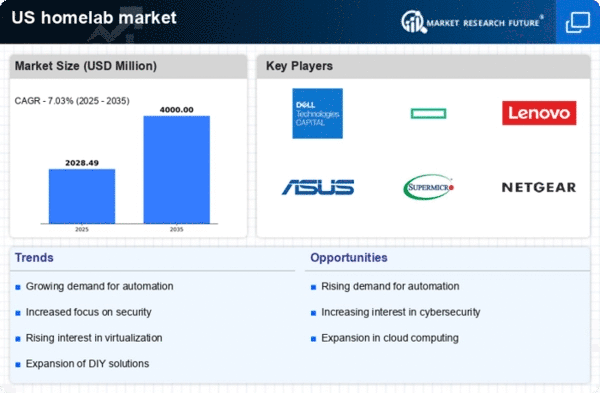
As per Market Research Future analysis, the US homelab market Size was estimated at 1895.25 USD Million in 2024. The US homelab market is projected to grow from 2028.49 USD Million in 2025 to 4000.0 USD Million by 2035, exhibiting a compound annual growth rate (CAGR) of 7.0% during the forecast period 2025 - 2035

Key Market Trends & Highlights

The US homelab market is experiencing robust growth driven by technological advancements and consumer interest in DIY solutions.

  • The largest segment in the US homelab market is home automation, reflecting a growing consumer preference for smart home technologies.
  • The fastest-growing segment is cybersecurity, as individuals increasingly seek to protect their home networks from threats.
  • Rising interest in DIY solutions is fostering a vibrant community focused on knowledge sharing and collaboration among enthusiasts.
  • Key market drivers include increased demand for home automation and advancements in networking technologies, which are shaping the market landscape.

Market Size & Forecast

2024 Market Size 1895.25 (USD Million)
2035 Market Size 4000.0 (USD Million)
CAGR (2025 - 2035) 7.03%

Major Players

Dell Technologies (US), Hewlett Packard Enterprise (US), Lenovo (CN), ASUS (TW), Supermicro (US), Netgear (US), Synology (TW), QNAP (TW), ZOTAC (HK)

Our Impact
Enabled $4.3B Revenue Impact for Fortune 500 and Leading Multinationals
Partnering with 2000+ Global Organizations Each Year
30K+ Citations by Top-Tier Firms in the Industry

US Homelab Market Trends

The homelab market is currently experiencing a notable evolution, driven by the increasing interest in personal computing and server management among tech enthusiasts and professionals. This trend appears to be fueled by the growing accessibility of advanced hardware and software solutions, which enable users to create customized environments for testing, development, and learning. As individuals seek to enhance their technical skills and experiment with various applications, the demand for homelab setups is likely to rise. Furthermore, the integration of cloud technologies and virtualization tools is reshaping how users approach their homelabs, allowing for more efficient resource management and scalability. In addition, the community surrounding the homelab market is thriving, with numerous online forums and resources available for knowledge sharing and support. This collaborative environment encourages innovation and experimentation, as users exchange ideas and solutions. The potential for remote work and the need for secure, private computing environments may also contribute to the sustained growth of this market. As individuals increasingly recognize the value of having a personal lab for development and testing, the homelab market is poised for continued expansion in the coming years.

Rising Interest in DIY Solutions

There is a growing trend towards do-it-yourself (DIY) solutions within the homelab market. Enthusiasts are increasingly building their own servers and networking equipment, driven by the desire for customization and cost-effectiveness. This trend reflects a broader movement towards self-sufficiency and hands-on learning, as individuals seek to gain practical experience in technology.

Integration of Cloud Technologies

The integration of cloud technologies into personal setups is becoming more prevalent. Users are leveraging cloud services to enhance their homelab environments, allowing for greater flexibility and scalability. This trend indicates a shift towards hybrid models, where local resources are complemented by cloud capabilities, providing users with a more robust and versatile infrastructure.

Community Engagement and Knowledge Sharing

The homelab market is characterized by a vibrant community that actively engages in knowledge sharing and collaboration. Online forums, social media groups, and local meetups facilitate discussions and the exchange of ideas. This trend highlights the importance of community support in fostering innovation and encouraging users to explore new technologies and methodologies.

US Homelab Market Drivers

Emergence of Edge Computing

The rise of edge computing is emerging as a significant driver for the homelab market. As organizations increasingly adopt edge computing solutions to process data closer to the source, individuals are also exploring similar setups at home. This trend is indicative of a broader shift towards decentralized computing, where users seek to reduce latency and improve performance. Market analysis suggests that the edge computing market is projected to grow by 30% annually through 2027. This growth is likely to encourage tech enthusiasts to establish homelabs that leverage edge computing principles, allowing for innovative applications and experiments. The homelab market stands to benefit from this trend, as users look to harness the power of edge computing for personal projects and learning opportunities.

Rise of Remote Work and Learning

The shift towards remote work and learning is a notable driver for the homelab market. As more individuals work from home or engage in online education, the need for reliable and efficient home computing solutions has intensified. This trend is reflected in the increasing sales of home office equipment, which saw a growth of 15% in 2025. Homelabs offer users the flexibility to create tailored environments that cater to their specific needs, whether for professional tasks or educational purposes. The ability to set up dedicated servers, virtual environments, and development platforms is appealing to those looking to optimize their productivity. As remote work and learning continue to be prevalent, the homelab market is expected to thrive, driven by the demand for customized home setups.

Growing Interest in Cybersecurity

The increasing focus on cybersecurity is significantly influencing the homelab market. As cyber threats become more sophisticated, individuals are recognizing the importance of securing their home networks. This awareness is driving users to establish homelabs for testing and learning about cybersecurity measures. Market data indicates that the cybersecurity industry is expected to reach $345 billion by 2026, highlighting the urgency for individuals to enhance their knowledge and skills in this area. Homelabs provide a practical environment for users to experiment with security tools and protocols, fostering a culture of proactive defense. Consequently, the homelab market is likely to see a rise in demand as users seek to bolster their cybersecurity capabilities and protect their personal information.

Increased Demand for Home Automation

The homelab market is experiencing a surge in demand for home automation solutions. As consumers increasingly seek to enhance their living environments, the integration of smart devices has become a priority. This trend is reflected in the market data, which indicates that the home automation sector is projected to grow at a CAGR of 25% through 2026. This growth is likely to drive the adoption of homelab setups, as users require robust systems to manage and control their devices. The desire for convenience and efficiency in home management is propelling individuals to invest in homelabs, which serve as centralized hubs for automation. Consequently, the homelab market is poised to benefit from this growing interest in smart home technologies, as more users look to create personalized and automated living spaces.

Advancements in Networking Technologies

The evolution of networking technologies is a pivotal driver for the homelab market. With the advent of faster internet speeds and improved networking protocols, users are increasingly able to set up complex homelab environments. Recent data suggests that the average internet speed in the US has reached 200 Mbps, facilitating seamless connectivity for multiple devices. This advancement allows enthusiasts to experiment with various configurations, from virtual machines to containerized applications. As networking becomes more accessible, the potential for innovation within the homelab market expands. Users are likely to explore new applications and services, further fueling the growth of this sector. The ability to create sophisticated networks at home is transforming how individuals engage with technology, making homelabs an attractive option for tech-savvy consumers.


Market Segment Insights

By Component: Hardware (Largest) vs. Software Solutions (Fastest-Growing)

In the US homelab market, the component segment demonstrates a notable distribution of market share among its three primary values: Hardware, Software Solutions, and Operating Systems. Among these, Hardware occupies the largest share, reflecting its dominance in the market, as many users seek robust physical components to build their homelabs. Conversely, Software Solutions, while not the largest, are rapidly gaining traction, appealing to a demographic that increasingly values the flexibility and scalability offered by software-driven solutions. The growth trends in this segment are driven by various factors. The rising adoption of cloud technologies has fostered a demand for Software Solutions, marking them as the fastest-growing category. Additionally, the continuous advancements in Hardware technology, such as improved processing capabilities and reduced costs, are stimulating consumer interest. Together, these elements signify a shift towards more integrated and software-oriented homelab setups, influencing purchasing decisions and future market dynamics.

Hardware (Dominant) vs. Software Solutions (Emerging)

Hardware remains the dominant value in the component segment, largely due to its foundational role in any homelab setup. Users prioritize high-performance servers, NAS units, and networking equipment that offer durability and reliability. This preference underscores the importance of investing in quality Hardware, as it enables seamless operations and is crucial for a functional homelab. On the other hand, Software Solutions are emerging as a strategic necessity, providing essential tools for management and automation that complement Hardware investments. Their rapid growth reflects a shift in user focus towards enhanced functionality and user experience, making them an increasingly vital part of the homelab ecosystem.

By End User: Professionals (Largest) vs. Home Users (Fastest-Growing)

In the US homelab market, the end user segment is primarily divided into two categories: professionals and home users. Professionals dominate this segment, leveraging homelabs for various technical and operational tasks. This user group tends to invest more heavily in advanced technologies and solutions, contributing significantly to their overall market share. On the other hand, home users represent the fastest-growing segment, driven by the increasing interest in DIY projects and personal development in tech skills. Factors such as the reduction in hardware costs and the rise of online educational resources are fueling this growth as more individuals seek to create their own homelab environments.

End Users: Professionals (Dominant) vs. Home Users (Emerging)

Professionals in the US homelab market are characterized by their advanced knowledge and technical skills, making them the largest user group. They typically utilize homelabs for software development, system testing, and network management, capitalizing on the flexibility and scalability these setups offer. In contrast, home users are emerging as a fast-growing demographic, attracted by user-friendly solutions and the availability of online support. This segment often seeks simplified setups for learning and experimentation, indicating a shift towards more accessible technologies that encourage personal skill enhancement and community engagement. Together, these segments highlight the diverse applications and appeal of homelabs across different user bases.

Get more detailed insights about US Homelab Market

Key Players and Competitive Insights

The homelab market exhibits a dynamic competitive landscape characterized by rapid technological advancements and increasing consumer demand for personalized computing solutions. Key players such as Dell Technologies (US), Hewlett Packard Enterprise (US), and Synology (TW) are strategically positioned to leverage innovation and customer-centric approaches. Dell Technologies (US) focuses on enhancing its product offerings through continuous innovation, while Hewlett Packard Enterprise (US) emphasizes partnerships to expand its market reach. Synology (TW) is known for its robust software solutions, which complement its hardware, thereby creating a comprehensive ecosystem for users. Collectively, these strategies foster a competitive environment that prioritizes technological advancement and customer satisfaction.In terms of business tactics, companies are increasingly localizing manufacturing and optimizing supply chains to enhance efficiency and reduce costs. The market structure appears moderately fragmented, with several players vying for market share. However, the influence of major companies like Dell Technologies (US) and Hewlett Packard Enterprise (US) is substantial, as they set industry standards and drive innovation. This competitive structure allows for a diverse range of products and services, catering to various consumer needs.

In October Dell Technologies (US) announced a new line of customizable servers aimed at the homelab segment, which is expected to enhance user experience through tailored solutions. This strategic move underscores Dell's commitment to innovation and its understanding of the growing demand for personalized computing environments. By offering customizable options, Dell Technologies (US) positions itself as a leader in meeting the specific needs of homelab enthusiasts.

In September Hewlett Packard Enterprise (US) expanded its partnership with a leading cloud service provider to integrate advanced AI capabilities into its homelab solutions. This collaboration is significant as it not only enhances the functionality of HPE's offerings but also aligns with the increasing trend of AI integration in technology solutions. By leveraging AI, HPE aims to provide users with smarter, more efficient systems that can adapt to their evolving needs.

In August Synology (TW) launched a new software update that significantly improves the performance and security of its NAS devices, which are popular in the homelab community. This update reflects Synology's ongoing commitment to enhancing user experience and security, which are critical factors for consumers in this market. By continuously improving its software, Synology (TW) strengthens its competitive position and fosters customer loyalty.

As of November current trends in the homelab market include a strong emphasis on digitalization, sustainability, and the integration of AI technologies. Strategic alliances among key players are shaping the competitive landscape, enabling companies to pool resources and expertise. Looking ahead, competitive differentiation is likely to evolve from price-based strategies to a focus on innovation, technology, and supply chain reliability. This shift suggests that companies will need to invest in research and development to stay ahead in a rapidly changing market.

Key Companies in the US Homelab Market include

Industry Developments

The US Homelab Market has seen significant developments recently, with companies like Dell enhancing their product offerings.In terms of mergers and acquisitions, Hewlett Packard Enterprise acquired a start-up focused on network optimization in July 2023, strengthening its position in the Homelab segment.The market valuation has experienced notable growth, with companies reporting increases in revenue driven by the rising demand for home-based technology solutions. 

This trend reflects a broader shift toward remote work and digital personalization, further incentivizing key players like Intel and AMD to innovate in server and processor technologies specifically designed for Homelabs. The US government has also recognized this growing sector, promoting initiatives to support tech home labs through local grants and resources.

Future Outlook

US Homelab Market Future Outlook

The Homelab Market is projected to grow at a 7.03% CAGR from 2025 to 2035, driven by increasing demand for home automation, data privacy, and remote work solutions.

New opportunities lie in:

  • Development of modular homelab systems for customizable setups.
  • Integration of AI-driven management tools for efficiency.
  • Expansion of subscription-based support services for maintenance and upgrades.

By 2035, the homelab market is expected to be robust, reflecting substantial growth and innovation.

Market Segmentation

US Homelab Market End User Outlook

  • Professionals
  • Home Users

US Homelab Market Component Outlook

  • Hardware
  • Software Solutions
  • Operating Systems

Report Scope

MARKET SIZE 2024 1895.25(USD Million)
MARKET SIZE 2025 2028.49(USD Million)
MARKET SIZE 2035 4000.0(USD Million)
COMPOUND ANNUAL GROWTH RATE (CAGR) 7.03% (2025 - 2035)
REPORT COVERAGE Revenue Forecast, Competitive Landscape, Growth Factors, and Trends
BASE YEAR 2024
Market Forecast Period 2025 - 2035
Historical Data 2019 - 2024
Market Forecast Units USD Million
Key Companies Profiled Dell Technologies (US), Hewlett Packard Enterprise (US), Lenovo (CN), ASUS (TW), Supermicro (US), Netgear (US), Synology (TW), QNAP (TW), ZOTAC (HK)
Segments Covered Component, End User
Key Market Opportunities Growing demand for personalized cloud solutions and home automation drives innovation in the homelab market.
Key Market Dynamics Rising consumer interest in home automation drives innovation and competition in the homelab market.
Countries Covered US
Leave a Comment

FAQs

What is the expected market size of the US Homelab Market in 2024?

The US Homelab Market is expected to be valued at 1.56 USD Billion in 2024.

What is the projected market size of the US Homelab Market by 2035?

By 2035, the US Homelab Market is projected to reach a value of 3.29 USD Billion.

What is the compound annual growth rate (CAGR) for the US Homelab Market from 2025 to 2035?

The CAGR for the US Homelab Market is anticipated to be 7.033% from 2025 to 2035.

Which component segment has the highest value in the US Homelab Market for 2024?

In 2024, the Hardware component segment of the US Homelab Market is valued at 0.67 USD Billion.

What will be the market value for Software Solutions in the US Homelab Market by 2035?

The Software Solutions segment in the US Homelab Market is expected to reach 1.16 USD Billion by 2035.

What is the forecasted market size for Operating Systems in the US Homelab Market for 2024?

The Operating Systems segment is forecasted to be valued at 0.34 USD Billion in 2024.

Who are the key players in the US Homelab Market?

Major players in the US Homelab Market include Intel, AMD, and Hewlett Packard Enterprise.

What are the emerging trends driving growth in the US Homelab Market?

Key trends driving growth in the US Homelab Market include increasing adoption of cloud technologies and demand for personalized computing solutions.

What challenges are currently facing the US Homelab Market?

The US Homelab Market is currently facing challenges such as rapid technological changes and security concerns.

What impacts do global conflicts have on the US Homelab Market?

Current global conflicts can create supply chain disruptions which may affect the US Homelab Market growth trajectory.

Download Free Sample

Kindly complete the form below to receive a free sample of this Report

Compare Licence

×
Features License Type
Single User Multiuser License Enterprise User
Price $4,950 $5,950 $7,250
Maximum User Access Limit 1 User Upto 10 Users Unrestricted Access Throughout the Organization
Free Customization
Direct Access to Analyst
Deliverable Format
Platform Access
Discount on Next Purchase 10% 15% 15%
Printable Versions