×
Request Free Sample ×

Kindly complete the form below to receive a free sample of this Report

* Please use a valid business email

Leading companies partner with us for data-driven Insights

clients tt-cursor
Hero Background

US Hemianopsia Market

ID: MRFR/Pharma/18403-HCR
100 Pages
Garvit Vyas
February 2026

US Hemianopsia Market Research Report By Type (Homonymous Hemianopsia, Heteronymous Hemianopsia, Quadrantanopia), By Cause (Stroke, Brain Tumor, Traumatic Brain Injury, Neurological Disorders), By Diagnostic Method (Visual Field Test, Optical Coherence Tomography, MRI) and By Treatment Type (Vision Therapy, Surgery, Medication) - Growth & Industry Forecast 2025 To 2035

Share:
Download PDF ×

We do not share your information with anyone. However, we may send you emails based on your report interest from time to time. You may contact us at any time to opt-out.

US Hemianopsia Market Infographic
Purchase Options

US Hemianopsia Market Summary

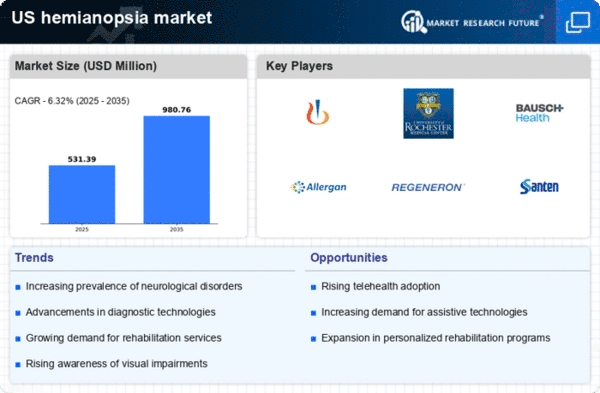
As per Market Research Future analysis, the US hemianopsia market Size was estimated at 499.8 USD Million in 2024. The US hemianopsia market is projected to grow from 531.39 USD Million in 2025 to 980.76 USD Million by 2035, exhibiting a compound annual growth rate (CAGR) of 6.3% during the forecast period 2025 - 2035

Key Market Trends & Highlights

The US hemianopsia market is experiencing growth driven by increased awareness and technological advancements.

  • Rising awareness and diagnosis of hemianopsia are leading to earlier interventions and improved patient outcomes.
  • Technological advancements in treatment options are enhancing the effectiveness of therapies available for hemianopsia.
  • The focus on personalized care is becoming more pronounced, tailoring treatments to individual patient needs.
  • Key market drivers include the increasing incidence of neurological disorders and advancements in diagnostic technologies.

Market Size & Forecast

2024 Market Size 499.8 (USD Million)
2035 Market Size 980.76 (USD Million)
CAGR (2025 - 2035) 6.32%

Major Players

Novartis (CH), Roche (CH), Bausch Health (CA), Allergan (IE), Regeneron Pharmaceuticals (US), Santen Pharmaceutical (JP), Hoya Corporation (JP), Carl Zeiss AG (DE)

Our Impact
Enabled $4.3B Revenue Impact for Fortune 500 and Leading Multinationals
Partnering with 2000+ Global Organizations Each Year
30K+ Citations by Top-Tier Firms in the Industry

US Hemianopsia Market Trends

The hemianopsia market is currently experiencing notable developments, driven by an increasing awareness of visual impairments and advancements in treatment options. Hemianopsia, characterized by a loss of vision in half of the visual field, often results from neurological conditions such as stroke or traumatic brain injury. As the population ages, the prevalence of such conditions is likely to rise, thereby expanding the patient base. Furthermore, healthcare providers are increasingly recognizing the importance of early diagnosis and intervention, which may lead to improved patient outcomes. This growing emphasis on timely treatment could potentially stimulate demand for innovative therapies and assistive technologies designed to aid individuals with hemianopsia. In addition, the hemianopsia market is influenced by ongoing research and development efforts aimed at enhancing therapeutic options. Emerging technologies, such as visual field restoration devices and neurostimulation techniques, are being explored to address the challenges faced by patients. Moreover, collaboration between healthcare professionals and technology developers appears to be fostering a more integrated approach to treatment. As awareness of hemianopsia continues to grow, it is anticipated that the market will evolve, with a focus on personalized care and tailored solutions for affected individuals. This evolution may ultimately lead to a more comprehensive understanding of the condition and its management, benefiting both patients and healthcare providers alike.

Rising Awareness and Diagnosis

There is a growing recognition of hemianopsia among healthcare professionals and the general public. Increased education about visual impairments is likely to lead to more individuals seeking diagnosis and treatment. This trend may result in a higher demand for specialized services and therapies tailored to those affected.

Technological Advancements in Treatment

Innovations in medical technology are playing a crucial role in the hemianopsia market. New devices and therapies, such as visual field restoration tools and neurostimulation methods, are being developed to improve patient outcomes. These advancements may enhance the quality of life for individuals living with hemianopsia.

Focus on Personalized Care

The trend towards personalized medicine is becoming increasingly relevant in the hemianopsia market. Tailored treatment plans that consider individual patient needs and conditions are likely to gain traction. This approach may lead to more effective management strategies and improved patient satisfaction.

US Hemianopsia Market Drivers

Rising Geriatric Population

The rising geriatric population in the US is a significant driver of the hemianopsia market. As individuals age, they become more susceptible to various health conditions, including those that can lead to hemianopsia, such as age-related macular degeneration and stroke. The US Census Bureau projects that by 2030, all baby boomers will be over 65 years old, resulting in a substantial increase in the elderly demographic. This demographic shift is likely to create a higher demand for eye care services and treatments specifically targeting hemianopsia. Consequently, healthcare providers may need to adapt their services to cater to this growing population, thereby influencing the trajectory of the hemianopsia market.

Advancements in Diagnostic Technologies

Innovations in diagnostic technologies are significantly impacting the hemianopsia market. Enhanced imaging techniques, such as optical coherence tomography (OCT) and advanced visual field testing, allow for earlier and more accurate detection of hemianopsia. The American Academy of Ophthalmology emphasizes the importance of timely diagnosis in improving patient outcomes. As these technologies become more accessible and affordable, healthcare providers are likely to adopt them more widely, leading to an increase in diagnosed cases. This trend may result in a corresponding rise in demand for treatment options, thereby driving growth in the hemianopsia market. Furthermore, the integration of artificial intelligence in diagnostic processes could streamline patient assessments, potentially enhancing the overall efficiency of care.

Growing Demand for Rehabilitation Services

The increasing demand for rehabilitation services is a notable driver of the hemianopsia market. As awareness of the impact of visual field loss on daily living grows, more patients are seeking specialized rehabilitation programs. According to the National Eye Institute, rehabilitation can significantly improve the quality of life for individuals with hemianopsia. This trend is likely to lead to a surge in the establishment of rehabilitation centers and the development of tailored programs, which may include orientation and mobility training, visual skills training, and compensatory strategies. Consequently, the expansion of these services is expected to create new opportunities within the hemianopsia market, as healthcare providers strive to meet the needs of this patient population.

Increasing Incidence of Neurological Disorders

The rising incidence of neurological disorders in the US is a crucial driver for the hemianopsia market. Conditions such as stroke, traumatic brain injury, and multiple sclerosis are known to contribute to the development of hemianopsia. According to the Centers for Disease Control and Prevention (CDC), stroke is a leading cause of long-term disability, affecting approximately 795,000 individuals annually in the US. This growing patient population necessitates enhanced diagnostic and therapeutic options, thereby propelling the hemianopsia market forward. As healthcare providers increasingly recognize the link between neurological conditions and visual field deficits, the demand for specialized treatments and rehabilitation services is likely to expand, further stimulating market growth.

Increased Investment in Research and Development

Investment in research and development (R&D) is a pivotal driver for the hemianopsia market. Pharmaceutical companies and medical device manufacturers are increasingly allocating resources to develop innovative treatments and technologies aimed at addressing hemianopsia. The National Institutes of Health (NIH) has reported a steady increase in funding for vision-related research, which may lead to breakthroughs in therapeutic options. This focus on R&D not only fosters the creation of new products but also enhances existing treatment modalities, thereby expanding the market landscape. As new therapies emerge, healthcare providers may be more inclined to adopt these advancements, further propelling the growth of the hemianopsia market.


Market Segment Insights

By Type: Homonymous Hemianopsia (Largest) vs. Quadrantanopia (Fastest-Growing)

In the US hemianopsia market, Homonymous Hemianopsia represents the largest segment, dominating the market share due to its prevalence among patients suffering from neurological disorders. This condition is characterized by a loss of vision in the outer half of the visual field in both eyes, making it a significant area of focus for healthcare providers. Meanwhile, Heteronymous Hemianopsia and Quadrantanopia are emerging segments with smaller shares, yet they contribute to a diversified landscape of visual impairments that are increasingly recognized in clinical settings. The growth trends in this segment are driven by rising awareness and advancements in diagnostic technologies, leading to improved detection and treatment options. Quadrantanopia, in particular, is becoming increasingly recognized as a relevant condition due to its association with various neurological conditions, resulting in an upward trend in demand for specialized therapy. As the medical community continues to educate and manage these conditions more effectively, segments like Quadrantanopia will likely experience more rapid growth compared to their counterparts.

Homonymous Hemianopsia (Dominant) vs. Quadrantanopia (Emerging)

Homonymous Hemianopsia is the dominant segment in the US hemianopsia market, characterized by a significant loss of half of the visual field on the same side in both eyes, often resulting from strokes or brain injuries. This condition has a comprehensive treatment ecosystem, including rehabilitative strategies and assistive technologies that cater to the needs of affected individuals. As healthcare providers enhance their focus on stroke recovery, the awareness of this condition has grown, contributing to its dominance in the market. On the other hand, Quadrantanopia, representing an emerging segment, involves loss of vision in a quarter of the visual field and is often associated with specific brain lesions. Acknowledging its distinct characteristics, healthcare professionals are increasingly focusing on targeted management options for this condition, leading to its rapid growth within the market.

By Cause: Stroke (Largest) vs. Traumatic Brain Injury (Fastest-Growing)

The US hemianopsia market is characterized by diverse causes, with stroke occupying the largest share due to its prevalence and significant impact on vision. Following stroke, traumatic brain injury has been on the rise as a notable contributor, reflecting an increase in awareness and diagnosis. Brain tumor and neurological disorders also represent critical segments, although they hold smaller market shares in comparison. In terms of growth trends, the stroke segment remains stable, while traumatic brain injury is experiencing rapid growth driven by improvements in medical imaging and rehabilitation techniques. Moreover, increasing public awareness about brain injuries and their consequences is propelling the demand for targeted therapies and interventions. The rise in aging populations also adds to the segment's dynamics, highlighting the urgency for effective treatment options.

Stroke (Dominant) vs. Brain Tumor (Emerging)

Stroke is the dominant cause within the US hemianopsia market, representing a well-established segment primarily influenced by the high rates of incidence and public health initiatives aimed at prevention and rehabilitation. Its significant market position is bolstered by extensive research and development dedicated to stroke-related therapies. In contrast, the brain tumor segment is emerging, characterized by advanced diagnostic technologies leading to earlier detection. As clinical studies advance, there is a growing focus on targeted treatments for brain tumors, which has made this segment increasingly vital. The dynamics between these two segments illustrate the urgency for continued innovation and patient-centric approaches in the treatment landscape.

By Diagnostic Method: Visual Field Test (Largest) vs. Optical Coherence Tomography (Fastest-Growing)

The US hemianopsia market is characterized by a diverse range of diagnostic methods, with the Visual Field Test capturing the largest market share. This method is widely recognized for its effectiveness in identifying visual field loss, making it a preferred choice among clinicians. On the other hand, Optical Coherence Tomography, while having a smaller share, is rapidly gaining traction due to its advanced imaging capabilities and increasing adoption rates in clinical practice. Growth trends indicate a strong shift towards more sophisticated diagnosis techniques in the US hemianopsia market. The demand for Optical Coherence Tomography is driven by advancements in technology, resulting in enhanced patient outcomes. Additionally, increased awareness regarding hemianopsia and its implications among healthcare professionals is expected to push the adoption of both Visual Field Tests and Optical Coherence Tomography in the upcoming years. Furthermore, MRI remains an essential tool, contributing to comprehensive diagnostics by providing detailed images of brain structure and function.

Diagnostic Methods: Visual Field Test (Dominant) vs. Optical Coherence Tomography (Emerging)

The Visual Field Test is the dominant diagnostic method in the US hemianopsia market, renowned for its simplicity and effectiveness in detecting peripheral vision loss. This test is integral to routine eye examinations, making it widely accessible and commonly utilized. In contrast, Optical Coherence Tomography is emerging rapidly due to its ability to deliver high-resolution cross-sectional images of the retina, facilitating a deeper understanding of various eye conditions, including hemianopsia. Its adoption is driven by technological progress, offering better precision compared to traditional methods. As both methods cater to different aspects of diagnosis, they complement each other by improving overall diagnostic accuracy and patient management in clinical settings.

By Treatment Type: Surgery (Largest) vs. Vision Therapy (Fastest-Growing)

In the US hemianopsia market, Surgery holds the largest market share among treatment types, as it offers immediate results and addresses the root causes of vision loss effectively. Vision Therapy, while smaller in market share, is experiencing rapid growth due to its non-invasive approach and increasing acceptance among patients. Medication, although important, stands at the periphery in terms of overall market distribution, as it complements the more prominent treatments. The growth trends in the US hemianopsia market indicate a significant shift towards minimally invasive and patient-centered approaches. Vision Therapy is becoming the fastest-growing segment, driven by rising awareness of its benefits and improvements in technology that enable personalized treatments. Meanwhile, Surgery remains a preferred choice for severe cases, highlighting a dual focus in treatment preferences within this evolving market.

Surgery (Dominant) vs. Vision Therapy (Emerging)

Surgery is the dominant treatment type in the US hemianopsia market, primarily utilized for patients with severe vision impairment. This approach is often favored for its capability to deliver immediate results and its effectiveness in addressing underlying anatomical issues. On the other hand, Vision Therapy is emerging strongly, appealing to a broader patient demographic due to its non-invasive techniques and tailored treatment plans. While Surgery is essential for acute cases, Vision Therapy is gaining traction for its ability to enhance visual processing and rehabilitation, particularly in mild to moderate conditions. The diverse methodologies underpinning these treatments reflect a balance between immediate corrective measures and long-term rehabilitative strategies.

Get more detailed insights about US Hemianopsia Market

Key Players and Competitive Insights

The hemianopsia market exhibits a competitive landscape characterized by a blend of innovation and strategic partnerships among key players. Companies such as Regeneron Pharmaceuticals (US), Novartis (CH), and Bausch Health (CA) are at the forefront, leveraging their extensive research capabilities and established market presence to drive growth. Regeneron Pharmaceuticals (US) focuses on developing cutting-edge therapies, while Novartis (CH) emphasizes strategic acquisitions to enhance its product portfolio. Bausch Health (CA) is actively pursuing regional expansion, particularly in North America, to capitalize on the growing demand for hemianopsia treatments. Collectively, these strategies foster a dynamic environment where innovation and market responsiveness are paramount.In terms of business tactics, companies are increasingly localizing manufacturing and optimizing supply chains to enhance efficiency and reduce costs. The competitive structure of the hemianopsia market appears moderately fragmented, with several players vying for market share. However, the influence of major companies is substantial, as they set industry standards and drive technological advancements that smaller firms often follow.

In October Regeneron Pharmaceuticals (US) announced a collaboration with a leading technology firm to integrate AI into its drug development processes. This strategic move is likely to streamline research and development, potentially reducing time-to-market for new therapies. The integration of AI could enhance the precision of clinical trials, thereby improving outcomes for patients suffering from hemianopsia.

In September Novartis (CH) completed the acquisition of a biotech company specializing in innovative ocular therapies. This acquisition is significant as it not only expands Novartis's product offerings but also strengthens its position in the hemianopsia market. By incorporating advanced technologies and novel treatment modalities, Novartis aims to address unmet medical needs and enhance patient care.

In August Bausch Health (CA) launched a new line of hemianopsia treatment devices designed to improve patient accessibility and ease of use. This initiative reflects Bausch's commitment to enhancing patient outcomes through innovative solutions. By focusing on user-friendly designs, the company is likely to capture a larger share of the market, appealing to both healthcare providers and patients.

As of November current trends in the hemianopsia market indicate a strong emphasis on digitalization, sustainability, and the integration of AI technologies. Strategic alliances are increasingly shaping the competitive landscape, enabling companies to pool resources and expertise. Looking ahead, competitive differentiation is expected to evolve, with a shift from price-based competition to a focus on innovation, technological advancements, and supply chain reliability. This transition may redefine market dynamics, compelling companies to invest in research and development to maintain a competitive edge.

Key Companies in the US Hemianopsia Market include

Industry Developments

The US Hemianopsia Market has witnessed significant activity lately, particularly around advancements in treatment options and technology integration. In September 2023, Genentech announced the initiation of a new clinical trial assessing the efficacy of their innovative therapy for visual impairment caused by hemianopsia. Meanwhile, Aerie Pharmaceuticals has made strides in the development of eye care products specifically targeting visual field defects, indicating a shift towards more specialized solutions.

Current affairs also reflect an increased focus on telemedicine and digital health tools in managing hemianopsia, aligning with broader trends toward remote healthcare provisions in the US. Mergers and acquisitions are shaping the landscape, with Novartis reportedly expanding its portfolio through a merger with a smaller tech firm focused on retinal health in July 2023, enhancing their research capabilities in this domain. Additionally, Regeneron Pharmaceuticals has bolstered its market position through strategic partnerships aimed at innovating treatment methods.

The overall valuation of companies in this sector has been positively impacted by these developments, with a projected growth rate fueled by ongoing research and collaboration among major players like Merck and Co., Roche, and Johnson and Johnson in recent years.

Future Outlook

US Hemianopsia Market Future Outlook

The Hemianopsia Market is projected to grow at a 6.32% CAGR from 2025 to 2035, driven by advancements in diagnostic technologies and increasing awareness of visual impairments.

New opportunities lie in:

  • Development of telehealth platforms for remote patient monitoring
  • Investment in AI-driven diagnostic tools for early detection
  • Expansion of rehabilitation services tailored for hemianopsia patients

By 2035, the market is expected to achieve substantial growth, enhancing patient care and treatment options.

Market Segmentation

US Hemianopsia Market Type Outlook

  • Homonymous Hemianopsia
  • Heteronymous Hemianopsia
  • Quadrantanopia

US Hemianopsia Market Cause Outlook

  • Stroke
  • Brain Tumor
  • Traumatic Brain Injury
  • Neurological Disorders

US Hemianopsia Market Treatment Type Outlook

  • Vision Therapy
  • Surgery
  • Medication

US Hemianopsia Market Diagnostic Method Outlook

  • Visual Field Test
  • Optical Coherence Tomography
  • MRI

Report Scope

MARKET SIZE 2024 499.8(USD Million)
MARKET SIZE 2025 531.39(USD Million)
MARKET SIZE 2035 980.76(USD Million)
COMPOUND ANNUAL GROWTH RATE (CAGR) 6.32% (2025 - 2035)
REPORT COVERAGE Revenue Forecast, Competitive Landscape, Growth Factors, and Trends
BASE YEAR 2024
Market Forecast Period 2025 - 2035
Historical Data 2019 - 2024
Market Forecast Units USD Million
Key Companies Profiled Novartis (CH), Roche (CH), Bausch Health (CA), Allergan (IE), Regeneron Pharmaceuticals (US), Santen Pharmaceutical (JP), Hoya Corporation (JP), Carl Zeiss AG (DE)
Segments Covered Type, Cause, Diagnostic Method, Treatment Type
Key Market Opportunities Advancements in digital therapies and assistive technologies enhance treatment options in the hemianopsia market.
Key Market Dynamics Technological advancements in treatment options are reshaping the competitive landscape of the hemianopsia market.
Countries Covered US
Leave a Comment

FAQs

What is the projected market size of the US Hemianopsia Market in 2024?

The US Hemianopsia Market is projected to be valued at 84.0 million USD in 2024.

What is the expected market valuation for the US Hemianopsia Market by 2035?

The expected market valuation for the US Hemianopsia Market is projected to reach 215.0 million USD by 2035.

What is the expected compound annual growth rate (CAGR) for the US Hemianopsia Market from 2025 to 2035?

The expected CAGR for the US Hemianopsia Market from 2025 to 2035 is 8.919 percent.

Which type of hemianopsia holds the largest market value in 2024?

In 2024, Homonymous Hemianopsia holds the largest market value at 30.0 million USD.

What is the projected market value for Heteronymous Hemianopsia by 2035?

The projected market value for Heteronymous Hemianopsia is expected to reach 72.0 million USD by 2035.

Which companies are considered key players in the US Hemianopsia Market?

Key players in the US Hemianopsia Market include Genentech, Aerie Pharmaceuticals, and Merck and Co.

What is the expected market value for Quadrantanopia in 2024?

The expected market value for Quadrantanopia in 2024 is 26.0 million USD.

What are the expected growth drivers for the US Hemianopsia Market?

Key growth drivers for the US Hemianopsia Market include increasing prevalence of neurological disorders and advancements in treatment options.

How does the US Hemianopsia Market growth rate vary by segment?

The US Hemianopsia Market's growth rate is influenced by the performance of each type segment, with Homonymous Hemianopsia showing significant potential.

What are the key challenges faced by the US Hemianopsia Market?

Key challenges faced by the US Hemianopsia Market include high treatment costs and limited awareness of hemianopsia conditions.

Download Free Sample

Kindly complete the form below to receive a free sample of this Report

Compare Licence

×
Features License Type
Single User Multiuser License Enterprise User
Price $4,950 $5,950 $7,250
Maximum User Access Limit 1 User Upto 10 Users Unrestricted Access Throughout the Organization
Free Customization
Direct Access to Analyst
Deliverable Format
Platform Access
Discount on Next Purchase 10% 15% 15%
Printable Versions