×
Request Free Sample ×

Kindly complete the form below to receive a free sample of this Report

* Please use a valid business email

Leading companies partner with us for data-driven Insights

clients tt-cursor
Hero Background

US Hand Wash Market

ID: MRFR/CG/19395-HCR
128 Pages
Garvit Vyas
February 2026

US Hand Wash Market Size, Share, Industry Trend & Analysis Research Report: By Product Type (Foam Hand Wash, Liquid Hand Wash, Gel Hand Wash, Antibacterial Hand Wash), By Packaging Type (Bottle, Pump, Refill Pouch, Sachet), By Distribution Channel (Supermarkets, Online Retail, Pharmacies, Convenience Stores) andBy End User (Residential, Commercial, Healthcare, Educational Institutions)- Forecast to 2035

Share:
Download PDF ×

We do not share your information with anyone. However, we may send you emails based on your report interest from time to time. You may contact us at any time to opt-out.

US Hand Wash Market Infographic
Purchase Options

US Hand Wash Market Summary

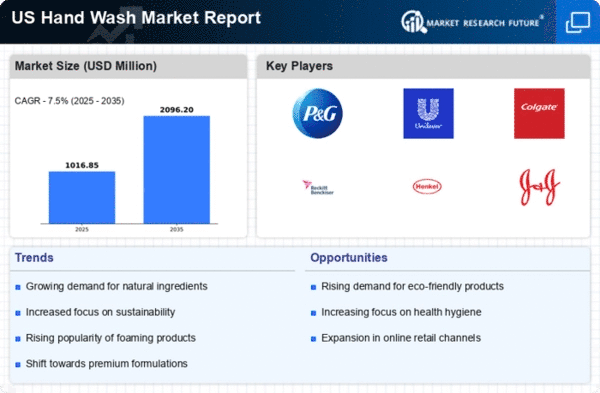
As per Market Research Future analysis, the US hand wash market Size was estimated at 945.91 USD Million in 2024. The US hand wash market is projected to grow from 1016.85 USD Million in 2025 to 2096.2 USD Million by 2035, exhibiting a compound annual growth rate (CAGR) of 7% during the forecast period 2025 - 2035

Key Market Trends & Highlights

The US hand wash market is experiencing a notable shift towards natural and sustainable products.

  • The largest segment in the US hand wash market is liquid hand wash, while the fastest-growing segment is foaming hand wash.
  • There is a marked trend towards the use of natural ingredients, reflecting consumer preferences for health-conscious products.
  • Sustainability in packaging is becoming increasingly important, with brands seeking eco-friendly solutions to attract environmentally aware consumers.
  • Increased health awareness and e-commerce growth are driving market expansion, as consumers prioritize hygiene and convenience.

Market Size & Forecast

2024 Market Size 945.91 (USD Million)
2035 Market Size 2096.2 (USD Million)
CAGR (2025 - 2035) 7.5%

Major Players

Procter & Gamble (US), Unilever (GB), Colgate-Palmolive (US), Reckitt Benckiser (GB), Henkel (DE), Johnson & Johnson (US), Caldrea (US), Method Products (US), Ecover (BE)

Our Impact
Enabled $4.3B Revenue Impact for Fortune 500 and Leading Multinationals
Partnering with 2000+ Global Organizations Each Year
30K+ Citations by Top-Tier Firms in the Industry

US Hand Wash Market Trends

The hand wash market is currently experiencing a notable transformation, driven by evolving consumer preferences and heightened awareness regarding hygiene practices. As individuals increasingly prioritize cleanliness, the demand for various hand wash formulations has surged. This shift is evident in the growing popularity of natural and organic products, which appeal to health-conscious consumers seeking safer alternatives. Furthermore, the market is witnessing a rise in innovative packaging solutions that enhance user experience while promoting sustainability. The integration of eco-friendly materials aligns with the broader trend of environmental consciousness among consumers, suggesting a potential shift in purchasing behaviors. In addition, the hand wash market is characterized by a diversification of product offerings, catering to a wide range of demographics. Brands are now focusing on creating specialized formulations that address specific needs, such as moisturizing properties or antibacterial effectiveness. This trend indicates a move towards personalization in hygiene products, as consumers seek solutions tailored to their individual requirements. Overall, the hand wash market appears poised for continued growth, driven by a combination of health awareness, innovation, and a commitment to sustainability.

Rise of Natural Ingredients

There is a growing trend towards the use of natural and organic ingredients in hand wash products. Consumers are increasingly concerned about the chemicals in personal care items, leading to a preference for formulations that are free from synthetic additives. This shift reflects a broader movement towards health and wellness, as individuals seek products that are both effective and gentle on the skin.

Sustainability in Packaging

Sustainability is becoming a key focus in the hand wash market, particularly in packaging solutions. Brands are exploring eco-friendly materials and designs that reduce environmental impact. This trend aligns with consumer demand for responsible products, as individuals are more likely to support companies that demonstrate a commitment to sustainability.

Personalization of Products

The hand wash market is witnessing a trend towards personalization, with brands offering specialized formulations to meet diverse consumer needs. This includes products designed for specific skin types or those that provide additional benefits, such as moisturizing or antibacterial properties. This approach caters to the desire for tailored solutions in personal care.

US Hand Wash Market Drivers

E-commerce Growth

The hand wash market is witnessing a significant transformation due to the rapid growth of e-commerce platforms. With an increasing number of consumers opting for online shopping, the accessibility of hand wash products has expanded dramatically. Data indicates that e-commerce sales in the personal care sector have risen by over 30% in the past year. This shift allows brands to reach a broader audience and cater to diverse consumer preferences. Additionally, the convenience of online shopping encourages impulse purchases, further driving sales in the hand wash market. Companies are investing in digital marketing strategies to enhance their online presence, ensuring that their products are easily discoverable and appealing to consumers in the digital space.

Regulatory Compliance

The hand wash market is significantly influenced by regulatory compliance, as government agencies establish guidelines to ensure product safety and efficacy. Compliance with these regulations is essential for brands aiming to maintain consumer trust and market access. Recent updates to safety standards have prompted manufacturers to reformulate products, ensuring they meet the latest requirements. This focus on compliance not only enhances product quality but also fosters consumer confidence in the hand wash market. Brands that proactively adapt to regulatory changes are better positioned to succeed, as they demonstrate a commitment to safety and transparency, which resonates with increasingly informed consumers.

Rising Disposable Income

The hand wash market benefits from the rising disposable income of consumers, particularly in urban areas. As individuals experience an increase in their purchasing power, they are more inclined to invest in premium hand wash products that offer enhanced features and benefits. Market data indicates that the demand for luxury and specialty hand washes has grown by approximately 15% in the last year. This trend suggests that consumers are willing to pay a premium for products that align with their lifestyle and values. Consequently, brands that position themselves as providers of high-quality, luxurious hand wash options are likely to capture a larger share of the market, capitalizing on the evolving preferences of affluent consumers.

Increased Health Awareness

The hand wash market experiences a notable surge in demand due to heightened health awareness among consumers. This trend is driven by a growing understanding of hygiene practices and their role in preventing illness. According to recent data, approximately 70% of consumers prioritize hand hygiene, leading to increased sales of hand wash products. The industry adapts by introducing formulations that emphasize antibacterial properties and skin-friendly ingredients. As consumers become more discerning, brands that effectively communicate their health benefits are likely to gain a competitive edge. This shift in consumer behavior not only boosts sales but also encourages innovation within the hand wash market, as companies strive to meet the evolving expectations of health-conscious consumers.

Innovative Product Offerings

Innovation plays a crucial role in shaping the hand wash market, as brands continuously seek to differentiate themselves through unique product offerings. The introduction of specialized formulations, such as foaming hand washes and moisturizing variants, caters to diverse consumer needs. Recent market analysis suggests that products featuring natural ingredients are gaining traction, with a reported 25% increase in sales for such items. This trend reflects a broader consumer preference for products that align with their values, particularly regarding health and environmental sustainability. As competition intensifies, companies that prioritize innovation and respond to consumer demands are likely to thrive in the evolving landscape of the hand wash market.


Market Segment Insights

By Type: Liquid Hand Wash (Largest) vs. Antibacterial Hand Wash (Fastest-Growing)

In the US hand wash market, the distribution of market share among the various segment values reveals that Liquid Hand Wash holds the largest share, appealing to a broad demographic due to its versatility and availability. Following closely is Foam Hand Wash, known for its luxurious lather and consumer-friendly nature, while Gel Hand Wash remains a staple in many households. Antibacterial Hand Wash, although smaller in overall market share, is gaining traction due to increased health awareness. The growth trends within this segment are driven primarily by changing consumer preferences and heightened awareness of hygiene. The rising demand for Antibacterial Hand Wash is influenced by the COVID-19 pandemic, leading consumers to prioritize hygiene solutions. Moreover, the innovative formulations of Foam and Liquid Hand Wash are attracting new customers, while eco-friendly options are setting the stage for future growth in this market.

Liquid Hand Wash (Dominant) vs. Antibacterial Hand Wash (Emerging)

Liquid Hand Wash is currently the dominant segment in the US hand wash market, characterized by its broad appeal and effective cleansing properties. It is commonly available in a variety of scents and formulations, catering to diverse consumer preferences. The segment enjoys significant recognition for its ease of use and extensive distribution, making it a preferred choice for everyday use. Conversely, Antibacterial Hand Wash is emerging as a key player, positioned as a necessary hygiene product in today’s health-conscious environment. This segment emphasizes the importance of germ protection, appealing to consumers seeking enhanced cleanliness. As public health awareness continues to rise, Antibacterial Hand Wash is likely to see increased adoption, bolstered by strategic marketing and product development.

By Packaging Type: Bottle (Largest) vs. Pump (Fastest-Growing)

In the US hand wash market, the packaging type segment showcases a diverse distribution, with bottles leading in market share. These traditional packaging options remain popular due to their convenience and suitability for frequent use. Pump dispensers follow as a significant player, gaining traction among consumers who prioritize hygiene and efficiency in hand washing routines. Refill pouches and sachets, while smaller in market share, cater to eco-conscious consumers seeking sustainable options. Growth trends in this segment indicate a rising preference for pump dispensers, which are increasingly seen as the fastest-growing type among consumers. This shift is driven by a focus on convenience and user-friendly features, along with an ecological inclination towards refillable options. As health and cleanliness become paramount, innovation in packaging is likely to further influence market dynamics, enhancing the demand for pump and refillable solutions.

Bottle (Dominant) vs. Refill Pouch (Emerging)

Bottles dominate the packaging type segment within the US hand wash market, favored for their practicality and effectiveness in dispensing liquid soaps. Their widespread acceptance is attributed to factors like branding visibility and ease of use. In contrast, refill pouches, though emerging, are carving a niche among environmentally conscious consumers who seek to reduce plastic waste. These pouches allow for convenient refilling of existing bottles, promoting sustainability without sacrificing functionality. The growing eco-awareness among consumers is gradually increasing the popularity of refill pouches, positioning them as a key alternative in the market.

By Distribution Channel: Supermarkets (Largest) vs. Online Retail (Fastest-Growing)

The distribution of market share within the segment indicates that supermarkets hold the largest portion of sales in the US hand wash market, reflecting consumer preferences for shopping in physical stores where they can see and select products in-person. Online retail has been capturing an increasing share, especially as consumers become more comfortable with e-commerce platforms, further driven by convenience and home delivery options available through these channels. Growth trends highlight the rapidly expanding online retail segment, which is quickly catching up to traditional channels due to the significant shift in consumer buying habits influenced by the convenience of online shopping. Factors like enhanced digital marketing strategies and improved logistics have enabled online platforms to appeal to a broader audience, making it the fastest-growing channel in the market.

Supermarkets: Dominant vs. Online Retail: Emerging

Supermarkets serve as the dominant distribution channel in the segment, offering a wide variety of hand wash products that cater to diverse consumer needs. They benefit from established customer loyalty and physical accessibility, which drives foot traffic and repeat purchases. Conversely, online retail represents an emerging channel with rapid growth potential, appealing to tech-savvy consumers looking for convenient shopping solutions. This segment thrives on offering competitive prices, frequent promotions, and the ability to deliver products directly to consumers. As shopping habits evolve, online retail is expected to continue gaining traction, leveraging advanced e-commerce technologies to enhance user experience and retain customers.

By End User: Residential (Largest) vs. Healthcare (Fastest-Growing)

The market share distribution among the various end user segments illustrates that the Residential segment holds a significant share in the US hand wash market, dominating due to the consistent demand stemming from households prioritizing hygiene. This segment benefits from large-scale retail availability and consumer preference for branded products, thus maintaining its large footprint against competing categories. Conversely, the Healthcare segment is the fastest-growing segment driven by increased health awareness and stringent hygiene regulations. In the wake of health crises, institutions and facilities are focusing on enhancing their sanitation protocols, leading to a surge in demand for efficient hand wash products. This growth trend is supported by innovations in formulations aimed at superior germ elimination and skin protection.

Residential (Dominant) vs. Healthcare (Emerging)

The Residential segment is characterized by robust consumer loyalty and a wide selection of products available in supermarkets and online platforms. This segment is driven by consumers' growing concerns about cleanliness and their willingness to invest in quality hand wash products. In contrast, the Healthcare segment represents an emerging market, propelled by the rising awareness of infection control and the need for effective hand hygiene. These products are tailored to meet stringent industry standards and provide a higher efficacy in germ removal, catering specifically to hospitals, clinics, and care facilities. As both segments evolve, they reflect the changing priorities of consumers and institutions towards hygiene.

Get more detailed insights about US Hand Wash Market

Key Players and Competitive Insights

The hand wash market exhibits a dynamic competitive landscape characterized by innovation, sustainability, and strategic partnerships. Key players such as Procter & Gamble (US), Unilever (GB), and Colgate-Palmolive (US) are actively shaping the market through their distinct operational focuses. Procter & Gamble (US) emphasizes product innovation, particularly in developing eco-friendly formulations, which aligns with the growing consumer demand for sustainable products. Unilever (GB) leverages its extensive distribution network to enhance market penetration, while Colgate-Palmolive (US) focuses on expanding its product lines to include natural ingredients, thereby appealing to health-conscious consumers. Collectively, these strategies foster a competitive environment that prioritizes sustainability and consumer preferences.The market structure appears moderately fragmented, with several players vying for market share. Key business tactics such as localizing manufacturing and optimizing supply chains are prevalent among these companies. For instance, local production not only reduces costs but also enhances responsiveness to regional consumer preferences. The collective influence of these major players contributes to a competitive atmosphere where innovation and operational efficiency are paramount.

In October Unilever (GB) announced a partnership with a leading technology firm to develop AI-driven solutions for personalized hand wash products. This strategic move is likely to enhance consumer engagement by offering tailored solutions that meet individual preferences, thereby positioning Unilever (GB) as a frontrunner in the personalization trend within the market. Such initiatives may significantly influence consumer loyalty and brand perception.

In September Procter & Gamble (US) launched a new line of biodegradable hand wash products, reinforcing its commitment to sustainability. This initiative not only addresses environmental concerns but also aligns with the increasing consumer preference for eco-friendly products. The launch is expected to strengthen Procter & Gamble's market position by appealing to environmentally conscious consumers, potentially increasing market share in a competitive landscape.

In August Colgate-Palmolive (US) expanded its product offerings by introducing a new range of hand washes infused with natural essential oils. This strategic expansion reflects the company's focus on health and wellness trends, catering to consumers seeking natural and organic options. The introduction of these products may enhance Colgate-Palmolive's competitive edge by attracting a niche market segment that prioritizes ingredient transparency and health benefits.

As of November the hand wash market is increasingly defined by trends such as digitalization, sustainability, and the integration of AI technologies. Strategic alliances among key players are shaping the competitive landscape, fostering innovation and enhancing product offerings. The shift from price-based competition to a focus on technological advancements and supply chain reliability is evident. Moving forward, competitive differentiation will likely hinge on the ability to innovate and adapt to evolving consumer preferences, with sustainability and personalization at the forefront of market strategies.

Key Companies in the US Hand Wash Market include

Industry Developments

The US Hand Wash Market has seen several noteworthy developments recently. In September 2023, Procter and Gamble launched a new line of eco-friendly hand wash products aimed at reducing plastic waste, contributing to an overall growth in sustainability trends within the market. Companies like Unilever have also been emphasizing their commitment to sustainable practices, introducing products that are both effective and environmentally friendly. In terms of mergers and acquisitions, in August 2023, Reckitt Benckiser announced the acquisition of a smaller organic hand wash brand, enhancing its product diversity and further establishing its position in the natural segment.

This strategic move is part of Reckitt's broader strategy to tap into the growing consumer preference for organic and eco-friendly products. From a market valuation perspective, the US Hand Wash Market was valued at approximately $2.3 billion in 2022, with projections indicating a robust growth trajectory driven by increased hygiene awareness and the ongoing aftereffects of the COVID-19 pandemic. Key players, including Softsoap and Dial, continue to innovate while adapting to changing consumer demands in this dynamic landscape.

Future Outlook

US Hand Wash Market Future Outlook

The Hand Wash Market is projected to grow at a 7.5% CAGR from 2025 to 2035, driven by increasing hygiene awareness, innovative formulations, and sustainable packaging solutions.

New opportunities lie in:

  • Expansion of eco-friendly refill stations in retail outlets.
  • Development of subscription-based hand wash delivery services.
  • Integration of smart technology in hand wash dispensers for enhanced user experience.

By 2035, the hand wash market is expected to achieve substantial growth, driven by innovation and consumer demand.

Market Segmentation

US Hand Wash Market Type Outlook

  • Foam Hand Wash
  • Liquid Hand Wash
  • Gel Hand Wash
  • Antibacterial Hand Wash

US Hand Wash Market End User Outlook

  • Residential
  • Commercial
  • Healthcare
  • Educational Institutions

US Hand Wash Market Packaging Type Outlook

  • Bottle
  • Pump
  • Refill Pouch
  • Sachet

US Hand Wash Market Distribution Channel Outlook

  • Supermarkets
  • Online Retail
  • Pharmacies
  • Convenience Stores

Report Scope

MARKET SIZE 2024 945.91(USD Million)
MARKET SIZE 2025 1016.85(USD Million)
MARKET SIZE 2035 2096.2(USD Million)
COMPOUND ANNUAL GROWTH RATE (CAGR) 7.5% (2025 - 2035)
REPORT COVERAGE Revenue Forecast, Competitive Landscape, Growth Factors, and Trends
BASE YEAR 2024
Market Forecast Period 2025 - 2035
Historical Data 2019 - 2024
Market Forecast Units USD Million
Key Companies Profiled Procter & Gamble (US), Unilever (GB), Colgate-Palmolive (US), Reckitt Benckiser (GB), Henkel (DE), Johnson & Johnson (US), Caldrea (US), Method Products (US), Ecover (BE)
Segments Covered Type, Packaging Type, Distribution Channel, End User
Key Market Opportunities Growing demand for eco-friendly formulations and sustainable packaging in the hand wash market.

Key Market Dynamics Rising consumer preference for eco-friendly formulations drives innovation in the hand wash market.
Countries Covered US
Leave a Comment

FAQs

What is the expected market size of the US Hand Wash Market in 2024?

The US Hand Wash Market is expected to be valued at 1.34 billion USD in 2024.

What is the projected market size of the US Hand Wash Market by 2035?

By 2035, the US Hand Wash Market is projected to reach approximately 3.45 billion USD.

What is the expected CAGR for the US Hand Wash Market from 2025 to 2035?

The expected CAGR for the US Hand Wash Market from 2025 to 2035 is 8.964 percent.

Which product type is expected to have the largest market share in 2024?

The Liquid Hand Wash product type is expected to hold the largest market share, valued at 0.54 billion USD in 2024.

What is the market size for Foam Hand Wash in 2024 and 2035?

Foam Hand Wash is valued at 0.4 billion USD in 2024 and is expected to grow to 1.05 billion USD by 2035.

What is the market size for Gel Hand Wash in 2024 compared to 2035?

Gel Hand Wash is valued at 0.26 billion USD in 2024 and is expected to reach 0.67 billion USD by 2035.

What is the projected market size for Antibacterial Hand Wash in 2035?

The Antibacterial Hand Wash segment is projected to grow to 0.41 billion USD by 2035.

Who are the major players in the US Hand Wash Market?

Key players include Softsoap, Seventh Generation, Henkel, SC Johnson, Purell, Dial, and Procter and Gamble.

What are some emerging trends in the US Hand Wash Market?

There is a growing trend for eco-friendly and antibacterial formulations, along with convenient packaging options.

What challenges does the US Hand Wash Market face?

Challenges include the increasing competition among brands and fluctuating raw material prices impacting production costs.

Download Free Sample

Kindly complete the form below to receive a free sample of this Report

Compare Licence

×
Features License Type
Single User Multiuser License Enterprise User
Price $4,950 $5,950 $7,250
Maximum User Access Limit 1 User Upto 10 Users Unrestricted Access Throughout the Organization
Free Customization
Direct Access to Analyst
Deliverable Format
Platform Access
Discount on Next Purchase 10% 15% 15%
Printable Versions