×
Request Free Sample ×

Kindly complete the form below to receive a free sample of this Report

* Please use a valid business email

Leading companies partner with us for data-driven Insights

clients tt-cursor
Hero Background

US Guar Gum Market

ID: MRFR/FnB/19652-HCR
200 Pages
Snehal Singh
February 2026

US Guar Gum Market Size, Share, Industry Trend & Analysis Research Report: By Type (Food Grade, Industrial Grade), By Function (Thickening, Gelling, Binding) andBy Application (Food & Beverages, Personal Care, Oil & Gas)- Forecast to 2035

Share:
Download PDF ×

We do not share your information with anyone. However, we may send you emails based on your report interest from time to time. You may contact us at any time to opt-out.

US Guar Gum Market Infographic
Purchase Options

US Guar Gum Market Summary

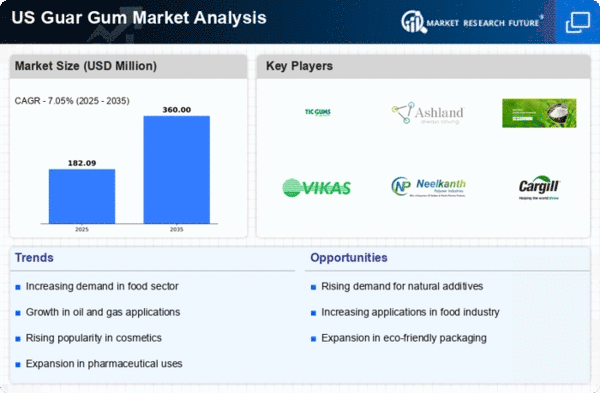
As per Market Research Future analysis, the US guar gum market size was estimated at 170.1 USD Million in 2024. The US guar gum market is projected to grow from 182.09 USD Million in 2025 to 360.0 USD Million by 2035, exhibiting a compound annual growth rate (CAGR) of 7.0% during the forecast period 2025 - 2035

Key Market Trends & Highlights

The US guar gum market is experiencing a notable shift towards natural ingredients and diverse applications.

  • The demand for natural ingredients in food and personal care products is rising steadily.
  • Pharmaceutical applications of guar gum are expanding, indicating a growing market segment.
  • Technological advancements in production processes are enhancing efficiency and product quality.
  • Key market drivers include the growing food industry applications and sustainability trends in manufacturing.

Market Size & Forecast

2024 Market Size 170.1 (USD Million)
2035 Market Size 360.0 (USD Million)
CAGR (2025 - 2035) 7.05%

Major Players

TIC Gums (US), Ashland Global Holdings (US), Guar Gum India (IN), Vikas WSP (IN), Neelkanth Polymers (IN), Cargill (US), Hindustan Gum & Chemicals (IN), Gum Technology (US)

Our Impact
Enabled $4.3B Revenue Impact for Fortune 500 and Leading Multinationals
Partnering with 2000+ Global Organizations Each Year
30K+ Citations by Top-Tier Firms in the Industry

US Guar Gum Market Trends

The guar gum market is currently experiencing notable shifts driven by various factors. The increasing demand for natural and organic food products has led to a rise in the utilization of guar gum as a thickening and stabilizing agent in the food industry. This trend aligns with consumer preferences for clean-label ingredients, which are perceived as healthier alternatives. Additionally, the expanding applications of guar gum in the pharmaceutical and cosmetic sectors further contribute to its growing significance. As industries seek to enhance product quality and performance, the versatility of guar gum positions it as a valuable ingredient across multiple domains. Moreover, the guar gum market is influenced by fluctuations in supply and pricing dynamics. The cultivation of guar beans is primarily concentrated in specific regions, making the market susceptible to agricultural conditions and climatic variations. This dependency on natural factors may lead to volatility in availability and pricing, impacting manufacturers and consumers alike. Furthermore, advancements in extraction and processing technologies are likely to enhance the efficiency of guar gum production, potentially stabilizing supply chains. Overall, The guar gum market reflects a complex interplay of consumer trends, agricultural factors, and technological innovations.

Rising Demand for Natural Ingredients

There is a growing trend towards the use of natural ingredients in food and personal care products. Guar gum, known for its thickening and stabilizing properties, is increasingly favored by manufacturers aiming to meet consumer preferences for clean-label products.

Expansion in Pharmaceutical Applications

The pharmaceutical sector is witnessing an uptick in the use of guar gum as a binding and thickening agent in drug formulations. This trend indicates a broader acceptance of natural polymers in healthcare, enhancing the market's relevance.

Technological Advancements in Production

Innovations in extraction and processing techniques are likely to improve the efficiency of guar gum production. These advancements may lead to more consistent supply and potentially lower costs, benefiting various industries reliant on this ingredient.

US Guar Gum Market Drivers

Growing Food Industry Applications

The food industry is increasingly incorporating guar gum as a thickening and stabilizing agent, which is driving growth in the guar gum market. Its ability to enhance texture and improve mouthfeel in various food products, such as sauces, dressings, and dairy items, is particularly valued. In the US, the food sector is projected to expand at a CAGR of approximately 4.5% over the next few years, which could lead to a heightened demand for guar gum. This trend is further supported by consumer preferences shifting towards natural and clean-label products, as guar gum is derived from a natural source. Consequently, the growing food industry applications are likely to play a pivotal role in shaping the dynamics of the guar gum market.

Rising Demand in Oil and Gas Sector

The oil and gas sector is increasingly adopting guar gum for its applications in hydraulic fracturing, where it serves as a gelling agent. This trend is particularly relevant in the US, where the shale gas industry has been expanding. The guar gum market benefits from this demand, as the oil and gas sector is projected to grow, potentially increasing the consumption of guar gum by approximately 6% annually. The versatility of guar gum in enhancing the efficiency of drilling fluids makes it a valuable component in this industry. Therefore, the rising demand in the oil and gas sector is a crucial driver for the guar gum market.

Sustainability Trends in Manufacturing

Sustainability is becoming a central theme in manufacturing processes across various industries, including those utilizing guar gum. The shift towards eco-friendly and sustainable practices is prompting manufacturers to seek natural alternatives to synthetic additives. Guar gum, being a biodegradable and renewable resource, aligns well with these sustainability goals. In the US, companies are increasingly adopting sustainable sourcing practices, which may lead to a growth in the guar gum market as manufacturers prioritize environmentally responsible ingredients. This trend indicates a potential shift in consumer preferences towards products that are not only effective but also sustainable, thereby influencing the dynamics of the guar gum market.

Increased Use in Personal Care Products

The personal care industry is witnessing a notable rise in the utilization of guar gum, which serves as a thickener and emulsifier in various formulations. Products such as shampoos, conditioners, and lotions are increasingly incorporating this natural ingredient due to its beneficial properties. The US personal care market is expected to grow at a rate of around 5% annually, which may lead to a corresponding increase in the demand for guar gum. This trend reflects a broader consumer shift towards products that are perceived as safer and more environmentally friendly. As a result, the increased use in personal care products is likely to significantly impact the guar gum market.

Technological Innovations in Processing

Technological advancements in the processing of guar gum are enhancing its quality and functionality, which is likely to benefit the guar gum market. Innovations in extraction and refining techniques are improving yield and reducing production costs, making guar gum more accessible to various industries. In the US, the introduction of advanced processing technologies could lead to a projected increase in market size by approximately 5% over the next few years. These innovations not only improve the efficiency of production but also enhance the performance characteristics of guar gum in applications ranging from food to pharmaceuticals. Thus, technological innovations in processing are poised to be a significant driver for the guar gum market.


Market Segment Insights

By Type: Food Grade (Largest) vs. Industrial Grade (Fastest-Growing)

In the US guar gum market, The Food Grade segment holds the largest share, primarily catering to the food and beverage industry that requires high purity and quality standards. This segment is driven by the increasing demand for natural food ingredients and clean label products, showcasing its importance as a staple thickening and stabilizing agent. On the other hand, the Industrial Grade segment, although smaller, is witnessing rapid growth, primarily due to its applications in various industries such as textiles, pharmaceuticals, and cosmetics. The versatility and performance of guar gum in industrial processes contribute to its rising adoption. The growth trends in the US guar gum market indicate a shift towards more sustainable and eco-friendly products, with both segments adapting to consumer preferences. The Food Grade segment anticipates consistent growth, fueled by health-conscious consumers seeking organic and natural additives. Meanwhile, the Industrial Grade segment is experiencing an acceleration in demand stemming from innovations in product formulations and the expansion of industries that utilize thickening and binding agents. As industries evolve, guar gum is positioned well to capitalize on these trends, reinforcing its market presence across diverse applications.

Food Grade: Dominant vs. Industrial Grade: Emerging

The Food Grade segment of the guar gum market is characterized by its high purity and compliance with food safety regulations, making it essential for the food industry. It is widely used as a thickening agent in products such as sauces, dairy items, and bakery goods, which adds to its dominance in the market. In contrast, the Industrial Grade segment is emerging rapidly, driven by its application in sectors like oil drilling, textile processing, and personal care products. This segment is gaining traction due to its cost-effectiveness and performance in various industrial applications. Companies are increasingly investing in innovation to enhance the properties of guar gum for industrial uses, which further solidifies its market position.

By Function: Thickening (Largest) vs. Gelling (Fastest-Growing)

In the US guar gum market, the market share distribution shows that thickening agents hold the largest portion of the segment, attributed to their diverse applications in food products, pharmaceuticals, and cosmetics. Following thickening, gelling agents have carved out a substantial share and are rapidly gaining traction due to the increasing demand for plant-based gelling solutions, making them a key player in the overall market dynamics. Growth trends within the function segment are driven by evolving consumer preferences for natural and organic products, which have boosted the demand for guar gum as a clean label ingredient. Additionally, the rise in food processing and the expanding applications in the personal care industry enhance the growth trajectory for all function segment values, particularly gelling, which is witnessing a surge in popularity among manufacturers focusing on healthier formulations.

Binding: Thickening (Dominant) vs. Gelling (Emerging)

Thickening agents dominate the function segment in the US guar gum market due to their essential role in enhancing the texture and stability of various products. They are widely employed in sauces, dressings, and dairy items, providing viscosity and mouthfeel that consumers expect. Conversely, gelling agents represent an emerging segment, driven largely by innovations in the food and beverage industry. Their ability to create desirable textures without synthetic additives appeals to health-conscious consumers. Both segment values are vital for product formulation, but as interest in healthier, cleaner products grows, gelling agents are increasingly being recognized for their potential, carving out a notable presence among traditional thickening agents.

By Application: Food & Beverages (Largest) vs. Personal Care (Fastest-Growing)

The US guar gum market showcases distinct market share distribution across various application segments. The Food & Beverages sector holds the largest share, driven by the rising demand for clean-label products and the incorporation of natural thickening agents in various food items. In contrast, the Personal Care segment is experiencing notable growth, primarily due to increasing consumer awareness regarding natural and organic beauty products that utilize guar gum for its emulsifying properties. Growth trends in the US guar gum market are largely influenced by evolving consumer preferences towards healthier and sustainable products. The Food & Beverages segment benefits from a significant shift towards cleaner ingredients, while the Personal Care sector capitalizes on the organic beauty trend. The Oil & Gas segment, while important, is more stable, relying on traditional industrial applications rather than rapid growth.

Food & Beverages (Dominant) vs. Personal Care (Emerging)

The Food & Beverages segment is characterized by its dominant market position within the US guar gum market, leveraging guar gum's natural thickening and stabilizing properties which are essential in food formulations such as sauces, dairy products, and gluten-free options. This segment thrives on the increasing trend of health-conscious consumers seeking natural ingredients. Conversely, the Personal Care segment, identified as emerging, is rapidly gaining traction as consumers shift towards products made from natural, plant-based ingredients, with guar gum serving as a crucial component in cosmetic formulations for its moisturizing and thickening attributes. This dynamic interplay between established and emerging application sectors underscores the overall growth potential in the US guar gum market.

Get more detailed insights about US Guar Gum Market

Key Players and Competitive Insights

The guar gum market exhibits a dynamic competitive landscape characterized by a blend of innovation, strategic partnerships, and regional expansion. Key players such as TIC Gums (US), Cargill (US), and Ashland Global Holdings (US) are at the forefront, each employing distinct strategies to enhance their market presence. TIC Gums (US) focuses on product innovation, particularly in developing customized solutions for the food and beverage sector, which appears to be a significant growth driver. Meanwhile, Cargill (US) emphasizes sustainability in its operations, aligning with the increasing consumer demand for environmentally friendly products. Ashland Global Holdings (US) is leveraging digital transformation to optimize its supply chain and improve customer engagement, thereby enhancing its competitive positioning.The market structure is moderately fragmented, with a mix of established players and emerging companies. Key tactics such as localizing manufacturing and optimizing supply chains are prevalent among major players, allowing them to respond swiftly to market demands. This collective approach not only strengthens their operational efficiency but also enhances their ability to compete on a global scale. The influence of these companies is substantial, as they shape market trends and consumer preferences through their strategic initiatives.

In October Cargill (US) announced a new initiative aimed at reducing its carbon footprint by 30% by 2030, which underscores its commitment to sustainability. This strategic move is likely to resonate well with environmentally conscious consumers and could enhance Cargill's brand loyalty. Furthermore, this initiative may position Cargill as a leader in sustainable practices within the guar gum sector, potentially attracting new partnerships and customers.

In September TIC Gums (US) launched a new line of guar gum products specifically designed for gluten-free applications. This product innovation not only caters to the growing gluten-free market but also demonstrates TIC Gums' agility in responding to consumer trends. By focusing on niche markets, TIC Gums may strengthen its competitive edge and expand its customer base significantly.

In August Ashland Global Holdings (US) entered into a strategic partnership with a technology firm to enhance its digital capabilities. This collaboration aims to integrate advanced analytics into its supply chain processes, which could lead to improved operational efficiencies and customer satisfaction. Such a move indicates Ashland's proactive approach to leveraging technology for competitive advantage, potentially setting a benchmark for others in the industry.

As of November the competitive trends in the guar gum market are increasingly defined by digitalization, sustainability, and the integration of artificial intelligence. Strategic alliances are becoming more prevalent, as companies seek to enhance their capabilities and market reach. The shift from price-based competition to a focus on innovation and supply chain reliability is evident, suggesting that future competitive differentiation will hinge on technological advancements and sustainable practices. Companies that can effectively navigate these trends are likely to emerge as leaders in the evolving market landscape.

Key Companies in the US Guar Gum Market include

Industry Developments

In the US Guar Gum Market, recent developments have been shaped by various factors influencing both supply and demand dynamics. Notably, in December 2022, Farbest Brands expanded its product line with innovative solutions that incorporate guar gum, targeting the food industry for its thickening properties. Additionally, in January 2023, Kerry Group announced its strategic focus on enhancing the functionality of their guar gum offerings to meet rising consumer preferences for clean labels.

The growing awareness of health and nutrition among consumers is driving up the market valuation for companies like BASF and Cargill, which have reported significant investments into Research and Development initiatives to produce highly refined guar gum products.In terms of mergers, Dufry AG completed its acquisition of a significant stake in a Guar Gum processing facility in September 2022, enhancing its capabilities in the food sector. In November 2022, ingredient Corporation strategically aligned with Ashland Global Holdings to create a more robust supply chain for US customers.

The rising interest in plant-based food products continues to bolster demand for guar gum as a functional ingredient, influencing market growth positively. Overall, the US Guar Gum Market is dynamically evolving reflecting consumer trends and corporate strategic decisions.

Future Outlook

US Guar Gum Market Future Outlook

The Guar Gum Market is projected to grow at a 7.05% CAGR from 2025 to 2035, driven by increasing demand in food, pharmaceuticals, and oil industries.

New opportunities lie in:

  • Development of bio-based guar gum products for eco-conscious consumers.
  • Expansion into emerging markets with tailored marketing strategies.
  • Investment in R&D for innovative applications in cosmetics and personal care.

By 2035, the guar gum market is expected to achieve robust growth, driven by diverse applications and strategic innovations.

Market Segmentation

US Guar Gum Market Type Outlook

  • Food Grade
  • Industrial Grade

US Guar Gum Market Function Outlook

  • Thickening
  • Gelling
  • Binding

US Guar Gum Market Application Outlook

  • Food & Beverages
  • Personal Care
  • Oil & Gas

Report Scope

MARKET SIZE 2024 170.1(USD Million)
MARKET SIZE 2025 182.09(USD Million)
MARKET SIZE 2035 360.0(USD Million)
COMPOUND ANNUAL GROWTH RATE (CAGR) 7.05% (2025 - 2035)
REPORT COVERAGE Revenue Forecast, Competitive Landscape, Growth Factors, and Trends
BASE YEAR 2024
Market Forecast Period 2025 - 2035
Historical Data 2019 - 2024
Market Forecast Units USD Million
Key Companies Profiled TIC Gums (US), Ashland Global Holdings (US), Guar Gum India (IN), Vikas WSP (IN), Neelkanth Polymers (IN), Cargill (US), Hindustan Gum & Chemicals (IN), Gum Technology (US)
Segments Covered Type, Function, Application
Key Market Opportunities Growing demand for natural thickening agents in food and cosmetics drives innovation in the guar gum market.
Key Market Dynamics Rising demand for natural thickeners drives innovation and competition in the guar gum market.

Countries Covered US
Leave a Comment

FAQs

What is the expected market size of the US Guar Gum Market in 2024?

The US Guar Gum Market is expected to be valued at approximately 170.1 million USD in 2024.

What is the projected market size for the US Guar Gum Market by 2035?

By 2035, the US Guar Gum Market is anticipated to reach a valuation of around 350.37 million USD.

What is the expected CAGR for the US Guar Gum Market from 2025 to 2035?

The expected CAGR for the US Guar Gum Market from 2025 to 2035 stands at 6.79%.

Which segment dominates the US Guar Gum Market?

The Industrial Grade segment is projected to dominate the US Guar Gum Market with a valuation of 100.07 million USD in 2024.

What is the valued size of the Food Grade segment in the US Guar Gum Market for 2024?

The Food Grade segment of the US Guar Gum Market is valued at approximately 70.03 million USD in 2024.

Who are some of the key players in the US Guar Gum Market?

Key players in the US Guar Gum Market include Farbest Brands, BASF, Kerry Group, and DuPont, among others.

What is the estimated size of the Industrial Grade segment in 2035?

The Industrial Grade segment is estimated to be valued at around 207.72 million USD by 2035.

What growth opportunities exist in the US Guar Gum Market?

The growing demand for natural thickening agents in an array of industries presents significant growth opportunities in the US Guar Gum Market.

What are some key applications of guar gum in the market?

Guar gum is prominently utilized as a thickener, stabilizer, and emulsifier in food and industrial applications.

What challenges might affect the growth of the US Guar Gum Market?

Fluctuating raw material prices and competition from synthetic alternatives may pose challenges to the growth of the US Guar Gum Market.

Download Free Sample

Kindly complete the form below to receive a free sample of this Report

Compare Licence

×
Features License Type
Single User Multiuser License Enterprise User
Price $4,950 $5,950 $7,250
Maximum User Access Limit 1 User Upto 10 Users Unrestricted Access Throughout the Organization
Free Customization
Direct Access to Analyst
Deliverable Format
Platform Access
Discount on Next Purchase 10% 15% 15%
Printable Versions