×
Request Free Sample ×

Kindly complete the form below to receive a free sample of this Report

* Please use a valid business email

Leading companies partner with us for data-driven Insights

clients tt-cursor
Hero Background

US Gold Nanoparticles Market

ID: MRFR/LS/17746-HCR
100 Pages
MRFR Team
February 2026

United States Americas Gold Nanoparticles Market Research Report to 2032

Share:
Download PDF ×

We do not share your information with anyone. However, we may send you emails based on your report interest from time to time. You may contact us at any time to opt-out.

US Gold Nanoparticles Market Infographic
Purchase Options

US Gold Nanoparticles Market Summary

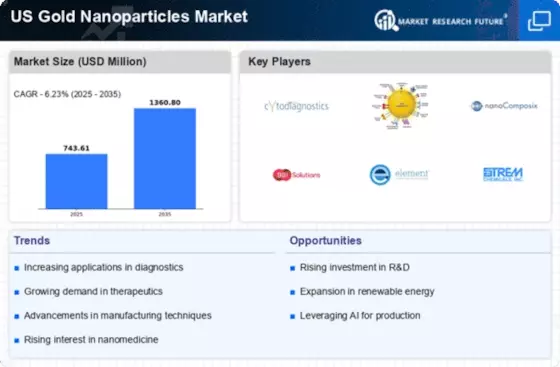
As per analysis, the US Gold Nanoparticles Market is projected to grow from USD 700.0 Million in 2024 to USD 1360.8 Million by 2035, exhibiting a compound annual growth rate (CAGR) of 6.23% during the forecast period (2025 - 2035).

Key Market Trends & Highlights

The US Gold Nanoparticles Market is poised for substantial growth driven by diverse applications and technological advancements.

  • The biomedical applications segment remains the largest, showcasing a robust demand for gold nanoparticles in drug delivery and imaging.
  • The electronics segment is the fastest-growing, fueled by innovations in sensing technologies and electronic components.
  • Integration into the cosmetic industry is gaining traction, reflecting a growing consumer interest in advanced skincare solutions.
  • Rising demand in biomedical applications and advancements in electronics and sensing technologies are key drivers propelling market expansion.

Market Size & Forecast

2024 Market Size 700.0 (USD Million)
2035 Market Size 1360.8 (USD Million)
CAGR (2025 - 2035) 6.23%

Major Players

Cytodiagnostics Inc (US), Gold Nanoparticles Inc (US), NanoComposix Inc (US), BBI Solutions (US), American Elements (US), Strem Chemicals Inc (US), Nanoshel LLC (US), Nanoparticles by Nanoshel (US)

Our Impact
Enabled $4.3B Revenue Impact for Fortune 500 and Leading Multinationals
Partnering with 2000+ Global Organizations Each Year
30K+ Citations by Top-Tier Firms in the Industry

US Gold Nanoparticles Market Trends

The US Gold Nanoparticles Market is currently experiencing a notable evolution, driven by advancements in nanotechnology and its diverse applications across various sectors. The increasing utilization of gold nanoparticles in biomedical fields, particularly in drug delivery and imaging, appears to be a significant factor propelling market growth. Furthermore, the rising demand for innovative materials in electronics and environmental applications suggests a robust future for this market segment. As research continues to unveil new properties and potential uses, the landscape of the US Gold Nanoparticles Market is likely to expand, attracting investments and fostering collaborations among key stakeholders. In addition to biomedical and electronic applications, the US Gold Nanoparticles Market is also witnessing interest from the cosmetics industry, where these particles are incorporated for their unique optical properties and potential skin benefits. Regulatory frameworks and safety assessments are evolving to accommodate these advancements, which may further enhance market dynamics. Overall, the trajectory of the US Gold Nanoparticles Market indicates a promising outlook, characterized by innovation and a growing understanding of the material's capabilities across multiple domains.

Biomedical Applications

The US Gold Nanoparticles Market is increasingly influenced by their applications in the biomedical sector. These nanoparticles are utilized for targeted drug delivery, enhancing the efficacy of treatments while minimizing side effects. Additionally, their role in imaging techniques, such as computed tomography and magnetic resonance imaging, is gaining traction, indicating a shift towards more precise medical interventions.

Electronics and Sensing

In the realm of electronics, gold nanoparticles are being integrated into various devices, enhancing performance and functionality. Their unique electrical properties make them suitable for use in sensors, which are crucial for detecting environmental changes and monitoring health parameters. This trend suggests a growing intersection between nanotechnology and electronic innovation.

Cosmetic Industry Integration

The incorporation of gold nanoparticles into cosmetic products is emerging as a noteworthy trend within the US Gold Nanoparticles Market. These particles are valued for their potential benefits in skin care formulations, including anti-aging properties and improved product efficacy. As consumer awareness of nanotechnology increases, the demand for such innovative cosmetic solutions is likely to rise.

US Gold Nanoparticles Market Drivers

Integration into the Cosmetic Industry

The US Gold Nanoparticles Market is witnessing a growing integration of gold nanoparticles into the cosmetic sector. The unique properties of gold nanoparticles, such as their ability to enhance skin penetration and provide anti-aging benefits, are driving their incorporation into skincare products. The cosmetic market is projected to grow at a CAGR of approximately 10% over the next few years, with gold nanoparticles playing a pivotal role in product differentiation. Major cosmetic brands are increasingly investing in research and development to formulate products that leverage the benefits of gold nanoparticles, thereby enhancing their market presence. This trend suggests a promising future for the US Gold Nanoparticles Market, as consumer demand for innovative and effective cosmetic solutions continues to rise.

Rising Demand in Biomedical Applications

The US Gold Nanoparticles Market is experiencing a notable surge in demand due to the increasing applications in biomedical fields. Gold nanoparticles are utilized in drug delivery systems, imaging, and diagnostics, which are critical for enhancing therapeutic efficacy. The market is projected to grow at a compound annual growth rate (CAGR) of approximately 15% over the next five years, driven by advancements in nanotechnology and the growing prevalence of chronic diseases. Furthermore, the integration of gold nanoparticles in targeted therapies is likely to revolutionize treatment protocols, making them more effective and personalized. This trend indicates a robust future for the US Gold Nanoparticles Market, as healthcare providers increasingly adopt these innovative solutions to improve patient outcomes.

Government Support and Regulatory Framework

The US Gold Nanoparticles Market is bolstered by supportive government policies and a robust regulatory framework. The US government has been actively promoting research and development in nanotechnology, providing funding and resources to facilitate innovation. Regulatory bodies, such as the FDA, are establishing guidelines for the safe use of nanomaterials, which is crucial for market growth. This supportive environment encourages companies to invest in the development of gold nanoparticles for various applications, including healthcare and electronics. As regulations become clearer and more favorable, the US Gold Nanoparticles Market is likely to experience accelerated growth, attracting new entrants and fostering competition.

Growing Interest in Sustainable Nanotechnology

The US Gold Nanoparticles Market is increasingly influenced by the growing interest in sustainable nanotechnology. As environmental concerns rise, there is a shift towards the development of eco-friendly production methods for gold nanoparticles. This trend is likely to attract investment and innovation in the sector, as companies seek to align with sustainability goals. The market for sustainable nanotechnology is projected to grow significantly, with an emphasis on reducing the environmental impact of production processes. This shift not only enhances the reputation of companies within the US Gold Nanoparticles Market but also meets the rising consumer demand for sustainable products. As sustainability becomes a priority, the industry is expected to adapt and thrive in this evolving landscape.

Advancements in Electronics and Sensing Technologies

The US Gold Nanoparticles Market is significantly influenced by advancements in electronics and sensing technologies. Gold nanoparticles are increasingly employed in the development of sensors and electronic devices due to their unique optical and electronic properties. The market for electronic applications is expected to expand, with a projected growth rate of around 12% annually. This growth is attributed to the rising demand for high-performance sensors in various sectors, including environmental monitoring and food safety. The incorporation of gold nanoparticles enhances the sensitivity and accuracy of these devices, thereby driving their adoption in the US market. As technology continues to evolve, the US Gold Nanoparticles Market is poised to benefit from these innovations, leading to enhanced product offerings and increased market penetration.


Market Segment Insights

By Application: Biomedical (Largest) vs. Electronics (Fastest-Growing)

In the US Gold Nanoparticles Market, the application of gold nanoparticles spreads across various sectors such as biomedical, electronics, catalysis, environmental, and cosmetics. Among these, biomedical applications take the lead, leveraging the biocompatibility and functionality of gold nanoparticles for drug delivery, imaging, and diagnostics. Following closely, the electronics sector showcases a significant market share evolution driven by innovations in nanotechnology applications, presenting growth potential. Looking at growth trends, the biomedical segment continues to expand, fueled by advancements in healthcare technology and an increasing demand for targeted therapies. Conversely, the electronics sector is emerging rapidly, driven by the surge in demand for efficient and miniaturized electronic components, which utilize gold nanoparticles for enhanced conductivity and performance. These segments present a duality of stability and rapid growth within the market landscape.

Biomedical (Dominant) vs. Electronics (Emerging)

The biomedical application of gold nanoparticles stands dominant in the US Gold Nanoparticles Market, owing to its critical role in drug delivery systems, cancer treatment, and imaging diagnostics. The key attributes of these nanoparticles, such as their size-dependent optical properties and biocompatibility, facilitate targeted therapeutic strategies and enhance imaging techniques. On the other hand, the electronics sector is emerging as a significant player, leveraging the unique properties of gold nanoparticles for applications like sensors and conductive inks. This sector's rapid advancements in nanotechnology are resulting in innovative solutions for the electronics industry, promising an increase in performance and efficiency. Together, these segments illustrate a landscape where stability in biomedical applications coexists with the dynamic growth of electronics.

By End Use: Pharmaceuticals (Largest) vs. Diagnostics (Fastest-Growing)

In the US Gold Nanoparticles Market, the end use segments show a varied distribution of market share, with Pharmaceuticals holding the largest portion. This segment is primarily driven by the increasing demand for targeted drug delivery systems and advanced therapeutic techniques utilizing gold nanoparticles. Following Pharmaceuticals, Diagnostics emerges as a significant area of application, favorably impacted by the rising need for improved diagnostic tools that leverage the unique properties of gold nanoparticles. Growth trends in the US market indicate a rapid expansion in the Diagnostics segment due to technological advancements and heightened focus on early detection of diseases. Innovations in diagnostic methods, such as biosensors and imaging techniques employing gold nanoparticles, are propelling this segment forward. Meanwhile, Pharmaceuticals continues to grow steadily, driven by research initiatives and increased investments in nanomedicine, showcasing its strength and resilience in the market landscape.

Pharmaceuticals: Dominant vs. Diagnostics: Emerging

The Pharmaceuticals segment remains dominant in the US Gold Nanoparticles Market, recognized for its innovative applications in drug formulation, delivery, and targeting. The ability of gold nanoparticles to enhance the efficacy of therapeutic agents positions this segment as a cornerstone of nanotechnology in healthcare. Conversely, the Diagnostics segment is emerging rapidly, capitalizing on advancements in medical imaging and the development of sensitive biosensors. This segment's growth is fueled by increased investments in research and development, highlighting the potential of gold nanoparticles in revolutionizing diagnostic capabilities. Both segments exhibit unique characteristics that cater to distinct needs within the healthcare framework, driving their respective evolutions in the marketplace.

By Form: Colloidal Gold Nanoparticles (Largest) vs. Gold Nanoparticle Powders (Fastest-Growing)

In the US Gold Nanoparticles Market, Colloidal Gold Nanoparticles hold the largest share, reflecting their widespread application in biomedical, diagnostic, and electronic fields. This form benefits from their ease of functionalization and stability, leading to a robust presence in commercial products. Gold Nanoparticle Coatings and Films follow, providing unique properties for industrial applications. However, Gold Nanoparticle Powders are gaining traction due to their innovative uses in additive manufacturing and various emerging technologies.

Colloidal Gold Nanoparticles (Dominant) vs. Gold Nanoparticle Films (Emerging)

Colloidal Gold Nanoparticles are characterized by their stability, ease of synthesis, and versatility, making them dominant in biomedical applications, such as targeted drug delivery and imaging. Their surface chemistry allows for functionalization, enabling enhanced interactiveness with biological entities. Conversely, Gold Nanoparticle Films, while still emerging, offer crucial optical and electronic properties due to their thin-film applications in sensors and electronics. The potential to improve performance in various optoelectronic devices and sensors positions them as a significant player in the market. The diverse functionality provided by these forms illustrates the innovative landscape of the US Gold Nanoparticles Market.

By Size: Small (Largest) vs. Medium (Fastest-Growing)

In the US Gold Nanoparticles Market, the size segmentation is characterized by three principal categories: Small, Medium, and Large. Small gold nanoparticles occupy the largest market share, benefiting from their extensive applications in biomedical fields such as drug delivery and diagnostics, owing to their superior stability and enhanced surface area. Medium-sized nanoparticles are also significant, catering to various industrial applications including catalysis and electronics, yet their share is slightly lower compared to the small category.

Size: Small (Dominant) vs. Medium (Emerging)

Small gold nanoparticles have established themselves as the dominant segment in the market due to their versatility and efficiency in diverse applications, particularly in the life sciences. Their unique properties enable high cellular uptake and better interaction with biological molecules. In contrast, medium-sized nanoparticles are emerging as significant players, gaining traction in the commercial sector for their balance of reactivity and stability. The growth of Medium is driven by increased research into nanotechnology and its applications in renewable energy and environmental solutions, indicating a robust trajectory in coming years.

By Synthesis Method: Chemical Reduction (Largest) vs. Biological Synthesis (Fastest-Growing)

In the US gold nanoparticles market, the synthesis method segment is experiencing a diversification into various methods, with chemical reduction holding the largest market share. This traditional method is favored for its scalability and cost-effectiveness, leading to widespread application in several industries including healthcare and electronics. Meanwhile, biological synthesis is rapidly gaining traction, especially due to the increased focus on sustainable and eco-friendly methods. This growing demand for environmentally friendly production processes is bolstering its market presence. The growth trends within this segment indicate a significant shift towards adopting innovative methods. Chemical reduction remains dominant due to established practices, while biological synthesis is fueled by advancements in biotechnology and increased consumer awareness regarding sustainability. Laser ablation and electrochemical synthesis also show promise, particularly for specialized applications, but they currently remain in the shadow of the dominant chemical reduction and emerging biological synthesis methods.

Chemical Reduction (Dominant) vs. Biological Synthesis (Emerging)

Chemical reduction is characterized by its well-established procedures and reliability, making it the dominant method in the US gold nanoparticles market. It offers precise control over particle size and distribution, which are critical factors for applications in electronics and medical imaging. On the other hand, biological synthesis is emerging as a viable alternative, leveraging natural processes and organisms to produce nanoparticles. This method is gaining popularity due to its low toxicity and environmental benefits, appealing to manufacturers seeking sustainable practices. As awareness of ecological impacts grows, biological synthesis is expected to expand its market footprint, challenging the dominance of chemical reduction in specific applications.

Get more detailed insights about US Gold Nanoparticles Market

Key Players and Competitive Insights

The Gold Nanoparticles Market is characterized by a dynamic competitive landscape, driven by advancements in nanotechnology and increasing applications across various sectors, including healthcare, electronics, and environmental science. Key players such as Cytodiagnostics Inc (US), Gold Nanoparticles Inc (US), and NanoComposix Inc (US) are strategically positioned to leverage these growth opportunities. Cytodiagnostics Inc (US) focuses on innovation in diagnostic applications, while Gold Nanoparticles Inc (US) emphasizes partnerships to enhance product offerings. Meanwhile, NanoComposix Inc (US) is known for its commitment to quality and customization, which collectively shapes a competitive environment that is both collaborative and competitive.

In terms of business tactics, companies are increasingly localizing manufacturing to reduce lead times and optimize supply chains. The market structure appears moderately fragmented, with several players vying for market share. This fragmentation allows for niche players to thrive, while larger companies consolidate their positions through strategic acquisitions and partnerships, thereby influencing the overall market dynamics.

In December 2025, Cytodiagnostics Inc (US) announced a collaboration with a leading biotechnology firm to develop a novel diagnostic tool utilizing gold nanoparticles. This strategic move is expected to enhance their product portfolio and expand their market reach, indicating a strong focus on innovation and collaboration in the healthcare sector. Such partnerships may also facilitate access to new technologies and expertise, further solidifying their competitive edge.

In November 2025, Gold Nanoparticles Inc (US) launched a new line of gold nanoparticle products tailored for the electronics industry. This initiative reflects their strategy to diversify applications and cater to emerging markets, potentially increasing their revenue streams. The introduction of these products may position them favorably against competitors, as the demand for advanced materials in electronics continues to rise.

In October 2025, NanoComposix Inc (US) expanded its manufacturing capabilities by investing in a state-of-the-art facility aimed at increasing production efficiency. This investment underscores their commitment to meeting growing demand while maintaining high-quality standards. By enhancing production capacity, they are likely to improve their competitive positioning and respond more effectively to market needs.

As of January 2026, current trends in the Gold Nanoparticles Market indicate a shift towards digitalization, sustainability, and the integration of AI technologies. Strategic alliances are becoming increasingly vital, as companies seek to enhance their innovation capabilities and market responsiveness. The competitive differentiation is expected to evolve, moving away from price-based competition towards a focus on technological advancements, product innovation, and supply chain reliability. This transition suggests that companies that prioritize these aspects will likely emerge as leaders in the market.

Key Companies in the US Gold Nanoparticles Market include

Future Outlook

US Gold Nanoparticles Market Future Outlook

The US Gold Nanoparticles Market is projected to grow at a 6.23% CAGR from 2025 to 2035, driven by advancements in biomedical applications, electronics, and environmental technologies.

New opportunities lie in:

  • Development of targeted drug delivery systems using gold nanoparticles.
  • Expansion into renewable energy applications for enhanced solar cell efficiency.
  • Creation of customized gold nanoparticle solutions for diagnostics and imaging.

By 2035, the market is expected to solidify its position as a leader in nanotechnology applications.

Market Segmentation

US Gold Nanoparticles Market Form Outlook

  • Colloidal Gold Nanoparticles
  • Gold Nanoparticle Coatings
  • Gold Nanoparticle Films
  • Gold Nanoparticle Powders

US Gold Nanoparticles Market Size Outlook

  • Small
  • Medium
  • Large

US Gold Nanoparticles Market End Use Outlook

  • Pharmaceuticals
  • Diagnostics
  • Research Laboratories
  • Industrial
  • Cosmetic Products

US Gold Nanoparticles Market Application Outlook

  • Biomedical
  • Electronics
  • Catalysis
  • Environmental
  • Cosmetics

US Gold Nanoparticles Market Synthesis Method Outlook

  • Chemical Reduction
  • Laser Ablation
  • Biological Synthesis
  • Electrochemical Synthesis

Report Scope

MARKET SIZE 2024700.0(USD Million)
MARKET SIZE 2025747.6(USD Million)
MARKET SIZE 20351360.8(USD Million)
COMPOUND ANNUAL GROWTH RATE (CAGR)6.23% (2024 - 2035)
REPORT COVERAGERevenue Forecast, Competitive Landscape, Growth Factors, and Trends
BASE YEAR2024
Market Forecast Period2025 - 2035
Historical Data2019 - 2024
Market Forecast UnitsUSD Million
Key Companies ProfiledCytodiagnostics Inc (US), Gold Nanoparticles Inc (US), NanoComposix Inc (US), BBI Solutions (US), American Elements (US), Strem Chemicals Inc (US), Nanoshel LLC (US), Nanoparticles by Nanoshel (US)
Segments CoveredApplication, End Use, Form, Size, Synthesis Method
Key Market OpportunitiesGrowing demand for targeted drug delivery systems enhances opportunities in the US Gold Nanoparticles Market.
Key Market DynamicsRising demand for gold nanoparticles in biomedical applications drives innovation and competition in the US market.
Countries CoveredUS
Leave a Comment

FAQs

What is the current valuation of the US Gold Nanoparticles Market?

The US Gold Nanoparticles Market was valued at 700.0 USD Million in 2024.

What is the projected market size for the US Gold Nanoparticles Market by 2035?

The market is expected to reach a valuation of 1360.8 USD Million by 2035.

What is the expected CAGR for the US Gold Nanoparticles Market during the forecast period?

The expected CAGR for the market from 2025 to 2035 is 6.23%.

Which companies are considered key players in the US Gold Nanoparticles Market?

Key players include Cytodiagnostics Inc, Gold Nanoparticles Inc, and NanoComposix Inc, among others.

What are the primary applications of gold nanoparticles in the market?

The primary applications include Biomedical, Electronics, Catalysis, Environmental, and Cosmetics.

How does the market segment by end use for gold nanoparticles?

The market segments by end use include Pharmaceuticals, Diagnostics, Research Laboratories, Industrial, and Cosmetic Products.

What forms do gold nanoparticles take in the market?

Gold nanoparticles are available in forms such as Colloidal, Coatings, Films, and Powders.

What size categories are available for gold nanoparticles?

The market categorizes gold nanoparticles into Small, Medium, and Large sizes.

What synthesis methods are utilized for producing gold nanoparticles?

Common synthesis methods include Chemical Reduction, Laser Ablation, Biological Synthesis, and Electrochemical Synthesis.

What is the expected growth trend for the gold nanoparticles market in the coming years?

The market is likely to experience steady growth, driven by advancements in applications and technology.

Download Free Sample

Kindly complete the form below to receive a free sample of this Report

Compare Licence

×
Features License Type
Single User Multiuser License Enterprise User
Price $4,950 $5,950 $7,250
Maximum User Access Limit 1 User Upto 10 Users Unrestricted Access Throughout the Organization
Free Customization
Direct Access to Analyst
Deliverable Format
Platform Access
Discount on Next Purchase 10% 15% 15%
Printable Versions