×
Request Free Sample ×

Kindly complete the form below to receive a free sample of this Report

* Please use a valid business email

Leading companies partner with us for data-driven Insights

clients tt-cursor
Hero Background

US Fruit Vegetable Ingredients Market

ID: MRFR/FnB/19490-HCR
128 Pages
Snehal Singh
February 2026

US Fruit and Vegetable Ingredients Market Size, Share, Industry Trend & Analysis Research Report: By Category (Organic, Conventional), By Form (Concentrates, Pastes & Purees, NFC Juices, Pieces & Powders, Others) andBy Application (Bakery & Confectionary, Beverages, Diary & Frozen Desserts, Soups, Sauces & Dressings, Sweet & Savory Snacks, Others)- Forecast to 2035

Share:
Download PDF ×

We do not share your information with anyone. However, we may send you emails based on your report interest from time to time. You may contact us at any time to opt-out.

US Fruit Vegetable Ingredients Market Infographic
Purchase Options

US Fruit Vegetable Ingredients Market Summary

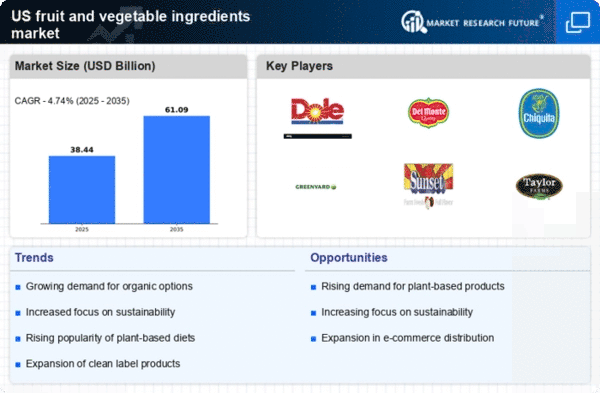
As per Market Research Future analysis, the US fruit and vegetable ingredients market size was estimated at 36.7 USD Billion in 2024. The US fruit vegetable-ingredients market is projected to grow from 38.44 USD Billion in 2025 to 61.09 USD Billion by 2035, exhibiting a compound annual growth rate (CAGR) of 4.7% during the forecast period 2025 - 2035

Key Market Trends & Highlights

The US The fruit and vegetable ingredients market is undergoing a dynamic shift towards health-oriented and sustainable products.

  • The market is witnessing a rise in plant-based ingredients, reflecting a broader trend towards healthier eating habits.
  • There is a growing focus on clean label products, as consumers increasingly seek transparency in food sourcing and processing.
  • Innovative flavor combinations are emerging, catering to the evolving palates of consumers looking for unique culinary experiences.
  • Key market drivers include growing health consciousness and sustainability concerns, which are shaping product development and consumer preferences.

Market Size & Forecast

2024 Market Size 36.7 (USD Billion)
2035 Market Size 61.09 (USD Billion)
CAGR (2025 - 2035) 4.74%

Major Players

Dole Food Company (US), Fresh Del Monte Produce (US), Chiquita Brands International (US), Greenyard (BE), Sunset Produce (CA), Taylor Farms (US), Bonduelle (FR), Mann Packing Company (US), Del Monte Foods (US)

Our Impact
Enabled $4.3B Revenue Impact for Fortune 500 and Leading Multinationals
Partnering with 2000+ Global Organizations Each Year
30K+ Citations by Top-Tier Firms in the Industry

US Fruit Vegetable Ingredients Market Trends

The fruit vegetable-ingredients market is currently experiencing a dynamic evolution, driven by shifting consumer preferences towards healthier and more sustainable food options. This market encompasses a wide array of products derived from fruits and vegetables, which are increasingly recognized for their nutritional benefits and versatility in culinary applications. As consumers become more health-conscious, there is a noticeable rise in demand for natural and organic ingredients, which are perceived as healthier alternatives to synthetic additives. This trend is further supported by a growing awareness of the environmental impact of food production, prompting manufacturers to seek sustainable sourcing practices and eco-friendly packaging solutions. In addition, the The fruit and vegetable ingredients market is witnessing innovation in product development., with companies exploring new processing techniques and flavor profiles to cater to diverse consumer tastes. The incorporation of fruits and vegetables into various food products, such as snacks, beverages, and sauces, is becoming more prevalent. This diversification not only enhances the nutritional value of these products but also appeals to a broader audience. As the market continues to evolve, it is likely that the emphasis on health, sustainability, and innovation will shape the future landscape of the fruit vegetable-ingredients market.

Rise of Plant-Based Ingredients

There is a growing trend towards the use of plant-based ingredients in food products. Consumers are increasingly seeking alternatives to animal-derived components, leading to a surge in the incorporation of fruits and vegetables into various formulations. This shift aligns with the broader movement towards healthier eating and sustainability.

Focus on Clean Label Products

The demand for clean label products is on the rise, as consumers prefer transparency in ingredient sourcing and processing. The fruit vegetable-ingredients market is responding by offering products that are minimally processed and free from artificial additives. This trend reflects a desire for authenticity and trust in food choices.

Innovative Flavor Combinations

Innovation in flavor profiles is becoming a key driver in the fruit vegetable-ingredients market. Manufacturers are experimenting with unique combinations of fruits and vegetables to create novel taste experiences. This trend not only enhances product appeal but also encourages consumers to explore new culinary possibilities.

US Fruit Vegetable Ingredients Market Drivers

Growing Health Consciousness

The increasing awareness of health and wellness among consumers is a pivotal driver for the fruit vegetable-ingredients market. As individuals become more informed about the nutritional benefits of fruits and vegetables, there is a marked shift towards incorporating these ingredients into daily diets. This trend is reflected in the market, where the demand for natural and organic fruit vegetable-ingredients has surged, with a reported growth rate of approximately 8% annually. Consumers are actively seeking products that offer health benefits, such as vitamins, minerals, and antioxidants, which are abundant in fruit and vegetable ingredients. This growing health consciousness is influencing food manufacturers to innovate and reformulate their products, thereby expanding the fruit vegetable-ingredients market. The industry is likely to continue evolving as more consumers prioritize health in their purchasing decisions.

Expansion of the Snack Food Segment

The expansion of the snack food segment is a significant driver for the fruit vegetable-ingredients market. With the increasing trend towards healthier snacking options, consumers are seeking snacks that incorporate fruits and vegetables. This shift is leading to the development of innovative snack products that utilize fruit vegetable-ingredients, such as fruit bars, vegetable chips, and smoothies. Recent market analysis indicates that the healthy snack segment is expected to grow by 12% in the coming years. This growth is prompting manufacturers to invest in research and development to create new snack products that appeal to health-conscious consumers. As the snack food market continues to evolve, the fruit vegetable-ingredients market is likely to benefit from this trend, providing opportunities for growth and innovation.

Rising Demand for Natural Food Colorants

The increasing demand for natural food colorants is a notable driver in the fruit vegetable-ingredients market. As consumers become more aware of the potential health risks associated with artificial additives, there is a growing preference for natural alternatives. Fruit and vegetable ingredients are being utilized not only for their nutritional benefits but also for their ability to provide vibrant colors to food products. The market for natural food colorants derived from fruits and vegetables is projected to grow at a rate of 7% annually. This trend is encouraging food manufacturers to explore innovative ways to incorporate these natural colorants into their products, thereby expanding the fruit vegetable-ingredients market. As the demand for clean label products continues to rise, the use of natural colorants is likely to become a standard practice in the industry.

Sustainability and Environmental Concerns

Sustainability has emerged as a critical driver in the fruit vegetable-ingredients market. Consumers are increasingly concerned about the environmental impact of their food choices, leading to a preference for sustainably sourced ingredients. This shift is prompting manufacturers to adopt eco-friendly practices, such as sourcing fruits and vegetables from local farms and utilizing organic farming methods. According to recent data, approximately 60% of consumers express a willingness to pay a premium for sustainably sourced products. This trend not only supports the growth of the fruit vegetable-ingredients market but also encourages innovation in sustainable packaging and production processes. As environmental awareness continues to rise, the industry is likely to see a greater emphasis on sustainability, influencing both consumer behavior and product development.

Technological Advancements in Food Processing

Technological advancements in food processing are significantly impacting the fruit vegetable-ingredients market. Innovations such as freeze-drying, high-pressure processing, and cold-press extraction are enhancing the quality and shelf-life of fruit and vegetable ingredients. These technologies allow for the preservation of nutrients and flavors, making it easier for manufacturers to incorporate these ingredients into various products. The market is witnessing a shift towards convenience, with ready-to-use fruit vegetable-ingredients gaining popularity among consumers. Recent statistics indicate that the processed fruit and vegetable segment is expected to grow by 10% over the next five years. As technology continues to evolve, it is likely to drive further growth in the fruit vegetable-ingredients market, enabling manufacturers to meet the changing demands of consumers.


Market Segment Insights

By Category: Organic (Largest) vs. Conventional (Fastest-Growing)

In the US fruit vegetable-ingredients market, the Organic segment holds a significant share, reflecting the increasing consumer preference for healthier and sustainable food options. This shift is attributed to rising awareness about the benefits of organic produce, leading to a steady demand for organic ingredients across various applications. On the other hand, Conventional ingredients also maintain a strong presence, appealing to budget-conscious consumers while providing wide availability and consistent quality. Growth trends indicate that while Organic remains the dominant choice among health-focused consumers, the Conventional segment is quickly gaining ground, driven by innovations in agricultural practices and distribution efficiencies. Factors such as changing dietary preferences, the promotion of convenient meal solutions, and the continued expansion of e-commerce platforms are propelling the growth of both segments, albeit at different paces. As consumers become more informed, the market dynamics continue to evolve, showcasing the diverse offerings available in the fruit vegetable-ingredients space.

Organic (Dominant) vs. Conventional (Emerging)

The Organic segment stands out as a dominant force in the US fruit vegetable-ingredients market, characterized by its health-conscious appeal and commitment to sustainable farming practices. Consumers are increasingly seeking organic options due to their perceived benefits, such as reduced exposure to chemicals and enhanced nutritional value. This segment is well-positioned to capitalize on trends favoring transparency and health. Conversely, the Conventional segment is emerging as a competitive alternative, offering affordability and accessibility without compromising on quality. It caters to a broader demographic, including those motivated by price sensitivity. As both segments continue to thrive, they contribute to a more diverse and dynamic market landscape.

By Form: Concentrates (Largest) vs. NFC Juices (Fastest-Growing)

In the US fruit vegetable-ingredients market, concentrates hold the largest market share among the segment values, significantly driven by their versatile application across various food and beverage products. This segment is followed by NFC juices, which, while smaller in share, are gaining traction rapidly due to rising consumer demand for natural and minimally processed options. Other segments such as pastes & purees, pieces and powder, and others contribute modestly to the market, showcasing a diverse array of available products. Growth trends in this segment are largely influenced by health-conscious consumers seeking convenient and nutritious ingredient options. The increasing preference for natural flavors and the demand for plant-based products boost the popularity of NFC juices, identified as the fastest-growing segment. Additionally, innovations in processing techniques and product formulations are creating opportunities for all segment values, enhancing their appeal in the market.

Concentrates (Dominant) vs. NFC Juices (Emerging)

Concentrates represent the dominant form in the market due to their extensive use in various applications, including beverages, sauces, and snacks. Their high concentration of flavors and ease of transportation make them favorable for manufacturers. NFC juices, on the other hand, are emerging as a popular alternative as they align with the growing trend toward health and wellness. Their appeal lies in the minimal processing and retention of natural flavors and nutrients. Both segments cater to different consumer preferences, with concentrates offering convenience and NFC juices providing a fresher, more authentic taste experience. As health awareness rises, NFC juices are likely to capture a larger share, while concentrates remain a staple for many food producers.

By Application: Beverages (Largest) vs. Dairy & Frozen Desserts (Fastest-Growing)

In the US fruit vegetable-ingredients market, the application segment distribution shows that Beverages holds the largest market share, driven by the rising demand for healthy and natural drink options. Following closely, Dairy & Frozen Desserts are on the radar, appealing to consumers seeking indulgence with a health-conscious twist, while Bakery & Confectionery, Soups, Sauces & Dressings, and Sweet & Savory Snacks collectively contribute to the diverse application landscape with their respective niches. The growth trends indicate a significant uptick in Dairy & Frozen Desserts, attributed to innovations in formulations that enhance flavor while reducing sugar content. Beverages maintain their prominence, spurred by a shift towards functional drinks incorporating fruit and vegetable ingredients. Meanwhile, consumer trends show an increasing preference for clean label products across all segments, driving growth in Soups, Sauces & Dressings as well.

Beverages: Dominant vs. Dairy & Frozen Desserts: Emerging

Beverages stand out as the dominant segment in the application category, characterized by a high demand for smoothies, juices, and health-focused drinks. The popularity of natural ingredients significantly boosts this sector, leading manufacturers to innovate continuously. On the other hand, Dairy & Frozen Desserts are emerging as a formidable player due to consumer trends favoring guilt-free indulgence, with products that feature lower calories and natural ingredients. This segment appeals to health-conscious consumers looking for satisfying yet nutritious options, creating a strong growth trajectory that may rival more established categories such as Beverages in the near future.

Get more detailed insights about US Fruit Vegetable Ingredients Market

Key Players and Competitive Insights

The fruit vegetable-ingredients market is characterized by a dynamic competitive landscape, driven by increasing consumer demand for healthy and sustainable food options. Key players such as Dole Food Company (US), Fresh Del Monte Produce (US), and Taylor Farms (US) are strategically positioned to leverage innovation and sustainability in their operations. Dole Food Company (US) focuses on expanding its organic product line, which aligns with the growing trend towards health-conscious eating. Fresh Del Monte Produce (US) emphasizes technological advancements in supply chain management to enhance product freshness and reduce waste. Taylor Farms (US) is actively pursuing partnerships with local farms to ensure a steady supply of fresh ingredients, thereby strengthening its market presence. Collectively, these strategies contribute to a competitive environment that prioritizes quality, sustainability, and consumer engagement.In terms of business tactics, companies are increasingly localizing manufacturing and optimizing supply chains to respond swiftly to market demands. The market structure appears moderately fragmented, with several key players holding substantial market shares while numerous smaller entities contribute to diversity. This fragmentation allows for innovation and niche offerings, although larger companies often dominate in terms of resources and market reach.

In October Dole Food Company (US) announced a partnership with a leading tech firm to develop an AI-driven platform aimed at enhancing supply chain efficiency. This strategic move is likely to streamline operations, reduce costs, and improve product traceability, thereby reinforcing Dole's commitment to sustainability and quality. The integration of AI technology may also provide a competitive edge in forecasting demand and managing inventory more effectively.

In September Fresh Del Monte Produce (US) launched a new line of plant-based snacks, capitalizing on the rising trend of plant-based diets. This initiative not only diversifies their product portfolio but also positions the company as a key player in the health-conscious segment of the market. The introduction of these snacks is expected to attract a younger demographic, further expanding their consumer base and enhancing brand loyalty.

In August Taylor Farms (US) expanded its distribution network by acquiring a regional supplier, which is anticipated to enhance its market reach and operational capabilities. This acquisition allows Taylor Farms to better serve its customers with fresher products while also optimizing logistics. Such strategic expansions are indicative of a broader trend where companies seek to consolidate their positions in the market through acquisitions and partnerships.

As of November the competitive trends in the fruit vegetable-ingredients market are increasingly defined by digitalization, sustainability, and the integration of advanced technologies. Strategic alliances are becoming more prevalent, enabling companies to pool resources and expertise to innovate more effectively. Looking ahead, competitive differentiation is likely to evolve from traditional price-based competition to a focus on innovation, technology adoption, and supply chain reliability. Companies that can successfully navigate these trends will likely secure a stronger foothold in the market.

Key Companies in the US Fruit Vegetable Ingredients Market include

Industry Developments

The US Fruit and Vegetable Ingredients Market has seen significant developments in recent months, particularly in the areas of product innovation and sustainability. Companies such as Dole Food Company and Fresh Del Monte Produce are increasingly focusing on organic and plant-based products to cater to the rising consumer demand for healthier options. In August 2023, Del Monte Foods announced a new line of sustainable fruit snacks, aimed at addressing environmental concerns associated with packaging waste.

The market has also been influenced by acquisitions, such as Seneca Foods acquiring a smaller regional fruit processing company in July 2023, enhancing its product offerings and market reach. Additionally, in June 2023, Chiquita Brands International expanded its fresh fruit distribution with a partnership focused on sustainable agriculture practices. The market valuation for companies like Ocean Spray Cranberries has seen a surge, reflecting increased consumer preferences for natural ingredients over artificial additives.

Over the past few years, the ongoing trend towards clean labeling has also driven innovation in the sector, prompting established companies like Kraft Heinz and ConAgra Foods to reformulate existing products to meet evolving consumer expectations.

Future Outlook

US Fruit Vegetable Ingredients Market Future Outlook

The The fruit and vegetable ingredients market is projected to grow at a 4.74% CAGR. from 2025 to 2035, driven by health trends, innovation, and sustainability initiatives.

New opportunities lie in:

  • Development of plant-based ingredient lines for health-conscious consumers.
  • Investment in advanced processing technologies to enhance product shelf life.
  • Expansion of e-commerce platforms for direct-to-consumer sales.

By 2035, the market is expected to achieve robust growth, driven by evolving consumer preferences and innovative product offerings.

Market Segmentation

US Fruit Vegetable Ingredients Market Form Outlook

  • Concentrates
  • Pastes & Purees
  • NFC Juices
  • Pieces and Powder
  • Others

US Fruit Vegetable Ingredients Market Category Outlook

  • Organic
  • Conventional

US Fruit Vegetable Ingredients Market Application Outlook

  • Bakery & Confectionery
  • Beverages
  • Dairy & Frozen Desserts
  • Soups, Sauces, & Dressings
  • Sweet & Savory Snacks
  • Others

Report Scope

MARKET SIZE 2024 36.7(USD Billion)
MARKET SIZE 2025 38.44(USD Billion)
MARKET SIZE 2035 61.09(USD Billion)
COMPOUND ANNUAL GROWTH RATE (CAGR) 4.74% (2025 - 2035)
REPORT COVERAGE Revenue Forecast, Competitive Landscape, Growth Factors, and Trends
BASE YEAR 2024
Market Forecast Period 2025 - 2035
Historical Data 2019 - 2024
Market Forecast Units USD Billion
Key Companies Profiled Dole Food Company (US), Fresh Del Monte Produce (US), Chiquita Brands International (US), Greenyard (BE), Sunset Produce (CA), Taylor Farms (US), Bonduelle (FR), Mann Packing Company (US), Del Monte Foods (US)
Segments Covered Category, Form, Application
Key Market Opportunities Growing demand for plant-based products drives innovation in the fruit vegetable-ingredients market.
Key Market Dynamics Rising consumer demand for natural ingredients drives innovation and competition in the fruit vegetable-ingredients market.
Countries Covered US
Leave a Comment

FAQs

What is the expected market size of the US Fruit and Vegetable Ingredients Market in 2024?

The US Fruit and Vegetable Ingredients Market is expected to be valued at 34.0 USD Billion in 2024.

What will the valuation of the US Fruit and Vegetable Ingredients Market be in 2035?

By 2035, the market is anticipated to reach a valuation of 60.0 USD Billion.

What is the expected CAGR for the US Fruit and Vegetable Ingredients Market from 2025 to 2035?

The expected CAGR for the market from 2025 to 2035 is 5.299 percent.

Which segment is projected to have a higher market value in 2035: Organic or Conventional fruit and vegetable ingredients?

In 2035, the Organic segment is projected to be valued at 18.5 USD Billion, while the Conventional segment is expected to reach 41.5 USD Billion.

Who are some of the key players in the US Fruit and Vegetable Ingredients Market?

Major players include Fresh Del Monte Produce, Del Monte Foods, Seneca Foods, and Dole Food Company.

What is the expected market value of the Organic segment in 2024?

The Organic segment of the US Fruit and Vegetable Ingredients Market is expected to be valued at 10.5 USD Billion in 2024.

What challenges should businesses in the US Fruit and Vegetable Ingredients Market be aware of?

Challenges may include supply chain disruptions and increasing competition from alternative ingredients.

What are some key growth drivers for the US Fruit and Vegetable Ingredients Market?

Key growth drivers include increasing consumer demand for healthy and organic food options.

How significant is the market share of Conventional fruit and vegetable ingredients in 2024?

The Conventional segment is expected to account for 23.5 USD Billion in market value in 2024.

What potential impact could global events have on the US Fruit and Vegetable Ingredients Market?

Global events can influence supply chains, prices, and consumer purchasing behaviors within the market.

Download Free Sample

Kindly complete the form below to receive a free sample of this Report

Compare Licence

×
Features License Type
Single User Multiuser License Enterprise User
Price $4,950 $5,950 $7,250
Maximum User Access Limit 1 User Upto 10 Users Unrestricted Access Throughout the Organization
Free Customization
Direct Access to Analyst
Deliverable Format
Platform Access
Discount on Next Purchase 10% 15% 15%
Printable Versions