×
Request Free Sample ×

Kindly complete the form below to receive a free sample of this Report

* Please use a valid business email

Leading companies partner with us for data-driven Insights

clients tt-cursor
Hero Background

US DIY Smart Home Market

ID: MRFR/SEM/14427-HCR
100 Pages
Garvit Vyas
February 2026

United States Diy Smart Home Industry Research Report to 2032

Share:
Download PDF ×

We do not share your information with anyone. However, we may send you emails based on your report interest from time to time. You may contact us at any time to opt-out.

US DIY Smart Home Market Infographic
Purchase Options

US DIY Smart Home Market Summary

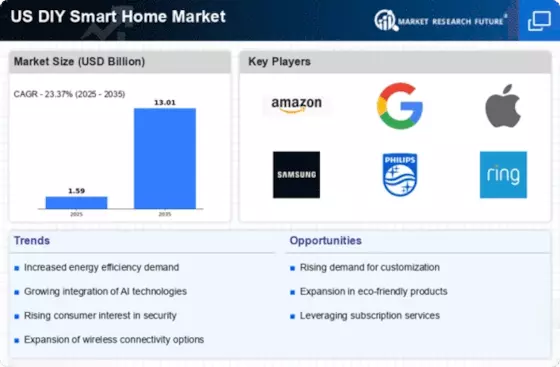
As per analysis, the US Diy Smart Home Market is projected to grow from USD 1.63 Billion in 2025 to USD 13.01 Billion by 2035, exhibiting a compound annual growth rate (CAGR) of 23.37% during the forecast period (2025 - 2035).

Key Market Trends & Highlights

The US DIY Smart Home Market is experiencing robust growth driven by consumer engagement and technological advancements.

  • The Home Security segment remains the largest in the US DIY Smart Home Market, reflecting heightened consumer concerns about safety.
  • Home Automation is the fastest-growing segment, indicating a shift towards more integrated and automated living solutions.
  • Energy efficiency is becoming a focal point for consumers, as they seek to reduce utility costs and environmental impact.
  • The growing demand for home automation and rising awareness of energy efficiency are key drivers propelling market expansion.

Market Size & Forecast

2024 Market Size 1.29 (USD Billion)
2035 Market Size 13.01 (USD Billion)
CAGR (2025 - 2035) 23.37%

Major Players

Amazon (US), Google (US), Apple (US), Samsung (US), Philips (US), Ring (US), Ecobee (US), August (US), Wyze (US)

Our Impact
Enabled $4.3B Revenue Impact for Fortune 500 and Leading Multinationals
Partnering with 2000+ Global Organizations Each Year
30K+ Citations by Top-Tier Firms in the Industry

US DIY Smart Home Market Trends

The US DIY Smart Home Market is currently experiencing a notable transformation, driven by advancements in technology and a growing consumer interest in home automation. As individuals increasingly seek to enhance their living environments, the demand for smart devices that offer convenience, security, and energy efficiency appears to be on the rise. This trend is further supported by the proliferation of affordable smart home products, which enables a broader demographic to engage in DIY projects. Homeowners are now more inclined to invest in systems that allow for remote monitoring and control, reflecting a shift towards a more connected lifestyle. Moreover, the integration of artificial intelligence and machine learning into smart home devices is likely to redefine user experiences. These technologies may facilitate personalized automation, adapting to individual preferences and routines. As consumers become more aware of the benefits associated with smart home solutions, the market is poised for continued growth. The increasing emphasis on sustainability and energy conservation also suggests that eco-friendly smart devices will gain traction, appealing to environmentally conscious consumers. Overall, the US DIY Smart Home Market is evolving rapidly, with innovations paving the way for a more interconnected and efficient future.

Increased Consumer Engagement

The US DIY Smart Home Market is witnessing a surge in consumer participation, as individuals take on home automation projects themselves. This trend is fueled by the availability of user-friendly products and online resources that empower homeowners to customize their living spaces.

Focus on Energy Efficiency

There is a growing emphasis on energy-efficient smart home solutions within the US DIY Smart Home Market. Consumers are increasingly motivated to adopt technologies that not only enhance convenience but also contribute to lower energy consumption and reduced utility costs.

Integration of AI Technologies

The incorporation of artificial intelligence into smart home devices is becoming more prevalent. This trend suggests that products will increasingly offer personalized experiences, adapting to user habits and preferences, thereby enhancing overall functionality.

US DIY Smart Home Market Drivers

Increased Focus on Home Security

The US DIY Smart Home Market is witnessing a heightened focus on home security solutions. With rising concerns about safety and property protection, consumers are increasingly investing in smart security systems, including cameras, alarms, and smart locks. Recent statistics reveal that nearly 40% of US households have implemented some form of smart security technology. This trend is driven by the desire for enhanced surveillance and remote monitoring capabilities, allowing homeowners to keep an eye on their properties from anywhere. As technology evolves, the availability of affordable and user-friendly security solutions is expanding, making it easier for consumers to enhance their home security. This growing emphasis on safety is likely to further stimulate the US DIY Smart Home Market.

Growing Demand for Home Automation

The US DIY Smart Home Market is experiencing a notable surge in demand for home automation solutions. Consumers are increasingly seeking ways to enhance convenience and security within their homes. According to recent data, approximately 30% of US households have adopted at least one smart home device, indicating a growing trend towards automation. This demand is driven by the desire for seamless control over home systems, such as lighting, heating, and security, through mobile applications. As technology advances, the availability of user-friendly DIY smart home products continues to expand, making it easier for consumers to integrate these solutions into their daily lives. This trend suggests that the US DIY Smart Home Market will likely continue to grow as more individuals recognize the benefits of home automation.

Rising Awareness of Energy Efficiency

In the US DIY Smart Home Market, there is an increasing awareness of energy efficiency among consumers. Many individuals are motivated to adopt smart home technologies that can help reduce energy consumption and lower utility bills. For instance, smart thermostats and energy monitoring systems allow homeowners to optimize their energy usage effectively. Data indicates that homes equipped with smart energy management systems can achieve energy savings of up to 20%. This growing focus on sustainability aligns with broader environmental goals and government initiatives aimed at promoting energy-efficient practices. As consumers become more environmentally conscious, the demand for energy-efficient smart home solutions is expected to rise, further propelling the US DIY Smart Home Market.

Advancements in Connectivity Technologies

The US DIY Smart Home Market is significantly influenced by advancements in connectivity technologies. The proliferation of high-speed internet and the expansion of wireless communication protocols, such as Wi-Fi and Zigbee, have facilitated the seamless integration of smart devices. This enhanced connectivity allows consumers to control multiple devices from a single platform, improving user experience and functionality. As of January 2026, it is estimated that over 50% of smart home devices in the US are connected to the internet, enabling real-time monitoring and control. This trend indicates that as connectivity continues to improve, the US DIY Smart Home Market will likely see increased adoption rates, as consumers seek more integrated and efficient solutions for their homes.

Expansion of Retail Channels and Online Platforms

The US DIY Smart Home Market is benefiting from the expansion of retail channels and online platforms. As more consumers turn to e-commerce for their shopping needs, the availability of smart home products has increased significantly. Major retailers and specialized online platforms are now offering a wide range of DIY smart home solutions, making it easier for consumers to access these technologies. This trend is supported by data indicating that online sales of smart home devices have grown by over 25% in the past year. The convenience of online shopping, combined with the ability to compare products and read reviews, is likely to drive further growth in the US DIY Smart Home Market. As consumers become more comfortable with purchasing smart home technologies online, the market is expected to expand.


Market Segment Insights

By Application: Home Security (Largest) vs. Home Automation (Fastest-Growing)

In the US DIY Smart Home Market, the application segment is marked by distinct categories, including Home Security, Energy Management, Lighting Control, Home Automation, and Entertainment. Home Security holds the largest share, driven by increasing concerns over safety and the need for real-time monitoring solutions. Energy Management also commands a significant presence as consumers adopt smart technologies to optimize energy use. Other segments like Lighting Control and Entertainment are growing, but at a slower pace compared to their major counterparts.

Home Security (Dominant) vs. Home Automation (Emerging)

Home Security is the dominant application in the DIY Smart Home landscape, characterized by advanced surveillance systems, smart locks, and alarm systems that provide peace of mind to homeowners. Its robustness stems from a heightened awareness of safety and burglary prevention. In contrast, Home Automation is emerging as a fast-growing segment fueled by innovations in technology and seamless integration capabilities that appeal to tech-savvy consumers. It encompasses a wide range of products, from smart speakers to automated HVAC systems, creating enhanced convenience and efficiency. As both segments evolve, they represent critical facets of the smart home ecosystem, driving consumer engagement and market penetration.

By End Use: Residential (Largest) vs. Commercial (Fastest-Growing)

In the US DIY smart home market, the residential segment dominates with a significant share, as homeowners increasingly adopt smart technologies to enhance convenience, security, and energy efficiency. This segment benefits from a wide range of products such as smart lighting, thermostats, and security systems, which are becoming essential components of modern homes. Meanwhile, the commercial segment, though smaller, is rapidly gaining traction as businesses recognize the benefits of smart technologies in optimizing operational efficiency and reducing costs. This growth is fueled by increasing investment in smart office solutions and IT infrastructure upgrades. Recent trends indicate a robust growth trajectory for the commercial segment, which is positioned to become the fastest-growing area within the DIY smart home market. Increased awareness of energy management solutions and the need for enhanced security measures drive businesses to integrate smart technologies. Technological advancements and reduced costs of smart devices are also significant contributors to the market's growth. Additionally, the industrial segment is emerging as companies leverage smart technologies to revolutionize their manufacturing processes, but it still remains behind residential and commercial sectors in terms of market share.

Residential (Dominant) vs. Commercial (Emerging)

The residential segment stands as the dominant player in the US DIY smart home market, characterized by a robust demand for smart solutions that enhance daily living. Consumers often seek products such as smart thermostats, lighting, and security systems that offer both convenience and energy savings. The growth of this segment is further propelled by the increasing number of tech-savvy homeowners eager to invest in smart technologies. In contrast, the commercial segment is emerging, focusing primarily on integrating smart technologies to improve business operations and efficiency. Although currently smaller, this sector is gradually expanding as companies recognize the potential benefits of these systems for workplace productivity and security enhancements. This shift suggests a promising future for more businesses to adopt smart home solutions, thereby contributing significantly to overall market evolution.

By Product Type: Smart Lighting (Largest) vs. Smart Security Systems (Fastest-Growing)

In the US DIY smart home market, smart lighting commands the largest market share, as homeowners increasingly prioritize energy efficiency and aesthetic control. The adoption of smart lighting solutions is prevalent, with products that offer customization and remote functionalities, creating a significant foothold in this segment. Following closely is smart security systems, which are capturing the attention of consumers due to the rising need for enhanced home security solutions, especially in light of increasing concerns around safety and surveillance.

Smart Lighting (Dominant) vs. Smart Security Systems (Emerging)

Smart lighting products are characterized by their ability to create customizable and adaptive lighting environments, contributing significantly to user comfort and energy savings. These solutions often feature integration with mobile apps and voice assistants, enhancing their appeal. Meanwhile, smart security systems have emerged as a crucial segment focused on protecting homes through innovative technology, such as cameras, motion sensors, and alarms. This segment is rapidly growing due to a heightened emphasis on safety, influencing many homeowners to invest in comprehensive security solutions that are user-friendly and easily integrated with existing smart home ecosystems.

By Technology: Wireless Technology (Largest) vs. Cloud-Based Technology (Fastest-Growing)

In the US DIY Smart Home Market, wireless technology currently dominates the landscape, accounting for the largest share of the market. This segment's widespread adoption is driven by consumer preferences for convenience and ease of installation, allowing homeowners to integrate smart devices with minimal hassle. Meanwhile, cloud-based technology is witnessing rapid adoption as consumers increasingly seek scalable solutions that enable remote access and enhanced functionality through cloud services.

Technology: Wireless (Dominant) vs. Cloud-Based (Emerging)

Wireless technology stands as the dominant player in the US DIY Smart Home Market, appealing to consumers with its easy installation and flexibility. Products utilizing wireless technology tend to be user-friendly, promoting a seamless integration of smart devices into existing home networks. On the other hand, cloud-based technology is emerging as a fast-growing segment, attracting consumers interested in advanced features such as remote monitoring, data analytics, and automation. As internet connectivity improves, more consumers are gravitating towards cloud-based solutions, driving innovation and enhancing the overall smart home experience.

By Consumer Demographics: Age Group (Largest) vs. Tech Savviness (Fastest-Growing)

In the US DIY Smart Home Market, age demographics play a crucial role in shaping consumer preferences. The largest segment is composed of individuals aged 30-45, who exhibit a strong inclination towards smart home technologies driven by their tech-savvy nature. Meanwhile, younger consumers, particularly those aged 18-29, are emerging as a rapidly growing segment due to their comfort with technology and internet-driven lifestyles. This demographic shift is reshaping the market landscape, making age a significant factor in the adoption of smart home solutions.

Age Group: 30-45 (Dominant) vs. Tech Savviness: 18-29 (Emerging)

Consumers aged 30-45 represent the dominant segment in the DIY smart home market, characterized by their blend of tech savviness and disposable income. This group values convenience, security, and efficiency, driving their interest in smart home solutions that enhance their lifestyles. Conversely, the 18-29 age group, marked by their rapid adoption of technology, is emerging as a key driver of growth in this segment. Their familiarity with digital ecosystems fuels demand for innovative smart home products, making them a significant player in the future expansion of the market.

Get more detailed insights about US DIY Smart Home Market

Key Players and Competitive Insights

The DIY Smart Home Market in the United States is characterized by a dynamic competitive landscape, driven by rapid technological advancements and increasing consumer demand for home automation solutions. Key players such as Amazon (US), Google (US), and Apple (US) are at the forefront, each adopting distinct strategies to enhance their market presence. Amazon (US) focuses on innovation through its Alexa ecosystem, continually expanding its compatibility with third-party devices, thereby fostering a robust developer community. Google (US), on the other hand, emphasizes integration across its product lines, leveraging its AI capabilities to enhance user experience. Apple (US) positions itself as a premium brand, prioritizing privacy and security in its HomeKit platform, which appeals to a specific segment of consumers. Collectively, these strategies contribute to a competitive environment that is increasingly centered around technological integration and user-centric design.
In terms of business tactics, companies are localizing manufacturing and optimizing supply chains to enhance efficiency and reduce costs. The market structure appears moderately fragmented, with a mix of established giants and emerging startups. This fragmentation allows for diverse offerings, yet the influence of key players remains substantial, as they set trends and standards that smaller companies often follow.
In December 2025, Amazon (US) announced the launch of a new line of smart home devices that integrate seamlessly with its existing Alexa ecosystem. This strategic move is significant as it not only expands Amazon's product portfolio but also reinforces its commitment to creating a cohesive smart home experience. By enhancing device interoperability, Amazon (US) aims to solidify its position as a leader in the DIY Smart Home Market, appealing to consumers seeking convenience and ease of use.
In November 2025, Google (US) unveiled an upgraded version of its Nest Hub, featuring enhanced AI capabilities that allow for more personalized user interactions. This development is crucial as it reflects Google's ongoing investment in artificial intelligence, which is likely to differentiate its offerings in a crowded market. By focusing on user experience and personalization, Google (US) seeks to attract a broader audience, particularly tech-savvy consumers who value advanced features.
In October 2025, Apple (US) expanded its HomeKit framework to include support for a wider range of third-party devices, signaling a strategic shift towards greater compatibility. This action is noteworthy as it enhances the appeal of Apple's ecosystem, allowing users to integrate various smart home products seamlessly. By fostering a more inclusive environment, Apple (US) aims to attract consumers who may have previously been deterred by compatibility issues, thereby expanding its market share.
As of January 2026, current trends in the DIY Smart Home Market are heavily influenced by digitalization, sustainability, and AI integration. Strategic alliances among companies are becoming increasingly common, as firms recognize the value of collaboration in enhancing product offerings and market reach. Looking ahead, competitive differentiation is likely to evolve, with a shift from price-based competition to a focus on innovation, technology, and supply chain reliability. Companies that can effectively leverage these trends will likely emerge as leaders in the market.

Key Companies in the US DIY Smart Home Market include

Future Outlook

US DIY Smart Home Market Future Outlook

The US DIY Smart Home Market is projected to grow at a 23.37% CAGR from 2025 to 2035, driven by technological advancements, consumer demand for automation, and energy efficiency.

New opportunities lie in:

  • Development of integrated smart home ecosystems for seamless user experience. Expansion of subscription-based services for ongoing software updates and support. Partnerships with home improvement retailers for exclusive product lines.

By 2035, the market is expected to be robust, characterized by innovation and widespread consumer adoption.

Market Segmentation

US DIY Smart Home Market End Use Outlook

  • Residential
  • Commercial
  • Industrial

US DIY Smart Home Market Technology Outlook

  • Wireless Technology
  • Wired Technology
  • Cloud-Based Technology
  • Mobile Application Technology

US DIY Smart Home Market Application Outlook

  • Home Security
  • Energy Management
  • Lighting Control
  • Home Automation
  • Entertainment

US DIY Smart Home Market Product Type Outlook

  • Smart Lighting
  • Smart Thermostats
  • Smart Security Systems
  • Smart Appliances
  • Smart Speakers

US DIY Smart Home Market Consumer Demographics Outlook

  • Age Group
  • Income Level
  • Tech Savviness
  • Home Ownership Status

Report Scope

MARKET SIZE 2024 1.29(USD Billion)
MARKET SIZE 2025 1.63(USD Billion)
MARKET SIZE 2035 13.01(USD Billion)
COMPOUND ANNUAL GROWTH RATE (CAGR) 23.37% (2024 - 2035)
REPORT COVERAGE Revenue Forecast, Competitive Landscape, Growth Factors, and Trends
BASE YEAR 2024
Market Forecast Period 2025 - 2035
Historical Data 2019 - 2024
Market Forecast Units USD Billion
Key Companies Profiled Amazon (US), Google (US), Apple (US), Samsung (US), Philips (US), Ring (US), Ecobee (US), August (US), Wyze (US)
Segments Covered Application, End Use, Product Type, Technology, Consumer Demographics
Key Market Opportunities Growing consumer interest in energy efficiency drives demand for innovative DIY smart home solutions.
Key Market Dynamics Rising consumer interest in energy efficiency drives innovation in the US DIY Smart Home Market.
Countries Covered US
Leave a Comment

FAQs

What is the current valuation of the US DIY Smart Home Market?

The US DIY Smart Home Market was valued at 1.29 USD Billion in 2024.

What is the projected market size for the US DIY Smart Home Market by 2035?

The market is projected to reach 13.01 USD Billion by 2035.

What is the expected CAGR for the US DIY Smart Home Market during the forecast period?

The expected CAGR for the market from 2025 to 2035 is 23.37%.

Which companies are the key players in the US DIY Smart Home Market?

Key players include Amazon, Google, Apple, Samsung, Philips, Ring, Ecobee, August, and Wyze.

What are the main application segments in the US DIY Smart Home Market?

Main application segments include Home Security, Energy Management, Lighting Control, Home Automation, and Entertainment.

How does the residential segment compare to commercial and industrial segments in terms of market valuation?

The residential segment was valued at 6.5 USD Billion in 2024, significantly higher than the commercial and industrial segments.

What product types dominate the US DIY Smart Home Market?

Dominant product types include Smart Lighting, Smart Thermostats, Smart Security Systems, Smart Appliances, and Smart Speakers.

What technologies are prevalent in the US DIY Smart Home Market?

Prevalent technologies include Wireless Technology, Wired Technology, Cloud-Based Technology, and Mobile Application Technology.

How do consumer demographics influence the US DIY Smart Home Market?

Consumer demographics such as Age Group, Income Level, Tech Savviness, and Home Ownership Status play a crucial role in market dynamics.

What was the valuation of the Home Security segment in 2024?

The Home Security segment was valued at 0.25 USD Billion in 2024 and is expected to grow significantly.

Download Free Sample

Kindly complete the form below to receive a free sample of this Report

Compare Licence

×
Features License Type
Single User Multiuser License Enterprise User
Price $4,950 $5,950 $7,250
Maximum User Access Limit 1 User Upto 10 Users Unrestricted Access Throughout the Organization
Free Customization
Direct Access to Analyst
Deliverable Format
Platform Access
Discount on Next Purchase 10% 15% 15%
Printable Versions