×
Request Free Sample ×

Kindly complete the form below to receive a free sample of this Report

* Please use a valid business email

Leading companies partner with us for data-driven Insights

clients tt-cursor
Hero Background

US Delirium Market

ID: MRFR/Pharma/18369-HCR
100 Pages
Garvit Vyas
February 2026

US Delirium Market Research Report By Drug (First-generation Antipsychotics, Second-generation Antipsychotics, Benzodiazepines), By Distribution Channel (Retail Pharmacies, Hospital Pharmacies, Online Pharmacies), By Type (Hyperactive, Hypoactive, Mixed), By Diagnosis (Laboratory Tests, Physical Examination, Imaging test, Blood test, Urine test) and By End-User (Hospitals, Research Centers, Specialty Centers) - Growth & Industry Forecast 2025 To 2035

Share:
Download PDF ×

We do not share your information with anyone. However, we may send you emails based on your report interest from time to time. You may contact us at any time to opt-out.

US Delirium Market Infographic
Purchase Options

US Delirium Market Summary

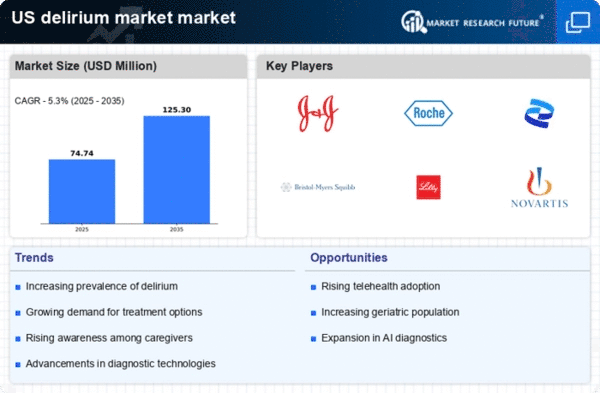
As per Market Research Future analysis, the US delirium Market Size was estimated at 70.98 USD Million in 2024. The US delirium Market industry is projected to grow from 74.74 USD Million in 2025 to 125.3 USD Million by 2035, exhibiting a compound annual growth rate (CAGR) of 5% during the forecast period 2025 - 2035

Key Market Trends & Highlights

The US delirium market is experiencing a transformative shift driven by increased awareness and technological advancements.

  • The market is witnessing a surge in awareness and education regarding delirium management.
  • Technological innovations are enhancing diagnostic and treatment options, particularly in the largest segment of hospital care.
  • A multidisciplinary approach is becoming prevalent, with the fastest-growing segment focusing on outpatient services.
  • Key market drivers include the rising incidence of delirium and increased research funding supporting non-pharmacological interventions.

Market Size & Forecast

2024 Market Size 70.98 (USD Million)
2035 Market Size 125.3 (USD Million)
CAGR (2025 - 2035) 5.3%

Major Players

Johnson & Johnson (US), Roche Holding AG (CH), Pfizer Inc. (US), Bristol-Myers Squibb Company (US), Eli Lilly and Company (US), Novartis AG (CH), AstraZeneca PLC (GB), Merck & Co., Inc. (US), Sanofi S.A. (FR)

Our Impact
Enabled $4.3B Revenue Impact for Fortune 500 and Leading Multinationals
Partnering with 2000+ Global Organizations Each Year
30K+ Citations by Top-Tier Firms in the Industry

US Delirium Market Trends

The delirium Market is currently experiencing notable shifts, driven by an increasing awareness of the condition and its implications for patient care. Delirium, characterized by acute confusion and altered consciousness, is often overlooked in clinical settings, yet its prevalence among hospitalized patients is substantial. As healthcare providers recognize the importance of early detection and management, there is a growing emphasis on developing effective treatment protocols. This trend is further supported by initiatives aimed at educating healthcare professionals about the signs and symptoms of delirium, which may lead to improved patient outcomes and reduced healthcare costs. Moreover, advancements in technology are playing a pivotal role in shaping the delirium Market. Innovative tools and applications designed for monitoring and assessing cognitive function are emerging, providing healthcare professionals with valuable resources to identify delirium more effectively. These technological advancements not only enhance diagnostic accuracy but also facilitate timely interventions. As the healthcare landscape evolves, the integration of technology into delirium management appears to be a promising avenue for improving care and addressing the challenges associated with this condition. Overall, the current trends suggest a proactive approach to delirium, focusing on education, early detection, and the utilization of technology to enhance patient care.

Increased Awareness and Education

There is a growing recognition of delirium's impact on patient outcomes, leading to enhanced educational efforts for healthcare providers. Training programs are being implemented to improve understanding and identification of delirium, which may result in better management strategies.

Technological Innovations

The emergence of advanced monitoring tools and applications is transforming the approach to delirium management. These technologies facilitate early detection and assessment, potentially improving intervention outcomes and overall patient care.

Focus on Multidisciplinary Approaches

A shift towards multidisciplinary care teams is evident, as collaboration among various healthcare professionals is recognized as essential for effective delirium management. This approach may enhance communication and streamline treatment protocols.

US Delirium Market Drivers

Increased Research Funding

The surge in research funding dedicated to understanding and treating delirium is a significant driver for the delirium Market. Government and private institutions are allocating substantial resources to investigate the underlying mechanisms of delirium and its long-term effects. For instance, the National Institutes of Health (NIH) has increased its funding for delirium-related research, which has seen a rise of over 20% in recent years. This influx of financial support is likely to foster innovation in treatment modalities and diagnostic tools, thereby enhancing the overall market landscape. As new findings emerge, they may lead to the development of targeted therapies, further propelling the growth of the delirium Market.

Rising Incidence of Delirium

The increasing incidence of delirium among hospitalized patients is a critical driver for the delirium Market. Studies indicate that approximately 30% of hospitalized patients experience delirium, particularly among the elderly population. This rise in cases necessitates enhanced diagnostic tools and treatment options, thereby expanding the market. The aging population in the US, projected to reach 73 million by 2030, further exacerbates this issue. As healthcare providers become more aware of the prevalence and impact of delirium, there is a growing demand for effective management strategies. Consequently, this trend is likely to stimulate growth in the delirium Market, as stakeholders seek innovative solutions to address the needs of this vulnerable patient demographic.

Integration of Digital Health Solutions

The integration of digital health solutions into delirium management represents a transformative driver for the delirium Market. Telehealth platforms and mobile applications are increasingly being utilized to monitor patients at risk of delirium, providing real-time data to healthcare providers. This trend is particularly relevant in the context of an aging population, where remote monitoring can enhance patient care and reduce hospital readmissions. The digital health market is projected to grow significantly, with estimates suggesting a compound annual growth rate (CAGR) of over 25% in the coming years. As these technologies become more prevalent, they are likely to reshape the landscape of the delirium Market, offering innovative ways to manage and prevent delirium.

Regulatory Support for Delirium Management

Regulatory bodies in the US are increasingly emphasizing the importance of delirium management, which acts as a catalyst for the delirium Market. Initiatives aimed at improving patient safety and quality of care have led to the establishment of guidelines that encourage the identification and treatment of delirium. For example, the Centers for Medicare & Medicaid Services (CMS) has introduced measures that incentivize hospitals to implement delirium screening protocols. This regulatory support is likely to drive the adoption of new technologies and treatment options, as healthcare providers seek to comply with these standards. Consequently, the delirium Market may experience accelerated growth as stakeholders respond to these regulatory changes.

Growing Demand for Non-Pharmacological Interventions

There is a notable shift towards non-pharmacological interventions in the management of delirium, which serves as a key driver for the delirium Market. Healthcare providers are increasingly recognizing the importance of holistic approaches, such as cognitive stimulation and environmental modifications, in preventing and managing delirium. This trend is supported by evidence suggesting that non-pharmacological strategies can reduce the incidence of delirium by up to 50%. As hospitals and care facilities adopt these practices, the demand for related products and services is expected to rise. This shift not only enhances patient outcomes but also creates new opportunities within the delirium Market for innovative solutions that align with these evolving care paradigms.


Market Segment Insights

By Type: Hyperactive (Largest) vs. Mixed (Fastest-Growing)

In the US delirium market, the distribution of segment values reveals that the Hyperactive type holds the largest share, driven by its more noticeable symptoms that facilitate quicker diagnosis and treatment options. Conversely, the Mixed type is gaining traction, appealing to healthcare professionals due to its complex nature and diverse symptoms that might require multifaceted treatment approaches. Each type plays a significant role in the overall market dynamics, influencing healthcare strategies and resource allocation. Growth trends within the US delirium market indicate a rising awareness and diagnosis of delirium types, which fuels the demand for tailored treatment plans. The increased investment in research and development for better management of Mixed type delirium is contributing to its rapid growth. Healthcare providers are focusing on comprehensive solutions that encompass all types, ensuring that they can address varying patient needs effectively. This trend reflects a broader shift towards personalized medicine, driven by the need for improved patient outcomes.

Hyperactive (Dominant) vs. Mixed (Emerging)

The Hyperactive type of delirium is characterized by heightened alertness, agitation, and restlessness, making it easily identifiable and often prioritized in treatment protocols. Its prominence in the US delirium market stems from the urgency it demands for intervention, thereby securing a dominant position. In contrast, the Mixed type presents a more complex clinical picture, encompassing features of both hyperactive and hypoactive states. As an emerging segment, it requires innovative approaches to address its diverse presentations. The Mixed type is gaining attention for its potential to affect wider patient demographics, thereby fostering increased research efforts and growing healthcare interest, marking a significant shift in how delirium is approached.

By Diagnosis and Treatment: Diagnosis (Largest) vs. Treatment (Fastest-Growing)

In the US delirium market, the diagnosis segment holds a significant market share, driven by the rising awareness and technological advancements in diagnostic tools. The emphasis on accurate and timely diagnosis is paramount, leading to a stable demand for diagnostic services. Conversely, the treatment segment is witnessing rapid growth due to increasing investments in research and development of new therapeutic options, making it a pivotal area in delirium management. The growth trends in this segment are primarily fueled by an aging population and rising incidences of delirium, amplifying the need for effective diagnosis and treatment strategies. Innovations, such as digital health solutions and personalized medicine, are further propelling this market. These trends reflect a shift towards more integrated and efficient care models, enhancing the overall outlook for both diagnosis and treatment segments.

Diagnosis (Dominant) vs. Treatment (Emerging)

The diagnosis segment is currently dominant in the US delirium market, characterized by advanced imaging techniques and the use of biomarkers to enhance diagnostic accuracy. This segment benefits from established protocols and a robust infrastructure for clinical assessments. In contrast, the treatment segment, while emerging, is gaining traction with advancements in pharmacotherapy and non-pharmacological approaches. As research continues to evolve, treatment options are becoming more diverse, catering to the unique needs of patients. Overall, both segments complement each other, as accurate diagnosis is essential for effective treatment.

By End User: Hospitals (Largest) vs. Research Centers (Fastest-Growing)

The market share distribution in the US delirium market market clearly shows that hospitals hold the largest share, underscoring their critical role in patient care. This segment is foundational, given that hospitals are primary treatment centers for acute delirium cases, thus driving a significant portion of the market's revenue. In contrast, specialty care facilities and research centers, while smaller in share, are growing rapidly, reflecting emerging trends in targeted delirium management and innovative treatment research. Growth trends in the US delirium market market are heavily influenced by the rising prevalence of delirium, particularly among older populations. Furthermore, advancements in medical technologies and increased awareness of delirium’s impact on recovery outcomes are propelling the demand for specialized care in hospitals and research centers. Investment in research is proving essential, enabling the development of new interventions, which suggests sustained growth in these segments over the coming years.

Hospitals (Dominant) vs. Research Centers (Emerging)

In the US delirium market market, hospitals are the dominant force due to their capacity to handle acute cases, infrastructure, and personnel trained in managing delirium and its complications. This segment benefits from established protocols and funding, allowing for better patient outcomes and greater efficiency in treatment. On the other hand, research centers are recognized as emerging players. They are vital for fostering innovation and translating research into clinical practices that address delirium, and their role is expanding as the need for specialized delirium protocols increases. The synergy between these segments ensures comprehensive care and the potential for groundbreaking advancements in delirium management.

Get more detailed insights about US Delirium Market

Key Players and Competitive Insights

The delirium market exhibits a complex competitive landscape characterized by a blend of innovation, strategic partnerships, and a focus on patient-centric solutions. Key players such as Johnson & Johnson (US), Pfizer Inc. (US), and Eli Lilly and Company (US) are actively shaping the market dynamics through their distinct operational strategies. Johnson & Johnson (US) emphasizes innovation in drug development, particularly in neuropsychiatric treatments, while Pfizer Inc. (US) focuses on expanding its portfolio through strategic acquisitions and collaborations aimed at enhancing therapeutic options for delirium. Eli Lilly and Company (US) is also notable for its commitment to research and development, particularly in the realm of cognitive disorders, which positions it favorably in the competitive environment.The business tactics employed by these companies reflect a concerted effort to optimize supply chains and localize manufacturing processes. The market structure appears moderately fragmented, with several players vying for market share, yet the influence of major companies remains substantial. This competitive structure allows for a diverse range of treatment options, catering to the varying needs of healthcare providers and patients alike.

In October Johnson & Johnson (US) announced a partnership with a leading technology firm to integrate AI-driven analytics into its clinical trials for delirium treatments. This strategic move is likely to enhance the efficiency of drug development processes and improve patient outcomes by enabling more personalized treatment approaches. The integration of AI signifies a shift towards data-driven decision-making in the pharmaceutical sector, which could set a new standard for clinical research.

In September Pfizer Inc. (US) launched a new initiative aimed at increasing access to delirium treatments in underserved communities. This initiative, which includes partnerships with local healthcare providers, underscores Pfizer's commitment to addressing health disparities and expanding its market reach. By focusing on accessibility, Pfizer not only enhances its corporate social responsibility profile but also positions itself as a leader in equitable healthcare solutions.

In August Eli Lilly and Company (US) unveiled a groundbreaking study demonstrating the efficacy of its latest drug candidate for delirium management. This announcement is pivotal as it not only reinforces Eli Lilly's reputation for innovation but also potentially opens new avenues for treatment protocols in clinical settings. The positive results from this study may lead to increased market penetration and bolster Eli Lilly's competitive standing.

As of November the competitive trends in the delirium market are increasingly defined by digitalization, sustainability, and the integration of advanced technologies such as AI. Strategic alliances are becoming more prevalent, facilitating knowledge sharing and resource optimization among key players. Looking ahead, the competitive differentiation is likely to evolve from traditional price-based strategies to a focus on innovation, technological advancements, and the reliability of supply chains. This shift indicates a broader transformation in the market, where companies that prioritize research and development, alongside sustainable practices, may emerge as frontrunners.

Key Companies in the US Delirium Market include

Industry Developments

Recent developments in the US Delirium Market indicate a growing focus on innovative treatment approaches. Bristol Myers Squibb is advancing its research initiatives, aiming to improve therapeutic outcomes. AstraZeneca and Eli Lilly have also made strides, enhancing their medication portfolios to better address delirium symptoms.

In terms of market activity, notable mergers and acquisitions include Merck's acquisition of a small biotech firm in August 2023 to bolster its delirium treatment pipeline, recognized by multiple industry outlets. Additionally, Novartis reported a successful clinical trial for a new drug aimed at preventing delirium in post-operative patients, showcasing their commitment to addressing this condition.

Pfizer and H Lundbeck are exploring collaboration opportunities to develop cognitive-enhancing agents for delirium management, reflecting an ongoing trend of partnerships in this space. The US Delirium Market is witnessing marked growth, partly driven by an increasing awareness of delirium's impact on patient outcomes across healthcare settings. Over the past few years, significant research funding has been allocated, highlighting the urgency and importance of developing effective treatments. This evolving market landscape is indicative of an understanding of the complexities surrounding delirium and its broader implications in clinical contexts.

Future Outlook

US Delirium Market Future Outlook

The Delirium Market is projected to grow at a 5.3% CAGR from 2025 to 2035, driven by increasing awareness, technological advancements, and enhanced healthcare services.

New opportunities lie in:

  • Development of AI-driven diagnostic tools for early detection.
  • Expansion of telehealth services for remote patient monitoring.
  • Investment in training programs for healthcare professionals on delirium management.

By 2035, the market is expected to achieve substantial growth, reflecting evolving healthcare needs.

Market Segmentation

US Delirium Market Type Outlook

  • Hyperactive
  • Hypoactive
  • Mixed

US Delirium Market End User Outlook

  • Hospitals
  • Speciality Care
  • Research Centers

US Delirium Market Diagnosis and Treatment Outlook

  • Diagnosis
  • Treatment

Report Scope

MARKET SIZE 2024 70.98(USD Million)
MARKET SIZE 2025 74.74(USD Million)
MARKET SIZE 2035 125.3(USD Million)
COMPOUND ANNUAL GROWTH RATE (CAGR) 5.3% (2025 - 2035)
REPORT COVERAGE Revenue Forecast, Competitive Landscape, Growth Factors, and Trends
BASE YEAR 2024
Market Forecast Period 2025 - 2035
Historical Data 2019 - 2024
Market Forecast Units USD Million
Key Companies Profiled Johnson & Johnson (US), Roche Holding AG (CH), Pfizer Inc. (US), Bristol-Myers Squibb Company (US), Eli Lilly and Company (US), Novartis AG (CH), AstraZeneca PLC (GB), Merck & Co., Inc. (US), Sanofi S.A. (FR)
Segments Covered Type, Diagnosis and Treatment, End User
Key Market Opportunities Advancements in digital therapeutics enhance patient monitoring and treatment options in the delirium market market.
Key Market Dynamics Rising awareness of delirium management drives innovation and competition among healthcare providers and pharmaceutical companies.
Countries Covered US
Leave a Comment

FAQs

What is the expected market size of the US Delirium Market by 2024?

The US Delirium Market is expected to be valued at 75.0 million USD by the year 2024.

What is the projected market size of the US Delirium Market by 2035?

By 2035, the US Delirium Market is expected to reach a valuation of 135.0 million USD.

What is the CAGR for the US Delirium Market from 2025 to 2035?

The expected compound annual growth rate for the US Delirium Market from 2025 to 2035 is 5.489%.

What is the market share of First-generation Antipsychotics in 2024?

In 2024, the market share for First-generation Antipsychotics is valued at 30.0 million USD.

How much is the market for Second-generation Antipsychotics projected to be in 2035?

The market for Second-generation Antipsychotics is projected to reach 45.0 million USD by 2035.

What is the expected market value for Benzodiazepines in 2024?

The expected market value for Benzodiazepines is 20.0 million USD in 2024.

Who are the key players in the US Delirium Market?

Major players in the US Delirium Market include Bristol Myers Squibb, AstraZeneca, Novartis, and Merck, among others.

What challenges might the US Delirium Market face during the forecast period?

The US Delirium Market may face challenges such as regulatory hurdles and competition from alternative treatments.

What opportunities exist in the US Delirium Market through 2035?

Opportunities in the US Delirium Market may include advancements in drug development and increasing awareness of delirium.

What impact does the current global scenario have on the US Delirium Market?

The current global scenario may influence supply chains and healthcare resources impacting the US Delirium Market.

Download Free Sample

Kindly complete the form below to receive a free sample of this Report

Compare Licence

×
Features License Type
Single User Multiuser License Enterprise User
Price $4,950 $5,950 $7,250
Maximum User Access Limit 1 User Upto 10 Users Unrestricted Access Throughout the Organization
Free Customization
Direct Access to Analyst
Deliverable Format
Platform Access
Discount on Next Purchase 10% 15% 15%
Printable Versions