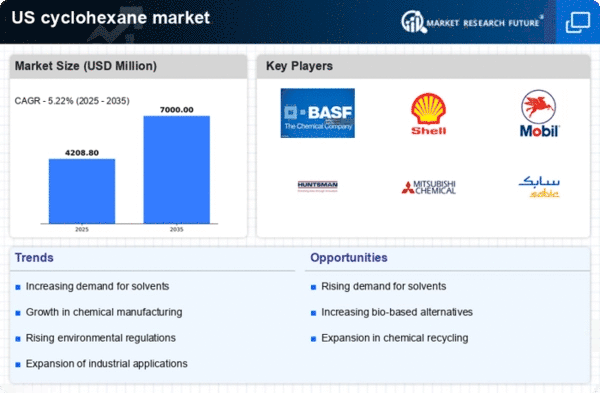
The cyclohexane market exhibits a competitive landscape characterized by a blend of established players and emerging innovators. Key growth drivers include the increasing demand for cyclohexane in the production of nylon and other synthetic fibers, alongside its applications in the automotive and electronics sectors. Major companies such as ExxonMobil Chemical (US), BASF SE (DE), and LyondellBasell Industries (US) are strategically positioned to leverage their extensive production capabilities and technological advancements. ExxonMobil Chemical (US) focuses on optimizing its supply chain and enhancing production efficiency, while BASF SE (DE) emphasizes innovation through sustainable practices and product development. LyondellBasell Industries (US) is actively pursuing partnerships to expand its market reach, collectively shaping a competitive environment that prioritizes efficiency and sustainability.In terms of business tactics, companies are increasingly localizing manufacturing to reduce transportation costs and enhance supply chain resilience. The market structure appears moderately fragmented, with a few dominant players exerting considerable influence. This fragmentation allows for niche players to thrive, yet the collective strategies of major companies significantly impact pricing and availability, creating a dynamic competitive atmosphere.
In October ExxonMobil Chemical (US) announced a major investment in its cyclohexane production facilities, aiming to increase output by 15% over the next two years. This strategic move is likely to enhance its market share and meet the growing demand from the automotive sector, where cyclohexane is essential for producing high-performance materials. The investment underscores ExxonMobil's commitment to maintaining a competitive edge through capacity expansion and technological upgrades.
In September BASF SE (DE) launched a new line of bio-based cyclohexane derivatives, targeting the growing market for sustainable chemicals. This initiative not only aligns with global sustainability trends but also positions BASF as a leader in eco-friendly solutions. The introduction of these products may attract environmentally conscious consumers and businesses, potentially reshaping market dynamics in favor of sustainable practices.
In August LyondellBasell Industries (US) entered into a strategic partnership with a leading technology firm to develop advanced recycling technologies for cyclohexane production. This collaboration aims to enhance the circular economy by reducing waste and improving resource efficiency. Such partnerships are indicative of a broader trend towards innovation and sustainability, which are becoming critical differentiators in the competitive landscape.
As of November current trends in the cyclohexane market reflect a shift towards digitalization, sustainability, and the integration of AI technologies. Strategic alliances are increasingly shaping the landscape, enabling companies to pool resources and expertise. The competitive differentiation is likely to evolve from traditional price-based competition to a focus on innovation, technological advancements, and supply chain reliability. Companies that can effectively navigate these trends will likely secure a competitive advantage in the evolving market.