×
Request Free Sample ×

Kindly complete the form below to receive a free sample of this Report

* Please use a valid business email

Leading companies partner with us for data-driven Insights

clients tt-cursor
Hero Background

US Content Delivery Network Market one

ID: MRFR/ICT/11412-HCR
100 Pages
Garvit Vyas
February 2026

US Content Delivery Network Market Size, Share and Trends Analysis Report By Type (Standard Content Delivery Network Market and Video Content Delivery Network Market), By Solution (Media Delivery, Web Performance Optimization, And Cloud Security), By Application (OTT Streaming, Network Optimization, Website & API Management, And Analytics & Performance Monitoring) And By Region (Europe, Asia-Pacific, North America, And Rest Of The World) –Market Forecast Till 2035.

Share:
Download PDF ×

We do not share your information with anyone. However, we may send you emails based on your report interest from time to time. You may contact us at any time to opt-out.

US Content Delivery Network Market one Infographic
Purchase Options

US Content Delivery Network Market one Summary

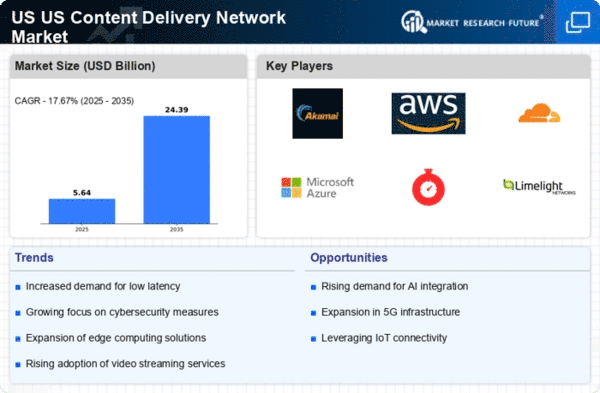
As per analysis, the US Content Delivery Network Market is projected to grow from USD 4.79 Billion in 2024 to USD 24.39 Billion by 2035, exhibiting a compound annual growth rate (CAGR) of 15.94% during the forecast period (2025 - 2035).

Key Market Trends & Highlights

The US Content Delivery Network Market is experiencing robust growth driven by evolving consumer demands and technological advancements.

  • The demand for streaming services continues to surge, positioning video streaming as the largest segment in the market.
  • Gaming emerges as the fastest-growing segment, reflecting a shift in consumer engagement and content consumption patterns.
  • The media and entertainment sector remains the largest contributor to CDN utilization, while retail is rapidly expanding its footprint in this space.
  • Key market drivers include the growing e-commerce sector and increased mobile internet usage, which are fueling the need for enhanced CDN solutions.

Market Size & Forecast

2024 Market Size 4.79 (USD Billion)
2035 Market Size 24.39 (USD Billion)
CAGR (2025 - 2035) 15.94%

Major Players

Akamai Technologies (US), Amazon Web Services (US), Cloudflare (US), Microsoft Azure (US), Fastly (US), Limelight Networks (US), StackPath (US), CDN77 (US), Verizon Media (US)

Our Impact
Enabled $4.3B Revenue Impact for Fortune 500 and Leading Multinationals
Partnering with 2000+ Global Organizations Each Year
30K+ Citations by Top-Tier Firms in the Industry

US Content Delivery Network Market one Trends

The US Content Delivery Network Market is currently experiencing a transformative phase, driven by the increasing demand for high-speed internet and the proliferation of digital content. As consumers continue to seek seamless online experiences, businesses are compelled to adopt advanced content delivery solutions. This shift is further fueled by the rise of streaming services, e-commerce platforms, and mobile applications, all of which require efficient data distribution to enhance user engagement. The market landscape is characterized by a growing emphasis on reducing latency and improving load times, which are critical for maintaining competitive advantage in a saturated digital environment. Moreover, the US Content Delivery Network Market is witnessing a surge in the adoption of edge computing technologies. This trend appears to be reshaping how content is delivered, as it allows for processing data closer to the end-user, thereby minimizing delays. Additionally, the increasing focus on cybersecurity measures within content delivery networks indicates a proactive approach to safeguarding sensitive information. As organizations prioritize data protection, the integration of robust security protocols into CDN solutions is likely to become a standard practice. Overall, the market is poised for continued growth, driven by technological advancements and evolving consumer expectations.

Increased Demand for Streaming Services

The US Content Delivery Network Market is seeing a notable rise in demand for streaming services. As more consumers turn to online platforms for entertainment, the need for efficient content delivery becomes paramount. This trend suggests that CDNs must adapt to handle high volumes of traffic while ensuring minimal buffering and optimal video quality.

Adoption of Edge Computing

Edge computing is gaining traction within the US Content Delivery Network Market. By processing data closer to the user, this technology reduces latency and enhances the overall user experience. The integration of edge computing into CDN strategies indicates a shift towards more localized data handling, which may improve service reliability.

Focus on Cybersecurity Enhancements

As cyber threats continue to evolve, the US Content Delivery Network Market is placing greater emphasis on cybersecurity. Companies are increasingly integrating advanced security measures into their CDN solutions to protect sensitive data. This trend highlights the importance of safeguarding user information while maintaining efficient content delivery.

US Content Delivery Network Market one Drivers

Growing E-commerce Sector

The US Content Delivery Network Market is experiencing a notable surge due to the rapid expansion of the e-commerce sector. As online shopping continues to gain traction, businesses are increasingly reliant on CDNs to ensure fast and reliable delivery of content. In 2025, e-commerce sales in the United States reached approximately 1 trillion USD, highlighting the critical need for efficient content distribution. CDNs play a pivotal role in enhancing user experience by reducing latency and improving load times, which are essential for retaining customers in a competitive market. Furthermore, the integration of CDNs with e-commerce platforms allows for seamless transactions and real-time inventory updates, thereby fostering consumer trust and satisfaction. This trend suggests that the growth of the e-commerce sector will continue to drive demand for CDN services in the US, making it a key market driver.

Emergence of Video Content

The US Content Delivery Network Market is significantly influenced by the emergence of video content as a dominant form of media consumption. In 2025, video streaming services accounted for nearly 80% of all internet traffic in the United States, underscoring the importance of CDNs in delivering high-quality video content. As consumers increasingly turn to platforms like Netflix, Hulu, and YouTube, the demand for reliable and efficient content delivery solutions has surged. CDNs facilitate the smooth streaming of video by distributing content across multiple servers, thereby reducing buffering and enhancing viewer satisfaction. This trend indicates that the growth of video content consumption will continue to be a driving force for CDN adoption in the US, as businesses strive to meet the expectations of their audiences.

Increased Mobile Internet Usage

The proliferation of mobile devices in the United States has significantly influenced the US Content Delivery Network Market. As of 2025, mobile internet usage accounts for over 50% of total web traffic, necessitating the need for optimized content delivery solutions. CDNs are essential in ensuring that mobile users receive content quickly and efficiently, regardless of their location. This shift towards mobile consumption has prompted businesses to invest in CDN services that can adapt to varying network conditions and device capabilities. Moreover, the rise of mobile applications further amplifies the demand for CDNs, as these applications require fast and reliable content delivery to enhance user engagement. Consequently, the increasing reliance on mobile internet is likely to propel the growth of the CDN market in the US, as companies seek to provide superior mobile experiences.

Regulatory Compliance and Data Sovereignty

The US Content Delivery Network Market is also shaped by the increasing emphasis on regulatory compliance and data sovereignty. With the implementation of various data protection laws, such as the California Consumer Privacy Act (CCPA), businesses are compelled to ensure that their content delivery practices align with legal requirements. CDNs can assist organizations in maintaining compliance by providing localized data storage and processing capabilities. This is particularly relevant for companies that handle sensitive customer information, as they must adhere to strict regulations regarding data privacy. As awareness of data protection continues to grow, the demand for CDNs that prioritize compliance and security is likely to increase, positioning regulatory considerations as a significant driver in the US market.

Technological Advancements in CDN Solutions

The US Content Delivery Network Market is witnessing a wave of technological advancements that are enhancing the capabilities of CDN solutions. Innovations such as artificial intelligence and machine learning are being integrated into CDN services to optimize content delivery and improve performance. These technologies enable CDNs to analyze user behavior and adapt content distribution strategies in real-time, resulting in faster load times and improved user experiences. Additionally, the rise of 5G technology is expected to further revolutionize the CDN landscape by providing faster and more reliable internet connections. As businesses seek to leverage these advancements to gain a competitive edge, the demand for cutting-edge CDN solutions is likely to grow, making technological innovation a key driver in the US market.


Market Segment Insights

By Application: Video Streaming (Largest) vs. Gaming (Fastest-Growing)

In the US Content Delivery Network Market, the application segment is primarily driven by video streaming, which holds the largest share due to the robust demand for high-quality, seamless streaming experiences. Following video streaming, web performance optimization and e-commerce applications also demonstrate significant market presence. Gaming, while currently smaller in market share, is rapidly gaining traction and has been increasingly adopted by users seeking optimized experiences, especially in real-time scenarios.

Video Streaming (Dominant) vs. Gaming (Emerging)

Video streaming is the dominant application within the US Content Delivery Network Market, recognized for its essential role in delivering rich media content efficiently to consumers. This segment is characterized by its sophisticated compression algorithms, adaptive bitrate streaming, and extensive content libraries, ensuring that users receive smooth playback without buffering. Meanwhile, gaming emerges as a rapidly growing segment due to the increasing popularity of online multiplayer games and e-sports, which demand low latency and high-speed connections. Both segments present unique challenges and opportunities, with video streaming focusing on high throughput and gaming concentrating on ultra-low latency, indicating the diverse requirements of end-users.

By End Use: Media and Entertainment (Largest) vs. Retail (Fastest-Growing)

In the US Content Delivery Network Market, the end use of Media and Entertainment accounts for the largest share, driven by the ever-growing demand for video streaming, live content delivery, and gaming applications. Retail, while smaller, is rapidly expanding as more businesses embrace digital platforms for e-commerce and customer engagement. Other segments like Education, Healthcare, and Government follow, showcasing varied but significant market footprints, reflecting the diverse needs that content delivery networks serve across the nation. Growth trends point towards an increasing dependency on CDNs in the Retail sector, primarily due to the surge in online shopping and digital interactions. Media and Entertainment remains robust due to technological advancements and the rise of OTT platforms. The Education sector is witnessing growth propelled by remote learning initiatives, while Healthcare and Government sectors are increasingly adopting CDN solutions to enhance service delivery and ensure data security, highlighting a significant transformation across industries.

Media and Entertainment (Dominant) vs. Retail (Emerging)

The Media and Entertainment sector stands as the dominant player in the US Content Delivery Network Market, driven by the insatiable appetite for high-quality video content and streaming services. This segment benefits from innovations in data compression and delivery technologies, enabling faster and more reliable access to content. In contrast, Retail is emerging as a significant force, capturing attention due to the rapid growth of e-commerce and the need for improved customer experience through personalized content delivery. As retailers increasingly leverage CDNs to optimize online transactions and enhance user engagement, the sector is witnessing substantial investment, making it a key player in the market's evolution.

By Deployment Type: Cloud-based (Largest) vs. Hybrid (Fastest-Growing)

In the US Content Delivery Network Market, the deployment type segment is characterized by a diverse distribution among Cloud-based, On-premises, and Hybrid solutions. Cloud-based deployment dominates the market due to its scalability and cost-effectiveness, appealing to businesses of all sizes looking to enhance their online content delivery. On-premises solutions, however, maintain a niche presence among enterprises requiring enhanced security and customizability, while Hybrid deployments are gaining traction as businesses seek to combine the benefits of both cloud and on-premises solutions in a more flexible delivery model.

Deployment Type: Cloud-based (Dominant) vs. Hybrid (Emerging)

The Cloud-based deployment type remains the dominant player in the US content delivery network market, known for its ability to provide on-demand resources and extensive scalability to meet fluctuating demand. Companies utilizing cloud solutions benefit from reduced maintenance costs and enhanced collaboration capabilities, making it ideal for businesses looking to optimize their digital presence. Conversely, the Hybrid deployment type is emerging rapidly, as it uniquely combines the strengths of cloud and on-premise systems. This flexibility allows organizations to retain control over sensitive data while enjoying the advantages of cloud scalability, which appeals to medium-sized and large businesses looking to balance security with efficiency.

By Service Type: Content Delivery (Largest) vs. Streaming Services (Fastest-Growing)

In the US Content Delivery Network Market, the service type segment shows that Content Delivery holds the largest market share, driven by increasing demand for efficient content distribution. Load Balancing and Security Services contribute significantly as well, catering to businesses seeking optimal performance and enhanced security. Streaming Services, while still growing, have gained notable traction owing to the rapid shift towards digital consumption and entertainment needs among consumers.

Content Delivery (Dominant) vs. Streaming Services (Emerging)

Content Delivery stands out as the dominant service in the segment, attributed to its widespread application in delivering web content, videos, and applications with reduced latency and improved performance. On the other hand, Streaming Services, although emerging, are quickly capturing market attention as more viewers prefer on-demand content consumption. With advancements in technology like 5G and Wi-Fi 6, the demand for quality streaming experiences encourages investments in more robust streaming solutions, projecting significant growth in this area.

By Network Type: Public Network (Largest) vs. Hybrid Network (Fastest-Growing)

In the US Content Delivery Network Market, the Public Network segment holds the largest share, driven by its extensive infrastructure and cost-effectiveness for businesses seeking to enhance their digital presence. This segment is particularly favored by companies that prefer to leverage widespread networks to deliver content efficiently to users across various geographies. Conversely, the Hybrid Network segment, which combines elements of both public and private networks, is experiencing rapid growth, appealing to organizations looking for greater flexibility and security in their content delivery solutions.

Public Network (Dominant) vs. Hybrid Network (Emerging)

The Public Network segment is characterized by its wide availability and scalability, offering broad accessibility to users without the need for substantial capital investment from content providers. This network type is ideal for companies that require reliable, fast delivery of static and dynamic content to a large audience. On the other hand, the Hybrid Network is emerging as a preferred choice for businesses that require a balance between the extensive reach of public networks and the security features of private networks. This segment appeals particularly to sectors like finance and healthcare, where data confidentiality and compliance are crucial, thus fostering a unique niche in the competitive landscape.

Get more detailed insights about US Content Delivery Network Market one

Key Players and Competitive Insights

The Content Delivery Network Market is characterized by a dynamic competitive landscape, driven by the increasing demand for high-speed content delivery and enhanced user experiences. Major players such as Akamai Technologies (US), Amazon Web Services (US), and Cloudflare (US) are at the forefront, each adopting distinct strategies to solidify their market positions. Akamai Technologies (US) focuses on innovation through continuous enhancement of its security features and performance optimization, while Amazon Web Services (US) leverages its extensive cloud infrastructure to offer integrated solutions that appeal to a broad customer base. Cloudflare (US), on the other hand, emphasizes its commitment to providing robust security and performance solutions, which has allowed it to capture a significant share of the market. Collectively, these strategies contribute to a competitive environment that is increasingly centered around technological advancement and customer-centric solutions.

In terms of business tactics, companies are increasingly localizing their operations and optimizing supply chains to enhance service delivery. The market structure appears moderately fragmented, with a mix of established players and emerging startups vying for market share. This fragmentation is indicative of the diverse needs of customers, which necessitates tailored solutions. The collective influence of key players shapes the market dynamics, as they engage in strategic partnerships and collaborations to expand their service offerings and geographical reach.

In December 2025, Akamai Technologies (US) announced a partnership with a leading telecommunications provider to enhance its edge computing capabilities. This strategic move is likely to bolster Akamai's position in the market by enabling faster content delivery and improved latency for end-users. Such partnerships are crucial in a landscape where speed and reliability are paramount.

In November 2025, Amazon Web Services (US) launched a new suite of machine learning tools designed to optimize content delivery processes. This initiative not only underscores AWS's commitment to innovation but also positions it as a leader in integrating AI technologies into CDN services. The introduction of these tools may significantly enhance operational efficiencies for clients, thereby attracting a wider customer base.

In October 2025, Cloudflare (US) expanded its global network by adding new data centers in key regions, which is expected to improve service availability and performance. This expansion reflects Cloudflare's strategy to enhance its infrastructure and meet the growing demand for reliable content delivery solutions. By investing in infrastructure, Cloudflare is likely to strengthen its competitive edge in the market.

As of January 2026, current trends in the Content Delivery Network Market are heavily influenced by digitalization, sustainability, and the integration of AI technologies. Strategic alliances are becoming increasingly important, as companies seek to leverage each other's strengths to enhance service offerings. The competitive differentiation is expected to evolve, shifting from price-based competition to a focus on innovation, technology, and supply chain reliability. This transition indicates a maturation of the market, where companies that prioritize technological advancements and customer-centric solutions are likely to thrive.

Key Companies in the US Content Delivery Network Market one include

Future Outlook

US Content Delivery Network Market one Future Outlook

The US Content Delivery Network Market is projected to grow at a 15.94% CAGR from 2025 to 2035, driven by increasing demand for high-speed content delivery and cloud services.

New opportunities lie in:

  • Expansion of edge computing services to enhance latency reduction.
  • Development of AI-driven analytics for content optimization.
  • Partnerships with e-commerce platforms for seamless media delivery.

By 2035, the market is expected to be robust, driven by technological advancements and strategic partnerships.

Market Segmentation

US Content Delivery Network Market one End Use Outlook

  • Media and Entertainment
  • Retail
  • Education
  • Healthcare
  • Government

US Content Delivery Network Market one Application Outlook

  • Video Streaming
  • Web Performance Optimization
  • Gaming
  • Software Distribution
  • E-commerce

US Content Delivery Network Market one Network Type Outlook

  • Public Network
  • Private Network
  • Hybrid Network

US Content Delivery Network Market one Service Type Outlook

  • Content Delivery
  • Load Balancing
  • Security Services
  • Streaming Services

US Content Delivery Network Market one Deployment Type Outlook

  • Cloud-based
  • On-premises
  • Hybrid

Report Scope

MARKET SIZE 20244.79(USD Billion)
MARKET SIZE 20255.64(USD Billion)
MARKET SIZE 203524.39(USD Billion)
COMPOUND ANNUAL GROWTH RATE (CAGR)15.94% (2024 - 2035)
REPORT COVERAGERevenue Forecast, Competitive Landscape, Growth Factors, and Trends
BASE YEAR2024
Market Forecast Period2025 - 2035
Historical Data2019 - 2024
Market Forecast UnitsUSD Billion
Key Companies ProfiledAkamai Technologies (US), Amazon Web Services (US), Cloudflare (US), Microsoft Azure (US), Fastly (US), Limelight Networks (US), StackPath (US), CDN77 (US), Verizon Media (US)
Segments CoveredApplication, End Use, Deployment Type, Service Type, Network Type
Key Market OpportunitiesExpansion of edge computing capabilities enhances performance in the US Content Delivery Network Market.
Key Market DynamicsRising demand for low-latency streaming drives innovation and competition in the US Content Delivery Network Market.
Countries CoveredUS
Leave a Comment
Download Free Sample

Kindly complete the form below to receive a free sample of this Report

Compare Licence

×
Features License Type
Single User Multiuser License Enterprise User
Price $4,950 $5,950 $7,250
Maximum User Access Limit 1 User Upto 10 Users Unrestricted Access Throughout the Organization
Free Customization
Direct Access to Analyst
Deliverable Format
Platform Access
Discount on Next Purchase 10% 15% 15%
Printable Versions