×
Request Free Sample ×

Kindly complete the form below to receive a free sample of this Report

* Please use a valid business email

Leading companies partner with us for data-driven Insights

clients tt-cursor
Hero Background

US Cloud Video Streaming Market

ID: MRFR/ICT/60613-HCR
200 Pages
Aarti Dhapte
February 2026

US Cloud Video Streaming Market Research Report By Components (Media Players, Service, Streaming Type, Cloud Deployment, Vertical), By Media Players (JW Player, Adobe Flash Player, Adobe Air, IOS Media Player), By Service (Professional Services, Managed Services), By Streaming Type (Live Streaming, Video on Demand, Video Hosting), By Cloud Deployment (Public Cloud, Private Cloud, Hybrid Cloud), and By Vertical (Media and Entertainment, BFSI, Education, Healthcare, Government) - Forecast to 2035

Share:
Download PDF ×

We do not share your information with anyone. However, we may send you emails based on your report interest from time to time. You may contact us at any time to opt-out.

US Cloud Video Streaming Market Infographic
Purchase Options

US Cloud Video Streaming Market Summary

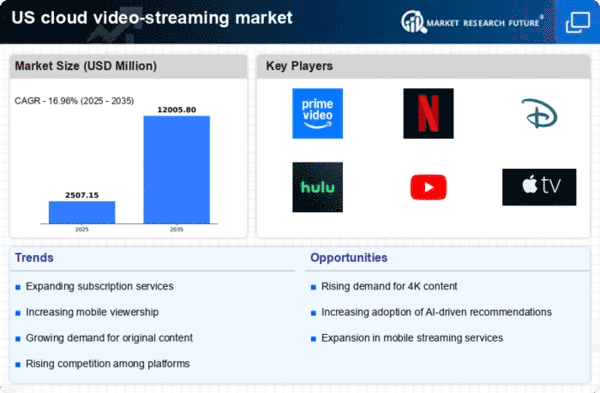
As per Market Research Future analysis, the US cloud video-streaming market size was estimated at 2143.6 USD Million in 2024. The US cloud video-streaming market is projected to grow from 2507.15 USD Million in 2025 to 12005.8 USD Million by 2035, exhibiting a compound annual growth rate (CAGR) of 16.9% during the forecast period 2025 - 2035

Key Market Trends & Highlights

The US cloud video-streaming market is experiencing robust growth driven by evolving consumer preferences and technological advancements.

  • The largest segment in the US cloud video-streaming market is subscription-based services, which continue to gain traction among consumers.
  • The fastest-growing segment is mobile streaming services, reflecting a shift towards on-the-go content consumption.
  • Technological advancements in streaming infrastructure are enhancing user experience and driving market expansion.
  • Rising demand for on-demand content and increased focus on data security and privacy are key drivers propelling market growth.

Market Size & Forecast

2024 Market Size 2143.6 (USD Million)
2035 Market Size 12005.8 (USD Million)
CAGR (2025 - 2035) 16.96%

Major Players

Amazon Prime Video (US), Netflix (US), Disney+ (US), Hulu (US), YouTube (US), Apple TV+ (US), HBO Max (US), Tencent Video (CN), iQIYI (CN)

Our Impact
Enabled $4.3B Revenue Impact for Fortune 500 and Leading Multinationals
Partnering with 2000+ Global Organizations Each Year
30K+ Citations by Top-Tier Firms in the Industry

US Cloud Video Streaming Market Trends

The cloud video-streaming market is currently experiencing a transformative phase, characterized by rapid technological advancements and evolving consumer preferences. As more individuals and businesses embrace digital content consumption, the demand for high-quality streaming services continues to rise. This shift is driven by the increasing availability of high-speed internet and the proliferation of smart devices, which facilitate seamless access to a variety of video content. Furthermore, the market is witnessing a surge in competition, with numerous platforms vying for consumer attention, leading to innovative offerings and pricing strategies. This dynamic environment suggests that companies must remain agile and responsive to changing market conditions to maintain their competitive edge. In addition, the cloud video-streaming market is likely to see a growing emphasis on personalized content delivery. As algorithms and data analytics improve, service providers are better equipped to tailor recommendations to individual users, enhancing the overall viewing experience. This trend not only fosters customer loyalty but also encourages higher engagement rates. Moreover, the integration of advanced technologies such as artificial intelligence and machine learning is expected to further refine content curation and delivery methods, potentially reshaping how audiences interact with video content in the future.

Increased Adoption of Subscription Models

The cloud video-streaming market is witnessing a notable shift towards subscription-based models. This trend reflects a growing consumer preference for on-demand access to diverse content libraries. As users seek flexibility and convenience, platforms are increasingly offering tiered subscription plans that cater to varying needs and budgets. This approach not only enhances user satisfaction but also provides companies with a steady revenue stream.

Enhanced User Experience through Technology

Technological advancements are playing a crucial role in shaping the cloud video-streaming market. Innovations such as adaptive bitrate streaming and improved compression techniques are enabling higher quality video delivery, even in bandwidth-constrained environments. Additionally, the integration of augmented reality and virtual reality features is likely to create immersive viewing experiences, attracting a broader audience.

Focus on Original Content Production

There is a growing emphasis on original content production within the cloud video-streaming market. Companies are investing heavily in creating exclusive shows and films to differentiate themselves from competitors. This strategy not only helps in attracting new subscribers but also fosters brand loyalty among existing users, as unique content becomes a key driver of consumer choice.

US Cloud Video Streaming Market Drivers

Rising Demand for On-Demand Content

The cloud video-streaming market experiences a notable surge in demand for on-demand content, driven by changing consumer preferences. Viewers increasingly favor the flexibility of accessing content at their convenience, leading to a shift from traditional broadcasting. In 2025, it is estimated that over 70% of households in the US subscribe to at least one streaming service, reflecting a significant transformation in viewing habits. This trend compels providers to enhance their offerings, resulting in a competitive landscape where content variety and availability become paramount. The cloud video-streaming market must adapt to these evolving demands, ensuring that platforms can deliver a diverse array of content to retain subscribers and attract new audiences.

Expansion of Mobile Streaming Services

The proliferation of mobile devices significantly influences the cloud video-streaming market, as consumers increasingly seek to access content on-the-go. With over 80% of US adults owning smartphones in 2025, mobile streaming is becoming a primary mode of content consumption. This trend encourages streaming platforms to optimize their services for mobile devices, ensuring compatibility and user-friendly interfaces. The cloud video-streaming market must prioritize mobile accessibility to capture this growing audience segment. Additionally, partnerships with mobile carriers may enhance service offerings, providing bundled subscriptions that attract new users. As mobile streaming continues to expand, it is likely to reshape the competitive dynamics within the market.

Increased Focus on Data Security and Privacy

As the cloud video-streaming market expands, concerns regarding data security and privacy become increasingly prominent. Consumers are becoming more aware of the risks associated with sharing personal information online, prompting streaming services to enhance their security measures. In 2025, it is anticipated that over 60% of users will prioritize platforms that demonstrate robust data protection protocols. This trend compels the cloud video-streaming market to invest in advanced encryption technologies and transparent privacy policies. By addressing these concerns, providers can build trust with their audiences, potentially leading to higher subscription rates and customer loyalty. The emphasis on security may also influence regulatory frameworks, shaping the future landscape of the industry.

Growing Integration of Artificial Intelligence

The integration of artificial intelligence (AI) into the cloud video-streaming market is emerging as a transformative driver. AI technologies facilitate personalized content recommendations, enhancing user engagement and retention. By analyzing viewing habits and preferences, streaming platforms can tailor their offerings to individual users, potentially increasing subscription rates. In 2025, it is estimated that AI-driven recommendations could account for up to 30% of content viewed on major platforms. This trend indicates a shift towards more user-centric experiences, where the cloud video-streaming market leverages data analytics to optimize content delivery. As competition intensifies, the ability to provide personalized experiences may become a critical differentiator for service providers.

Technological Advancements in Streaming Infrastructure

Technological innovations play a crucial role in shaping the cloud video-streaming market. The advent of 5G technology, for instance, promises to enhance streaming quality and reduce latency, thereby improving user experience. As of 2025, approximately 50% of the US population is projected to have access to 5G networks, which could significantly impact streaming services. Enhanced bandwidth and faster data transfer rates enable providers to offer higher resolution content, including 4K and 8K streaming. Consequently, the cloud video-streaming market is likely to witness increased user engagement and satisfaction, as consumers benefit from seamless streaming experiences. This technological evolution may also lead to new business models and revenue streams for service providers.


Market Segment Insights

By Components: Media Players (Largest) vs. Services (Fastest-Growing)

Within the Components segment of the US cloud video-streaming market, Media Players hold a significant share, reflecting their established importance in content delivery to consumers. Meanwhile, Services are gaining traction, emerging as a critical component in driving user engagement and subscription growth in this competitive landscape. The distribution showcases Media Players as a robust backbone, while Services steadily carve out their place in this evolving sector. The growth prospects for the Components segment are promising, with Services being the standout player. As technology advances, more users opt for diverse streaming services, leading to an increase in demand. Media Players continue to adapt, integrating new features to enhance user experiences. This dual growth is driven by changing consumer preferences towards personalized content, making both segments crucial for industry stakeholders to capitalize on.

Media Players (Dominant) vs. Services (Emerging)

Media Players are integral to the US cloud video-streaming market, providing the necessary hardware and software for seamless playback and user interaction. They are characterized by their compatibility with various streaming services, ensuring users can access a broad range of content effortlessly. On the other hand, Services are rapidly emerging as a key driver of innovation, with platforms offering subscription-based models equipped with original content and features tailored to enhance viewer engagement. This dynamic underscores the balance within the segment, as Media Players maintain dominance while Services capitalize on changing consumer habits and technology to redefine the viewing experience.

By Streaming Type: Video on Demand (Largest) vs. Live Streaming (Fastest-Growing)

In the US cloud video-streaming market, Video on Demand currently holds the largest market share, significantly prominent due to its convenience and flexibility for viewers. Live Streaming follows as the fastest-growing segment, driven by advancements in technology and increased consumer interest in real-time content. Video Hosting plays a vital role but trails in comparison with a smaller share, often acting as a supplementary service for content creators. The growth trends in this segment are primarily influenced by the rising demand for on-the-go accessibility and the increase in mobile internet penetration. Live Streaming's rapid ascension is fueled by social media integration and the surge in live events, creating a more engaging viewer experience. The ongoing evolution of user preferences and technological innovations are expected to propel these segments further, shaping the competitive landscape of the market.

Video on Demand (Dominant) vs. Live Streaming (Emerging)

Video on Demand is the dominant force in the US cloud video-streaming market, providing users with the flexibility to watch content anytime and anywhere, thereby aligning with modern viewing habits. This segment capitalizes on vast libraries of content, including movies and series, catering to diverse audience preferences. Live Streaming, on the other hand, is emerging dynamically, gaining traction through interactive experiences such as gaming, sports, and social events. Its real-time engagement offers unique value, attracting a younger demographic eager for immediacy. As both segments evolve, the competition will intensify, pushing innovations and consumer-centric approaches to the forefront.

By Cloud Deployment: Public Cloud (Largest) vs. Private Cloud (Fastest-Growing)

In the US cloud video-streaming market, the distribution of market share among the cloud deployment segments reveals a significant inclination towards Public Cloud services, which dominate the landscape with its extensive resource availability and scalability. Meanwhile, Private Cloud, driven by increasing privacy concerns, offers tailored solutions and is emerging as a notable contender. Hybrid Cloud, while growing, currently occupies a smaller portion of the market. Growth trends indicate that the demand for cloud video-streaming services is transforming, with Public Cloud remaining the cornerstone due to its flexibility and wide adoption among enterprises. In contrast, Private Cloud is witnessing accelerated growth as organizations seek enhanced security and customizability. This trend illustrates a market striving for balance between flexibility and security in cloud deployment strategies.

Public Cloud (Dominant) vs. Private Cloud (Emerging)

Public Cloud services are characterized by their broad infrastructure, enabling seamless streaming capabilities and a vast audience reach. This segment’s dominance is fueled by its ability to provide on-demand resources, allowing companies to scale quickly in response to user demand. Meanwhile, Private Cloud is gaining traction for its security features and tailored solutions to specific business needs. This segment appeals to enterprises that prioritize data security and compliance. The growing adoption of video content and a shift towards personalized experiences suggest that while Public Cloud maintains dominance, Private Cloud is positioning itself as a strong, emerging choice for businesses seeking robust security and specialized functionalities.

By Vertical: Media and Entertainment (Largest) vs. Education (Fastest-Growing)

In the US cloud video-streaming market, the Media and Entertainment sector holds the largest share due to robust demand for streaming content, fueled by an increase in on-demand viewing habits and the proliferation of various streaming platforms. Other segments such as BFSI, Healthcare, and Government contribute significantly, but the lion's share remains with Media and Entertainment, capitalizing on rapid technological advancements and the growing appetite for diverse content offerings. Conversely, the Education segment is emerging as the fastest-growing sector within the US cloud video-streaming market. The growing adoption of online learning and digital educational tools has led institutions to leverage video streaming technologies for delivering high-quality educational content. This trend is further accelerated by the increase in remote learning initiatives and the necessity for interactive teaching methods, positioning Education for substantial growth in the coming years.

Media and Entertainment (Dominant) vs. Education (Emerging)

The Media and Entertainment segment is characterized by its extensive library of content options and a strong subscriber base across various platforms. This dominance is supported by a variety of services including movies, series, live sports, and user-generated content, enabling a versatile offering that appeals to diverse audiences. On the other hand, the Education sector is emerging with innovative video streaming applications tailored for learning environments, enabling institutions to provide immersive and interactive experiences. This shift not only enhances learning engagement but also introduces new possibilities for content delivery in virtual classrooms, making it a pivotal player in the growth of the US cloud video-streaming market.

Get more detailed insights about US Cloud Video Streaming Market

Key Players and Competitive Insights

The cloud video-streaming market in the US is characterized by intense competition and rapid evolution, driven by technological advancements and shifting consumer preferences. Major players such as Amazon Prime Video (US), Netflix (US), and Disney+ (US) are at the forefront, each adopting distinct strategies to enhance their market positioning. Amazon Prime Video (US) focuses on integrating its streaming service with its broader ecosystem, leveraging its e-commerce platform to drive subscriptions. Netflix (US), on the other hand, emphasizes original content production, aiming to differentiate itself through exclusive offerings. Disney+ (US) capitalizes on its extensive library of beloved franchises, while also investing in new content to attract diverse audiences. Collectively, these strategies contribute to a competitive landscape that is both dynamic and multifaceted.The business tactics employed by these companies reflect a nuanced understanding of market demands. For instance, localizing content to cater to regional tastes has become a common approach, enhancing viewer engagement. The market structure appears moderately fragmented, with several key players vying for consumer attention. This fragmentation allows for a variety of content offerings, yet the influence of major companies remains substantial, shaping consumer expectations and industry standards.

In October Amazon Prime Video (US) announced a partnership with a leading telecommunications provider to bundle streaming services with internet subscriptions. This strategic move is likely to enhance customer acquisition by providing added value to consumers, thereby increasing market penetration. Such partnerships may also facilitate improved service delivery and customer satisfaction, reinforcing Amazon's competitive edge in the market.

In September Netflix (US) unveiled a new tier of service that incorporates ad-supported content, aiming to attract a broader audience segment. This shift not only diversifies its revenue streams but also reflects a growing trend towards ad-supported models in the streaming industry. By offering a lower-cost option, Netflix (US) may effectively compete with emerging platforms that cater to budget-conscious consumers, thereby maintaining its market share.

In August Disney+ (US) expanded its content library by acquiring rights to several popular international series, enhancing its global appeal. This strategic acquisition is indicative of Disney's commitment to providing a diverse range of content, which is essential for attracting and retaining subscribers in an increasingly competitive environment. By broadening its offerings, Disney+ (US) positions itself as a formidable player in the cloud video-streaming market.

As of November current trends in the cloud video-streaming market include a pronounced focus on digitalization, sustainability, and the integration of artificial intelligence (AI) into content delivery and user experience. Strategic alliances are increasingly shaping the competitive landscape, enabling companies to pool resources and expertise. Looking ahead, competitive differentiation is expected to evolve, with a shift from price-based competition towards innovation, technological advancements, and supply chain reliability. This transition underscores the importance of adaptability and forward-thinking strategies in maintaining a competitive advantage.

Key Companies in the US Cloud Video Streaming Market include

Industry Developments

In order to increase the scalability of its cloud delivery and advertising-supported streaming infrastructure, Disney completed its full acquisition of Hulu in November 2023, securing a combined streaming offering under the Disney ecosystem and paving the way for a unified Disney+/Hulu bundled service scheduled for roll-out in 2024.

With the launch of its Freestream FAST platform in 2023, Sling TV expanded its reach through platforms like Roku and Amazon Fire TV and signaled its shift toward hybrid monetization and cloud-native delivery. The platform offers over 335 free ad-supported channels in addition to 10 hours of free cloud DVR storage, which is an industry first.In order to remain competitive with Sling and Hulu Live, YouTube TV (Google) bolstered its position as a cloud-delivered virtual cable substitute in the United States by providing premium sports bundles and limitless cloud DVR.

In order to enable streaming resilience and minimal latency during periods of heavy demand, including NFL Sunday Ticket broadcasts on live platforms, Amazon Prime Video resumed investing in infrastructure through AWS in late 2024.By Q4 2024, Netflix had grown to 301.6 million members globally, with 84.1% of those users residing in North America. The company also continued to drive innovation in cloud media, such as platform-level video processing and spatial audio.

Future Outlook

US Cloud Video Streaming Market Future Outlook

The Cloud Video Streaming Market is projected to grow at a 16.96% CAGR from 2025 to 2035, driven by increasing demand for high-quality content and advancements in streaming technology.

New opportunities lie in:

  • Development of AI-driven content recommendation systems
  • Expansion of subscription-based models for niche markets
  • Partnerships with telecom providers for bundled streaming services

By 2035, the market is expected to be robust, driven by innovation and strategic partnerships.

Market Segmentation

US Cloud Video Streaming Market Vertical Outlook

  • Media and Entertainment
  • BFSI
  • Education
  • Healthcare
  • Government
  • Others

US Cloud Video Streaming Market Components Outlook

  • Media Players
  • Services

US Cloud Video Streaming Market Streaming Type Outlook

  • Live Streaming
  • Video on Demand
  • Video Hosting

US Cloud Video Streaming Market Cloud Deployment Outlook

  • Public Cloud
  • Private Cloud
  • Hybrid Cloud

Report Scope

MARKET SIZE 2024 2143.6(USD Million)
MARKET SIZE 2025 2507.15(USD Million)
MARKET SIZE 2035 12005.8(USD Million)
COMPOUND ANNUAL GROWTH RATE (CAGR) 16.96% (2025 - 2035)
REPORT COVERAGE Revenue Forecast, Competitive Landscape, Growth Factors, and Trends
BASE YEAR 2024
Market Forecast Period 2025 - 2035
Historical Data 2019 - 2024
Market Forecast Units USD Million
Key Companies Profiled Amazon Prime Video (US), Netflix (US), Disney+ (US), Hulu (US), YouTube (US), Apple TV+ (US), HBO Max (US), Tencent Video (CN), iQIYI (CN)
Segments Covered Components, Streaming Type, Cloud Deployment, Vertical
Key Market Opportunities Integration of advanced AI-driven analytics enhances user engagement in the cloud video-streaming market.
Key Market Dynamics Rising consumer demand for high-quality content drives innovation and competition in the cloud video-streaming market.
Countries Covered US
Leave a Comment

FAQs

What was the market size of the US Cloud Video Streaming Market in 2024?

The US Cloud Video Streaming Market was valued at 1.67 billion USD in 2024.

What is the expected market value of the US Cloud Video Streaming Market by 2035?

By 2035, the US Cloud Video Streaming Market is anticipated to reach a value of 9.59 billion USD.

What is the expected compound annual growth rate (CAGR) for the US Cloud Video Streaming Market from 2025 to 2035?

The expected CAGR for the US Cloud Video Streaming Market from 2025 to 2035 is 17.222%.

Which segments are included in the US Cloud Video Streaming Market's component classification?

The components of the US Cloud Video Streaming Market are categorized into Media Players, Service, Streaming Type, Cloud Deployment, and Vertical.

What will the market value for Media Players in the US Cloud Video Streaming Market be like by 2035?

Media Players in the US Cloud Video Streaming Market are projected to be valued at 1.45 billion USD by 2035.

What is the anticipated value of the Service segment in the US Cloud Video Streaming Market by 2035?

The Service segment of the US Cloud Video Streaming Market is expected to reach 3.3 billion USD by 2035.

Which companies are considered major players in the US Cloud Video Streaming Market?

Major players in the US Cloud Video Streaming Market include Disney, Hulu, Google, Apple, Sling TV, Roku, Zoom Video Communications, IBM, Paramount, Amazon, Microsoft, Netflix, Peacock, and Facebook.

What will be the market value of the Streaming Type segment in the US Cloud Video Streaming Market by 2035?

The Streaming Type segment is expected to be valued at 2.8 billion USD in the US Cloud Video Streaming Market by 2035.

How much is the Cloud Deployment segment projected to be worth in the US Cloud Video Streaming Market by 2035?

The Cloud Deployment segment is projected to reach a value of 1.9 billion USD in the US Cloud Video Streaming Market by 2035.

What is the projected value of the Vertical segment in the US Cloud Video Streaming Market by 2035?

The Vertical segment is anticipated to be valued at 0.94 billion USD in the US Cloud Video Streaming Market by 2035.

Download Free Sample

Kindly complete the form below to receive a free sample of this Report

Compare Licence

×
Features License Type
Single User Multiuser License Enterprise User
Price $4,950 $5,950 $7,250
Maximum User Access Limit 1 User Upto 10 Users Unrestricted Access Throughout the Organization
Free Customization
Direct Access to Analyst
Deliverable Format
Platform Access
Discount on Next Purchase 10% 15% 15%
Printable Versions