×
Request Free Sample ×

Kindly complete the form below to receive a free sample of this Report

* Please use a valid business email

Leading companies partner with us for data-driven Insights

clients tt-cursor
Hero Background

US China Robotics Market

ID: MRFR/SEM/11705-HCR
100 Pages
Garvit Vyas
February 2026

United States Robotics Industry Research Report to 2032

Share:
Download PDF ×

We do not share your information with anyone. However, we may send you emails based on your report interest from time to time. You may contact us at any time to opt-out.

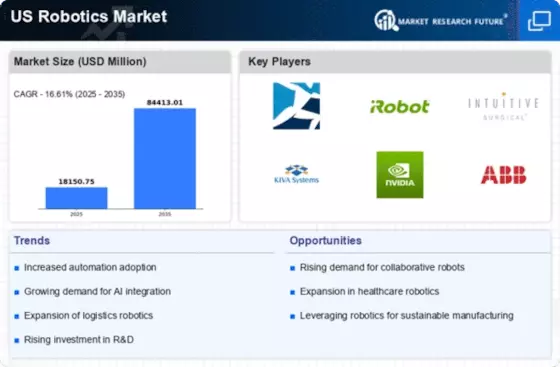
US China Robotics Market Infographic
Purchase Options

US China Robotics Market Summary

As per analysis, the US Robotics Market is projected to grow from USD 15,565.35 Million in 2024 to USD 18,432.52 Million in 2025, exhibiting a compound annual growth rate (CAGR) of 16.61% during the forecast period (2025 - 2035).

Key Market Trends & Highlights

The US Robotics Market is poised for substantial growth driven by automation and technological advancements.

  • Industrial robotics remains the largest segment, primarily fueled by increased automation in manufacturing processes.
  • Service robotics is the fastest-growing segment, particularly in healthcare applications, reflecting a rising demand for robotic assistance.
  • Collaborative robots are gaining traction, enhancing productivity and safety in various operational environments.
  • Key market drivers include advancements in AI and machine learning, alongside increased demand for automation across industries.

Market Size & Forecast

2024 Market Size 15565.35 (USD Million)
2035 Market Size 84413.01 (USD Million)
CAGR (2025 - 2035) 16.61%

Major Players

Boston Dynamics (US), iRobot (US), Intuitive Surgical (US), Kiva Systems (US), NVIDIA (US), ABB (US), Fanuc (US), Yaskawa (US), Universal Robots (US)

Our Impact
Enabled $4.3B Revenue Impact for Fortune 500 and Leading Multinationals
Partnering with 2000+ Global Organizations Each Year
30K+ Citations by Top-Tier Firms in the Industry

US China Robotics Market Trends

The US Robotics Market is currently experiencing a transformative phase characterized by rapid advancements in technology and increasing adoption across various sectors. Industries such as manufacturing, healthcare, and logistics are integrating robotic solutions to enhance efficiency and productivity. This shift appears to be driven by the need for automation to address labor shortages and improve operational capabilities. Furthermore, the growing emphasis on artificial intelligence and machine learning is likely to propel the development of more sophisticated robotic systems, enabling them to perform complex tasks with greater autonomy. In addition, the US government is actively supporting the robotics sector through funding initiatives and research programs aimed at fostering innovation. This support may lead to the emergence of new startups and collaborations between academia and industry, further enriching the ecosystem. As the market evolves, it seems that the focus will increasingly shift towards creating robots that can work alongside humans, enhancing safety and collaboration in workplaces. Overall, the US Robotics Market is poised for substantial growth, driven by technological advancements and strategic investments in automation solutions.

Increased Automation in Manufacturing

The US Robotics Market is witnessing a notable trend towards automation in manufacturing processes. Companies are increasingly deploying robotic systems to streamline production lines, reduce operational costs, and enhance product quality. This trend reflects a broader movement towards smart manufacturing, where robots are integrated with advanced technologies to optimize efficiency.

Expansion in Healthcare Robotics

Healthcare is emerging as a significant sector for robotics applications in the US. Robotic systems are being utilized for surgical procedures, patient care, and rehabilitation. This expansion indicates a growing recognition of the potential benefits of robotics in improving patient outcomes and operational efficiency within healthcare facilities.

Collaborative Robots on the Rise

Collaborative robots, or cobots, are gaining traction in the US Robotics Market. These systems are designed to work alongside human operators, enhancing productivity while ensuring safety. The increasing adoption of cobots suggests a shift towards more flexible and adaptable manufacturing environments, where human-robot collaboration is prioritized.

US China Robotics Market Drivers

Increased Demand for Automation

The US Robotics Market is experiencing a notable surge in demand for automation across various sectors. This trend is primarily driven by the need for enhanced efficiency and productivity. According to recent data, the manufacturing sector alone is projected to invest over 20 billion dollars in robotic solutions by 2026. Companies are increasingly adopting robotics to streamline operations, reduce labor costs, and improve product quality. This shift towards automation is not limited to manufacturing; it extends to logistics, agriculture, and even retail. As businesses recognize the potential of robotics to optimize processes, the US Robotics Market is likely to witness sustained growth, with automation becoming a cornerstone of operational strategy.

Government Initiatives and Funding

Government initiatives play a crucial role in shaping the US Robotics Market. Federal and state programs are increasingly focused on promoting robotics research and development. For example, the National Robotics Initiative aims to accelerate the development and use of robots in the US, fostering collaboration between academia, industry, and government. Additionally, funding opportunities for robotics startups and research projects are on the rise, with the government allocating millions of dollars to support innovation in this field. This financial backing not only stimulates growth within the US Robotics Market but also encourages the development of cutting-edge technologies that can enhance productivity and competitiveness across various sectors.

Growing Interest in Robotics Education

The US Robotics Market is witnessing a growing interest in robotics education, which is essential for cultivating a skilled workforce. Educational institutions are increasingly incorporating robotics into their curricula, from K-12 programs to university-level courses. This trend is driven by the recognition that a strong foundation in robotics and related technologies is vital for future job markets. As more students gain exposure to robotics, the talent pool for the industry expands, potentially addressing the skills gap that currently exists. Furthermore, partnerships between educational institutions and robotics companies are becoming more common, facilitating internships and hands-on experiences. This emphasis on education is likely to bolster the US Robotics Market by ensuring a steady supply of qualified professionals ready to meet the demands of an evolving technological landscape.

Advancements in AI and Machine Learning

The integration of artificial intelligence (AI) and machine learning technologies is transforming the US Robotics Market. These advancements enable robots to perform complex tasks with greater autonomy and precision. For instance, AI-driven robots are now capable of learning from their environments and adapting to new challenges, which enhances their utility in various applications. The market for AI in robotics is expected to grow significantly, with estimates suggesting a compound annual growth rate of over 30% through 2026. This technological evolution not only improves operational efficiency but also expands the scope of robotics in sectors such as healthcare, where robots assist in surgeries and patient care. Consequently, the US Robotics Market is poised for a paradigm shift as AI continues to redefine the capabilities of robotic systems.

Rising Adoption of Robotics in Healthcare

The healthcare sector is increasingly adopting robotics, significantly impacting the US Robotics Market. Robotic systems are being utilized for surgical procedures, rehabilitation, and patient monitoring, enhancing the quality of care and operational efficiency. The market for medical robots is projected to reach over 10 billion dollars by 2026, driven by advancements in robotic-assisted surgery and telemedicine. Hospitals are investing in robotic technologies to improve patient outcomes and reduce recovery times. Moreover, the COVID-19 pandemic has accelerated the adoption of robotics in healthcare, as facilities seek to minimize human contact and enhance safety protocols. This trend indicates a robust future for the US Robotics Market, as healthcare continues to embrace innovative solutions to meet evolving patient needs.


Market Segment Insights

By Application: Industrial Robotics (Largest) vs. Service Robotics (Fastest-Growing)

In the US Robotics Market, Industrial Robotics holds a substantial market share, leading the segment due to its widespread adoption across manufacturing and production sectors. This dominance is driven by automation needs, efficiency improvements, and cost reductions, making industrial robots crucial for large-scale operations. Following industrial robots, Service Robotics is emerging rapidly as a notable segment, carving out significant shares particularly in hospitality, cleaning, and customer service applications. This shift marks a trend towards automation in everyday tasks, fundamentally changing service delivery models.

Application: Industrial Robotics (Dominant) vs. Service Robotics (Emerging)

Industrial Robotics dominate the US market as they are integral to manufacturing and production processes, ensuring high efficiency and precision. These robots execute repetitive tasks like assembly, welding, and painting, making them indispensable in sectors such as automotive and electronics. Conversely, Service Robotics, which include applications in healthcare, logistics, and domestic services, represent the growing wave of automation in personal and professional environments. This segment is characterized by innovation in AI and machine learning, driving rapid development and adoption. The increasing demand for automation in personal services signifies the potential of Service Robotics to reshape industries, marking it as an emerging market with opportunities for growth.

By End Use: Manufacturing (Largest) vs. Logistics (Fastest-Growing)

The US Robotics Market is significantly influenced by the end-use segments, where manufacturing holds the largest share, capitalizing on automation trends to enhance productivity and efficiency. Logistics, while smaller in share, is rapidly catching up as companies invest heavily in technologies like autonomous robots for warehousing and distribution, driven by the increasing demand for efficient supply chain solutions and delivery systems. As industries evolve, the growth trends in these segments highlight distinct patterns. Manufacturing robots are largely focused on assembly and quality control, embodying a mature market with established players. Conversely, the logistics segment is expanding quickly, fueled by online retail growth and the need for faster fulfillment solutions, leading to innovative robotic applications that cater to the shifting landscape of distribution and delivery.

Manufacturing: Assembly Robots (Dominant) vs. Agriculture: Drone Technology (Emerging)

In the US Robotics Market, the manufacturing segment is dominated by assembly robots, which are integral in streamlining production processes across various industries. These robots enhance operational efficiency and ensure precision in tasks such as welding, painting, and assembly. Their established presence underscores their importance in traditional manufacturing setups. In contrast, the agriculture segment is witnessing the emergence of drone technology, which is transforming farming practices. These drones are utilized for crop monitoring, planting, and spraying, providing farmers with data-driven insights and improving yield. As agriculture faces the challenges of sustainability and efficiency in food production, drone technologies are becoming essential, showcasing the shift towards automation in one of the oldest sectors.

By Type: Collaborative Robots (Largest) vs. Humanoid Robots (Fastest-Growing)

In the US Robotics Market, the distribution of market share among various robot types reveals significant trends. Collaborative Robots (Cobots) have emerged as the largest segment, driven by their versatility and ease of integration into existing workflows. Meanwhile, Humanoid Robots, although currently smaller in market share compared to Cobots, showcase remarkable growth potential as advancements in AI and robotics continue to emerge.

Collaborative Robots: Cobots (Dominant) vs. Humanoid Robots (Emerging)

Collaborative Robots, or Cobots are designed to work alongside humans, enhancing productivity without the need for safety cages that traditional industrial robots require. Their dominance in the market stems from increasing demand for automation in sectors like manufacturing and logistics. On the other hand, Humanoid Robots represent a rapidly emerging segment, captivating interest across industries like healthcare, education, and entertainment. Their design, which mimics human form and functions, helps them perform tasks that require a human-like approach, thus driving innovation and investment in this area. Both segments illustrate the evolving landscape of robotics in the US, highlighting the shift towards more interactive and efficient systems.

Get more detailed insights about US China Robotics Market

Key Players and Competitive Insights

The Robotics Market in the US is characterized by a dynamic competitive landscape, driven by rapid technological advancements and increasing demand across various sectors, including manufacturing, healthcare, and logistics. Key players such as Boston Dynamics (US), iRobot (US), and Intuitive Surgical (US) are at the forefront, each adopting distinct strategies to enhance their market positioning. Boston Dynamics (US) focuses on innovation in robotic mobility and manipulation, while iRobot (US) emphasizes consumer robotics, particularly in home automation. Intuitive Surgical (US) continues to lead in surgical robotics, leveraging its established reputation to expand its product offerings and market reach. Collectively, these strategies contribute to a competitive environment that is increasingly defined by technological prowess and strategic partnerships.
In terms of business tactics, companies are increasingly localizing manufacturing to reduce supply chain vulnerabilities and enhance responsiveness to market demands. The competitive structure of the Robotics Market appears moderately fragmented, with several key players exerting substantial influence. This fragmentation allows for niche players to thrive, while larger companies leverage their resources to optimize supply chains and innovate rapidly, thereby shaping the overall market dynamics.
In December 2025, Boston Dynamics (US) announced a partnership with a leading logistics firm to integrate its robotic solutions into warehouse operations. This strategic move is likely to enhance operational efficiency and reduce labor costs, positioning Boston Dynamics (US) as a pivotal player in the logistics sector. The collaboration underscores the growing trend of automation in supply chain management, which is expected to gain momentum in the coming years.
In November 2025, iRobot (US) unveiled its latest home cleaning robot, which incorporates advanced AI capabilities for improved navigation and efficiency. This launch not only reinforces iRobot's commitment to innovation but also reflects the increasing consumer demand for smart home technologies. The integration of AI into consumer robotics may significantly enhance user experience and operational effectiveness, potentially leading to increased market share for iRobot (US).
In October 2025, Intuitive Surgical (US) expanded its product line with the introduction of a new robotic surgical system designed for minimally invasive procedures. This development is indicative of the company's strategy to diversify its offerings and cater to a broader range of surgical applications. By enhancing its technological capabilities, Intuitive Surgical (US) is likely to strengthen its competitive edge in the healthcare sector, where precision and efficiency are paramount.
As of January 2026, current trends in the Robotics Market are heavily influenced by digitalization, sustainability, and the integration of AI technologies. Strategic alliances are becoming increasingly vital, as companies seek to combine expertise and resources to drive innovation. The competitive differentiation is expected to evolve, shifting from price-based competition to a focus on technological advancement, reliability in supply chains, and sustainable practices. This transition may redefine market leadership, as companies that prioritize innovation and adaptability are likely to emerge as frontrunners in the Robotics Market.

Key Companies in the US China Robotics Market include

Future Outlook

US China Robotics Market Future Outlook

The US Robotics Market is projected to grow at a 16.61% CAGR from 2025 to 2035, driven by advancements in AI, automation, and increased demand across various sectors.

New opportunities lie in:

  • Development of autonomous delivery drones for urban logistics. Integration of robotics in healthcare for surgical assistance. Expansion of robotic process automation in financial services.

By 2035, the US Robotics Market is poised for substantial growth, reflecting its critical role in diverse industries.

Market Segmentation

US China Robotics Market Type Outlook

  • Autonomous Robots
  • Humanoid Robots
  • Collaborative Robots
  • Mobile Robots
  • Articulated Robots

US China Robotics Market End Use Outlook

  • Manufacturing
  • Healthcare
  • Logistics
  • Construction
  • Agriculture

US China Robotics Market Application Outlook

  • Industrial Robotics
  • Service Robotics
  • Medical Robotics
  • Agricultural Robotics
  • Military Robotics

Report Scope

MARKET SIZE 2024 15565.35(USD Million)
MARKET SIZE 2025 18432.52(USD Million)
MARKET SIZE 2035 84413.01(USD Million)
COMPOUND ANNUAL GROWTH RATE (CAGR) 16.61% (2024 - 2035)
REPORT COVERAGE Revenue Forecast, Competitive Landscape, Growth Factors, and Trends
BASE YEAR 2024
Market Forecast Period 2025 - 2035
Historical Data 2019 - 2024
Market Forecast Units USD Million
Key Companies Profiled Boston Dynamics (US), iRobot (US), Intuitive Surgical (US), Kiva Systems (US), NVIDIA (US), ABB (US), Fanuc (US), Yaskawa (US), Universal Robots (US)
Segments Covered Application, End Use, Type
Key Market Opportunities Integration of artificial intelligence in automation processes enhances efficiency in the US Robotics Market.
Key Market Dynamics Growing demand for automation drives innovation and competition in the US Robotics Market.
Countries Covered US
Leave a Comment

FAQs

What is the current valuation of the US Robotics Market?

As of 2024, the US Robotics Market was valued at approximately 15565.35 USD Million.

What is the projected market valuation for the US Robotics Market in 2035?

The US Robotics Market is projected to reach a valuation of about 84413.01 USD Million by 2035.

What is the expected CAGR for the US Robotics Market during the forecast period 2025 - 2035?

The expected CAGR for the US Robotics Market from 2025 to 2035 is 16.61%.

Which companies are considered key players in the US Robotics Market?

Key players in the US Robotics Market include Boston Dynamics, iRobot, Intuitive Surgical, Kiva Systems, NVIDIA, ABB, Fanuc, Yaskawa, and Universal Robots.

What are the main segments of the US Robotics Market by application?

The main segments by application include Industrial Robotics, Service Robotics, Medical Robotics, Agricultural Robotics, and Military Robotics.

How did the Industrial Robotics segment perform in 2024?

In 2024, the Industrial Robotics segment was valued at approximately 6000.0 USD Million, with projections reaching 32000.0 USD Million.

What is the valuation of the Medical Robotics segment in 2024?

The Medical Robotics segment was valued at around 3000.0 USD Million in 2024, with future projections of 15000.0 USD Million.

What are the projected valuations for the Agricultural Robotics segment by 2035?

The Agricultural Robotics segment is expected to grow from 2000.0 USD Million in 2024 to approximately 10000.0 USD Million by 2035.

Which type of robots is expected to have the highest valuation by 2035?

Articulated Robots are projected to reach a valuation of about 26000.0 USD Million by 2035, indicating strong growth potential.

What end-use sectors are driving the US Robotics Market?

The end-use sectors driving the market include Manufacturing, Healthcare, Logistics, Construction, and Agriculture.

Download Free Sample

Kindly complete the form below to receive a free sample of this Report

Compare Licence

×
Features License Type
Single User Multiuser License Enterprise User
Price $4,950 $5,950 $7,250
Maximum User Access Limit 1 User Upto 10 Users Unrestricted Access Throughout the Organization
Free Customization
Direct Access to Analyst
Deliverable Format
Platform Access
Discount on Next Purchase 10% 15% 15%
Printable Versions