×
Request Free Sample ×

Kindly complete the form below to receive a free sample of this Report

* Please use a valid business email

Leading companies partner with us for data-driven Insights

clients tt-cursor
Hero Background

US Cellular Concrete Market

ID: MRFR/PCM/12042-HCR
100 Pages
MRFR Team
February 2026

US Cellular Concrete Market

Share:
Download PDF ×

We do not share your information with anyone. However, we may send you emails based on your report interest from time to time. You may contact us at any time to opt-out.

US Cellular Concrete Market Infographic
Purchase Options

US Cellular Concrete Market Summary

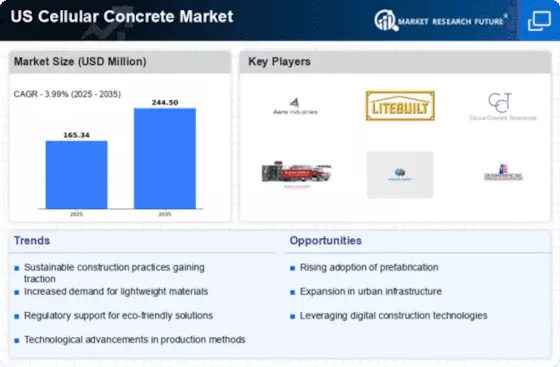
As per analysis, the US Cellular Concrete Market is projected to grow from USD 159.0 Million in 2024 to USD 244.5 Million by 2035, exhibiting a compound annual growth rate (CAGR) of 3.99% during the forecast period (2025 - 2035).

Key Market Trends & Highlights

The US Cellular Concrete Market is poised for growth driven by sustainability and technological advancements.

  • The Building Construction segment remains the largest contributor to the US Cellular Concrete Market, reflecting a robust demand for innovative materials.
  • In contrast, the Road Construction segment is currently the fastest-growing area, indicating a shift towards more sustainable infrastructure solutions.
  • Within the residential sector, cellular concrete is widely utilized, while the commercial segment is experiencing rapid growth due to increasing urbanization.
  • Key market drivers include a strong focus on sustainability and technological advancements, which are shaping the future of cellular concrete applications.

Market Size & Forecast

2024 Market Size 159.0 (USD Million)
2035 Market Size 244.5 (USD Million)
CAGR (2025 - 2035) 3.99%

Major Players

Aerix Industries (US), Litebuilt (US), Cellular Concrete Technologies (US), Alabama Concrete (US), Concretesafe (US), U.S. Concrete (US), BASF Corporation (US), Cemex (US)

Our Impact
Enabled $4.3B Revenue Impact for Fortune 500 and Leading Multinationals
Partnering with 2000+ Global Organizations Each Year
30K+ Citations by Top-Tier Firms in the Industry

US Cellular Concrete Market Trends

The US Cellular Concrete Market is currently experiencing a notable transformation, driven by a growing emphasis on sustainable construction practices and energy efficiency. This market segment appears to be gaining traction as builders and developers increasingly recognize the benefits of cellular concrete, which offers lightweight properties and excellent thermal insulation. The material's versatility allows for a wide range of applications, from residential to commercial projects, suggesting a potential for expansion in various sectors. Furthermore, the increasing focus on reducing carbon footprints in construction aligns well with the characteristics of cellular concrete, which can contribute to more environmentally friendly building solutions. In addition, advancements in technology and manufacturing processes are likely to enhance the performance and affordability of cellular concrete products. Innovations in mixing techniques and the introduction of new additives may improve the material's strength and durability, making it an attractive option for a broader audience. As the US Cellular Concrete Market continues to evolve, it seems poised to play a crucial role in the future of construction, particularly as regulatory frameworks increasingly favor sustainable materials. Stakeholders in this market may need to adapt to changing consumer preferences and technological advancements to remain competitive and capitalize on emerging opportunities.

Sustainability Focus

The US Cellular Concrete Market is witnessing a pronounced shift towards sustainable building materials. As environmental concerns gain prominence, cellular concrete's lightweight and insulating properties are appealing to builders aiming to reduce energy consumption and carbon emissions. This trend indicates a growing preference for materials that align with eco-friendly construction practices.

Technological Advancements

Innovations in production techniques are reshaping the US Cellular Concrete Market. Enhanced mixing methods and the incorporation of advanced additives are likely to improve the performance characteristics of cellular concrete. These developments may lead to increased strength and durability, making the material more competitive in various construction applications.

Diverse Applications

The versatility of cellular concrete is becoming increasingly recognized within the US Cellular Concrete Market. Its applicability spans residential, commercial, and industrial sectors, suggesting a broadening market base. This trend indicates that as awareness of cellular concrete's benefits grows, its adoption across different construction types is likely to expand.

US Cellular Concrete Market Drivers

Cost-Effectiveness

Cost-effectiveness is a significant driver for the US Cellular Concrete Market One Industry, as the material offers a competitive advantage in terms of both production and application costs. Cellular concrete's lightweight nature reduces transportation expenses and labor costs during installation, making it an economically viable option for builders and contractors. In 2025, the average cost of cellular concrete was estimated to be 10-15% lower than traditional concrete, which is particularly appealing in a market where cost control is paramount. Additionally, the long-term energy savings associated with cellular concrete's insulation properties further enhance its cost-effectiveness, as buildings constructed with this material often require less energy for heating and cooling. This financial advantage positions the US Cellular Concrete Market One Industry favorably in a competitive landscape, encouraging wider adoption among construction professionals.

Regulatory Support

Regulatory support plays a crucial role in shaping the US Cellular Concrete Market One Industry, as government policies increasingly favor the adoption of sustainable building materials. Various state and federal regulations are being implemented to promote energy efficiency and reduce greenhouse gas emissions in the construction sector. For example, the Energy Policy Act encourages the use of materials that contribute to energy savings, which directly benefits the cellular concrete market. In 2025, approximately 30 states had adopted building codes that incentivize the use of energy-efficient materials, further driving demand for cellular concrete. This regulatory environment not only fosters innovation within the industry but also provides a stable framework for manufacturers to invest in new technologies and sustainable practices, ultimately enhancing the market's growth prospects.

Diverse Applications

The versatility of cellular concrete is a key driver for the US Cellular Concrete Market One Industry, as it finds applications across various sectors, including residential, commercial, and industrial construction. Its lightweight nature and excellent thermal insulation properties make it suitable for a wide range of building types, from low-rise homes to high-rise commercial structures. In 2025, the residential construction sector in the US was valued at approximately 600 billion USD, with cellular concrete increasingly being utilized for energy-efficient housing solutions. Additionally, its use in infrastructure projects, such as roadways and bridges, is gaining traction due to its ability to reduce overall construction weight and improve load-bearing capacities. This diverse applicability not only expands the market potential for cellular concrete but also reinforces its position as a preferred material in the evolving construction landscape.

Sustainability Focus

The US Cellular Concrete Market Industry is experiencing a notable shift towards sustainability, driven by increasing environmental awareness among consumers and regulatory bodies. The demand for eco-friendly construction materials is on the rise, as cellular concrete offers reduced carbon emissions compared to traditional concrete. In 2025, the market for sustainable building materials in the US was valued at approximately 81 billion USD, with cellular concrete playing a pivotal role in this growth. This trend is further supported by government initiatives aimed at promoting green building practices, which encourage the use of materials that minimize environmental impact. As a result, manufacturers in the US Cellular Concrete Market One Industry are increasingly investing in sustainable production methods, which not only enhance their market competitiveness but also align with the broader goals of reducing the construction sector's carbon footprint.

Technological Advancements

Technological advancements are significantly influencing the US Cellular Concrete Market One Industry, as innovations in production techniques and material formulations enhance the performance and applicability of cellular concrete. Recent developments in mixing technologies and additives have improved the material's strength, durability, and insulation properties, making it a more attractive option for various construction projects. For instance, the introduction of advanced foaming agents has enabled manufacturers to produce lighter and more efficient cellular concrete blocks. In 2025, the market for construction technology in the US was projected to reach 1.5 trillion USD, indicating a robust investment in innovative building materials. These advancements not only cater to the growing demand for high-performance materials but also position the US Cellular Concrete Market One Industry as a leader in modern construction solutions.

Market Segment Insights

By Application: Building Construction (Largest) vs. Road Construction (Fastest-Growing)

In the US Cellular Concrete Market, the application segment shows diverse distributions, with Building Construction holding the largest share. This segment is favored due to its extensive adaptations in residential and commercial projects, driving demand significantly. In contrast, Road Construction is emerging rapidly, propelled by increasing investments in infrastructure and the need for sustainable materials to enhance road longevity and performance. The growth trends within these applications reveal a shifting focus toward eco-friendly solutions and durability in construction. Building Construction continues to be reliable, yet Road Construction is witnessing unprecedented growth as the government emphasizes infrastructure restoration and development, further driven by advancements in cellular concrete technology, which promises improved strength-to-weight ratios and ease of installation.

Building Construction (Dominant) vs. Precast Concrete Products (Emerging)

Building Construction remains the dominant force within the US Cellular Concrete Market, utilizing cellular concrete for its superior insulation and lightweight properties, which enhance energy efficiency in both residential and commercial buildings. This segment benefits from a stable demand driven by urbanization and housing developments. Conversely, Precast Concrete Products are emerging as a significant player due to their ease of use and customization potential. These products contribute to faster construction timelines and reduced on-site waste. As construction trends shift towards prefabrication and modular designs, Precast Concrete Products are gaining traction, highlighting an evolving market landscape that recognizes efficiency and sustainability in construction methodologies.

By End Use: Residential (Largest) vs. Commercial (Fastest-Growing)

The US Cellular Concrete Market showcases a diverse distribution of end-use segments. Residential applications currently lead the market, accounting for a substantial portion of market share due to the increasing demand for innovative construction solutions and energy-efficient materials. Commercial applications follow closely, driven by investment in infrastructure development and the rising trend of sustainable building practices.

Residential (Dominant) vs. Commercial (Emerging)

In the residential sector, cellular concrete is preferred for its lightweight properties and cost-effectiveness, making it an ideal choice for modern home construction. The segment benefits from growing consumer awareness and expanding residential projects. On the other hand, the commercial segment is identified as the fastest-growing area, propelled by increasing construction activities, the trend towards green building, and advancements in technology that enhance the performance of cellular concrete. This emerging segment is characterized by its adaptability to various applications, including low-rise and high-rise buildings, making it crucial for future market growth.

By Material Type: Foamed Concrete (Largest) vs. Lightweight Concrete (Fastest-Growing)

In the US Cellular Concrete Market, Foamed Concrete holds the largest share, propelled by its versatile applications in various construction projects. Contrarily, Lightweight Concrete is emerging as the fastest-growing segment, appealing to industries looking for energy efficiency and reduced structural loads. Aerated Concrete also plays a notable role, but it is Foamed Concrete that continues to dominate the market landscape, attributed to its cost-effectiveness and ease of use in large-scale applications.

Foamed Concrete (Dominant) vs. Lightweight Concrete (Emerging)

Foamed Concrete remains the dominant player in the US Cellular Concrete Market due to its unique properties, including lower density and superior insulation capabilities, making it widely suitable for diverse construction needs. This segment is particularly favored for producing lightweight structures without compromising strength. On the other hand, Lightweight Concrete is rapidly emerging, driven by the increasing demand for sustainable building materials. Its ability to reduce energy consumption and overall material weight positions it as a viable alternative for modern construction practices. Consequently, while Foamed Concrete continues to prevail, the trajectory for Lightweight Concrete indicates a promising growth path.

By Production Method: Wet Mix Process (Largest) vs. Precast Method (Fastest-Growing)

In the US Cellular Concrete Market, the production method segment is comprised of diverse techniques that contribute to a wide array of product offerings. The Wet Mix Process holds the largest market share due to its well-established production techniques and ability to mass-produce high-quality cellular concrete. In contrast, the Dry Mix Process and Precast Method, while significant, have a smaller footprint in comparison. This distribution highlights the diverse applications and preferences that characterize the market landscape. Looking at growth trends, the Precast Method emerges as the fastest-growing segment, driven by increasing demand for durable and efficient construction materials. Factors such as rapid urbanization, infrastructure development projects, and a shift towards sustainable construction practices fuel this growth. The Dry Mix Process is witnessing gradual acceptance, particularly in niche applications, as the industry seeks innovative solutions to meet evolving construction demands.

Wet Mix Process (Dominant) vs. Precast Method (Emerging)

The Wet Mix Process is recognized as the dominant force in the US Cellular Concrete Market One, characterized by its ability to produce a consistent and high-quality product that meets the demands of various construction applications. This method facilitates the mixing of water, cement, and aggregates into a homogeneous paste, leading to superior performance properties. Conversely, the Precast Method is gaining traction as an emerging alternative, particularly appealing to modern builders who are increasingly focused on speed and efficiency. This method involves casting concrete components in a controlled environment, enhancing quality control and allowing for reduced construction times. Both methods showcase distinct advantages, catering to diverse segments of the market.

Get more detailed insights about US Cellular Concrete Market

Key Players and Competitive Insights

The Cellular Concrete Market One is currently characterized by a dynamic competitive landscape, driven by increasing demand for lightweight construction materials and enhanced energy efficiency. Key players such as Aerix Industries (US), BASF Corporation (US), and U.S. Concrete (US) are strategically positioning themselves through innovation and regional expansion. Aerix Industries (US) focuses on developing advanced cellular concrete solutions that cater to various construction needs, while BASF Corporation (US) emphasizes sustainability in its product offerings. U.S. Concrete (US) is leveraging its extensive distribution network to enhance market penetration, collectively shaping a competitive environment that prioritizes technological advancement and customer-centric solutions.

In terms of business tactics, companies are increasingly localizing manufacturing to reduce lead times and optimize supply chains. The market appears moderately fragmented, with several players vying for market share. This fragmentation allows for niche players to thrive, while larger corporations consolidate their positions through strategic partnerships and acquisitions. The collective influence of these key players fosters a competitive structure that encourages innovation and responsiveness to market demands.

In December 2025, Aerix Industries (US) announced the launch of a new line of eco-friendly cellular concrete products aimed at reducing carbon emissions in construction. This strategic move not only aligns with global sustainability trends but also positions Aerix as a leader in environmentally responsible building materials. The introduction of these products is likely to attract environmentally conscious clients and enhance the company's market share.

In November 2025, BASF Corporation (US) expanded its partnership with a leading construction firm to integrate advanced digital solutions into its cellular concrete production processes. This collaboration is expected to streamline operations and improve product quality, reflecting a broader trend towards digital transformation in the industry. By enhancing operational efficiency, BASF aims to solidify its competitive edge in a rapidly evolving market.

In October 2025, U.S. Concrete (US) completed the acquisition of a regional cellular concrete manufacturer, significantly increasing its production capacity and market reach. This acquisition is strategically important as it allows U.S. Concrete to diversify its product offerings and cater to a broader customer base. The move is indicative of a trend where larger firms seek to consolidate their positions through strategic acquisitions, thereby enhancing their competitive advantage.

As of January 2026, current trends in the Cellular Concrete Market One indicate a strong emphasis on digitalization, sustainability, and the integration of AI technologies. Strategic alliances are increasingly shaping the competitive landscape, enabling companies to leverage shared resources and expertise. Looking ahead, competitive differentiation is likely to evolve from traditional price-based competition to a focus on innovation, technological advancements, and supply chain reliability. This shift underscores the importance of adaptability and forward-thinking strategies in maintaining a competitive edge in the market.

Key Companies in the US Cellular Concrete Market include

Future Outlook

US Cellular Concrete Market Future Outlook

The US Cellular Concrete Market One is projected to grow at a 3.99% CAGR from 2025 to 2035, driven by increasing demand for lightweight construction materials and sustainability initiatives.

New opportunities lie in:

  • Development of advanced cellular concrete formulations for enhanced thermal insulation
  • Expansion into prefabricated construction modules utilizing cellular concrete
  • Implementation of automated mixing and dispensing technologies for efficiency

By 2035, the market is expected to solidify its position as a leader in innovative construction solutions.

Market Segmentation

US Cellular Concrete Market End Use Outlook

  • Residential
  • Commercial
  • Industrial
  • Institutional

US Cellular Concrete Market Application Outlook

  • Building Construction
  • Road Construction
  • Infrastructure Development
  • Precast Concrete Products

US Cellular Concrete Market Material Type Outlook

  • Foamed Concrete
  • Lightweight Concrete
  • Aerated Concrete

US Cellular Concrete Market Production Method Outlook

  • Wet Mix Process
  • Dry Mix Process
  • Precast Method

Report Scope

MARKET SIZE 2024159.0(USD Million)
MARKET SIZE 2025166.5(USD Million)
MARKET SIZE 2035244.5(USD Million)
COMPOUND ANNUAL GROWTH RATE (CAGR)3.99% (2024 - 2035)
REPORT COVERAGERevenue Forecast, Competitive Landscape, Growth Factors, and Trends
BASE YEAR2024
Market Forecast Period2025 - 2035
Historical Data2019 - 2024
Market Forecast UnitsUSD Million
Key Companies ProfiledAerix Industries (US), Litebuilt (US), Cellular Concrete Technologies (US), Alabama Concrete (US), Concretesafe (US), U.S. Concrete (US), BASF Corporation (US), Cemex (US)
Segments CoveredApplication, End Use, Material Type, Production Method
Key Market OpportunitiesGrowing demand for sustainable construction materials drives innovation in the US Cellular Concrete Market One.
Key Market DynamicsRising demand for lightweight construction materials drives innovation and competition in the US Cellular Concrete Market.
Countries CoveredUS
Leave a Comment

FAQs

What is the current valuation of the US Cellular Concrete Market One?

The market valuation was 159.0 USD Million in 2024.

What is the projected market valuation for the US Cellular Concrete Market One by 2035?

The projected valuation for 2035 is 244.5 USD Million.

What is the expected CAGR for the US Cellular Concrete Market One during the forecast period?

The expected CAGR for the market from 2025 to 2035 is 3.99%.

Which companies are considered key players in the US Cellular Concrete Market One?

Key players include Aerix Industries, Litebuilt, Cellular Concrete Technologies, Alabama Concrete, Concretesafe, U.S. Concrete, BASF Corporation, and Cemex.

What are the main applications of cellular concrete in the US market?

Main applications include Building Construction, Road Construction, Infrastructure Development, and Precast Concrete Products.

How does the residential sector perform in the US Cellular Concrete Market One?

The residential sector had a valuation range of 40.0 to 60.0 USD Million.

What is the valuation range for the commercial sector in the US Cellular Concrete Market One?

The commercial sector's valuation ranges from 50.0 to 80.0 USD Million.

What types of materials are used in cellular concrete production?

Materials include Foamed Concrete, Lightweight Concrete, and Aerated Concrete.

What production methods are utilized in the US Cellular Concrete Market One?

Production methods include Wet Mix Process, Dry Mix Process, and Precast Method.

What is the valuation range for the infrastructure development segment in the US Cellular Concrete Market One?

The infrastructure development segment had a valuation range of 40.0 to 60.0 USD Million.

Download Free Sample

Kindly complete the form below to receive a free sample of this Report

Compare Licence

×
Features License Type
Single User Multiuser License Enterprise User
Price $4,950 $5,950 $7,250
Maximum User Access Limit 1 User Upto 10 Users Unrestricted Access Throughout the Organization
Free Customization
Direct Access to Analyst
Deliverable Format
Platform Access
Discount on Next Purchase 10% 15% 15%
Printable Versions