×
Request Free Sample ×

Kindly complete the form below to receive a free sample of this Report

* Please use a valid business email

Leading companies partner with us for data-driven Insights

clients tt-cursor
Hero Background

US Cell Line Development Market

ID: MRFR/MED/48058-HCR
200 Pages
Rahul Gotadki
February 2026

US Cell Line Development Market Research Report: Size, Share, Trend Analysis By Applications (Drug Discovery, Bioproduction, Toxicity Testing, Stem Cell Research, Genetic Engineering), By Types (Hybridoma Cell Lines, Recombinant Cell Lines, Continuous Cell Lines, Primary Cell Lines), By End Users (Pharmaceutical Companies, Biotechnology Companies, Academic Research Institutions, Contract Research Organizations) and By Process (Cell Line Development, Cell Line Banking, Characterization, Quality Control) - Growth Outlook & Industry Forecast 2025 To 2035

Share:
Download PDF ×

We do not share your information with anyone. However, we may send you emails based on your report interest from time to time. You may contact us at any time to opt-out.

US Cell Line Development Market Infographic
Purchase Options

US Cell Line Development Market Summary

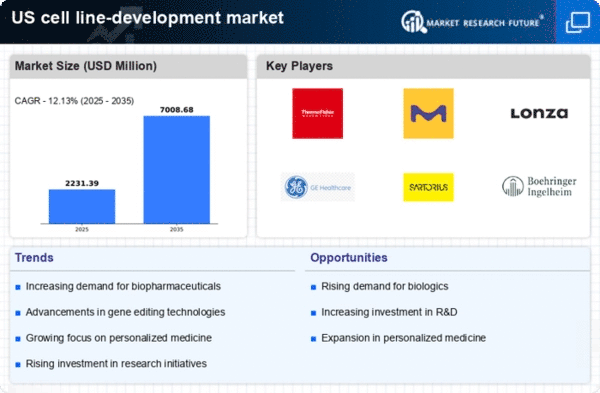
As per Market Research Future analysis, the US cell line-development market size was estimated at 1990.0 USD Million in 2024. The US cell line-development market is projected to grow from 2231.39 USD Million in 2025 to 7008.68 USD Million by 2035, exhibiting a compound annual growth rate (CAGR) of 12.1% during the forecast period 2025 - 2035

Key Market Trends & Highlights

The US cell line-development market is experiencing robust growth driven by technological advancements and increasing demand for biopharmaceuticals.

  • The market is witnessing a surge in demand for biopharmaceuticals, indicating a shift towards more complex therapeutic solutions.
  • Advancements in cell line technologies are enhancing the efficiency and productivity of biopharmaceutical production.
  • Regulatory support and funding initiatives are fostering innovation and expansion within the cell line-development sector.
  • Rising investment in biotechnology and the growing prevalence of chronic diseases are key drivers propelling market growth.

Market Size & Forecast

2024 Market Size 1990.0 (USD Million)
2035 Market Size 7008.68 (USD Million)
CAGR (2025 - 2035) 12.13%

Major Players

Thermo Fisher Scientific (US), Merck KGaA (DE), Lonza Group (CH), GE Healthcare (US), Sartorius AG (DE), Boehringer Ingelheim (DE), Promega Corporation (US), Corning Incorporated (US), Charles River Laboratories (US)

Our Impact
Enabled $4.3B Revenue Impact for Fortune 500 and Leading Multinationals
Partnering with 2000+ Global Organizations Each Year
30K+ Citations by Top-Tier Firms in the Industry

US Cell Line Development Market Trends

the cell line-development market is experiencing notable growth, driven by advancements in biotechnology and increasing demand for biopharmaceuticals. The rise in research activities related to drug discovery and development has led to a heightened need for reliable and efficient cell lines. Furthermore, the expansion of personalized medicine is influencing the market, as tailored therapies require specific cell lines for testing and validation. This trend suggests a shift towards more specialized and high-quality cell line products, which may enhance the overall efficacy of therapeutic interventions. In addition, regulatory support and funding from government agencies appear to bolster innovation within the cell line-development market. Initiatives aimed at promoting research and development in biotechnology are likely to create a favorable environment for market players. As the industry evolves, collaboration between academic institutions and commercial entities may become increasingly important, facilitating the exchange of knowledge and resources. Overall, the cell line-development market seems poised for continued expansion, with various factors contributing to its dynamic landscape.

Increased Demand for Biopharmaceuticals

The cell line-development market is witnessing a surge in demand for biopharmaceuticals, as these products are essential for treating various diseases. This trend is likely driven by the growing prevalence of chronic conditions and the need for innovative therapies. As a result, companies are focusing on developing more efficient and robust cell lines to meet the needs of biopharmaceutical production.

Advancements in Cell Line Technologies

Technological advancements in cell line development are transforming the market landscape. Innovations such as gene editing and high-throughput screening are enabling researchers to create more precise and functional cell lines. These developments may enhance the efficiency of drug discovery processes and improve the overall quality of therapeutic products.

Regulatory Support and Funding Initiatives

Regulatory bodies and government agencies are increasingly supporting the cell line-development market through funding initiatives and favorable policies. This support is likely to encourage research and development activities, fostering innovation and collaboration among stakeholders. As a result, the market may experience accelerated growth and enhanced competitiveness.

US Cell Line Development Market Drivers

Rising Investment in Biotechnology

The cell line-development market is experiencing a surge in investment from both public and private sectors. In the US, biotechnology firms are increasingly allocating substantial funds towards research and development, which is projected to reach approximately $200 billion by 2026. This influx of capital is likely to enhance the capabilities of cell line-development, enabling the creation of more sophisticated and efficient cell lines. Furthermore, venture capital investments in biotech startups have seen a notable increase, indicating a robust interest in innovative solutions within the cell line-development market. This financial backing is essential for advancing technologies and methodologies, ultimately driving growth in the industry.

Growing Prevalence of Chronic Diseases

The rising incidence of chronic diseases in the US is a significant driver for the cell line-development market. As conditions such as cancer, diabetes, and cardiovascular diseases become more prevalent, there is an increasing need for effective therapeutic solutions. The cell line-development market plays a crucial role in drug discovery and development, providing essential tools for researchers to understand disease mechanisms and test new treatments. According to recent statistics, chronic diseases account for nearly 70% of all deaths in the US, underscoring the urgent need for innovative therapies. This growing health crisis is likely to propel demand for advanced cell lines, thereby stimulating growth in the market.

Increased Focus on Personalized Medicine

The shift towards personalized medicine is reshaping the landscape of the cell line-development market. As healthcare moves towards tailored therapies, the need for specific cell lines that can mimic individual patient responses is becoming more pronounced. This trend is particularly evident in oncology, where personalized treatments are gaining traction. The market for personalized medicine is projected to reach $2 trillion by 2025, indicating a substantial opportunity for the cell line-development market to provide customized solutions. This focus on individualized therapies is likely to drive demand for diverse and specialized cell lines, fostering growth in the industry.

Technological Innovations in Cell Culture

Technological advancements in cell culture techniques are significantly impacting the cell line-development market. Innovations such as 3D cell culture, CRISPR gene editing, and automated cell line generation are enhancing the efficiency and accuracy of cell line development. These technologies allow for the creation of more physiologically relevant models, which are essential for drug testing and development. The market for cell culture technologies is expected to grow at a CAGR of around 10% over the next few years, reflecting the increasing adoption of these advanced methodologies. As researchers seek to improve the reliability of their results, the demand for innovative cell line-development solutions is likely to rise.

Expansion of Research Institutions and Laboratories

The expansion of research institutions and laboratories in the US is a key driver for the cell line-development market. With an increasing number of academic and private research facilities being established, there is a growing demand for cell lines to support various research initiatives. This trend is supported by government funding and grants aimed at promoting scientific research, which have seen a rise of approximately 5% annually. As these institutions seek to advance their research capabilities, the need for high-quality cell lines becomes paramount. This expansion is expected to contribute significantly to the growth of the cell line-development market, as more researchers require access to diverse cell line resources.


Market Segment Insights

By Application: Drug Discovery (Largest) vs. Genetic Engineering (Fastest-Growing)

In the US cell line-development market, Drug Discovery represents the largest application segment, dominating the market with a significant share. This segment's extensive use in pharmaceutical research and development illustrates its crucial role in bringing new therapies to market. Closely following, Bioproduction and Toxicity Testing also play critical roles, although they maintain smaller market shares. Stem Cell Research has garnered substantial attention and funding, solidifying its presence while serving specialized research needs. As the market evolves, Genetic Engineering emerges as the fastest-growing segment driven by advancements in CRISPR technology and other gene-editing techniques. This rapid expansion is fueled by the increasing demand for precision medicine and the growing number of applications across various fields, including therapeutics and agricultural biotechnology. The rising interest in personalized medicine also propels investments in Genetic Engineering, promising continued growth in this segment.

Drug Discovery (Dominant) vs. Genetic Engineering (Emerging)

Drug Discovery is the dominant segment in the US cell line-development market, characterized by its extensive applications in new drug development processes. This segment leverages advanced cell lines for high-throughput screening and in-vivo testing, highlighting its importance in pharmaceutical innovation and regulatory compliance. On the other hand, Genetic Engineering, labeled as an emerging segment, is rapidly gaining traction due to technological advancements and research initiatives focusing on genetic modification for therapeutic interventions. The synergy between these two segments illustrates a landscape where Drug Discovery leads in market stability while Genetic Engineering is poised for significant growth driven by innovation and research advancements.

By Type: Recombinant Cell Lines (Largest) vs. Hybridoma Cell Lines (Fastest-Growing)

The US cell line-development market is primarily dominated by recombinant cell lines, which account for a significant share due to their widespread application in therapeutic developments and bioproduction. Following closely are hybridoma cell lines, which, while smaller in market share, have garnered attention for their specialized use in monoclonal antibody production, contributing to their growth within the market. In recent years, the trend towards personalized medicine and biopharmaceuticals has fueled the demand for both recombinant and hybridoma cell lines. Recombinant cell lines benefit from advancements in genetic engineering, enhancing their utility and efficiency. Hybridoma cell lines, on the other hand, are witnessing rapid adoption due to innovative research in immunotherapy, positioning them as a crucial player in the evolving landscape of cell line development.

Recombinant Cell Lines (Dominant) vs. Hybridoma Cell Lines (Emerging)

Recombinant cell lines serve as the backbone of the biopharmaceutical industry, providing critical tools for the development of complex biologics and monoclonal antibodies. Their ability to produce large quantities of proteins has positioned them as the dominant force in the market. In contrast, hybridoma cell lines, while emerging, are gaining traction due to their strong reliance on antibody production for therapeutic applications. The recent advancements in hybridization techniques and the ability to generate high-affinity antibodies are making hybridoma cell lines increasingly favorable, especially in niche therapeutic areas. Both types are essential, but recombinant cell lines currently lead in terms of application breadth and industrial integration.

By End User: Pharmaceutical Companies (Largest) vs. Biotechnology Companies (Fastest-Growing)

The US cell line-development market is characterized by a diverse array of end users, with pharmaceutical companies commanding the largest share. These entities utilize cell lines extensively for drug development, screening, and production, establishing their dominance in the market. In contrast, biotechnology companies, while smaller in market share, are emerging rapidly, driven by innovation and the increasing need for specialized therapies. Their agile and research-intensive nature positions them as significant market players. Growth trends in this segment reveal a strong expansion trajectory for biotechnology companies. The surge in personalized medicine and biologics fuels their growth, as these firms pivot to develop novel therapies using advanced cell line technologies. Additionally, the increasing collaboration between biotechnology firms and academic institutions enhances research capabilities, fostering a dynamic ecosystem. Pharmaceutical companies are also expected to adapt by integrating novel technologies to maintain their competitive edge, creating a characteristic balance of stability and innovation in the market.

Pharmaceutical Companies (Dominant) vs. Biotechnology Companies (Emerging)

Pharmaceutical companies are currently the dominant players in the US cell line-development market, thanks to their substantial investments in R&D and established market presence. Their extensive resources enable them to leverage advanced cell line technologies for drug development, efficacy testing, and production scaling. On the other hand, biotechnology companies represent the emerging segment, characterized by flexibility and a focus on cutting-edge innovations. While they may not have the same level of resources, their emphasis on developing targeted therapies and biologics positions them favorably in the evolving landscape. As these companies increasingly collaborate with academic institutions and other stakeholders, they enhance their scientific capabilities and market relevance, contributing to a competitive yet complementary dynamic within the sector.

By Process: Cell Line Development (Largest) vs. Quality Control (Fastest-Growing)

The US cell line-development market showcases a diverse landscape with significant contributions from various processes. Among these, Cell Line Development holds the largest market share, reflecting the foundational importance of this process in the broader biopharmaceutical landscape. In contrast, Quality Control has emerged as the fastest-growing segment, driven by increasing regulatory demands and the need for robust product assurance, indicating a shift in focus towards process reliability and safety. Recent trends highlight an upsurge in investments in technology and infrastructure aimed at enhancing process efficiency and throughput. The demand for personalized medicine and advanced therapies has acted as a catalyst for the growth of both Cell Line Development and Quality Control. Additionally, innovations in automation and data analytics are shaping the future of these processes, positioning them for sustained growth in the US cell line-development market.

Cell Line Development (Dominant) vs. Quality Control (Emerging)

Cell Line Development remains the dominant component of the US cell line-development market, characterized by its essential role in creating stable and reproducible cell lines that underpin biopharmaceutical production. This process is critical for biotherapeutics development, providing the foundational cells needed for further experimentation and drug efficacy testing. Conversely, Quality Control is an emerging focus area, gaining prominence due to its necessity for maintaining product integrity and compliance with stringent regulatory standards. The shift towards more rigorous quality assurance measures is resulting in elevated investments in Quality Control processes. As both segments evolve, they are increasingly intertwined, with advancements in Cell Line Development informing improvements in Quality Control practices.

Get more detailed insights about US Cell Line Development Market

Key Players and Competitive Insights

The cell line-development market is characterized by a dynamic competitive landscape, driven by increasing demand for biopharmaceuticals and advancements in biotechnology. Key players such as Thermo Fisher Scientific (US), Merck KGaA (DE), and Lonza Group (CH) are strategically positioned to leverage innovation and expand their operational capabilities. Thermo Fisher Scientific (US) focuses on enhancing its product portfolio through continuous innovation, while Merck KGaA (DE) emphasizes strategic partnerships to bolster its research and development efforts. Lonza Group (CH) is actively pursuing regional expansion to tap into emerging markets, thereby shaping a competitive environment that is increasingly collaborative and innovation-driven.In terms of business tactics, companies are localizing manufacturing and optimizing supply chains to enhance efficiency and responsiveness to market demands. The market structure appears moderately fragmented, with a mix of established players and emerging companies. This fragmentation allows for diverse strategies, yet the collective influence of key players like GE Healthcare (US) and Sartorius AG (DE) is significant, as they drive technological advancements and set industry standards.
In October GE Healthcare (US) announced a strategic partnership with a leading academic institution to develop next-generation cell line technologies. This collaboration aims to accelerate the development of innovative therapies, indicating GE's commitment to staying at the forefront of biopharmaceutical advancements. Such partnerships are likely to enhance their research capabilities and expand their market reach.
In September Sartorius AG (DE) launched a new line of cell culture media designed to improve cell growth and productivity. This product introduction not only reflects Sartorius's focus on innovation but also positions the company to meet the evolving needs of biopharmaceutical manufacturers. The strategic importance of this launch lies in its potential to capture market share in a highly competitive segment, thereby reinforcing Sartorius's market position.
In August Promega Corporation (US) expanded its manufacturing facility in Wisconsin to increase production capacity for its cell line development products. This expansion is indicative of Promega's proactive approach to meet growing demand and enhance supply chain reliability. By investing in local manufacturing, Promega is likely to improve its operational efficiency and responsiveness to customer needs, which is crucial in a rapidly evolving market.
As of November current trends in the cell line-development market include a strong emphasis on digitalization, sustainability, and the integration of artificial intelligence (AI) in research processes. Strategic alliances are increasingly shaping the competitive landscape, enabling companies to pool resources and expertise. Looking ahead, competitive differentiation is expected to evolve from traditional price-based competition to a focus on innovation, technological advancements, and supply chain reliability. This shift underscores the importance of agility and responsiveness in meeting the complex demands of the biopharmaceutical industry.

Key Companies in the US Cell Line Development Market include

Industry Developments

The US Cell Line Development Market has seen significant developments recently, with prominent companies like Thermo Fisher Scientific and Promega Corporation continuously enhancing their product offerings to meet the growing demand for biopharmaceuticals and therapeutics. In October 2023, Merck KGaA announced the expansion of its cell culture media production to support increased research activity, demonstrating the rising interest in cell line applications.

Companies such as WuXi AppTec and Lonza Group are investing heavily in Research and Development to accelerate innovations in cell line engineering.In terms of mergers and acquisitions, Horizon Discovery announced its acquisition by PerkinElmer in May 2023, aiming to leverage Horizon's gene editing capabilities in research and diagnostics.

This merger highlights the ongoing consolidation in the market as firms seek to enhance their technological expertise and expand their service portfolios.Overall, market valuation in the US Cell Line Development Market sector is expected to grow substantially as demand for advanced therapy medicinal products rises, supported by funding from public and private sectors aimed at accelerating biopharmaceutical advancements. The landscape remains dynamic, with activities across major players indicating a robust growth trajectory in the near future.

Future Outlook

US Cell Line Development Market Future Outlook

The Cell Line Development Market is projected to grow at a 12.13% CAGR from 2025 to 2035, driven by advancements in biopharmaceuticals, increasing R&D investments, and rising demand for personalized medicine.

New opportunities lie in:

  • Development of high-throughput screening technologies for rapid cell line generation.
  • Expansion of contract research organizations (CROs) offering specialized cell line services.
  • Investment in automation solutions to enhance efficiency in cell line production.

By 2035, the market is expected to achieve substantial growth, positioning itself as a leader in biopharmaceutical innovation.

Market Segmentation

US Cell Line Development Market Type Outlook

  • Hybridoma Cell Lines
  • Recombinant Cell Lines
  • Continuous Cell Lines
  • Primary Cell Lines

US Cell Line Development Market Process Outlook

  • Cell Line Development
  • Cell Line Banking
  • Characterization
  • Quality Control

US Cell Line Development Market End User Outlook

  • Pharmaceutical Companies
  • Biotechnology Companies
  • Academic Research Institutions
  • Contract Research Organizations

US Cell Line Development Market Application Outlook

  • Drug Discovery
  • Bioproduction
  • Toxicity Testing
  • Stem Cell Research
  • Genetic Engineering

Report Scope

MARKET SIZE 2024 1990.0(USD Million)
MARKET SIZE 2025 2231.39(USD Million)
MARKET SIZE 2035 7008.68(USD Million)
COMPOUND ANNUAL GROWTH RATE (CAGR) 12.13% (2025 - 2035)
REPORT COVERAGE Revenue Forecast, Competitive Landscape, Growth Factors, and Trends
BASE YEAR 2024
Market Forecast Period 2025 - 2035
Historical Data 2019 - 2024
Market Forecast Units USD Million
Key Companies Profiled Thermo Fisher Scientific (US), Merck KGaA (DE), Lonza Group (CH), GE Healthcare (US), Sartorius AG (DE), Boehringer Ingelheim (DE), Promega Corporation (US), Corning Incorporated (US), Charles River Laboratories (US)
Segments Covered Application, Type, End User, Process
Key Market Opportunities Advancements in gene editing technologies enhance efficiency in the cell line-development market.
Key Market Dynamics Technological advancements and regulatory changes drive innovation and competition in the cell line-development market.
Countries Covered US
Leave a Comment

FAQs

What was the market size of the US Cell Line Development Market by 2024?

The US Cell Line Development Market reached a valuation of 1.5 USD Billion by the year 2024.

How much is the US Cell Line Development Market projected to be worth by 2035?

By 2035, the US Cell Line Development Market is projected to grow to a value of 2.5 USD Billion.

What is the compound annual growth rate (CAGR) for the US Cell Line Development Market from 2025 to 2035?

The market is expected to experience a CAGR of 4.753% during the forecast period from 2025 to 2035.

Which application holds the highest market value in the US Cell Line Development Market for 2024?

In 2024, the Drug Discovery application holds the highest market value at 0.45 USD Billion.

What will be the market size of the Bioproduction application by 2035?

The Bioproduction application is expected to reach a market size of 0.65 USD Billion by 2035.

Who are the major players in the US Cell Line Development Market?

Key players in the market include Promega Corporation, Gibco, Lonza Group, and Thermo Fisher Scientific, among others.

What was the market size for the Toxicity Testing application in 2024?

The Toxicity Testing application reached a market size of 0.3 USD Billion in 2024.

What challenges does the US Cell Line Development Market face?

Challenges in the market include regulatory hurdles and the high costs associated with cell line development.

What is the market value for Stem Cell Research in 2035?

The market value for Stem Cell Research is projected to be 0.3 USD Billion by 2035.

What is a significant growth driver for the US Cell Line Development Market?

The rising demand for biologics and personalized medicine is a significant growth driver for the market.

Download Free Sample

Kindly complete the form below to receive a free sample of this Report

Compare Licence

×
Features License Type
Single User Multiuser License Enterprise User
Price $4,950 $5,950 $7,250
Maximum User Access Limit 1 User Upto 10 Users Unrestricted Access Throughout the Organization
Free Customization
Direct Access to Analyst
Deliverable Format
Platform Access
Discount on Next Purchase 10% 15% 15%
Printable Versions