×
Request Free Sample ×

Kindly complete the form below to receive a free sample of this Report

* Please use a valid business email

Leading companies partner with us for data-driven Insights

clients tt-cursor
Hero Background

US Betaine Market

ID: MRFR/FnB/19504-HCR
200 Pages
Snehal Singh
February 2026

US Betaine Market Size, Share, Industry Trend & Analysis Research Report: By Type (Cocamidopropyl Betaine, Betaine Anhydrous, Others), By Category (Natural, Synthetic) andBy Application (Personal Care, Animal Feed, Food & Beverages)- Forecast to 2035

Share:
Download PDF ×

We do not share your information with anyone. However, we may send you emails based on your report interest from time to time. You may contact us at any time to opt-out.

US Betaine Market Infographic
Purchase Options

US Betaine Market Summary

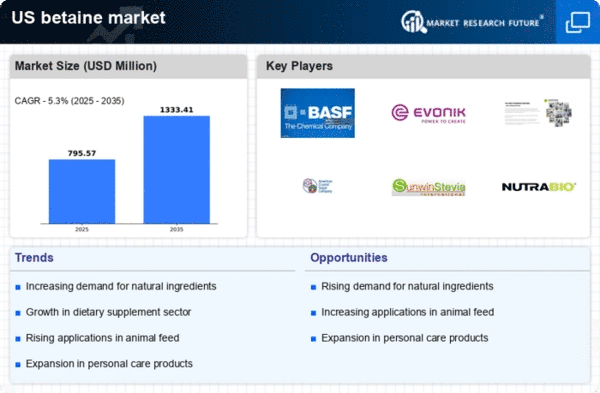
As per Market Research Future analysis, the US betaine market Size was estimated at 755.53 USD Million in 2024. The US betaine market is projected to grow from 795.57 USD Million in 2025 to 1333.41 USD Million by 2035, exhibiting a compound annual growth rate (CAGR) of 5% during the forecast period 2025 - 2035

Key Market Trends & Highlights

The US betaine market is experiencing a robust growth trajectory driven by health trends and natural ingredient demand.

  • The largest segment in the US betaine market is dietary supplements, reflecting a growing consumer focus on health and wellness.
  • The fastest-growing segment is personal care products, indicating a shift towards natural ingredients in beauty and skincare.
  • Regulatory developments and quality standards are shaping the market landscape, ensuring product safety and efficacy.
  • Key market drivers include the rising demand in dietary supplements and the growing application in animal feed, highlighting the versatility of betaine.

Market Size & Forecast

2024 Market Size 755.53 (USD Million)
2035 Market Size 1333.41 (USD Million)
CAGR (2025 - 2035) 5.3%

Major Players

BASF SE (DE), Evonik Industries AG (DE), Zhejiang Jianfeng Chemical Co Ltd (CN), American Crystal Sugar Company (US), Sunwin Stevia International Inc (US), NutraBio Labs Inc (US), Kemin Industries Inc (US), Ginkgo BioWorks Inc (US)

Our Impact
Enabled $4.3B Revenue Impact for Fortune 500 and Leading Multinationals
Partnering with 2000+ Global Organizations Each Year
30K+ Citations by Top-Tier Firms in the Industry

US Betaine Market Trends

The betaine market is currently experiencing notable growth, driven by increasing awareness of health benefits associated with betaine consumption. This compound, found in various foods such as beets and spinach, is recognized for its potential to enhance athletic performance and support liver function. As consumers become more health-conscious, the demand for betaine supplements and functional foods is likely to rise. Additionally, the food and beverage industry is incorporating betaine into products aimed at improving nutritional profiles, which may further stimulate market expansion. Moreover, the trend towards natural ingredients in dietary supplements is influencing the betaine market. Manufacturers are increasingly focusing on sourcing betaine from natural sources, aligning with consumer preferences for clean label products. This shift may lead to innovations in product formulations, catering to a diverse range of dietary needs. As the market evolves, regulatory frameworks and quality standards will play a crucial role in shaping the landscape, ensuring that products meet safety and efficacy requirements. Overall, the betaine market appears poised for continued growth, driven by health trends and consumer demand for natural solutions.

Rising Demand for Natural Ingredients

There is a growing preference among consumers for products containing natural ingredients. This trend is influencing the betaine market, as manufacturers seek to source betaine from natural sources. The shift towards clean label products is likely to drive innovation in formulations, catering to health-conscious consumers.

Increased Focus on Health and Wellness

The betaine market is benefiting from a broader trend towards health and wellness. As individuals become more aware of the health benefits associated with betaine, such as improved athletic performance and liver support, demand for supplements and functional foods is expected to rise.

Regulatory Developments and Quality Standards

Regulatory frameworks are evolving to ensure the safety and efficacy of betaine products. As the market expands, adherence to quality standards will be essential for manufacturers. This focus on regulation may enhance consumer trust and drive further growth in the betaine market.

US Betaine Market Drivers

Growing Application in Animal Feed

The betaine market is experiencing a notable increase in demand due to its growing application in animal feed. As livestock producers seek to enhance feed efficiency and overall animal health, betaine has emerged as a preferred additive. It is known to improve growth rates and reduce feed conversion ratios, which are critical metrics in the livestock industry. In 2025, the incorporation of betaine in animal feed is projected to rise by approximately 15%, reflecting a shift towards more sustainable and efficient farming practices. This trend is likely to bolster the betaine market, as producers aim to meet the rising demand for high-quality meat and dairy products.

Expansion in Personal Care Products

The betaine market is also benefiting from its expanding use in personal care products. With consumers increasingly gravitating towards products that are both effective and gentle on the skin, betaine's properties as a surfactant and moisturizer are gaining traction. The personal care sector is projected to account for around 20% of the total betaine market by 2025. This growth is driven by the rising demand for natural and mild ingredients in cosmetics and skincare formulations. As brands strive to meet consumer expectations for safety and efficacy, the incorporation of betaine is likely to become more prevalent, further propelling the market.

Rising Demand in Dietary Supplements

The betaine market is witnessing a surge in demand within the dietary supplements sector. As health-conscious consumers increasingly seek products that support metabolic health and athletic performance, betaine has gained recognition for its potential benefits. Research indicates that betaine supplementation may enhance exercise performance and promote muscle recovery. By 2025, the dietary supplements segment is expected to represent approximately 25% of the overall betaine market. This trend is indicative of a broader shift towards preventive health measures, as consumers prioritize supplements that contribute to overall well-being.

Technological Advancements in Production

Technological advancements in the production of betaine are playing a crucial role in shaping the betaine market. Innovations in extraction and synthesis methods are leading to more efficient production processes, which can reduce costs and improve product quality. As manufacturers adopt these advanced technologies, the availability of high-purity betaine is likely to increase, catering to diverse applications across various industries. This shift may enhance the competitive landscape of the betaine market, as companies strive to differentiate their offerings through superior quality and performance.

Increased Awareness of Environmental Sustainability

The betaine market is also influenced by the growing awareness of environmental sustainability among consumers and manufacturers alike. As the demand for eco-friendly products rises, betaine, derived from natural sources, is positioned favorably in the market. Companies are increasingly focusing on sustainable sourcing and production practices, which align with consumer preferences for environmentally responsible products. This trend is expected to drive growth in the betaine market, as stakeholders seek to capitalize on the intersection of sustainability and consumer demand.


Market Segment Insights

By Category: Natural (Largest) vs. Synthetic (Fastest-Growing)

In the US betaine market, the distribution between natural and synthetic categories reveals a strong preference for natural betaine, which commands the largest share due to its perception as a healthier and more sustainable option. Synthetic betaine, while smaller in market share, has started gaining traction, particularly in regions focused on cost-effective production and scalability. The growth trends indicate that synthetic betaine is the fastest-growing segment as manufacturers innovate to enhance functionality and reduce production costs. Drivers such as increasing demand in the animal feed sector, rising health consciousness among consumers, and advancing technologies in synthetic processing are propelling this segment forward, thereby contributing to a more competitive landscape against natural betaine.

Betaine: Natural (Dominant) vs. Synthetic (Emerging)

Natural betaine is characterized by its origin from plant sources, such as sugar beets and spinach, which appeals to health-oriented consumers and product manufacturers. Its established dominance in the market is supported by a strong consumer preference for clean-label products that promote wellness. On the other hand, synthetic betaine is emerging as an alternative, especially for industries where cost-efficiency and large-scale production are prioritized. Although it is still gaining ground, the advancements in production methods and increasing applications in food and pharmaceuticals are enhancing its market viability, positioning synthetic betaine as a noteworthy competitor in the US betaine market.

By Type: Cocamidopropyl Betaine (Largest) vs. Betaine Anhydrous (Fastest-Growing)

In the US betaine market, Cocamidopropyl Betaine holds the largest share, significantly contributing to the overall market dynamics. This segment benefits from its versatile applications in personal care and cosmetic products, making it a preferred choice among manufacturers. On the other hand, Betaine Anhydrous, while having a smaller share, is gaining traction due to the increasing demand for clean label products and natural ingredients in various industries. The growth trends indicate that Betaine Anhydrous is on the rise, fueled by consumer preferences shifting towards sustainable and health-oriented products. This segment is particularly driven by its use in dietary supplements and food products, where it is recognized for its performance-enhancing qualities. Additionally, innovation in product formulations and expanding applications are expected to further bolster the growth of both segments in the coming years.

Cocamidopropyl Betaine (Dominant) vs. Betaine Anhydrous (Emerging)

Cocamidopropyl Betaine is a dominant player in the US betaine market, known for its surfactant properties and ability to enhance foam in personal care products. It is widely used in shampoos, body washes, and other formulations, appealing to a broad consumer base. The segment benefits from established manufacturing processes and a strong supply chain. In contrast, Betaine Anhydrous represents an emerging segment, appealing to health-conscious consumers with its applications in nutritional supplements and functional foods. Its increasing popularity is attributed to its effectiveness in boosting athletic performance and its clean label status, making it highly attractive in a market that prioritizes transparency and natural ingredients.

By Application: Personal Care (Largest) vs. Food & Beverages (Fastest-Growing)

In the US betaine market, the application segment exhibits a diverse distribution among its values. Personal Care holds the largest market share, driven by the increasing demand for natural and effective ingredients in skin and hair care products. Following closely, Animal Feed usage is significant due to the growing livestock industry, while Food & Beverages take a smaller, yet rapidly expanding share. Others segment accounts for niche applications, contributing to the overall market dynamics. The growth trends in this segment are influenced by various factors, including the rising consumer preference for cleaner and sustainable products. Personal Care remains dominant due to continuous innovation and brand loyalty, whereas Food & Beverages are emerging as the fastest-growing segment, fueled by changes in dietary habits and a focus on health. Additionally, regulatory support for natural ingredients further boosts the Adoption of betaine across applications, positioning the market for substantial growth in the coming years.

Personal Care: Dominant vs. Food & Beverages: Emerging

Personal Care represents the dominant application in the US betaine market, characterized by its extensive use in cosmetics and personal hygiene products. This segment benefits from the trend toward natural ingredients, with consumers increasingly seeking products that provide effective results without harsh chemicals. Additionally, it enjoys strong brand loyalty and ongoing innovation, allowing for a robust position within the market. On the other hand, the Food & Beverages segment, while currently smaller, is emerging with high growth potential. It capitalizes on the trend towards healthier food choices and clean-label products, positioning betaine as an appealing ingredient for enhancing flavor and nutritional value without synthetic additives. This duality of dominant and emerging segments signifies a dynamic landscape within the application category.

Get more detailed insights about US Betaine Market

Key Players and Competitive Insights

The betaine market exhibits a dynamic competitive landscape characterized by a blend of innovation, strategic partnerships, and regional expansion. Key players such as BASF SE (DE), Evonik Industries AG (DE), and American Crystal Sugar Company (US) are at the forefront, each employing distinct strategies to enhance their market positioning. BASF SE (DE) focuses on innovation in product development, particularly in sustainable betaine production methods, which aligns with the growing demand for eco-friendly ingredients. Meanwhile, Evonik Industries AG (DE) emphasizes strategic partnerships to bolster its supply chain and expand its product offerings, thereby enhancing its competitive edge. American Crystal Sugar Company (US) leverages its extensive agricultural network to optimize production efficiency, which is crucial in a market that is increasingly sensitive to supply chain disruptions.The business tactics employed by these companies reflect a moderately fragmented market structure, where localized manufacturing and supply chain optimization are pivotal. The collective influence of these key players shapes the market dynamics, as they navigate challenges such as fluctuating raw material costs and evolving consumer preferences. Their ability to adapt to these challenges through strategic initiatives is indicative of a competitive environment that rewards agility and innovation.

In October BASF SE (DE) announced a new initiative aimed at increasing the production capacity of its betaine products by 20%, a move that underscores its commitment to meeting rising demand in the personal care and food industries. This expansion not only enhances BASF's market share but also positions the company as a leader in sustainable production practices, potentially attracting environmentally conscious consumers.

In September Evonik Industries AG (DE) entered into a strategic partnership with a leading biotechnology firm to develop bio-based betaine solutions. This collaboration is significant as it aligns with the industry's shift towards sustainable ingredients, allowing Evonik to diversify its product portfolio while reinforcing its commitment to sustainability. Such partnerships are likely to enhance Evonik's competitive positioning in a market that increasingly values eco-friendly products.

In August American Crystal Sugar Company (US) launched a new line of betaine products derived from sugar beets, which are marketed as natural and sustainable alternatives to synthetic options. This strategic move not only caters to the growing consumer demand for natural ingredients but also leverages the company's existing agricultural infrastructure, thereby optimizing production costs and enhancing profitability.

As of November the betaine market is increasingly defined by trends such as digitalization, sustainability, and the integration of artificial intelligence in production processes. Strategic alliances are becoming more prevalent, as companies recognize the need to collaborate in order to innovate and meet consumer demands effectively. Looking ahead, competitive differentiation is likely to evolve from traditional price-based competition towards a focus on innovation, technological advancements, and supply chain reliability. This shift suggests that companies that prioritize these aspects will be better positioned to thrive in an increasingly competitive landscape.

Key Companies in the US Betaine Market include

Industry Developments

The recent developments in the US Betaine Market have shown significant growth driven by rising demand across various sectors, particularly in personal care and food industries. Companies like FMC Corporation, Givaudan, and BASF are continuously innovating their product offerings to cater to the evolving consumer needs, with FMC Corporation reporting an increase in market share in August 2023 due to expanding applications of Betaine in health supplements. In terms of mergers and acquisitions, Evonik Industries announced its acquisition of a minor stake in a startup focused on sustainable Betaine production in July 2023, aligning with industry trends towards sustainability.

Additionally, American Vanguard Corporation and Stepan Company have been collaborating on research initiatives aimed at enhancing Betaine production efficiency. Over the last couple of years, significant investments have been made in production facilities, with Solvay announcing a new operational site in January 2022 to meet growing demand. The financial valuation of companies like Dow and Huntsman Corporation has likewise seen upward momentum, reflecting the sector's positive outlook. As competition intensifies, these developments underscore the importance of innovation and strategic alliances in the US Betaine Market.

Future Outlook

US Betaine Market Future Outlook

The Betaine Market is projected to grow at a 5.3% CAGR from 2025 to 2035, driven by increasing demand in food, feed, and personal care sectors.

New opportunities lie in:

  • Development of customized betaine formulations for specific industries.
  • Expansion into emerging markets with tailored marketing strategies.
  • Investment in R&D for innovative betaine applications in nutraceuticals.

By 2035, the betaine market is expected to achieve robust growth, solidifying its position in various sectors.

Market Segmentation

US Betaine Market Type Outlook

  • Cocamidopropyl Betaine
  • Betaine Anhydrous
  • Others

US Betaine Market Category Outlook

  • Natural
  • Synthetic

US Betaine Market Application Outlook

  • Personal Care
  • Animal Feed
  • Food & Beverages
  • Others

Report Scope

MARKET SIZE 2024 755.53(USD Million)
MARKET SIZE 2025 795.57(USD Million)
MARKET SIZE 2035 1333.41(USD Million)
COMPOUND ANNUAL GROWTH RATE (CAGR) 5.3% (2025 - 2035)
REPORT COVERAGE Revenue Forecast, Competitive Landscape, Growth Factors, and Trends
BASE YEAR 2024
Market Forecast Period 2025 - 2035
Historical Data 2019 - 2024
Market Forecast Units USD Million
Key Companies Profiled BASF SE (DE), Evonik Industries AG (DE), Zhejiang Jianfeng Chemical Co Ltd (CN), American Crystal Sugar Company (US), Sunwin Stevia International Inc (US), NutraBio Labs Inc (US), Kemin Industries Inc (US), Ginkgo BioWorks Inc (US)
Segments Covered Category, Type, Application
Key Market Opportunities Growing demand for plant-based betaine in food and beverage applications presents a lucrative opportunity.
Key Market Dynamics Rising demand for natural betaine in food and beverage sectors drives innovation and competition among manufacturers.
Countries Covered US
Leave a Comment

FAQs

What is the projected market size of the US Betaine Market in 2024?

The US Betaine Market is expected to be valued at 752.5 million USD in 2024.

What is the expected compound annual growth rate (CAGR) for the US Betaine Market from 2025 to 2035?

The US Betaine Market is anticipated to grow at a CAGR of 4.692% from 2025 to 2035.

What will the market value of Cocamidopropyl Betaine be in 2035?

Cocamidopropyl Betaine is projected to reach a market value of 350.0 million USD by 2035.

Which major companies are key players in the US Betaine Market?

Key players in the US Betaine Market include FMC Corporation, Givaudan, and BASF among others.

What will be the market size for Betaine Anhydrous in 2024?

Betaine Anhydrous is expected to be valued at 350.0 million USD in 2024.

What is expected growth for the US Betaine Market in terms of market value by 2035?

The market size is anticipated to reach approximately 1246.07 million USD by 2035.

What is the expected market size for the 'Others' segment of the US Betaine Market in 2035?

The 'Others' segment is projected to be valued at 346.07 million USD in 2035.

What are the key applications driving the growth of the US Betaine Market?

The US Betaine Market is driven by applications in personal care, agriculture, and food industries.

What challenges does the US Betaine Market face in achieving growth?

Challenges for the US Betaine Market include regulatory compliance and market competition.

How will the US Betaine Market grow during the forecast period in terms of value?

The US Betaine Market is expected to witness a significant increase in value, growing from 752.5 million USD in 2024 to 1246.07 million USD by 2035.

Download Free Sample

Kindly complete the form below to receive a free sample of this Report

Compare Licence

×
Features License Type
Single User Multiuser License Enterprise User
Price $4,950 $5,950 $7,250
Maximum User Access Limit 1 User Upto 10 Users Unrestricted Access Throughout the Organization
Free Customization
Direct Access to Analyst
Deliverable Format
Platform Access
Discount on Next Purchase 10% 15% 15%
Printable Versions